EduTools 2.0
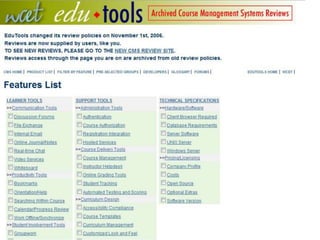
EduTools 1.0
•   Ground-breaking comparison tool
•   Used for RFP generation
•   Provider content vetted by WCET
•   Resource-intensive to maintain
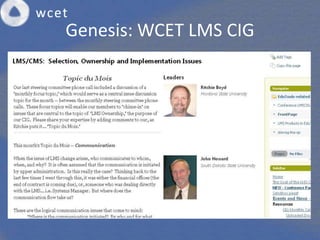
Genesis: WCET LMS CIG
Revision Drivers
• Ubiquitous
• Converging feature sets
• Handle administrivia

• Student expectations
• Focus on learning not learner management
• Constant change
Driving Questions
• Semi-permeable borders
  – Content
  – Non-students
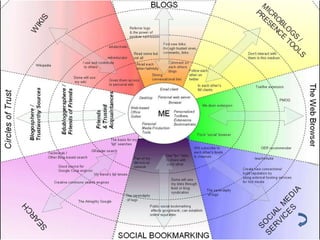
• Personal learning environments
  – Content
  – Non-students
• Small pieces, loosely joined
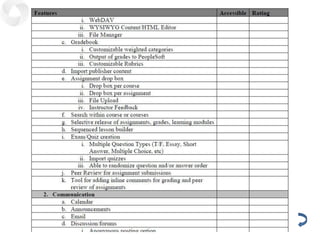
EduTools Survey
1.   Portal          6. Interoperability
2.   Communication   7. Accessibility
3.   Tests           8. Community
4.   Grades          9. Administration
5.   Reports         10.Technical
                     11.Price
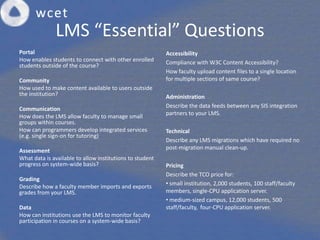
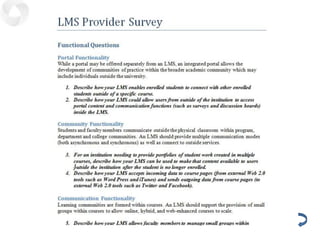
LMS “Essential” Questions
Portal                                                    Accessibility
How enables students to connect with other enrolled       Compliance with W3C Content Accessibility?
students outside of the course?
                                                          How faculty upload content files to a single location
Community                                                 for multiple sections of same course?
How used to make content available to users outside
the institution?                                          Administration
                                                          Describe the data feeds between any SIS integration
Communication
                                                          partners to your LMS.
How does the LMS allow faculty to manage small
groups within courses.
How can programmers develop integrated services           Technical
(e.g. single sign-on for tutoring)
                                                          Describe any LMS migrations which have required no
                                                          post-migration manual clean-up.
Assessment
What data is available to allow institutions to student
progress on system-wide basis?                            Pricing
                                                          Describe the TCO price for:
Grading
                                                          • small institution, 2,000 students, 100 staff/faculty
Describe how a faculty member imports and exports
grades from your LMS.                                     members, single-CPU application server.
                                                          • medium-sized campus, 12,000 students, 500
Data                                                      staff/faculty, four-CPU application server.
How can institutions use the LMS to monitor faculty
participation in courses on a system-wide basis?
EduTools Data
• LMS Filters
  – Type
     • Proprietary vs. Open Source
  – Location
     • Local vs. Hosted
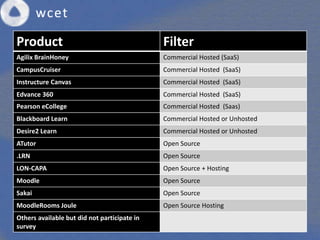
Product                  LMS Respondents
                                 Filter
Agilix BrainHoney                             Commercial Hosted (SaaS)
CampusCruiser                                 Commercial Hosted (SaaS)
Instructure Canvas                            Commercial Hosted (SaaS)
Edvance 360                                   Commercial Hosted (SaaS)
Pearson eCollege                              Commercial Hosted (Saas)
Blackboard Learn                              Commercial Hosted or Unhosted
Desire2 Learn                                 Commercial Hosted or Unhosted
ATutor                                        Open Source
.LRN                                          Open Source
LON-CAPA                                      Open Source + Hosting
Moodle                                        Open Source
Sakai                                         Open Source
MoodleRooms Joule                             Open Source Hosting
Others available but did not participate in
survey
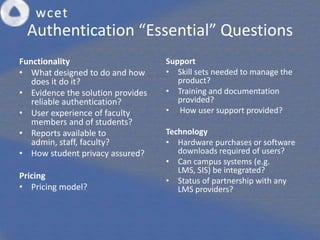
Authentication “Essential” Questions
Functionality                      Support
• What designed to do and how      • Skill sets needed to manage the
   does it do it?                     product?
• Evidence the solution provides   • Training and documentation
   reliable authentication?           provided?
• User experience of faculty       • How user support provided?
   members and of students?
• Reports available to             Technology
   admin, staff, faculty?          • Hardware purchases or software
• How student privacy assured?        downloads required of users?
                                   • Can campus systems (e.g.
                                      LMS, SIS) be integrated?
Pricing
                                   • Status of partnership with any
• Pricing model?                      LMS providers?
EduTools Data
• Authentication Filter: Technology
  – Biometric
  – Challenge-Response
  – Monitoring
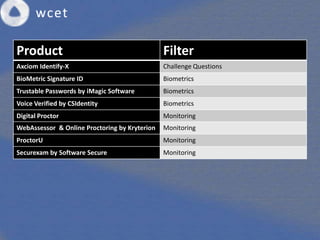
Product           Filter
    Authentication Respondents
Axciom Identify-X                              Challenge Questions
BioMetric Signature ID                         Biometrics
Trustable Passwords by iMagic Software         Biometrics
Voice Verified by CSIdentity                   Biometrics
Digital Proctor                                Monitoring
WebAssessor & Online Proctoring by Kryterion   Monitoring
ProctorU                                       Monitoring
Securexam by Software Secure                   Monitoring
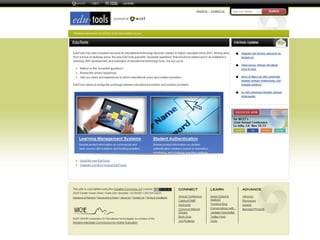
EduTools Mockup
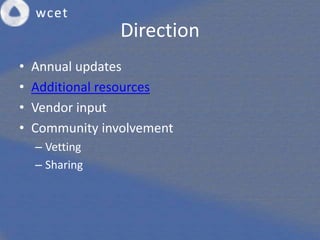
Direction
•   Annual updates
•   Additional resources
•   Vendor input
•   Community involvement
    – Vetting
    – Sharing
Future

Ed U Tools
   2.0
           coming soon
End
RFP
PLE
Survey Questions
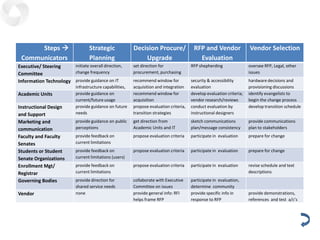
Communications
      Steps                      Strategic               Decision Procure/               RFP and Vendor                Vendor Selection
 Communicators                    Planning                    Upgrade                       Evaluation
Executive/ Steering    initiate overall direction,        set direction for              RFP shepherding                oversee RFP, Legal, other
Committee              change frequency                   procurement, purchasing                                       issues
Information Technology provide guidance on IT             recommend window for           security & accessibility       hardware decisions and
                           infrastructure capabilities,   acquisition and integration    evaluation                     provisioning discussions
Academic Units             provide guidance on            recommend window for           develop evaluation criteria;   identify evangelists to
                           current/future usage           acquisition                    vendor research/reviews        begin the change process
Instructional Design       provide guidance on future     propose evaluation criteria,   conduct evaluation by          develop transition schedule
and Support                needs                          transition strategies          instructional designers
Marketing and              provide guidance on public     get direction from             sketch communications          provide communications
communication              perceptions                    Academic Units and IT          plan/message consistency       plan to stakeholders
Faculty and Faculty        provide feedback on            propose evaluation criteria    participate in evaluation      prepare for change
Senates                    current limitations
Students or Student        provide feedback on            propose evaluation criteria    participate in evaluation      prepare for change
Senate Organizations       current limitations (users)
Enrollment Mgt/            provide feedback on            propose evaluation criteria    participate in evaluation      revise schedule and text
Registrar                  current limitations                                                                          descriptions
Governing Bodies           provide direction for          collaborate with Executive     participate in evaluation,
                           shared service needs           Committee on issues            determine community
Vendor                     none                           provide general info: RFI      provide specific info in       provide demonstrations,
                                                          helps frame RFP                response to RFP                references and test a/c’s

Edu Tools2

  • 1.
  • 2.
    EduTools 1.0 • Ground-breaking comparison tool • Used for RFP generation • Provider content vetted by WCET • Resource-intensive to maintain
  • 3.
  • 4.
    Revision Drivers • Ubiquitous •Converging feature sets • Handle administrivia • Student expectations • Focus on learning not learner management • Constant change
  • 5.
    Driving Questions • Semi-permeableborders – Content – Non-students • Personal learning environments – Content – Non-students • Small pieces, loosely joined
  • 6.
    EduTools Survey 1. Portal 6. Interoperability 2. Communication 7. Accessibility 3. Tests 8. Community 4. Grades 9. Administration 5. Reports 10.Technical 11.Price
  • 7.
    LMS “Essential” Questions Portal Accessibility How enables students to connect with other enrolled Compliance with W3C Content Accessibility? students outside of the course? How faculty upload content files to a single location Community for multiple sections of same course? How used to make content available to users outside the institution? Administration Describe the data feeds between any SIS integration Communication partners to your LMS. How does the LMS allow faculty to manage small groups within courses. How can programmers develop integrated services Technical (e.g. single sign-on for tutoring) Describe any LMS migrations which have required no post-migration manual clean-up. Assessment What data is available to allow institutions to student progress on system-wide basis? Pricing Describe the TCO price for: Grading • small institution, 2,000 students, 100 staff/faculty Describe how a faculty member imports and exports grades from your LMS. members, single-CPU application server. • medium-sized campus, 12,000 students, 500 Data staff/faculty, four-CPU application server. How can institutions use the LMS to monitor faculty participation in courses on a system-wide basis?
  • 8.
    EduTools Data • LMSFilters – Type • Proprietary vs. Open Source – Location • Local vs. Hosted
  • 9.
    Product LMS Respondents Filter Agilix BrainHoney Commercial Hosted (SaaS) CampusCruiser Commercial Hosted (SaaS) Instructure Canvas Commercial Hosted (SaaS) Edvance 360 Commercial Hosted (SaaS) Pearson eCollege Commercial Hosted (Saas) Blackboard Learn Commercial Hosted or Unhosted Desire2 Learn Commercial Hosted or Unhosted ATutor Open Source .LRN Open Source LON-CAPA Open Source + Hosting Moodle Open Source Sakai Open Source MoodleRooms Joule Open Source Hosting Others available but did not participate in survey
  • 10.
    Authentication “Essential” Questions Functionality Support • What designed to do and how • Skill sets needed to manage the does it do it? product? • Evidence the solution provides • Training and documentation reliable authentication? provided? • User experience of faculty • How user support provided? members and of students? • Reports available to Technology admin, staff, faculty? • Hardware purchases or software • How student privacy assured? downloads required of users? • Can campus systems (e.g. LMS, SIS) be integrated? Pricing • Status of partnership with any • Pricing model? LMS providers?
  • 11.
    EduTools Data • AuthenticationFilter: Technology – Biometric – Challenge-Response – Monitoring
  • 12.
    Product Filter Authentication Respondents Axciom Identify-X Challenge Questions BioMetric Signature ID Biometrics Trustable Passwords by iMagic Software Biometrics Voice Verified by CSIdentity Biometrics Digital Proctor Monitoring WebAssessor & Online Proctoring by Kryterion Monitoring ProctorU Monitoring Securexam by Software Secure Monitoring
  • 13.
  • 14.
    Direction • Annual updates • Additional resources • Vendor input • Community involvement – Vetting – Sharing
  • 15.
    Future Ed U Tools 2.0 coming soon
  • 16.
  • 17.
  • 18.
  • 19.
  • 20.
    Communications Steps  Strategic Decision Procure/ RFP and Vendor Vendor Selection Communicators Planning Upgrade Evaluation Executive/ Steering initiate overall direction, set direction for RFP shepherding oversee RFP, Legal, other Committee change frequency procurement, purchasing issues Information Technology provide guidance on IT recommend window for security & accessibility hardware decisions and infrastructure capabilities, acquisition and integration evaluation provisioning discussions Academic Units provide guidance on recommend window for develop evaluation criteria; identify evangelists to current/future usage acquisition vendor research/reviews begin the change process Instructional Design provide guidance on future propose evaluation criteria, conduct evaluation by develop transition schedule and Support needs transition strategies instructional designers Marketing and provide guidance on public get direction from sketch communications provide communications communication perceptions Academic Units and IT plan/message consistency plan to stakeholders Faculty and Faculty provide feedback on propose evaluation criteria participate in evaluation prepare for change Senates current limitations Students or Student provide feedback on propose evaluation criteria participate in evaluation prepare for change Senate Organizations current limitations (users) Enrollment Mgt/ provide feedback on propose evaluation criteria participate in evaluation revise schedule and text Registrar current limitations descriptions Governing Bodies provide direction for collaborate with Executive participate in evaluation, shared service needs Committee on issues determine community Vendor none provide general info: RFI provide specific info in provide demonstrations, helps frame RFP response to RFP references and test a/c’s

Editor's Notes

  • #19 From Scott Leslie’s blog