State Of LMS In Higher Education
Understanding The Big Picture


OCTOBER 22, 2009
Presentation Outline

 Introduction and Background
 LMS Market
 - Status of market
 - What does it mean
 Peer System Information
 - What is happening at each system
 Major Trends
 Q&A


                                      2
What will you learn in this session?

 Gain an understanding of the LMS profiles of
 peer systems
 Gain insight on the current state of the LMS
 vendor market
 Discuss key issues faced by higher education
 institutions and systems

 What you won’t learn:
 - Magic to solving all your LMS institutional issues
 - No crystal ball on the future of the next generation LMS
 - Getting all campuses in one system to agree on one LMS

                                                              3
What are the CSU LMS System-wide Initiatives?

 #1 Vendor Relationship and Contract Management
 - System-wide LMS RFP
 - Ongoing discussions with Vendors
 - LMS Sandboxes
 #2 Moodle Consortium
 #3 Integration
 - SIS Integration
 - IMS Integration
 #4 LMS Best Practices
 - Rubric for Online Instruction
 - Transforming Course Design

                                                  4
“LMS Futures” Group

 4 CIOs, 4 Provosts, Chancellor’s Office staff
 - Met bi-weekly online from January to June
 Creating a Roadmap to the future
 - LMS Services
 - LMS Environment
 Investigating System-wide Strategies
 Laying out options
 Determine Communications Plan
 Make recommendations to the CSU campuses
 Gather feedback


                                                 5
LMS Market Update


                    6
7
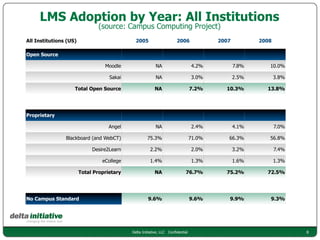
LMS Adoption by Year: All Institutions
                               (source: Campus Computing Project)
All Institutions (US)                         2005                     2006              2007          2008

Open Source

                                  Moodle                  NA                     4.2%           7.8%      10.0%

                                    Sakai                 NA                     3.0%           2.5%          3.8%

                    Total Open Source                    NA                      7.2%      10.3%         13.8%


Proprietary

                                    Angel                 NA                     2.4%           4.1%          7.0%

                Blackboard (and WebCT)               75.3%                       71.0%      66.3%         56.8%

                             Desire2Learn             2.2%                       2.0%           3.2%          7.4%

                                 eCollege             1.4%                       1.3%           1.6%          1.3%

                        Total Proprietary                NA                 76.7%          75.2%         72.5%


No Campus Standard                                   9.6%                        9.6%       9.9%          9.3%


                                            Delta Initiative, LLC Confidential                                       8
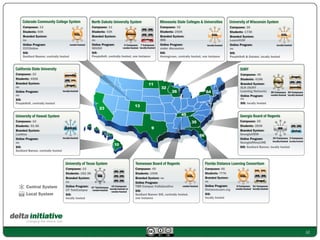
Higher Education Peer System


             17                9
Criteria for Selecting Systems to Research

 Cross-section of governance models
 - totally centralized; selectively centralized; consortial
   clusters; totally local
 Cross-section of open source and proprietary
 Diversity similar to the CSU system
 - faculty & students; curricular; geographical; campus
   culture


                                                              10
Sources of Information

 System web sites
 Interviews with System users, administrators
 NCHEMS – referred to WCET (Edutools)
 AASCU Members List
 - http://www.aascu.org/association/members/index.htm
 SHEEO State Quick Facts
 - (http://www.sheeo.org/sqf/sqf.htm)
 Educause CIO listserv responses


                                                        11
12
13
Holistic View of
LMS Decisions


                   14
15
Trends


         16
Trends

 No one model for balance between central / local
 services supporting the LMS
 - Each reflects the culture & history of the system
 - Often includes combination of centralized services for
   smaller campuses, with local services for larger
   campuses
 - Maintaining flexibility for services is important
 - Integration of LMS with ERP and other systems is critical
   (class rosters, grades, identification, etc.) for adoption


                                                                17
Trends

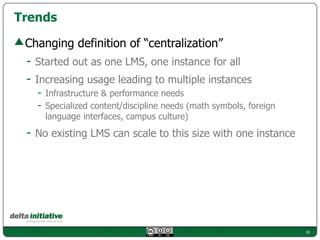
 Changing definition of “centralization”
 - Started out as one LMS, one instance for all
 - Increasing usage leading to multiple instances
   - Infrastructure & performance needs
   - Specialized content/discipline needs (math symbols, foreign
     language interfaces, campus culture)

 - No existing LMS can scale to this size with one instance


                                                                   18
Trends

 Major disruption driven externally by LMS vendors,
 not educational institutions or needs
 - Raises concern about impact on institutions
 - Leading to renewed discussions about open source
   solutions
 - Rethinking roles of various systems and how to organize
   services
   - Course management system
   - Content management system
   - Integration with Student Information Systems


                                                             19
LMS Market Trends to Watch

 Open source movement will grow, but not a panacea
 Managed and hosted services will grow, but not a
 panacea
 Big players (SIS and Publishers) will continue to try
 to enter market, but will not rush in
 Market will not change unless customer behavior
 changes
 - These are not typical market dynamics at play
 - Consortiums and open source providing most change


                                                         20
Contact Information
  Phil Hill
    • phill@deltainitiative.com
    • (919) 270-9337
  Molly Langstaff
    • mlangstaff@deltainitiative.com
    • (319) 331-1063
  Kathy Fernandes
    • kfernandes@csuchico.edu
    • (530) 898-6294


                                       21

State of LMS in Higher Education: Understanding the Big Picture

  • 1.
    State Of LMSIn Higher Education Understanding The Big Picture OCTOBER 22, 2009
  • 2.
    Presentation Outline Introductionand Background LMS Market - Status of market - What does it mean Peer System Information - What is happening at each system Major Trends Q&A 2
  • 3.
    What will youlearn in this session? Gain an understanding of the LMS profiles of peer systems Gain insight on the current state of the LMS vendor market Discuss key issues faced by higher education institutions and systems What you won’t learn: - Magic to solving all your LMS institutional issues - No crystal ball on the future of the next generation LMS - Getting all campuses in one system to agree on one LMS 3
  • 4.
    What are theCSU LMS System-wide Initiatives? #1 Vendor Relationship and Contract Management - System-wide LMS RFP - Ongoing discussions with Vendors - LMS Sandboxes #2 Moodle Consortium #3 Integration - SIS Integration - IMS Integration #4 LMS Best Practices - Rubric for Online Instruction - Transforming Course Design 4
  • 5.
    “LMS Futures” Group 4 CIOs, 4 Provosts, Chancellor’s Office staff - Met bi-weekly online from January to June Creating a Roadmap to the future - LMS Services - LMS Environment Investigating System-wide Strategies Laying out options Determine Communications Plan Make recommendations to the CSU campuses Gather feedback 5
  • 6.
  • 7.
  • 8.
    LMS Adoption byYear: All Institutions (source: Campus Computing Project) All Institutions (US) 2005 2006 2007 2008 Open Source Moodle NA 4.2% 7.8% 10.0% Sakai NA 3.0% 2.5% 3.8% Total Open Source NA 7.2% 10.3% 13.8% Proprietary Angel NA 2.4% 4.1% 7.0% Blackboard (and WebCT) 75.3% 71.0% 66.3% 56.8% Desire2Learn 2.2% 2.0% 3.2% 7.4% eCollege 1.4% 1.3% 1.6% 1.3% Total Proprietary NA 76.7% 75.2% 72.5% No Campus Standard 9.6% 9.6% 9.9% 9.3% Delta Initiative, LLC Confidential 8
  • 9.
  • 10.
    Criteria for SelectingSystems to Research Cross-section of governance models - totally centralized; selectively centralized; consortial clusters; totally local Cross-section of open source and proprietary Diversity similar to the CSU system - faculty & students; curricular; geographical; campus culture 10
  • 11.
    Sources of Information System web sites Interviews with System users, administrators NCHEMS – referred to WCET (Edutools) AASCU Members List - http://www.aascu.org/association/members/index.htm SHEEO State Quick Facts - (http://www.sheeo.org/sqf/sqf.htm) Educause CIO listserv responses 11
  • 12.
  • 13.
  • 14.
  • 15.
  • 16.
  • 17.
    Trends No onemodel for balance between central / local services supporting the LMS - Each reflects the culture & history of the system - Often includes combination of centralized services for smaller campuses, with local services for larger campuses - Maintaining flexibility for services is important - Integration of LMS with ERP and other systems is critical (class rosters, grades, identification, etc.) for adoption 17
  • 18.
    Trends Changing definitionof “centralization” - Started out as one LMS, one instance for all - Increasing usage leading to multiple instances - Infrastructure & performance needs - Specialized content/discipline needs (math symbols, foreign language interfaces, campus culture) - No existing LMS can scale to this size with one instance 18
  • 19.
    Trends Major disruptiondriven externally by LMS vendors, not educational institutions or needs - Raises concern about impact on institutions - Leading to renewed discussions about open source solutions - Rethinking roles of various systems and how to organize services - Course management system - Content management system - Integration with Student Information Systems 19
  • 20.
    LMS Market Trendsto Watch Open source movement will grow, but not a panacea Managed and hosted services will grow, but not a panacea Big players (SIS and Publishers) will continue to try to enter market, but will not rush in Market will not change unless customer behavior changes - These are not typical market dynamics at play - Consortiums and open source providing most change 20
  • 21.
    Contact Information Phil Hill • phill@deltainitiative.com • (919) 270-9337 Molly Langstaff • mlangstaff@deltainitiative.com • (319) 331-1063 Kathy Fernandes • kfernandes@csuchico.edu • (530) 898-6294 21