Lurking: A New Learning Style?


Jennifer Freeman , UT System TeleCampus
Michael Anderson , UT System TeleCampus
My Course Is Interactive
•   Interactivity is the heart of my course
•   But some students aren’t posting
•   Yet they’re mastering the concepts!
•   Can students learn without interacting?
What is Lurking?
• A “lurker” receives online communications without
  contributing
• An estimated 90% of internet users are lurkers
• 50% in an educational setting

         lurk - a : to lie in wait in a place of concealment
           especially for an evil purpose b: to move furtively
           or inconspicuously c : to persist in staying
           - Merriam-Webster


• Negative connotations…new term needed?
Is Lurking a Bad Thing?
• Are lurkers just being lazy?
• Lurking seems “anti-interactive”
• Lurking makes it difficult to measure or grade
  students’ participation
• Are lurkers “robbing” their peers of student-
  student interaction?
• Do lurkers feel isolated?
Lurkers Speak Out
“I lurk because I hate to type … It feels like a
   lot of meaning and immediacy gets lost in
   the process.”

“Sometimes I don't post because so many
  others find their voices before I can get my
  own responses together & coherent.”

 “…if I posted more, I'd miss some great stuff
                    due to time constraints…”
Lurkers Speak Out
“…as a new user it seems all too easy to make
  'dumb mistakes' so it seems safer just to be
  quiet until the interface is more familiar.”

‘I often find it difficult to enter the fray
   when the conversation seems to be
   dominated so much by a few individuals…”

“I definitely remember the disappointment at
   not getting any response at all to my first
   few posts.”
Why Are They Lurking?
        Problems We Can Address
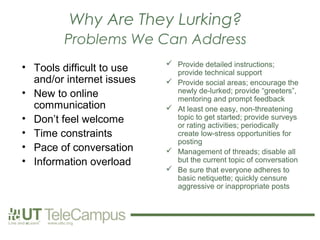
                            Provide detailed instructions;
• Tools difficult to use       provide technical support
  and/or internet issues      Provide social areas; encourage the
• New to online                newly de-lurked; provide “greeters”,
                               mentoring and prompt feedback
  communication               At least one easy, non-threatening
• Don’t feel welcome           topic to get started; provide surveys
                               or rating activities; periodically
• Time constraints             create low-stress opportunities for
                               posting
• Pace of conversation        Management of threads; disable all
• Information overload         but the current topic of conversation
                              Be sure that everyone adheres to
                               basic netiquette; quickly censure
                               aggressive or inappropriate posts
Why Are They Lurking?
             Because They Prefer It
•   Shyness
•   Need to process and reflect
•   Fear of commitment
•   Linear thinking
•   Language issues
•   Writing issues
•   Pace of conversation
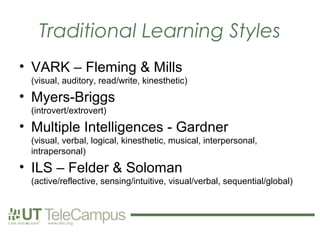
Traditional Learning Styles
• VARK – Fleming & Mills
 (visual, auditory, read/write, kinesthetic)
• Myers-Briggs
 (introvert/extrovert)
• Multiple Intelligences - Gardner
 (visual, verbal, logical, kinesthetic, musical, interpersonal,
 intrapersonal)
• ILS – Felder & Soloman
 (active/reflective, sensing/intuitive, visual/verbal, sequential/global)
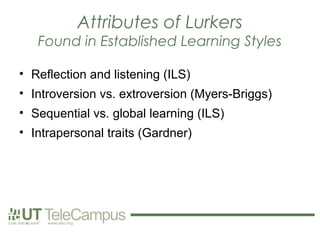
Attributes of Lurkers
   Found in Established Learning Styles

• Reflection and listening (ILS)
• Introversion vs. extroversion (Myers-Briggs)
• Sequential vs. global learning (ILS)
• Intrapersonal traits (Gardner)
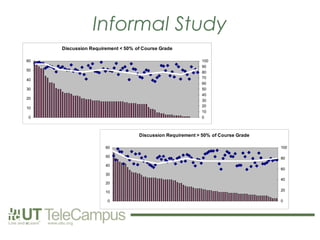
Informal Study
     Discussion Requirement < 50% of Course Grade

60                                                          100
                                                            90
50
                                                            80
                                                            70
40
                                                            60
30                                                          50
                                                            40
20
                                                            30
                                                            20
10
                                                            10
0                                                           0


                                   Discussion Requirement > 50% of Course Grade

                      60                                                          100

                      50                                                          80
                      40
                                                                                  60
                      30
                                                                                  40
                      20

                      10                                                          20

                       0                                                          0
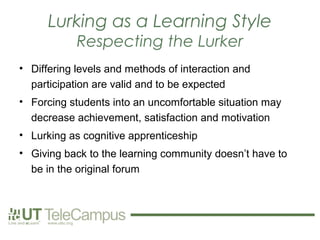
Lurking as a Learning Style
            Respecting the Lurker
• Differing levels and methods of interaction and
  participation are valid and to be expected
• Forcing students into an uncomfortable situation may
  decrease achievement, satisfaction and motivation
• Lurking as cognitive apprenticeship
• Giving back to the learning community doesn’t have to
  be in the original forum
Benefits of Accepting Lurkers
• Lurkers haven’t “invested in” an opinion, and can present
  a new point of view and raise new questions
• Lurkers are at the edges of the community and can
  make connections, build bridges
• Student achievement, satisfaction and motivation are
  increased
New Labels for Lurkers
• Read-only participants (Williams)
• Peripheral participants (McDonald)
• Peeps
• Observers
• Vicarious participants
• Listeners
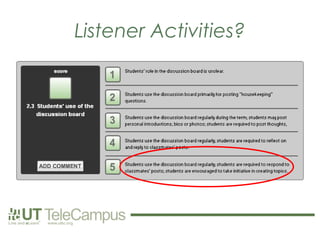
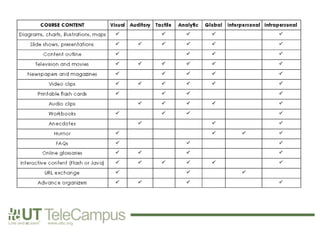
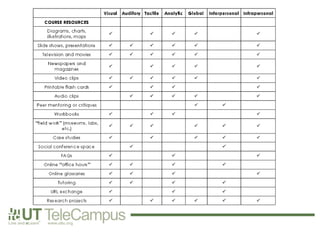
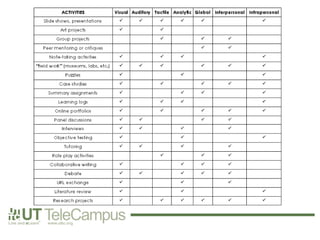
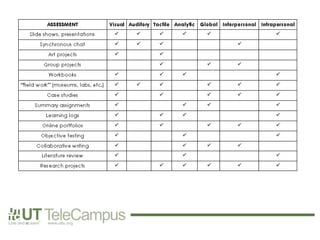
Listener Activities?
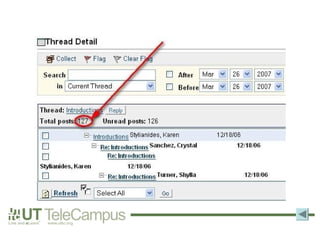
Activities for Listeners
 Topic summaries
 Use the course statistics
 Require thread summaries (you’ll know they’re reading!)
 Anonymous posting; avatars
Activities for Listeners
 Surveys; rating systems
 Case studies
 Learning Logs
 Portfolios
 Literature review
 Group project (researcher role)
 Determine strengths and assign alternate tasks
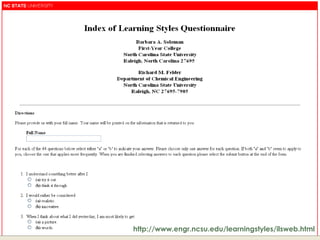
http://www.engr.ncsu.edu/learningstyles/ilsweb.html
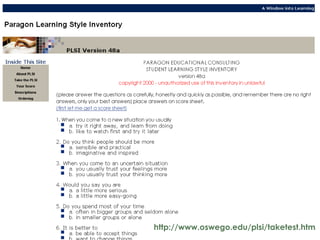
http://www.oswego.edu/plsi/taketest.htm
http://www.learning-styles-online.com/
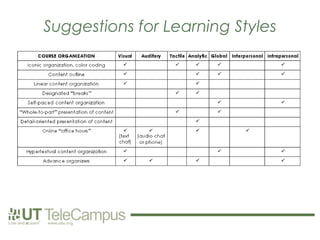
Suggestions for Learning Styles
References
“Are You a Lurker?” Online discussion. [http://www.well.com/conf/vc/16.html]
Felder, R. M. and B.A. Soloman. Learning Styles and Strategies.
    [http://www.ncsu.edu/felder-public/ILSdir/styles.htm]
Fleming, N.D. and C. Mills. VARK: A Guide to Learning Styles. 1992.
“Involving Lurkers in Online Discussions.” Teaching OntheNet. LERN.
     [http://www.teachingonthenet.org/articles/involvingLurkers.htm]
“Learning Styles.” Teaching and Learning With Technology. Penn State.
    [http://tlt.its.psu.edu/suggestions/research/learning_styles.shtml]
McDonald, Jacquie. “Let’s Get More Positive About the Term ‘Lurker’.” CPSquare Class Project. July 2003.
   [http://www.groups-that-work.com/GTWedit/GTW/lurkerprojectcopworkshopspring03rev.pdf]
Nonnecke, B. and J. Preece and D. Andrews. “The Top Five Reasons for Lurking: Improving Community
   Experiences for Everyone.” Computers in Human Behavior. 2,1.
Soroka, Vladimir and Sheizaf Rafaeli. “Invisible Participants: How Cultural Capital Relates to Lurking
    Behavior.” IBM Haifa Research Lab. [http://www2006.org/programme/files/xhtml/1018/p1018-soroka-
    xhtml.html]
Vinson, Jack. “Lurking Builds Commonality.” Blog entry.
    [http://blog.jackvinson.com/archives/2004/02/06/lurking_builds_commonality.html]
Williams, Bill. “Participation in Online Courses: How Essential is It?” Setubal Polytechnic, Portugal.
Jennifer Freeman
Michael Anderson
Lurking
Lurking

Lurking

  • 1.
    Lurking: A NewLearning Style? Jennifer Freeman , UT System TeleCampus Michael Anderson , UT System TeleCampus
  • 2.
    My Course IsInteractive • Interactivity is the heart of my course • But some students aren’t posting • Yet they’re mastering the concepts! • Can students learn without interacting?
  • 3.
    What is Lurking? •A “lurker” receives online communications without contributing • An estimated 90% of internet users are lurkers • 50% in an educational setting lurk - a : to lie in wait in a place of concealment especially for an evil purpose b: to move furtively or inconspicuously c : to persist in staying - Merriam-Webster • Negative connotations…new term needed?
  • 4.
    Is Lurking aBad Thing? • Are lurkers just being lazy? • Lurking seems “anti-interactive” • Lurking makes it difficult to measure or grade students’ participation • Are lurkers “robbing” their peers of student- student interaction? • Do lurkers feel isolated?
  • 5.
    Lurkers Speak Out “Ilurk because I hate to type … It feels like a lot of meaning and immediacy gets lost in the process.” “Sometimes I don't post because so many others find their voices before I can get my own responses together & coherent.” “…if I posted more, I'd miss some great stuff due to time constraints…”
  • 6.
    Lurkers Speak Out “…asa new user it seems all too easy to make 'dumb mistakes' so it seems safer just to be quiet until the interface is more familiar.” ‘I often find it difficult to enter the fray when the conversation seems to be dominated so much by a few individuals…” “I definitely remember the disappointment at not getting any response at all to my first few posts.”
  • 7.
    Why Are TheyLurking? Problems We Can Address  Provide detailed instructions; • Tools difficult to use provide technical support and/or internet issues  Provide social areas; encourage the • New to online newly de-lurked; provide “greeters”, mentoring and prompt feedback communication  At least one easy, non-threatening • Don’t feel welcome topic to get started; provide surveys or rating activities; periodically • Time constraints create low-stress opportunities for posting • Pace of conversation  Management of threads; disable all • Information overload but the current topic of conversation  Be sure that everyone adheres to basic netiquette; quickly censure aggressive or inappropriate posts
  • 8.
    Why Are TheyLurking? Because They Prefer It • Shyness • Need to process and reflect • Fear of commitment • Linear thinking • Language issues • Writing issues • Pace of conversation
  • 9.
    Traditional Learning Styles •VARK – Fleming & Mills (visual, auditory, read/write, kinesthetic) • Myers-Briggs (introvert/extrovert) • Multiple Intelligences - Gardner (visual, verbal, logical, kinesthetic, musical, interpersonal, intrapersonal) • ILS – Felder & Soloman (active/reflective, sensing/intuitive, visual/verbal, sequential/global)
  • 10.
    Attributes of Lurkers Found in Established Learning Styles • Reflection and listening (ILS) • Introversion vs. extroversion (Myers-Briggs) • Sequential vs. global learning (ILS) • Intrapersonal traits (Gardner)
  • 11.
    Informal Study Discussion Requirement < 50% of Course Grade 60 100 90 50 80 70 40 60 30 50 40 20 30 20 10 10 0 0 Discussion Requirement > 50% of Course Grade 60 100 50 80 40 60 30 40 20 10 20 0 0
  • 12.
    Lurking as aLearning Style Respecting the Lurker • Differing levels and methods of interaction and participation are valid and to be expected • Forcing students into an uncomfortable situation may decrease achievement, satisfaction and motivation • Lurking as cognitive apprenticeship • Giving back to the learning community doesn’t have to be in the original forum
  • 13.
    Benefits of AcceptingLurkers • Lurkers haven’t “invested in” an opinion, and can present a new point of view and raise new questions • Lurkers are at the edges of the community and can make connections, build bridges • Student achievement, satisfaction and motivation are increased
  • 14.
    New Labels forLurkers • Read-only participants (Williams) • Peripheral participants (McDonald) • Peeps • Observers • Vicarious participants • Listeners
  • 15.
  • 16.
    Activities for Listeners Topic summaries  Use the course statistics  Require thread summaries (you’ll know they’re reading!)  Anonymous posting; avatars
  • 17.
    Activities for Listeners Surveys; rating systems  Case studies  Learning Logs  Portfolios  Literature review  Group project (researcher role)  Determine strengths and assign alternate tasks
  • 18.
  • 19.
  • 20.
  • 21.
  • 26.
    References “Are You aLurker?” Online discussion. [http://www.well.com/conf/vc/16.html] Felder, R. M. and B.A. Soloman. Learning Styles and Strategies. [http://www.ncsu.edu/felder-public/ILSdir/styles.htm] Fleming, N.D. and C. Mills. VARK: A Guide to Learning Styles. 1992. “Involving Lurkers in Online Discussions.” Teaching OntheNet. LERN. [http://www.teachingonthenet.org/articles/involvingLurkers.htm] “Learning Styles.” Teaching and Learning With Technology. Penn State. [http://tlt.its.psu.edu/suggestions/research/learning_styles.shtml] McDonald, Jacquie. “Let’s Get More Positive About the Term ‘Lurker’.” CPSquare Class Project. July 2003. [http://www.groups-that-work.com/GTWedit/GTW/lurkerprojectcopworkshopspring03rev.pdf] Nonnecke, B. and J. Preece and D. Andrews. “The Top Five Reasons for Lurking: Improving Community Experiences for Everyone.” Computers in Human Behavior. 2,1. Soroka, Vladimir and Sheizaf Rafaeli. “Invisible Participants: How Cultural Capital Relates to Lurking Behavior.” IBM Haifa Research Lab. [http://www2006.org/programme/files/xhtml/1018/p1018-soroka- xhtml.html] Vinson, Jack. “Lurking Builds Commonality.” Blog entry. [http://blog.jackvinson.com/archives/2004/02/06/lurking_builds_commonality.html] Williams, Bill. “Participation in Online Courses: How Essential is It?” Setubal Polytechnic, Portugal.
  • 27.

Editor's Notes

  • #4 Lurking is a normal part of internet behavior: they come, they read, they think; then they leave. Lurking takes place in mailing lists, discussion boards, blogs, web (amazon, epinions) gaming sites… introduce texas hold ‘m example
  • #5 We’ve all heard about the three types of interaction and how important they are in online learning: student-instructor, student-student, student-content
  • #8 Students sometimes would like to post, but don’t due to: Unfamiliar with discussion interface/tools Technical or internet connectivity issues Inexperience with online culture/netiquette/acronyms (texas hold ‘em example: nh, ty, tytyty) Lack of instructor directions and/or feedback Negative feedback, or no feedback from peers Can’t respond fast enough Too much to read Too many threads going on at once
  • #9 Would rather listen than talk Don’t enjoy debate/confrontation Fear of saying the wrong thing Brain doesn’t work that way English not first language Trouble communicating thoughts in writing Can’t keep up – poker example: beginner’s table vs. intermediate table
  • #11 Active and reflective learners Active learners - doing something active with it—discussing or applying it or explaining it to others. Reflective learners prefer to think about it quietly first. Active learners tend to like group work more than reflective learners, who prefer working alone. Sensing and intuitive learners Sensors often like solving problems by well-established methods and dislike complications and surprises; intuitors like innovation and dislike repetition. Sequential and global learners Sequential learners tend to follow logical stepwise paths in finding solutions; global learners may be able to solve complex problems quickly or put things together in novel ways once they have grasped the big picture, but they may have difficulty explaining how they did it. Interpersonal Intelligence ability to relate and understand others . These learners try to see things from other people&apos;s point of view in order to understand how they think and feel. They often have an uncanny ability to sense feelings, intentions and motivations. They are great organizers and encourage co-operation. Example: poker beginners using the text chat area to ask questions between hands Intrapersonal Intelligence ability to self-reflect and be aware of one&apos;s inner state of being. These learners try to understand their inner feelings, dreams, relationships with others, and strengths and weaknesses. Example: between hands I took notes on my cards, who won and what I was thinking during the last hand
  • #12 15 courses 10 students selected at random from each Undergraduate and graduate Variety of discussion requirements Compared frequency of posting with grade Conclusions:
  • #13 Trying to force everyone to interact in the same was is as futile as expecting everyone to learn in the same way. Forcing students into an uncomfortable, stressful situation will decrease their satisfaction and motivation. Poker example: Had the text chat tool in Yahoo poker are been mandatory somehow, I would have been intimidated and probably would not have used it. Not fair to the learning community? True, one can be a recipient for only so long. But the “giving back” need not occur in the original forum.
  • #14 Poker example: Because I was able to focus on “listening” in the intermediate area for as long as I needed to, I was actually able to answer a question about an acronym when I returned to the beginner’s area. Had I jumped in and started playing right away, I would not have been able to pay attention to the text chat area and learn that. Non-lurkers will also recognize and appreciate the instructor’s flexibility.
  • #18 Consider having students complete a “learning style” questionnaire