Enhancing Existing Online and
Traditional Curriculums to Meet
the Needs of K-12 Learners

Dr. Andrew Berning - Chief Technology & Information
                      Officer
Rich Lewis - Instructional Technology Specialist
Carrollton-Farmers Branch ISD
Technology Services Division


2009-2010
Online Technology
Acceptance
   In the K-12 environment, we are now embracing
    Online technology as a tool to support student
    achievement.
   Our approach is to integrate time-honored
    teaching strategies with the latest available
    technologies.
   It is imperative to remember that while technology
    allows us to make learning opportunities available
    beyond the traditional school day, K-12 students
    require rich interaction (student-content, student-
    student, student-teacher) and ongoing instructor
    support to be successful in the online environment.
What is the “Virtual
Campus”?
   Mission Statement
     To promote student achievement at the
     highest levels through flexible, online learning
     opportunities that meet C-FB ISD, Texas and
     national standards.
   We provide and support online courses for
    acceleration and to enhance course
    availability
   We support tools for use by traditional
    classroom teachers to extend educational
    opportunities to their students beyond the
    four-walls of the classroom.
Virtual Campus Details
   Online Courses: Online and Campus
    Based
     Health, P.E. Foundations, BCIS, Comm.
      Apps.
     Other Courses based on Campus Request
       ○ Foreign Languages, AP Courses
     2008-2009- ~400 enrollments
   Blended Model Courses
     UT-ASKME / Moodle online Algebra I,
      Geometry
     1-to-1 Wireless Laptop Classroom
      Environments
     160 middle and high school students
Enter
   Moodle (Modular Object Oriented Dynamic
    Learning Environment).
 Introduced to the district via staff at our
  Alternative High School.
 Identified as a solution for making content and
  learning activities available to students who
  struggle with traditional high school
  environments.
 We saw possibilities beyond serving more than
  just the “non-traditional” students – to meet all
  students where they are… the Internet.
We have the right tool, but how
do we effectively implement it?
   Targets
     Improving our existing online/blended
      offerings
     Enhance and increase flexibility of our
      Professional Development programs
     Opportunity for teachers to expand the reach
      of their classroom resources and curriculum
      beyond the classroom
     Act as a repository for digital textbooks
2007-2008 Laying the
Foundation
   Examining our blended and online courses, we
    discovered that many did not meet the
    interactivity standards of iNACOL.
     Most courses were singular learning experiences.
     The most interaction they afforded was direct
      feedback from the teacher.
   Our first opportunity would be to enhance our
    existing online-based programs.
     We, in effect, wrapped existing online curriculums
      with Moodle. Created pass-thru sign-in to external
      curriculums and linked directly to them from the
      Moodle course. Moodle was the one-stop course for
      the students.
2007-2008 Laying the
Foundation
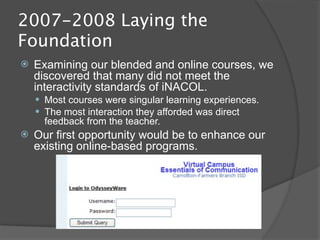
   Examining our blended and online courses, we
    discovered that many did not meet the
    interactivity standards of iNACOL.
     Most courses were singular learning experiences.
     The most interaction they afforded was direct
      feedback from the teacher.
   Our first opportunity would be to enhance our
    existing online-based programs.
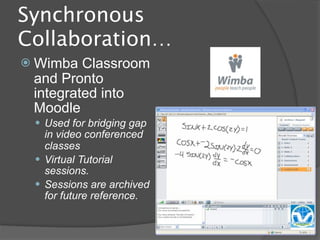
Synchronous
Collaboration…
 Wimba  Classroom
 and Pronto
 integrated into
 Moodle
  Used for bridging gap
   in video conferenced
   classes
  Virtual Tutorial
   sessions.
  Sessions are archived
   for future reference.
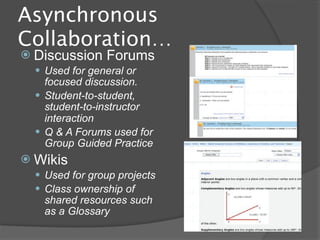
Asynchronous
Collaboration…
 Discussion    Forums
   Used for general or
    focused discussion.
   Student-to-student,
    student-to-instructor
    interaction
   Q & A Forums used for
    Group Guided Practice
 Wikis
   Used for group projects
   Class ownership of
   shared resources such
   as a Glossary
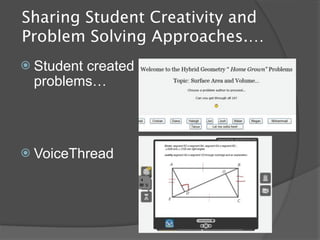
Sharing Student Creativity and
Problem Solving Approaches.…
 Student
        created
 problems…


 VoiceThread
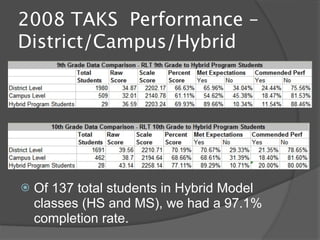
2008 TAKS Performance –
District/Campus/Hybrid


   Of 137 total students in Hybrid Model
    classes (HS and MS), we had a 97.1%
    completion rate.
“High Tech, High Touch”
Vision
   It is our vision that all teachers will make their
    course resources available online.
   Further, we envision teachers utilizing the
    evolving online tools available to them to
    increase the learning opportunities for their
    students.
     Want to create learning opportunities that reach
      beyond the classroom and that are available
      24/7/365.
                  …. so how do we get there?
2008-2009 Grassroots Effort
   Began offering voluntary training to early
    adopters.
     Rationale was that the best promotion would
      be to seek out tech savvy teachers who
      would voluntarily experiment with integrating
      Moodle into their classrooms.
     Teachers take more note of what works for
      other teachers than what the technology
      groups says will work for them.
Leveraging Moodle features
   Like our enhancements of our online
    and blended courses, teachers
    immediately began using…
     Discussion forums
     Chats
     Questionnaires
     Journaling (via online text assignments)
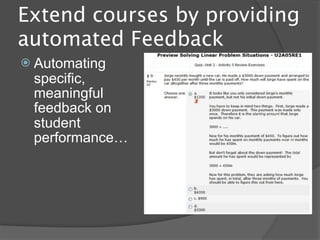
Extend courses by providing
automated Feedback
 Automating
 specific,
 meaningful
 feedback on
 student
 performance…
2009-2010 Mass
Penetration
 We have the experience and knowledge
  now to make the vision a reality.
 C-FB Moodle University
     Online, On-demand source for all things
      Moodle.
     Both a reference site, and a formal training
      course.
     District Q&A
     Best Practices Podcast
Future Content Area
Portals
 Expanding the idea of a blended model
 Create content area portals that make
  existing curriculum content and activities
  available online, then extend the portal
  to include additional collaborative
  resources for dynamic support,
  enrichment, or remediation at a campus
  or district level.


                                               17
Dr. Andrew Berning
                    Rich Lewis
Carrollton-Farmers Branch ISD
 Technology Services Division
          berninga@cfbisd.edu
            lewisri@cfbisd.edu
          Thank you!!!

Enhancing Existing Curriculums with an LMS

  • 1.
    Enhancing Existing Onlineand Traditional Curriculums to Meet the Needs of K-12 Learners Dr. Andrew Berning - Chief Technology & Information Officer Rich Lewis - Instructional Technology Specialist Carrollton-Farmers Branch ISD Technology Services Division 2009-2010
  • 2.
    Online Technology Acceptance  In the K-12 environment, we are now embracing Online technology as a tool to support student achievement.  Our approach is to integrate time-honored teaching strategies with the latest available technologies.  It is imperative to remember that while technology allows us to make learning opportunities available beyond the traditional school day, K-12 students require rich interaction (student-content, student- student, student-teacher) and ongoing instructor support to be successful in the online environment.
  • 3.
    What is the“Virtual Campus”?  Mission Statement  To promote student achievement at the highest levels through flexible, online learning opportunities that meet C-FB ISD, Texas and national standards.  We provide and support online courses for acceleration and to enhance course availability  We support tools for use by traditional classroom teachers to extend educational opportunities to their students beyond the four-walls of the classroom.
  • 4.
    Virtual Campus Details  Online Courses: Online and Campus Based  Health, P.E. Foundations, BCIS, Comm. Apps.  Other Courses based on Campus Request ○ Foreign Languages, AP Courses  2008-2009- ~400 enrollments  Blended Model Courses  UT-ASKME / Moodle online Algebra I, Geometry  1-to-1 Wireless Laptop Classroom Environments  160 middle and high school students
  • 5.
    Enter  Moodle (Modular Object Oriented Dynamic Learning Environment).  Introduced to the district via staff at our Alternative High School.  Identified as a solution for making content and learning activities available to students who struggle with traditional high school environments.  We saw possibilities beyond serving more than just the “non-traditional” students – to meet all students where they are… the Internet.
  • 6.
    We have theright tool, but how do we effectively implement it?  Targets  Improving our existing online/blended offerings  Enhance and increase flexibility of our Professional Development programs  Opportunity for teachers to expand the reach of their classroom resources and curriculum beyond the classroom  Act as a repository for digital textbooks
  • 7.
    2007-2008 Laying the Foundation  Examining our blended and online courses, we discovered that many did not meet the interactivity standards of iNACOL.  Most courses were singular learning experiences.  The most interaction they afforded was direct feedback from the teacher.  Our first opportunity would be to enhance our existing online-based programs.  We, in effect, wrapped existing online curriculums with Moodle. Created pass-thru sign-in to external curriculums and linked directly to them from the Moodle course. Moodle was the one-stop course for the students.
  • 8.
    2007-2008 Laying the Foundation  Examining our blended and online courses, we discovered that many did not meet the interactivity standards of iNACOL.  Most courses were singular learning experiences.  The most interaction they afforded was direct feedback from the teacher.  Our first opportunity would be to enhance our existing online-based programs.
  • 9.
    Synchronous Collaboration…  Wimba Classroom and Pronto integrated into Moodle  Used for bridging gap in video conferenced classes  Virtual Tutorial sessions.  Sessions are archived for future reference.
  • 10.
    Asynchronous Collaboration…  Discussion Forums  Used for general or focused discussion.  Student-to-student, student-to-instructor interaction  Q & A Forums used for Group Guided Practice  Wikis  Used for group projects  Class ownership of shared resources such as a Glossary
  • 11.
    Sharing Student Creativityand Problem Solving Approaches.…  Student created problems…  VoiceThread
  • 12.
    2008 TAKS Performance– District/Campus/Hybrid  Of 137 total students in Hybrid Model classes (HS and MS), we had a 97.1% completion rate.
  • 13.
    “High Tech, HighTouch” Vision  It is our vision that all teachers will make their course resources available online.  Further, we envision teachers utilizing the evolving online tools available to them to increase the learning opportunities for their students.  Want to create learning opportunities that reach beyond the classroom and that are available 24/7/365. …. so how do we get there?
  • 14.
    2008-2009 Grassroots Effort  Began offering voluntary training to early adopters.  Rationale was that the best promotion would be to seek out tech savvy teachers who would voluntarily experiment with integrating Moodle into their classrooms.  Teachers take more note of what works for other teachers than what the technology groups says will work for them.
  • 15.
    Leveraging Moodle features  Like our enhancements of our online and blended courses, teachers immediately began using…  Discussion forums  Chats  Questionnaires  Journaling (via online text assignments)
  • 16.
    Extend courses byproviding automated Feedback  Automating specific, meaningful feedback on student performance…
  • 17.
    2009-2010 Mass Penetration  Wehave the experience and knowledge now to make the vision a reality.  C-FB Moodle University  Online, On-demand source for all things Moodle.  Both a reference site, and a formal training course.  District Q&A  Best Practices Podcast
  • 18.
    Future Content Area Portals Expanding the idea of a blended model  Create content area portals that make existing curriculum content and activities available online, then extend the portal to include additional collaborative resources for dynamic support, enrichment, or remediation at a campus or district level. 17
  • 19.
    Dr. Andrew Berning Rich Lewis Carrollton-Farmers Branch ISD Technology Services Division berninga@cfbisd.edu lewisri@cfbisd.edu Thank you!!!