EDITORIAL
WRITING
EDITORIAL
WRITING
SHARED OPINION (Collective Stand)
It is a section in newspaper or magazines in which the writers or
ditors share their opinion on a highly sensible topics (issue).
It is the heart and soul of the newspapers.
It attempts to influence, by giving readers all the facts and
oncerns
EDITORIAL
WRITING
SHARED OPINION (Collective Stand)
presents newspaper’s opinion on an issue.
Reflects majoroty vote of the editorial board.
s meant to influence public opinion, promote critical thinking, and
ometimes cause people to take action on an issue.
Serves as an opinionated news story.
EDITORIAL
WRITING
SHARED OPINION (Collective Stand)
In general, an editorial is a short essay that shares editorial
oard’s opinion on a current event or social issue. Its goal is to
ersuade the reader to consider your perspective and change
heir opinion. Editorials often focus on controversial issues with
idely different viewpoints.
EDITORIAL
WRITING
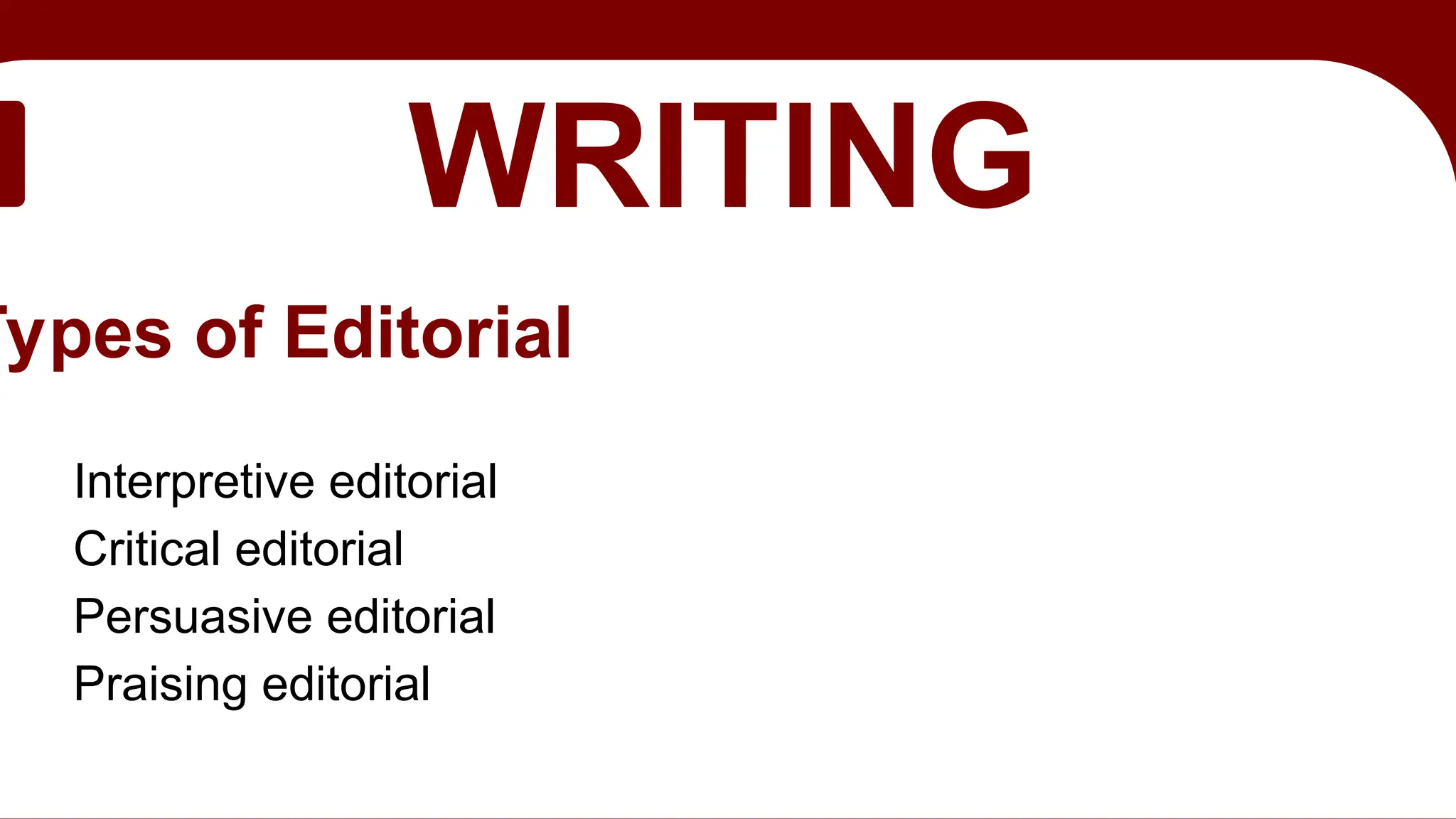
Types of Editorial
Interpretive editorial
Critical editorial
Persuasive editorial
Praising editorial
EDITORIAL
WRITING
nterpretive Editorial
explains and provides background information on an event or
sue. This type of editorial aims to raise awareness and discuss
ow the topic is relevant to the reader.
xample: when the president signs a bill into law
EDITORIAL
WRITING
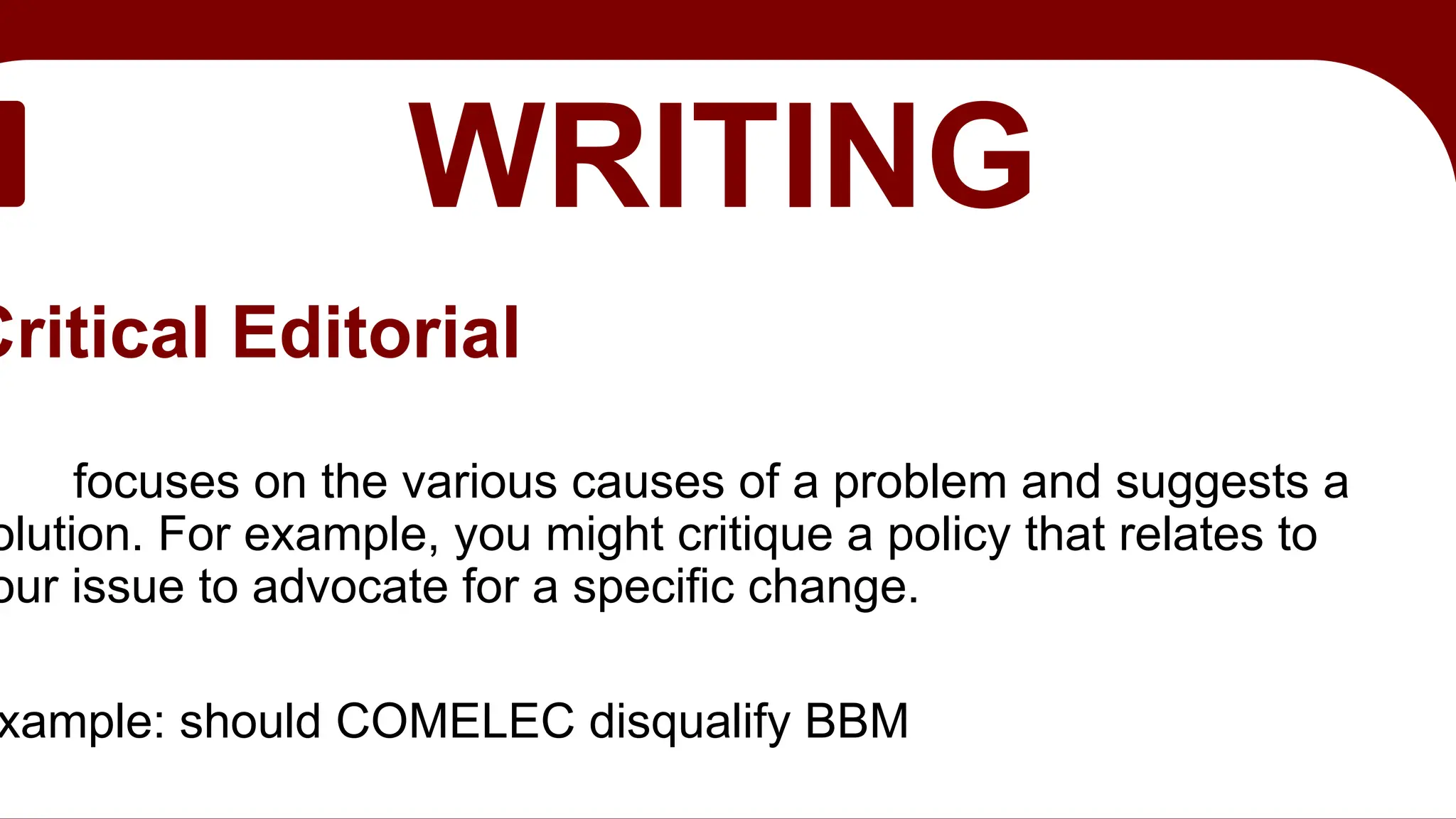
Critical Editorial
focuses on the various causes of a problem and suggests a
olution. For example, you might critique a policy that relates to
our issue to advocate for a specific change.
xample: should COMELEC disqualify BBM
EDITORIAL
WRITING
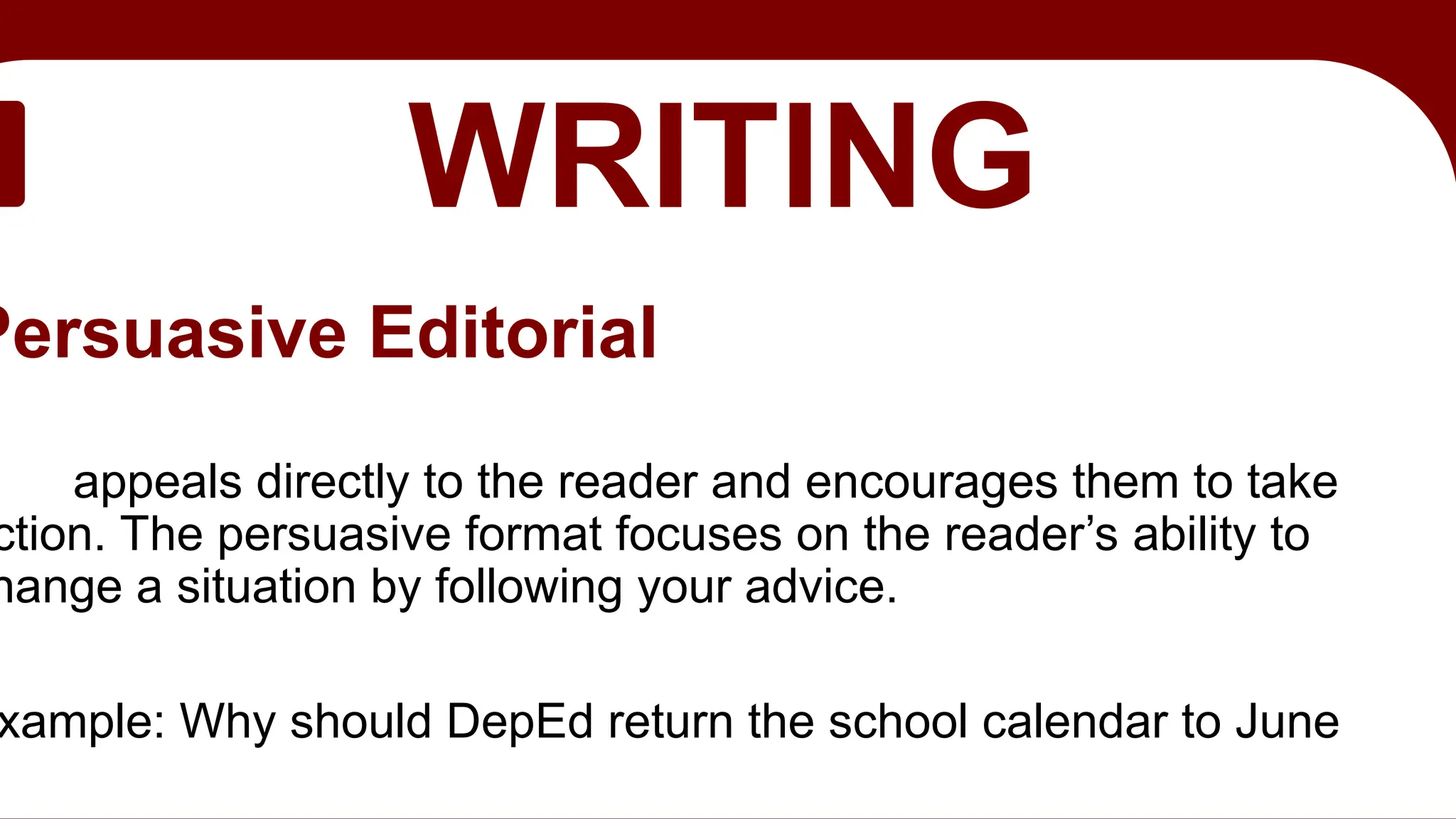
Persuasive Editorial
appeals directly to the reader and encourages them to take
ction. The persuasive format focuses on the reader’s ability to
hange a situation by following your advice.
xample: Why should DepEd return the school calendar to June
EDITORIAL
WRITING
Persuasive Editorial
shows appreciation for a person or organization based on
heir involvement in an issue. This type of editorial is not as
ommon as the other issue.
xample: Maria Ressa as Nobel Prize Awardee
EDITORIAL
WRITING
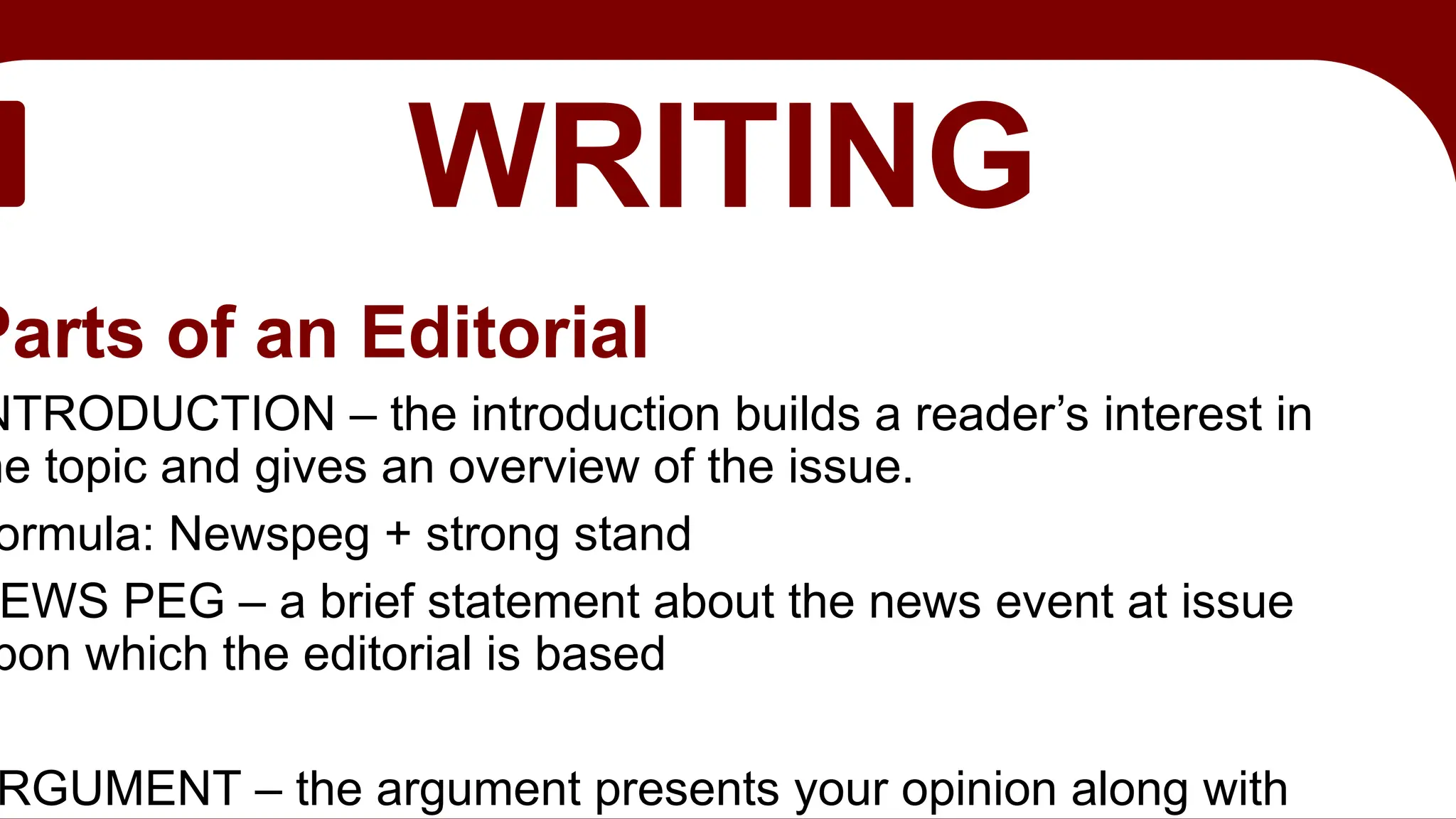
Parts of an Editorial
NTRODUCTION – the introduction builds a reader’s interest in
he topic and gives an overview of the issue.
ormula: Newspeg + strong stand
EWS PEG – a brief statement about the news event at issue
pon which the editorial is based
RGUMENT – the argument presents your opinion along with
EDITORIAL
WRITING
Parts of an Editorial
VIDENCE – the evidence supports your argument with facts,
esearch or anecdotes.
OUNTERARGUMENT – all editorial writers should establish
redibility by presenting a fair review of the perspectives involved.
While a praising editorial might be mostly positive with a brief
eference to an issue, a critical editorial needs to address the
EDITORIAL
WRITING
Parts of an Editorial
EFUTATION – after sharing the counter-argument with a reader,
he writer must explain why that argument is not accurate or
elevant. Refuting the counterargument allows you to promote
our point of view while still seeming fair.
EDITORIAL
WRITING
Parts of an Editorial
ONCLUSION – in the final paragraph of your editorial,
ummarize your point of view and remind the reader why they
hould care about this issue.
STEPS IN WRITING AN EDITORIAL
•First, look for a sensible topic/issue
relevant to readers in the general public.
•Essentialize to the lives of the target
audience.
STEPS IN WRITING AN EDITORIAL
•Second, there are opposite views about the
topic/issue.
•Third, the editors must have a clear stand/ position
in which the whole publication believes in.
•Lastly, the opinions must be supported with pieces
of evidence justify their position.
KEY CONCEPTS ON EDITORIAL
• Collective stand of the publication.
• Presents opposite viewpoints that compete for
readers’ attention not just the publication’s
viewpoint.
• Takes leadership position on issues affecting the
community.
Goal of an Editorial
The goals of editorial:
➮ to present viewpoints
➮ to educate the public on a certain
issue
➮ to influence/shape public opinion
PRELIMINARIES
WHERE/HOW
DO WE START?
PRELIMINARIES.
1. Choose a topic.
SOURCES: screaming
news, commissioned
news, trending news
• Current and timely
• Substantial for
writing
2. Obtain background
material and information
about your topic
➲ observe
➲ read
➲ interview
➲ research.
PHASE 1: PRE-WRITNG STAGE
1. Identify your purpose and audience – inform,
interpret, criticize, argue, suggest reforms, urge
readers to action.
➲ Explain or interpret the way the newspaper
covered a sensitive or controversial subject.
➲ Criticize constructive actions, decisions or
situations to get readers to see the problem.
PHASE 1: PRE-WRITNG STAGE
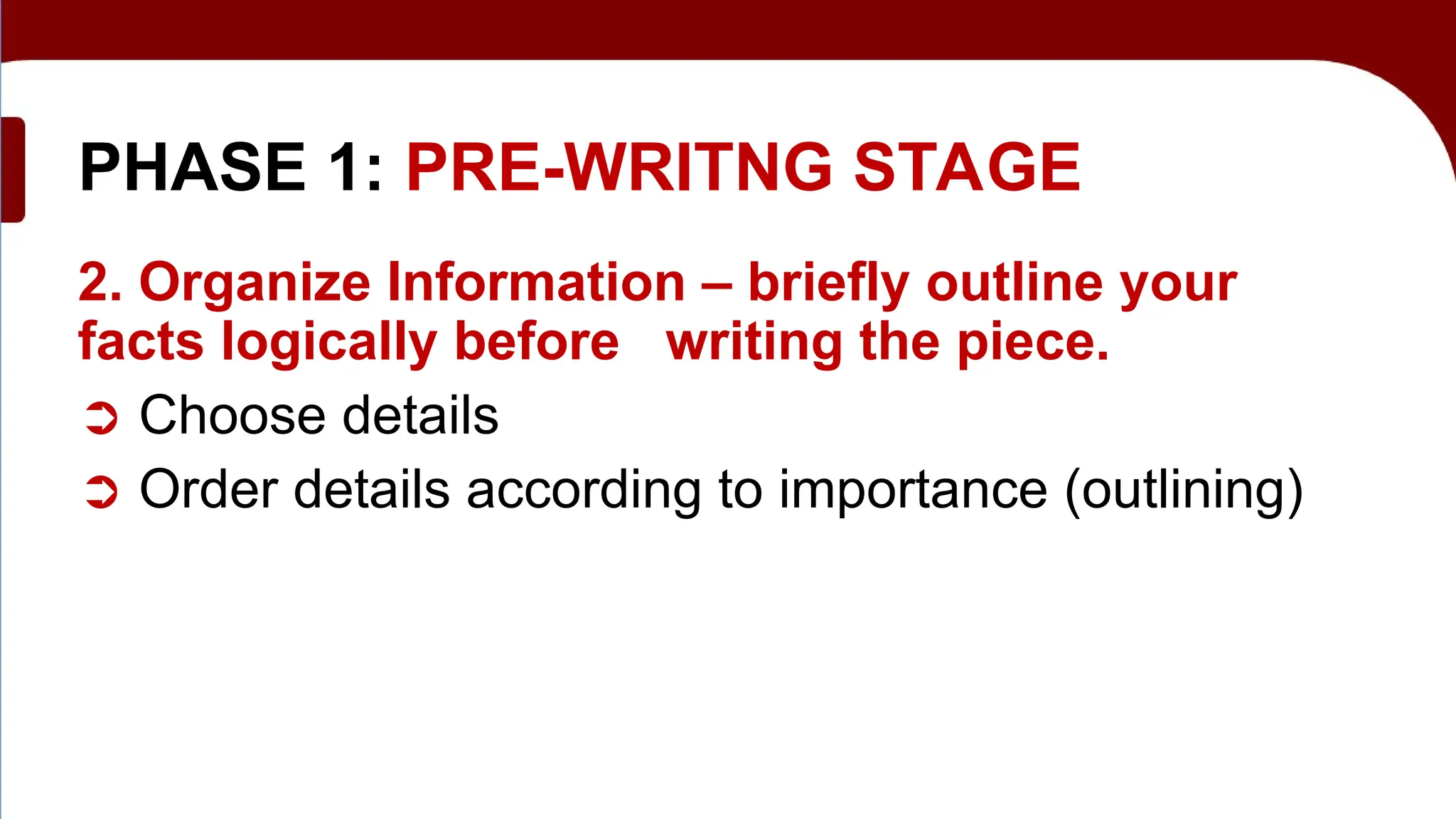
2. Organize Information – briefly outline your
facts logically before writing the piece.
➲ Choose details
➲ Order details according to importance (outlining)
PHASE 1: PRE-WRITNG STAGE
FOCUS ON A CENTRAL THEME
➲ The single greatest error made by
beginning writers is trying to say too much.
➲ The error comes from the belief that, in
order to be convincing, an argument must be
utterly comprehensive, addressing every
possible issue that relates to it.
PHASE 1: PRE-WRITNG STAGE
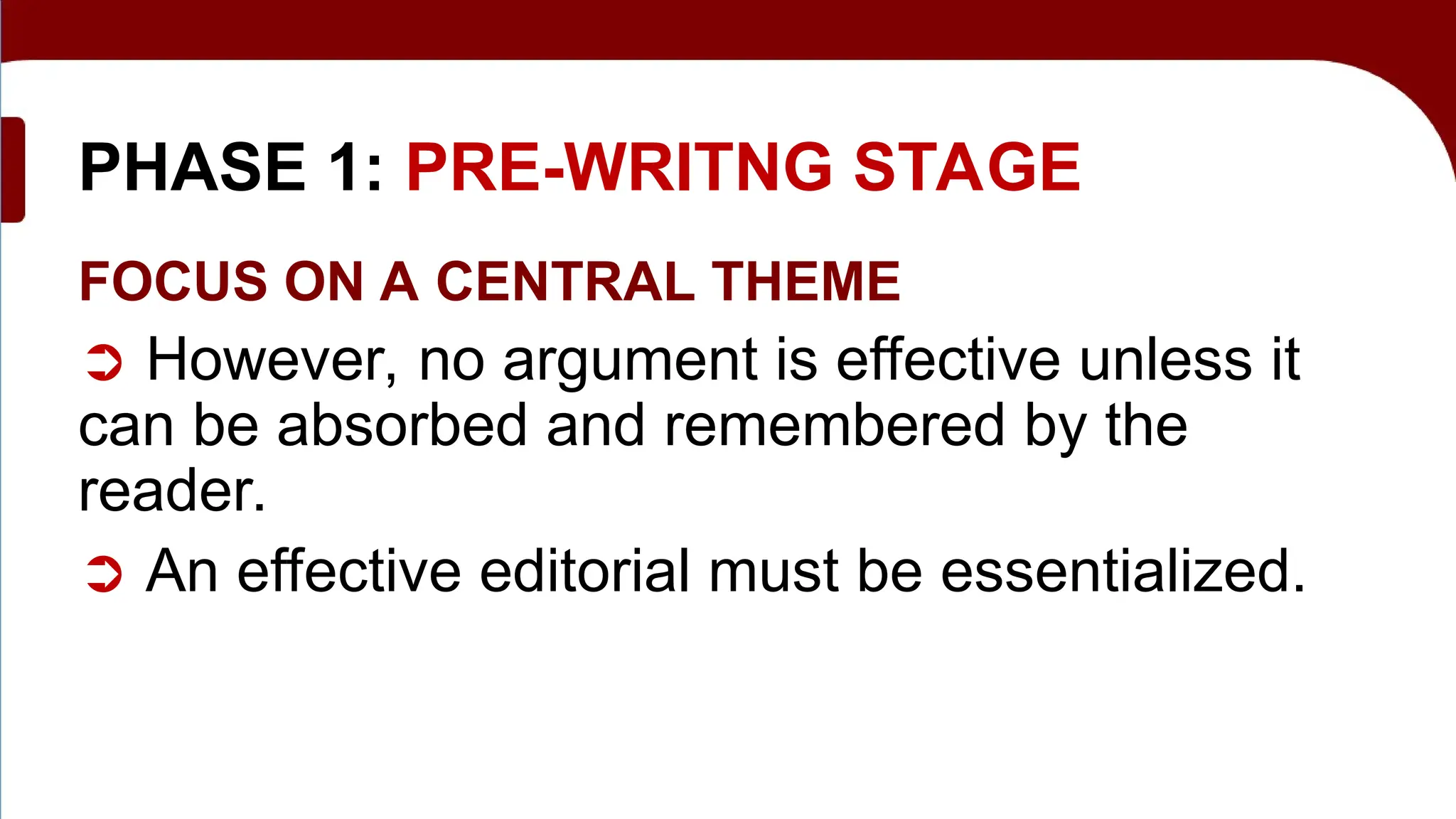
FOCUS ON A CENTRAL THEME
➲ However, no argument is effective unless it
can be absorbed and remembered by the
reader.
➲ An effective editorial must be essentialized.
PHASE 1: PRE-WRITNG STAGE
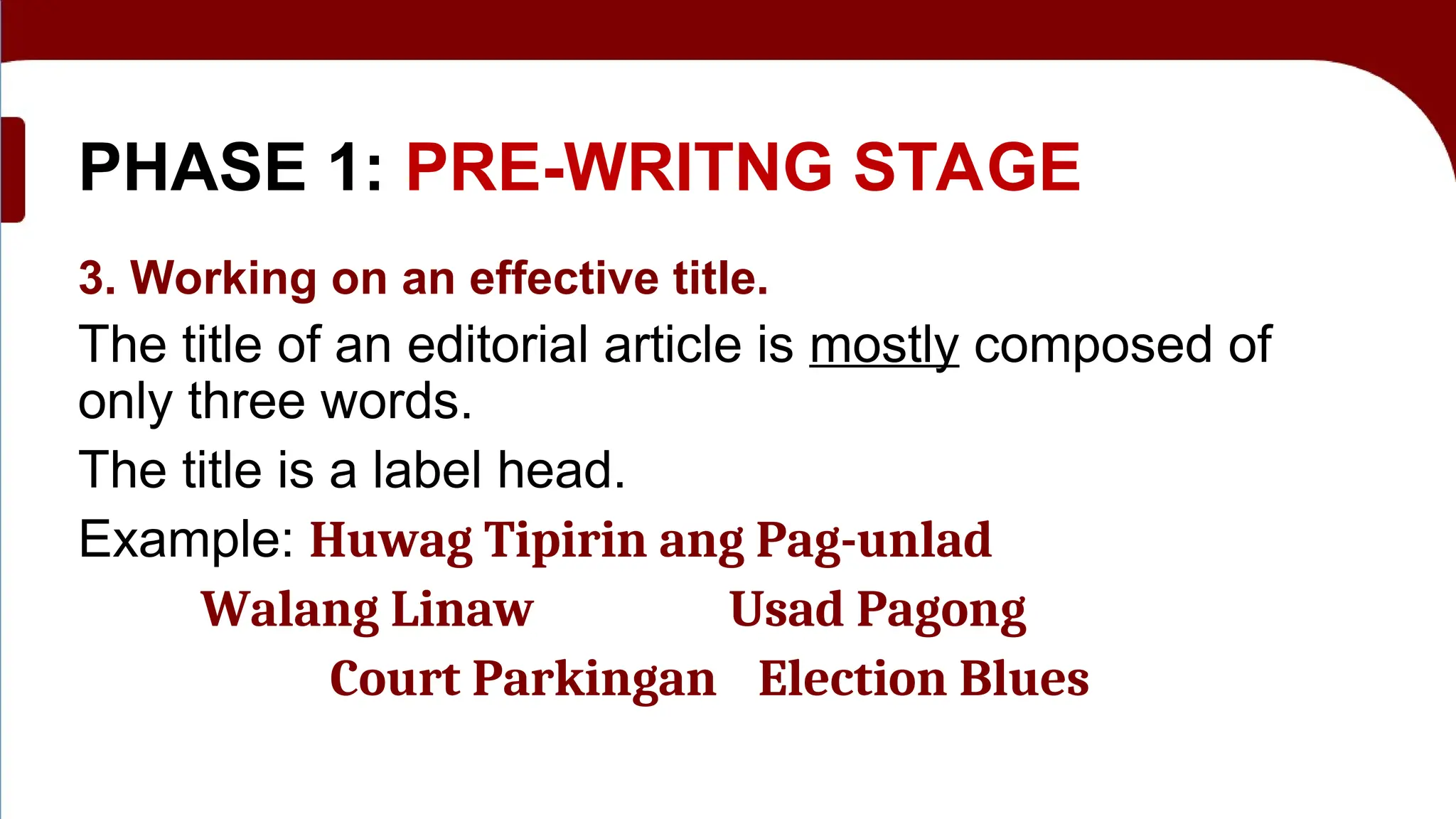
3. Working on an effective title.
The title of an editorial article is mostly composed of
only three words.
The title is a label head.
Example: Huwag Tipirin ang Pag-unlad
Walang Linaw Usad Pagong
Court Parkingan Election Blues
PHASE 1: PRE-WRITNG STAGE
3. Working on an effective title.
Example: Malapit nang mag-end and ‘Endo’
Bukbok na Diskarte
Sinagasaan ng Train (Law)
Saving YOUth
Ruling Out the Law
PHASE 2: WRITING STAGE
INTRODUCTION:
- presentation of the SITUATION/NEWS ITEM
(newspeg)
- stand/ position
PHASE 2: WRITING STAGE
BODY
Claims fully supported by proofs
4E: Explanation/Evidence/Example/Extra Details
Tools: narrative of incidents, statement from credible
sources, statistics, provision from memo, order, by-laws,
constitution, etc.
PHASE 2: WRITING STAGE
CONCLUSION
Recap of the main points
Recommending a SOLUTION/ CALLING
for an ACTION
OUTLINING
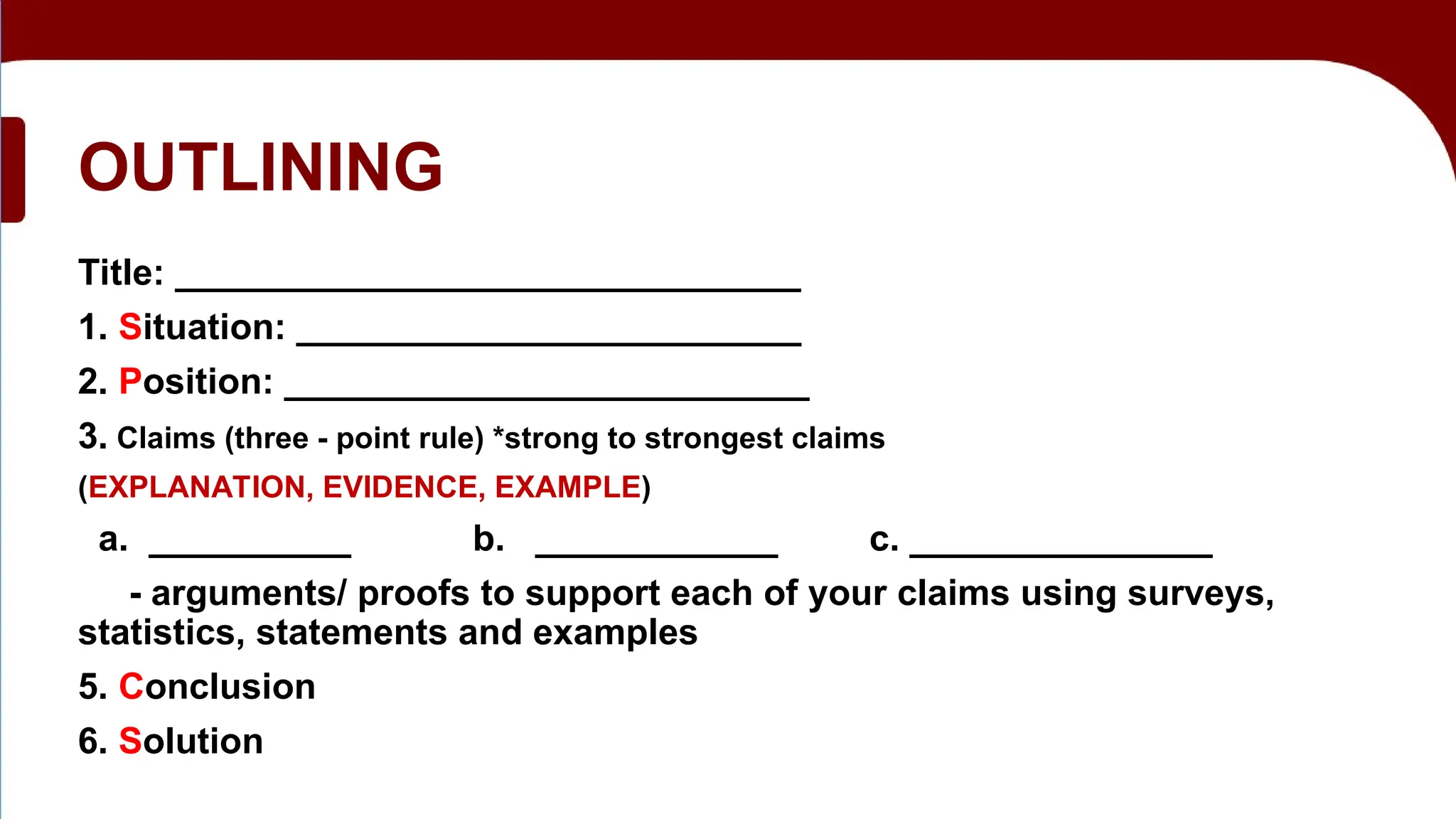
Title: _______________________________
1. Situation: _________________________
2. Position: __________________________
3. Claims (three - point rule) *strong to strongest claims
(EXPLANATION, EVIDENCE, EXAMPLE)
a. __________ b. ____________ c. _______________
- arguments/ proofs to support each of your claims using surveys,
statistics, statements and examples
5. Conclusion
6. Solution
OUTLINING
1 title
The writer may lastly write the title because this should be found on
a certain part of the article. The title must have fangs, catchy and
there is a call for action.
This must be short but catchy.
The writer may use play of words (pun), joke or a prominent phrase
used in internet and social media.
OUTLINING
1 introduction
It contains a brief background of the issue being discussed
(news peg) and most importantly the stand (position) of the
editorial article . This may be a positive or a negative reaction.
OUTLINING
1 body (evidence/s + opinion)
It contains at least three paragraphs that contain clear
arguments of the issue. The arguments may be positive or negative
depending on the position of the publication. Each argument must
be based on facts.
OUTLINING
1 body (evidence/s + opinion)
Use facts, numbers, expert quotes, and theoretical ideas to
challenge the other side.
OUTLINING
1 body (counterargument)
This paragraph should include at least one counterpoint to the latter
arguments. If you made three points against something before, add
one positive aspect here.
OUTLINING
1 body (contradict
counterargument)
After addressing the counterarguments from the other side, you
should reaffirm your main point by restating your main viewpoint ,
which is the core of your opinion.
OUTLINING
1 conclusion (conclusion +
solution)
Consider the overall impact of the issue, potential future problems,
and possible solutions that are practical, ethical, and legal. Then
state your overall position.
Finish with a strong conclusion and a compelling call to action.
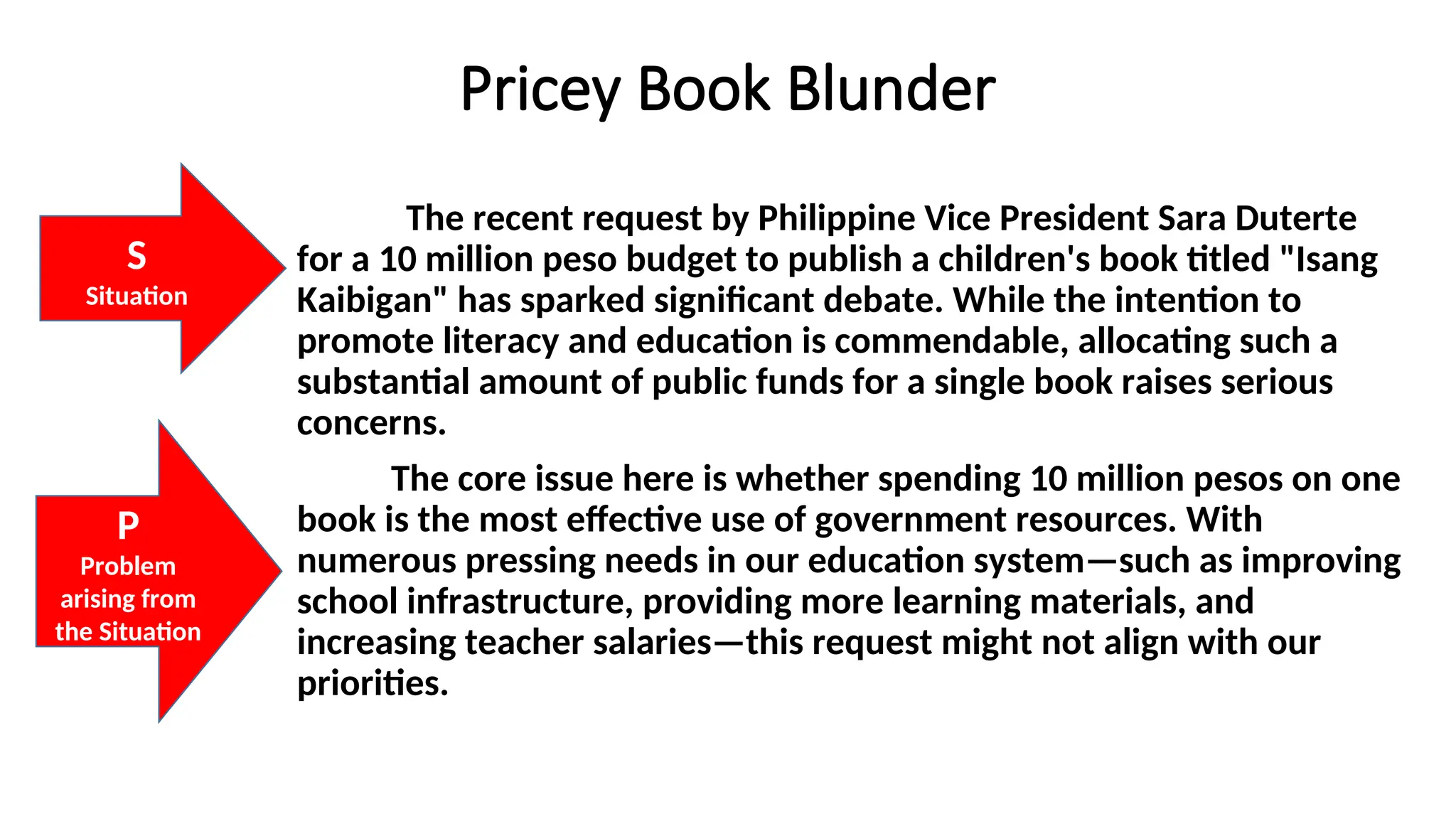
Pricey Book Blunder
The recent request by Philippine Vice President Sara Duterte
for a 10 million peso budget to publish a children's book titled "Isang
Kaibigan" has sparked significant debate. While the intention to
promote literacy and education is commendable, allocating such a
substantial amount of public funds for a single book raises serious
concerns.
The core issue here is whether spending 10 million pesos on one
book is the most effective use of government resources. With
numerous pressing needs in our education system—such as improving
school infrastructure, providing more learning materials, and
increasing teacher salaries—this request might not align with our
priorities.
S
Situation
P
Problem
arising from
the Situation
..
Instead of focusing on a single book, the
government should consider investing in broader
educational programs that can reach more children.
Funds could be used to purchase a variety of educational
materials for schools, support teacher training, or
improve classroom environments.
We believe spending 10 million pesos on the book
"Isang Kaibigan" isn’t the best choice for several reasons.
P
Proposed
course of action
P
Position
...
Spending 10 million pesos on a single book appears
excessive, particularly when we consider the cost of other
educational resources. For the same amount, we could
support multiple educational initiatives, such as refurbishing
classrooms, purchasing textbooks, or providing school
supplies. According to the Department of Education, the
average cost of improving a classroom is around 500,000
pesos, so this budget could enhance the learning
environment for 20 classrooms. Additionally, 10 million
pesos could fund numerous student scholarships or provide
essential learning materials for thousands of students,
offering a broader impact and addressing more pressing
educational needs.
E
Explanation
.
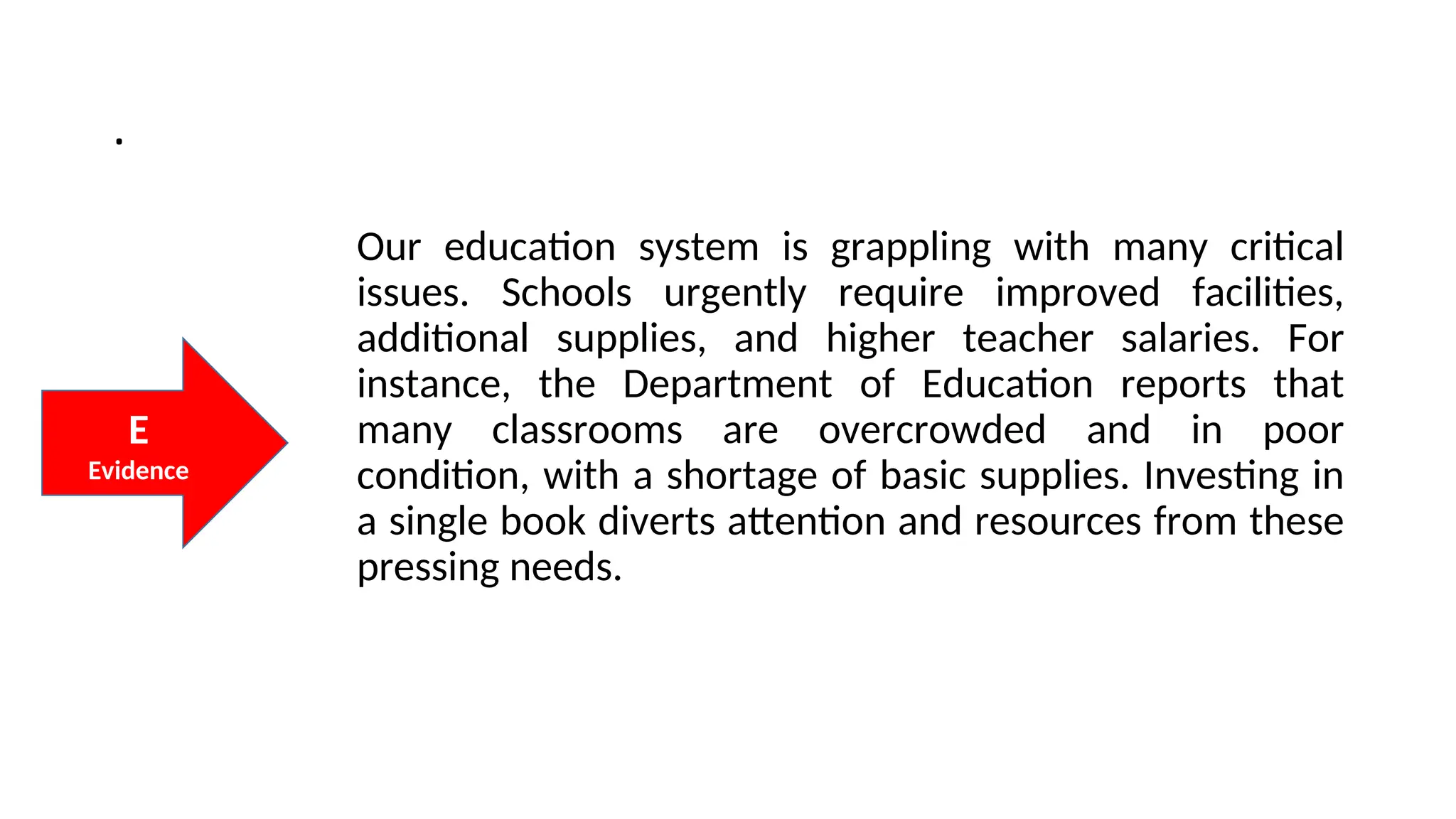
Our education system is grappling with many critical
issues. Schools urgently require improved facilities,
additional supplies, and higher teacher salaries. For
instance, the Department of Education reports that
many classrooms are overcrowded and in poor
condition, with a shortage of basic supplies. Investing in
a single book diverts attention and resources from these
pressing needs.
E
Evidence
.
Large budget allocations for specific projects must be
carefully examined to ensure transparency and
accountability. According to the Commission on Audit,
it's essential to provide detailed justifications for
significant expenditures to prevent misuse of funds.
Without solid evidence demonstrating that the book
"Isang Kaibigan" will have a substantial impact on
educational outcomes, it’s difficult to justify such a hefty
expenditure.
E
Example
. Supporters might argue that investing in a
quality children’s book can have long-lasting
educational benefits by encouraging reading and
learning. While this is true, it does not outweigh
the need for a more balanced approach that
addresses immediate educational challenges.
C
Counterargum
ent
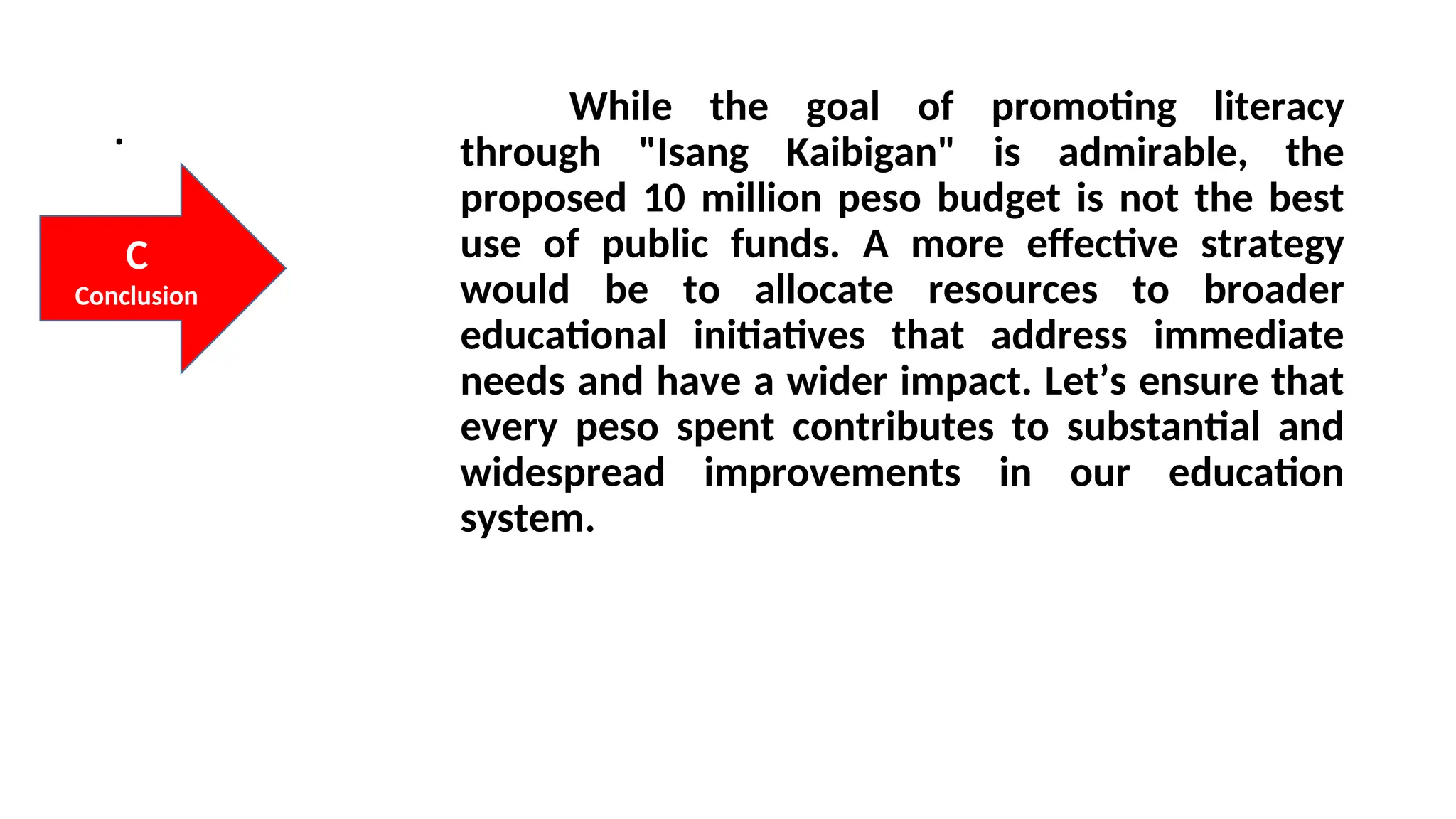
. While the goal of promoting literacy
through "Isang Kaibigan" is admirable, the
proposed 10 million peso budget is not the best
use of public funds. A more effective strategy
would be to allocate resources to broader
educational initiatives that address immediate
needs and have a wider impact. Let’s ensure that
every peso spent contributes to substantial and
widespread improvements in our education
system.
C
Conclusion
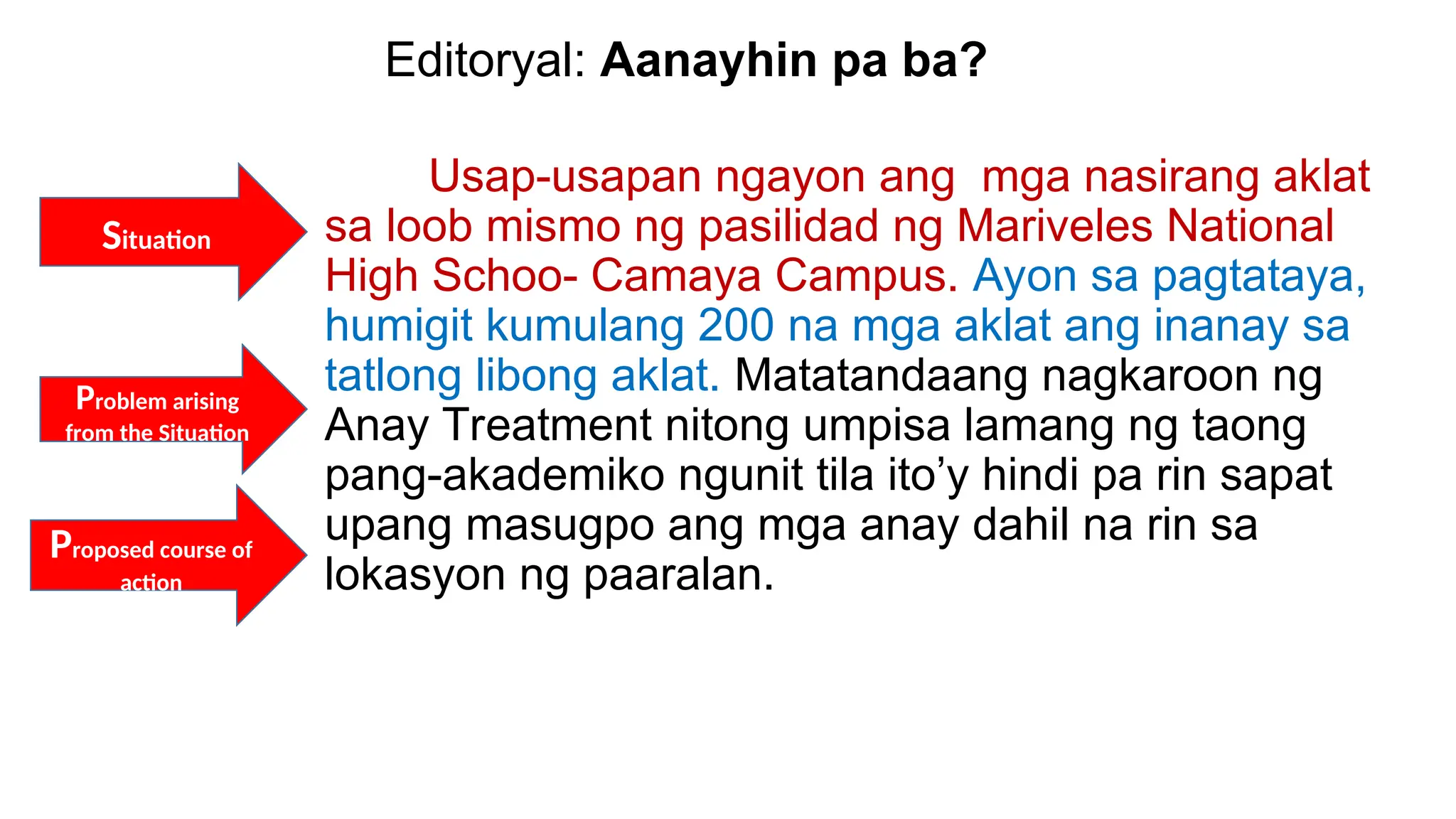
Usap-usapan ngayon ang mga nasirang aklat
sa loob mismo ng pasilidad ng Mariveles National
High Schoo- Camaya Campus. Ayon sa pagtataya,
humigit kumulang 200 na mga aklat ang inanay sa
tatlong libong aklat. Matatandaang nagkaroon ng
Anay Treatment nitong umpisa lamang ng taong
pang-akademiko ngunit tila ito’y hindi pa rin sapat
upang masugpo ang mga anay dahil na rin sa
lokasyon ng paaralan.
Editoryal: Aanayhin pa ba?
Situation
Problem arising
from the Situation
Proposed course of
action
Nakakapanghinayang man, hindi naman natin
maaaring ibaling ang lahat ng sisi sa administrayon
ng paaralan. Hindi man gustuhin ng mga taong
responsible rito, itinago ang mga nasabing aklat
dahil hindi pa itinuturo sa ating paaralan ang ilang
mga asignaturang may kinalaman sa aklat ayon na
rin sa kaslukuyang custodian.
P
Position
Ngunit sa kabilang banda, tila naglalaro ng hot potato ang ilang mga taong
responsible rito. Hindi maibigay ng kasalukuyang custodian nang diretso sa mga
estudyante ang mga aklat dahil walang mananagot sa oras na ito’y masira at mawala
kaya’t hanggat maaari’y sa mga guro ito ibinibigay. Tila naman natatakot ang ilang mga
guro sa responsibilidad ng panghihiram ng mga aklat dahil na rin sa parehong dahilan
na baka ang mga ito’y masira o hindi naman kaya’y mawala at sila ang managot ditto.
Nakapagtataka nga lamang dahil mas mahalaga pang maingatan ang aklat
kaysa sa mapakinabangan nito ng mga estudyante. Ginagastusan mula sa kaban ng
bayan ang mga aklat upang magamit ng mga estudyante hindi para itago na lamang
dahil sa pangambang ito’y masira o mawala.
Tila parehas din naman ang kinahantungan ng pagtatambak nito sa bodega at
pagbibigay nito sa mga estudyante, sa huli’y nasira rin naman ngunit ang pagkakaiba
nga lamang ay hindi ito gaanong napakinabangan. Ngayong nasira na ang mga aklat,
aanhin pa natin ito?
Samantala upang agapan na rin ang problemang ito, inaaasahang ang
pagkakaroon ng silid-aklatan sa oras na pormal nang magagamit ang bagong tayong
pasilidad ng paaralan. Ang mga inanay na mga aklat na man ay ipapadala sa Division
Office.
Hindi naman kawatan ang mga estudyante.
Nawa’y matutunan sana ng mga taong responsible sa
mga kagamitan ng paaralan ang pagtitiwala sa mga ito.
Nawa’y maipakita rin naman ng mga estudyante na
sila’y mapagkakatiwalaan sa mga kagamitan ng
paaralan.
C
Conclusion
PHASE 3: POST WRITING/ASSESSMENT. WHAT IS
COMMON AMONG THE SAMPLE EDITORIALS?
• State the problem/situation
• Give your position on the problem
• Give the situation and background of the problem. Explain.
• Weigh in.
• Craft a conclusion/ summarize the main points
• Offer a solution to the problem/ call for an action.
COLUMN WRITING
Simply, column writing is a journalistic output to express
one’s point of view on an issue.
ESSENTIALS
➲ Article giving opinion/ perspective from the writer.
➲ Approximately 500 to 850 words
➲ Opinion of the columnist not necessarily shared by
the staff.
PURPOSE/S
A. Analyze an issue, whether local or national.
B. Introduce new issues to the public, existing or
ongoing, but need attention.
C. Express an argument and stance on what should
be supported regarding an issue.
D. Mobilize readers and the masses about the issue
being discussed.
COLUMN WRITING
➲ Columns are the most personal of all newspaper
writing.
It has a very personal appeal, an authoritative
influence, and very useful contribution to make in
spreading news and opinions.
➲ They’re written to inform, to influence, or to entertain
readers.
➲ It has high in reader-interest for they stimulate public
Sources of Materials
➲ Current news Commendable Reports
➲
➲ Observations Investigations
➲
➲ Interviews
CONTENT
The ‘OPINION’ column
Resembles an editorial in form but, in contrast
with the editorial’s impersonal and anonymous
approach, carries the personal and stand of the writers
own idea.
Structure of a COLUMN
1. Column's regular title
2. Headline - try to use some alliteration or anything witty.
-Kitang kita ang kita / Money matters
-kwento ng kwenta / Silent session
use of pun - SPEDtacular / PROSTItuition
3. byline
Structure of a COLUMN
Lead/ Introduction (hook: clearly present the main
point.
In the first paragraph, there may be a question, anecdote,
personal story, or even an analogy that reflects the issue
the article will revolve around. It is brief, filled with
emotion, often of alarm, opposition, or a negative critique
toward the events.
Structure of a COLUMN
Lead/ Introduction (hook: clearly present the main point.
a. shocking statistics
The Department of Education confirmed that public school
teachers' debt has reached P300billion. This is the
accumulated value of teachers' loan from GSIS amounting to
P178 billion and Pag-Ibig Fund with P120 billion excluding
the loans from private lending institutions.
Structure of a COLUMN
Lead/ Introduction (hook: clearly present the main point.
b. controversial statement
Prostitution is everywhere in Lucena City. What is more
shocking is that there are more males involve in this
'trade' than the females, city DSWD office reported.
Structure of a COLUMN
Lead/ Introduction (hook: clearly present the main point.
c. rhetorical question
If we have forgiven the Japanese that easy, why can't
we forgive Marcos too?
Structure of a COLUMN
Body / Points, Proof and Analysis
In the body, it's powerful if you can find the strongest and
most concrete evidence. It could be laws, proclamations,
presidential decrees, or expert statements to counter the
opposition. This is also where you present the points
explaining why you stand by your position.
Structure of a COLUMN
Body / Points, Proof and Analysis
2-5 supporting facts (each fact is on its own paragraph)
a. POINT - state the fact
b. PROOF - paraphrase or quote an external source/
statement of same or related incident
c. ANALYSIS - comment on fact and proof presented. Write
about YOUR OPINION on the facts you have included.
Comment on each fact.
Structure of a COLUMN
Conclusion
•conclude by creatively restating your main point.
•finish with a statement linking to your lead.
(a call for action works well)
Structure of a COLUMN
Conclusion
•In this section, you need to connect all the ideas and
provide a conclusion. The conclusion should also include
solutions that are practical and not just empty words.
Huwag Tipirin ang Pagbangon
Ni Mark Lester Andrei Cruzet
Bilang bahagi ng rehabilitasyon ng Marawi City, naglaan ang
Department of Budget and Management (DBM) ng limang libong piso
ngayong taon. Malayong-malayo ito sa pahayag ni Marawi Mayor
Majul Usman Gandamra na nangangailanagn sila ng 90 bilyong piso.
Kaugnay nito, maling-mali na tila tinitipid ang pagbangon ng lungsod.
Kung sisipatin ang kalagayan ng Marawi matapos ang limang buwang
sagupaan sa pagitan ng Armed Forces of the Philippines (AFP) at
Maute-ISIS group, hindi maitatanggi na nawasak ang halos kabuuan
ng siyudad. Sa ganitong kalagayan, sadyang kulang na kulang ang
halagang ipinagkaloob ng DBM.
Malinaw na lahat ng aspeto ng pamumuhay ng mga taga-
Marawi ay nangangailangan ng rehabilitasyon. Kabilang na riyan
ang pagsasaayos ng mga nasirang kabahayan, mosque, paaralan
at iba pang gusali. Hindi rin dapat isantabi ang relief goods,
tulong pinansyal at pangkabuhayan ng mga apektadong
residente. Lubha rin silang nangangailangan ng matagalang
pagsasailalim sa ‘stress debriefing’
At ‘counselling’ lalo pa’t karamihan sa kanila ay
dumaranas ng matinding trauma particular ang mga bata.
Kataka-takang kakarampot lamang ang pondo ang ibinibigay ng
pamahalaan sa Marawi rehabilitation gayong maliwanag pa sasikat ng
araw kung gaano kalaki ang pangangailangan ng lungsod. Nakahahabag
ang kalagayan ng ating mga kababayan na tila nanlilimos ng awa sa mga
lingcod-bayan. Maihahalintulad natin ang pangyayaring ito sa pulubing
nanlilimos sa isang mayamang tao ngunit tanging sentimo lang ang
ipinagkakaloob.
Gayunpaman, walang dudang Malaki ang halaga ng donsasyong
makakalap mula sa mga local na Non-Government Organization (NGO) at
banyagang bansa. Marahil ito ang rason kung bakit kampante ang
gobyerno kahit kakarampot lamang ang ibinigay nilang tulong.
Magkaroon naman sana ng kaunting kahihiyan na mas Malaki pa ang
naitulong ng ibang mga bansa sa ating kababayan kaysa sa mismong
gobyerno natin.
Malaki rin ang posibilidad na maulit ang nangyari noong panahon
ng bagyong Yolanda kung saan ibinulsa ang ilang bahagi ng
pondo. Nakakapang-galaiti na katiting na nga lang ang tulong ng
pamahalaan sa Marawi ay posibleng manakaw pa. kung kaya,
nararapat tiyakin na mapupunta sa mga benepisyaryo ang lahat
ng pondo at hindi sa bulsa ng masisibang politico.
Sa kabilang banda, hindi lang naman sa gobyerno dapat iasa ang
tulong sa Marawi. Nararapat din tayong tumulong sa ating mga
kababayan, in-cash o in-kind donation man. Higit sa lahat,
ipagdasal natin ang agarang pagbangon ng mga kapatid nating
Muslim.
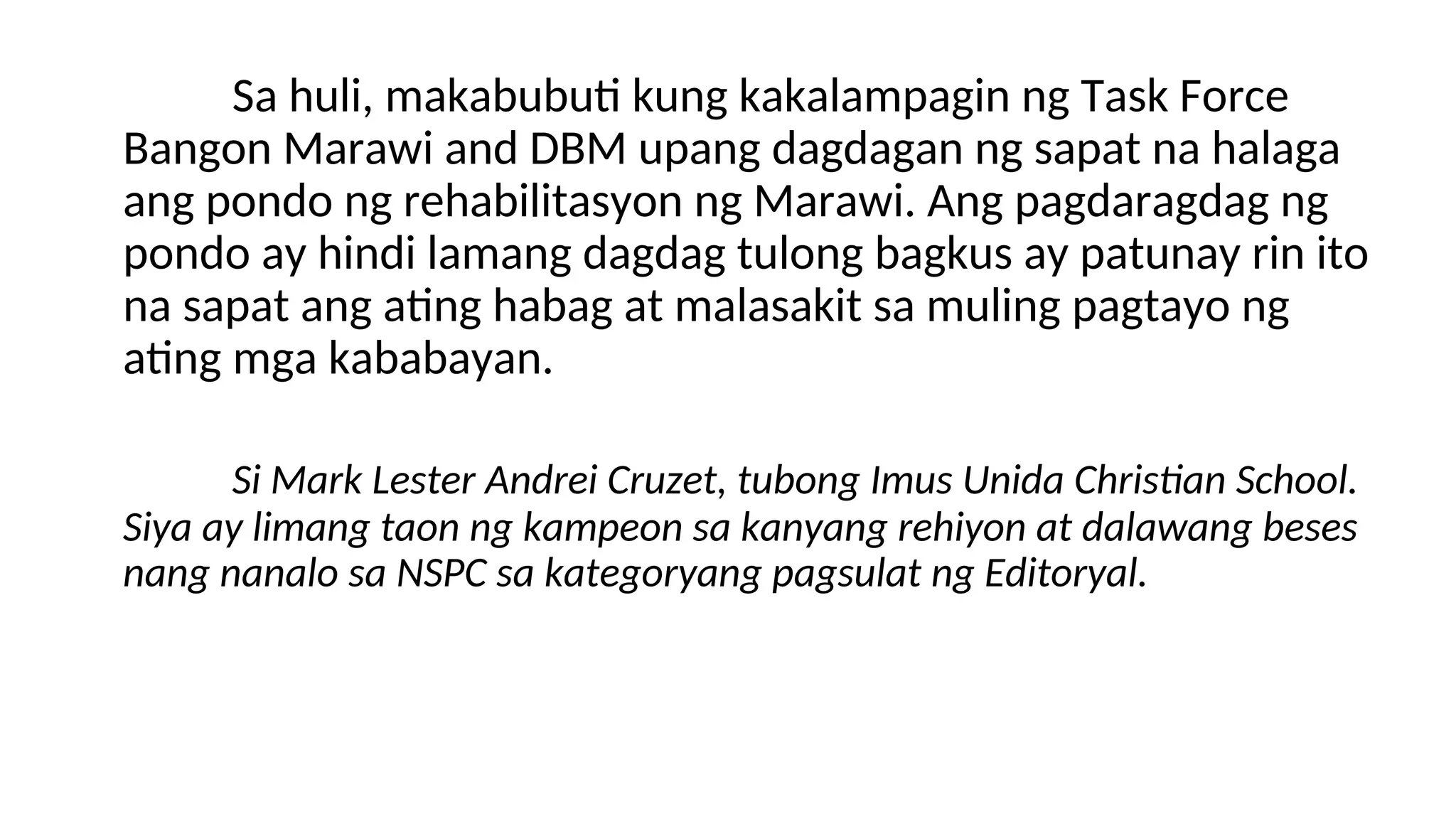
Sa huli, makabubuti kung kakalampagin ng Task Force
Bangon Marawi and DBM upang dagdagan ng sapat na halaga
ang pondo ng rehabilitasyon ng Marawi. Ang pagdaragdag ng
pondo ay hindi lamang dagdag tulong bagkus ay patunay rin ito
na sapat ang ating habag at malasakit sa muling pagtayo ng
ating mga kababayan.
Si Mark Lester Andrei Cruzet, tubong Imus Unida Christian School.
Siya ay limang taon ng kampeon sa kanyang rehiyon at dalawang beses
nang nanalo sa NSPC sa kategoryang pagsulat ng Editoryal.
POINTERS.
• personal is political
• personal insights should be tested against facts
• no such thing as “this is my opinion.”
• even opinions should be based on facts not merely emotion
• column writing promotes diversity.
DISCOURSE
• the ability and power to connect seemingly unrelated matters.
Example:
-Duterte and Hitler
-Martial law and hair color policy
-heavy traffic and ants
.
.
.
.
.
.
THANK YOU FOR LISTENING...
.
. SITUATION:
Demafelis case and the Kuwaiti gov't action
STAND/POSITION:
It 'appears' justice is served.
CLAIM/ARGUMENT:
Despite the arrest, it is not
known where and when the
employers will have to face the
consequences.
CLAIM/ARGUMENT:
Demafelis recruiter
is still at large
CLAIM/ARGUMENT:
Government's slow action on the
lifting of total ban among Filipinos
from working in Kuawit
RECAP OF THE MAIN POINTS:
Unless there's no good job in our country,
the OFWs will continue to work in Kuwait.
CONCLUSION:
Serious and lonf-term solution
to end similar cases.

EDITORIAL OPINION WRITING.ppt -tRAINING MATERIAL FOR jOURNALISM

  • 1.
  • 2.
    EDITORIAL WRITING SHARED OPINION (CollectiveStand) It is a section in newspaper or magazines in which the writers or ditors share their opinion on a highly sensible topics (issue). It is the heart and soul of the newspapers. It attempts to influence, by giving readers all the facts and oncerns
  • 3.
    EDITORIAL WRITING SHARED OPINION (CollectiveStand) presents newspaper’s opinion on an issue. Reflects majoroty vote of the editorial board. s meant to influence public opinion, promote critical thinking, and ometimes cause people to take action on an issue. Serves as an opinionated news story.
  • 4.
    EDITORIAL WRITING SHARED OPINION (CollectiveStand) In general, an editorial is a short essay that shares editorial oard’s opinion on a current event or social issue. Its goal is to ersuade the reader to consider your perspective and change heir opinion. Editorials often focus on controversial issues with idely different viewpoints.
  • 5.
    EDITORIAL WRITING Types of Editorial Interpretiveeditorial Critical editorial Persuasive editorial Praising editorial
  • 6.
    EDITORIAL WRITING nterpretive Editorial explains andprovides background information on an event or sue. This type of editorial aims to raise awareness and discuss ow the topic is relevant to the reader. xample: when the president signs a bill into law
  • 7.
    EDITORIAL WRITING Critical Editorial focuses onthe various causes of a problem and suggests a olution. For example, you might critique a policy that relates to our issue to advocate for a specific change. xample: should COMELEC disqualify BBM
  • 8.
    EDITORIAL WRITING Persuasive Editorial appeals directlyto the reader and encourages them to take ction. The persuasive format focuses on the reader’s ability to hange a situation by following your advice. xample: Why should DepEd return the school calendar to June
  • 9.
    EDITORIAL WRITING Persuasive Editorial shows appreciationfor a person or organization based on heir involvement in an issue. This type of editorial is not as ommon as the other issue. xample: Maria Ressa as Nobel Prize Awardee
  • 10.
    EDITORIAL WRITING Parts of anEditorial NTRODUCTION – the introduction builds a reader’s interest in he topic and gives an overview of the issue. ormula: Newspeg + strong stand EWS PEG – a brief statement about the news event at issue pon which the editorial is based RGUMENT – the argument presents your opinion along with
  • 11.
    EDITORIAL WRITING Parts of anEditorial VIDENCE – the evidence supports your argument with facts, esearch or anecdotes. OUNTERARGUMENT – all editorial writers should establish redibility by presenting a fair review of the perspectives involved. While a praising editorial might be mostly positive with a brief eference to an issue, a critical editorial needs to address the
  • 12.
    EDITORIAL WRITING Parts of anEditorial EFUTATION – after sharing the counter-argument with a reader, he writer must explain why that argument is not accurate or elevant. Refuting the counterargument allows you to promote our point of view while still seeming fair.
  • 13.
    EDITORIAL WRITING Parts of anEditorial ONCLUSION – in the final paragraph of your editorial, ummarize your point of view and remind the reader why they hould care about this issue.
  • 14.
    STEPS IN WRITINGAN EDITORIAL •First, look for a sensible topic/issue relevant to readers in the general public. •Essentialize to the lives of the target audience.
  • 15.
    STEPS IN WRITINGAN EDITORIAL •Second, there are opposite views about the topic/issue. •Third, the editors must have a clear stand/ position in which the whole publication believes in. •Lastly, the opinions must be supported with pieces of evidence justify their position.
  • 16.
    KEY CONCEPTS ONEDITORIAL • Collective stand of the publication. • Presents opposite viewpoints that compete for readers’ attention not just the publication’s viewpoint. • Takes leadership position on issues affecting the community.
  • 17.
    Goal of anEditorial The goals of editorial: ➮ to present viewpoints ➮ to educate the public on a certain issue ➮ to influence/shape public opinion
  • 18.
  • 19.
    PRELIMINARIES. 1. Choose atopic. SOURCES: screaming news, commissioned news, trending news • Current and timely • Substantial for writing 2. Obtain background material and information about your topic ➲ observe ➲ read ➲ interview ➲ research.
  • 20.
    PHASE 1: PRE-WRITNGSTAGE 1. Identify your purpose and audience – inform, interpret, criticize, argue, suggest reforms, urge readers to action. ➲ Explain or interpret the way the newspaper covered a sensitive or controversial subject. ➲ Criticize constructive actions, decisions or situations to get readers to see the problem.
  • 21.
    PHASE 1: PRE-WRITNGSTAGE 2. Organize Information – briefly outline your facts logically before writing the piece. ➲ Choose details ➲ Order details according to importance (outlining)
  • 22.
    PHASE 1: PRE-WRITNGSTAGE FOCUS ON A CENTRAL THEME ➲ The single greatest error made by beginning writers is trying to say too much. ➲ The error comes from the belief that, in order to be convincing, an argument must be utterly comprehensive, addressing every possible issue that relates to it.
  • 23.
    PHASE 1: PRE-WRITNGSTAGE FOCUS ON A CENTRAL THEME ➲ However, no argument is effective unless it can be absorbed and remembered by the reader. ➲ An effective editorial must be essentialized.
  • 24.
    PHASE 1: PRE-WRITNGSTAGE 3. Working on an effective title. The title of an editorial article is mostly composed of only three words. The title is a label head. Example: Huwag Tipirin ang Pag-unlad Walang Linaw Usad Pagong Court Parkingan Election Blues
  • 25.
    PHASE 1: PRE-WRITNGSTAGE 3. Working on an effective title. Example: Malapit nang mag-end and ‘Endo’ Bukbok na Diskarte Sinagasaan ng Train (Law) Saving YOUth Ruling Out the Law
  • 26.
    PHASE 2: WRITINGSTAGE INTRODUCTION: - presentation of the SITUATION/NEWS ITEM (newspeg) - stand/ position
  • 27.
    PHASE 2: WRITINGSTAGE BODY Claims fully supported by proofs 4E: Explanation/Evidence/Example/Extra Details Tools: narrative of incidents, statement from credible sources, statistics, provision from memo, order, by-laws, constitution, etc.
  • 28.
    PHASE 2: WRITINGSTAGE CONCLUSION Recap of the main points Recommending a SOLUTION/ CALLING for an ACTION
  • 29.
    OUTLINING Title: _______________________________ 1. Situation:_________________________ 2. Position: __________________________ 3. Claims (three - point rule) *strong to strongest claims (EXPLANATION, EVIDENCE, EXAMPLE) a. __________ b. ____________ c. _______________ - arguments/ proofs to support each of your claims using surveys, statistics, statements and examples 5. Conclusion 6. Solution
  • 30.
    OUTLINING 1 title The writermay lastly write the title because this should be found on a certain part of the article. The title must have fangs, catchy and there is a call for action. This must be short but catchy. The writer may use play of words (pun), joke or a prominent phrase used in internet and social media.
  • 31.
    OUTLINING 1 introduction It containsa brief background of the issue being discussed (news peg) and most importantly the stand (position) of the editorial article . This may be a positive or a negative reaction.
  • 32.
    OUTLINING 1 body (evidence/s+ opinion) It contains at least three paragraphs that contain clear arguments of the issue. The arguments may be positive or negative depending on the position of the publication. Each argument must be based on facts.
  • 33.
    OUTLINING 1 body (evidence/s+ opinion) Use facts, numbers, expert quotes, and theoretical ideas to challenge the other side.
  • 34.
    OUTLINING 1 body (counterargument) Thisparagraph should include at least one counterpoint to the latter arguments. If you made three points against something before, add one positive aspect here.
  • 35.
    OUTLINING 1 body (contradict counterargument) Afteraddressing the counterarguments from the other side, you should reaffirm your main point by restating your main viewpoint , which is the core of your opinion.
  • 36.
    OUTLINING 1 conclusion (conclusion+ solution) Consider the overall impact of the issue, potential future problems, and possible solutions that are practical, ethical, and legal. Then state your overall position. Finish with a strong conclusion and a compelling call to action.
  • 37.
    Pricey Book Blunder Therecent request by Philippine Vice President Sara Duterte for a 10 million peso budget to publish a children's book titled "Isang Kaibigan" has sparked significant debate. While the intention to promote literacy and education is commendable, allocating such a substantial amount of public funds for a single book raises serious concerns. The core issue here is whether spending 10 million pesos on one book is the most effective use of government resources. With numerous pressing needs in our education system—such as improving school infrastructure, providing more learning materials, and increasing teacher salaries—this request might not align with our priorities. S Situation P Problem arising from the Situation
  • 38.
    .. Instead of focusingon a single book, the government should consider investing in broader educational programs that can reach more children. Funds could be used to purchase a variety of educational materials for schools, support teacher training, or improve classroom environments. We believe spending 10 million pesos on the book "Isang Kaibigan" isn’t the best choice for several reasons. P Proposed course of action P Position
  • 39.
    ... Spending 10 millionpesos on a single book appears excessive, particularly when we consider the cost of other educational resources. For the same amount, we could support multiple educational initiatives, such as refurbishing classrooms, purchasing textbooks, or providing school supplies. According to the Department of Education, the average cost of improving a classroom is around 500,000 pesos, so this budget could enhance the learning environment for 20 classrooms. Additionally, 10 million pesos could fund numerous student scholarships or provide essential learning materials for thousands of students, offering a broader impact and addressing more pressing educational needs. E Explanation
  • 40.
    . Our education systemis grappling with many critical issues. Schools urgently require improved facilities, additional supplies, and higher teacher salaries. For instance, the Department of Education reports that many classrooms are overcrowded and in poor condition, with a shortage of basic supplies. Investing in a single book diverts attention and resources from these pressing needs. E Evidence
  • 41.
    . Large budget allocationsfor specific projects must be carefully examined to ensure transparency and accountability. According to the Commission on Audit, it's essential to provide detailed justifications for significant expenditures to prevent misuse of funds. Without solid evidence demonstrating that the book "Isang Kaibigan" will have a substantial impact on educational outcomes, it’s difficult to justify such a hefty expenditure. E Example
  • 42.
    . Supporters mightargue that investing in a quality children’s book can have long-lasting educational benefits by encouraging reading and learning. While this is true, it does not outweigh the need for a more balanced approach that addresses immediate educational challenges. C Counterargum ent
  • 43.
    . While thegoal of promoting literacy through "Isang Kaibigan" is admirable, the proposed 10 million peso budget is not the best use of public funds. A more effective strategy would be to allocate resources to broader educational initiatives that address immediate needs and have a wider impact. Let’s ensure that every peso spent contributes to substantial and widespread improvements in our education system. C Conclusion
  • 44.
    Usap-usapan ngayon angmga nasirang aklat sa loob mismo ng pasilidad ng Mariveles National High Schoo- Camaya Campus. Ayon sa pagtataya, humigit kumulang 200 na mga aklat ang inanay sa tatlong libong aklat. Matatandaang nagkaroon ng Anay Treatment nitong umpisa lamang ng taong pang-akademiko ngunit tila ito’y hindi pa rin sapat upang masugpo ang mga anay dahil na rin sa lokasyon ng paaralan. Editoryal: Aanayhin pa ba? Situation Problem arising from the Situation Proposed course of action
  • 45.
    Nakakapanghinayang man, hindinaman natin maaaring ibaling ang lahat ng sisi sa administrayon ng paaralan. Hindi man gustuhin ng mga taong responsible rito, itinago ang mga nasabing aklat dahil hindi pa itinuturo sa ating paaralan ang ilang mga asignaturang may kinalaman sa aklat ayon na rin sa kaslukuyang custodian. P Position
  • 46.
    Ngunit sa kabilangbanda, tila naglalaro ng hot potato ang ilang mga taong responsible rito. Hindi maibigay ng kasalukuyang custodian nang diretso sa mga estudyante ang mga aklat dahil walang mananagot sa oras na ito’y masira at mawala kaya’t hanggat maaari’y sa mga guro ito ibinibigay. Tila naman natatakot ang ilang mga guro sa responsibilidad ng panghihiram ng mga aklat dahil na rin sa parehong dahilan na baka ang mga ito’y masira o hindi naman kaya’y mawala at sila ang managot ditto. Nakapagtataka nga lamang dahil mas mahalaga pang maingatan ang aklat kaysa sa mapakinabangan nito ng mga estudyante. Ginagastusan mula sa kaban ng bayan ang mga aklat upang magamit ng mga estudyante hindi para itago na lamang dahil sa pangambang ito’y masira o mawala. Tila parehas din naman ang kinahantungan ng pagtatambak nito sa bodega at pagbibigay nito sa mga estudyante, sa huli’y nasira rin naman ngunit ang pagkakaiba nga lamang ay hindi ito gaanong napakinabangan. Ngayong nasira na ang mga aklat, aanhin pa natin ito? Samantala upang agapan na rin ang problemang ito, inaaasahang ang pagkakaroon ng silid-aklatan sa oras na pormal nang magagamit ang bagong tayong pasilidad ng paaralan. Ang mga inanay na mga aklat na man ay ipapadala sa Division Office.
  • 47.
    Hindi naman kawatanang mga estudyante. Nawa’y matutunan sana ng mga taong responsible sa mga kagamitan ng paaralan ang pagtitiwala sa mga ito. Nawa’y maipakita rin naman ng mga estudyante na sila’y mapagkakatiwalaan sa mga kagamitan ng paaralan. C Conclusion
  • 48.
    PHASE 3: POSTWRITING/ASSESSMENT. WHAT IS COMMON AMONG THE SAMPLE EDITORIALS? • State the problem/situation • Give your position on the problem • Give the situation and background of the problem. Explain. • Weigh in. • Craft a conclusion/ summarize the main points • Offer a solution to the problem/ call for an action.
  • 49.
    COLUMN WRITING Simply, columnwriting is a journalistic output to express one’s point of view on an issue.
  • 50.
    ESSENTIALS ➲ Article givingopinion/ perspective from the writer. ➲ Approximately 500 to 850 words ➲ Opinion of the columnist not necessarily shared by the staff.
  • 51.
    PURPOSE/S A. Analyze anissue, whether local or national. B. Introduce new issues to the public, existing or ongoing, but need attention. C. Express an argument and stance on what should be supported regarding an issue. D. Mobilize readers and the masses about the issue being discussed.
  • 52.
    COLUMN WRITING ➲ Columnsare the most personal of all newspaper writing. It has a very personal appeal, an authoritative influence, and very useful contribution to make in spreading news and opinions. ➲ They’re written to inform, to influence, or to entertain readers. ➲ It has high in reader-interest for they stimulate public
  • 53.
    Sources of Materials ➲Current news Commendable Reports ➲ ➲ Observations Investigations ➲ ➲ Interviews
  • 54.
    CONTENT The ‘OPINION’ column Resemblesan editorial in form but, in contrast with the editorial’s impersonal and anonymous approach, carries the personal and stand of the writers own idea.
  • 55.
    Structure of aCOLUMN 1. Column's regular title 2. Headline - try to use some alliteration or anything witty. -Kitang kita ang kita / Money matters -kwento ng kwenta / Silent session use of pun - SPEDtacular / PROSTItuition 3. byline
  • 56.
    Structure of aCOLUMN Lead/ Introduction (hook: clearly present the main point. In the first paragraph, there may be a question, anecdote, personal story, or even an analogy that reflects the issue the article will revolve around. It is brief, filled with emotion, often of alarm, opposition, or a negative critique toward the events.
  • 57.
    Structure of aCOLUMN Lead/ Introduction (hook: clearly present the main point. a. shocking statistics The Department of Education confirmed that public school teachers' debt has reached P300billion. This is the accumulated value of teachers' loan from GSIS amounting to P178 billion and Pag-Ibig Fund with P120 billion excluding the loans from private lending institutions.
  • 58.
    Structure of aCOLUMN Lead/ Introduction (hook: clearly present the main point. b. controversial statement Prostitution is everywhere in Lucena City. What is more shocking is that there are more males involve in this 'trade' than the females, city DSWD office reported.
  • 59.
    Structure of aCOLUMN Lead/ Introduction (hook: clearly present the main point. c. rhetorical question If we have forgiven the Japanese that easy, why can't we forgive Marcos too?
  • 60.
    Structure of aCOLUMN Body / Points, Proof and Analysis In the body, it's powerful if you can find the strongest and most concrete evidence. It could be laws, proclamations, presidential decrees, or expert statements to counter the opposition. This is also where you present the points explaining why you stand by your position.
  • 61.
    Structure of aCOLUMN Body / Points, Proof and Analysis 2-5 supporting facts (each fact is on its own paragraph) a. POINT - state the fact b. PROOF - paraphrase or quote an external source/ statement of same or related incident c. ANALYSIS - comment on fact and proof presented. Write about YOUR OPINION on the facts you have included. Comment on each fact.
  • 62.
    Structure of aCOLUMN Conclusion •conclude by creatively restating your main point. •finish with a statement linking to your lead. (a call for action works well)
  • 63.
    Structure of aCOLUMN Conclusion •In this section, you need to connect all the ideas and provide a conclusion. The conclusion should also include solutions that are practical and not just empty words.
  • 64.
    Huwag Tipirin angPagbangon Ni Mark Lester Andrei Cruzet Bilang bahagi ng rehabilitasyon ng Marawi City, naglaan ang Department of Budget and Management (DBM) ng limang libong piso ngayong taon. Malayong-malayo ito sa pahayag ni Marawi Mayor Majul Usman Gandamra na nangangailanagn sila ng 90 bilyong piso. Kaugnay nito, maling-mali na tila tinitipid ang pagbangon ng lungsod. Kung sisipatin ang kalagayan ng Marawi matapos ang limang buwang sagupaan sa pagitan ng Armed Forces of the Philippines (AFP) at Maute-ISIS group, hindi maitatanggi na nawasak ang halos kabuuan ng siyudad. Sa ganitong kalagayan, sadyang kulang na kulang ang halagang ipinagkaloob ng DBM.
  • 65.
    Malinaw na lahatng aspeto ng pamumuhay ng mga taga- Marawi ay nangangailangan ng rehabilitasyon. Kabilang na riyan ang pagsasaayos ng mga nasirang kabahayan, mosque, paaralan at iba pang gusali. Hindi rin dapat isantabi ang relief goods, tulong pinansyal at pangkabuhayan ng mga apektadong residente. Lubha rin silang nangangailangan ng matagalang pagsasailalim sa ‘stress debriefing’ At ‘counselling’ lalo pa’t karamihan sa kanila ay dumaranas ng matinding trauma particular ang mga bata.
  • 66.
    Kataka-takang kakarampot lamangang pondo ang ibinibigay ng pamahalaan sa Marawi rehabilitation gayong maliwanag pa sasikat ng araw kung gaano kalaki ang pangangailangan ng lungsod. Nakahahabag ang kalagayan ng ating mga kababayan na tila nanlilimos ng awa sa mga lingcod-bayan. Maihahalintulad natin ang pangyayaring ito sa pulubing nanlilimos sa isang mayamang tao ngunit tanging sentimo lang ang ipinagkakaloob. Gayunpaman, walang dudang Malaki ang halaga ng donsasyong makakalap mula sa mga local na Non-Government Organization (NGO) at banyagang bansa. Marahil ito ang rason kung bakit kampante ang gobyerno kahit kakarampot lamang ang ibinigay nilang tulong. Magkaroon naman sana ng kaunting kahihiyan na mas Malaki pa ang naitulong ng ibang mga bansa sa ating kababayan kaysa sa mismong gobyerno natin.
  • 67.
    Malaki rin angposibilidad na maulit ang nangyari noong panahon ng bagyong Yolanda kung saan ibinulsa ang ilang bahagi ng pondo. Nakakapang-galaiti na katiting na nga lang ang tulong ng pamahalaan sa Marawi ay posibleng manakaw pa. kung kaya, nararapat tiyakin na mapupunta sa mga benepisyaryo ang lahat ng pondo at hindi sa bulsa ng masisibang politico. Sa kabilang banda, hindi lang naman sa gobyerno dapat iasa ang tulong sa Marawi. Nararapat din tayong tumulong sa ating mga kababayan, in-cash o in-kind donation man. Higit sa lahat, ipagdasal natin ang agarang pagbangon ng mga kapatid nating Muslim.
  • 68.
    Sa huli, makabubutikung kakalampagin ng Task Force Bangon Marawi and DBM upang dagdagan ng sapat na halaga ang pondo ng rehabilitasyon ng Marawi. Ang pagdaragdag ng pondo ay hindi lamang dagdag tulong bagkus ay patunay rin ito na sapat ang ating habag at malasakit sa muling pagtayo ng ating mga kababayan. Si Mark Lester Andrei Cruzet, tubong Imus Unida Christian School. Siya ay limang taon ng kampeon sa kanyang rehiyon at dalawang beses nang nanalo sa NSPC sa kategoryang pagsulat ng Editoryal.
  • 69.
    POINTERS. • personal ispolitical • personal insights should be tested against facts • no such thing as “this is my opinion.” • even opinions should be based on facts not merely emotion • column writing promotes diversity. DISCOURSE • the ability and power to connect seemingly unrelated matters. Example: -Duterte and Hitler -Martial law and hair color policy -heavy traffic and ants
  • 70.
  • 71.
  • 72.
  • 73.
  • 74.
  • 75.
    . THANK YOU FORLISTENING...
  • 76.
    . . SITUATION: Demafelis caseand the Kuwaiti gov't action STAND/POSITION: It 'appears' justice is served. CLAIM/ARGUMENT: Despite the arrest, it is not known where and when the employers will have to face the consequences. CLAIM/ARGUMENT: Demafelis recruiter is still at large CLAIM/ARGUMENT: Government's slow action on the lifting of total ban among Filipinos from working in Kuawit RECAP OF THE MAIN POINTS: Unless there's no good job in our country, the OFWs will continue to work in Kuwait. CONCLUSION: Serious and lonf-term solution to end similar cases.