Engaging In Moderate
To Vigorous Physical
Activity
QUARTER 1 – MODULE 3
Aerobic Exercise
and Aerobic
Fitness
Aerobic Exercise is any physical activity that makes
you sweat, causes you to breathe harder, and gets
your heart beating faster compared to when you are
at rest.
There are four techniques in getting the heart beat
per minute, and they are as follows:
1. Apical Site
2. Carotid Pulse Site
3. Radial Pulse Site
4. Temporal Pulse Site
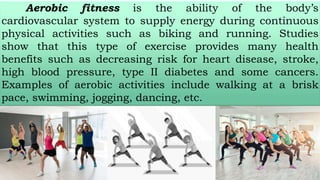
Aerobic fitness is the ability of the body’s
cardiovascular system to supply energy during continuous
physical activities such as biking and running. Studies
show that this type of exercise provides many health
benefits such as decreasing risk for heart disease, stroke,
high blood pressure, type II diabetes and some cancers.
Examples of aerobic activities include walking at a brisk
pace, swimming, jogging, dancing, etc.
Muscular Strength
and Bone
Strengthening
Exercises
Muscular strength is the ability of the muscles to exert
a force during an activity such as lifting weights. Muscle
strengthening exercises involve using your muscles to work
against a resistance such as your body weight, elastic bands
or weights.
Bone strengthening exercise, or
any weight-bearing activity that produces
a force on the bone, is also important to
overall health for children and adults.
This force is usually produced by
impact with the ground and results in
bone growth in children and healthy
maintenance of bone density in adults.
Examples of bone strengthening
activities include jumping, walking,
jogging, and weight lifting exercises. As
you can see, some exercises such as
walking or jogging serve a dual purpose
of strengthening our bones and our
aerobic system.
Muscular
Endurance and
Resistance Training
Muscular endurance, on the other hand, is how many
times you can lift a certain amount of weight. Resistance
training (also referred to as weight training or strength
training) helps increase muscular strength and endurance.
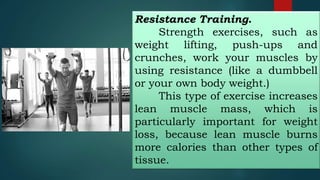
Resistance Training.
Strength exercises, such as
weight lifting, push-ups and
crunches, work your muscles by
using resistance (like a dumbbell
or your own body weight.)
This type of exercise increases
lean muscle mass, which is
particularly important for weight
loss, because lean muscle burns
more calories than other types of
tissue.
Circuit Training
and Flexibility
Exercise
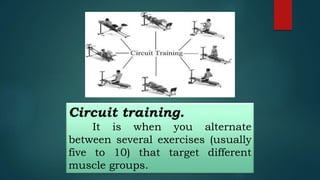
Circuit training.
It is when you alternate
between several exercises (usually
five to 10) that target different
muscle groups.
Flexibility exercises
stretch your muscles and
may improve your range of
motion at your joints. They can
improve your flexibility and
reduce your risk of injury
during sports and other
activities. It is usually done in
warm-up exercise to condition
the muscle and in the Cooling
down exercise to allow the body
to gradual transition in a
resting or near-resting state.
Static Stretching
(Active and
Passive Static)
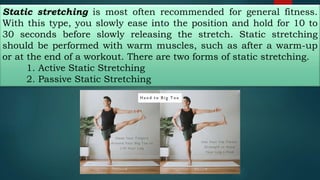
Static stretching is most often recommended for general fitness.
With this type, you slowly ease into the position and hold for 10 to
30 seconds before slowly releasing the stretch. Static stretching
should be performed with warm muscles, such as after a warm-up
or at the end of a workout. There are two forms of static stretching.
1. Active Static Stretching
2. Passive Static Stretching
Dynamic
Stretching
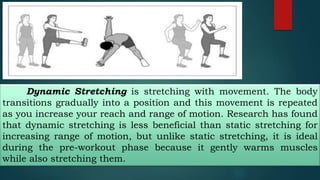
Dynamic Stretching is stretching with movement. The body
transitions gradually into a position and this movement is repeated
as you increase your reach and range of motion. Research has found
that dynamic stretching is less beneficial than static stretching for
increasing range of motion, but unlike static stretching, it is ideal
during the pre-workout phase because it gently warms muscles
while also stretching them.
Intensity of Physical Activity
► Refers to the rate at which the activity is being performed
or the magnitude of the effort required to perform an
activity or exercise.
► Can be thought of as how hard a person works to perform
the activity.
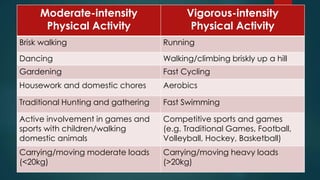
Moderate-intensity
Physical Activity
Vigorous-intensity
Physical Activity
Brisk walking Running
Dancing Walking/climbing briskly up a hill
Gardening Fast Cycling
Housework and domestic chores Aerobics
Traditional Hunting and gathering Fast Swimming
Active involvement in games and
sports with children/walking
domestic animals
Competitive sports and games
(e.g. Traditional Games, Football,
Volleyball, Hockey, Basketball)
Carrying/moving moderate loads
(<20kg)
Carrying/moving heavy loads
(>20kg)
How Do I
Assess My
Fitness Level
Start recording your pulse rate.
1. Resting Heart Rate (lower is better)
- between 60 to 100 beats per minute (bpm) is normal.
- more active person as low as 40 bpm
2. For moderate-intensity physical activity
- 64% and 76% of your maximum heart rate (MHR)
3. For vigorous-intensity physical activity
- 77% and 93% of maximum heart rate (MHR)
MHR = 220 - ________ (your age) MHR =____________
HOPE-1-MODULE-3.pptx

HOPE-1-MODULE-3.pptx

  • 1.
    Engaging In Moderate ToVigorous Physical Activity QUARTER 1 – MODULE 3
  • 2.
  • 3.
    Aerobic Exercise isany physical activity that makes you sweat, causes you to breathe harder, and gets your heart beating faster compared to when you are at rest. There are four techniques in getting the heart beat per minute, and they are as follows: 1. Apical Site 2. Carotid Pulse Site 3. Radial Pulse Site 4. Temporal Pulse Site
  • 5.
    Aerobic fitness isthe ability of the body’s cardiovascular system to supply energy during continuous physical activities such as biking and running. Studies show that this type of exercise provides many health benefits such as decreasing risk for heart disease, stroke, high blood pressure, type II diabetes and some cancers. Examples of aerobic activities include walking at a brisk pace, swimming, jogging, dancing, etc.
  • 6.
  • 7.
    Muscular strength isthe ability of the muscles to exert a force during an activity such as lifting weights. Muscle strengthening exercises involve using your muscles to work against a resistance such as your body weight, elastic bands or weights.
  • 8.
    Bone strengthening exercise,or any weight-bearing activity that produces a force on the bone, is also important to overall health for children and adults. This force is usually produced by impact with the ground and results in bone growth in children and healthy maintenance of bone density in adults. Examples of bone strengthening activities include jumping, walking, jogging, and weight lifting exercises. As you can see, some exercises such as walking or jogging serve a dual purpose of strengthening our bones and our aerobic system.
  • 9.
  • 10.
    Muscular endurance, onthe other hand, is how many times you can lift a certain amount of weight. Resistance training (also referred to as weight training or strength training) helps increase muscular strength and endurance.
  • 11.
    Resistance Training. Strength exercises,such as weight lifting, push-ups and crunches, work your muscles by using resistance (like a dumbbell or your own body weight.) This type of exercise increases lean muscle mass, which is particularly important for weight loss, because lean muscle burns more calories than other types of tissue.
  • 12.
  • 13.
    Circuit training. It iswhen you alternate between several exercises (usually five to 10) that target different muscle groups.
  • 14.
    Flexibility exercises stretch yourmuscles and may improve your range of motion at your joints. They can improve your flexibility and reduce your risk of injury during sports and other activities. It is usually done in warm-up exercise to condition the muscle and in the Cooling down exercise to allow the body to gradual transition in a resting or near-resting state.
  • 15.
  • 16.
    Static stretching ismost often recommended for general fitness. With this type, you slowly ease into the position and hold for 10 to 30 seconds before slowly releasing the stretch. Static stretching should be performed with warm muscles, such as after a warm-up or at the end of a workout. There are two forms of static stretching. 1. Active Static Stretching 2. Passive Static Stretching
  • 17.
  • 18.
    Dynamic Stretching isstretching with movement. The body transitions gradually into a position and this movement is repeated as you increase your reach and range of motion. Research has found that dynamic stretching is less beneficial than static stretching for increasing range of motion, but unlike static stretching, it is ideal during the pre-workout phase because it gently warms muscles while also stretching them.
  • 19.
    Intensity of PhysicalActivity ► Refers to the rate at which the activity is being performed or the magnitude of the effort required to perform an activity or exercise. ► Can be thought of as how hard a person works to perform the activity.
  • 20.
    Moderate-intensity Physical Activity Vigorous-intensity Physical Activity Briskwalking Running Dancing Walking/climbing briskly up a hill Gardening Fast Cycling Housework and domestic chores Aerobics Traditional Hunting and gathering Fast Swimming Active involvement in games and sports with children/walking domestic animals Competitive sports and games (e.g. Traditional Games, Football, Volleyball, Hockey, Basketball) Carrying/moving moderate loads (<20kg) Carrying/moving heavy loads (>20kg)
  • 21.
    How Do I AssessMy Fitness Level
  • 22.
    Start recording yourpulse rate. 1. Resting Heart Rate (lower is better) - between 60 to 100 beats per minute (bpm) is normal. - more active person as low as 40 bpm 2. For moderate-intensity physical activity - 64% and 76% of your maximum heart rate (MHR) 3. For vigorous-intensity physical activity - 77% and 93% of maximum heart rate (MHR) MHR = 220 - ________ (your age) MHR =____________