EDITORIAL
WRITING /
FEATURE
WRITING
JONELL SEGADOR GREGORIO
Echelon Development School
Champion (Coach) Editorial Writing English
Elementary (NSPC 2018, Dumaguete City)
EDITORIAL WRITING
– An editorial is an article that presents the newspaper's opinion on an
issue. It is considered the voice of the newspaper. It is the official stand of
editorial board on a particular issue. Thus, it is usually unsigned or carries
no byline.
– It can be on any topic, but it should be relevant to an issue that is being
talked about in society in general. It is a reaction to a news event or issue.
– It should be backed up with facts, data, and/ or statistics
– It can offer an solution to solve the problem mentioned earlier
– It should be “memorable” especially in its concluding part
A. It is an article that expresses opinion
– It is an opinion, yes… but NOT your own opinion (Unless you are
a columnist).
– Avoid using “I” or “Me” in writing the editorial š
– These types of editorials usually have no bylines and are
attributed to a statement coming from the newspaper/ campus
paper itself.
– An editorial is not necessarily written by the Editor-in-Chief
B. It can be on any topic, but it should be relevant to
an issue that is being talked about in society in
general
– The topic chosen can be or not be related to the
front page of the newspaper. š
– Best topics are those that are current issues in
society. If the topic is current, readers will be
interested to read it since it grasps their attention.
C. It should be backed up with relevant
facts, data, and/ or statistics š
– Make sure to use the most recent information. š
– In some cases, you can use older information as sources to help prove your
case (e.g. historical data). š
– Use statistics to help prove your argument. (e.g. number of typhoon victims
if you are writing a piece on natural disasters, SWS survey numbers when
you are writing about elections, etc.) š
– Avoid “hearsays” when citing a number… it might be wrong and will ruin
the integrity of the piece. Err on the side of caution.
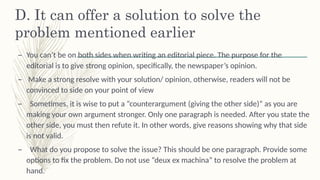
D. It can offer a solution to solve the
problem mentioned earlier š
– You can’t be on both sides when writing an editorial piece. The purpose for the
editorial is to give strong opinion, specifically, the newspaper’s opinion. š
– Make a strong resolve with your solution/ opinion, otherwise, readers will not be
convinced to side on your point of view
– Sometimes, it is wise to put a “counterargument (giving the other side)” as you are
š
making your own argument stronger. Only one paragraph is needed. After you state the
other side, you must then refute it. In other words, give reasons showing why that side
is not valid.
– What do you propose to solve the issue? This should be one paragraph. Provide some
š
options to fix the problem. Do not use “deux ex machina” to resolve the problem at
hand.
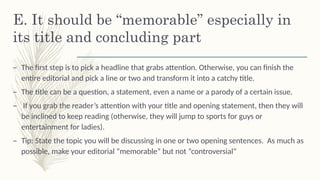
E. It should be “memorable” especially in
its title and concluding part š
– The first step is to pick a headline that grabs attention. Otherwise, you can finish the
entire editorial and pick a line or two and transform it into a catchy title. š
– The title can be a question, a statement, even a name or a parody of a certain issue. š
– If you grab the reader’s attention with your title and opening statement, then they will
be inclined to keep reading (otherwise, they will jump to sports for guys or
entertainment for ladies).
– Tip: State the topic you will be discussing in one or two opening sentences. As much as
š
possible, make your editorial “memorable” but not “controversial”
– Make sure your strongest argument is left for last. Do not also become
passive in the arguments that come before the strongest.
– The conclusion should be able to “tie up” all your arguments so that it will
š
become a “recap” to the entire piece. š
– Your conclusion should also have a few solutions you think would help with
the issue at hand. It would be great if you could get the reader to engage in
asking him or herself questions on how they stand on a particular issue. š
– Tip: It should appeal to the emotion or the intellect or should make the
reader act on something. Do you want them to rise up in protest, post an FB
comment, write government officials, stage a walkout, etc. Then that editorial
should convey that.
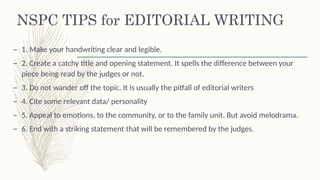
NSPC TIPS for EDITORIAL WRITING
– 1. Make your handwriting clear and legible.
– 2. Create a catchy title and opening statement. It spells the difference between your
piece being read by the judges or not.
– 3. Do not wander off the topic. It is usually the pitfall of editorial writers
– 4. Cite some relevant data/ personality
– 5. Appeal to emotions, to the community, or to the family unit. But avoid melodrama.
– 6. End with a striking statement that will be remembered by the judges.
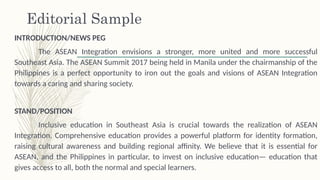
Editorial Sample
INTRODUCTION/NEWS PEG
The ASEAN Integration envisions a stronger, more united and more successful
Southeast Asia. The ASEAN Summit 2017 being held in Manila under the chairmanship of the
Philippines is a perfect opportunity to iron out the goals and visions of ASEAN Integration
towards a caring and sharing society.
STAND/POSITION
Inclusive education in Southeast Asia is crucial towards the realization of ASEAN
Integration. Comprehensive education provides a powerful platform for identity formation,
raising cultural awareness and building regional affinity. We believe that it is essential for
ASEAN, and the Philippines in particular, to invest on inclusive education— education that
gives access to all, both the normal and special learners.
ARGUMENT/EVIDENCE 1
It is lamentable to think that 93-150 million children in the world have
disabilities. This puts them at a disadvantage to the opportunities given to other
learners. They suffer psychological burdens such as bullying and discrimination in
schools. Under inclusive education, they will be given equal opportunities to learn
and excel. They will be provided with physical access to learning and a more sensitive
approach to teaching.
ARGUMENT/EVIDENCE 2
It is imperative that ASEAN countries invest on people’s education. Part of that
is increasing the number of teachers who will teach all kinds of learners. It is
estimated that 6.26 million teachers are needed in order to achieve universal primary
and secondary education in the ASEAN region.
ARGUMENT/EVIDENCE 3
A well-educated citizenry redounds to more skilled workers. According to
the Asian Development Bank, the ASEAN Economic Community will provide 14
million jobs, 3.1 million of which are available for Filipinos. As such, the
government needs to invest in world-class skills education if we want to benefit
from the expansion of markets in the region. Jobs in information technology
and business process outsourcing (BPO) can be lucrative for physically-disabled,
yet highly-skilled individuals.
COUNTERARGUMENT
Although other people would say that special children have special
needs, and thus, should be sent to special schools, studies have shown that
special children in regular schools can behave and learn like a normal learner
would, given the access and sensitivity to their needs.
YOUR ROLE
As campus journalists, we have great role in advancing inclusive
education. We have the power to write and write about the plight of
the physically-handicapped, the marginalized, the minority and the
special children so they can gain acceptance in society. The social
media such as Facebook, Youtube and Twitter can be used as platform
to share their struggles and triumphs, and to show how similar they
are to normal learners. We can act as their mouthpiece and their
advocate so they can that they belong in this society; that they too,
are productive members of our community in its quest for a
prosperous ASEAN.
CALL TO ACTION/SOLUTION
It is therefore crucial that governments in the ASEAN region work
together for the integration, and inclusion, of all learners in our education
system. They must make sure that there is no weak link among our citizens,
that everyone is treated with sensitivity and equality to opportunities.
CONCLUSION
After all, the ASEAN Integration envisions to uplift the lives of every
citizen in the region. This is a vision that everyone shares and aspires for
together. In the road to progress and better future, no one should be left
behind.
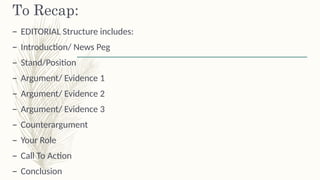
To Recap:
– EDITORIAL Structure includes:
– Introduction/ News Peg
– Stand/Position
– Argument/ Evidence 1
– Argument/ Evidence 2
– Argument/ Evidence 3
– Counterargument
– Your Role
– Call To Action
– Conclusion
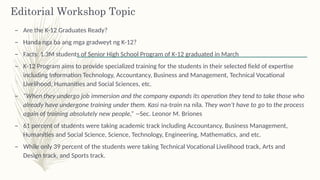
Editorial Workshop Topic
– Are the K-12 Graduates Ready?
– Handa nga ba ang mga gradweyt ng K-12?
– Facts: 1.3M students of Senior High School Program of K-12 graduated in March
– K-12 Program aims to provide specialized training for the students in their selected field of expertise
including Information Technology, Accountancy, Business and Management, Technical Vocational
Livelihood, Humanities and Social Sciences, etc.
– “When they undergo job immersion and the company expands its operation they tend to take those who
already have undergone training under them. Kasi na-train na nila. They won’t have to go to the process
again of training absolutely new people,” --Sec. Leonor M. Briones
– 61 percent of students were taking academic track including Accountancy, Business Management,
Humanities and Social Science, Science, Technology, Engineering, Mathematics, and etc.
– While only 39 percent of the students were taking Technical Vocational Livelihood track, Arts and
Design track, and Sports track.
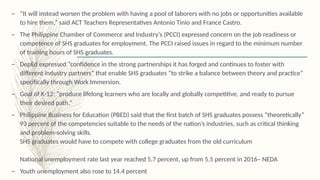
– “It will instead worsen the problem with having a pool of laborers with no jobs or opportunities available
to hire them,” said ACT Teachers Representatives Antonio Tinio and France Castro.
– The Philippine Chamber of Commerce and Industry’s (PCCI) expressed concern on the job readiness or
competence of SHS graduates for employment. The PCCI raised issues in regard to the minimum number
of training hours of SHS graduates.
– DepEd expressed “confidence in the strong partnerships it has forged and continues to foster with
different industry partners” that enable SHS graduates “to strike a balance between theory and practice”
specifically through Work Immersion.
– Goal of K-12: “produce lifelong learners who are locally and globally competitive, and ready to pursue
their desired path.”
– Philippine Business for Education (PBED) said that the first batch of SHS graduates possess “theoretically”
93 percent of the competencies suitable to the needs of the nation’s industries, such as critical thinking
and problem-solving skills.
SHS graduates would have to compete with college graduates from the old curriculum
National unemployment rate last year reached 5.7 percent, up from 5.5 percent in 2016– NEDA
– Youth unemployment also rose to 14.4 percent
Feature Writing
– Feature article digs deeper(news only provides facts)
– Feature is the soul of the newspaper
– In-depth focus on a certain person or topic
– It can be ANY topic under the sun
– Usually, feature articles can be found in lifestyle sections or feature pages
of newspapers, magazines, online blogs, etc.
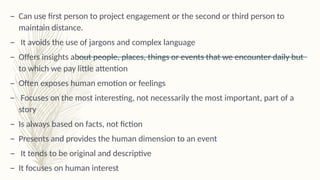
– Can use first person to project engagement or the second or third person to
maintain distance.
– It avoids the use of jargons and complex language
– Offers insights about people, places, things or events that we encounter daily but
to which we pay little attention
– Often exposes human emotion or feelings
– Focuses on the most interesting, not necessarily the most important, part of a
story
– Is always based on facts, not fiction
– Presents and provides the human dimension to an event
– It tends to be original and descriptive
– It focuses on human interest
QUALITIES OF FEATURES 1
– 1. It contains an introduction, body, and conclusion.
– 2. The contents are based on the writer’s development of ideas.
– 3. Can have complex narration or presentation, if “suspended interest structure is
used.”
– 4. It often reflects the personality, tendencies, beliefs, and aspirations of the writer.
– 5. It includes quotations from principal characters, experts, and variety of sources. 6.
– It can use the elements of fiction and informal writing.
– 7. It can use photographs, charts, sidebars or boxes, drawings, diagrams, among
others to reinforce the message and bring life and color to the subject.
Types of Features
– 1. NEWS BEHIND THE NEWS STORIES An in-depth look at the stories behind a current news.
– 2. PERSONALITY SKETCH/PROFILE Profile stories of the rich and the famous personalities.
– 3. SCIENCE AND TECHNOLOGY STORIES They concentrate on the latest advancement in science and technology
– 4. HUMAN APPEAL STORIES They are also called “concerned stories”, highlight the dramatic condition and
experiences of certain groups of people. They are written using heart-piercing presentations which evoke
emotional responses the readers.
– 5. HISTORICAL AND CULTURAL FEATURES Historical events and sites can provide readers a sense of identity. By
comparing the present to the past, they can see how time has changed their environment, culture, values and
perspectives.
– 6. HOW-TO AND WHAT-TO-DO FEATURES They are educational in essence. They provide knowledge about
process or activity.
– 7. LIFE STYE FEATURES Changing fashion trends and life-styles makes an interesting reading.
– 8. ENTERTAINMENT FEATURES Movie stars, pop singers, and show business events are common subjects.
– 9. . TRAVEL FEATURES These features highlight the beauty of interacting with people and places. Very descriptive
WAYS TO DEVELOP THE LEAD
– 1. Question lead asks the reader’s questions which the article will try to explore and
discuss.
– 2. Startling statements or exclamation leads to compel attention
– 3. Striking statement lead is enticing piece of information in a short punchy format.
– 4. Descriptive lead can draw the reader into the story by creating a strong image in his or
her mind. The words are colorful and concrete
– 5. Summary lead sums up the general topic of the story
– 6. Anecdotal lead relies on a conversational tone to create an intimacy between the
reader, the writer and the characters in the article. It is loaded with specific details..
– 7. Quotation lead relies on an arresting quote.
– 8. Contrast lead, the writer sets off his subject with two apparently contradictory pieces
of information. This is to emphasize two contending ideas or events.
Basic Structure
Introduction.
– It should catch reader’s attention
– Should set the tone of the feature article
– Advice for beginners: Consider the ‘who’, ‘what’, ‘where’, ‘why’ and ‘how’
Body
– What is the “filling” of the article? Is it a quote, a scenery, a revelation, a realization, etc.
– Try to have an interesting “subhead” after four or five paragraphs
– Use descriptive language to tickle the mind of your reader (especially in this age that readers are dwindling)
– You can add your own opinion BUT it will be stronger if it is backed by an expert, a study or even of popular
culture
Conclusion
– Tie the entire article well together. Don’t leave your reader hanging.
– Do not “Editorialize” the topic or “Sermonize” your reader
– As much as possible, have an interesting conclusion that makes your readers think (or if it is a travel piece, makes
– In competitions, do not afraid to “go local”
– Make your handwriting legible
– Improve the simple narration strategy by magnifying the character of a person or an
event. Instead of saying that Pedro is happy, sad or angry try to reconstruct the
sentence by saying that, “Pedro was so happy that he kissed the forehead and
cheeks of Mario and hugged him tight.”
– Avoid using ambiguous modifiers such as “tall,” “short,” “fat,” “thin.”
– Animate verbs and work for sounds. Add color to the actions of the characters.
Instead of “drank quickly,” write “gulped,” walked quietly – tiptoed. 4. Use the
active voice.
– Avoid cliches by reconstructing them.
– Play with figures of speech. a. simile b. metaphor c. personification
– Vary sentence length. This is to emphasize thought.
How do you end?
– Tie up your closing sentence with your opening paragraph.
– Everybody Belongs
Atasha Delle L. Sucgang, Grade 7
NSPC 2018 Qualifier, Feature Writing
In the past, children with disabilities, children belonging to ethnic groups,
and even Muslim children have been at the receiving end of discrimination and
marginalization in regular schools. They suffered because of their differences and
special needs.
But now, because of inclusive education implemented in many schools, these
barriers between normal children and children with special needs have been
gradually taken down.
Inclusive Education is one of the pillars of ASEAN Integration. It is a ray of
light that gives the youth opportunity to reach for their dreams.
Not normal, but special
Ten-year-old Kian has been diagnosed with autism. His speech was impaired and he is easily
triggered to become violent and aggressive. His parents could not afford therapy so he was enrolled in
a private school in Altavas where inclusive education is implemented. He started studying in here
when he was in Preparatory.
Back then, Kian could not talk well. He can’t also read, write, and focus on what he is doing. He
would just run around, play, and get the attention of anyone. Kian could not do anything but play.
But Kian’s integration to a regular school has helped him behave normally despite his special
needs. He was given tasks and expectations just like a normal student. As years pass by, Kian has
shown maturity, both emotionally and mentally.
At school, he can now read well, speaks clearly enough to be understood by everybody, and
obeys if he is told to do things
Kian’s story has inspired many parents to enrol their children with special needs in a regular
school, where their acceptance has opened doors to discovering their hidden potentials.
Minority Report
As an Ati, Boknoy has dark skin, flat nose, and kinky hair. Boknoy is a kind-
hearted boy, but because of this physical looks, he is being bullied at school. As a
result, he has become bashful and developed inferiority complex.
Boknoy transferred to a public elementary school where Atis and other ethnic
groups, children with disabilities, and normal children, learn together. The school
became his sanctuary.
Boknoy felt alive again, and just realized how fun learning in school is. He has
After five years in that school, Boknoy will be graduating from elementary this
March. He is now confident and can mingle with anyone. You can now see the real
smile on Boknoy’s face.
A smile that you couldn’t see before.
Out of school, but not out of hope
Alvin is a 17 year old teenager. He only finished Grade 2 due to poverty. His
mother is a labandera and his father is a kainginero. They can’t afford sending
Alvin to school so they just took Alvin to the kaingin and work with his father to fill
their stomach at least two times a day.
Alvin dreamed to be a seaman. But because of lack of money, Alvin said
goodbye to his dreams.
The Alternative Learning System or ALS gave him another shot at reaching
for his dream. He enrolled in ALS and passed the examination that allowed him to
enrol in high school.
Now, Alvin is in his 4th
year in high school and will be graduating with
honors. Inclusive Education and ALS was Alvin’s only hope to unshackle their
family from poverty. Inclusion and ALS had helped many lives through education
Kian, Boknoy, and Alvin are just some of the youth who benefited
from Inclusive Education. Thousands more are given a bright ray of hope to
succeed.
Every child in this world has the right to be educated. Normal children,
those with disabilities, minorities, Muslims, and even those who experience
poverty should learn together to make the world’s future better and brighter.
Integrating them in regular schools that foster acceptance, respect and
equality will mean that no one will be left behind.
In our quest for a better life and better future, everybody belongs.
Thank You!
Editorial and Feature Writing Lecture.pptx

Editorial and Feature Writing Lecture.pptx

  • 1.
    EDITORIAL WRITING / FEATURE WRITING JONELL SEGADORGREGORIO Echelon Development School Champion (Coach) Editorial Writing English Elementary (NSPC 2018, Dumaguete City)
  • 2.
    EDITORIAL WRITING – Aneditorial is an article that presents the newspaper's opinion on an issue. It is considered the voice of the newspaper. It is the official stand of editorial board on a particular issue. Thus, it is usually unsigned or carries no byline. – It can be on any topic, but it should be relevant to an issue that is being talked about in society in general. It is a reaction to a news event or issue. – It should be backed up with facts, data, and/ or statistics – It can offer an solution to solve the problem mentioned earlier – It should be “memorable” especially in its concluding part
  • 3.
    A. It isan article that expresses opinion – It is an opinion, yes… but NOT your own opinion (Unless you are a columnist). – Avoid using “I” or “Me” in writing the editorial š – These types of editorials usually have no bylines and are attributed to a statement coming from the newspaper/ campus paper itself. – An editorial is not necessarily written by the Editor-in-Chief
  • 4.
    B. It canbe on any topic, but it should be relevant to an issue that is being talked about in society in general – The topic chosen can be or not be related to the front page of the newspaper. š – Best topics are those that are current issues in society. If the topic is current, readers will be interested to read it since it grasps their attention.
  • 5.
    C. It shouldbe backed up with relevant facts, data, and/ or statistics š – Make sure to use the most recent information. š – In some cases, you can use older information as sources to help prove your case (e.g. historical data). š – Use statistics to help prove your argument. (e.g. number of typhoon victims if you are writing a piece on natural disasters, SWS survey numbers when you are writing about elections, etc.) š – Avoid “hearsays” when citing a number… it might be wrong and will ruin the integrity of the piece. Err on the side of caution.
  • 6.
    D. It canoffer a solution to solve the problem mentioned earlier š – You can’t be on both sides when writing an editorial piece. The purpose for the editorial is to give strong opinion, specifically, the newspaper’s opinion. š – Make a strong resolve with your solution/ opinion, otherwise, readers will not be convinced to side on your point of view – Sometimes, it is wise to put a “counterargument (giving the other side)” as you are š making your own argument stronger. Only one paragraph is needed. After you state the other side, you must then refute it. In other words, give reasons showing why that side is not valid. – What do you propose to solve the issue? This should be one paragraph. Provide some š options to fix the problem. Do not use “deux ex machina” to resolve the problem at hand.
  • 7.
    E. It shouldbe “memorable” especially in its title and concluding part š – The first step is to pick a headline that grabs attention. Otherwise, you can finish the entire editorial and pick a line or two and transform it into a catchy title. š – The title can be a question, a statement, even a name or a parody of a certain issue. š – If you grab the reader’s attention with your title and opening statement, then they will be inclined to keep reading (otherwise, they will jump to sports for guys or entertainment for ladies). – Tip: State the topic you will be discussing in one or two opening sentences. As much as š possible, make your editorial “memorable” but not “controversial”
  • 8.
    – Make sureyour strongest argument is left for last. Do not also become passive in the arguments that come before the strongest. – The conclusion should be able to “tie up” all your arguments so that it will š become a “recap” to the entire piece. š – Your conclusion should also have a few solutions you think would help with the issue at hand. It would be great if you could get the reader to engage in asking him or herself questions on how they stand on a particular issue. š – Tip: It should appeal to the emotion or the intellect or should make the reader act on something. Do you want them to rise up in protest, post an FB comment, write government officials, stage a walkout, etc. Then that editorial should convey that.
  • 9.
    NSPC TIPS forEDITORIAL WRITING – 1. Make your handwriting clear and legible. – 2. Create a catchy title and opening statement. It spells the difference between your piece being read by the judges or not. – 3. Do not wander off the topic. It is usually the pitfall of editorial writers – 4. Cite some relevant data/ personality – 5. Appeal to emotions, to the community, or to the family unit. But avoid melodrama. – 6. End with a striking statement that will be remembered by the judges.
  • 10.
    Editorial Sample INTRODUCTION/NEWS PEG TheASEAN Integration envisions a stronger, more united and more successful Southeast Asia. The ASEAN Summit 2017 being held in Manila under the chairmanship of the Philippines is a perfect opportunity to iron out the goals and visions of ASEAN Integration towards a caring and sharing society. STAND/POSITION Inclusive education in Southeast Asia is crucial towards the realization of ASEAN Integration. Comprehensive education provides a powerful platform for identity formation, raising cultural awareness and building regional affinity. We believe that it is essential for ASEAN, and the Philippines in particular, to invest on inclusive education— education that gives access to all, both the normal and special learners.
  • 11.
    ARGUMENT/EVIDENCE 1 It islamentable to think that 93-150 million children in the world have disabilities. This puts them at a disadvantage to the opportunities given to other learners. They suffer psychological burdens such as bullying and discrimination in schools. Under inclusive education, they will be given equal opportunities to learn and excel. They will be provided with physical access to learning and a more sensitive approach to teaching. ARGUMENT/EVIDENCE 2 It is imperative that ASEAN countries invest on people’s education. Part of that is increasing the number of teachers who will teach all kinds of learners. It is estimated that 6.26 million teachers are needed in order to achieve universal primary and secondary education in the ASEAN region.
  • 12.
    ARGUMENT/EVIDENCE 3 A well-educatedcitizenry redounds to more skilled workers. According to the Asian Development Bank, the ASEAN Economic Community will provide 14 million jobs, 3.1 million of which are available for Filipinos. As such, the government needs to invest in world-class skills education if we want to benefit from the expansion of markets in the region. Jobs in information technology and business process outsourcing (BPO) can be lucrative for physically-disabled, yet highly-skilled individuals. COUNTERARGUMENT Although other people would say that special children have special needs, and thus, should be sent to special schools, studies have shown that special children in regular schools can behave and learn like a normal learner would, given the access and sensitivity to their needs.
  • 13.
    YOUR ROLE As campusjournalists, we have great role in advancing inclusive education. We have the power to write and write about the plight of the physically-handicapped, the marginalized, the minority and the special children so they can gain acceptance in society. The social media such as Facebook, Youtube and Twitter can be used as platform to share their struggles and triumphs, and to show how similar they are to normal learners. We can act as their mouthpiece and their advocate so they can that they belong in this society; that they too, are productive members of our community in its quest for a prosperous ASEAN.
  • 14.
    CALL TO ACTION/SOLUTION Itis therefore crucial that governments in the ASEAN region work together for the integration, and inclusion, of all learners in our education system. They must make sure that there is no weak link among our citizens, that everyone is treated with sensitivity and equality to opportunities. CONCLUSION After all, the ASEAN Integration envisions to uplift the lives of every citizen in the region. This is a vision that everyone shares and aspires for together. In the road to progress and better future, no one should be left behind.
  • 15.
    To Recap: – EDITORIALStructure includes: – Introduction/ News Peg – Stand/Position – Argument/ Evidence 1 – Argument/ Evidence 2 – Argument/ Evidence 3 – Counterargument – Your Role – Call To Action – Conclusion
  • 16.
    Editorial Workshop Topic –Are the K-12 Graduates Ready? – Handa nga ba ang mga gradweyt ng K-12? – Facts: 1.3M students of Senior High School Program of K-12 graduated in March – K-12 Program aims to provide specialized training for the students in their selected field of expertise including Information Technology, Accountancy, Business and Management, Technical Vocational Livelihood, Humanities and Social Sciences, etc. – “When they undergo job immersion and the company expands its operation they tend to take those who already have undergone training under them. Kasi na-train na nila. They won’t have to go to the process again of training absolutely new people,” --Sec. Leonor M. Briones – 61 percent of students were taking academic track including Accountancy, Business Management, Humanities and Social Science, Science, Technology, Engineering, Mathematics, and etc. – While only 39 percent of the students were taking Technical Vocational Livelihood track, Arts and Design track, and Sports track.
  • 17.
    – “It willinstead worsen the problem with having a pool of laborers with no jobs or opportunities available to hire them,” said ACT Teachers Representatives Antonio Tinio and France Castro. – The Philippine Chamber of Commerce and Industry’s (PCCI) expressed concern on the job readiness or competence of SHS graduates for employment. The PCCI raised issues in regard to the minimum number of training hours of SHS graduates. – DepEd expressed “confidence in the strong partnerships it has forged and continues to foster with different industry partners” that enable SHS graduates “to strike a balance between theory and practice” specifically through Work Immersion. – Goal of K-12: “produce lifelong learners who are locally and globally competitive, and ready to pursue their desired path.” – Philippine Business for Education (PBED) said that the first batch of SHS graduates possess “theoretically” 93 percent of the competencies suitable to the needs of the nation’s industries, such as critical thinking and problem-solving skills. SHS graduates would have to compete with college graduates from the old curriculum National unemployment rate last year reached 5.7 percent, up from 5.5 percent in 2016– NEDA – Youth unemployment also rose to 14.4 percent

  • 18.
    Feature Writing – Featurearticle digs deeper(news only provides facts) – Feature is the soul of the newspaper – In-depth focus on a certain person or topic – It can be ANY topic under the sun – Usually, feature articles can be found in lifestyle sections or feature pages of newspapers, magazines, online blogs, etc.
  • 19.
    – Can usefirst person to project engagement or the second or third person to maintain distance. – It avoids the use of jargons and complex language – Offers insights about people, places, things or events that we encounter daily but to which we pay little attention – Often exposes human emotion or feelings – Focuses on the most interesting, not necessarily the most important, part of a story – Is always based on facts, not fiction – Presents and provides the human dimension to an event – It tends to be original and descriptive – It focuses on human interest
  • 20.
    QUALITIES OF FEATURES1 – 1. It contains an introduction, body, and conclusion. – 2. The contents are based on the writer’s development of ideas. – 3. Can have complex narration or presentation, if “suspended interest structure is used.” – 4. It often reflects the personality, tendencies, beliefs, and aspirations of the writer. – 5. It includes quotations from principal characters, experts, and variety of sources. 6. – It can use the elements of fiction and informal writing. – 7. It can use photographs, charts, sidebars or boxes, drawings, diagrams, among others to reinforce the message and bring life and color to the subject.
  • 21.
    Types of Features –1. NEWS BEHIND THE NEWS STORIES An in-depth look at the stories behind a current news. – 2. PERSONALITY SKETCH/PROFILE Profile stories of the rich and the famous personalities. – 3. SCIENCE AND TECHNOLOGY STORIES They concentrate on the latest advancement in science and technology – 4. HUMAN APPEAL STORIES They are also called “concerned stories”, highlight the dramatic condition and experiences of certain groups of people. They are written using heart-piercing presentations which evoke emotional responses the readers. – 5. HISTORICAL AND CULTURAL FEATURES Historical events and sites can provide readers a sense of identity. By comparing the present to the past, they can see how time has changed their environment, culture, values and perspectives. – 6. HOW-TO AND WHAT-TO-DO FEATURES They are educational in essence. They provide knowledge about process or activity. – 7. LIFE STYE FEATURES Changing fashion trends and life-styles makes an interesting reading. – 8. ENTERTAINMENT FEATURES Movie stars, pop singers, and show business events are common subjects. – 9. . TRAVEL FEATURES These features highlight the beauty of interacting with people and places. Very descriptive
  • 22.
    WAYS TO DEVELOPTHE LEAD – 1. Question lead asks the reader’s questions which the article will try to explore and discuss. – 2. Startling statements or exclamation leads to compel attention – 3. Striking statement lead is enticing piece of information in a short punchy format. – 4. Descriptive lead can draw the reader into the story by creating a strong image in his or her mind. The words are colorful and concrete – 5. Summary lead sums up the general topic of the story – 6. Anecdotal lead relies on a conversational tone to create an intimacy between the reader, the writer and the characters in the article. It is loaded with specific details.. – 7. Quotation lead relies on an arresting quote. – 8. Contrast lead, the writer sets off his subject with two apparently contradictory pieces of information. This is to emphasize two contending ideas or events.
  • 23.
    Basic Structure Introduction. – Itshould catch reader’s attention – Should set the tone of the feature article – Advice for beginners: Consider the ‘who’, ‘what’, ‘where’, ‘why’ and ‘how’ Body – What is the “filling” of the article? Is it a quote, a scenery, a revelation, a realization, etc. – Try to have an interesting “subhead” after four or five paragraphs – Use descriptive language to tickle the mind of your reader (especially in this age that readers are dwindling) – You can add your own opinion BUT it will be stronger if it is backed by an expert, a study or even of popular culture Conclusion – Tie the entire article well together. Don’t leave your reader hanging. – Do not “Editorialize” the topic or “Sermonize” your reader – As much as possible, have an interesting conclusion that makes your readers think (or if it is a travel piece, makes
  • 24.
    – In competitions,do not afraid to “go local” – Make your handwriting legible – Improve the simple narration strategy by magnifying the character of a person or an event. Instead of saying that Pedro is happy, sad or angry try to reconstruct the sentence by saying that, “Pedro was so happy that he kissed the forehead and cheeks of Mario and hugged him tight.” – Avoid using ambiguous modifiers such as “tall,” “short,” “fat,” “thin.” – Animate verbs and work for sounds. Add color to the actions of the characters. Instead of “drank quickly,” write “gulped,” walked quietly – tiptoed. 4. Use the active voice. – Avoid cliches by reconstructing them. – Play with figures of speech. a. simile b. metaphor c. personification – Vary sentence length. This is to emphasize thought.
  • 25.
    How do youend? – Tie up your closing sentence with your opening paragraph.
  • 26.
    – Everybody Belongs AtashaDelle L. Sucgang, Grade 7 NSPC 2018 Qualifier, Feature Writing In the past, children with disabilities, children belonging to ethnic groups, and even Muslim children have been at the receiving end of discrimination and marginalization in regular schools. They suffered because of their differences and special needs. But now, because of inclusive education implemented in many schools, these barriers between normal children and children with special needs have been gradually taken down. Inclusive Education is one of the pillars of ASEAN Integration. It is a ray of light that gives the youth opportunity to reach for their dreams.
  • 27.
    Not normal, butspecial Ten-year-old Kian has been diagnosed with autism. His speech was impaired and he is easily triggered to become violent and aggressive. His parents could not afford therapy so he was enrolled in a private school in Altavas where inclusive education is implemented. He started studying in here when he was in Preparatory. Back then, Kian could not talk well. He can’t also read, write, and focus on what he is doing. He would just run around, play, and get the attention of anyone. Kian could not do anything but play. But Kian’s integration to a regular school has helped him behave normally despite his special needs. He was given tasks and expectations just like a normal student. As years pass by, Kian has shown maturity, both emotionally and mentally. At school, he can now read well, speaks clearly enough to be understood by everybody, and obeys if he is told to do things Kian’s story has inspired many parents to enrol their children with special needs in a regular school, where their acceptance has opened doors to discovering their hidden potentials.
  • 28.
    Minority Report As anAti, Boknoy has dark skin, flat nose, and kinky hair. Boknoy is a kind- hearted boy, but because of this physical looks, he is being bullied at school. As a result, he has become bashful and developed inferiority complex. Boknoy transferred to a public elementary school where Atis and other ethnic groups, children with disabilities, and normal children, learn together. The school became his sanctuary. Boknoy felt alive again, and just realized how fun learning in school is. He has After five years in that school, Boknoy will be graduating from elementary this March. He is now confident and can mingle with anyone. You can now see the real smile on Boknoy’s face. A smile that you couldn’t see before.
  • 29.
    Out of school,but not out of hope Alvin is a 17 year old teenager. He only finished Grade 2 due to poverty. His mother is a labandera and his father is a kainginero. They can’t afford sending Alvin to school so they just took Alvin to the kaingin and work with his father to fill their stomach at least two times a day. Alvin dreamed to be a seaman. But because of lack of money, Alvin said goodbye to his dreams. The Alternative Learning System or ALS gave him another shot at reaching for his dream. He enrolled in ALS and passed the examination that allowed him to enrol in high school. Now, Alvin is in his 4th year in high school and will be graduating with honors. Inclusive Education and ALS was Alvin’s only hope to unshackle their family from poverty. Inclusion and ALS had helped many lives through education
  • 30.
    Kian, Boknoy, andAlvin are just some of the youth who benefited from Inclusive Education. Thousands more are given a bright ray of hope to succeed. Every child in this world has the right to be educated. Normal children, those with disabilities, minorities, Muslims, and even those who experience poverty should learn together to make the world’s future better and brighter. Integrating them in regular schools that foster acceptance, respect and equality will mean that no one will be left behind. In our quest for a better life and better future, everybody belongs.
  • 31.