The
structure of
academic
text
Q1 – Week 1
E n g l i s h f o r
A c a d e m i c a n d
P r o f e s s i o n a l
P u r p o s e s
Teacher Loleth C. Apordo
1. What is the easiest writing assignment
you have done so far?
2. How about the most difficult writing
assignment you have done?
3. Based on your answer, what do you think
is academic writing and its differences from
other kinds of writing?
___________________________________________________________
_________
ACTIVITY 1
A n s w e r t h e f o l l o w i n g q u e s t i o n s .
The learner will be able to:
• determines the structure of a
specific academic text
• differentiates language used in
academic texts from various academic
texts
• explains the specific ideas
contained in various academic texts
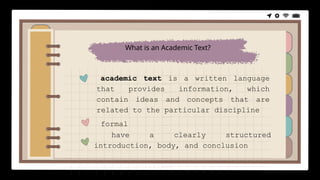
academic text is a written language
that provides information, which
contain ideas and concepts that are
related to the particular discipline
formal
What is an Academic Text?
have a clearly structured
introduction, body, and conclusion
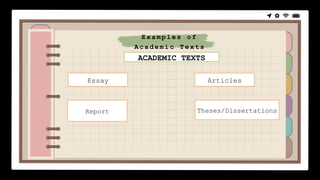
E x a m p l e s o f
A c a d e m i c T e x t s
ACADEMIC TEXTS
Essay Articles
Theses/Dissertations
Report
TYPES OF ACADEMIC TEXTS
• Descriptive – provides facts and information
- identify, report, record, summarize,
define
• Analytical – organize facts and information into
categories, parts, , groups, parts, types o
relationship
- analyze, compare, contrast, relate, &
examine
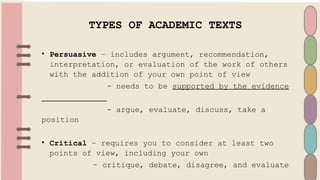
TYPES OF ACADEMIC TEXTS
• Persuasive – includes argument, recommendation,
interpretation, or evaluation of the work of others
with the addition of your own point of view
- needs to be supported by the evidence
- argue, evaluate, discuss, take a
position
• Critical – requires you to consider at least two
points of view, including your own
- critique, debate, disagree, and evaluate
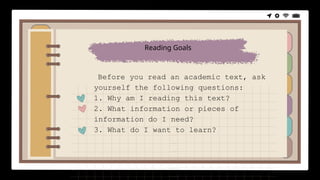
Before you read an academic text, ask
yourself the following questions:
1. Why am I reading this text?
2. What information or pieces of
information do I need?
3. What do I want to learn?
Reading Goals
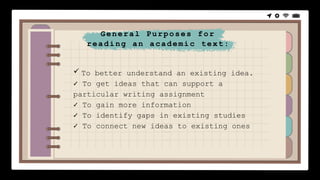
General Purposes for
reading an academic text:
 To better understand an existing idea.
✓ To get ideas that can support a
particular writing assignment
✓ To gain more information
✓ To identify gaps in existing studies
✓ To connect new ideas to existing ones
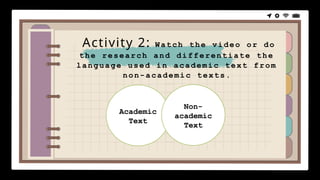
Activity 2: Watch the video or do
the research and differentiate the
language used in academic text from
non-academic texts.
Academic
Text
Non-
academic
Text
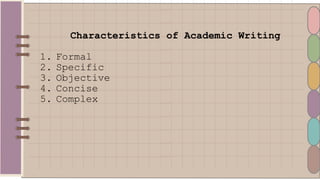
Characteristics of Academic Writing
1. Formal
2. Specific
3. Objective
4. Concise
5. Complex
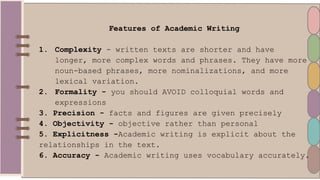
Features of Academic Writing
1. Complexity - written texts are shorter and have
longer, more complex words and phrases. They have more
noun-based phrases, more nominalizations, and more
lexical variation.
2. Formality - you should AVOID colloquial words and
expressions
3. Precision - facts and figures are given precisely
4. Objectivity - objective rather than personal
5. Explicitness -Academic writing is explicit about the
relationships in the text.
6. Accuracy - Academic writing uses vocabulary accurately.
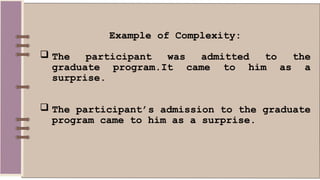
Example of Complexity:
 The participant was admitted to the
graduate program.It came to him as a
surprise.
 The participant’s admission to the graduate
program came to him as a surprise.
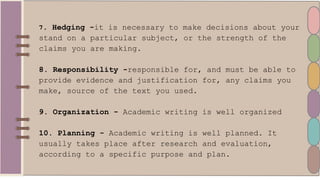
7. Hedging -it is necessary to make decisions about your
stand on a particular subject, or the strength of the
claims you are making.
8. Responsibility -responsible for, and must be able to
provide evidence and justification for, any claims you
make, source of the text you used.
9. Organization - Academic writing is well organized
10. Planning - Academic writing is well planned. It
usually takes place after research and evaluation,
according to a specific purpose and plan.
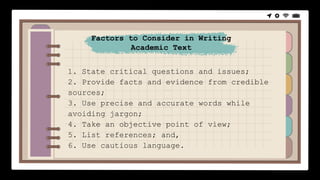
Factors to Consider in Writing
Academic Text
1. State critical questions and issues;
2. Provide facts and evidence from credible
sources;
3. Use precise and accurate words while
avoiding jargon;
4. Take an objective point of view;
5. List references; and,
6. Use cautious language.
Activity 3. Write T if the statement is true and F if
it is false. Write your answer in your ACTIVITY
NOTEBOOK.
_______1. Academic reading requires concentration and
comprehension.
_______2. Academic texts are completely different from non
academic texts in terms of structure, content and style.
_______3. Authors of academic texts usually present facts
to support their main argument.
_______4. Completing academic readings appears to a full
understanding of the texts.
_______5. Essentially, the language of academic texts is
precise and accurate.
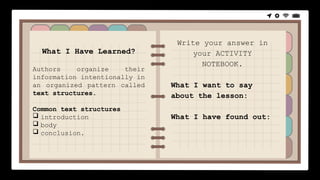
What I Have Learned?
Authors organize their
information intentionally in
an organized pattern called
text structures.
Common text structures
 introduction
 body
 conclusion.
Write your answer in
your ACTIVITY
NOTEBOOK.
What I want to say
about the lesson:
What I have found out:
A c t i v i t y 5 . U s i n g
a m i n i m u m o f 3 0 0
w o r d s a n d m a x i m u m
o f 5 0 0 w o r d s ,
w r i t e a n
a n a l y s i s o f t h e
w r i t i n g s t y l e a n d
o r g a n i z a t i o n o f
t h e a r t i c l e . W r i t e
y o u r
a n s w e r i n y o u r
E F A P P A C T I V I T Y
N O T E B O O K .
References
A. Books Sources
Barrot, Jessie and Sipacio, Philippe John. Communicate Today English for Academic &
Professional Purposes for Senior High School. Quezon City: C & E Publishing, Inc.,
2016.
Cruz, Rosalina, Laurel, Ma. Milagros, and Lucero, Adelaida. English for Academic and
Professional Purposes Reader Learner’s Material. Quezon City. Department of
Education. 2016
Cruz, Rosalina, Laurel, Ma. Milagros, and Lucero, Adelaida. English for Academic and
Professional Purposes Reader Teacher’s Guide. Quezon City. Department of
Education. 2016
Gabelo, Nerissa, and Geron, Cristina. Reading-Writing Connection for the 21st Century
Learners for Senior High School. Malabon City. Mutya Publishing House, Inc. 2016.
Valdez, P. English for the globalized classroom series. English for Academic &
Professional Purposes. The Phoenix Publishing House Inc. 2016
Oracion, G. M. & Dalona, I. F. English for Academic and Professional Purposes. Tagum
City. Diocesan Printing Press and Publishing, Inc. 2018
B. Online Sources
Google. “Writing Structure” Accessed June 28, 2020.
https://sokogskriv.no/en/writing/structure.html
Google. “Academic and Non Academic Texts” Accessed June 28, 2020.
http://www.screencast.com/users/Uni_Rdg_Library/folders/Study%20Advice/me
dia/898c4360-f86d-4808-812a-758d4ef4ac02
Google. “Covid 19 Statement” Accessed June 28, 2020.
https://www.unicef.org/philippines/press-releases/unicef-philippines-statement-
covid-19
Google. “Academic Texts” Accessed June 28, 2020.
http://online-
resources.elc.cityu.edu.hk/ELSS/Resource/Language%20Features%20of%20A
cademic%20Texts/part2/index.html

Academic Texts Structure (Academic Text and Non Academic Text)

  • 1.
    The structure of academic text Q1 –Week 1 E n g l i s h f o r A c a d e m i c a n d P r o f e s s i o n a l P u r p o s e s Teacher Loleth C. Apordo
  • 2.
    1. What isthe easiest writing assignment you have done so far? 2. How about the most difficult writing assignment you have done? 3. Based on your answer, what do you think is academic writing and its differences from other kinds of writing? ___________________________________________________________ _________ ACTIVITY 1 A n s w e r t h e f o l l o w i n g q u e s t i o n s .
  • 3.
    The learner willbe able to: • determines the structure of a specific academic text • differentiates language used in academic texts from various academic texts • explains the specific ideas contained in various academic texts
  • 4.
    academic text isa written language that provides information, which contain ideas and concepts that are related to the particular discipline formal What is an Academic Text? have a clearly structured introduction, body, and conclusion
  • 5.
    E x am p l e s o f A c a d e m i c T e x t s ACADEMIC TEXTS Essay Articles Theses/Dissertations Report
  • 6.
    TYPES OF ACADEMICTEXTS • Descriptive – provides facts and information - identify, report, record, summarize, define • Analytical – organize facts and information into categories, parts, , groups, parts, types o relationship - analyze, compare, contrast, relate, & examine
  • 7.
    TYPES OF ACADEMICTEXTS • Persuasive – includes argument, recommendation, interpretation, or evaluation of the work of others with the addition of your own point of view - needs to be supported by the evidence - argue, evaluate, discuss, take a position • Critical – requires you to consider at least two points of view, including your own - critique, debate, disagree, and evaluate
  • 8.
    Before you readan academic text, ask yourself the following questions: 1. Why am I reading this text? 2. What information or pieces of information do I need? 3. What do I want to learn? Reading Goals
  • 9.
    General Purposes for readingan academic text:  To better understand an existing idea. ✓ To get ideas that can support a particular writing assignment ✓ To gain more information ✓ To identify gaps in existing studies ✓ To connect new ideas to existing ones
  • 10.
    Activity 2: Watchthe video or do the research and differentiate the language used in academic text from non-academic texts. Academic Text Non- academic Text
  • 11.
    Characteristics of AcademicWriting 1. Formal 2. Specific 3. Objective 4. Concise 5. Complex
  • 12.
    Features of AcademicWriting 1. Complexity - written texts are shorter and have longer, more complex words and phrases. They have more noun-based phrases, more nominalizations, and more lexical variation. 2. Formality - you should AVOID colloquial words and expressions 3. Precision - facts and figures are given precisely 4. Objectivity - objective rather than personal 5. Explicitness -Academic writing is explicit about the relationships in the text. 6. Accuracy - Academic writing uses vocabulary accurately.
  • 13.
    Example of Complexity: The participant was admitted to the graduate program.It came to him as a surprise.  The participant’s admission to the graduate program came to him as a surprise.
  • 14.
    7. Hedging -itis necessary to make decisions about your stand on a particular subject, or the strength of the claims you are making. 8. Responsibility -responsible for, and must be able to provide evidence and justification for, any claims you make, source of the text you used. 9. Organization - Academic writing is well organized 10. Planning - Academic writing is well planned. It usually takes place after research and evaluation, according to a specific purpose and plan.
  • 15.
    Factors to Considerin Writing Academic Text 1. State critical questions and issues; 2. Provide facts and evidence from credible sources; 3. Use precise and accurate words while avoiding jargon; 4. Take an objective point of view; 5. List references; and, 6. Use cautious language.
  • 16.
    Activity 3. WriteT if the statement is true and F if it is false. Write your answer in your ACTIVITY NOTEBOOK. _______1. Academic reading requires concentration and comprehension. _______2. Academic texts are completely different from non academic texts in terms of structure, content and style. _______3. Authors of academic texts usually present facts to support their main argument. _______4. Completing academic readings appears to a full understanding of the texts. _______5. Essentially, the language of academic texts is precise and accurate.
  • 17.
    What I HaveLearned? Authors organize their information intentionally in an organized pattern called text structures. Common text structures  introduction  body  conclusion. Write your answer in your ACTIVITY NOTEBOOK. What I want to say about the lesson: What I have found out:
  • 18.
    A c ti v i t y 5 . U s i n g a m i n i m u m o f 3 0 0 w o r d s a n d m a x i m u m o f 5 0 0 w o r d s , w r i t e a n a n a l y s i s o f t h e w r i t i n g s t y l e a n d o r g a n i z a t i o n o f t h e a r t i c l e . W r i t e y o u r a n s w e r i n y o u r E F A P P A C T I V I T Y N O T E B O O K .
  • 19.
    References A. Books Sources Barrot,Jessie and Sipacio, Philippe John. Communicate Today English for Academic & Professional Purposes for Senior High School. Quezon City: C & E Publishing, Inc., 2016. Cruz, Rosalina, Laurel, Ma. Milagros, and Lucero, Adelaida. English for Academic and Professional Purposes Reader Learner’s Material. Quezon City. Department of Education. 2016 Cruz, Rosalina, Laurel, Ma. Milagros, and Lucero, Adelaida. English for Academic and Professional Purposes Reader Teacher’s Guide. Quezon City. Department of Education. 2016 Gabelo, Nerissa, and Geron, Cristina. Reading-Writing Connection for the 21st Century Learners for Senior High School. Malabon City. Mutya Publishing House, Inc. 2016. Valdez, P. English for the globalized classroom series. English for Academic & Professional Purposes. The Phoenix Publishing House Inc. 2016 Oracion, G. M. & Dalona, I. F. English for Academic and Professional Purposes. Tagum City. Diocesan Printing Press and Publishing, Inc. 2018 B. Online Sources Google. “Writing Structure” Accessed June 28, 2020. https://sokogskriv.no/en/writing/structure.html Google. “Academic and Non Academic Texts” Accessed June 28, 2020. http://www.screencast.com/users/Uni_Rdg_Library/folders/Study%20Advice/me dia/898c4360-f86d-4808-812a-758d4ef4ac02 Google. “Covid 19 Statement” Accessed June 28, 2020. https://www.unicef.org/philippines/press-releases/unicef-philippines-statement- covid-19 Google. “Academic Texts” Accessed June 28, 2020. http://online- resources.elc.cityu.edu.hk/ELSS/Resource/Language%20Features%20of%20A cademic%20Texts/part2/index.html

Editor's Notes

  • #17 It is important to understand text structure to empower you as a reader.