3i’s
Inquiries,
Investigation and
immersion
Brainstorming for
Research Topics
✗ A good researcher must carefully
choose a topic that is doable and
✗ significant to a certain discipline or
field. Many researchers find selecting a
✗ research topic a difficult task. Some do
it through brainstorming or by
✗ observing their surroundings.
Activity:
Taking into consideration your experiences from
your previous research subjects, decide whether
each sentence must be a criterion in choosing a
good research problem. On your ¼ sheet of paper,
write YES if the statement can be considered as a
criterion and NO if otherwise.
4
5
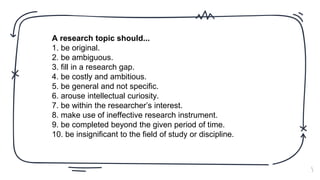
A research topic should...
1. be original.
2. be ambiguous.
3. fill in a research gap.
4. be costly and ambitious.
5. be general and not specific.
6. arouse intellectual curiosity.
7. be within the researcher’s interest.
8. make use of ineffective research instrument.
9. be completed beyond the given period of time.
10. be insignificant to the field of study or discipline.
✗ A common challenge when beginning to
write a research paper is
✗ determining how to narrow down your
topic. To assist you in the selection
✗ process, here are some guidelines given
by Baraceros
6
✗ 1. INTEREST IN THE
SUBJECT MATTER
7
8
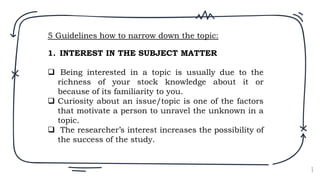
1. INTEREST IN THE SUBJECT MATTER
 Being interested in a topic is usually due to the
richness of your stock knowledge about it or
because of its familiarity to you.
 Curiosity about an issue/topic is one of the factors
that motivate a person to unravel the unknown in a
topic.
 The researcher’s interest increases the possibility of
the success of the study.
5 Guidelines how to narrow down the topic:
✗ 2. RICHNESS OF
AVAILABLE SOURCES OR
SUPPORTING EVIDENCES
9
10
2. RICHNESS OF AVAILABLE SOURCES OR
SUPPORTING EVIDENCES
 One of the things that you should do is to collect a
lot of information on your topic of interest.
 This enables you to find evidences that would
support your topic.
 You must ensure that your sources come from a
wide variety of literature such as books, journal,
periodicals, online articles, etc.
✗ 3. TIMELINESS AND
RELEVANCE OF THE
TOPIC
11
12
3. TIMELINESS AND RELEVANCE OF THE
TOPIC
 Your topic should be relevant and timely.
 A topic is relevant if it serves as an instrument
in improving the society or if it answers or
solves current issues which are some of the
reasons why research is conducted
✗ 4. LIMITATION OF THE
TOPIC
13
14
4. LIMITATIONS OF THE SUBJECT
 Aside from your interest, you must also
consider the significance of the topic in your
track and strand.
 Remember that research is conducted to
contribute something valuable to a particular
area or discipline.
✗ 5. PERSONAL RESOURCES
15
16
5. PERSONAL RESOURCES
 Prior to finalizing your chosen topic, you must
assess your research abilities as a student.
 You may do so by taking your financial capability,
health condition, personal qualifications and
trainings as a researcher, needed facilities and time
allotment into account.
 It is important that all of these aspects are
considered in order for you to guarantee the
accomplishment of your research.
✗ Now that you have learned the
considerations in formulating a
research
✗ problem, here are the steps
that will guide you trim down
your area of
✗ interest.
17
1. Focus on your track, strand or area of
specialization.
For Example: HUMSS
18
2. Recall the specific area, lesson or issue in
your respective field or strand that has piqued
or aroused your interest the most.
For Example: Public Speaking
19
3. Generate an unanswered question or an
unresolved problem from your chosen area or
lesson.
Why do people feel anxious when speaking in
public?
20
4. Assess the question or problem based on the five
guidelines stated above.
 I'm interested in the topic.
 There are available sources of data.
 It is timely and relevant.
 It will contribute to my strand.
 It is doable considering my personal resources.
21
5. Write your research problem.
 Factors Affecting the Speaking
Anxiety of Students
22
✗ LET’S HAVE A QUIZ!!
✗ ARE YOU READY?
23
24
1. The researcher’s interest increases the possibility
of the success of the study
2. Prior to finalizing your chosen topic, you must
assess your research abilities as a student.
3. Your topic should be relevant
4. Research is conducted to contribute something
valuable to a particular area or discipline.
5. One of the things that you should do is to collect a
lot of information on your topic of interest.
25
6. It consider the significance of the topic in your track and
strand.
7. You must ensure that your sources come from a wide
variety of literature such as books, journal, periodicals,
online articles, etc.
8. Curiosity about an issue/topic is one of the factors that
motivate a person to unravel the unknown in a topic
9. This enables you to find evidences that would support
your topic.
10. Prior to finalizing your chosen topic, you must assess
your research abilities as a student.
26
Test your wits and complete the paragraphs below by sharing
your learnings from the previous discussions. Write your answers on your
notebook. (15 points)
When deciding on a research topic, there are guidelines that we must
follow. These are ______________, ______________, ______________,
______________, and ______________. These guidelines must be considered
1. because __________________________________.
The research topic must be simple and specific enough for us to
accomplish it with consideration of our limitations and within the given
period of time. To attain this, first we have to ________________________ and
then ________________________. After this, we must ________________________
to be followed by ________________________. To complete the procedure, we
can now _______________________.
27
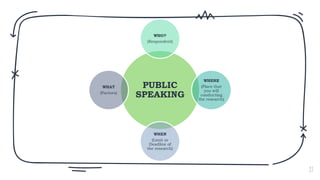
PUBLIC
SPEAKING
WHO?
(Respondent)
WHERE
(Place that
you will
conducting
the research)
WHEN
(Limit or
Deadline of
the research)
WHAT
(Factors)
28
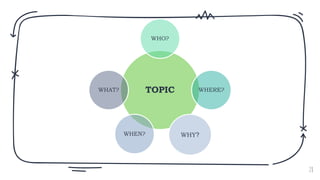
TOPIC
WHO?
WHERE?
WHEN?
WHAT?
WHY?

3I's.pptx

  • 1.
  • 2.
  • 3.
    ✗ A goodresearcher must carefully choose a topic that is doable and ✗ significant to a certain discipline or field. Many researchers find selecting a ✗ research topic a difficult task. Some do it through brainstorming or by ✗ observing their surroundings.
  • 4.
    Activity: Taking into considerationyour experiences from your previous research subjects, decide whether each sentence must be a criterion in choosing a good research problem. On your ¼ sheet of paper, write YES if the statement can be considered as a criterion and NO if otherwise. 4
  • 5.
    5 A research topicshould... 1. be original. 2. be ambiguous. 3. fill in a research gap. 4. be costly and ambitious. 5. be general and not specific. 6. arouse intellectual curiosity. 7. be within the researcher’s interest. 8. make use of ineffective research instrument. 9. be completed beyond the given period of time. 10. be insignificant to the field of study or discipline.
  • 6.
    ✗ A commonchallenge when beginning to write a research paper is ✗ determining how to narrow down your topic. To assist you in the selection ✗ process, here are some guidelines given by Baraceros 6
  • 7.
    ✗ 1. INTERESTIN THE SUBJECT MATTER 7
  • 8.
    8 1. INTEREST INTHE SUBJECT MATTER  Being interested in a topic is usually due to the richness of your stock knowledge about it or because of its familiarity to you.  Curiosity about an issue/topic is one of the factors that motivate a person to unravel the unknown in a topic.  The researcher’s interest increases the possibility of the success of the study. 5 Guidelines how to narrow down the topic:
  • 9.
    ✗ 2. RICHNESSOF AVAILABLE SOURCES OR SUPPORTING EVIDENCES 9
  • 10.
    10 2. RICHNESS OFAVAILABLE SOURCES OR SUPPORTING EVIDENCES  One of the things that you should do is to collect a lot of information on your topic of interest.  This enables you to find evidences that would support your topic.  You must ensure that your sources come from a wide variety of literature such as books, journal, periodicals, online articles, etc.
  • 11.
    ✗ 3. TIMELINESSAND RELEVANCE OF THE TOPIC 11
  • 12.
    12 3. TIMELINESS ANDRELEVANCE OF THE TOPIC  Your topic should be relevant and timely.  A topic is relevant if it serves as an instrument in improving the society or if it answers or solves current issues which are some of the reasons why research is conducted
  • 13.
    ✗ 4. LIMITATIONOF THE TOPIC 13
  • 14.
    14 4. LIMITATIONS OFTHE SUBJECT  Aside from your interest, you must also consider the significance of the topic in your track and strand.  Remember that research is conducted to contribute something valuable to a particular area or discipline.
  • 15.
    ✗ 5. PERSONALRESOURCES 15
  • 16.
    16 5. PERSONAL RESOURCES Prior to finalizing your chosen topic, you must assess your research abilities as a student.  You may do so by taking your financial capability, health condition, personal qualifications and trainings as a researcher, needed facilities and time allotment into account.  It is important that all of these aspects are considered in order for you to guarantee the accomplishment of your research.
  • 17.
    ✗ Now thatyou have learned the considerations in formulating a research ✗ problem, here are the steps that will guide you trim down your area of ✗ interest. 17
  • 18.
    1. Focus onyour track, strand or area of specialization. For Example: HUMSS 18
  • 19.
    2. Recall thespecific area, lesson or issue in your respective field or strand that has piqued or aroused your interest the most. For Example: Public Speaking 19
  • 20.
    3. Generate anunanswered question or an unresolved problem from your chosen area or lesson. Why do people feel anxious when speaking in public? 20
  • 21.
    4. Assess thequestion or problem based on the five guidelines stated above.  I'm interested in the topic.  There are available sources of data.  It is timely and relevant.  It will contribute to my strand.  It is doable considering my personal resources. 21
  • 22.
    5. Write yourresearch problem.  Factors Affecting the Speaking Anxiety of Students 22
  • 23.
    ✗ LET’S HAVEA QUIZ!! ✗ ARE YOU READY? 23
  • 24.
    24 1. The researcher’sinterest increases the possibility of the success of the study 2. Prior to finalizing your chosen topic, you must assess your research abilities as a student. 3. Your topic should be relevant 4. Research is conducted to contribute something valuable to a particular area or discipline. 5. One of the things that you should do is to collect a lot of information on your topic of interest.
  • 25.
    25 6. It considerthe significance of the topic in your track and strand. 7. You must ensure that your sources come from a wide variety of literature such as books, journal, periodicals, online articles, etc. 8. Curiosity about an issue/topic is one of the factors that motivate a person to unravel the unknown in a topic 9. This enables you to find evidences that would support your topic. 10. Prior to finalizing your chosen topic, you must assess your research abilities as a student.
  • 26.
    26 Test your witsand complete the paragraphs below by sharing your learnings from the previous discussions. Write your answers on your notebook. (15 points) When deciding on a research topic, there are guidelines that we must follow. These are ______________, ______________, ______________, ______________, and ______________. These guidelines must be considered 1. because __________________________________. The research topic must be simple and specific enough for us to accomplish it with consideration of our limitations and within the given period of time. To attain this, first we have to ________________________ and then ________________________. After this, we must ________________________ to be followed by ________________________. To complete the procedure, we can now _______________________.
  • 27.
    27 PUBLIC SPEAKING WHO? (Respondent) WHERE (Place that you will conducting theresearch) WHEN (Limit or Deadline of the research) WHAT (Factors)
  • 28.