An article that states the newspaper’s
stance on a particular issue.
It an opinionated news story- ideas are
presented as opinion.
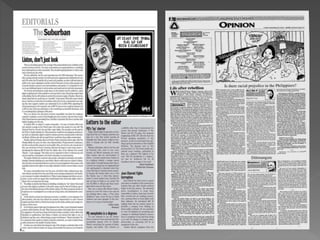
Editorials appear on the newspaper’s
editorial page, a page which includes
editorials, columns, opinion articles,
letters to the editor, reviews and
cartoons.
 The daily lives of students in the school—
their interaction with each other, with the
faculty, with the administration.
 Issues concerning classes, extracurricular
activities, jobs and after-school activities
 Also community, state, national and
international issues are of concern to the
well-informed student.
 Identify your purpose and audience
Explain or interpret the way the newspaper
covered a sensitive issue or controversial
event
Criticize constructively actions, decisions or
situations
Praise to commend people or organizations
for a job well done
Persuade to get readers immediately see the
solution and not the problem
 Organize your content into 3 parts-
INTRODUCTION (Editorial Lead)
contains the NEWSPEG with the reaction.
 It must contain enough sparks to urge
the readers read the whole article.
 It must be brief.
A newspeg is a brief statement about the news event
upon which the editorial is based or an existing
issue that needs to be solved right away.
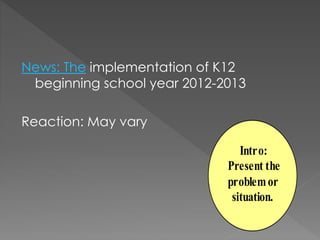
News: The implementation of K12
beginning school year 2012-2013
Reaction: May vary
Intro:
Present the
problemor
situation.
Sample 1
From Philippine Star
EDITORIAL - K to 12 for all
For millions of Filipinos, kindergarten and other
preparatory courses before first grade used to
give children with financial means an early
edge in academic achievements over their
underprivileged peers. With the enactment of
Republic Act 10533, kindergarten is now free
for all Filipinos and required for entry to first
grade.
Your arguments should be supported by
facts and logical reasoning
Position---Reason----Facts/Evidences---
Explanation
Hence, the content of your editorial must
be well-researched.
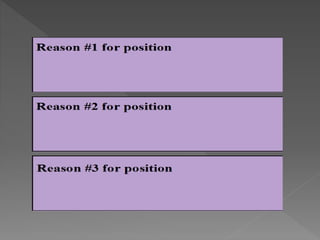
The BODY of the EDITORIAL NEEDS
FACTS.
Your opinions will be
baseless without support.
The ending sometimes called the
clincher, summarizes the editorial
stand.
Restatement of the stand of the editorial
Leave the reader thinking or push them
into action.
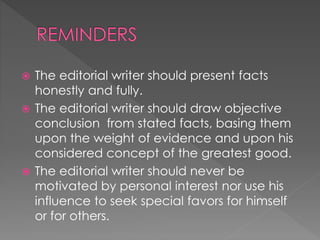
 The editorial writer should present facts
honestly and fully.
 The editorial writer should draw objective
conclusion from stated facts, basing them
upon the weight of evidence and upon his
considered concept of the greatest good.
 The editorial writer should never be
motivated by personal interest nor use his
influence to seek special favors for himself
or for others.
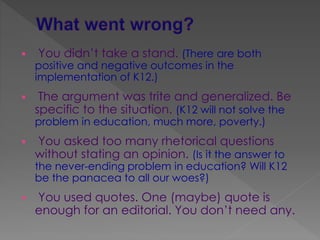
 You didn’t take a stand. (There are both
positive and negative outcomes in the
implementation of K12.)
 The argument was trite and generalized. Be
specific to the situation. (K12 will not solve the
problem in education, much more, poverty.)
 You asked too many rhetorical questions
without stating an opinion. (Is it the answer to
the never-ending problem in education? Will K12
be the panacea to all our woes?)
 You used quotes. One (maybe) quote is
enough for an editorial. You don’t need any.
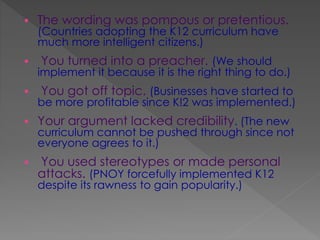
 The wording was pompous or pretentious.
(Countries adopting the K12 curriculum have
much more intelligent citizens.)
 You turned into a preacher. (We should
implement it because it is the right thing to do.)
 You got off topic. (Businesses have started to
be more profitable since K!2 was implemented.)
 Your argument lacked credibility. (The new
curriculum cannot be pushed through since not
everyone agrees to it.)
 You used stereotypes or made personal
attacks. (PNOY forcefully implemented K12
despite its rawness to gain popularity.)
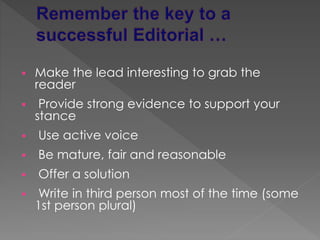
 Make the lead interesting to grab the
reader
 Provide strong evidence to support your
stance
 Use active voice
 Be mature, fair and reasonable
 Offer a solution
 Write in third person most of the time (some
1st person plural)
Pray.
I can do all things through Christ who
strengthens me.
Philippians 4:13

Editorial Writing

  • 2.
    An article thatstates the newspaper’s stance on a particular issue. It an opinionated news story- ideas are presented as opinion.
  • 3.
    Editorials appear onthe newspaper’s editorial page, a page which includes editorials, columns, opinion articles, letters to the editor, reviews and cartoons.
  • 5.
     The dailylives of students in the school— their interaction with each other, with the faculty, with the administration.  Issues concerning classes, extracurricular activities, jobs and after-school activities  Also community, state, national and international issues are of concern to the well-informed student.
  • 6.
     Identify yourpurpose and audience Explain or interpret the way the newspaper covered a sensitive issue or controversial event Criticize constructively actions, decisions or situations Praise to commend people or organizations for a job well done Persuade to get readers immediately see the solution and not the problem
  • 7.
     Organize yourcontent into 3 parts- INTRODUCTION (Editorial Lead) contains the NEWSPEG with the reaction.  It must contain enough sparks to urge the readers read the whole article.  It must be brief.
  • 8.
    A newspeg isa brief statement about the news event upon which the editorial is based or an existing issue that needs to be solved right away.
  • 9.
    News: The implementationof K12 beginning school year 2012-2013 Reaction: May vary Intro: Present the problemor situation.
  • 10.
    Sample 1 From PhilippineStar EDITORIAL - K to 12 for all For millions of Filipinos, kindergarten and other preparatory courses before first grade used to give children with financial means an early edge in academic achievements over their underprivileged peers. With the enactment of Republic Act 10533, kindergarten is now free for all Filipinos and required for entry to first grade.
  • 11.
    Your arguments shouldbe supported by facts and logical reasoning Position---Reason----Facts/Evidences--- Explanation Hence, the content of your editorial must be well-researched.
  • 13.
    The BODY ofthe EDITORIAL NEEDS FACTS. Your opinions will be baseless without support.
  • 14.
    The ending sometimescalled the clincher, summarizes the editorial stand. Restatement of the stand of the editorial Leave the reader thinking or push them into action.
  • 15.
     The editorialwriter should present facts honestly and fully.  The editorial writer should draw objective conclusion from stated facts, basing them upon the weight of evidence and upon his considered concept of the greatest good.  The editorial writer should never be motivated by personal interest nor use his influence to seek special favors for himself or for others.
  • 16.
     You didn’ttake a stand. (There are both positive and negative outcomes in the implementation of K12.)  The argument was trite and generalized. Be specific to the situation. (K12 will not solve the problem in education, much more, poverty.)  You asked too many rhetorical questions without stating an opinion. (Is it the answer to the never-ending problem in education? Will K12 be the panacea to all our woes?)  You used quotes. One (maybe) quote is enough for an editorial. You don’t need any.
  • 17.
     The wordingwas pompous or pretentious. (Countries adopting the K12 curriculum have much more intelligent citizens.)  You turned into a preacher. (We should implement it because it is the right thing to do.)  You got off topic. (Businesses have started to be more profitable since K!2 was implemented.)  Your argument lacked credibility. (The new curriculum cannot be pushed through since not everyone agrees to it.)  You used stereotypes or made personal attacks. (PNOY forcefully implemented K12 despite its rawness to gain popularity.)
  • 18.
     Make thelead interesting to grab the reader  Provide strong evidence to support your stance  Use active voice  Be mature, fair and reasonable  Offer a solution  Write in third person most of the time (some 1st person plural)
  • 19.
    Pray. I can doall things through Christ who strengthens me. Philippians 4:13