An editorial expressesthe newspaper's
opinion. It is the voice and stance of the paper.
It represents the editorial board's majority
vote, the newspaper's governing body.
Normally, an editorial is unsigned.
Editorial writers, like lawyers, aim to persuade
readers to agree with them. Editorials aim to
influence public opinion, stimulate critical
thinking, and prompt action.
3.
Editorials grow froman editor's and/or an
editorial board's focus on issues. They are
generally focused on issues that are
thought important to raise for
consideration by readers and are often
written to provoke conversation rather
than to represent a specific viewpoint.
4.
Editorials are writtenby the
newspaper's editor or the
editorial board, representing the
collective viewpoint of the
editorial team.
6.
Editorial comes inmany types.
The type of editorial that should be written will
depend on the writer's goals, including
whether they are to inform, interpret, critique,
praise, dispute, or entertain. Cruz 2010, cites
different types of editorials.
7.
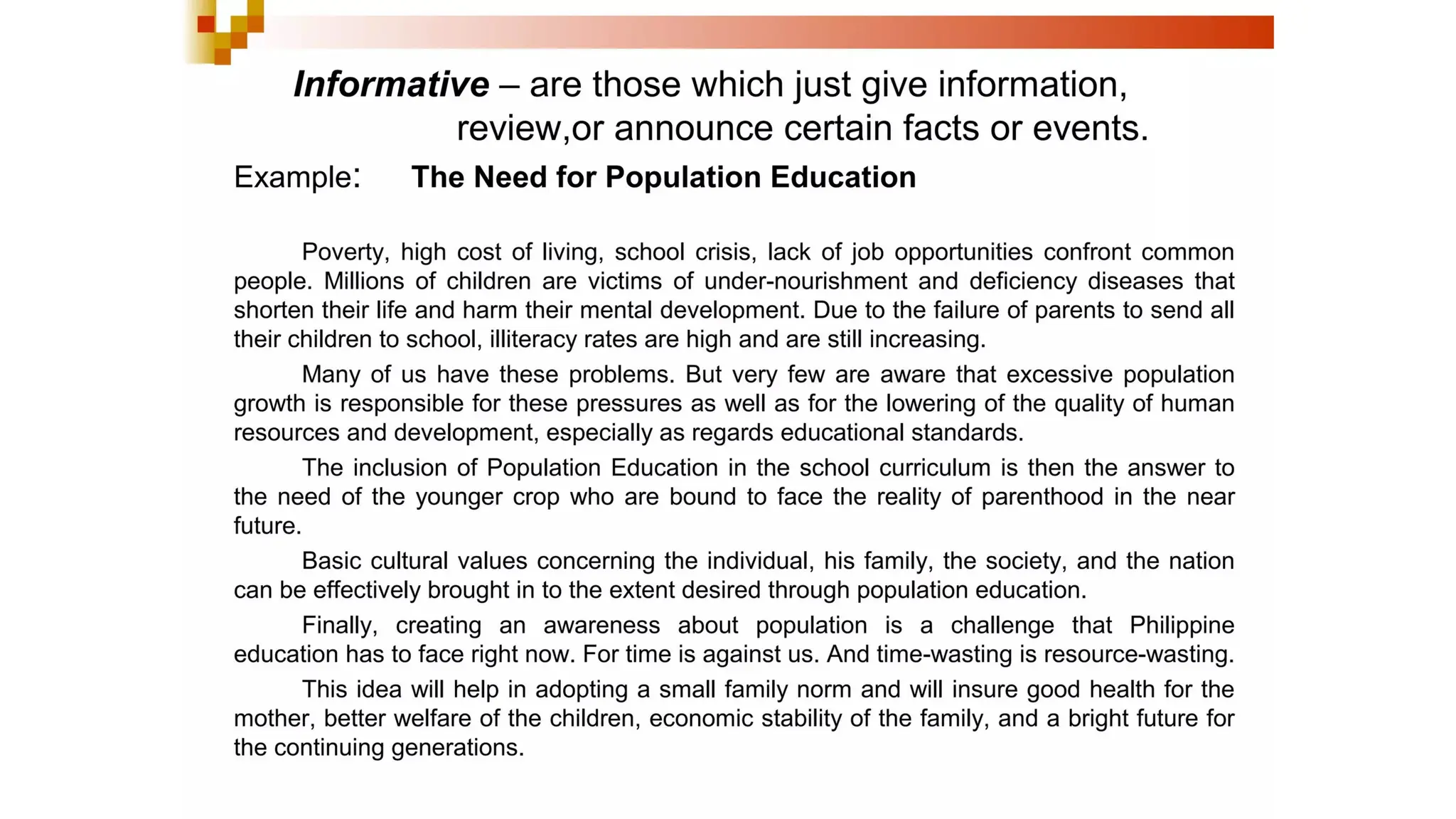
Informational editorial –
Itaims to enlighten readers of facts they
may not be familiar with. It briefly explains
the facts it adds or restates from news
reports. It could give a definition of a
phrase, name a person or thing, give
background information, etc.
9.
Editorial of interpretation–
It explains the significance or meaning of a news
event, current idea, condition, or situation, theory, or
hypothesis. The writer doesn’t argue nor criticize, but
merely present both sides of an issue and leaves the
judgment to the reader. It merely interprets, say for
example, the content of a new memorandum issued by
the principal.
10.
It clarifies theimportance or meaning
of a news event, contemporary
concepts, a circumstance, a
predicament, a theory, or an assertion.
The author just offers all sides of an
issue and leaves it up to the reader to
make up their own mind.
12.
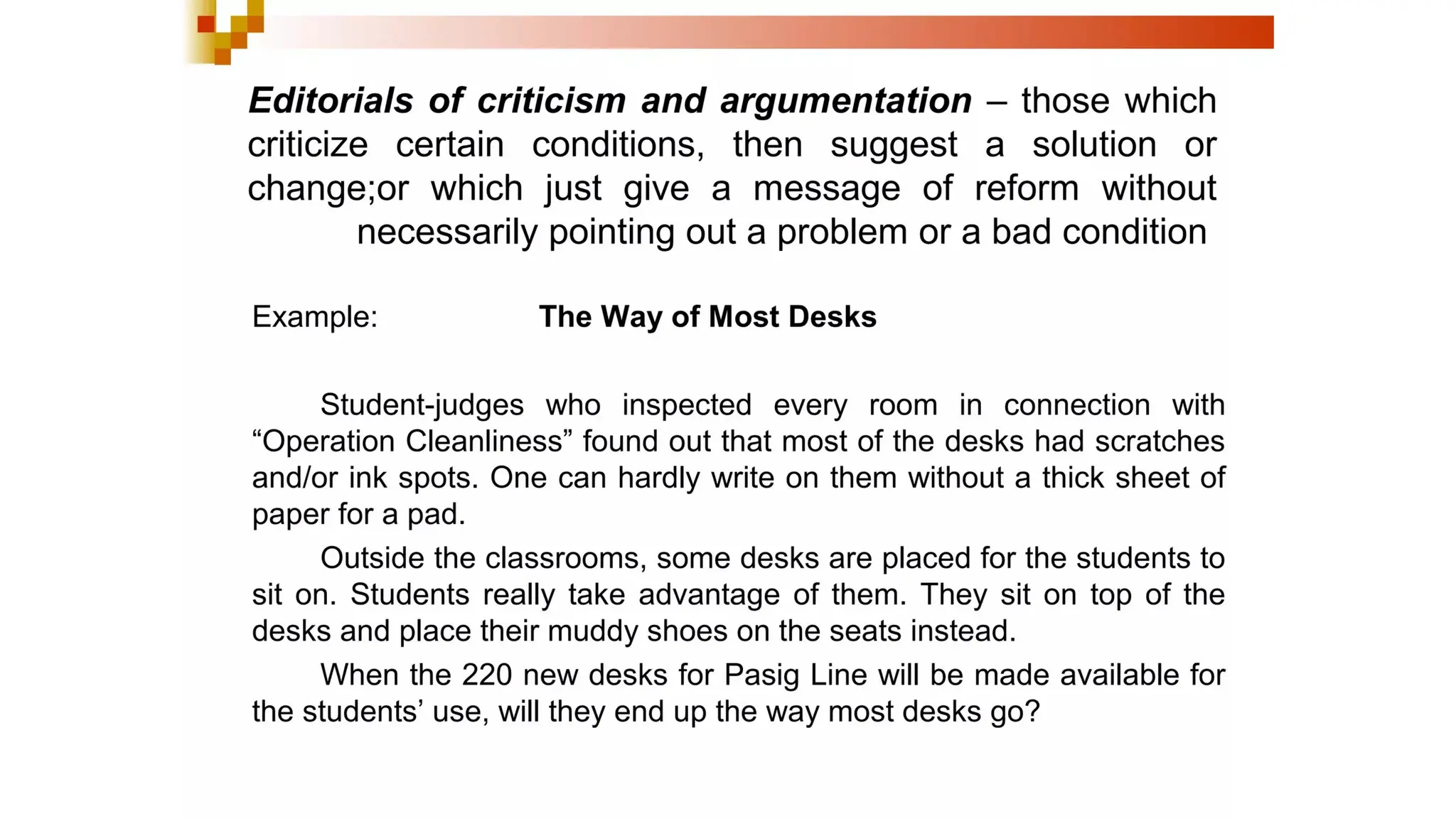
Editorial of Criticism–
It highlights the positive or negative
aspects of a problem or circumstance
that was discussed in the news. The
reader is intended to be persuaded by
it. At the conclusion, a remedy is
suggested.
Both an editorialand an article are the parts of a newspaper. While many people believe that both are the
same, there are some key differences between them.
As said before, an editorial is written by the editor in charge of the newspaper and expresses the views of
the editor or the editorial board.
It is an opinionated piece of writing, and it is written to influence the thought process and viewpoint of the
readers.
All the other news in a newspaper are called articles. These could be news articles, sports news, or any
other relevant news. Usually, it is fact-based, as the writer will have a narrow chance of adding their
opinion.
As an initialpoint, Editorials can be
roughly analyzed as per the following
parameters:
• Clarity of the content
• Suitability of the content for the intended
audience
• Structure of the manuscript
• Grammatical structure
29.
Analyzing the Topic:
Appropriatetopic for a subjective essay can be a
challenge.
It is important to select a topic that has separate and
distinct "sides" -- one of which you support.
The Title of the editorial should not be too long or too
short
It should be terse, crisp and clear: one which gives an idea
30.
Organization:
It is ofteneasy to get off track when discussing your
views on a topic so it is essential that you stay
organized. Begin by writing an outline that contains
the main points in the order you want to cover
them. Decide how each paragraph will be used to
advance your argument and be sure that it leads to
a logical conclusion.
44.
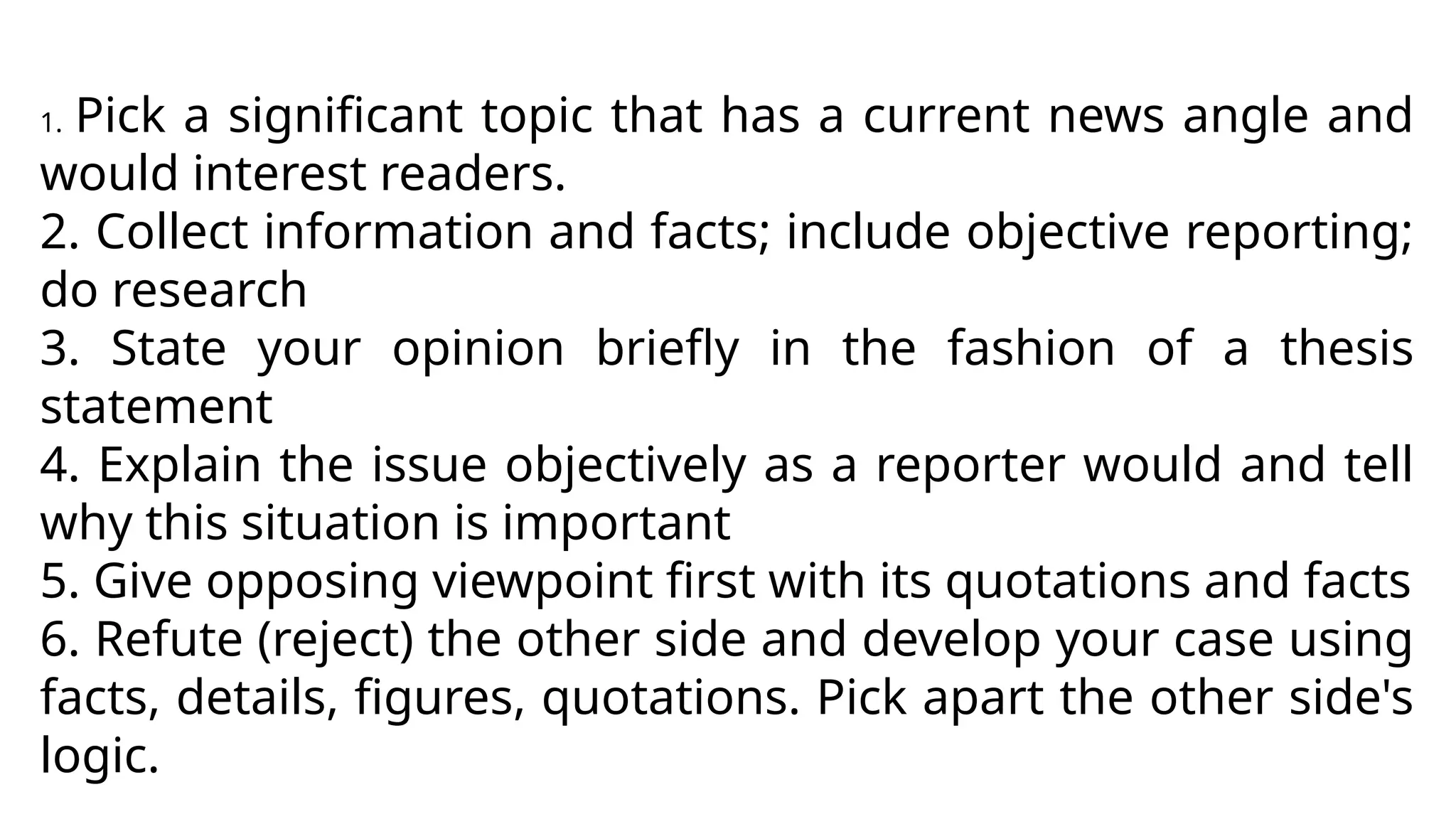
1. Pick asignificant topic that has a current news angle and
would interest readers.
2. Collect information and facts; include objective reporting;
do research
3. State your opinion briefly in the fashion of a thesis
statement
4. Explain the issue objectively as a reporter would and tell
why this situation is important
5. Give opposing viewpoint first with its quotations and facts
6. Refute (reject) the other side and develop your case using
facts, details, figures, quotations. Pick apart the other side's
logic.
45.
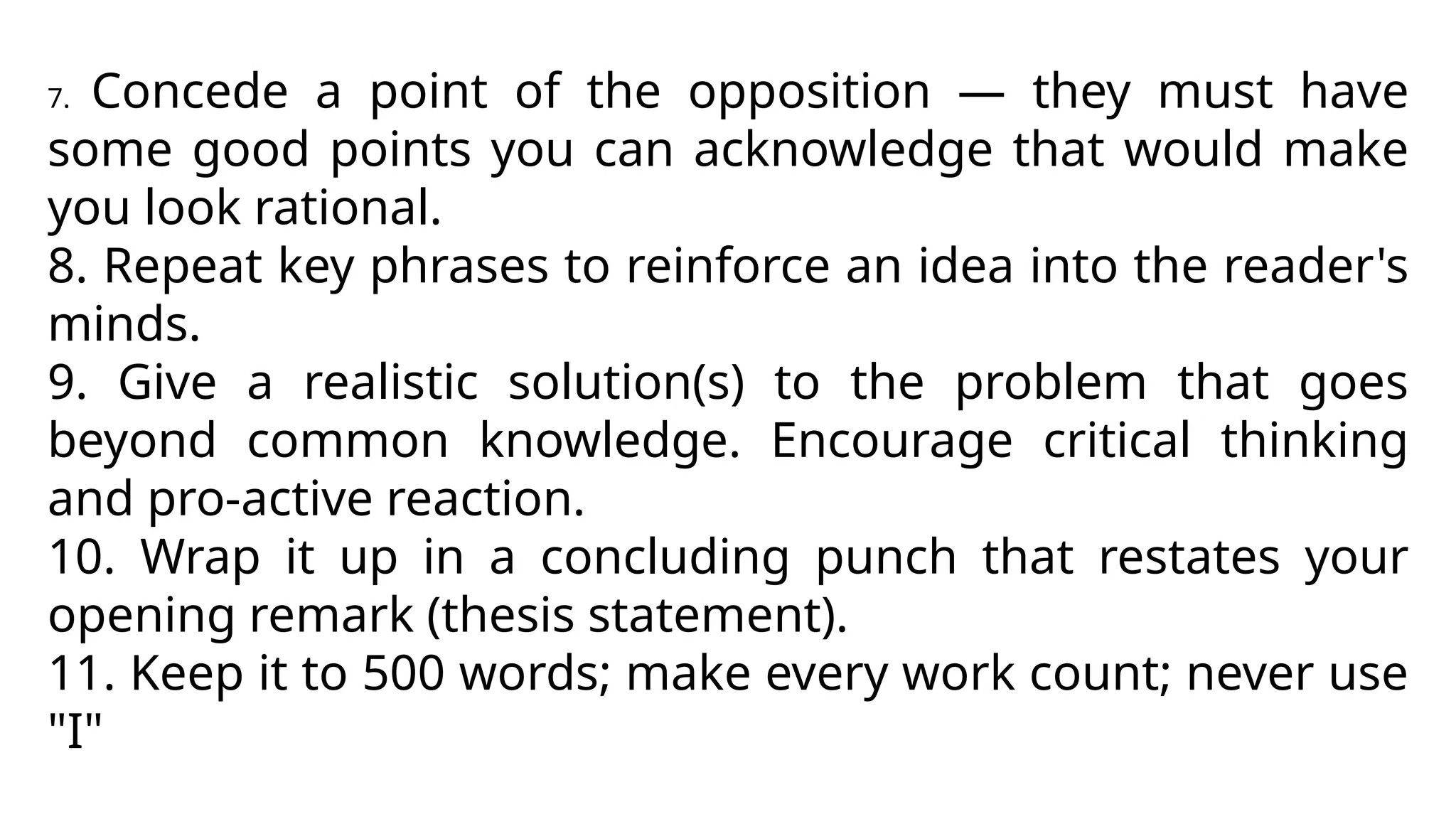
7. Concede apoint of the opposition — they must have
some good points you can acknowledge that would make
you look rational.
8. Repeat key phrases to reinforce an idea into the reader's
minds.
9. Give a realistic solution(s) to the problem that goes
beyond common knowledge. Encourage critical thinking
and pro-active reaction.
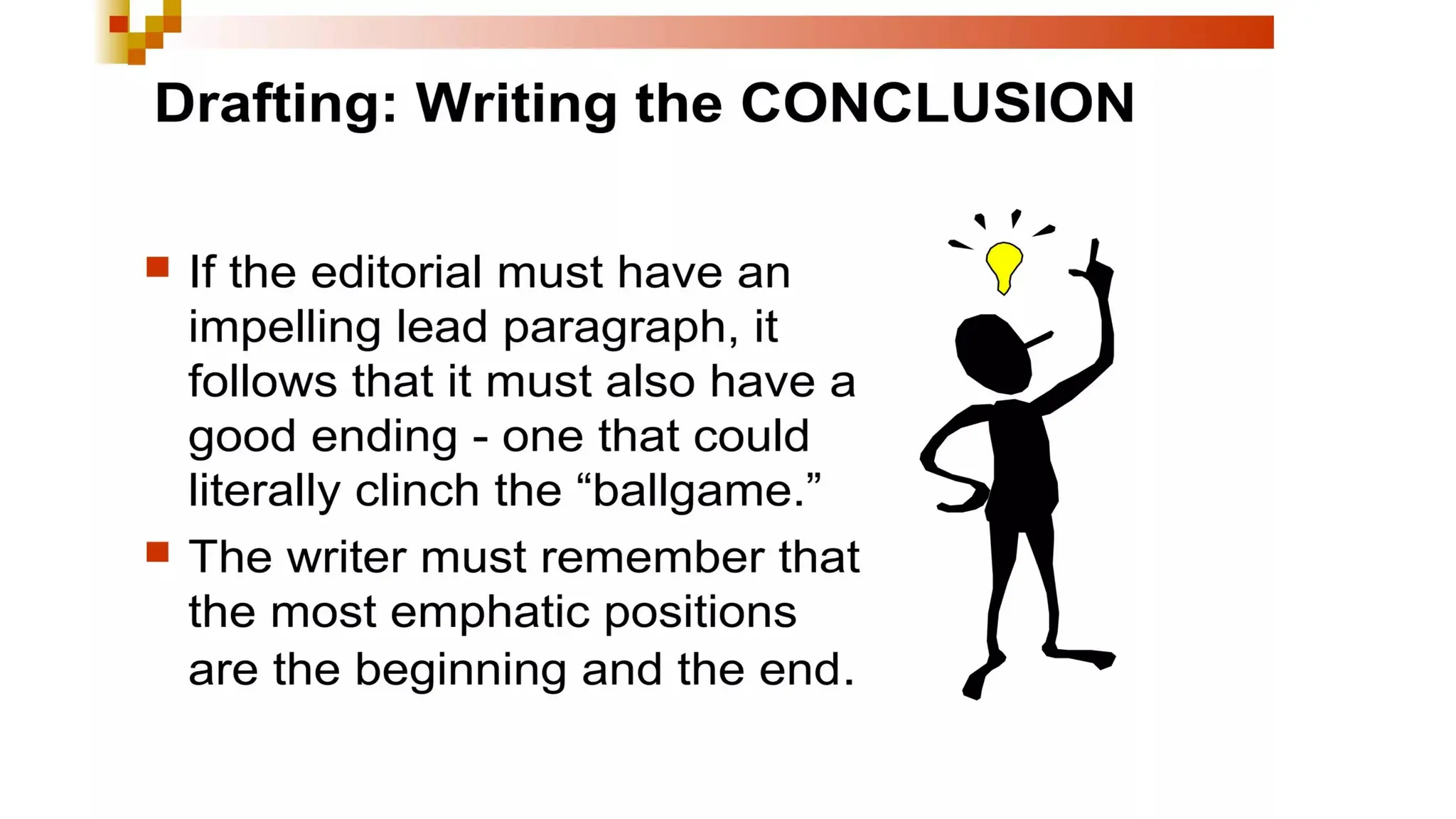
10. Wrap it up in a concluding punch that restates your
opening remark (thesis statement).
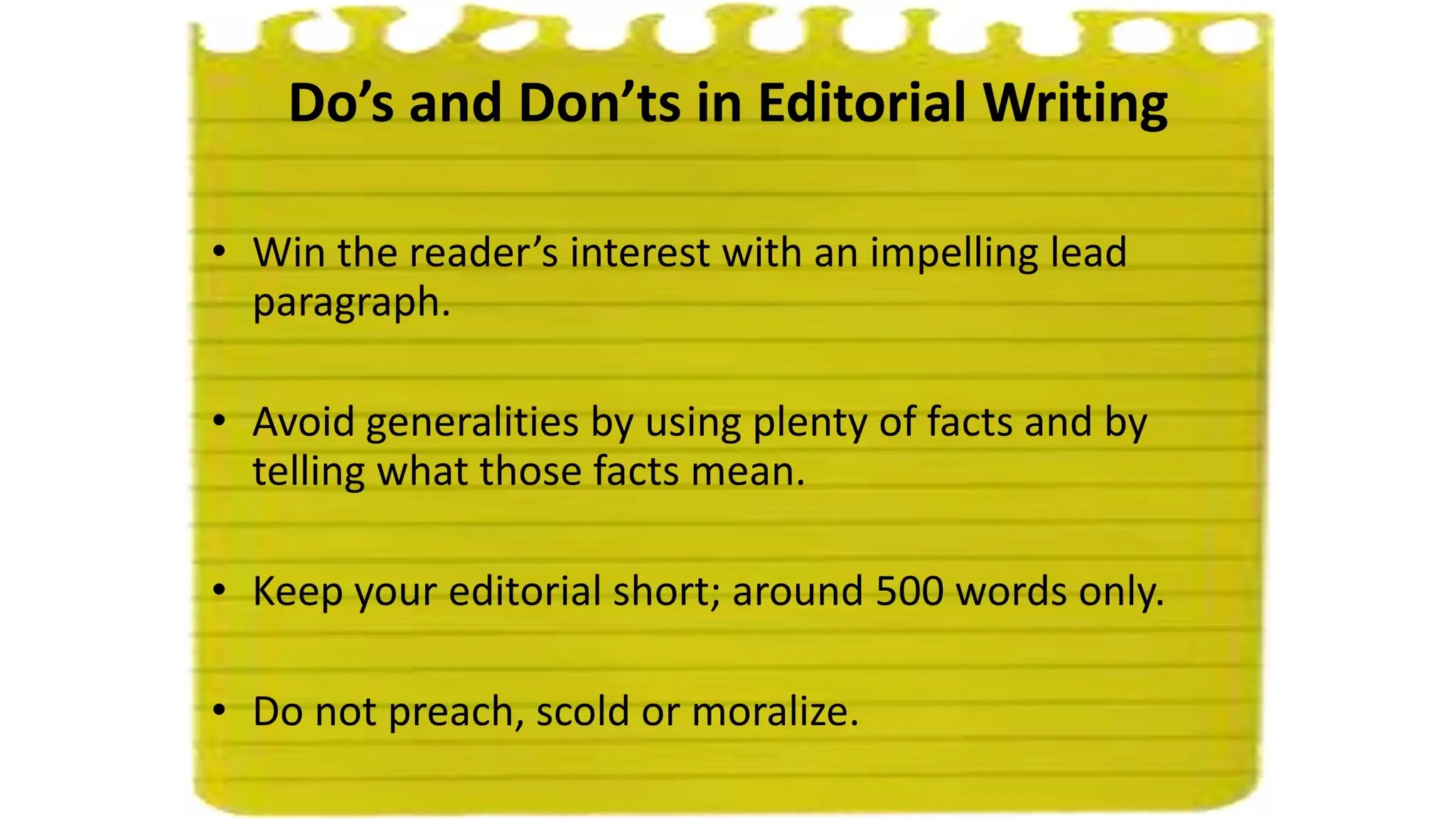
11. Keep it to 500 words; make every work count; never use
"I"
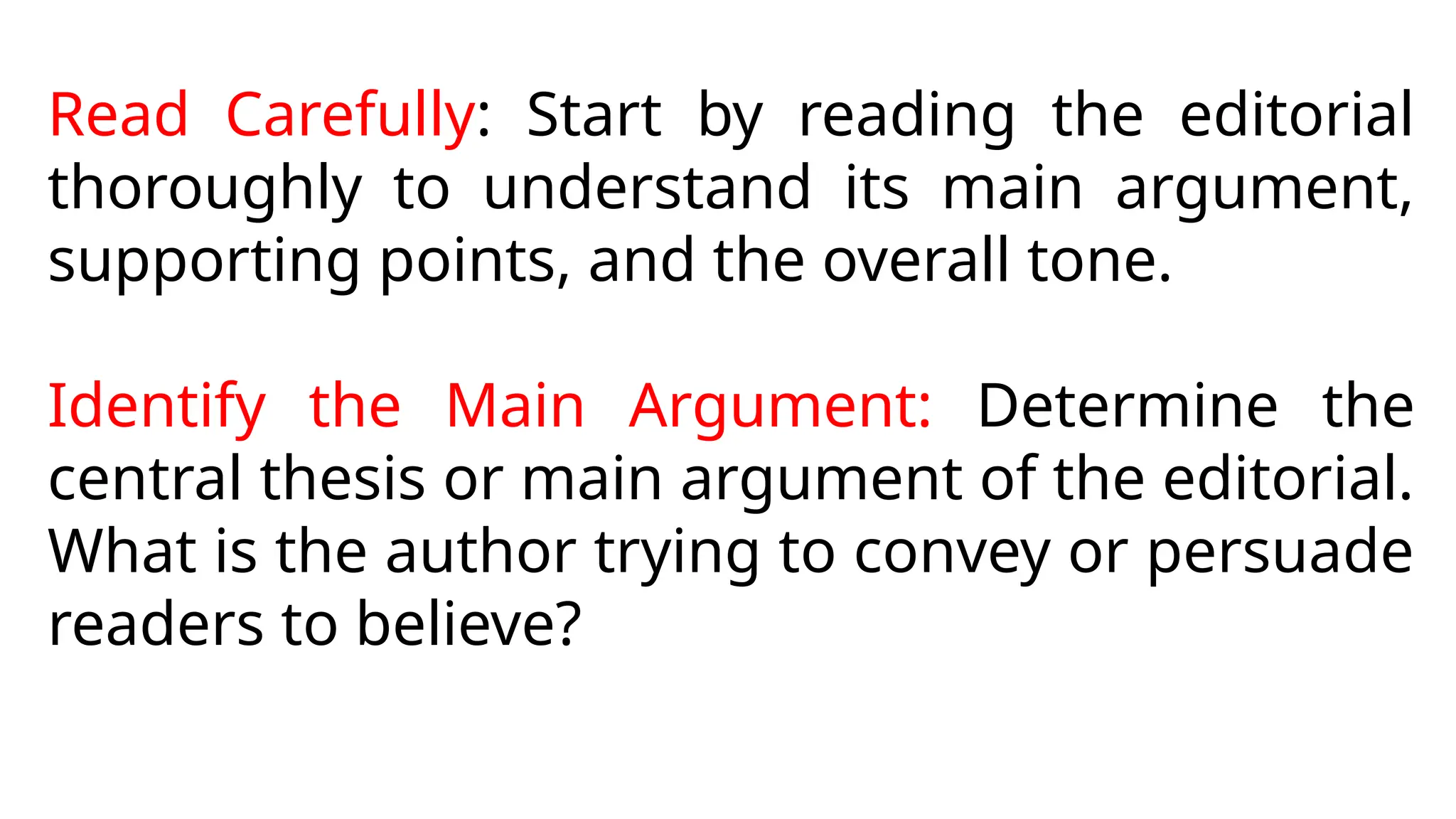
Read Carefully: Startby reading the editorial
thoroughly to understand its main argument,
supporting points, and the overall tone.
Identify the Main Argument: Determine the
central thesis or main argument of the editorial.
What is the author trying to convey or persuade
readers to believe?
48.
Evaluate the Evidence:
Lookfor evidence, data, statistics,
anecdotes, or examples that the author
uses to support their argument. Assess
the credibility and relevance of this
evidence. Are there any logical fallacies or
biases present?
49.
Consider the Toneand Language:
Pay attention to the tone of the editorial. Is it
persuasive, informative, or argumentative?
Analyze the language used by the author. Are
there any emotionally charged words or
persuasive techniques employed?
50.
Examine the Structure:Consider how the editorial is
structured. Does it have a clear introduction, body
paragraphs, and conclusion? How does the author
transition between different points or arguments?
Identify the Target Audience: Determine who the
editorial is targeting. Is it aimed at a specific
demographic, political group, or general readership?
Understanding the intended audience can provide
insights into the author's motives and goals.
51.
Evaluate Counterarguments: Considerwhether the
author addresses opposing viewpoints or
counterarguments. How does the author respond to
these challenges? Does the editorial effectively refute
opposing perspectives?
Assess the Overall Effectiveness: Evaluate how well
the editorial achieves its objectives. Does it
effectively persuade readers to agree with the
author's viewpoint? Consider the clarity of the
argument, the strength of the evidence, and the
overall impact on the reader.
52.
Consider the PublicationContext: Take into account
the publication in which the editorial appears. Is it
from a reputable source? What biases might be
associated with the publication, and how might they
influence the editorial's content?
Reflect on Your Own Response: Finally, reflect on
your own reaction to the editorial. Do you agree or
disagree with the author's argument? Why or why
not? Analyzing your own response can help deepen
your understanding of the editorial's impact.
Introduction: Begin byintroducing the editorial you're analyzing,
including its title, author, publication date, and context. Provide a
brief overview of the main topic or issue addressed in the editorial.
Summary of the Editorial: Summarize the main arguments and points
made in the editorial. Highlight the author's main thesis or central
message.
Rhetorical Strategies: Analyze the rhetorical strategies used by the
author to persuade the audience. This could include appeals to ethos
(credibility), pathos (emotion), and logos (logic), as well as the use of
persuasive language, tone, and imagery.
55.
Evidence and Support:Evaluate the evidence and
support provided by the author to bolster their
arguments. Assess the credibility and relevance of
the evidence presented and whether it effectively
supports the author's claims.
Counterarguments: Identify any counterarguments
or opposing viewpoints presented in the editorial.
Evaluate how the author addresses these
counterarguments and whether they effectively
refute them or acknowledge their validity.
56.
Impact and Effectiveness:Assess the overall impact
and effectiveness of the editorial. Consider whether
the author successfully convinces or persuades the
audience, and evaluate the editorial's potential
influence on public opinion or policy.
Conclusion: Summarize your analysis and offer your
final thoughts on the editorial. Reflect on the
strengths and weaknesses of the editorial, and
consider its broader significance within the context
of the issue being discussed.
57.
Recommendations: If applicable,provide
recommendations for how the editorial could be improved
or strengthened. This could include suggestions for
addressing weaknesses in the argument, expanding on
certain points, or appealing to a broader audience.
By conducting a thorough editorial analysis, you can gain a
deeper understanding of the persuasive techniques and
arguments employed by the author, as well as the broader
implications of the editorial within its societal and political
context.
Lack of Clarity:If the editorial fails to articulate its main points
clearly or if the arguments are poorly organized, readers may
struggle to understand the message.
Bias and Subjectivity: If the editorial displays overt bias or lacks
objectivity, it may alienate readers who hold different
perspectives. Effective editorials strive for balance and present
multiple viewpoints.
Weak Arguments: An editorial may be ineffective if its arguments
are unsubstantiated or based on faulty reasoning. Weak
arguments diminish the credibility of the editorial and fail to
persuade readers.
60.
Insufficient Evidence: Ifthe editorial lacks credible
evidence to support its claims or assertions, readers
may question the validity of the arguments
presented.
Poor Writing Style: An editorial may lose impact if it
is poorly written, with grammatical errors, awkward
phrasing, or confusing language. A clear and
engaging writing style is essential for effectively
conveying the message.
61.
Failure to Engagethe Audience: An editorial may be
ineffective if it fails to engage the intended audience
or address their concerns. Effective editorials
resonate with readers and encourage them to reflect
on the issues presented.
Lack of Timeliness: If the editorial addresses
outdated or irrelevant topics, it may fail to capture
the interest of readers. Timeliness is crucial for
ensuring that editorials remain relevant and
impactful.
62.
https://discover.hubpages.com/literature/Editorial-Definition-Types-and-Examples -- vgood
https://classroom.synonym.com/write-report-high-school-6506746.html
https://www.slideshare.net/MahrukhCheema/editorial-writing-28240438 --gud
https://myperfectwords.com/blog/general/how-to-write-an-editorial -- v good
https://slideplayer.com/slide/6646941/.
https://journsociety01.wordpress.com/types-of-editorial/-- v gud..
https://www.aliventures.com/fix-bad-writing/-- v.good