Editing
What does editing do?
• Editing is used to embellish or heighten a certain technique used
in film. This could be to do with transitions between shots, filters
on the camera lens or used to edit in particular computer based
characters or actions e.g. fire explosions, shooting bullets etc. In
short, editing is used to make a motion picture coherent and flow
into the different scenes with great effect.
How does editing work?
• There are three stages to editing: Rough Cut, Directors Cut and
Final Cut. There are several editing stages and the editor
cut/rough cut is normally the first pass of what the final film will
look like. The film editor has already got an idea of how the film
should look like by discussing with the director how the film
should be sequenced. When shooting is finished, the director can
then turn their full attention on the editing and refining the film,
hence the name directors cut, which can take longer than the
actual filming. The final cut is when all institutions and credits are
added in. This is when a director may no longer want to be
associated with the final release of the film.
Editing terms
• Cut - a cut is an abrupt, but usually trivial film transition from one sequence to
another -
• Dissolve - a gradual transition from one image to another -
• Fade – Come or cause to come gradually into or out of view, or to merge into
another shot - https://www.youtube.com/watch?v=0ibOfpr2g5k
• Jump Cut – When there is an abrupt cut where the location has stayed the same
but positioning of character, mise en scene etc. has changed making the cut
incoherent. - https://www.youtube.com/watch?v=wH4cNrUB4ss
How does shot reverse shot help the
narrative or generate meaning?
• A shot reverse shot is when the one character is shown interacting
with another character (often off screen), and then the other
character is shown looking back at the first character. Since the
characters are shown facing in opposite directions, the viewer
assumes that they are looking at each other. Also, due to eye line
match between the audience and character, the audience
subconsciencly make the connection between the character and
the object/character in the next shot, which makes the narrative
and sequence of shots coherent and flowing.
Why is the 180 degree rule important?
• The 180-degree rule enables the audience to visually connect with
unseen movement happening around and behind the immediate
subject and is important in the narration of battle scenes. Also, it
can be used in stylistic way to make the audience feel
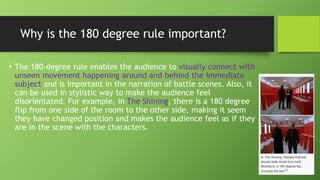
disorientated. For example, in The Shining, there is a 180 degree
flip from one side of the room to the other side, making it seem
they have changed position and makes the audience feel as if they
are in the scene with the characters.
How and why is the point of view shot used?
• The point of view shot is used to show what a character is looking
at (represented through the camera). The POV shot is used to
show a characters perspective to the audience and so the
audience are a secondary view to what the character is looking at.
It is used because looking through the characters eyes makes the
story more coherent and simpler for the audience to follow.
How else can the pov shot be generated?
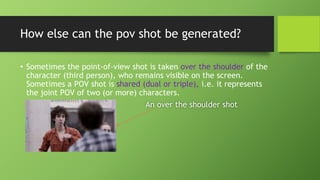
• Sometimes the point-of-view shot is taken over the shoulder of the
character (third person), who remains visible on the screen.
Sometimes a POV shot is shared (dual or triple), i.e. it represents
the joint POV of two (or more) characters.
An over the shoulder shot
What is parallel/cross cut editing?
• Cross-cutting is an editing technique most often used in films to
establish action occurring at the same time in two different
locations. In a cross-cut, the camera will cut away from one action
to another action, which can suggest the simultaneity of these two
actions (this is not always the case).
What editing techniques are used to generate
suspense?
• Montage – Where the director would carefully choose a series of
close ups to make a sequence full of suspension. For example, a
close-up of a hand, arm, face, and gun falling to the floor – and
tie them all together to dramatize an action. This method allows
one to portray an event by showing various pieces of it, while
having total control of the timing.
Explain in your own words how the mouse
sequence creates tension?
• a sequence is a series of scenes that form a distinct narrative
unit, which is usually connected either by unity of location or
unity of time. For example a heist film might include an extended
recruitment sequence in which the leader of the gang collects
together the conspirators, a robbery sequence, an escape
sequence, and so on. This can create tension because as the
sequence continues to grow, the shots will build the tension until
the climax of the film/scene.
Why is timing important when creating
suspense?
• Timing is very important as the suspense needs to be continuous
throughout the film and increase and build to the climax of the
film, as if the suspense grew too quickly people may miss the
climax or they might misunderstand the climax as another bit of
the suspension because the suspension has grown too strong too
quickly. This can work the other way where the suspense has built
up too slow and the audience are then expecting the climax,
which makes the film pretty much pointless.
Explain in your own words what the
continuity system is?
• Continuity editing gives the viewer the impression that the action
unfolds with consistency in both space and time. In most films,
logical coherence is achieved by cutting to continuity, which
emphasizes smooth transition of time and space. This system is
used to make sense for the audience and make the film realistic
and natural as possible.
Why does editing strive to be invisible?
• Editing is always wanting to be invisible because it shows
professionalism and it makes it realistic and naturalistic for the
audience to watch. Also, the editing is invisible so it can keep the
audience engaged with the story and characters.

Editing for film

  • 1.
  • 2.
    What does editingdo? • Editing is used to embellish or heighten a certain technique used in film. This could be to do with transitions between shots, filters on the camera lens or used to edit in particular computer based characters or actions e.g. fire explosions, shooting bullets etc. In short, editing is used to make a motion picture coherent and flow into the different scenes with great effect.
  • 3.
    How does editingwork? • There are three stages to editing: Rough Cut, Directors Cut and Final Cut. There are several editing stages and the editor cut/rough cut is normally the first pass of what the final film will look like. The film editor has already got an idea of how the film should look like by discussing with the director how the film should be sequenced. When shooting is finished, the director can then turn their full attention on the editing and refining the film, hence the name directors cut, which can take longer than the actual filming. The final cut is when all institutions and credits are added in. This is when a director may no longer want to be associated with the final release of the film.
  • 4.
    Editing terms • Cut- a cut is an abrupt, but usually trivial film transition from one sequence to another - • Dissolve - a gradual transition from one image to another - • Fade – Come or cause to come gradually into or out of view, or to merge into another shot - https://www.youtube.com/watch?v=0ibOfpr2g5k • Jump Cut – When there is an abrupt cut where the location has stayed the same but positioning of character, mise en scene etc. has changed making the cut incoherent. - https://www.youtube.com/watch?v=wH4cNrUB4ss
  • 5.
    How does shotreverse shot help the narrative or generate meaning? • A shot reverse shot is when the one character is shown interacting with another character (often off screen), and then the other character is shown looking back at the first character. Since the characters are shown facing in opposite directions, the viewer assumes that they are looking at each other. Also, due to eye line match between the audience and character, the audience subconsciencly make the connection between the character and the object/character in the next shot, which makes the narrative and sequence of shots coherent and flowing.
  • 6.
    Why is the180 degree rule important? • The 180-degree rule enables the audience to visually connect with unseen movement happening around and behind the immediate subject and is important in the narration of battle scenes. Also, it can be used in stylistic way to make the audience feel disorientated. For example, in The Shining, there is a 180 degree flip from one side of the room to the other side, making it seem they have changed position and makes the audience feel as if they are in the scene with the characters.
  • 7.
    How and whyis the point of view shot used? • The point of view shot is used to show what a character is looking at (represented through the camera). The POV shot is used to show a characters perspective to the audience and so the audience are a secondary view to what the character is looking at. It is used because looking through the characters eyes makes the story more coherent and simpler for the audience to follow.
  • 8.
    How else canthe pov shot be generated? • Sometimes the point-of-view shot is taken over the shoulder of the character (third person), who remains visible on the screen. Sometimes a POV shot is shared (dual or triple), i.e. it represents the joint POV of two (or more) characters. An over the shoulder shot
  • 9.
    What is parallel/crosscut editing? • Cross-cutting is an editing technique most often used in films to establish action occurring at the same time in two different locations. In a cross-cut, the camera will cut away from one action to another action, which can suggest the simultaneity of these two actions (this is not always the case).
  • 10.
    What editing techniquesare used to generate suspense? • Montage – Where the director would carefully choose a series of close ups to make a sequence full of suspension. For example, a close-up of a hand, arm, face, and gun falling to the floor – and tie them all together to dramatize an action. This method allows one to portray an event by showing various pieces of it, while having total control of the timing.
  • 11.
    Explain in yourown words how the mouse sequence creates tension? • a sequence is a series of scenes that form a distinct narrative unit, which is usually connected either by unity of location or unity of time. For example a heist film might include an extended recruitment sequence in which the leader of the gang collects together the conspirators, a robbery sequence, an escape sequence, and so on. This can create tension because as the sequence continues to grow, the shots will build the tension until the climax of the film/scene.
  • 12.
    Why is timingimportant when creating suspense? • Timing is very important as the suspense needs to be continuous throughout the film and increase and build to the climax of the film, as if the suspense grew too quickly people may miss the climax or they might misunderstand the climax as another bit of the suspension because the suspension has grown too strong too quickly. This can work the other way where the suspense has built up too slow and the audience are then expecting the climax, which makes the film pretty much pointless.
  • 13.
    Explain in yourown words what the continuity system is? • Continuity editing gives the viewer the impression that the action unfolds with consistency in both space and time. In most films, logical coherence is achieved by cutting to continuity, which emphasizes smooth transition of time and space. This system is used to make sense for the audience and make the film realistic and natural as possible.
  • 14.
    Why does editingstrive to be invisible? • Editing is always wanting to be invisible because it shows professionalism and it makes it realistic and naturalistic for the audience to watch. Also, the editing is invisible so it can keep the audience engaged with the story and characters.