+
Film and Video Editing
Techniques
Natalie Lynch
+ Provide a simple definition of what film editing is
• Film editing is part of post production when film making. It is a
technical and creative process in which you cut different
sections of footage and fit them together into a sequence.
Different effects and transitions are added during film editing
too.
+ Can you list some examples of early film editing? Think
about the different ways that film makers could combine
shots using the technology of the time. Include web
links/images where necessary
• Experimentation with editing started to happen in the very late
1800s and early 1900s. An example of early film editing is
Edwin S Porter’s ‘Great Train Robbery’. In this and other films
made around the same time, shots all lasted around 1 minute
before cutting to the next. The cameraman would stop cranking
the camera in order to end each shot began it again once the
next shot was ready to film. This massively shows a contrast
with technology of today where shots last on average 2 – 3
seconds and are all edited on computer software. They would
combine shots in order to progress the action and the story
line. Films at that time didn’t really have much detail and most
are staged but used plot, action, close ups and dissolves.
+ Describe the concept of ‘montage’ and juxtaposition
[remember Eisenstein and Kuleshov] and give an
example
• The term ‘montage’ was created by Sergei Eisenstein who
transformed the principles of editing to make them more
conceptual and detailed. It means putting together shots in order
to progress the action and theme of the storyline in the video.
An example of a montage is in the opening sequence for ‘Hot Fuzz’. It shows the
same character through various situations. All the shots are linked together by
transitions using small details from each shot.
• Juxtaposition is where you place two things (contrasting) side by
side and let the viewer compare them in order to create their own
meaning / relationship for it.
Lev Kuleshov, who is a Soviet filmmaker, carried out experiments and research on
the effects of juxtaposition and came up with the ‘Kuleshov Effect’. He found that the
audience will attach a specific meaning to something depending on how the shot is
put together.
+ List the types of cut/edit you can use and provide an
example of each on in use
• Match Cut – This is where two shots are placed together but the content of the two separate
shots are matched in order to carry on the action and keep it consistent. Alfred Hitchcock’s
‘Psycho’ shows the use of match cutting just after a murder of one of the characters.
• Cross Cut – This is one of the most commonly used edits in films to show what’s going on in two
different locations. It will cut away from one action to another, which usually shows that they’re
happening at the same time. Examples of this can be found largely in Christopher Nolan’s
blockbuster films ‘Interstellar’, ‘The Dark Knight’ and ‘Inception’.
• Jump Cut – This type of cut allows the editor to move forward in time. It is where shots are filmed
from different camera angles but ones that only slightly vary from each other, therefore creating a
manipulation of the space around the focus. An example of this can be found in Sergei
Eisenstein’s ‘The Battleship Potemkin’.
• Cutting on Action – This is where the editor cuts from one shot to another. The movement is
matched and placed specifically next to another shot so that the scene flows more and the action
fits together. This type of cut can also create more tension within the scene as well as making the
action a faster pace.
• Split Edit – A split edit is where, during the transition between two shots, the video and audio will
change at different times. They can be put into place in order to hide the transitions between
shots but also to allow the audience to see or understand the context before or after actually
hearing the speech. This is shown a couple of times during ‘Ferris Bueller's Day Off’.
+ List the types of cut/edit you can use and provide an
example of each on in use
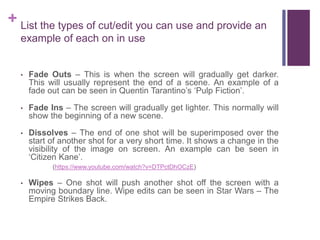
• Fade Outs – This is when the screen will gradually get darker.
This will usually represent the end of a scene. An example of a
fade out can be seen in Quentin Tarantino’s ‘Pulp Fiction’.
• Fade Ins – The screen will gradually get lighter. This normally will
show the beginning of a new scene.
• Dissolves – The end of one shot will be superimposed over the
start of another shot for a very short time. It shows a change in the
visibility of the image on screen. An example can be seen in
‘Citizen Kane’.
(https://www.youtube.com/watch?v=DTPctDhOCzE)
• Wipes – One shot will push another shot off the screen with a
moving boundary line. Wipe edits can be seen in Star Wars – The
Empire Strikes Back.
+ Below, list the four relationships between shots
• The four different relationships are picture, rhythm, time and
space.
Editing and Graphic Relationships
Editing and Rhythmic Relationships
Editing and Temporal Relationships
Editing and Spatial Relationships
+ For GRAPHIC relationships provide a description and examples of it’s
usage [with a weblink to a sequence on YouTube and still frames where
necessary – you may add more slides if you need to]
• Images may be edited in order to either to create contrast or
continuity. Colour clash, movement from shot to shot and
consistency of formal elements need to be taken into
consideration.
• An example would be in ’A Space Odyssey’ 2001 where the
bone that’s thrown into the air cuts to a space satellite.
https://www.youtube.com/watch?v=mI3s5fA7Zhk
+ For RYTHMIC relationships provide a description and examples of it’s
usage [with a weblink to a sequence on YouTube and still frames where
necessary – you may add more slides if you need to]
• Adjusting screen duration of various shots can affect the rhythm
of a video or clip and how it progresses. Using long takes, short
takes, or even a balance of the two, can affect the tempo or
pace of a scene.
• An example of where the shots are very short and fast is in ’Kill
Bill Vol. 1’.
https://www.youtube.com/watch?v=kgRlzeYc1nk
+ For TEMPORAL relationships provide a description and examples of it’s
usage [with a weblink to a sequence on YouTube and still frames where
necessary – you may add more slides if you need to]
• Editing can be done in order to manipulate the time scale
shown through the video by either extending or contracting
time. It can also be done in order to more time forwards or
backwards.
• Again, in ‘A Space Odyssey’, a temporal relationship can be
seen in the same clip as before because when the match cut
takes place, it cuts to what’s meant to be the future.
+ Define the ‘Hollywood method’ of continuity editing and why it
became so prevalent…
• This relationship became prevalent during the 1930s / 1940s. It
is where the shots are put together in a certain way so that
there’s a smooth transition from shot to shot and that the
audience doesn’t become confused by the change of angle. It
can be looked at in three different ways;
The 180 degree line
POV and Identification
Cross Cutting
The ‘Hollywood method’ is the most commonly used and
dominant editing method today.
+ Provide a description of a scene where the 180 degree line has
been used, how does it provide spatial continuity/discontinuity?
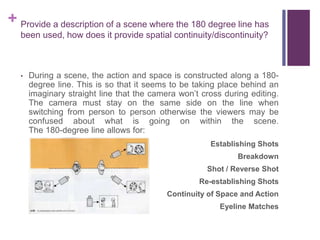
• During a scene, the action and space is constructed along a 180-
degree line. This is so that it seems to be taking place behind an
imaginary straight line that the camera won’t cross during editing.
The camera must stay on the same side on the line when
switching from person to person otherwise the viewers may be
confused about what is going on within the scene.
The 180-degree line allows for:
Establishing Shots
Breakdown
Shot / Reverse Shot
Re-establishing Shots
Continuity of Space and Action
Eyeline Matches
+ Provide a description of a scene where the 180 degree line has
been used, how does it provide spatial continuity/discontinuity?
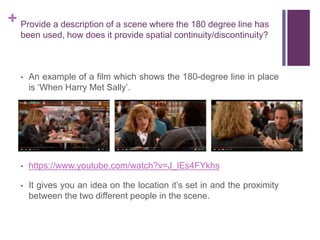
• An example of a film which shows the 180-degree line in place
is ‘When Harry Met Sally’.
• https://www.youtube.com/watch?v=J_lEs4FYkhs
• It gives you an idea on the location it’s set in and the proximity
between the two different people in the scene.
+ POV and identification – explain how we are invited to identify
with a character through POV and shot reverse shot
• Editing can help to create a point of view of a character for the
audience. For example, this can be done by the ‘shot-reverse
shot’ sequence which shows the character looking at
something / someone in one shot, then in the next it will show
what they’re looking at.
If the scene then returns to the first shot, making it shot number 3 in
the sequence, then the filmmaker is creating identification with the
character.
• This can be seen in the film ‘Psycho’ when one of the main
actors is talking to another person in an office setting.
+ Provide a definition of cross-cutting/parallel editing, what is so
effective about this technique? Where might a director use it?
• Cross cutting is where the scene will jump between action
taking place in two or more different locations.
• It can be used to give an idea that all the events are happening
at the same time and can give dramatic effects.
• To see cross cutting in place, ’The Godfather’ shows examples
of this.
https://www.youtube.com/watch?v=1CDlBLvc3YE
• Cross cutting is also commonly used to show spatial
relationships in scenes from a film. It will show different
characters within a scene from a different point of view.
+ What is Ellipsis? Select an example and explain how it
works…
• An ellipsis is where you shorten the duration of the plot in a
film. It is the difference between screen time and real time.
They are usually marked by an editing transition, including a
face, dissolve, wipe, jump cut or a change of scene, which give
the impression of a gap in time.
+ What is meant by the term ‘intensified continuity’? Why do you
think continuity editing has developed in this way?
• Intensified Continuity explains that there’s more shots in films,
therefore meaning more editing.
• Newer, more contemporary feature films might have over 2000
shots, with action films containing 3000 or more shots. This is
potentially why action is shot closer up to actors rather than
long shots.
• It has developed this way as it adds more excitement to the
scene and you can really focus on the detail of the actor’s faces
and the action within the scene.
+
Your Case Study
+
Free choice case study
 Your individual case study should describe the development of
editing in film and aim to highlight the different aspects of
editing discussed in the lecture [with examples]
 You should select at least 2 different examples/clips to discuss
– you should include links to these and use still images to
support your arguments
 Use the questions listed on the next slide to start your
investigations
+
Questions to ask
 When any two shots are joined, you can ask several questions:
1. How are the shots graphically continuous or discontinuous?
2. What rhythmic relations are created?
3. Are the shots spatially continuous? If not, what creates the
spatial discontinuity? [Cross-cutting? Ambiguous cues?] If the
shots are continuous, how does the 180-degree system
create the continuity?
4. Are the shots temporally continuous? If so, what creates the
continuity? [e.g. matches on action?] If not, what creates the
discontinuity?

Editing Techniques

  • 1.
    + Film and VideoEditing Techniques Natalie Lynch
  • 2.
    + Provide asimple definition of what film editing is • Film editing is part of post production when film making. It is a technical and creative process in which you cut different sections of footage and fit them together into a sequence. Different effects and transitions are added during film editing too.
  • 3.
    + Can youlist some examples of early film editing? Think about the different ways that film makers could combine shots using the technology of the time. Include web links/images where necessary • Experimentation with editing started to happen in the very late 1800s and early 1900s. An example of early film editing is Edwin S Porter’s ‘Great Train Robbery’. In this and other films made around the same time, shots all lasted around 1 minute before cutting to the next. The cameraman would stop cranking the camera in order to end each shot began it again once the next shot was ready to film. This massively shows a contrast with technology of today where shots last on average 2 – 3 seconds and are all edited on computer software. They would combine shots in order to progress the action and the story line. Films at that time didn’t really have much detail and most are staged but used plot, action, close ups and dissolves.
  • 4.
    + Describe theconcept of ‘montage’ and juxtaposition [remember Eisenstein and Kuleshov] and give an example • The term ‘montage’ was created by Sergei Eisenstein who transformed the principles of editing to make them more conceptual and detailed. It means putting together shots in order to progress the action and theme of the storyline in the video. An example of a montage is in the opening sequence for ‘Hot Fuzz’. It shows the same character through various situations. All the shots are linked together by transitions using small details from each shot. • Juxtaposition is where you place two things (contrasting) side by side and let the viewer compare them in order to create their own meaning / relationship for it. Lev Kuleshov, who is a Soviet filmmaker, carried out experiments and research on the effects of juxtaposition and came up with the ‘Kuleshov Effect’. He found that the audience will attach a specific meaning to something depending on how the shot is put together.
  • 5.
    + List thetypes of cut/edit you can use and provide an example of each on in use • Match Cut – This is where two shots are placed together but the content of the two separate shots are matched in order to carry on the action and keep it consistent. Alfred Hitchcock’s ‘Psycho’ shows the use of match cutting just after a murder of one of the characters. • Cross Cut – This is one of the most commonly used edits in films to show what’s going on in two different locations. It will cut away from one action to another, which usually shows that they’re happening at the same time. Examples of this can be found largely in Christopher Nolan’s blockbuster films ‘Interstellar’, ‘The Dark Knight’ and ‘Inception’. • Jump Cut – This type of cut allows the editor to move forward in time. It is where shots are filmed from different camera angles but ones that only slightly vary from each other, therefore creating a manipulation of the space around the focus. An example of this can be found in Sergei Eisenstein’s ‘The Battleship Potemkin’. • Cutting on Action – This is where the editor cuts from one shot to another. The movement is matched and placed specifically next to another shot so that the scene flows more and the action fits together. This type of cut can also create more tension within the scene as well as making the action a faster pace. • Split Edit – A split edit is where, during the transition between two shots, the video and audio will change at different times. They can be put into place in order to hide the transitions between shots but also to allow the audience to see or understand the context before or after actually hearing the speech. This is shown a couple of times during ‘Ferris Bueller's Day Off’.
  • 6.
    + List thetypes of cut/edit you can use and provide an example of each on in use • Fade Outs – This is when the screen will gradually get darker. This will usually represent the end of a scene. An example of a fade out can be seen in Quentin Tarantino’s ‘Pulp Fiction’. • Fade Ins – The screen will gradually get lighter. This normally will show the beginning of a new scene. • Dissolves – The end of one shot will be superimposed over the start of another shot for a very short time. It shows a change in the visibility of the image on screen. An example can be seen in ‘Citizen Kane’. (https://www.youtube.com/watch?v=DTPctDhOCzE) • Wipes – One shot will push another shot off the screen with a moving boundary line. Wipe edits can be seen in Star Wars – The Empire Strikes Back.
  • 7.
    + Below, listthe four relationships between shots • The four different relationships are picture, rhythm, time and space. Editing and Graphic Relationships Editing and Rhythmic Relationships Editing and Temporal Relationships Editing and Spatial Relationships
  • 8.
    + For GRAPHICrelationships provide a description and examples of it’s usage [with a weblink to a sequence on YouTube and still frames where necessary – you may add more slides if you need to] • Images may be edited in order to either to create contrast or continuity. Colour clash, movement from shot to shot and consistency of formal elements need to be taken into consideration. • An example would be in ’A Space Odyssey’ 2001 where the bone that’s thrown into the air cuts to a space satellite. https://www.youtube.com/watch?v=mI3s5fA7Zhk
  • 9.
    + For RYTHMICrelationships provide a description and examples of it’s usage [with a weblink to a sequence on YouTube and still frames where necessary – you may add more slides if you need to] • Adjusting screen duration of various shots can affect the rhythm of a video or clip and how it progresses. Using long takes, short takes, or even a balance of the two, can affect the tempo or pace of a scene. • An example of where the shots are very short and fast is in ’Kill Bill Vol. 1’. https://www.youtube.com/watch?v=kgRlzeYc1nk
  • 10.
    + For TEMPORALrelationships provide a description and examples of it’s usage [with a weblink to a sequence on YouTube and still frames where necessary – you may add more slides if you need to] • Editing can be done in order to manipulate the time scale shown through the video by either extending or contracting time. It can also be done in order to more time forwards or backwards. • Again, in ‘A Space Odyssey’, a temporal relationship can be seen in the same clip as before because when the match cut takes place, it cuts to what’s meant to be the future.
  • 11.
    + Define the‘Hollywood method’ of continuity editing and why it became so prevalent… • This relationship became prevalent during the 1930s / 1940s. It is where the shots are put together in a certain way so that there’s a smooth transition from shot to shot and that the audience doesn’t become confused by the change of angle. It can be looked at in three different ways; The 180 degree line POV and Identification Cross Cutting The ‘Hollywood method’ is the most commonly used and dominant editing method today.
  • 12.
    + Provide adescription of a scene where the 180 degree line has been used, how does it provide spatial continuity/discontinuity? • During a scene, the action and space is constructed along a 180- degree line. This is so that it seems to be taking place behind an imaginary straight line that the camera won’t cross during editing. The camera must stay on the same side on the line when switching from person to person otherwise the viewers may be confused about what is going on within the scene. The 180-degree line allows for: Establishing Shots Breakdown Shot / Reverse Shot Re-establishing Shots Continuity of Space and Action Eyeline Matches
  • 13.
    + Provide adescription of a scene where the 180 degree line has been used, how does it provide spatial continuity/discontinuity? • An example of a film which shows the 180-degree line in place is ‘When Harry Met Sally’. • https://www.youtube.com/watch?v=J_lEs4FYkhs • It gives you an idea on the location it’s set in and the proximity between the two different people in the scene.
  • 14.
    + POV andidentification – explain how we are invited to identify with a character through POV and shot reverse shot • Editing can help to create a point of view of a character for the audience. For example, this can be done by the ‘shot-reverse shot’ sequence which shows the character looking at something / someone in one shot, then in the next it will show what they’re looking at. If the scene then returns to the first shot, making it shot number 3 in the sequence, then the filmmaker is creating identification with the character. • This can be seen in the film ‘Psycho’ when one of the main actors is talking to another person in an office setting.
  • 15.
    + Provide adefinition of cross-cutting/parallel editing, what is so effective about this technique? Where might a director use it? • Cross cutting is where the scene will jump between action taking place in two or more different locations. • It can be used to give an idea that all the events are happening at the same time and can give dramatic effects. • To see cross cutting in place, ’The Godfather’ shows examples of this. https://www.youtube.com/watch?v=1CDlBLvc3YE • Cross cutting is also commonly used to show spatial relationships in scenes from a film. It will show different characters within a scene from a different point of view.
  • 16.
    + What isEllipsis? Select an example and explain how it works… • An ellipsis is where you shorten the duration of the plot in a film. It is the difference between screen time and real time. They are usually marked by an editing transition, including a face, dissolve, wipe, jump cut or a change of scene, which give the impression of a gap in time.
  • 17.
    + What ismeant by the term ‘intensified continuity’? Why do you think continuity editing has developed in this way? • Intensified Continuity explains that there’s more shots in films, therefore meaning more editing. • Newer, more contemporary feature films might have over 2000 shots, with action films containing 3000 or more shots. This is potentially why action is shot closer up to actors rather than long shots. • It has developed this way as it adds more excitement to the scene and you can really focus on the detail of the actor’s faces and the action within the scene.
  • 18.
  • 19.
    + Free choice casestudy  Your individual case study should describe the development of editing in film and aim to highlight the different aspects of editing discussed in the lecture [with examples]  You should select at least 2 different examples/clips to discuss – you should include links to these and use still images to support your arguments  Use the questions listed on the next slide to start your investigations
  • 20.
    + Questions to ask When any two shots are joined, you can ask several questions: 1. How are the shots graphically continuous or discontinuous? 2. What rhythmic relations are created? 3. Are the shots spatially continuous? If not, what creates the spatial discontinuity? [Cross-cutting? Ambiguous cues?] If the shots are continuous, how does the 180-degree system create the continuity? 4. Are the shots temporally continuous? If so, what creates the continuity? [e.g. matches on action?] If not, what creates the discontinuity?