1
Thursday 15th September
Narrative Structure in Film
How films tell stories
LO: To identify key narrative techniques
 Narrative form – structure through which movies tell stories
 Every film tells us a story – this is a narrative film.
 Narratives are everywhere: they appear throughout media and society -> they are
common in fiction film but appear in all basic kinds of film
 A narrative is a strong of events occurring in space and time – they don’t unfold
randomly, they are an ordered series of events connected by things that happen:
cause and effect (e.g. CAUSE: someone on Shutter Island goes missing; EFFECT:
Teddy has to go to the island or CAUSE: action – robbing a bank; EFFECT: Police
investigation, Mob upset, Batman informed etc.)
 The logic of cause and effect ties together character traits, goals, obstacles and
actions.
Key Events – Beauty and the Beast
1. Belle’s father gets captured by the Beast (ACT 1)
2. Belle goes to the castle to save her father (ACT 2)
3. The Beast keeps Belle captive in the castle (RISING ACTION)
4. Belle meets the enchanted objects
5. The Beast falls in love with Belle
6. Belle misses her father, the Beast lets her go (STAKES GET HIGHER)
7. Belle gets attacked & Beast saves her
8. Belle leaves the castle, then goes back to warn Beast of Gaston coming to kill him
(ACT 3)
9. Gaston & others go to the castle to kill the Beast (CRISIS)
10. Gaston is killed by the Beast, the Beast becomes the Prince (FALLING ACTION)
11. Belle and Prince get frisky, spell is broken (RESOLUTION)
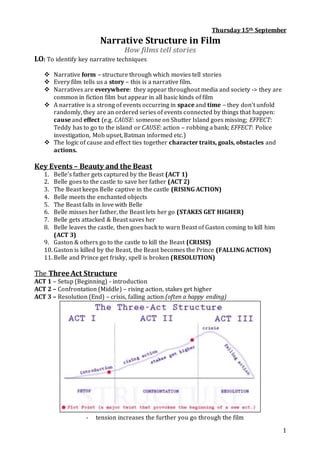
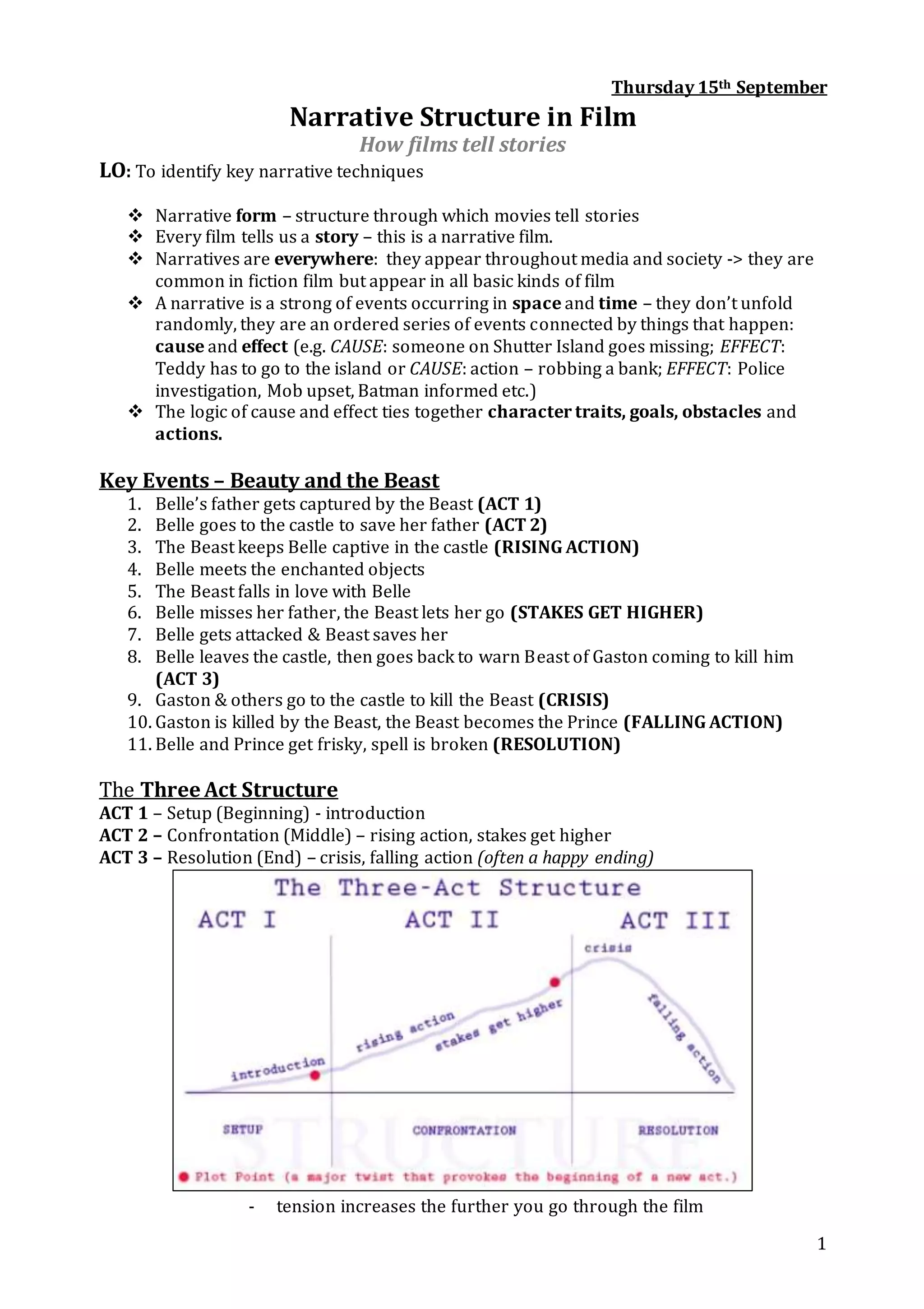
The Three Act Structure
ACT 1 – Setup (Beginning) - introduction
ACT 2 – Confrontation (Middle) – rising action, stakes get higher
ACT 3 – Resolution (End) – crisis, falling action (often a happy ending)
- tension increases the further you go through the film
2
Narrative Structure
Set Up/Exposition – meet characters, establish setting, set the tone (establish the normal
of the film word)
Rising Action – central conflict introduced, tension between protagonist & antagonist
begins, many things happen & stakes get higher
Climax – turning point, marks a change, for better or worse
Falling Action – major action has happened: this is the aftermath, this is the sorting of the
major conflict’s resolution (starting to wind down)
Dénouement/Resolution – creation of the new normal: the conflict is resolved
Tzvetan Todorov
Theory of Equilibrium and Disequilibrium
These are the expected stages of a narrative.
1. State of equilibrium (all is as it’s supposed to be)
2. A disruption of that order by an event
3. A recognition that the disorder has occurred
4. An attempt to repair the damage of the disruption
5. A return or restoration of a NEW equilibrium
Todorov argues that narrative involves a transformation. The characters or the situations
are transformed through the process of the disruption.
- often, Thriller films start at the disequilibrium, and we have flashbacks to the equilibrium
because we get quite bored of that pattern
How NarrativeUnfolds
Typically a narrative begins with one situation (exposition).
A series of changes occurs according to a pattern of cause and effect.
Finally a new situation arises – through character choice and conflict – that restores
equilibrium to the world of the story and brings around the end of the narrative.
The new story equilibrium almost always results in character change.

Narrative Structure In Films - Lesson Notes

  • 1.
    1 Thursday 15th September NarrativeStructure in Film How films tell stories LO: To identify key narrative techniques  Narrative form – structure through which movies tell stories  Every film tells us a story – this is a narrative film.  Narratives are everywhere: they appear throughout media and society -> they are common in fiction film but appear in all basic kinds of film  A narrative is a strong of events occurring in space and time – they don’t unfold randomly, they are an ordered series of events connected by things that happen: cause and effect (e.g. CAUSE: someone on Shutter Island goes missing; EFFECT: Teddy has to go to the island or CAUSE: action – robbing a bank; EFFECT: Police investigation, Mob upset, Batman informed etc.)  The logic of cause and effect ties together character traits, goals, obstacles and actions. Key Events – Beauty and the Beast 1. Belle’s father gets captured by the Beast (ACT 1) 2. Belle goes to the castle to save her father (ACT 2) 3. The Beast keeps Belle captive in the castle (RISING ACTION) 4. Belle meets the enchanted objects 5. The Beast falls in love with Belle 6. Belle misses her father, the Beast lets her go (STAKES GET HIGHER) 7. Belle gets attacked & Beast saves her 8. Belle leaves the castle, then goes back to warn Beast of Gaston coming to kill him (ACT 3) 9. Gaston & others go to the castle to kill the Beast (CRISIS) 10. Gaston is killed by the Beast, the Beast becomes the Prince (FALLING ACTION) 11. Belle and Prince get frisky, spell is broken (RESOLUTION) The Three Act Structure ACT 1 – Setup (Beginning) - introduction ACT 2 – Confrontation (Middle) – rising action, stakes get higher ACT 3 – Resolution (End) – crisis, falling action (often a happy ending) - tension increases the further you go through the film
  • 2.
    2 Narrative Structure Set Up/Exposition– meet characters, establish setting, set the tone (establish the normal of the film word) Rising Action – central conflict introduced, tension between protagonist & antagonist begins, many things happen & stakes get higher Climax – turning point, marks a change, for better or worse Falling Action – major action has happened: this is the aftermath, this is the sorting of the major conflict’s resolution (starting to wind down) Dénouement/Resolution – creation of the new normal: the conflict is resolved Tzvetan Todorov Theory of Equilibrium and Disequilibrium These are the expected stages of a narrative. 1. State of equilibrium (all is as it’s supposed to be) 2. A disruption of that order by an event 3. A recognition that the disorder has occurred 4. An attempt to repair the damage of the disruption 5. A return or restoration of a NEW equilibrium Todorov argues that narrative involves a transformation. The characters or the situations are transformed through the process of the disruption. - often, Thriller films start at the disequilibrium, and we have flashbacks to the equilibrium because we get quite bored of that pattern How NarrativeUnfolds Typically a narrative begins with one situation (exposition). A series of changes occurs according to a pattern of cause and effect. Finally a new situation arises – through character choice and conflict – that restores equilibrium to the world of the story and brings around the end of the narrative. The new story equilibrium almost always results in character change.