INTRODUCTION TO EDI
WHAT IS EDI?
Sponsored© Copyright 2013,
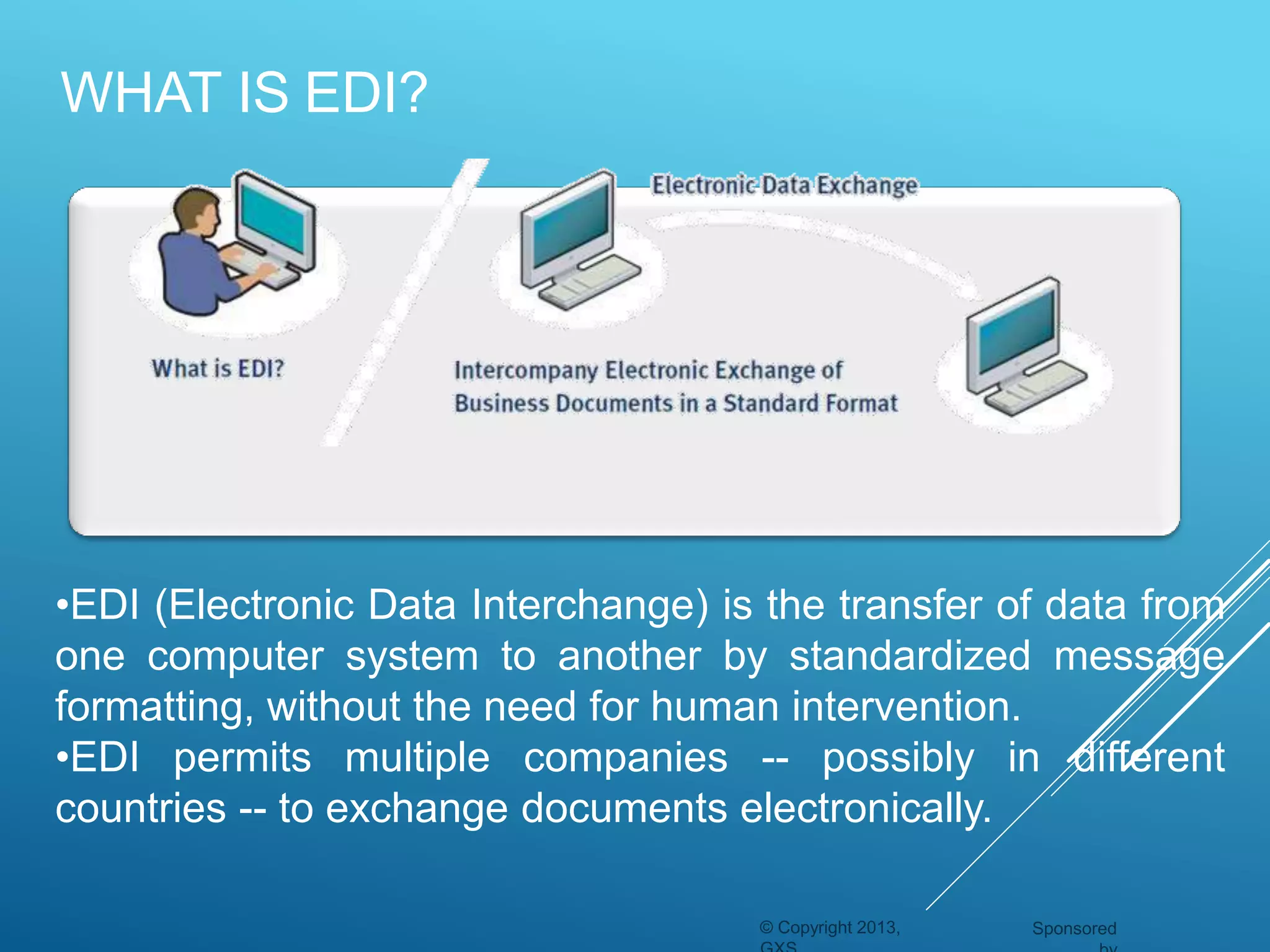
•EDI (Electronic Data Interchange) is the transfer of data from
one computer system to another by standardized message
formatting, without the need for human intervention.
•EDI permits multiple companies -- possibly in different
countries -- to exchange documents electronically.
• EDI is mostly used for computer-to-computer
exchange of standard business documents in
electronic format between two companies
• EDI operates under two principles
• firstly electronic documents replace paper ones
• secondly the exchange of documents takes place in
a standardized format.
Why we use EDI?
INFORMATION FLOW WITH OUT
EDI
INFORMATION FLOW WITHOUTEDI
INFORMATION FLOW WITHOUT
EDI
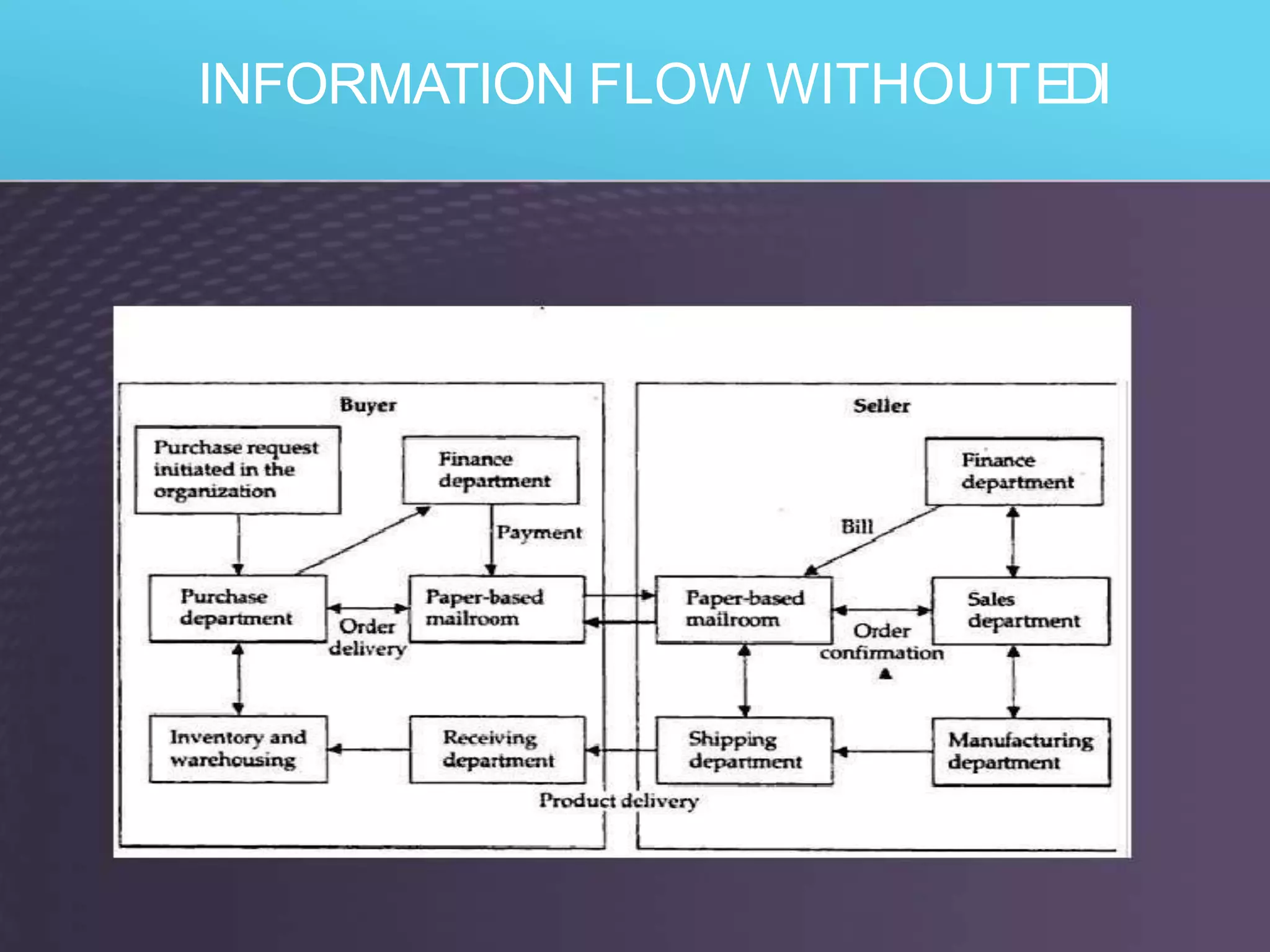
 The fig showsthe information flow when paper documentsare
shuffled between organizations via the mailroom
 When the buyer sendsapurchaseorder, then relevant data extracted
& recorded on a hardcopy.
 This hard copyisforwarded toseveralsteps,at last manually
entered into systemby the data entry operators.
 This processissome what overhead in labor costs&time delays.
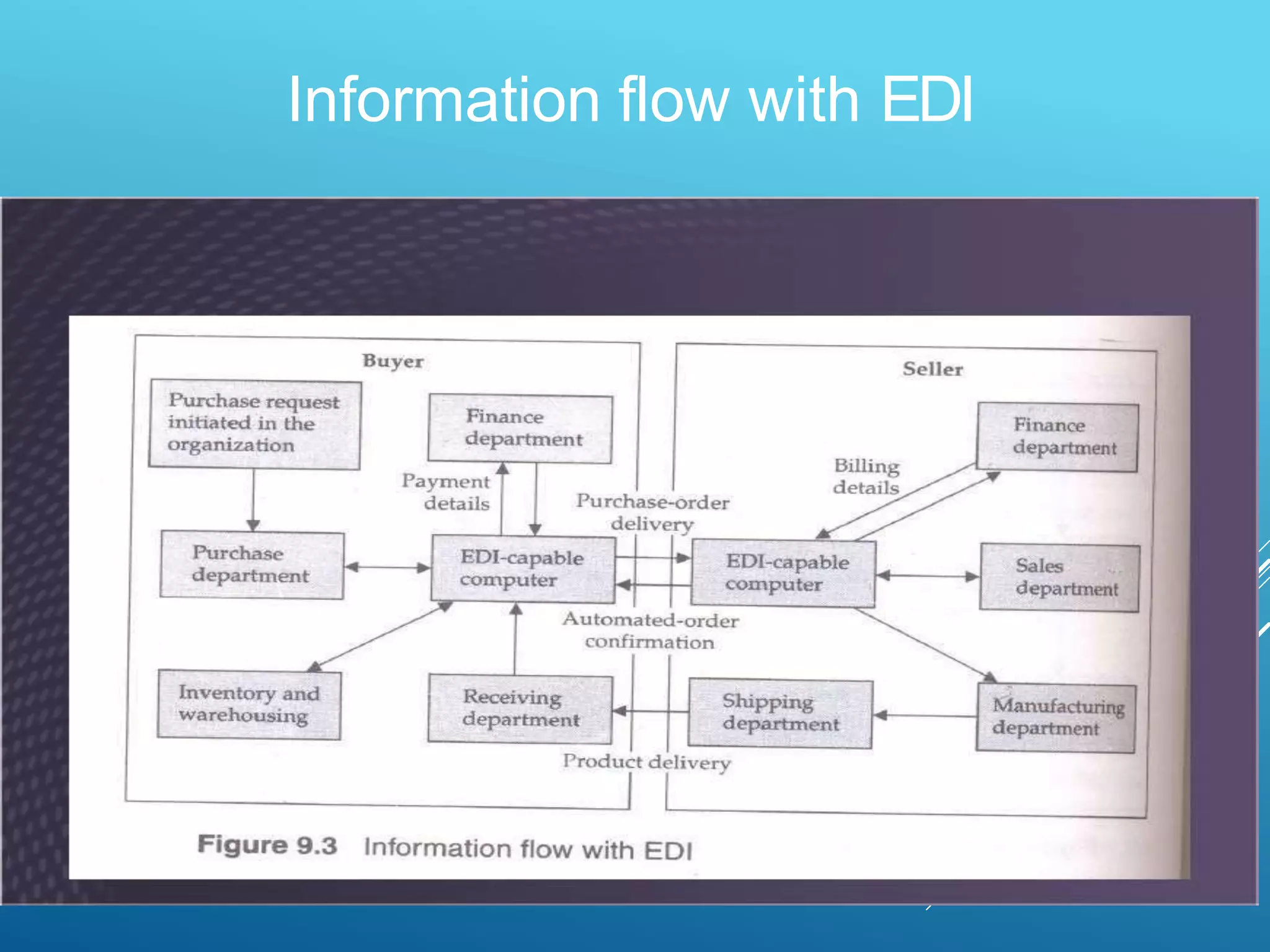
INFORMATION FLOW WITH EDI
Information flow with EDI
INFORMATION FLOW WITH EDI
Information flow with EDIare as follows:
 Buyersendspurchaseorder to sellercomputer
 Sellersendspurchaseorder confirmation to buyer
 Sellersendsbooking request to transportcompany
 Transport companysendsbooking confirmation to seller
 Sellersendsadvanceship notice to buyer
 Transport companysendsstatus to seller
 BuyersendsReceiptadviceto seller
 Sellersendsinvoice to buyer
 Buyersendspayment to seller EDIasafast, inexpensive & safemethod
BENEFITS OF EDI
1) Efficient transmission: Information is transmitted from one organization to
another organization efficiently and swiftly.
2) Automated Data entry: Data is entered automatically by EDI software. For
instance, when purchase order (PO) from one company is received by another
company. Sales order (SO) is automatically generated at other company’s system
with the help of EDI software.
3) Receipt verification: Receipt verification can easily be done with help of EDI
software.
4) Data Validation: Data validation is automatically done.
5) Availability of free software: Free softwares are available depending upon the
EDI format chosen. For example- In TRADACOMS EDI format, Price Information
file and order files are available for free.
6) Low cost: Lower administrative, resource and maintenance cost.
7) Faster processing: With the help of EDI, business processes can be executed
at a much faster rate as compared to the traditional method sending information.
8) Building long-term relationships: EDI helps in building long term relationships
with trading partners and hence helps in business growth.
9) Reduction in error: EDI has discarded manual data entry and paperwork. So
there are minimal chances of error.
10) Security: By EDI business transactions are more secure.
EDI STANDARDS
 EDI standards help to ensure that electronic business documents can be
exchanged between companies with ease.
 There are many different EDI standards in use locally and
around the world,
 ANSI ASC X12 (X12) is routinely used in the U.S., and EDIFACT
(Electronic Data Interchange for Administration, Commerce and
Transport) is used outside of the U.S.
 Also, numerous other standards relate to specific industries, such
as VDA for the German automotive industry.
 The Data Interchange Standards Association (DISA), a company
that develops the standards for interchanging electronic business
across multiple industries.
EDI SYSTEM
Different types of EDI are implemented to suit the
business's needs, capabilities and budget --assisting
multiple consistent business partners, supporting
partners around the globe or in other situations.
•Direct EDI
•EDI via VAN (value-added network), EDI Network Services
Provider
•EDI via Applicability Statement version 2 (AS2)
•EDI via FTP/VPN, SFTPS, FTPS
•Web EDI
•Mobile EDI
Methods of EDI
1) Expensive: Setup and maintenance of some of the formats of EDI
is expensive.
2) Initial setup is time consuming: Initial cost to setup EDI is time
consuming.
3) EDI standard changes: The business process depends on EDI
standard format. If any of the standard format changes then the
business process has to be changed accordingly.
4) System electronic protection: An EDI enabled system needs
electronic protection from viruses, hacking and other frauds.
5) Staff training cost: Staff needs training in order to run EDI enabled
software. Investment has to be done in training.
6) Proper backup should be maintained as the whole data depends
on EDI. In case of any crash of EDI system, proper backup has to be
maintained and extra cost is required for it.
Drawbacks of EDI
EXAMPLES
 Adidas
 General Motors
 Pizza Hut
 Rockwell
 Volvo
 Intel
 KFC
 Toyota
CONCLUSION
 To summarize, EDI is a protocol maintained by ANSI
that provides a common language that enables the
computer to computer exchange of business
documents such as invoices and purchase order.
 EDI streamlines the procurement process making it
efficient by reducing or eliminating manual data.
Introduction to EDI

Introduction to EDI

  • 1.
  • 2.
    WHAT IS EDI? Sponsored©Copyright 2013, •EDI (Electronic Data Interchange) is the transfer of data from one computer system to another by standardized message formatting, without the need for human intervention. •EDI permits multiple companies -- possibly in different countries -- to exchange documents electronically.
  • 3.
    • EDI ismostly used for computer-to-computer exchange of standard business documents in electronic format between two companies • EDI operates under two principles • firstly electronic documents replace paper ones • secondly the exchange of documents takes place in a standardized format. Why we use EDI?
  • 4.
    INFORMATION FLOW WITHOUT EDI INFORMATION FLOW WITHOUTEDI
  • 5.
    INFORMATION FLOW WITHOUT EDI The fig showsthe information flow when paper documentsare shuffled between organizations via the mailroom  When the buyer sendsapurchaseorder, then relevant data extracted & recorded on a hardcopy.  This hard copyisforwarded toseveralsteps,at last manually entered into systemby the data entry operators.  This processissome what overhead in labor costs&time delays.
  • 6.
    INFORMATION FLOW WITHEDI Information flow with EDI
  • 7.
    INFORMATION FLOW WITHEDI Information flow with EDIare as follows:  Buyersendspurchaseorder to sellercomputer  Sellersendspurchaseorder confirmation to buyer  Sellersendsbooking request to transportcompany  Transport companysendsbooking confirmation to seller  Sellersendsadvanceship notice to buyer  Transport companysendsstatus to seller  BuyersendsReceiptadviceto seller  Sellersendsinvoice to buyer  Buyersendspayment to seller EDIasafast, inexpensive & safemethod
  • 8.
    BENEFITS OF EDI 1)Efficient transmission: Information is transmitted from one organization to another organization efficiently and swiftly. 2) Automated Data entry: Data is entered automatically by EDI software. For instance, when purchase order (PO) from one company is received by another company. Sales order (SO) is automatically generated at other company’s system with the help of EDI software. 3) Receipt verification: Receipt verification can easily be done with help of EDI software. 4) Data Validation: Data validation is automatically done. 5) Availability of free software: Free softwares are available depending upon the EDI format chosen. For example- In TRADACOMS EDI format, Price Information file and order files are available for free. 6) Low cost: Lower administrative, resource and maintenance cost. 7) Faster processing: With the help of EDI, business processes can be executed at a much faster rate as compared to the traditional method sending information. 8) Building long-term relationships: EDI helps in building long term relationships with trading partners and hence helps in business growth. 9) Reduction in error: EDI has discarded manual data entry and paperwork. So there are minimal chances of error. 10) Security: By EDI business transactions are more secure.
  • 9.
    EDI STANDARDS  EDIstandards help to ensure that electronic business documents can be exchanged between companies with ease.  There are many different EDI standards in use locally and around the world,  ANSI ASC X12 (X12) is routinely used in the U.S., and EDIFACT (Electronic Data Interchange for Administration, Commerce and Transport) is used outside of the U.S.  Also, numerous other standards relate to specific industries, such as VDA for the German automotive industry.  The Data Interchange Standards Association (DISA), a company that develops the standards for interchanging electronic business across multiple industries.
  • 10.
    EDI SYSTEM Different typesof EDI are implemented to suit the business's needs, capabilities and budget --assisting multiple consistent business partners, supporting partners around the globe or in other situations.
  • 11.
    •Direct EDI •EDI viaVAN (value-added network), EDI Network Services Provider •EDI via Applicability Statement version 2 (AS2) •EDI via FTP/VPN, SFTPS, FTPS •Web EDI •Mobile EDI Methods of EDI
  • 12.
    1) Expensive: Setupand maintenance of some of the formats of EDI is expensive. 2) Initial setup is time consuming: Initial cost to setup EDI is time consuming. 3) EDI standard changes: The business process depends on EDI standard format. If any of the standard format changes then the business process has to be changed accordingly. 4) System electronic protection: An EDI enabled system needs electronic protection from viruses, hacking and other frauds. 5) Staff training cost: Staff needs training in order to run EDI enabled software. Investment has to be done in training. 6) Proper backup should be maintained as the whole data depends on EDI. In case of any crash of EDI system, proper backup has to be maintained and extra cost is required for it. Drawbacks of EDI
  • 13.
    EXAMPLES  Adidas  GeneralMotors  Pizza Hut  Rockwell  Volvo  Intel  KFC  Toyota
  • 14.
    CONCLUSION  To summarize,EDI is a protocol maintained by ANSI that provides a common language that enables the computer to computer exchange of business documents such as invoices and purchase order.  EDI streamlines the procurement process making it efficient by reducing or eliminating manual data.