Meaning of entrepreneur
• An entrepreneur is a person who has already
started or is in the process of starting an
enterprise.
Definition
• Joseph Schumpeter
”Entrepreneur is an innovator who brings
economic development through new
combinations of factors of production”.
Definitions
• Webster’s dictionary
“ one who organizes, manages and assumes the
risk of a business or Enterprise”.
• A. H.Cole
“ Entrepreneurship is a purposeful activity of an
individual or a group of associated individuals,
undertaken to initiate, maintain or organize profit
oriented business unit for the production and
distribution of economic goods and service.
Introduction to Entrepreneurship
• What is Entrepreneurship?
– Entrepreneurship is the process of creating something
new of value by devoting (giving) the necessary time and
effort.
– By accepting and acknowledging the necessary financial,
psychological, and social risks, and
– Finally receiving the resulting rewards be it monetary and
personal satisfaction and freedom to do what you want.
Robert D.Hisrich, M. Peters & D.A Shepherd
ENTREPRENEURSHIP
• Is the process by which individuals pursue
opportunities without regard to resources they
currently control.
• The essence of entrepreneurial behavior is
identifying and putting useful ideas into practice.
• The task typically requires creativity, drive and
willingness to take risks that can be accomplished
by either an individual or a group
Entrepreneurship
Process of creating something new & assuming
the risks & rewards
- Creation Process (for entrepreneur & audiences)
- Devotion of time & effort
- Assuming Risks (Financial, Psychological & Social)
- Rewards (Independence, satisfaction & monetary
rewards)
Historical Evolution Of Entrepreneurship
 Earliest Period
 Middle Ages
 17th Century
 18th Century
 19th & 20th Century
EARLIEST PERIOD
 the earliest definition of entrepreneur may be related to the
person (merchant – adventurer) who attempted to establish
trade routes to the far east
 they would sign a contract with money person to sell his
goods.
 the capitalist was a passive risk bearer.
 merchant adventurer took the active role in trading bearing
all the physical and emotional risks while the capitalist was a
passive risk bearer.
 when he completes the trip, the profits divided (capitalist –
75% , adventurer – remaining 25%)
MIDDLE AGES
• the term was used to describe both an actor and a
person who managed large production projects
• did not take any risks but merely managed using the
resources provided usually by the government of
the country
• a typical entrepreneur in the middle ages was cleric
– the person in charge of great architectural works,
such as castles and fortifications, public buildings,
abbeys and cathedrals
• 18th Century:
– 1725: RICHARD CANTILLION ( person bearing risks
is different from one supplying capital)
• 19th Century:
– 1803: JEAN BAPTISTE SAY (separated profits of
entrepreneur from profits of capital)
– 1876: FRANCIS WALKER (distinguished between
those who supplied funds and received interest
and those who received profit from managerial
capabilities)
• 20th Century:
– 1934: JOSEPH SCHUMPETER (entrepreneur is an
innovator and develops untried technology)
– 1961: DAVID McClelland (entrepreneur is an
energetic, moderate risk taker)
– 1964: PETER DRUCKER (maximizes opportunities)
– 1975: ALBERT SHAPERO (takes initiative, organizes
some social and economic mechanisms, and
accepts risks of failure)
– 1980: KARL VESPER (entrepreneur seen differently
by economists, psychologists, business persons
and politicians)
– 1983: GIFFORD PINCHOT (intrapreneur is an
entrepreneur within an already established
organization)
Characteristics or Personal Competency of an Entrepreneur.
Initiative
Sees and Acts on Opportunities
Persistence
Information seeking
Concern for High Quality Work and Output – Increased
Productivity.
Commitment to Work Contract
Efficiency Orientation
Systematic and organized planning
Problem Solving
Self Confidence
Assertiveness – Negotiation with suppliers & customers
Persuasive & Influential – Peers and stakeholders
Inspirational - employees
Effective Communicator – external & internal of
organization
Main features of entrepreneurship
An economic activity
A Creative activity
An innovative function
A dynamic process
An organizing function
A risk bearing function
A gap filling function
A goal oriented activity
Common Characteristics of Entrepreneurs
•Commitment, determination, and perseverance
•Drive to achieve
•Opportunity orientation
•Initiative and responsibility
•Persistent problem solving
•Seeking feedback
•Internal locus of control
•Tolerance for ambiguity
•Calculated risk taking
•Tolerance for failure
•High energy level
•Creativity and Innovativeness
•Vision
•Self-confidence and optimism
•Independence
•Team building
Entrepreneurial Characteristics – Indian Perspective
1. Vision : Dream and visualizing the ways and means to achieve,
visualizing market demands, socio-economic and
technological environment
 Without the vision of making a big mark on the mobile
industry Dhirubhai and now Anil Ambani could not have made
what Reliance Communication (An Anil Dhirubhai Ambani
Group) is today.
2. Knowledge : Conceptual knowledge and technicalities of
technological, operational, financial & market dynamics.
 Without sound knowledge of computers Naryanmurthy could
not have made Infosys.
3. Desire to Succeed
 Constantly work to achieve higher goals.
 Without a desire to succeed constantly Mukesh
Ambani would not have planned to ventured into
Retail, Real Estates and Biotech.
4. Independence
 Needs independence in work and decision making
without following rules of thumb and make their own
rules and destiny.
 Without a desire for independence, Sabeer Bhatia
would not have quit his job to start enterprise own his
own and created Hotmail.com and Arzoo.com
5. Optimism
 Highly optimistic about achieving their vision.
 Without optimism Narayanmurthy (who took loan from his wife
as not having enough finances) would not have left a lucrative
job and created Infosys.
6. Value Addition
 Not rule of thumb , but a constant desire to introduce something
new to existing business.
 Create, innovate or even add value to the existing products.
 Without value addition of ‘life time free incoming calls’ Tata
Indicom would not have been able to create space in already
saturated mobile markets.
7. Leadership
 Exhibits qualities of a leader -Good Planners,
Organizers, Good Communication Skills, Empathetic
toward their employees, good decision-makers, initiative
to implement plans, result oriented
8. Hard working
 At time also called as workaholics.
 Continuous efforts to achieve success and know that
there is no substitute for hard work
9. Desire to control over their own fate
 Do not move in herds like sheep but pave own paths.
 Do not believe in luck or destiny but create their own
destiny.
Attributes and Skills
 These so called entrepreneurial characteristics
can be looked at to determine a set of skills
useful for entrepreneur to possess.
Group Skills –work and learn together, task
force, project teams
Technical Skills – technological, writing, mgt,
organizing.
Business mgt skills, DM and analytical skills
Personal Entrepreneurial Skills- risk, innovative,
visionary, persistent, manage change.
20
Types of Entrepreneurs
• Novice Entrepreneur
– Has no prior business ownership experiences as a business
founder, inheritor, or purchaser
• Habitual Entrepreneur
– Has prior business ownership experience
• Nascent Entrepreneur
– In the process of starting a new business
– Can be either a novice or a habitual entrepreneur
21
Types of Entrepreneurs (cont’d)
• Serial Entrepreneur
– Has sold or closed an original business and
establishes another new business
– Continues the cycle of selling/closing and
establishing
• Portfolio Entrepreneur
– Retains an original business and builds a portfolio of
additional businesses
• Through inheriting, establishing, and purchasing the
businesses
23
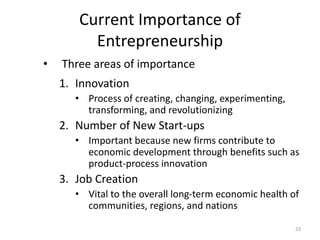
Current Importance of
Entrepreneurship
• Three areas of importance
1. Innovation
• Process of creating, changing, experimenting,
transforming, and revolutionizing
2. Number of New Start-ups
• Important because new firms contribute to
economic development through benefits such as
product-process innovation
3. Job Creation
• Vital to the overall long-term economic health of
communities, regions, and nations
• Entrepreneurship is the dynamic need of a
developing nation and sustains the process of
economic development in the following ways:
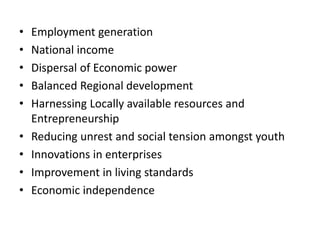
• Employment generation
• National income
• Dispersal of Economic power
• Balanced Regional development
• Harnessing Locally available resources and
Entrepreneurship
• Reducing unrest and social tension amongst youth
• Innovations in enterprises
• Improvement in living standards
• Economic independence
Entrepreneurial Environment
• Entrepreneurial Environment is a combination of
factors that play a role in the development of
entrepreneurship.
• First, it refers to the overall economic, socio-
cultural, and political factors that influence
people’s willingness and ability to undertake
entrepreneurial activities.
• Second, it refers to the availability of assistance
and support services that facilitate the start-up
process.
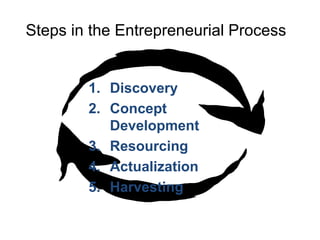
Steps in the Entrepreneurial Process
1. Discovery
2. Concept
Development
3. Resourcing
4. Actualization
5. Harvesting
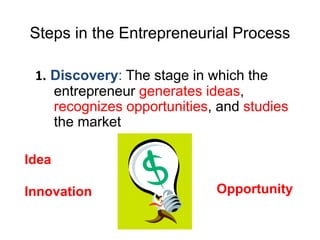
Steps in the Entrepreneurial Process
1. Discovery: The stage in which the
entrepreneur generates ideas,
recognizes opportunities, and studies
the market
Idea
OpportunityInnovation
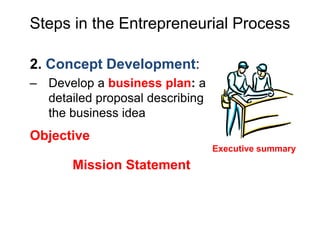
Steps in the Entrepreneurial Process
2. Concept Development:
– Develop a business plan: a
detailed proposal describing
the business idea
Executive summary
Objective
Mission Statement
Steps in the Entrepreneurial Process
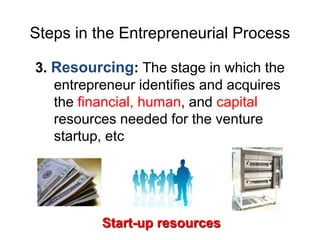
3. Resourcing: The stage in which the
entrepreneur identifies and acquires
the financial, human, and capital
resources needed for the venture
startup, etc
Start-up resources
Steps in the Entrepreneurial
Process
4. Actualization: The stage in which
the entrepreneur operates the
business and utilizes resources to
achieve its goals/objectives.
$$ Grand Opening $$
Day-to-Day Operations
Steps in the Entrepreneurial
Process
5. Harvesting: The stage in which the
entrepreneur decides on business’s
future growth/ development, or
demise
What is your 5-year or 10-year plan?
Consider adding locations or providing different products/services
Will you go public?

1. entrepreneur & entreprenurship

  • 1.
    Meaning of entrepreneur •An entrepreneur is a person who has already started or is in the process of starting an enterprise. Definition • Joseph Schumpeter ”Entrepreneur is an innovator who brings economic development through new combinations of factors of production”.
  • 2.
    Definitions • Webster’s dictionary “one who organizes, manages and assumes the risk of a business or Enterprise”. • A. H.Cole “ Entrepreneurship is a purposeful activity of an individual or a group of associated individuals, undertaken to initiate, maintain or organize profit oriented business unit for the production and distribution of economic goods and service.
  • 3.
    Introduction to Entrepreneurship •What is Entrepreneurship? – Entrepreneurship is the process of creating something new of value by devoting (giving) the necessary time and effort. – By accepting and acknowledging the necessary financial, psychological, and social risks, and – Finally receiving the resulting rewards be it monetary and personal satisfaction and freedom to do what you want. Robert D.Hisrich, M. Peters & D.A Shepherd
  • 4.
    ENTREPRENEURSHIP • Is theprocess by which individuals pursue opportunities without regard to resources they currently control. • The essence of entrepreneurial behavior is identifying and putting useful ideas into practice. • The task typically requires creativity, drive and willingness to take risks that can be accomplished by either an individual or a group
  • 5.
    Entrepreneurship Process of creatingsomething new & assuming the risks & rewards - Creation Process (for entrepreneur & audiences) - Devotion of time & effort - Assuming Risks (Financial, Psychological & Social) - Rewards (Independence, satisfaction & monetary rewards)
  • 6.
    Historical Evolution OfEntrepreneurship  Earliest Period  Middle Ages  17th Century  18th Century  19th & 20th Century
  • 7.
    EARLIEST PERIOD  theearliest definition of entrepreneur may be related to the person (merchant – adventurer) who attempted to establish trade routes to the far east  they would sign a contract with money person to sell his goods.  the capitalist was a passive risk bearer.  merchant adventurer took the active role in trading bearing all the physical and emotional risks while the capitalist was a passive risk bearer.  when he completes the trip, the profits divided (capitalist – 75% , adventurer – remaining 25%)
  • 8.
    MIDDLE AGES • theterm was used to describe both an actor and a person who managed large production projects • did not take any risks but merely managed using the resources provided usually by the government of the country • a typical entrepreneur in the middle ages was cleric – the person in charge of great architectural works, such as castles and fortifications, public buildings, abbeys and cathedrals
  • 9.
    • 18th Century: –1725: RICHARD CANTILLION ( person bearing risks is different from one supplying capital) • 19th Century: – 1803: JEAN BAPTISTE SAY (separated profits of entrepreneur from profits of capital) – 1876: FRANCIS WALKER (distinguished between those who supplied funds and received interest and those who received profit from managerial capabilities)
  • 10.
    • 20th Century: –1934: JOSEPH SCHUMPETER (entrepreneur is an innovator and develops untried technology) – 1961: DAVID McClelland (entrepreneur is an energetic, moderate risk taker) – 1964: PETER DRUCKER (maximizes opportunities)
  • 11.
    – 1975: ALBERTSHAPERO (takes initiative, organizes some social and economic mechanisms, and accepts risks of failure) – 1980: KARL VESPER (entrepreneur seen differently by economists, psychologists, business persons and politicians) – 1983: GIFFORD PINCHOT (intrapreneur is an entrepreneur within an already established organization)
  • 12.
    Characteristics or PersonalCompetency of an Entrepreneur. Initiative Sees and Acts on Opportunities Persistence Information seeking Concern for High Quality Work and Output – Increased Productivity. Commitment to Work Contract Efficiency Orientation Systematic and organized planning Problem Solving Self Confidence Assertiveness – Negotiation with suppliers & customers Persuasive & Influential – Peers and stakeholders Inspirational - employees Effective Communicator – external & internal of organization
  • 13.
    Main features ofentrepreneurship An economic activity A Creative activity An innovative function A dynamic process An organizing function A risk bearing function A gap filling function A goal oriented activity
  • 14.
    Common Characteristics ofEntrepreneurs •Commitment, determination, and perseverance •Drive to achieve •Opportunity orientation •Initiative and responsibility •Persistent problem solving •Seeking feedback •Internal locus of control •Tolerance for ambiguity •Calculated risk taking •Tolerance for failure •High energy level •Creativity and Innovativeness •Vision •Self-confidence and optimism •Independence •Team building
  • 15.
    Entrepreneurial Characteristics –Indian Perspective 1. Vision : Dream and visualizing the ways and means to achieve, visualizing market demands, socio-economic and technological environment  Without the vision of making a big mark on the mobile industry Dhirubhai and now Anil Ambani could not have made what Reliance Communication (An Anil Dhirubhai Ambani Group) is today. 2. Knowledge : Conceptual knowledge and technicalities of technological, operational, financial & market dynamics.  Without sound knowledge of computers Naryanmurthy could not have made Infosys.
  • 16.
    3. Desire toSucceed  Constantly work to achieve higher goals.  Without a desire to succeed constantly Mukesh Ambani would not have planned to ventured into Retail, Real Estates and Biotech. 4. Independence  Needs independence in work and decision making without following rules of thumb and make their own rules and destiny.  Without a desire for independence, Sabeer Bhatia would not have quit his job to start enterprise own his own and created Hotmail.com and Arzoo.com
  • 17.
    5. Optimism  Highlyoptimistic about achieving their vision.  Without optimism Narayanmurthy (who took loan from his wife as not having enough finances) would not have left a lucrative job and created Infosys. 6. Value Addition  Not rule of thumb , but a constant desire to introduce something new to existing business.  Create, innovate or even add value to the existing products.  Without value addition of ‘life time free incoming calls’ Tata Indicom would not have been able to create space in already saturated mobile markets.
  • 18.
    7. Leadership  Exhibitsqualities of a leader -Good Planners, Organizers, Good Communication Skills, Empathetic toward their employees, good decision-makers, initiative to implement plans, result oriented 8. Hard working  At time also called as workaholics.  Continuous efforts to achieve success and know that there is no substitute for hard work 9. Desire to control over their own fate  Do not move in herds like sheep but pave own paths.  Do not believe in luck or destiny but create their own destiny.
  • 19.
    Attributes and Skills These so called entrepreneurial characteristics can be looked at to determine a set of skills useful for entrepreneur to possess. Group Skills –work and learn together, task force, project teams Technical Skills – technological, writing, mgt, organizing. Business mgt skills, DM and analytical skills Personal Entrepreneurial Skills- risk, innovative, visionary, persistent, manage change.
  • 20.
    20 Types of Entrepreneurs •Novice Entrepreneur – Has no prior business ownership experiences as a business founder, inheritor, or purchaser • Habitual Entrepreneur – Has prior business ownership experience • Nascent Entrepreneur – In the process of starting a new business – Can be either a novice or a habitual entrepreneur
  • 21.
    21 Types of Entrepreneurs(cont’d) • Serial Entrepreneur – Has sold or closed an original business and establishes another new business – Continues the cycle of selling/closing and establishing • Portfolio Entrepreneur – Retains an original business and builds a portfolio of additional businesses • Through inheriting, establishing, and purchasing the businesses
  • 23.
    23 Current Importance of Entrepreneurship •Three areas of importance 1. Innovation • Process of creating, changing, experimenting, transforming, and revolutionizing 2. Number of New Start-ups • Important because new firms contribute to economic development through benefits such as product-process innovation 3. Job Creation • Vital to the overall long-term economic health of communities, regions, and nations
  • 24.
    • Entrepreneurship isthe dynamic need of a developing nation and sustains the process of economic development in the following ways:
  • 25.
    • Employment generation •National income • Dispersal of Economic power • Balanced Regional development • Harnessing Locally available resources and Entrepreneurship • Reducing unrest and social tension amongst youth • Innovations in enterprises • Improvement in living standards • Economic independence
  • 26.
    Entrepreneurial Environment • EntrepreneurialEnvironment is a combination of factors that play a role in the development of entrepreneurship. • First, it refers to the overall economic, socio- cultural, and political factors that influence people’s willingness and ability to undertake entrepreneurial activities. • Second, it refers to the availability of assistance and support services that facilitate the start-up process.
  • 27.
    Steps in theEntrepreneurial Process 1. Discovery 2. Concept Development 3. Resourcing 4. Actualization 5. Harvesting
  • 28.
    Steps in theEntrepreneurial Process 1. Discovery: The stage in which the entrepreneur generates ideas, recognizes opportunities, and studies the market Idea OpportunityInnovation
  • 29.
    Steps in theEntrepreneurial Process 2. Concept Development: – Develop a business plan: a detailed proposal describing the business idea Executive summary Objective Mission Statement
  • 30.
    Steps in theEntrepreneurial Process 3. Resourcing: The stage in which the entrepreneur identifies and acquires the financial, human, and capital resources needed for the venture startup, etc Start-up resources
  • 31.
    Steps in theEntrepreneurial Process 4. Actualization: The stage in which the entrepreneur operates the business and utilizes resources to achieve its goals/objectives. $$ Grand Opening $$ Day-to-Day Operations
  • 32.
    Steps in theEntrepreneurial Process 5. Harvesting: The stage in which the entrepreneur decides on business’s future growth/ development, or demise What is your 5-year or 10-year plan? Consider adding locations or providing different products/services Will you go public?