E-COMMERCE
(DR.SELVAMOHANA.K)
Introduction to E-commerce
Traditional Commerce-Meaning
• Commerce refers to the buying and selling of goods and
services for money or in kind.
• It is a branch of business. It includes all the processes that
have to do with the exchange of products and services.
• The term usually refers to doing business on a large scale.
Specifically, on a scale large enough to require
transportation from seller to buyer.
• The transportation may be across a town, a state or
county, or from country-to-country.
E-commerce-Meaning
• Electronic commerce, or e-commerce, is a type
of business model, that enables a firm or individual to
conduct business over an electronic network,
typically the internet.
• Electronic commerce operates in all four of the major
market segments:
• business to business, business to consumer, consumer
to consumer, and consumer to business.
• Electronics Commerce is a methodology of modern
business, which addresses the need of business
organizations, vendors and customers
• It reduce cost and improve the quality of goods and
services while increasing the speed of delivery.
• Ecommerce refers to the paperless exchange of
business information using the following ways
 Electronic Data Exchange (EDI)
 Electronic Mail (e-mail)
 Electronic Fund Transfer (EFT)
 Other Network-based technologies
Features of E-commerce
• Non-Cash Payment − E-Commerce enables the use of
credit cards, debit cards, smart cards, electronic fund
transfer via bank's website, and other modes of electronics
payment.
• 24x7 Service availability − E-commerce automates the
business of enterprises and the way they provide services to
their customers. It is available anytime, anywhere.
• Advertising / Marketing − E-commerce increases the
reach of advertising of products and services of businesses.
It helps in better marketing management of
products/services.
• Improved Sales − Using e-commerce, orders for the
products can be generated anytime, anywhere without any
human intervention. It gives a big boost to existing sales
volumes.
• Support − E-commerce provides various ways to
provide pre-sales and post-sales assistance to provide
better services to customers.
• Inventory Management − E-commerce automates
inventory management. Reports get generated
instantly when required. Product inventory
management becomes very efficient and easy to
maintain.
• Communication improvement − E-commerce
provides ways for faster, efficient, reliable
communication with customers and partners.
E-Commerce advantages
E-Commerce advantages can be broadly
classified in three major categories
• Advantages to Organizations
• Advantages to Consumers
• Advantages to Society
Advantages to Organizations
• Organizations can expand their market to national and
international markets with minimum capital investment.
• An organization can easily locate more customers, best
suppliers, and suitable business partners across the globe.
• E-commerce helps organizations to reduce the cost to
create process, distribute, retrieve and manage the paper
based information by digitizing the information.
• E-commerce improves the brand image of the company.
• E-commerce helps organization to provide better customer
services.
• E-commerce helps to simplify the business processes
and makes them faster and efficient.
• E-commerce reduces the paper work.
• E-commerce increases the productivity of
organizations.
• It supports "pull" type supply management.
• In "pull" type supply management, a business process
starts when a request comes from a customer and it uses
just-in-time manufacturing way.
Advantages to Customers
• It provides 24x7 support. Customers can enquire about a
product or service and place orders anytime, anywhere from
any location.
• E-commerce application provides users with more options
and quicker delivery of products.
• E-commerce application provides users with more options
to compare and select the cheaper and better options.
• A customer can put review comments about a product and
can see what others are buying, or see the review comments
of other customers before making a final purchase.
• It provides readily available information.
• A customer can see the relevant detailed
information within seconds, rather than waiting
for days or weeks.
• E-Commerce increases the competition among
organizations and as a result, organizations
provides substantial discounts to customers.
Advantages to Society
• Customers need not travel to shop a product, thus less
traffic on road and low air pollution.
• E-commerce helps in reducing the cost of products,
so less affluent people can also afford the products.
• E-commerce has enabled rural areas to access
services and products, which are otherwise not
available to them.
• E-commerce helps the government to deliver public
services such as healthcare, education, social services
at a reduced cost and in an improved manner.
Disadvantages of e-commerce
• Technical disadvantages
• Non-Technical disadvantages
Technical Disadvantages
• There can be lack of system security, reliability or
standards owing to poor implementation of e-commerce.
• The software development industry is still evolving and
keeps changing rapidly.
• In many countries, network bandwidth might cause an
issue.
• Special types of web servers or other software might be
required by the vendor, setting the e-commerce environment
apart from network servers.
• Sometimes, it becomes difficult to integrate an
e-commerce software or website with existing
applications or databases.
• There could be software/hardware
compatibility issues, as some e-commerce
software may be incompatible with some
operating system or any other component.
Non-Technical Disadvantages
• Initial cost − The cost of creating/building an e-
commerce application in-house may be very high.
• There could be delays in launching an e-Commerce
application due to mistakes, and lack of experience.
• User resistance − Users may not trust the site being an
unknown faceless seller.
• Such mistrust makes it difficult to convince traditional
users to switch from physical stores to online/virtual
stores.
• Security/ Privacy − It is difficult to ensure the security
or privacy on online transactions.
• Lack of touch or feel of products during online
shopping is a drawback.
• E-commerce applications are still evolving and
changing rapidly.
• Internet access is still not cheaper and is
inconvenient to use for many potential customers,
for example, those living in remote villages.
E-commerce business models
• Business - to - Business (B2B)
• Business - to - Consumer (B2C)
• Consumer - to - Consumer (C2C)
• Consumer - to - Business (C2B)
• Business - to - Government (B2G)(application
submission)
• Government - to - Business (G2B)(auction,
tender, purpose)
• Government - to - Citizen (G2C)(birth, death
registrations etc..)
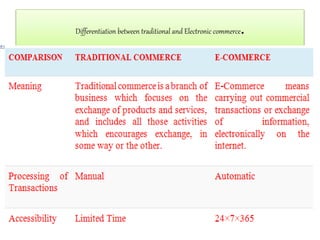
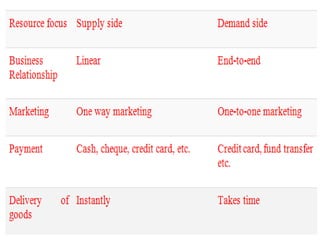
Differentiation between traditional and Electronic commerce.
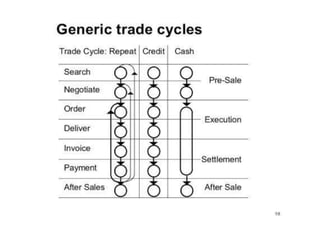
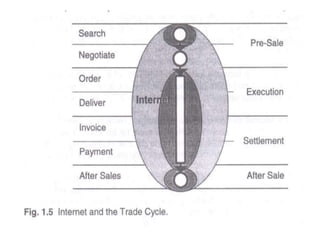
• A trade cycle is the series of exchanges,
between a customer and supplier that take
place when a commercial exchange is
executed. A general trade cycle consists of:
• Pre-Sales: Finding a supplier and agreeing the
terms.
• Execution: Selecting goods and taking
delivery.
• Settlement: Invoice (if any) and payment.
• After-Sales: Following up complaints or
providing maintenance.
EDI-ELECTRONIC DATA
INTERCHANGE
• EDI or Electronic Data Interchange is the
virtual exchange of data or business documents
in electronic format between trading partners.
• This exchange of documents is generally
between buyer and supplier and consists of
transferring purchase orders, invoices,
payments, shipping notices and various other
documents
• And by nature eliminates paper trails,
improves operational efficiency and enhances
virtual exchanges with new trading partners.
• With EDI, any company can virtually interact
with another organization anywhere in the
world without the hassle of waiting times and
forecasting future procedures.
The process flow
• EDI replaces the manual processes involved in
ordering and distribution,
• creating easy electronic trading between both
buyer and supplier.
• EDI eliminates waiting times associated with
manual processing, provides users with real-
time product and stock level information,
• creates benchmarks for future sales forecasting
and reduces overheads by creating an efficient
business process.
Benefits of EDI
• By implementing EDI, companies could add
value to their organization by automatically
processing information, reducing clerical tasks
and eliminating data entry errors.
• Using EDI for the end-to-end use of electronic
transactions throughout the business cycle results
in significant savings in time and resources.
• Current trading partners benefit from the
uninterrupted flow of information
• and availability of the technology opens doors for
new business opportunities.
Other benefits include
Minimal paper usage
• EDI reduces associated expenses of storage,
printing, postage, mailing and recycling
Enhanced quality of data
• EDI minimizes data entry errors, improves
accounts payable/receivable times as processes
become streamlined and can be used for
forecasting
Improved turnaround times
• Business cycle is improved and stock levels are kept
constantly up to date and visible
Improved timelines
• EDI transfer ensures real-time processing and
eliminates times associated with manually sending,
receiving and entering orders
Costs saving in operational efficiency
• EDI reduces the time it takes staff to manually create
invoices and process purchase orders and increases
efficiency in operations
Helps create a greener world
• EDI eliminates paper trails and ensures paper usage is
kept to a minimum
HISTORY OF E-COMMERCE
2005 to present
Major reforms that have taken place in the E-Commerce
industry between these years are-
• Large retailers are pushed to sell online
• Small businesses have seen a rise, with local sellers now
operating from social media platforms
• Operational costs have lowered down in the B2B sector
• Parcel delivery costs have seen a significant rise with
growing E-Commerce industry
• Several ecommerce marketplaces have emerged
enabling more sellers to sell online
• Logistics has evolved with the introduction of
automation tools and artificial intelligence
• Social media has become a tool to increase sales and
market brand
• The buying habits of customers have significantly
changed.
The impact of E-commerce on organisational structure and HRM
• E-commerce had a great impact on organisational
structure, there is “no one size fits for all” approach,
and there are some common factors to ensure the
organisational structure.
• Complexity of business: The number of categories of
products the company manufactures and extent to
which it operates across the consumer segments will
influence the model
• Maturity of E-commerce: how mature a company is
in e-commerce will affect the model, grew up company
will in-house with their built-in capability but for
starters ,outsourcing dependence will be there.
• Size and ambition of business: Integrated
organizational model will be implemented for
large firms with strong ambitions to grow
with e-commerce.
• Co-culture: Collaborative culture and
transversal ways of working will naturally
come together and take a more multi-
functional approach to the major E-platforms.
The impact of E-commerce on HRM
E-HRM is the integration of all HR systems
and activities using the web based
technologies.
• E-recruitment- The process of hiring the
potential candidates for the vacant job
positions, using the electronic resources,
particularly the internet.
• E-selection instantly provides an accurate
picture of a candidate's fitness for filling a
specific position.
• E-learning- E-learning can also be termed as
a network enabled transfer of skills and
knowledge, and the delivery of education is
made to a large number of recipients at the
same or different times.
• E-training- The delivery of
a learning, training or education program by
electronic means.
• E-learning involves the use of a computer or
electronic device (e.g. a mobile phone) in
some way to provide training, educational
or learning material.
limitations of traditional commerce gets vanished out through
E-commerce
• Immediacy - no going to the shops or waiting in
queues
• price - goods bought online tend to be cheaper
• choice - the range of goods available is vast and
with sites that let as compare goods from many
retailers it is easy to find what customer want
• 24-hour availability - the shop never closes
• speed – we can locate what we want much
quicker
• Global markets - neither customer nor the
vendor are restricted to their locality
• Interactivity - get immediate feedback on
prices, features etc..
• Less paperwork - always a good thing!
scope of E-commerce
Electronic Markets:
• An electronic market is the use of information
and communications technology to present a
range of offerings available in a market
segment
• so that the purchasers can compare the prices
(and other attributes) of the offerings and make
a purchase decision.
Electronic DataInterchange (EDI):
• EDI provides a standardized system for coding
trade transactions so that they can be
communicated directly from one computer system
to another
• without the need for printed orders and invoices
and the delays and errors implicit in paper
handling.
• EDI is used by organizations that make a large
number of regular transactions.
• One sector where EDI is extensively used is the
large supermarket chains which use EDI for
transactions with their suppliers.
Internet Commerce:
• Information and communications technologies
can also be used to advertise and make sales of a
wide range of goods and services.
• This type of e-Commerce is typified by the
commercial use of the Internet.
• The Internet can, for example, be used for the
purchase of books that are then delivered by post
or the booking of tickets that can be picked up by
the clients when they arrive at the event.
• It is to be noted that the Internet is not the only
technology used for this type of service and this is
not the only use of the Internet in e-Commerce
different E-commerce categories
E-auctioning:
• The electronic auction is an e-business between
auctioneers and bidders, which takes place on
an electronic marketplace.
• It is an electronic commerce which occurs
business to business (B2B), business to consumer
(B2C), or consumer-to-consumer (C2C).
Two types of E-auction are,
• 1. Forward auction- several buyers bid for one
sellers goods.
• 2. Backward auction- Several sellers bid for one
buyers order.
E-Franchising
E-Franchising operation, Franchisor/owner sells rights to
use his brand to an entrepreneur called franchisee, in
return franchisee agree to follow franchisor’s business
model and pay royalty based on sales percentage.
E-Gambling
E-gambling is a means of using internet to place bets on
casino, games, sports etc. bets usually placed through
credit cards and wins/losses paid accordingly.
E-mailing
A system for sending and receiving messages
electronically over a computer network. A message or
messages sent or received by such a system.
E-banking
• E-banking is online banking which enables easy, fast, safe, efficient access to
bank account and carry out 24 *7 at any place using internet as a means.
E-Directories
• Also called Netware Directory Services, Novell E-DIRECTORY
is directory service software that is used to centrally managing access to
resources on multiple servers and computers within a network.
• Directories are used to locate not only retail stores, but also businesses online.

E commerce

  • 1.
  • 2.
    Introduction to E-commerce TraditionalCommerce-Meaning • Commerce refers to the buying and selling of goods and services for money or in kind. • It is a branch of business. It includes all the processes that have to do with the exchange of products and services. • The term usually refers to doing business on a large scale. Specifically, on a scale large enough to require transportation from seller to buyer. • The transportation may be across a town, a state or county, or from country-to-country.
  • 3.
    E-commerce-Meaning • Electronic commerce,or e-commerce, is a type of business model, that enables a firm or individual to conduct business over an electronic network, typically the internet. • Electronic commerce operates in all four of the major market segments: • business to business, business to consumer, consumer to consumer, and consumer to business.
  • 4.
    • Electronics Commerceis a methodology of modern business, which addresses the need of business organizations, vendors and customers • It reduce cost and improve the quality of goods and services while increasing the speed of delivery. • Ecommerce refers to the paperless exchange of business information using the following ways  Electronic Data Exchange (EDI)  Electronic Mail (e-mail)  Electronic Fund Transfer (EFT)  Other Network-based technologies
  • 6.
    Features of E-commerce •Non-Cash Payment − E-Commerce enables the use of credit cards, debit cards, smart cards, electronic fund transfer via bank's website, and other modes of electronics payment. • 24x7 Service availability − E-commerce automates the business of enterprises and the way they provide services to their customers. It is available anytime, anywhere. • Advertising / Marketing − E-commerce increases the reach of advertising of products and services of businesses. It helps in better marketing management of products/services. • Improved Sales − Using e-commerce, orders for the products can be generated anytime, anywhere without any human intervention. It gives a big boost to existing sales volumes.
  • 7.
    • Support −E-commerce provides various ways to provide pre-sales and post-sales assistance to provide better services to customers. • Inventory Management − E-commerce automates inventory management. Reports get generated instantly when required. Product inventory management becomes very efficient and easy to maintain. • Communication improvement − E-commerce provides ways for faster, efficient, reliable communication with customers and partners.
  • 8.
    E-Commerce advantages E-Commerce advantagescan be broadly classified in three major categories • Advantages to Organizations • Advantages to Consumers • Advantages to Society
  • 9.
    Advantages to Organizations •Organizations can expand their market to national and international markets with minimum capital investment. • An organization can easily locate more customers, best suppliers, and suitable business partners across the globe. • E-commerce helps organizations to reduce the cost to create process, distribute, retrieve and manage the paper based information by digitizing the information. • E-commerce improves the brand image of the company. • E-commerce helps organization to provide better customer services.
  • 10.
    • E-commerce helpsto simplify the business processes and makes them faster and efficient. • E-commerce reduces the paper work. • E-commerce increases the productivity of organizations. • It supports "pull" type supply management. • In "pull" type supply management, a business process starts when a request comes from a customer and it uses just-in-time manufacturing way.
  • 11.
    Advantages to Customers •It provides 24x7 support. Customers can enquire about a product or service and place orders anytime, anywhere from any location. • E-commerce application provides users with more options and quicker delivery of products. • E-commerce application provides users with more options to compare and select the cheaper and better options. • A customer can put review comments about a product and can see what others are buying, or see the review comments of other customers before making a final purchase.
  • 12.
    • It providesreadily available information. • A customer can see the relevant detailed information within seconds, rather than waiting for days or weeks. • E-Commerce increases the competition among organizations and as a result, organizations provides substantial discounts to customers.
  • 13.
    Advantages to Society •Customers need not travel to shop a product, thus less traffic on road and low air pollution. • E-commerce helps in reducing the cost of products, so less affluent people can also afford the products. • E-commerce has enabled rural areas to access services and products, which are otherwise not available to them. • E-commerce helps the government to deliver public services such as healthcare, education, social services at a reduced cost and in an improved manner.
  • 14.
    Disadvantages of e-commerce •Technical disadvantages • Non-Technical disadvantages
  • 15.
    Technical Disadvantages • Therecan be lack of system security, reliability or standards owing to poor implementation of e-commerce. • The software development industry is still evolving and keeps changing rapidly. • In many countries, network bandwidth might cause an issue. • Special types of web servers or other software might be required by the vendor, setting the e-commerce environment apart from network servers.
  • 16.
    • Sometimes, itbecomes difficult to integrate an e-commerce software or website with existing applications or databases. • There could be software/hardware compatibility issues, as some e-commerce software may be incompatible with some operating system or any other component.
  • 17.
    Non-Technical Disadvantages • Initialcost − The cost of creating/building an e- commerce application in-house may be very high. • There could be delays in launching an e-Commerce application due to mistakes, and lack of experience. • User resistance − Users may not trust the site being an unknown faceless seller. • Such mistrust makes it difficult to convince traditional users to switch from physical stores to online/virtual stores. • Security/ Privacy − It is difficult to ensure the security or privacy on online transactions.
  • 18.
    • Lack oftouch or feel of products during online shopping is a drawback. • E-commerce applications are still evolving and changing rapidly. • Internet access is still not cheaper and is inconvenient to use for many potential customers, for example, those living in remote villages.
  • 19.
    E-commerce business models •Business - to - Business (B2B) • Business - to - Consumer (B2C) • Consumer - to - Consumer (C2C) • Consumer - to - Business (C2B) • Business - to - Government (B2G)(application submission) • Government - to - Business (G2B)(auction, tender, purpose) • Government - to - Citizen (G2C)(birth, death registrations etc..)
  • 20.
    Differentiation between traditionaland Electronic commerce.
  • 25.
    • A tradecycle is the series of exchanges, between a customer and supplier that take place when a commercial exchange is executed. A general trade cycle consists of: • Pre-Sales: Finding a supplier and agreeing the terms. • Execution: Selecting goods and taking delivery. • Settlement: Invoice (if any) and payment. • After-Sales: Following up complaints or providing maintenance.
  • 26.
    EDI-ELECTRONIC DATA INTERCHANGE • EDIor Electronic Data Interchange is the virtual exchange of data or business documents in electronic format between trading partners. • This exchange of documents is generally between buyer and supplier and consists of transferring purchase orders, invoices, payments, shipping notices and various other documents
  • 27.
    • And bynature eliminates paper trails, improves operational efficiency and enhances virtual exchanges with new trading partners. • With EDI, any company can virtually interact with another organization anywhere in the world without the hassle of waiting times and forecasting future procedures.
  • 28.
    The process flow •EDI replaces the manual processes involved in ordering and distribution, • creating easy electronic trading between both buyer and supplier. • EDI eliminates waiting times associated with manual processing, provides users with real- time product and stock level information, • creates benchmarks for future sales forecasting and reduces overheads by creating an efficient business process.
  • 30.
    Benefits of EDI •By implementing EDI, companies could add value to their organization by automatically processing information, reducing clerical tasks and eliminating data entry errors. • Using EDI for the end-to-end use of electronic transactions throughout the business cycle results in significant savings in time and resources. • Current trading partners benefit from the uninterrupted flow of information • and availability of the technology opens doors for new business opportunities.
  • 31.
    Other benefits include Minimalpaper usage • EDI reduces associated expenses of storage, printing, postage, mailing and recycling Enhanced quality of data • EDI minimizes data entry errors, improves accounts payable/receivable times as processes become streamlined and can be used for forecasting
  • 32.
    Improved turnaround times •Business cycle is improved and stock levels are kept constantly up to date and visible Improved timelines • EDI transfer ensures real-time processing and eliminates times associated with manually sending, receiving and entering orders
  • 33.
    Costs saving inoperational efficiency • EDI reduces the time it takes staff to manually create invoices and process purchase orders and increases efficiency in operations Helps create a greener world • EDI eliminates paper trails and ensures paper usage is kept to a minimum
  • 34.
  • 37.
    2005 to present Majorreforms that have taken place in the E-Commerce industry between these years are- • Large retailers are pushed to sell online • Small businesses have seen a rise, with local sellers now operating from social media platforms • Operational costs have lowered down in the B2B sector • Parcel delivery costs have seen a significant rise with growing E-Commerce industry
  • 38.
    • Several ecommercemarketplaces have emerged enabling more sellers to sell online • Logistics has evolved with the introduction of automation tools and artificial intelligence • Social media has become a tool to increase sales and market brand • The buying habits of customers have significantly changed.
  • 39.
    The impact ofE-commerce on organisational structure and HRM • E-commerce had a great impact on organisational structure, there is “no one size fits for all” approach, and there are some common factors to ensure the organisational structure. • Complexity of business: The number of categories of products the company manufactures and extent to which it operates across the consumer segments will influence the model • Maturity of E-commerce: how mature a company is in e-commerce will affect the model, grew up company will in-house with their built-in capability but for starters ,outsourcing dependence will be there.
  • 40.
    • Size andambition of business: Integrated organizational model will be implemented for large firms with strong ambitions to grow with e-commerce. • Co-culture: Collaborative culture and transversal ways of working will naturally come together and take a more multi- functional approach to the major E-platforms.
  • 41.
    The impact ofE-commerce on HRM E-HRM is the integration of all HR systems and activities using the web based technologies. • E-recruitment- The process of hiring the potential candidates for the vacant job positions, using the electronic resources, particularly the internet. • E-selection instantly provides an accurate picture of a candidate's fitness for filling a specific position.
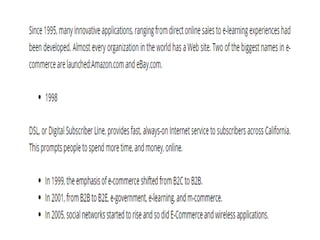
  • 42.
    • E-learning- E-learningcan also be termed as a network enabled transfer of skills and knowledge, and the delivery of education is made to a large number of recipients at the same or different times. • E-training- The delivery of a learning, training or education program by electronic means. • E-learning involves the use of a computer or electronic device (e.g. a mobile phone) in some way to provide training, educational or learning material.
  • 43.
    limitations of traditionalcommerce gets vanished out through E-commerce • Immediacy - no going to the shops or waiting in queues • price - goods bought online tend to be cheaper • choice - the range of goods available is vast and with sites that let as compare goods from many retailers it is easy to find what customer want • 24-hour availability - the shop never closes • speed – we can locate what we want much quicker
  • 44.
    • Global markets- neither customer nor the vendor are restricted to their locality • Interactivity - get immediate feedback on prices, features etc.. • Less paperwork - always a good thing!
  • 45.
  • 46.
    Electronic Markets: • Anelectronic market is the use of information and communications technology to present a range of offerings available in a market segment • so that the purchasers can compare the prices (and other attributes) of the offerings and make a purchase decision.
  • 47.
    Electronic DataInterchange (EDI): •EDI provides a standardized system for coding trade transactions so that they can be communicated directly from one computer system to another • without the need for printed orders and invoices and the delays and errors implicit in paper handling. • EDI is used by organizations that make a large number of regular transactions. • One sector where EDI is extensively used is the large supermarket chains which use EDI for transactions with their suppliers.
  • 48.
    Internet Commerce: • Informationand communications technologies can also be used to advertise and make sales of a wide range of goods and services. • This type of e-Commerce is typified by the commercial use of the Internet. • The Internet can, for example, be used for the purchase of books that are then delivered by post or the booking of tickets that can be picked up by the clients when they arrive at the event. • It is to be noted that the Internet is not the only technology used for this type of service and this is not the only use of the Internet in e-Commerce
  • 49.
    different E-commerce categories E-auctioning: •The electronic auction is an e-business between auctioneers and bidders, which takes place on an electronic marketplace. • It is an electronic commerce which occurs business to business (B2B), business to consumer (B2C), or consumer-to-consumer (C2C). Two types of E-auction are, • 1. Forward auction- several buyers bid for one sellers goods. • 2. Backward auction- Several sellers bid for one buyers order.
  • 50.
    E-Franchising E-Franchising operation, Franchisor/ownersells rights to use his brand to an entrepreneur called franchisee, in return franchisee agree to follow franchisor’s business model and pay royalty based on sales percentage. E-Gambling E-gambling is a means of using internet to place bets on casino, games, sports etc. bets usually placed through credit cards and wins/losses paid accordingly. E-mailing A system for sending and receiving messages electronically over a computer network. A message or messages sent or received by such a system.
  • 51.
    E-banking • E-banking isonline banking which enables easy, fast, safe, efficient access to bank account and carry out 24 *7 at any place using internet as a means. E-Directories • Also called Netware Directory Services, Novell E-DIRECTORY is directory service software that is used to centrally managing access to resources on multiple servers and computers within a network. • Directories are used to locate not only retail stores, but also businesses online.