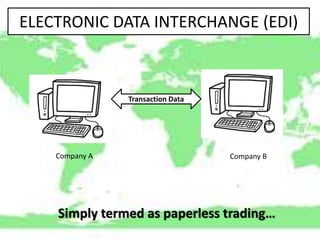
Company A Company B
Transaction Data
ELECTRONIC DATA INTERCHANGE (EDI)
Simply termed as paperless trading…
Components
• Definitions
• Trade Cycle
• Paper Document Interchange
• Electronic Data Interchange
• Steps in EDI System
• Benefits of EDI
• Advantages of EDI
• Disadvantages of EDI
• Summary
EDI Defination….
EDI is the computer-to-computer exchange of routine business
documents (data) in a standard format between companies.
EDI is the exchange of documents in standardized electronic
form, between organizations, in an automated manner, directly
from a computer application in one organization to an
application in another organization
International Data Exchange Association (IDEA) formally define
EDI as:
“The transfer of structured data, by agreed message standards,
from one computer system to another, by electronic means”.
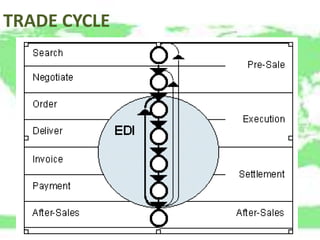
TRADE CYCLE
Paper Document Interchange
Electronic Data Interchange
Steps in an EDI System
Following are the steps in an EDI System.
• A program generates a file that contains the
processed document.
• The document is converted into an agreed
standard format.
• The file containing the document is sent
electronically on the network.
• The trading partner receives the file.
• An acknowledgement document is generated
and sent to the originating organization.
Benefits of EDI
The benefits of EDI include:
• Time savings and associated financial savings
accrued,
• Improved accuracy,
• Improved trading partner relationships and client
interactions,
• Improved reconciliation of transactions
exchanged.
Advantages of an EDI System
Following are the advantages of having an EDI system.
• Reduction in data entry errors. − Chances of errors are much less while
using a computer for data entry.
• Shorter processing life cycle − Orders can be processed as soon as they are
entered into the system. It reduces the processing time of the transfer
documents.
• Electronic form of data − It is quite easy to transfer or share the data, as it
is present in electronic format.
• Reduction in paperwork − As a lot of paper documents are replaced with
electronic documents, there is a huge reduction in paperwork.
• Cost Effective − As time is saved and orders are processed very effectively,
EDI proves to be highly cost effective.
• Standard Means of communication − EDI enforces standards on the
content of data and its format which leads to clearer communication.
Following are the disadvantages of having an EDI system.
• Trading Partners Involvement – Highly dependence on the participation of
trading partners. You need to be confident that they will do their part. EDI will
be meaningless if your trading partner didn't get involved using EDI system
effectively
• Costly for smaller companies – Many small companies are facing resources
problems in getting starter with the initial implementation of EDI system. It is
beyond the resources these companies to invest tens or hundreds of
thousands of dollars in setting and implementation costs, as well as weeks of
personnel training, to get an EDI system running
• Difficult to agree on standard to be used –Even though there are widely-
accepted and used standards, there are no ways to force trading partners to
accept these standards. Cooperation between trading partners is needed in
order to develop a common rules to avoid differences in interpretation.
Disadvantages of an EDI System
Eventually more and more business
transactions will migrate to the World Wide
Web due to the ease of access to this medium.
Deciding which transactions are best suited for
EDI over the Internet will be a function of
accessibility, data security/privacy, and the
means of communication. These three areas
should be studied carefully when proceeding
with large-scale EDI or E-Commerce initiatives.
Summary
Edi

Edi

  • 1.
    Company A CompanyB Transaction Data ELECTRONIC DATA INTERCHANGE (EDI) Simply termed as paperless trading…
  • 2.
    Components • Definitions • TradeCycle • Paper Document Interchange • Electronic Data Interchange • Steps in EDI System • Benefits of EDI • Advantages of EDI • Disadvantages of EDI • Summary
  • 3.
    EDI Defination…. EDI isthe computer-to-computer exchange of routine business documents (data) in a standard format between companies. EDI is the exchange of documents in standardized electronic form, between organizations, in an automated manner, directly from a computer application in one organization to an application in another organization International Data Exchange Association (IDEA) formally define EDI as: “The transfer of structured data, by agreed message standards, from one computer system to another, by electronic means”.
  • 4.
  • 5.
  • 6.
  • 7.
    Steps in anEDI System Following are the steps in an EDI System. • A program generates a file that contains the processed document. • The document is converted into an agreed standard format. • The file containing the document is sent electronically on the network. • The trading partner receives the file. • An acknowledgement document is generated and sent to the originating organization.
  • 8.
    Benefits of EDI Thebenefits of EDI include: • Time savings and associated financial savings accrued, • Improved accuracy, • Improved trading partner relationships and client interactions, • Improved reconciliation of transactions exchanged.
  • 9.
    Advantages of anEDI System Following are the advantages of having an EDI system. • Reduction in data entry errors. − Chances of errors are much less while using a computer for data entry. • Shorter processing life cycle − Orders can be processed as soon as they are entered into the system. It reduces the processing time of the transfer documents. • Electronic form of data − It is quite easy to transfer or share the data, as it is present in electronic format. • Reduction in paperwork − As a lot of paper documents are replaced with electronic documents, there is a huge reduction in paperwork. • Cost Effective − As time is saved and orders are processed very effectively, EDI proves to be highly cost effective. • Standard Means of communication − EDI enforces standards on the content of data and its format which leads to clearer communication.
  • 10.
    Following are thedisadvantages of having an EDI system. • Trading Partners Involvement – Highly dependence on the participation of trading partners. You need to be confident that they will do their part. EDI will be meaningless if your trading partner didn't get involved using EDI system effectively • Costly for smaller companies – Many small companies are facing resources problems in getting starter with the initial implementation of EDI system. It is beyond the resources these companies to invest tens or hundreds of thousands of dollars in setting and implementation costs, as well as weeks of personnel training, to get an EDI system running • Difficult to agree on standard to be used –Even though there are widely- accepted and used standards, there are no ways to force trading partners to accept these standards. Cooperation between trading partners is needed in order to develop a common rules to avoid differences in interpretation. Disadvantages of an EDI System
  • 11.
    Eventually more andmore business transactions will migrate to the World Wide Web due to the ease of access to this medium. Deciding which transactions are best suited for EDI over the Internet will be a function of accessibility, data security/privacy, and the means of communication. These three areas should be studied carefully when proceeding with large-scale EDI or E-Commerce initiatives. Summary

Editor's Notes

  • #5 A trade cycle is the series of exchanges, between a customer and supplier, that take place when a commercial exchange is executed. A general trade cycle consists of: Pre-Sales: Finding a supplier and agreeing the terms. Execution: Selecting goods and taking delivery. Settlement: Invoice (if any) and payment. After-Sales: Following up complaints or providing maintenance. For business-to-business transactions the trade cycle typically involves the provision of credit with execution preceding settlement whereas in consumer-to-business these two steps are typically co-incident. The nature of the trade cycle can indicate the e-Commerce technology most suited to the exchange. Commercial transactions that are repeated on a regular basis, such as supermarkets replenishing their shelves, is one category of trade cycle. EDI is the e-Commerce technology appropriate to these exchanges,
  • #6 Old way of doing business involves paper document interchange. Problems with this process: Time to process a paper document , Time to send paper document through mail, Mailing costs, Time to re-enter data several times , Increased opportunity for errors due to re-entry of data ,Time to file and manage document storage, Space required for document storage
  • #7 Electronic interchange between the computer and an electronic post office eliminates these problems, Information is exchanged via electronic post office or VAN