Edema
Ⅰ. concept
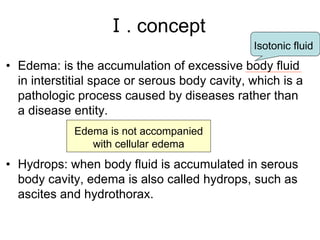
• Edema: is the accumulation of excessive body fluid
in interstitial space or serous body cavity, which is a
pathologic process caused by diseases rather than
a disease entity.
• Hydrops: when body fluid is accumulated in serous
body cavity, edema is also called hydrops, such as
ascites and hydrothorax.
Isotonic fluid
Edema is not accompanied
with cellular edema
Ⅱ. classification
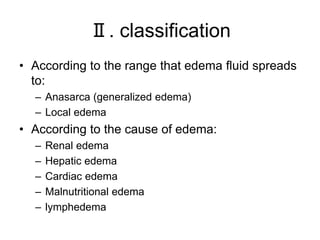
• According to the range that edema fluid spreads
to:
– Anasarca (generalized edema)
– Local edema
• According to the cause of edema:
– Renal edema
– Hepatic edema
– Cardiac edema
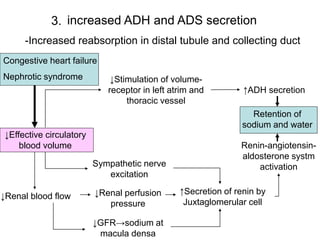
– Malnutritional edema
– lymphedema
Ⅲ. Etiology and pathogenesis
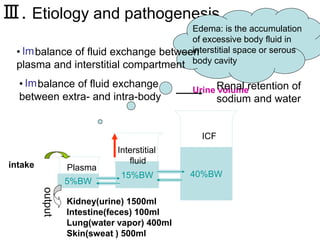
40%BW15%BW
5%BW
Interstitial
fluid
Plasma
ICF
吸收水分
intake
Edema: is the accumulation
of excessive body fluid in
interstitial space or serous
body cavity
• balance of fluid exchange between
plasma and interstitial compartment
• balance of fluid exchange
between extra- and intra-body
Urine volume
Im
Im Renal retention of
sodium and water
Kidney(urine) 1500ml
Intestine(feces) 100ml
Lung(water vapor) 400ml
Skin(sweat ) 500ml
output
(Ⅰ). imbalance of fluid exchange between
plasma and interstitial compartment
capillaries
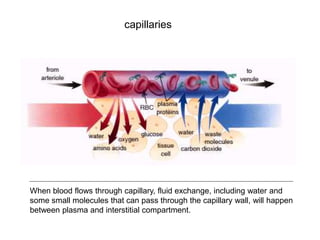
When blood flows through capillary, fluid exchange, including water and
some small molecules that can pass through the capillary wall, will happen
between plasma and interstitial compartment.
Figure 7-7
Total Pressure Differences Inside and Outside Capillary
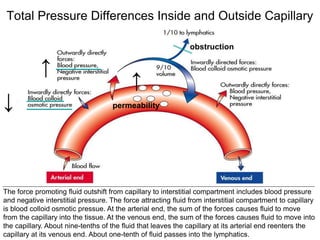
The force promoting fluid outshift from capillary to interstitial compartment includes blood pressure
and negative interstitial pressure. The force attracting fluid from interstitial compartment to capillary
is blood colloid osmotic pressue. At the arterial end, the sum of the forces causes fluid to move
from the capillary into the tissue. At the venous end, the sum of the forces causes fluid to move into
the capillary. About nine-tenths of the fluid that leaves the capillary at its arterial end reenters the
capillary at its venous end. About one-tenth of fluid passes into the lymphatics.
↑
↑
permeability↓
obstruction
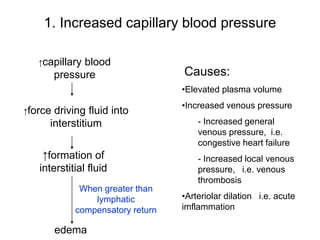
1. Increased capillary blood pressure
Causes:
•Elevated plasma volume
•Increased venous pressure
- Increased general
venous pressure, i.e.
congestive heart failure
- Increased local venous
pressure, i.e. venous
thrombosis
•Arteriolar dilation i.e. acute
imflammation
↑capillary blood
pressure
↑force driving fluid into
interstitium
↑formation of
interstitial fluid
edema
When greater than
lymphatic
compensatory return
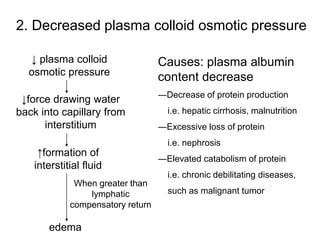
2. Decreased plasma colloid osmotic pressure
Causes: plasma albumin
content decrease
―Decrease of protein production
i.e. hepatic cirrhosis, malnutrition
―Excessive loss of protein
i.e. nephrosis
―Elevated catabolism of protein
i.e. chronic debilitating diseases,
such as malignant tumor
↓ plasma colloid
osmotic pressure
↓force drawing water
back into capillary from
interstitium
↑formation of
interstitial fluid
edema
When greater than
lymphatic
compensatory return
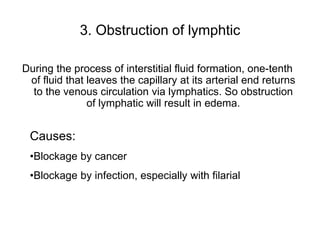
3. Obstruction of lymphtic
During the process of interstitial fluid formation, one-tenth
of fluid that leaves the capillary at its arterial end returns
to the venous circulation via lymphatics. So obstruction
of lymphatic will result in edema.
Causes:
•Blockage by cancer
•Blockage by infection, especially with filarial
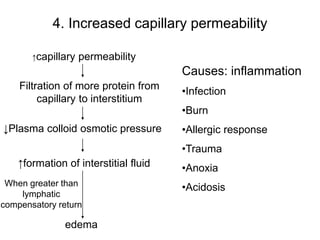
4. Increased capillary permeability
↑capillary permeability
Filtration of more protein from
capillary to interstitium
↑formation of interstitial fluid
edema
When greater than
lymphatic
compensatory return
↓Plasma colloid osmotic pressure
Causes: inflammation
•Infection
•Burn
•Allergic response
•Trauma
•Anoxia
•Acidosis
(Ⅱ). Imbalance of fluid exchange
between extra- and intra-body
------ renal retention of sodium and water
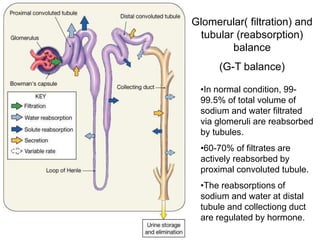
•In normal condition, 99-
99.5% of total volume of
sodium and water filtrated
via glomeruli are reabsorbed
by tubules.
•60-70% of filtrates are
actively reabsorbed by
proximal convoluted tubule.
•The reabsorptions of
sodium and water at distal
tubule and collectiong duct
are regulated by hormone.
Glomerular( filtration) and
tubular (reabsorption)
balance
(G-T balance)
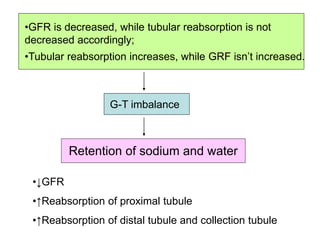
Retention of sodium and water
•GFR is decreased, while tubular reabsorption is not
decreased accordingly;
•Tubular reabsorption increases, while GRF isn’t increased.
•↓GFR
•↑Reabsorption of proximal tubule
•↑Reabsorption of distal tubule and collection tubule
G-T imbalance
1. Decreased glomerular filtration rate (GFR)
• When decreased GFR is not accompanied with
decreased tubular reabsorption, retention of
sodium and water will be caused.
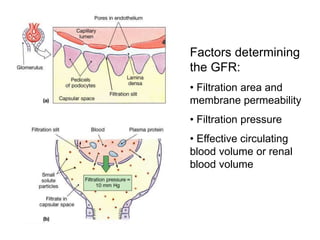
Factors determining
the GFR:
• Filtration area and
membrane permeability
• Filtration pressure
• Effective circulating
blood volume or renal
blood volume
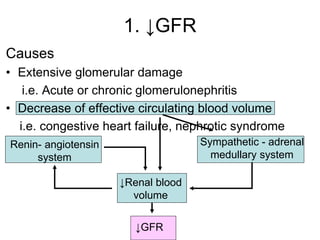
1. ↓GFR
Causes
• Extensive glomerular damage
i.e. Acute or chronic glomerulonephritis
• Decrease of effective circulating blood volume
i.e. congestive heart failure, nephrotic syndrome
↓Renal blood
volume
Renin- angiotensin
system
Sympathetic - adrenal
medullary system
↓GFR
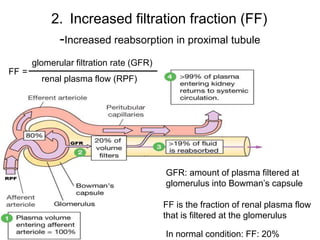
-Increased reabsorption in proximal tubule
Increased filtration fraction (FF)2.
glomerular filtration rate (GFR)
renal plasma flow (RPF)
=FF
GFR: amount of plasma filtered at
glomerulus into Bowman’s capsule
FF is the fraction of renal plasma flow
that is filtered at the glomerulus
In normal condition: FF: 20%
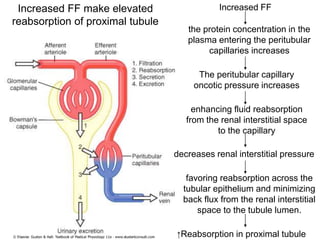
the protein concentration in the
plasma entering the peritubular
capillaries increases
The peritubular capillary
oncotic pressure increases
enhancing fluid reabsorption
from the renal interstitial space
to the capillary
decreases renal interstitial pressure
favoring reabsorption across the
tubular epithelium and minimizing
back flux from the renal interstitial
space to the tubule lumen.
↑Reabsorption in proximal tubule
Increased FFIncreased FF make elevated
reabsorption of proximal tubule
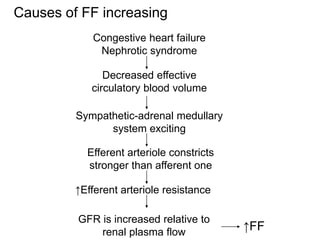
Causes of FF increasing
Congestive heart failure
Nephrotic syndrome
Decreased effective
circulatory blood volume
Sympathetic-adrenal medullary
system exciting
Efferent arteriole constricts
stronger than afferent one
↑Efferent arteriole resistance
GFR is increased relative to
renal plasma flow ↑FF
-Increased reabsorption in distal tubule and collecting duct
increased ADH and ADS secretion3.
Congestive heart failure
Nephrotic syndrome
↓Effective circulatory
blood volume
↑ADH secretion
↓Renal blood flow ↓Renal perfusion
pressure
↓GFR→sodium at
macula densa
↑Secretion of renin by
Juxtaglomerular cell
Sympathetic nerve
excitation
Renin-angiotensin-
aldosterone systm
activation
Retention of
sodium and water
↓Stimulation of volume-
receptor in left atrim and
thoracic vessel
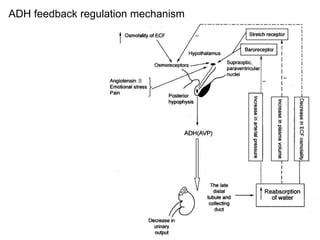
ADH feedback regulation mechanism
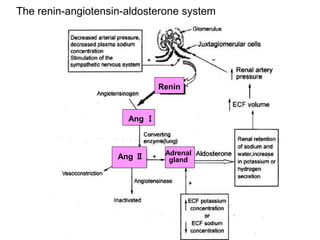
Renin
Ang Ⅰ
Ang Ⅱ Adrenal
gland
The renin-angiotensin-aldosterone system
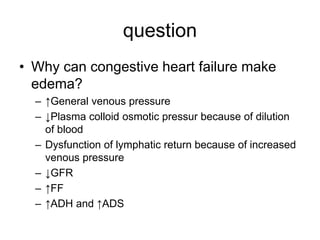
question
• Why can congestive heart failure make
edema?
– ↑General venous pressure
– ↓Plasma colloid osmotic pressur because of dilution
of blood
– Dysfunction of lymphatic return because of increased
venous pressure
– ↓GFR
– ↑FF
– ↑ADH and ↑ADS
Ⅳ. Alterations of metabolism and
function
1. The feature of edema fluid
• Transudates
– Formed under almost normal capillary permeability
– Low content of cells and protein
• Exception: edema fluid due to lymphatic obstruction
• Exudates
– Resulted from an increase in capillary permeability
– Contain plentifu cells and a large amount of protein
– Usually seen in inflammation
2. The cutaneous characters of edema
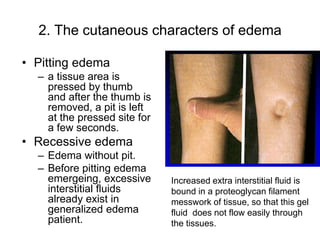
• Pitting edema
– a tissue area is
pressed by thumb
and after the thumb is
removed, a pit is left
at the pressed site for
a few seconds.
• Recessive edema
– Edema without pit.
– Before pitting edema
emergeing, excessive
interstitial fluids
already exist in
generalized edema
patient.
Increased extra interstitial fluid is
bound in a proteoglycan filament
messwork of tissue, so that this gel
fluid does not flow easily through
the tissues.
3. Distribution character of generalize
edema
Influencing factors
• Gravity
• Structure of tissue
• Local hemodynamics
•Cardiac edema: ankle
•Renal edema: eyelids and face
•Hepatic edema: ascites
4. Effect of edema
• Generally, edema is harmfu, i.e.
– Impedes nutritional supply to cells
– Edema of brain is life-threatening, intracranial
pressure increase, herniation
• Protect effect: the edeme fluid of
inflammatory edema can dilute, neutralize
toxin and transport the antibody.

Edema

  • 1.
  • 2.
    Ⅰ. concept • Edema:is the accumulation of excessive body fluid in interstitial space or serous body cavity, which is a pathologic process caused by diseases rather than a disease entity. • Hydrops: when body fluid is accumulated in serous body cavity, edema is also called hydrops, such as ascites and hydrothorax. Isotonic fluid Edema is not accompanied with cellular edema
  • 3.
    Ⅱ. classification • Accordingto the range that edema fluid spreads to: – Anasarca (generalized edema) – Local edema • According to the cause of edema: – Renal edema – Hepatic edema – Cardiac edema – Malnutritional edema – lymphedema
  • 4.
    Ⅲ. Etiology andpathogenesis 40%BW15%BW 5%BW Interstitial fluid Plasma ICF 吸收水分 intake Edema: is the accumulation of excessive body fluid in interstitial space or serous body cavity • balance of fluid exchange between plasma and interstitial compartment • balance of fluid exchange between extra- and intra-body Urine volume Im Im Renal retention of sodium and water Kidney(urine) 1500ml Intestine(feces) 100ml Lung(water vapor) 400ml Skin(sweat ) 500ml output
  • 5.
    (Ⅰ). imbalance offluid exchange between plasma and interstitial compartment
  • 6.
    capillaries When blood flowsthrough capillary, fluid exchange, including water and some small molecules that can pass through the capillary wall, will happen between plasma and interstitial compartment.
  • 7.
    Figure 7-7 Total PressureDifferences Inside and Outside Capillary The force promoting fluid outshift from capillary to interstitial compartment includes blood pressure and negative interstitial pressure. The force attracting fluid from interstitial compartment to capillary is blood colloid osmotic pressue. At the arterial end, the sum of the forces causes fluid to move from the capillary into the tissue. At the venous end, the sum of the forces causes fluid to move into the capillary. About nine-tenths of the fluid that leaves the capillary at its arterial end reenters the capillary at its venous end. About one-tenth of fluid passes into the lymphatics. ↑ ↑ permeability↓ obstruction
  • 8.
    1. Increased capillaryblood pressure Causes: •Elevated plasma volume •Increased venous pressure - Increased general venous pressure, i.e. congestive heart failure - Increased local venous pressure, i.e. venous thrombosis •Arteriolar dilation i.e. acute imflammation ↑capillary blood pressure ↑force driving fluid into interstitium ↑formation of interstitial fluid edema When greater than lymphatic compensatory return
  • 9.
    2. Decreased plasmacolloid osmotic pressure Causes: plasma albumin content decrease ―Decrease of protein production i.e. hepatic cirrhosis, malnutrition ―Excessive loss of protein i.e. nephrosis ―Elevated catabolism of protein i.e. chronic debilitating diseases, such as malignant tumor ↓ plasma colloid osmotic pressure ↓force drawing water back into capillary from interstitium ↑formation of interstitial fluid edema When greater than lymphatic compensatory return
  • 10.
    3. Obstruction oflymphtic During the process of interstitial fluid formation, one-tenth of fluid that leaves the capillary at its arterial end returns to the venous circulation via lymphatics. So obstruction of lymphatic will result in edema. Causes: •Blockage by cancer •Blockage by infection, especially with filarial
  • 11.
    4. Increased capillarypermeability ↑capillary permeability Filtration of more protein from capillary to interstitium ↑formation of interstitial fluid edema When greater than lymphatic compensatory return ↓Plasma colloid osmotic pressure Causes: inflammation •Infection •Burn •Allergic response •Trauma •Anoxia •Acidosis
  • 12.
    (Ⅱ). Imbalance offluid exchange between extra- and intra-body ------ renal retention of sodium and water
  • 13.
    •In normal condition,99- 99.5% of total volume of sodium and water filtrated via glomeruli are reabsorbed by tubules. •60-70% of filtrates are actively reabsorbed by proximal convoluted tubule. •The reabsorptions of sodium and water at distal tubule and collectiong duct are regulated by hormone. Glomerular( filtration) and tubular (reabsorption) balance (G-T balance)
  • 14.
    Retention of sodiumand water •GFR is decreased, while tubular reabsorption is not decreased accordingly; •Tubular reabsorption increases, while GRF isn’t increased. •↓GFR •↑Reabsorption of proximal tubule •↑Reabsorption of distal tubule and collection tubule G-T imbalance
  • 15.
    1. Decreased glomerularfiltration rate (GFR) • When decreased GFR is not accompanied with decreased tubular reabsorption, retention of sodium and water will be caused.
  • 16.
    Factors determining the GFR: •Filtration area and membrane permeability • Filtration pressure • Effective circulating blood volume or renal blood volume
  • 17.
    1. ↓GFR Causes • Extensiveglomerular damage i.e. Acute or chronic glomerulonephritis • Decrease of effective circulating blood volume i.e. congestive heart failure, nephrotic syndrome ↓Renal blood volume Renin- angiotensin system Sympathetic - adrenal medullary system ↓GFR
  • 18.
    -Increased reabsorption inproximal tubule Increased filtration fraction (FF)2. glomerular filtration rate (GFR) renal plasma flow (RPF) =FF GFR: amount of plasma filtered at glomerulus into Bowman’s capsule FF is the fraction of renal plasma flow that is filtered at the glomerulus In normal condition: FF: 20%
  • 19.
    the protein concentrationin the plasma entering the peritubular capillaries increases The peritubular capillary oncotic pressure increases enhancing fluid reabsorption from the renal interstitial space to the capillary decreases renal interstitial pressure favoring reabsorption across the tubular epithelium and minimizing back flux from the renal interstitial space to the tubule lumen. ↑Reabsorption in proximal tubule Increased FFIncreased FF make elevated reabsorption of proximal tubule
  • 20.
    Causes of FFincreasing Congestive heart failure Nephrotic syndrome Decreased effective circulatory blood volume Sympathetic-adrenal medullary system exciting Efferent arteriole constricts stronger than afferent one ↑Efferent arteriole resistance GFR is increased relative to renal plasma flow ↑FF
  • 21.
    -Increased reabsorption indistal tubule and collecting duct increased ADH and ADS secretion3. Congestive heart failure Nephrotic syndrome ↓Effective circulatory blood volume ↑ADH secretion ↓Renal blood flow ↓Renal perfusion pressure ↓GFR→sodium at macula densa ↑Secretion of renin by Juxtaglomerular cell Sympathetic nerve excitation Renin-angiotensin- aldosterone systm activation Retention of sodium and water ↓Stimulation of volume- receptor in left atrim and thoracic vessel
  • 22.
  • 23.
    Renin Ang Ⅰ Ang ⅡAdrenal gland The renin-angiotensin-aldosterone system
  • 24.
    question • Why cancongestive heart failure make edema? – ↑General venous pressure – ↓Plasma colloid osmotic pressur because of dilution of blood – Dysfunction of lymphatic return because of increased venous pressure – ↓GFR – ↑FF – ↑ADH and ↑ADS
  • 25.
    Ⅳ. Alterations ofmetabolism and function
  • 26.
    1. The featureof edema fluid • Transudates – Formed under almost normal capillary permeability – Low content of cells and protein • Exception: edema fluid due to lymphatic obstruction • Exudates – Resulted from an increase in capillary permeability – Contain plentifu cells and a large amount of protein – Usually seen in inflammation
  • 27.
    2. The cutaneouscharacters of edema • Pitting edema – a tissue area is pressed by thumb and after the thumb is removed, a pit is left at the pressed site for a few seconds. • Recessive edema – Edema without pit. – Before pitting edema emergeing, excessive interstitial fluids already exist in generalized edema patient. Increased extra interstitial fluid is bound in a proteoglycan filament messwork of tissue, so that this gel fluid does not flow easily through the tissues.
  • 28.
    3. Distribution characterof generalize edema Influencing factors • Gravity • Structure of tissue • Local hemodynamics •Cardiac edema: ankle •Renal edema: eyelids and face •Hepatic edema: ascites
  • 29.
    4. Effect ofedema • Generally, edema is harmfu, i.e. – Impedes nutritional supply to cells – Edema of brain is life-threatening, intracranial pressure increase, herniation • Protect effect: the edeme fluid of inflammatory edema can dilute, neutralize toxin and transport the antibody.