Section II 
Gardening for 
Wildlife 
This section provides a general introduction to 
ecological concepts, which will assist you in the 
process of creating your Schoolyard Habitats site 
and the use of the site for instruction. Also 
included is practical, easy-to-use information on 
the concept and practice of gardening for wildlife. 
Ecology 101 
Introduction to Native Plants 
Habitat Basics 
Butterfly Gardening 
Restoration Projects 
Soil 
Composting 
Container Gardening
The survival of individual species of animals and plants relies on the health of 
their habitat. Today, more than 900 types of plants and animals in North 
America have been designated as endangered. To prevent the extinction of these 
species and to conserve the amazing diversity of living things on this continent, 
people must work together to protect and restore habitat for wildlife. Schoolyard 
Habitats projects provide the opportunity for students, teachers, and community 
volunteers to act as wildlife biologists and restoration ecologists as they work on a 
small scale habitat project on their own schoolgrounds. 
Every living species has specific habitat requirements. 
Habitat is the arrangement of living and non-living things which together supply 
an organism’s basic requirements for life. These essential components include 
sources of food, water, cover, and safe places to raise young. 
Each species’ habitat has a characteristic physical environment, including climate, 
and often a characteristic type of vegetation. Eastern temperate forests tend to 
have cold winters and wet, hot summers. Broadleaf trees like oak and maple live 
well in these conditions; Eastern forests are defined by the mix of oak, maple, 
birch, and other trees that grow there. These trees create a canopy that shades the 
forest floor and provides habitat for many creatures, such as gray squirrels, white-footed 
mice, white-tailed deer, blue jays, and more. Deserts, on the other hand, 
receive little rain throughout the year and can only support plants able to tolerate 
dry conditions such as cacti and sagebrush, which in turn characterize the habitat 
for many other plants and animals. 
In forests and all other habitat types, plants and animals living there are adapted 
to their environment (they have inherited characteristics that enable them to 
survive in that location). Most plants and animals have one kind of habitat that 
suits them best, although they may be able to survive in several others. Other 
living things can survive in only one kind of habitat. 
Even when two organisms live in the same area, their needs and how they meet 
these needs may be distinct, allowing them to share the same space without 
competition. Two birds, for instance, might live in the same tree but eat 
different foods, have different predators and have different tolerances to 
temperature. The birds live in the same place, but do not fill the same role, or 
niche. If organisms share the same niche, they may compete and limit the 
number of organisms that can live there. Competition, over a long 
time, may lead to greater animal and plant diversity as 
ECOLOGY 101 | 19 
organisms carve out distinct niches. 
Organisms of different 
species can coexist in the 
same type of habitat while 
having separate niches. 
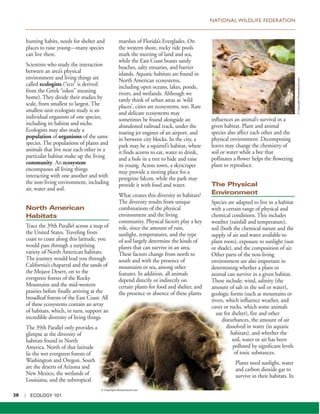
One acre of prairie is home to 
plants like grasses and clovers; insects like beetles and 
grasshoppers; and small mammals like deer mice and 
prairie dogs. Since each has its own niche—diet, foraging or 
Ecology 101 
NATIONALWILDLIFE FEDERATION 
www. nwf . o r g 
© Copyright Shutterstock.com
hunting habits, needs for shelter and 
places to raise young—many species 
can live there. 
Scientists who study the interaction 
between an area’s physical 
environment and living things are 
called ecologists (“eco” is derived 
from the Greek “oikos” meaning 
home). They divide their studies by 
scale, from smallest to largest. The 
smallest unit ecologists study is an 
individual organism of one species, 
including its habitat and niche. 
Ecologists may also study a 
population of organisms of the same 
species. The populations of plants and 
animals that live near each other in a 
particular habitat make up the living 
community. An ecosystem 
encompasses all living things 
interacting with one another and with 
the non-living environment, including 
air, water and soil. 
North American 
Habitats 
Trace the 39th Parallel across a map of 
the United States. Traveling from 
coast to coast along this latitude, you 
would pass through a surprising 
variety of North American habitats. 
The journey would lead you through 
California’s chaparral and the sands of 
the Mojave Desert, on to the 
evergreen forests of the Rocky 
Mountains and the mid-western 
prairies before finally arriving at the 
broadleaf forests of the East Coast. All 
of these ecosystems contain an array 
of habitats, which, in turn, support an 
incredible diversity of living things. 
The 39th Parallel only provides a 
glimpse at the diversity of 
habitats found in North 
America. North of that latitude 
lie the wet evergreen forests of 
Washington and Oregon. South 
are the deserts of Arizona and 
New Mexico, the wetlands of 
Louisiana, and the subtropical 
ECOLOGY 101 
marshes of Florida’s Everglades. On 
the western shore, rocky tide pools 
mark the meeting of land and sea, 
while the East Coast boasts sandy 
beaches, salty estuaries, and barrier 
islands. Aquatic habitats are found in 
North American ecosystems, 
including open oceans, lakes, ponds, 
rivers, and wetlands. Although we 
rarely think of urban areas as ‘wild 
places’, cities are ecosystems, too. Rare 
and delicate ecosystems may 
sometimes be found alongside an 
abandoned railroad track, under the 
roaring jet engines of an airport, and 
in between city blocks. In the city, a 
park may be a squirrel’s habitat, where 
it finds acorns to eat, water to drink, 
and a hole in a tree to hide and raise 
its young. Across town, a skyscraper 
may provide a nesting place for a 
peregrine falcon, while the park may 
provide it with food and water. 
What creates this diversity in habitats? 
The diversity results from unique 
combinations of the physical 
environment and the living 
community. Physical factors play a key 
role, since the amount of rain, 
sunlight, temperatures, and the type 
of soil largely determine the kinds of 
plants that can survive in an area. 
These factors change from north to 
south and with the presence of 
mountains or sea, among other 
features. In addition, all animals 
depend directly or indirectly on 
certain plants for food and shelter, and 
the presence or absence of these plants 
influences an animal’s survival in a 
given habitat. Plant and animal 
species also affect each other and the 
physical environment. Decomposing 
leaves may change the chemistry of 
soil or water while a bee that 
pollinates a flower helps the flowering 
plant to reproduce. 
The Physical 
Environment 
Species are adapted to live in a habitat 
with a certain range of physical and 
chemical conditions. This includes 
weather (rainfall and temperature), 
soil (both the chemical nature and the 
supply of air and water available to 
plant roots), exposure to sunlight (sun 
or shade), and the composition of air. 
Other parts of the non-living 
environment are also important in 
determining whether a plant or 
animal can survive in a given habitat. 
These include: wind, salinity (the 
amount of salt in the soil or water), 
geologic forms (such as mountains or 
rivers, which influence weather, and 
caves or rocks, which some animals 
use for shelter), fire and other 
disturbances, the amount of air 
dissolved in water (in aquatic 
habitats), and whether the 
soil, water or air has been 
polluted by significant levels 
of toxic substances. 
Plants need sunlight, water 
and carbon dioxide gas to 
survive in their habitats. In 
www. nwf . o r g 
NATIONALWILDLIFE FEDERATION 
20 | 
© Copyright Shutterstock.com 
© Copyright Shutterstock.com
ECOLOGY 101 
addition, they require nutrients 
such as nitrogen and 
phosphorous to grow.Without 
sufficient amounts of these non-living 
factors, a plant would 
weaken and eventually die. All 
habitats must have both a 
suitable physical environment 
and the organisms on which 
animals depend. 
Many parts of the physical 
environment can become 
limiting factors when in short 
supply or in excess.Within a 
habitat, each species has factors 
that limit its growth or 
reproduction. In a desert the lack of 
water is a serious limiting factor to 
plant growth. Add water with 
irrigation, and plants grow more 
quickly. Stop irrigation, and growth 
returns to normal. For a tree seedling 
on the shaded forest floor, amount of 
sunlight may be what most limits the 
seedling’s growth. Other examples of 
limiting factors include temperature, 
supply of minerals in soil, land for 
territory and the availability of food 
and nutrients. Temperature and other 
factors become limiting to growth 
and/or reproduction when they 
approach the limits of what a living 
thing can tolerate. 
Food Chains and 
Food Webs 
Within a habitat, most organisms 
depend on other living things to meet 
their needs for food and often for 
shelter. Taking in food is critical to 
survival. From food, living things get 
the energy they need to go about the 
business of being alive. Plants get their 
energy from the food they make 
through the process of 
photosynthesis, and animals get their 
energy by eating plants and other 
animals. The path through which 
energy and nutrients pass from one 
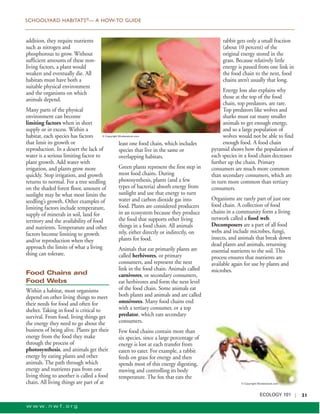
living thing to another is called a food 
chain. All living things are part of at 
least one food chain, which includes 
species that live in the same or 
overlapping habitats. 
Green plants represent the first step in 
most food chains. During 
photosynthesis, plants (and a few 
types of bacteria) absorb energy from 
sunlight and use that energy to turn 
water and carbon dioxide gas into 
food. Plants are considered producers 
in an ecosystem because they produce 
the food that supports other living 
things in a food chain. All animals 
rely, either directly or indirectly, on 
plants for food. 
Animals that eat primarily plants are 
called herbivores, or primary 
consumers, and represent the next 
link in the food chain. Animals called 
carnivores, or secondary consumers, 
eat herbivores and form the next level 
of the food chain. Some animals eat 
both plants and animals and are called 
omnivores. Many food chains end 
with a tertiary consumer, or a top 
predator, which eats secondary 
consumers. 
Few food chains contain more than 
six species, since a large percentage of 
energy is lost at each transfer from 
eaten to eater. For example, a rabbit 
feeds on grass for energy and then 
spends most of this energy digesting, 
moving and controlling its body 
temperature. The fox that eats the 
rabbit gets only a small fraction 
(about 10 percent) of the 
original energy stored in the 
grass. Because relatively little 
energy is passed from one link in 
the food chain to the next, food 
chains aren’t usually that long. 
Energy loss also explains why 
those at the top of the food 
chain, top predators, are rare. 
Top predators like wolves and 
sharks must eat many smaller 
animals to get enough energy, 
and so a large population of 
wolves would not be able to find 
enough food. A food chain 
pyramid shows how the population of 
each species in a food chain decreases 
further up the chain. Primary 
consumers are much more common 
than secondary consumers, which are 
in turn more common than tertiary 
consumers. 
Organisms are rarely part of just one 
food chain. A collection of food 
chains in a community form a living 
network called a food web. 
Decomposers are a part of all food 
webs and include microbes, fungi, 
insects, and animals that break down 
dead plants and animals, returning 
essential nutrients to the soil. This 
process ensures that nutrients are 
available again for use by plants and 
microbes. 
SCHOOLYARD HABITATS®— A HOW-TO GUIDE 
| 21 
www. nwf . o r g 
© Copyright Shutterstock.com 
© Copyright Shutterstock.com
Predator and Prey 
Beyond providing food-energy for the 
predator, predator-prey relationships 
help keep populations of both species 
in check.When a predator is 
removed, prey populations may grow 
out of control, beyond the ability of 
the habitat to support them. For 
example, in Arizona in the early 
1900s, hunters killed huge numbers of 
wolves, mountain lions, and coyotes; 
all of these were top predators in the 
area of mule deer.With the decline of 
predators, the mule deer population 
grew from 4,000 individuals in 1907 
to more than 100,000 in 1924. The 
huge population of deer stripped their 
habitat of all the leaves, plants and 
other greenery they used as food. 
With food scarce, many deer starved 
and fewer were able to reproduce. By 
1939, the deer population had 
declined to just 10,000 individuals. 
Other Interactions 
Food webs aren’t the only 
kind of interaction 
between living things in a 
habitat. Although you may 
not think about it, each 
time you seek shade under 
the boughs of a tree, you 
interact with the tree. 
Plants and animals in a 
community depend on each 
ECOLOGY 101 
other to meet needs other than food, 
such as shelter, places to raise young, 
pollination, and the distribution of 
seeds. 
For an example of these other kinds of 
relationships, just look a saguaro 
cactus. In the desert, mice and rabbits 
help disperse the seeds of the saguaro 
cactus to new locations. During its 
first years of life, a saguaro cactus 
needs shaded habitat. To meet this 
need, the cactus depends on other 
plants, such as a mesquite tree, to 
protect it from the hot sun while the 
root system develops. Later in life, the 
cactus provides shelter (and food) to 
many other organisms. Gila 
woodpeckers build nests in it; once 
vacated, the nest may provide a home 
for elf owls, lizards, insects, or spiders. 
Like the saguaro cactus in the Sonoran 
Desert, prairie dogs are important 
species in their short grass prairie 
ecosystem. They live in ‘towns’ made 
up of hundreds of underground 
burrows and tunnels in the grasslands 
of the American Midwest. Burrows 
are built with chambers set aside for 
sleeping and storing food. 
Abandoned burrows 
provide shelter for 
many other prairie 
critters, including 
prairie rattlesnakes, 
black-footed ferrets, 
and burrowing owls. 
Life Cycles and 
Habitat 
Butterflies look drastically different as 
adults than they did when they were 
young caterpillars. The types of food, 
water and cover they require also 
change. Many organisms have 
different needs as they go through the 
stages of their life cycle, especially 
organisms like butterflies that undergo 
metamorphosis. In these cases, the life 
requirements of the young, or larval 
stage, of a species can be extremely 
different from the needs of an adult. 
In this way, some species may have 
more diverse needs within their 
habitat than others. 
Specialists and 
Generalists 
Scientists consider the members of a 
species generalists if they can live in a 
wide range of habitat types and eat a 
wide variety of foods. Specialists, on 
the other hand, include species that 
live in a narrow niche and can live 
only in one or very few types of 
habitats. Relatively, generalists are 
better able to adjust to changes in the 
environment by finding a new source 
of food or cover. Populations of 
specialists grow when the resources 
they rely on are available, but may not 
be able to survive if changes threatens 
their only food, cover or nesting 
resource. 
What is the quintessential generalist? 
The raccoon! They are generalists 
found in many different habitats. 
Raccoons live in habitats as diverse as 
woodland, grassland, wetland, desert, 
and seashore, not to mention the 
alleys of inner cities and suburban 
lanes. They live throughout North 
America—from Canada to Panama. 
What are their secrets for success? For 
one, they eat a varied diet, and can 
find nutrition from many different 
sources. Raccoon diets include plants, 
nuts, fish, rodents ,or the leftovers 
www. nwf . o r g 
NATIONALWILDLIFE FEDERATION 
22 | 
© Copyright Shutterstock.com
ECOLOGY 101 
found in garbage cans. This flexibility 
means that if one source of food 
disappears, raccoons are still able to 
find another. For cover, they do not 
have specific needs. Any hole or 
crevice will do. Raccoons have been 
known to make hideouts in pipes, tree 
holes and small rock hollows. 
By contrast, monarch caterpillars 
depend on a single group of plants— 
the milkweeds—for food. These 
caterpillars have evolved the ability to 
eat this plant that most other insects 
find poisonous. As a result, there 
exists less competition for milkweed 
leaves. But this same specialization 
makes monarchs vulnerable. If 
milkweed disappears from one area, 
monarchs may have to move to a new 
habitat. If anything threatens the 
plant over a larger area, or if the 
butterfly is forced into habitat where 
milkweed cannot grow, the butterfly 
population will be threatened. 
Adaptations 
An adaptation is an inherited trait 
that helps an animal or plant survive 
in its habitat. 
Diet, behavior, physical anatomy and 
even physiology (internal 
mechanisms), are ways animals adapt 
to their surroundings. Many living 
things have evolved unique ways of 
dealing with the problems of survival. 
An animal’s adaptations—such as an 
eagle’s keen sense of sight or a 
hummingbird’s long beak—develop 
over a very long time and can be 
passed on to offspring. 
Animals have adapted 
to even the harshest 
environments. Some 
aquatic insects have 
evolved a way to 
survive extremely 
cold temperatures. 
They can freeze while 
remaining alive.When 
the air warms up, these 
© Copyright Shutterstock.com 
insects thaw and return to normal 
shape and activity. Similarly, plants 
and animals who call the desert home 
have adapted over thousands of years 
to life in a place that gets fewer than 
10 inches of rainfall each year. These 
adaptations allow organisms like the 
kangaroo rat (which gets all the water 
it needs from plants it eats) and the 
saguaro cactus (which stores enough 
water to survive years) to thrive in the 
desert environment. 
But adaptations are useful only in the 
habitat for which an animal is 
adapted. A freshwater newt, adapted 
to living in or near water, wouldn’t 
survive long in the desert. 
People often confuse adaptation 
with adjusting or responding 
to a change in environment. 
Adjustment happens, for 
example, whenever 
humans climb to high 
altitudes. On top of a 
15,000-foot mountain, it 
feels colder and there is 
less oxygen to breathe. 
Humans adjust through 
behaviors such as wearing warm 
clothes and staying inside a tent. 
Within a short time period, humans 
go through a reversible physiological 
change, which allows them to breathe 
in a low-oxygen environment. Once 
climbers return to sea level, they 
return to normal. This is a temporary 
change that is not passed on to 
children. Adaptations occur over long 
periods of time and are passed on 
from one generation to the next. 
Limiting Factors 
Just as some species require specific 
spatial requirements to meet their 
needs, other species have very specific 
food or cover requirements. If one of 
these critical elements or factors is 
missing a species cannot survive. 
These most specific habitat needs are 
called limiting factors because their 
absence limits whether a species can 
live. 
For example, many decades ago the 
North American wood duck was 
disappearing. Scientists had to 
determine why this species was 
declining alongside other flourishing 
duck species. The answer was simple 
once the situation was examined by 
looking at the habitat requirements 
for wood ducks.Wood ducks require 
snags (old dead trees) with holes in 
them to raise their young. Wood 
ducks were loosing their habitats 
because wetlands with old dead trees 
were being destroyed for 
development. Resource agency and 
conservation organizations worked 
together to restore the habitat by 
placing wood duck boxes on posts or 
in living trees near wetlands. The 
wood duck boxes simulate the holes in 
trees wood duck require to raise its 
young. Thanks to the placement of 
wood duck boxes the species is 
thriving and its habitat restored. The 
loss of suitable places to raise young 
was the limiting factor for the wood 
duck. 
SCHOOLYARD HABITATS®— A HOW-TO GUIDE 
| 23 
www. nwf . o r g 
© Copyright Shutterstock.com
Habitat Size 
Animals differ in the size of habitat 
they require. In general, large animals 
need more food-energy to survive and 
so need to hunt or forage within a 
larger area than does a small animal. 
For the larvae of the longhorn beetle, 
a small area inside a single oak tree 
may be sufficient. Beetle larvae live 
below the tree’s bark, creating tunnels 
as they feed on wood and hide from 
hungry predators. A squirrel might 
find cover in the same oak, but its 
habitat, which includes its entire 
foraging range, stretches over 3 to 4 
acres. One kind of warbler bird may 
require up to 7,000 acres of forest 
habitat for a breeding pair, while a 
black bear needs as much as 40,000 
acres for its home range. 
Other factors influence habitat size. 
An organism’s feeding habits, 
mobility, nesting preferences, and 
territoriality can all play a role in 
determining its required habitat size. 
A bee, which has the mobility of flight 
and needs to find food with a high 
sugar content, has a much larger 
habitat than an ant. Plant-eating 
grazers like buffalo need only a 
quarter the habitat that carnivores 
such as wolves require. Leaves and 
grass are relatively common and easy 
to find for buffalo. By contrast, prey 
animals are much harder to find than 
grass, so their predators need to search 
a larger area to find them. 
ECOLOGY 101 
Biodiversity and 
Endangered Species 
Today, habitat loss is the leading 
threat facing wilderness, wildlife and 
biodiversity in North America. The 
term ‘biodiversity’ refers to the 
variety of species of plants and 
animals in a given area. One way to 
measure the biodiversity of a given 
area is to count the number of types 
of species living within that area. 
Biological diversity has been 
recognized as an important measure of 
an ecosystem’s health. All members of 
food webs, including humans, rely on 
healthy ecosystems to provide food 
and materials needed to live. The 
more diverse an ecosystem, the greater 
chance that some species will be able 
to survive sudden disturbances in the 
system caused by climactic change, 
human impacts or the loss of a key 
species. 
Tropical rainforests face the greatest 
threats to declines in biodiversity, but 
much of North America has also 
suffered serious declines. In 1973, 
concern over the loss of wildlife led to 
the creation of the U.S. Endangered 
Species Act, which aims to protect the 
rarest species from extinction. To date, 
over 1,100 plants and animals in the 
United States are rare enough that 
they have been listed on the federal 
endangered and threatened species 
list. An endangered animal or plant 
has so few individuals left that it has 
been officially 
identified as close 
to extinction. 
Threatened species 
are not in such 
dire situations but 
have suffered rapid 
declines in their 
populations. The 
Endangered 
Species Act 
provides for active 
conservation and management of 
these species. 
The sheer number of endangered, 
threatened and vulnerable species, 
along with high costs involved in their 
protection, has made conserving these 
species a challenging task. More 
recently, conservationists and federal 
managers have shifted their focus 
from individual species to the habitats 
of endangered and threatened species. 
Focusing on critical habitats, home to 
a diverse group of plants and animals, 
seems the most effective method to 
save wildlife. In saving the habitat of 
an endangered species, managers will 
also be able to save the many unique 
organisms that share that habitat. 
Habitat Loss 
In some cases, human alteration of the 
environment can endanger plants and 
animals in a given area. For example, 
scientists linked the seaside sparrow’s 
extinction in 1987 directly to the loss 
and fragmentation of its habitat. In a 
little over two centuries, vast portions 
of the North American landscape have 
been altered by human activities, 
including development of housing, 
roads and cities, farming, resource 
extraction, pollution, and hunting. 
Noteworthy examples include: 
Prairies once covered 40% of the 
lower 48 states. Much of this 
Mid-Western grassland habitat 
has been lost to farming, 
development and overgrazing. In 
addition, periodic fires that 
 
www. nwf . o r g 
NATIONALWILDLIFE FEDERATION 
24 | 
© Copyright Shutterstock.com 
© Copyright Shutterstock.com
ECOLOGY 101 
SCHOOLYARD HABITATS®— A HOW-TO GUIDE 
grasses depend upon have long 
been suppressed, allowing other 
species to flourish.Wild grazers 
like bison, which also played an 
important role in the grass 
ecosystem, were over-hunted long 
ago. Scientists estimate that 99% 
of tall grass prairies, which once 
stretched over 90 million acres on 
the Eastern edge of the prairie 
states, have been lost to 
development and farming. Prairie 
loss has led to steep declines in 
many species’ populations, 
including black-tailed prairie dogs 
and the now very rare black-footed 
ferrets. 
More than 90% of old-growth 
forests of the Pacific Northwest 
have been disturbed by 
development and logging. Many 
species, such as the endangered 
northern spotted owl, need a 
mature forest habitat to survive. 
Over 50% of wetlands in the 
lower 48 states have been cleared, 
drained, filled, or destroyed. 
Many of those remaining face 
problems with inadequate water 
supplies (due to upstream dams 
and diversions), polluted run-off 
from agriculture and industry, 
and continued pressure for 
development. In California, only 
10% of original wetlands remain, 
most lost to agriculture and 
development. Especially notable 
has been the shrinking of 
wetlands in Florida, where the 
Everglades once reached from 
above Orlando to the state’s 
southern tip. The loss in wetlands 
there has contributed to a 90% 
drop in the number of waterfowl 
in the area. A full one-third of 
endangered plant species grows in 
wetland habitats throughout the 
U.S. 
Although beginning to recover, 
more than 80% of New England 
forests were cut when Europeans 
settled the region and the land 
was converted to farmland. As 
agriculture has moved to the mid-west, 
Eastern forests are slowly re-establishing 
themselves. Acid rain, 
a by-product of modern industrial 
emissions, still poses a threat to 
the health of these ecosystems. 
The Southeastern United States 
was once covered in longleaf pine 
forests, which stretched from 
Virginia to Texas. Only about 3% 
of these historical ecosystems still 
exist, resulting in endangerment 
of birds like the red-cockaded 
woodpecker. The rest has long 
since been converted to cities, 
farms and tree plantations or has 
lost key habitat features due to 
logging, fire suppression and use 
of adjacent lands. 
Riparian ecosystems face the 
greatest threats from dams, 
diversion of water, and pollution. 
Most major rivers in North 
America are dammed to provide 
energy, control flooding, and 
divert water for irrigation and 
other uses. Inadequate river water 
threatens wildlife that needs 
flowing or deep water. 
Human Impacts 
As human populations continue to 
grow, more and more natural areas are 
developed or converted to cropland to 
meet increasing human demands for 
housing and food. 
Development—the building of new 
houses, streets, highways, offices, 
schools, shopping centers and parks, 
and the clearing of land often 
associated with new construction—is 
a leading cause of habitat loss. 
Building on wild land can destroy or 
seriously degrade wildlife habitat. The 
extraction of natural resources from 
certain areas can impact habitat 
quality and species viability as well. 
Conversion of wild habitat into 
farmland increases with our need to 
grow food for greater numbers of 
people. It also drastically changes the 
habitat.While some organisms, like 
migratory cranes on the Platte River 
who feed on waste corn from the 
year’s harvest, can live with farms, 
others, such as many of the native 
grasses of the prairie, cannot. 
Run-off from farms, such as fertilizers 
and pesticides, can create problems in 
downstream habitats. If too much 
fertilizer washes into a pond, for 
example, the amount of available 
nitrogen and phosphate can 
completely alter the physical 
environment of the lake, creating huge 
algae blooms, which deplete oxygen 
and seriously harm or even kill other 
wildlife living there. 


| 25 
www. nwf . o r g 
© Copyright Shutterstock.com 
© Copyright Shutterstock.com
Pesticides also harm birds, butterflies 
and other insects. Birds of prey, for 
example, suffer enormously from 
pesticides even though they may not 
consume them directly. Each animal 
they consume may have a small 
amount of the toxic substance in its 
body, and these amounts can 
accumulate in the bird’s body over 
time. 
To protect wildlife, we need to better 
balance human needs with 
conservation and restoration of 
habitats. Sometimes, unexpected 
consequences of human activity harm 
a habitat. For example, pollution 
(such as fertilizer in a lake or toxic 
levels of chemicals) may render a 
habitat unsuitable for life. 
Natural Impacts on 
Habitats 
Catastrophic natural events can also 
spell disaster for habitats over the 
short-term. But even after a severe 
flood or fire, most ecosystems can 
recover. In most cases, the habitat 
develops back into a healthy 
community similar to the pre-fire or 
flood habitat over time. 
Other powerful natural impacts can 
come from disease, extremes in 
weather and climate change. Disease 
ECOLOGY 101 
can destroy a population of one 
species, which may impact the lives of 
others. Some 250,000 ducks on Great 
Salt Lake appeared to have died from 
botulism, a bacterial disease, in 1932. 
While the local population of ducks 
was decimated, ducks from other areas 
eventually moved in and repopulated 
the Lake. Even extremes in weather 
(an especially cold winter or long 
drought) may become lethal to many. 
Hurricane Hugo destroyed many 
older longleaf pine trees that 
endangered red-cockaded 
woodpeckers rely on for cover. 
Some habitats, such as mid-western 
prairies or longleaf pine forests of the 
south, actually rely on periodic natural 
disturbances, such as fire, to stay 
healthy. Yellowstone National Park is a 
good example of such an ecosystem 
and a place where fires have long been 
suppressed to protect property and 
people in the area.When large 
wilderness fires erupted in 
Yellowstone, the burning did cause 
some tragic losses of wildlife and park 
facilities. But within a few short years, 
the many benefits of a natural fire 
(often started by lightning) became 
apparent. The park experienced an 
ecological re-birth, with greater plant 
and tree diversity, leading to greater 
animal diversity and a healthy, stable 
ecosystem. 
While most ecosystems have the 
resiliency to bounce back after a severe 
natural event, some changes may be 
too great. Climate change, as 
evidenced in ice ages that regularly 
occur on Earth, may permanently 
alter the group of species able to grow 
in a habitat. Human activity also may 
change ecosystems irreversibly. For 
example, when a new species is 
introduced to a habitat, the entire 
structure of the place may change, 
never to return to its original state. 
www. nwf . o r g 
NATIONALWILDLIFE FEDERATION 
26 | 
© Copyright © Copyright Shutterstock.com Shutterstock.com 
© Copyright Shutterstock.com
SCHOOLYARD HABITATS®— A HOW-TO GUIDE 
Introduced Species 
Some species are intentionally or 
accidentally introduced into a non-native 
habitat from elsewhere. The 
impacts of particularly aggressive 
species can be enormous, altering the 
entire structure of an area or 
ecosystem. 
For example, the nutria, a small 
beaver-like mammal, was imported 
from South America and released into 
the wild in a number of habitats 
earlier this century. Fur farmers 
wanted them for their pelts. They are 
now found in 15 states and have 
caused much habitat havoc. In 
Louisiana, 20 animals were released in 
1938. There are now 20 million living 
in the bayous and wetlands of that 
state. Their voracious appetite for 
wetland plants, added to their 
constant digging, has resulted in 
100,000 acres of marsh turned into 
open water, destroying the winter 
habitat of waterfowl. Aside from 
alligators in the southeast, there are no 
natural predators to keep nutria in 
check. 
The weedy and shade-loving English 
ivy plant is another example of a non-native 
species that has caused many 
problems for habitats it invades. The 
ivy is native to Europe and Asia and 
was introduced into landscaping and 
gardens by some of America’s early 
colonists. It has escaped from gardens 
into many forests, where it creates 
dense cover on the forest floor and 
lowers plant diversity in the forest. 
Little sunlight reaches below ivy and 
the shade stops native wildflowers, 
trees and shrubs from sprouting and 
growing. These native plants are the 
ones wildlife rely on for food, cover 
and places to raise young. No animals 
appear to use ivy to meet their needs, 
save the European starling, another 
introduced, non-native species. 
Habitat Fragmentation 
Habitats are increasingly divided into 
smaller and smaller areas because of 
development or other land uses, such 
as roads, housing, parking lots, and 
lawns, until many islands of 
unconnected fragments remain. 
Habitat fragmentation can lead to 
huge losses of wildlife because it 
affects overall habitat size, creates 
more edges, and isolates species from 
other members of their population. 
Some habitat fragments are just too 
small to provide for all the needs of a 
species. A black bear that needs 
40,000 acres of forest habitat to 
survive, will not survive in a 2,000 
acre fragment. Even for species with a 
smaller habitat range, the fragment 
may be too small to support enough 
individuals for a healthy breeding 
population. 
Carving up a habitat creates more 
edges and changes the qualities of a 
habitat. Many bird species, for 
instance, live in the interior of a forest 
and have a hard time thriving along 
edges, where they are more vulnerable 
to attacks by predators. Physical 
factors along edges differ too— 
without the shade of the forest 
canopy, more sunlight reaches the 
ground and allows a thick understory 
to grow. Some birds need a relatively 
sparse area of forest floor to 
successfully forage for food. 
Fragmentation also isolates 
populations or individuals by creating 
barriers to movement.Without forest 
cover, it may be harder for young to 
disperse to new areas. New individuals 
from other populations may no longer 
be able to reach those living in the 
habitat fragment, meaning that the 
genetic diversity of the population 
may decline. Studies show that 
decreases in the size of the habitat 
fragments directly correlate with 
declines in species diversity. 
The Good News 
Many conservation efforts have been successful in managing wildlife species and in 
setting aside larger tracts of wilderness so that wildlife can continue to thrive in 
these areas. Many people are beginning to make wiser decisions about the ways in 
which land is developed and are joining in efforts to restore local habitat. It is even 
possible to restore degraded habitats. Many schools across the country are making 
their contribution through Schoolyard Habitats projects. From Florida to Alaska, 
schools are creating wildlife habitat and restoring wetlands, prairies and forests on 
their schoolyards. Schools are engaging in Schoolyard Habitats projects to restore 
biological diversity in their communities by removing invasive exotics and planting 
native species. They are providing much needed temporary habitat for migratory 
birds and butterflies on long journeys, and year-round habitat for numerous local 
residents. The work of schools is helping to open the eyes of the larger community to 
the important issue of habitat loss, and showing communities that by working 
together, we can make a difference. 
ECOLOGY 101 | 27 
www. nwf . o r g 
© Copyright Shutterstock.com
NATIONALWILDLIFE FEDERATION 
| 28 
Introduction to Native Plants 
www. nwf . o r g 
A native plant is a species that naturally occurs on a site and has not been 
introduced from another region or country. Native plants thrive in their natural 
setting without disrupting natural ecological processes because they are perfectly 
adapted to the conditions of that locale. Native plants provide the best diversity of 
habitat elements for wildlife.Wildlife species have evolved to rely upon native 
plants as food, cover, and sometimes even for water. The NationalWildlife 
Federation strongly encourages the use of native plant species in all new 
plantings. 
By choosing native plants for your Schoolyard Habitats site, you 
will: provide the best overall food sources for wildlife 
require less water and overall maintenance 
provide excellent support to local wildlife species 
help maintain the diversity of plant species in our communities 
The wildlife in our communities flourish amid locally native plants. However, 
there are hundreds of species of exotic plants available for sale, which are 
originally from Asia, Europe, Africa, or Australia and now call the landscapes of 
North America home. These plants do not sustain local wildlife as well as native 
plants do. Though these plants may offer birds fruit, squirrels nuts, and 
hummingbirds and butterflies nectar, they do not provide the full range of 
seasonal habitat benefits that appropriate locally native species provide. If we 
want to attract wildlife and to restore the critical, often unseen small pieces in 
our ecosystems, we need to bring back locally native plants. 
An equally important reason to use locally native plants is to reduce 
the possibility that exotic plants from our landscapes will run wild. 
Native plants do not become invasive; that is, they will not 
reproduce rampantly, invading and impoverishing the 
diversity of our remaining natural habitats (as an increasing 
number of exotic plants now do). Non-native plants 
often reproduce quickly, depleting the diversity of 
remaining natural habitats.When a non-native 
species is planted in a new place, it is isolated 
from its original region or country and 
the controls present there: insects and 
diseases that limited its spread in 
its place of origin. This lack of 
controls in a new area often 
allows the plant species to spread 
unchecked in its new 
environment. 
Rapidly growing and reproducing 
exotics often displace native plants 
that cannot compete with them. 
Consequently, animals that depend 
on native plants to provide a 
© Copyright Shutterstock.com 
INTRODUCTION TO NATIVE PLANTS
INTRODUCTION TO NATIVE PLANTS 
SCHOOLYARD HABITATS®— A HOW-TO GUIDE 
particular habitat component 
may not find a suitable 
replacement among the non-native 
species. Exotic plants 
that have been popular in 
formal landscaping but which 
have been particularly invasive 
in many parts of the U.S. (and 
therefore should not be 
planted) include: purple 
loosestrife, multiflora and 
Cherokee roses, Asiatic bush 
honeysuckle, Japanese honeysuckle, 
nandina, privet, autumn and Russian 
olive, and burning bush euonymus, 
among many others. NWF and your 
local native plant societies can provide 
region-specific plant lists to assist with 
your plant selections. 
Locally native plant species meet 
virtually any landscaping need. By 
choosing native species, you will 
replace the monotony of the few 
exotics that so dominate our 
landscapes and the spread of exotic 
invasives which are choking out the 
diversity of local plants in woodlands, 
roadsides, meadows, and natural 
ecosystems. 
Our landscapes, carefully planted with 
locally native species, can be effective 
instruments in restoring native plants 
to our communities and open spaces. 
Most local nurseries and 
plant centers sell native plants, 
whether they know it or not. Since 
some nursery staff may not be familiar 
with native plants and their benefits, 
educating yourself about the plants 
you would like to purchase prior to 
visiting the nursery is helpful. Many 
nurseries are willing to special-order 
plants that they do not normally 
stock. If possible, request your plants 
by species name rather than common 
name, as one common name is often 
ascribed to many different species. 
The best sources of finding reputable 
native plant suppliers are your state 
native plant or wildflower society. 
| 29 
www. nwf . o r g 
© Copyright Shutterstock.com 
© Copyright Shutterstock.com
All wildlife needs an appropriate combination of food, water, cover, and places to 
raise young. Therefore Schoolyard Habitats sites must include these four essential 
habitat elements specific to the local wildlife they seek to support and attract. 
Some areas of the schoolyard might already be visited by wildlife; these areas may 
naturally provide some or all essential habitat elements. If so, consider enhancing 
or restoring habitat that already exists. It is just as important to restore and 
conserve existing habitat areas as it is to create new habitat on the schoolyard. 
Providing a wide variety of appropriate habitat elements will attract a diversity of 
wildlife to your schoolyard. After learning about habitat basics, use the Site 
Inventory activity to evaluate your schoolyard and determine how it can be 
enhanced to better support local wildlife. 
Following are a few brief suggestions on how to provide food, water, cover and 
places for wildlife to raise young on your schoolgrounds. Accompanying each 
habitat component is a preview of the corresponding portion of the Schoolyard 
Habitats Application which your school will eventually be completing. 
Food 
The ideal Schoolyard Habitats plan uses vegetation to supply as much food as 
possible to meet the year-round needs of many local species. Shrubs, trees, and 
other plants produce foods, such as acorns, nuts, berries, and other seeds. Leaves, 
buds, catkins, nectar, and pollen are also important food sources. 
Locally native plants are the basis for the 
natural food chain in any given ecosystem. 
Therefore, it is important that any Schoolyard 
Habitats plantings consist of locally native 
plant species that include trees, shrubs, 
perennials, and annuals. Contact a Cooperative 
Extension office, local garden center, state non-game 
wildlife program, nature center, or the 
NationalWildlife Federation field office closest 
to you for recommendations about the best 
locally native wildlife plants. 
While plants are maturing, and in areas with 
cold winters, natural food sources can be 
supplemented with food for birds. The best 
foods for feeders are sunflower, safflower, proso 
millet seed, niger seed, and suet. In warm 
months, sugar water in regularly cleaned 
humming bird feeders supplements the nectar 
and insects that flowers provide. Feeder 
maintenance is an excellent ongoing student 
project. 
HABITAT BASICS 
Habitat Basics 
www. nwf . o r g 
NATIONALWILDLIFE FEDERATION 
| 30 
© Copyright Shutterstock.com
HABITAT BASICS 
SCHOOLYARD HABITATS®— A HOW-TO GUIDE 
Water 
Throughout the year, wildlife needs 
water for drinking, bathing, and in 
some cases, breeding.Water can be 
supplied in a birdbath or other 
shallow dish, a small pond, a shallow 
wetland, or stream.While vegetation 
holds droplets from rain or morning 
dew, a more constant, reliable source 
of water is needed by many wildlife 
species and therefore is recommended 
in Schoolyard Habitats sites. 
Butterflies, birds, frogs, and toads 
often prefer to use shallow, puddle-like 
water sources. Create puddles by 
filling a shallow basin with clean sand; 
sink the basin into the ground in a 
sunny spot within your garden. Keep 
it flooded so that some of the water 
and sand spill over the edge at 
different times of the season. 
An elevated birdbath may protect 
birds from cats and other predators, 
and can be an attractive addition to 
your Schoolyard Habitats site. Place 
birdbaths near an overhanging branch 
or a nearby bush to provide a quick 
escape route for songbirds from 
predators but not so close that 
predators have a good hiding place 
within pouncing range. The bath 
Basic Steps for Building a Pond: 
1. Check Local Regulations. Many schools are concerned with the 
liability issues of having open water on their campuses. Before 
planning pond construction, check school district and municipality 
guidelines. These are usually easy-to-follow regulations regarding 
the size, depth, and location of schoolyard water features. 
2. Observe the natural flow of water on the property. The best time 
to do this is right after it rains. The ideal site for the pond may be 
where water naturally accumulates on the schoolyard. Make sure 
that the site does not receive excess nutrients from compost piles, 
fertilizers placed on lawns, or street runoff. 
3. Choose Pond Structure. One of several options available for 
creating pond structures is to use a commercially available flexible 
liner. Create a basin by excavating the soil and providing a 
gradually sloping beach area so that amphibians and other wildlife 
species can leave and enter the pond easily. Many schools choose 
to provide an overflow “wetland” area next to the pond (a place for 
water to flow during excessive precipitation), to support additional 
types of plants and wildlife, and to thereby provide greater 
educational opportunities. 
4. Install. Before laying the liner, pad the hole with a layer of sand or 
some old carpeting, and then put the liner in place. Secure with 
rocks. Before filling pond with water, check to see if the local 
municipality uses chlorine or chloramine. Chlorine will dissipate 
after one week, but a neutralizer is necessary in order to adjust 
chloramine levels. 
5. Add Water and Vegetation. Cover the surface of your pond with a 
layer of leaves. These will sink to the bottom and form an organic 
layer and provide habitat for microorganisms. Place plenty of 
plants, rocks and tree branches in the pond as emergent structures 
so wildlife have places to sun and to seek cover. A good way to 
mimic nature’s recipe for a healthy pond is to add a bucket of water 
from a nearby natural pond. Do not stock the pond with fish. 
Wildlife will eventually find the pond on their own. If aquatic plants 
are added, be sure to add only native species—these will offer the 
maximum benefits to local wildlife. Avoid exotic ornamentals. 
6. Take Safety Precautions. Address safety concerns by educating 
students about potential risks. Student-made educational signs 
posted close to the pond are a great way to call attention to the 
presence of water. Another way to slow foot traffic and create a 
boundary between the pond and a playground area, for instance, is 
to install low fences or benches around the pond. Small ponds may 
also be created in courtyards where students are always visible. 
Another solution is to create a deep basin, and back-fill much of the 
basin with large rocks. This type of pond will support small aquatic 
species while remaining quite shallow (which will allay fears of 
potential danger to students). 
| 31 
www. nwf . o r g
NATIONALWILDLIFE FEDERATION 
www. nwf . o r g 
32 | 
should be no deeper than 3” and have 
gently sloping sides, with water less 
than 2” deep. In summer heat, be sure 
to replace water regularly and to keep 
birdbaths clean. In winter, if 
temperatures drop well below freezing, 
use a birdbath heater or remove ice in 
the morning and refill with water 
daily. 
If a creek, stream, pond or wetland 
already exists on the schoolyard, 
consider enhancing or restoring that 
area. If a water body is not present, 
many schools choose to create a pond 
as part of their Schoolyard Habitats 
project. Ponds not only help support a 
greater diversity of wildlife, but 
expand opportunities for hands-on 
teaching and learning. Students with 
schoolyard ponds learn directly about 
everything from aquatic insects to 
water quality to physical science. A 
small pond built into the ground can 
provide water for drinking and 
bathing as well as cover and 
reproductive areas for small fish, 
amphibians, insects, and reptiles. 
Many birds and amphibians rely on 
insects that spend part or all of their 
life in the water. Observing naturally 
occurring local ponds will help 
students learn about the characteristics 
and life requirements of locally native 
aquatic plants and animals. 
Some people are hesitant about 
creating a pond because they associate 
ponds with mosquitoes. Though some 
may see them as a nuisance, 
mosquitoes do help support many 
natural predators such as bats and 
dragonflies. In healthy ecosystems 
with plenty of native vegetation, 
mosquitoes usually do not pose any 
problems. If mosquito larvae are a 
concern, eliminate standing water by 
installing a small circulating pump. 
Many certified NationalWildlife 
Federation Schoolyard Habitats sites 
have installed ponds on their 
schoolgrounds.Whether they have 
removed a concrete courtyard, or 
simply converted an unused corner of 
grassy lawn, they are all now enjoying 
the wildlife that visit and make their 
homes in these ponds, and the 
instructional possibilities the pond 
provides. 
Cover 
Wildlife needs protective cover from 
heat, cold, wind, rain, and predators. 
Many plants that offer food can also 
provide valuable escape cover for 
wildlife. Densely branched shrubs, 
evergreens, grasses, as well as hollow 
trees—upright and fallen— 
rock piles, brush piles, and 
stone walls can all provide 
cover for many animal 
species. 
The ideal wildlife habitat 
area includes plants 
ranging in size and 
density from low ground 
cover to tall, mature 
trees. Arranging plants in 
groups that mimic the 
growth of plant 
communities (rather than 
in isolated islands) will increase the 
amount of cover provided. Increasing 
the diversity of plant species will 
increase the diversity of wildlife that is 
supported; this variety of plant life 
provides birds and other animals with 
a wide array of appropriate cover for 
feeding, hiding, courting, and nesting 
activities. 
To add to the types of cover on the 
schoolyard, students can construct 
and erect nesting boxes for the 
resident or migratory songbirds, 
ducks, and bats that live in the area 
(these structures are also available 
commercially). Each type of wildlife 
nesting box has specific requirements; 
it is important to identify the overall 
box size, entrance size, design, and 
placement needed in order to 
successfully attract specific species. 
Following these specifications will 
both ensure that the box is usable by 
the intended species, and that the box 
is not unduly vulnerable to that 
species’ predators. 
Resources for Nest Box Plans 
and Information: 
The U.S. Fish andWildlife 
Service maintains an excellent list 
of how to attract and support 13 
bird species through nest boxes: 
http://migratorybirds.fws.gov/pa 
mphlet/pamplets.html 
Bat Conservation International 
provides detailed plans on its 
website for constructing bat 
boxes, bat conservation issues. 
Videos, books, and many 
other resources can also be 
ordered online: 
www.batcons.org 
The North 
American Bluebird Society 
provides thorough 
information about 
bluebirds and supporting 
local populations through 
bluebird boxes: 
www.nabluebirdsociety.org 
HABITAT BASICS 
© Copyright Shutterstock.com 
© Copyright Shutterstock.com
| 33 
SCHOOLYARD HABITATS®— A HOW-TO GUIDE 
www. nwf . o r g 
HABITAT BASICS 
Places to Raise Young 
To be complete, habitat areas must 
include safe places in which wildlife 
can raise their young. Examples 
include appropriate areas for nesting, 
specific plants upon which butterfly 
larvae depend, and the security of 
pond water for tadpoles. 
Consider providing places to raise 
young through both vegetation and 
human-made devices. Attach 
birdhouses and nesting shelves to 
posts, trees, or buildings. Maintain as 
many snags (dead, standing trees with 
hollow cavities) as possible. Plant 
dense pockets of shrubbery to provide 
safe areas for many species of wildlife. 
Some of our most interesting animals 
require a body of water as a safe haven 
for their young. Many salamanders, 
frogs, toads, and insects, like 
dragonflies and water boatmen, begin 
life in water and are unlikely to 
prosper on the schoolyard without the 
safe, healthy water environments that 
a clean stream or small pond can offer. 
Sustainable Gardening 
A sustainable garden works in 
harmony with nature. In sustainable 
systems, plants are grown without 
depleting natural resources or 
contributing to pollution. And, in 
order for anything to be sustainable, it 
should continue for a long time. This 
means that it should sustain itself as 
much as possible, without constant 
inputs from you. 
There are many techniques that can 
improve the health of the garden and 
minimize any negative impact on the 
environment. 
Mulching 
Mulch helps keep water in the soil 
and available to the plant, rather than 
evaporating into the air. This can help 
reduce water consumption. As 
mulch breaks down, it provides 
nutrients to the soil, which can help 
reduce or eliminate the need for 
additional fertilizers. Be sure to use 
mulches that are from sustainable 
forestry practices (not Cypress tree 
mulch), and that are free from pests 
and diseases. Your cooperative 
extension office can help you find 
sources of mulch in your local 
community. 
Reducing Lawn Areas 
Grass lawns often require chemicals 
and frequent maintenance. Gas-powered 
lawnmowers produce high 
amounts of greenhouse gases, which 
contribute to the air pollution that 
causes global warming. Since lawns 
are often made of only a few types of 
plants that most animals do not 
consume, they do not provide a lot of 
value for wildlife. Replacing grass 
lawn with native 
wildflowers, bushes, 
and trees provides the 
food, shelter, and 
cover that help to 
maintain healthy, 
natural ecosystems 
and reduces your time 
and labor working on 
the lawn! 
Xeriscaping 
Xeriscaping is an approach to 
landscaping that minimizes outdoor 
water use while maintaining soil 
integrity through the use of native, 
drought-tolerant plants. This is a 
common practice in drier areas, such 
as theWest and Southwest, where 
water supplies and water quality are in 
very short supply. 
Removing Invasives and 
Restoring Native Plant 
Communities 
Native plants are better for the 
environment than exotic plants, 
generally requiring less fertilizer and 
other additives, less water, and less 
effort in pest control. They are 
especially important to native wildlife, 
such as pollinators, that may have 
coevolved with a particular species. 
Pollinators often rely on a certain type 
of flower as a source of food, while the 
flower depends on the pollinator to 
transport its pollen to other flowers 
for reproduction. 
When non-native plants are used, 
they often times upset the delicate 
balance of a local ecosystem and 
sometimes even out-compete native 
species to the point of extinction. 
Wildlife benefit more when native 
plant communities remain intact, or 
are restored to their natural habitats, 
providing the best source of food for 
wildlife. 
© Copyright Shutterstock.com
Once the habitat basics of food, water, cover, and places to raise young are 
understood, it becomes much easier to identify and provide for the needs of local 
wildlife. Engage students in learning about the specific needs of various local 
species. Because so many schools decide to attract and support butterflies as part 
of their Schoolyard Habitats project, following are suggestions for creating 
butterfly habitat. 
A butterfly garden is a great addition to any habitat project, no matter how large 
or small. Beyond the beauty butterflies bring to a schoolyard, they also play a 
key role in ecosystems by pollinating plants. Studying butterflies is an excellent 
way to teach concepts of life cycles, the importance of biodiversity, and 
interdependence of species in a hands-on way. Butterfly gardens can be created in 
a small area; many schools plant butterfly gardens in courtyards or close to 
windows so that their activity can be easily observed. In order to attract 
butterflies, your Schoolyard Habitats site will need to provide places for them to 
sun, sources of nectar, food sources for caterpillars, and access to water. 
Butterflies are often found resting in sunny patches: they use the sun for 
orientation and to regulate body temperatures. Like all insects, butterflies are 
ectothermic (they do not produce their own body heat). They fly best when their 
body temperature is between 85-100°F. (Students may notice that butterflies are 
not very active on cloudy days). 
To provide sunning spots for butterflies, place large, flat stones in the schoolyard. 
If necessary, remove a little soil to stabilize the rock. Also make sure the selected 
vegetation is planted in an area that receives sun for most 
of the day. 
Minerals are an essential part of male butterflies’ diet. 
These minerals are readily available dissolved in water, 
especially water existing in puddles. The large surface 
area-to-volume ratio of shallow water allows for greater 
evaporation, which concentrates the dissolved minerals in 
the remaining water. Butterflies do not need a large 
amount of water; in fact they quickly expel most of the 
water they uptake, 
primarily retaining dissolved minerals. 
Students can make one or more butterfly puddles by 
creating a small depression in the ground and allowing 
them to fill with water. As part of ongoing site 
maintenance, students should check on the puddle during 
dry periods, and spray periodically with a hose. 
Another way to provide water is to dig a hole in the 
ground to accommodate a container. Place the container 
in the hole, level the ground to the top of the container 
and fill with rocks and soil. Fill with water until the soil 
becomes saturated and there is standing water at the 
surface. Be sure to check for water periodically. 
BUTTERFLY GARDENING 
Butterfly Gardening 
www. nwf . o r g 
NATIONALWILDLIFE FEDERATION 
| 34 
© Copyright Shutterstock.com
BUTTERFLY GARDENING 
SCHOOLYARD HABITATS®— A HOW-TO GUIDE 
When selecting plants for a butterfly 
garden, be sure to choose locally 
native plants that provide both nectar 
plants for the adult butterfly, and leafy 
host plants for eggs and caterpillars. 
Overlap the blooming time of the 
flowering nectar plants; butterflies 
require a nectar source throughout 
their adult lives. Be sure not to use 
chemical or biological pest controls on 
or around the plants in the butterfly 
garden, as these can be fatal to 
butterflies and their larva. Plant the 
vegetation in a sunny spot that is 
protected from the wind. 
Butterflies visit and pollinate 
hundreds of flowers. Common nectar 
plants include: aster, joe-pye weeds, 
milkweeds, black-eyed susan, phlox, 
butterfly-weed, purple coneflower, 
sweet pepperbush, sunflowers, 
cardinal flower, goldenrod, and many, 
many more. Your local nursery or 
native plant society will be able to 
recommend plants appropriate for 
your region. 
The chart below summarizes common 
butterflies that have ranges 
throughout most of the U.S. and the 
plants that are required for their 
respective caterpillars. 
Many lessons can be learned from 
observing the life cycle and changes of 
butterflies. The importance of 
biodiversity is illustrated by different 
plant requirements of the larva, and 
adult stages. The relationship 
between plants and butterflies is a 
great example of interdependence; the 
plants need butterflies for pollination 
and butterflies need plants as food 
sources and places to lay their eggs. 
There are two formal international 
programs that support butterfly 
monitoring by students; see 
Monitoring Projects (p. __) for more 
information. 
Butterfly Caterpillar Food Source 
American Painted Lady cudweeds, everlasts, antennarias 
Cabbage White many plants in the mustard family 
and nasturtium 
Clouded Sulphur clovers 
Gray Hairstreak many pea and mallow family 
members; many others 
Monarch milkweed family, esp. swamp 
milkweed and butterflyweed 
Mourning Cloak willows, American elm, quaking 
aspen, paper birch, hackberry 
Painted Lady thistles, mallows, nievitas, yellow 
fiddleneck 
Pearl Crescent asters 
Red Admiral/ White Admiral wild cherries, black oaks, aspens, 
yellow and black birch 
Spring Azure dogwoods, wild black cherry, 
viburnums, staghorn sumac, others 
Viceroy willows, cottonwood, aspen 
| 35 
www. nwf . o r g 
© Copyright Shutterstock.com 
© Copyright Shutterstock.com
NATIONALWILDLIFE FEDERATION 
Many schools with larger amounts of land focus their Schoolyard Habitats efforts 
on restoring local ecosystems and enhancing these areas. School communities 
across the U.S. have joined together to restore prairies, wetlands and forests on or 
adjacent to school property. 
Those with intact ecosystems on site can study these areas and identify ways in 
which these areas can be enhanced to improve the habitat value for local wildlife. 
As with all Schoolyard Habitats projects, tapping into community resources and 
expertise is essential. 
| 36 
www. nwf . o r g 
RESTORATION PROJECTS 
Restoration Projects 
A Teacher’s Story: Engaging Iowa Youth in Schoolyard Prairie 
Restoration by Michael Blair 
(Excerpted from Habitats Newsletter, NWF, Summer 2001) 
In 1991, after working for four years in Honduras, I decided to return to Des Moines 
to teach. I was assigned to a 7th grade science position at Hoyt Middle School. 
Drawing on my experiences in Central America, I expanded on the standard tropical 
rainforest unit and engaged the students in fund-raising activities to buy acres of 
rainforest. Around that time, I learned that 200 years ago, 85% of Iowa was 
covered in prairie but that today, less than 1% of the original prairie is left. It 
occurred to me one day: What if someone in Brazil started buying up Iowa 
farmland and turning it into prairie? I created an open-ended lesson on the effect 
this would have on Iowa. After the lesson, many students felt strongly that we 
needed to take care of our environment before we started telling others what to do 
with theirs. 
Together, we decided that reconstructing a 
prairie was the best way to understand 
one; by doing so we would also be giving 
future students an outdoor laboratory. For 
me, there is no other way to teach than to 
have the students experience things first 
hand and to make it relevant to them. I had 
no prior experience with prairie restoration 
but learned along with the students. 
During the following year, my at-risk 
students in our School-Within-A-School 
program researched prairie reconstruction 
methods. One group studied the kinds of 
plants that grew locally 200 years ago; a 
second researched the best ways to 
prepare the land and to plant the seeds; and 
the third group raised money and kept track 
of the finances. The principal obtained 
donations and the teachers adapted their 
curriculum to focus on the prairie across 
the disciplines. Although I was transferred 
continued
| 37 
SCHOOLYARD HABITATS®— A HOW-TO GUIDE 
A Teacher's Story—continued from page 36 
www. nwf . o r g 
RESTORATION PROJECTS 
a year later, the teachers that followed me expanded 
the prairie to three times its original size. 
At my current school—Roosevelt High School—my 
students and I have established the 3,600- square-foot 
“Sunflower Prairie.” The students help to maintain the 
prairie and use it in the fall and spring for a variety of 
activities: biology classes can be found studying the 
plants and animals in the prairie, while English classes 
read prairie literature under the sunflowers. 
The prairie projects have given me a greater awareness 
of how much we have lost in Iowa over the years. My 
students and I are learning new things virtually every 
day. Through these projects, the students and 
community have become aware that a prairie is not 
just a weed patch but something of great value and 
beauty. Former students continue to feel a sense of 
stewardship; they tell me they stop by the prairies to 
see how they are doing. One day, a year after I left 
Hoyt Middle School, I stopped by to see how the 
prairie was progressing. Before I got to the prairie, I 
saw two little girls jump off their bicycles and run into 
the prairie to play hide-and-seek. I knew from that point 
on that this prairie would have the support of future 
generations of students.
Soil is the basic building block of any Schoolyard Habitats project, it is needed to 
provide plant material with micronutrients, air, and water. Soil is composed of 
living and non-living material. It is about 25% water, 25% air, 45% mineral 
(rock particles), and 5% organic matter. Organic matter is made up of decaying 
plant and animal matter. Bacteria and fungi live in this orgainic matter and 
change it; along with the minerals, air and water into forms that plants can 
readily use to become healthy food and cover sources for wildlife. 
Soil structure 
The ideal soil for your project site is loam. It is dark in appearance, crumbly to 
touch, slightly moist. Loam contains less than 52% sand, between 28-50 % silt, 
and 7-27% clay. 
All soil is composed of sand, silt, and clay. These distinctions are made by 
particle size only, with sand being the largest and clay the smallest. The particle 
size of soil components determines the soil structure, which affects how well 
water is retained, how much air is in the soil and how easily minerals are released 
for uptake. Younger students can collect soil samples from the schoolyard, and 
create charts indicating what they find in their sample on close inspection (i.e. 
pine needles, rocks, worms, etc.). Basic information about soil structure can also 
be gained by conducting the Squeeze Test or Jar Test. (See boxes p. X) 
pH 
Most plants thrive in soils with a pH between 6 and 7. The pH of the soil 
greatly affects the activity of soil organisms and the availability of nutrients. For 
example, when the pH is lower than 6 some nutrients become less water soluble, 
therefore less available for uptake by plants. 
Engage students in testing the pH of the soil. Prepare a soil slurry with some 
distilled water and soil in a clean dish. It should have the consistency of thick 
mud. Let the slurry stand for one hour. Then put a strip of litmus 
SOIL 
Soil 
Jar Test 
A test for determining soil composition is the glass jar test. 
Obtain one cup of soil; remove any pebbles, debris, leaves, or 
roots. Break up any lumps. Place the soil in a glass jar with a 
tight fitting lid. Add 1-2 cups water. Shake the jar vigorously 
until the soil is suspended. After one minute measure the 
amount of soil that has settled with a ruler, this is the sand 
content. After one hour measure the amount of soil that has 
settled, subtract the amount of sand. This is the silt content. 
24 hours later measure the total amount of soil settled, subtract 
the amount of sand and silt. This is the clay content of the soil. 
Divide the depth of each layer by the total depth of the soil, and 
then multiply by 100 to get percentages of soil components. 
Ex: .5/3 x 100 = 16.6 % sand/silt/clay. 
www. nwf . o r g 
NATIONALWILDLIFE FEDERATION 
| 38
SOIL 
SCHOOLYARD HABITATS®— A HOW-TO GUIDE 
Squeeze Test 
Grab a small handful of soil. Make a fist and release. If the soil falls apart 
and feels gritty, it is sand. Sandy soil has quick drainage and low nutrient 
levels, requiring frequent watering and fertilization. If the soil has a slippery 
texture and slides apart, it has a high 
percentage of silt. Silty soil has poor 
drainage and moderate ability to retain 
nutrients. If the soil retains it shape 
after it is squeezed and is sticky when 
wet it is mostly clay. Clay is rock-hard 
when dry; it can store nutrients, but 
roots and water have difficulty 
penetrating it. Loam is a mixture of all 
three of these particles. It has a crumbly 
texture with some grittiness and some stickiness. 
paper in the slurry and leave it there 
for one minute. Rinse off the paper 
and compare the changed color to the 
kit’s litmus chart to determine the pH. 
Nutrients 
The three nutrients that plants use 
most are nitrogen (N), phosphorous 
(P), and potassium (K). Nitrogen is 
responsible for leafy growth and the 
dark green color of leaves. 
Phosphorus encourages plant cell 
division. It is necessary for flower and 
seed formation, helps roots grow, and 
protects plants from disease. 
Potassium also encourages root 
growth and protects against disease. It 
is an important nutrient for the 
process of photosynthesis. 
Micronutrients, while used in smaller 
quantities, are equally important to 
the growth of healthy plants. There 
are 10 micronutrients that are derived 
directly from minerals and decaying 
plant matter: calcium, magnesium, 
sulfur, iron, copper, manganese, 
boron, chlorine, zinc, and 
molybdenum. Carbon, hydrogen and 
oxygen are essential for plant growth, 
but these nutrients are found in the 
air spaces in the soil structure, not the 
physical soil itself. 
| 39 
www. nwf . o r g 
© Copyright Shutterstock.com 
© Copyright Shutterstock.com
A great way to enhance the richness of soil and to 
add nutrients and micronutrients is to apply compost 
at least once a year. Composting food scraps and 
yard waste also reduces the amount of solid waste 
going to landfills. An estimated 3/4 of solid waste 
produced in the U.S. is comprised of organic material 
that could easily be composted. 
Composting will also save your school money that 
may otherwise be spent on fertilizers and soil. 
Composting can be a great illustration of concepts 
such as nutrient cycling and decomposition. For 
information on constructing or purchasing a bin, see the Resource section at the 
end of this section. 
Materials for composting are split into 
two groups: greens and browns. Greens 
are materials that are high in nitrogen 
and browns are high in carbon. An ideal 
ratio for an optimal compost pile is 30 parts 
carbon to one part nitrogen. The closer to 
this ratio, the higher the temperature of the pile and the 
more quickly materials will decompose. This figure is based on 
weight, not volume. Generally, if you have equal amounts of 
greens and browns by volume, the pile should operate well. High nitrogen 
materials, such as fresh cut grass, should be used in a smaller ratio (40:60). 
GREENS (nitrogen) BROWNS (carbon) 
fruit straw 
vegetables fallen leaves 
hair clippings shredded newspaper 
tea/ coffee grounds and filters dried prunings 
fresh yard clippings corn stalks 
—————————————————————————— 
Materials that should not be composted 
meat dairy products 
oils (butter, mayonnaise) pine needles 
bones dog or cat manure 
barbecue ashes/coal forks, knives, etc. 
Shred coarse material before placing in the bin, this will increase the surface area 
of the material and lead to quicker decomposition. 
Some schools collect their “greens” (fruits and vegetables) in the school cafeteria, 
which both reduces the amount of school waste, and helps create more compost. 
After educating the school community about the purpose of composting, and 
COMPOSTING 
Composting 
www. nwf . o r g 
NATIONALWILDLIFE FEDERATION 
| 40 
© Copyright Shutterstock.com 
© Copyright Shutterstock.com
COMPOSTING 
exactly what can and cannot be added 
to the compost, consider placing a 
bucket with a tight fitting lid (pickle 
buckets work well) next to the 
trashcans in the cafeteria to collect 
melon rinds, vegetable scraps, etc. 
The contents of these buckets should 
be added to the compost pile daily to 
avoid any unpleasant odors. 
Locate the bin in a shady, well-drained 
area. The bin should either be placed 
on top of, or the bottom should be 
made of wooden slats, leaving spaces 
for air to flow through the pile. The 
micro- and macro- organisms living 
and working in the compost pile need 
air to survive and work efficiently. 
Allowing airflow will also reduce 
unpleasant odors, but take care not to 
leave holes that are large enough for 
rodents to get in. Some composters in 
urban areas use wire mesh to make or 
line compost bins to prevent rodent 
visitors. 
Begin the pile with a layer of browns 
at the bottom; moisten this layer. A 
compost pile should consistently be as 
“wet as a squeezed out sponge.” Add 
a green layer. Build as many layers 
possible with your materials. The 
layers should be spread out well and 
not too deep. Always make sure the 
top layer is made of browns and that 
it completely covers the lower layers. 
This will discourage odors and pests. 
Mix the pile thoroughly every week or 
two. The compost is ready for use 
when the materials have all broken-down 
into a crumbly soil texture. 
Worm Bins 
Vermiculture is both the art of worm 
composting and the resulting worm 
castings, which are the best fertilizer 
available. Vermiculture is a popular 
way to compost in a school setting 
because it can be done inside in 
compact containers. It is also a great 
way to demonstrate on a small scale 
how to provide habitat for creatures. 
For a worm bin to work you will need 
to understand and provide the proper 
food, water, cover and places to raise 
young that the worms and 
microorganisms require to survive in 
your classroom. 
To determine the size of the worm 
bin, survey the amount of food scraps 
that are normally generated. For 
every pound of food scraps generated 
per week, one square foot of surface 
area should be provided. An average 
estimate is two square feet of surface 
area per person. Bins 
should be between 
10-18 inches 
deep with a 
tight-fitting lid and holes in the 
bottom or side for ventilation. Keep 
the holes 1/4” or smaller to keep bugs 
out. There are many low-cost, pre-made 
bins on the market (see 
Resources p. x). 
Make a worm bed by placing 1” strips 
of newspaper or shredded cardboard 
or peat moss in the bin, filling it 1/3 
to 3/4 of the way full. Moisten the 
bed and add a few handfuls of soil. 
You will need to get some red wigglers 
(Eisenia fetida). Red wigglers are the 
worms that can often be found just at 
the soil’s surface eating leaves or 
manure. They are the best for worm 
bins because they can withstand 
warmer temperatures than other 
earthworms. These worms can be 
obtained from a bait shop, a friend’s 
vermiculture bin, or by mail order. 
General guidelines are 1 pound of 
worms to every 3.5 pounds of food. 
Place the worms in the bin and give 
them about 1 pound of food scraps 
initially. Leave them alone for a few 
weeks; allow them to get used to their 
new home. After the first few weeks, 
the worms should be able to handle 
about 1 pound of food scraps per 
square foot of surface area per week. 
Always bury fresh food scraps under 
the bedding to eliminate fruit fly 
problems. 
Keep the bedding moist, but not wet. 
Apply the same rule as for other 
compost piles—as wet as a squeezed 
out sponge. Place the bin where it 
will not freeze or overheat. 
Temperatures over 84°F are fatal to 
red wigglers. 
The kitchen scraps 
that are added to the 
bin will add moisture 
as they decompose. 
Worm bins should be able to 
absorb this excess moisture, but 
when using plastic or metal bins 
you may have to add some more 
bedding material periodically to 
absorb the water. If the bins are 
SCHOOLYARD HABITATS®— A HOW-TO GUIDE 
| 41 
www. nwf . o r g 
© Copyright Shutterstock.com 
© Copyright Shutterstock.com
located outside, holes can be drilled in 
the bottom for drainage. The bin will 
give off a mild odor if it is too wet. 
Adding shredded newspaper will 
eliminate this problem. 
The worm bin should be harvested at 
least once a year. It can be harvested 
as quickly as 2-3 months after the bin 
is set up. To harvest, simply reach in 
and scoop out the compost worms 
and all. Sprinkle the compost around 
(but not covering) the base of plants, 
1/4 to 1 thick. Or blend the 
compost into soil using no more than 
20% compost. 
When adding new plants to the 
schoolyard, add compost or 
vermiculture to the habitat’s existing 
soil; be sure to add less than one-half 
the volume of the existing soil. If you 
place the “good” stuff only around 
new plants the roots may refuse to 
spread into the pre-existing, untreated 
soil. 
Suggested Resources 
Acorn Naturalists 
17821 East 17th Street, #130 
PO Box 2423 
Tustin, CA 92781-2423 
1-800-422-8886 
www.acornnaturalists.com 
Supplies many teaching tools 
including worm bins and vermiculture 
and composting books. 
Let’s Get Growing 
1900 CommercialWay 
Santa Cruz, CA 95065 
1-800-408-1868 
www.letsgetgrowing.com 
Supplies materials for composting, soil 
studies, and general gardening 
resources. 
COMPOSITE 
Mastercomposter.com 
Online organization that serves as a 
clearinghouse for composting 
information. Directory for local 
programs, places to buy tools, bins, 
worms, and much more. 
www.mastercomposter.com 
University of Missouri 
Cooperative Extension 
www.muextension.missouri.edu/xplor 
/agguides/hort/g06956.htm 
Comprehensive site with technical 
information. 
www. nwf . o r g 
NATIONALWILDLIFE FEDERATION 
42 | 
© Copyright Shutterstock.com
NATIONALWILDLIFE FEDERATION 
Limited space is a reality for many schools, and a large-scale Schoolyard Habitats 
project may therefore be impossible. Some schools simply have limited property, 
while others have dedicated much of their land to parking areas or playing fields. 
The common problems of limited space and/or poor soil can be overcome by 
maximizing the small strips of land which are available, and by complementing 
these areas with wildlife-attracting plants in containers. Growing plants in 
containers is also a good way to curb competition from weeds. Many schools 
have grown thriving habitats on top of asphalt, rooftops, and paved courtyards in 
this way. 
Container Selection 
In selecting containers, there are many options including the traditional clay or 
plastic pots available at any nursery.When buying plastic containers, avoid dark 
colors that will absorb sunlight, and overheat the plants’ roots. Containers must 
have drainage holes which are large enough for water to drain through, but small 
enough so that soil is not lost through the openings. If the container has holes 
that are too large, place a layer of gravel over the opening. This will prevent soil 
from washing out of the container. 
The size of the container should be appropriate to the size and number of plants 
that will be placed in it. Plants are ready to be transplanted to a larger container 
when they become root bound. Carefully hold the container upside down and 
gently slide the plant out. If the roots are crowded along the sides and bottom of 
the plant, it is ready to be transplanted. Plant in a container that has a 
circumference about two inches larger than the current pot. Fill the container 
part way with quality soil. Place the plant in the center, keeping the soil level 
about two inches below the top of the container. This will prevent the soil from 
washing away during watering. Fill in the sides of the container with more soil, 
and pack the soil down lightly. 
Another option is to build your own wooden planter boxes.When selecting 
lumber, choose wood that naturally resists the damaging effects of water, such as 
cedar and redwood. Avoid wood treated with preservatives containing 
pentachlorophena or arsenic. This chemical is toxic to plant life. Containers 
holding large trees should be built so they are 
easy to take apart (i.e. with nuts and bolts) for 
periodic root maintenance. 
To make containers accessible for those in 
wheelchairs, mount the containers on 
sawhorses or wooden legs. Raised beds should 
have 27” clearance from the ground to the 
bottom of the bed to be wheelchair accessible. 
For more information on accessible gardens, 
visit the American Horticultural Therapy 
Association’s website at www.ahta.org . 
CONTAINER GARDENING 
Container Gardening 
| 43 
© Copyright Shutterstock.com 
www. nwf . o r g
NATIONALWILDLIFE FEDERATION 
Soil and Water for 
Container Plants 
Soil drainage is important in all 
gardening, and especially so in 
container gardening. Make sure your 
containers allow excess water to flow 
through, since water trapped at the 
bottom of the plant can harm, and 
eventually kill, some plants. To ensure 
proper drainage, buy pots with 
drainage holes or drill holes into your 
containers and planter boxes. 
A mix of organic matter, vermiculite 
and peat moss will provide good soil 
structure and proper drainage. 
Contact your local nursery or 
cooperative extension office in 
choosing the proper mix for your 
plants. These supplies can usually be 
purchased in bulk quantities at garden 
centers or nurseries. Since plants 
grown in containers live in limited 
amounts of soil they dry out quickly 
and need to be watered often. 
Frequent watering, though necessary, 
leaches nutrients out of the soil. 
Replace the lost nutrients by 
supplementing the soil with compost, 
manure, or another natural fertilizer at 
the start of each growing season. 
44 | CONTAINER GARDENING 
www. nwf . o r g 
Rooftop Gardening 
If your school has limited land to use 
for creating a wildlife habitat and 
outdoor classroom, consider creating a 
garden on the school rooftop. Be sure 
to include the maintenance facilities 
personnel in early discussions. Roofs 
must be checked for stability and 
leaks. Some roofs also need to be 
protected from foot traffic. Plants will 
be exposed to more wind and sunlight 
on the roof than they would be at 
ground level. To compensate for this, 
choose hardier plants. Simple 
structures such as wooden trellises or 
burlap screens can provide some wind 
protection and areas of shade. 
Suggested Resources 
To learn about the City of Chicago’s 
efforts to reduce energy demand and 
improve air quality through rooftop 
gardens, visit: 
www.ci.chi.il.us/Environment/html/R 
ooftopGarden.htm 
Also visit the Rooftop Garden 
Resource Group at 
www.interlog.com/~rooftop 
National Gardening Association 
Online catalog offers several 
containers and kits for easy-to-construct 
planter boxes. 
www.kidsgardening.com. 
“Our Roof Garden location was 
selected because it is our only 
possibility for green space. The nearest 
park is a gated one, and therefore, we 
have no access to natural spaces 
without hopping on the bus or 
subway. Our location is so man-made, 
that I find it imperative to 
connect students with the natural, 
living world; with the growing loss of 
community gardens in New York 
City, we are forced, not unhappily, to 
look skyward for green solutions.” 
--School of the Future, 
New York, NY 
© Copyright Shutterstock.com

Schoolyard Habitats: How to Guide - Part 2, Gardening for Wildlife

  • 1.
    Section II Gardeningfor Wildlife This section provides a general introduction to ecological concepts, which will assist you in the process of creating your Schoolyard Habitats site and the use of the site for instruction. Also included is practical, easy-to-use information on the concept and practice of gardening for wildlife. Ecology 101 Introduction to Native Plants Habitat Basics Butterfly Gardening Restoration Projects Soil Composting Container Gardening
  • 2.
    The survival ofindividual species of animals and plants relies on the health of their habitat. Today, more than 900 types of plants and animals in North America have been designated as endangered. To prevent the extinction of these species and to conserve the amazing diversity of living things on this continent, people must work together to protect and restore habitat for wildlife. Schoolyard Habitats projects provide the opportunity for students, teachers, and community volunteers to act as wildlife biologists and restoration ecologists as they work on a small scale habitat project on their own schoolgrounds. Every living species has specific habitat requirements. Habitat is the arrangement of living and non-living things which together supply an organism’s basic requirements for life. These essential components include sources of food, water, cover, and safe places to raise young. Each species’ habitat has a characteristic physical environment, including climate, and often a characteristic type of vegetation. Eastern temperate forests tend to have cold winters and wet, hot summers. Broadleaf trees like oak and maple live well in these conditions; Eastern forests are defined by the mix of oak, maple, birch, and other trees that grow there. These trees create a canopy that shades the forest floor and provides habitat for many creatures, such as gray squirrels, white-footed mice, white-tailed deer, blue jays, and more. Deserts, on the other hand, receive little rain throughout the year and can only support plants able to tolerate dry conditions such as cacti and sagebrush, which in turn characterize the habitat for many other plants and animals. In forests and all other habitat types, plants and animals living there are adapted to their environment (they have inherited characteristics that enable them to survive in that location). Most plants and animals have one kind of habitat that suits them best, although they may be able to survive in several others. Other living things can survive in only one kind of habitat. Even when two organisms live in the same area, their needs and how they meet these needs may be distinct, allowing them to share the same space without competition. Two birds, for instance, might live in the same tree but eat different foods, have different predators and have different tolerances to temperature. The birds live in the same place, but do not fill the same role, or niche. If organisms share the same niche, they may compete and limit the number of organisms that can live there. Competition, over a long time, may lead to greater animal and plant diversity as ECOLOGY 101 | 19 organisms carve out distinct niches. Organisms of different species can coexist in the same type of habitat while having separate niches. One acre of prairie is home to plants like grasses and clovers; insects like beetles and grasshoppers; and small mammals like deer mice and prairie dogs. Since each has its own niche—diet, foraging or Ecology 101 NATIONALWILDLIFE FEDERATION www. nwf . o r g © Copyright Shutterstock.com
  • 3.
    hunting habits, needsfor shelter and places to raise young—many species can live there. Scientists who study the interaction between an area’s physical environment and living things are called ecologists (“eco” is derived from the Greek “oikos” meaning home). They divide their studies by scale, from smallest to largest. The smallest unit ecologists study is an individual organism of one species, including its habitat and niche. Ecologists may also study a population of organisms of the same species. The populations of plants and animals that live near each other in a particular habitat make up the living community. An ecosystem encompasses all living things interacting with one another and with the non-living environment, including air, water and soil. North American Habitats Trace the 39th Parallel across a map of the United States. Traveling from coast to coast along this latitude, you would pass through a surprising variety of North American habitats. The journey would lead you through California’s chaparral and the sands of the Mojave Desert, on to the evergreen forests of the Rocky Mountains and the mid-western prairies before finally arriving at the broadleaf forests of the East Coast. All of these ecosystems contain an array of habitats, which, in turn, support an incredible diversity of living things. The 39th Parallel only provides a glimpse at the diversity of habitats found in North America. North of that latitude lie the wet evergreen forests of Washington and Oregon. South are the deserts of Arizona and New Mexico, the wetlands of Louisiana, and the subtropical ECOLOGY 101 marshes of Florida’s Everglades. On the western shore, rocky tide pools mark the meeting of land and sea, while the East Coast boasts sandy beaches, salty estuaries, and barrier islands. Aquatic habitats are found in North American ecosystems, including open oceans, lakes, ponds, rivers, and wetlands. Although we rarely think of urban areas as ‘wild places’, cities are ecosystems, too. Rare and delicate ecosystems may sometimes be found alongside an abandoned railroad track, under the roaring jet engines of an airport, and in between city blocks. In the city, a park may be a squirrel’s habitat, where it finds acorns to eat, water to drink, and a hole in a tree to hide and raise its young. Across town, a skyscraper may provide a nesting place for a peregrine falcon, while the park may provide it with food and water. What creates this diversity in habitats? The diversity results from unique combinations of the physical environment and the living community. Physical factors play a key role, since the amount of rain, sunlight, temperatures, and the type of soil largely determine the kinds of plants that can survive in an area. These factors change from north to south and with the presence of mountains or sea, among other features. In addition, all animals depend directly or indirectly on certain plants for food and shelter, and the presence or absence of these plants influences an animal’s survival in a given habitat. Plant and animal species also affect each other and the physical environment. Decomposing leaves may change the chemistry of soil or water while a bee that pollinates a flower helps the flowering plant to reproduce. The Physical Environment Species are adapted to live in a habitat with a certain range of physical and chemical conditions. This includes weather (rainfall and temperature), soil (both the chemical nature and the supply of air and water available to plant roots), exposure to sunlight (sun or shade), and the composition of air. Other parts of the non-living environment are also important in determining whether a plant or animal can survive in a given habitat. These include: wind, salinity (the amount of salt in the soil or water), geologic forms (such as mountains or rivers, which influence weather, and caves or rocks, which some animals use for shelter), fire and other disturbances, the amount of air dissolved in water (in aquatic habitats), and whether the soil, water or air has been polluted by significant levels of toxic substances. Plants need sunlight, water and carbon dioxide gas to survive in their habitats. In www. nwf . o r g NATIONALWILDLIFE FEDERATION 20 | © Copyright Shutterstock.com © Copyright Shutterstock.com
  • 4.
    ECOLOGY 101 addition,they require nutrients such as nitrogen and phosphorous to grow.Without sufficient amounts of these non-living factors, a plant would weaken and eventually die. All habitats must have both a suitable physical environment and the organisms on which animals depend. Many parts of the physical environment can become limiting factors when in short supply or in excess.Within a habitat, each species has factors that limit its growth or reproduction. In a desert the lack of water is a serious limiting factor to plant growth. Add water with irrigation, and plants grow more quickly. Stop irrigation, and growth returns to normal. For a tree seedling on the shaded forest floor, amount of sunlight may be what most limits the seedling’s growth. Other examples of limiting factors include temperature, supply of minerals in soil, land for territory and the availability of food and nutrients. Temperature and other factors become limiting to growth and/or reproduction when they approach the limits of what a living thing can tolerate. Food Chains and Food Webs Within a habitat, most organisms depend on other living things to meet their needs for food and often for shelter. Taking in food is critical to survival. From food, living things get the energy they need to go about the business of being alive. Plants get their energy from the food they make through the process of photosynthesis, and animals get their energy by eating plants and other animals. The path through which energy and nutrients pass from one living thing to another is called a food chain. All living things are part of at least one food chain, which includes species that live in the same or overlapping habitats. Green plants represent the first step in most food chains. During photosynthesis, plants (and a few types of bacteria) absorb energy from sunlight and use that energy to turn water and carbon dioxide gas into food. Plants are considered producers in an ecosystem because they produce the food that supports other living things in a food chain. All animals rely, either directly or indirectly, on plants for food. Animals that eat primarily plants are called herbivores, or primary consumers, and represent the next link in the food chain. Animals called carnivores, or secondary consumers, eat herbivores and form the next level of the food chain. Some animals eat both plants and animals and are called omnivores. Many food chains end with a tertiary consumer, or a top predator, which eats secondary consumers. Few food chains contain more than six species, since a large percentage of energy is lost at each transfer from eaten to eater. For example, a rabbit feeds on grass for energy and then spends most of this energy digesting, moving and controlling its body temperature. The fox that eats the rabbit gets only a small fraction (about 10 percent) of the original energy stored in the grass. Because relatively little energy is passed from one link in the food chain to the next, food chains aren’t usually that long. Energy loss also explains why those at the top of the food chain, top predators, are rare. Top predators like wolves and sharks must eat many smaller animals to get enough energy, and so a large population of wolves would not be able to find enough food. A food chain pyramid shows how the population of each species in a food chain decreases further up the chain. Primary consumers are much more common than secondary consumers, which are in turn more common than tertiary consumers. Organisms are rarely part of just one food chain. A collection of food chains in a community form a living network called a food web. Decomposers are a part of all food webs and include microbes, fungi, insects, and animals that break down dead plants and animals, returning essential nutrients to the soil. This process ensures that nutrients are available again for use by plants and microbes. SCHOOLYARD HABITATS®— A HOW-TO GUIDE | 21 www. nwf . o r g © Copyright Shutterstock.com © Copyright Shutterstock.com
  • 5.
    Predator and Prey Beyond providing food-energy for the predator, predator-prey relationships help keep populations of both species in check.When a predator is removed, prey populations may grow out of control, beyond the ability of the habitat to support them. For example, in Arizona in the early 1900s, hunters killed huge numbers of wolves, mountain lions, and coyotes; all of these were top predators in the area of mule deer.With the decline of predators, the mule deer population grew from 4,000 individuals in 1907 to more than 100,000 in 1924. The huge population of deer stripped their habitat of all the leaves, plants and other greenery they used as food. With food scarce, many deer starved and fewer were able to reproduce. By 1939, the deer population had declined to just 10,000 individuals. Other Interactions Food webs aren’t the only kind of interaction between living things in a habitat. Although you may not think about it, each time you seek shade under the boughs of a tree, you interact with the tree. Plants and animals in a community depend on each ECOLOGY 101 other to meet needs other than food, such as shelter, places to raise young, pollination, and the distribution of seeds. For an example of these other kinds of relationships, just look a saguaro cactus. In the desert, mice and rabbits help disperse the seeds of the saguaro cactus to new locations. During its first years of life, a saguaro cactus needs shaded habitat. To meet this need, the cactus depends on other plants, such as a mesquite tree, to protect it from the hot sun while the root system develops. Later in life, the cactus provides shelter (and food) to many other organisms. Gila woodpeckers build nests in it; once vacated, the nest may provide a home for elf owls, lizards, insects, or spiders. Like the saguaro cactus in the Sonoran Desert, prairie dogs are important species in their short grass prairie ecosystem. They live in ‘towns’ made up of hundreds of underground burrows and tunnels in the grasslands of the American Midwest. Burrows are built with chambers set aside for sleeping and storing food. Abandoned burrows provide shelter for many other prairie critters, including prairie rattlesnakes, black-footed ferrets, and burrowing owls. Life Cycles and Habitat Butterflies look drastically different as adults than they did when they were young caterpillars. The types of food, water and cover they require also change. Many organisms have different needs as they go through the stages of their life cycle, especially organisms like butterflies that undergo metamorphosis. In these cases, the life requirements of the young, or larval stage, of a species can be extremely different from the needs of an adult. In this way, some species may have more diverse needs within their habitat than others. Specialists and Generalists Scientists consider the members of a species generalists if they can live in a wide range of habitat types and eat a wide variety of foods. Specialists, on the other hand, include species that live in a narrow niche and can live only in one or very few types of habitats. Relatively, generalists are better able to adjust to changes in the environment by finding a new source of food or cover. Populations of specialists grow when the resources they rely on are available, but may not be able to survive if changes threatens their only food, cover or nesting resource. What is the quintessential generalist? The raccoon! They are generalists found in many different habitats. Raccoons live in habitats as diverse as woodland, grassland, wetland, desert, and seashore, not to mention the alleys of inner cities and suburban lanes. They live throughout North America—from Canada to Panama. What are their secrets for success? For one, they eat a varied diet, and can find nutrition from many different sources. Raccoon diets include plants, nuts, fish, rodents ,or the leftovers www. nwf . o r g NATIONALWILDLIFE FEDERATION 22 | © Copyright Shutterstock.com
  • 6.
    ECOLOGY 101 foundin garbage cans. This flexibility means that if one source of food disappears, raccoons are still able to find another. For cover, they do not have specific needs. Any hole or crevice will do. Raccoons have been known to make hideouts in pipes, tree holes and small rock hollows. By contrast, monarch caterpillars depend on a single group of plants— the milkweeds—for food. These caterpillars have evolved the ability to eat this plant that most other insects find poisonous. As a result, there exists less competition for milkweed leaves. But this same specialization makes monarchs vulnerable. If milkweed disappears from one area, monarchs may have to move to a new habitat. If anything threatens the plant over a larger area, or if the butterfly is forced into habitat where milkweed cannot grow, the butterfly population will be threatened. Adaptations An adaptation is an inherited trait that helps an animal or plant survive in its habitat. Diet, behavior, physical anatomy and even physiology (internal mechanisms), are ways animals adapt to their surroundings. Many living things have evolved unique ways of dealing with the problems of survival. An animal’s adaptations—such as an eagle’s keen sense of sight or a hummingbird’s long beak—develop over a very long time and can be passed on to offspring. Animals have adapted to even the harshest environments. Some aquatic insects have evolved a way to survive extremely cold temperatures. They can freeze while remaining alive.When the air warms up, these © Copyright Shutterstock.com insects thaw and return to normal shape and activity. Similarly, plants and animals who call the desert home have adapted over thousands of years to life in a place that gets fewer than 10 inches of rainfall each year. These adaptations allow organisms like the kangaroo rat (which gets all the water it needs from plants it eats) and the saguaro cactus (which stores enough water to survive years) to thrive in the desert environment. But adaptations are useful only in the habitat for which an animal is adapted. A freshwater newt, adapted to living in or near water, wouldn’t survive long in the desert. People often confuse adaptation with adjusting or responding to a change in environment. Adjustment happens, for example, whenever humans climb to high altitudes. On top of a 15,000-foot mountain, it feels colder and there is less oxygen to breathe. Humans adjust through behaviors such as wearing warm clothes and staying inside a tent. Within a short time period, humans go through a reversible physiological change, which allows them to breathe in a low-oxygen environment. Once climbers return to sea level, they return to normal. This is a temporary change that is not passed on to children. Adaptations occur over long periods of time and are passed on from one generation to the next. Limiting Factors Just as some species require specific spatial requirements to meet their needs, other species have very specific food or cover requirements. If one of these critical elements or factors is missing a species cannot survive. These most specific habitat needs are called limiting factors because their absence limits whether a species can live. For example, many decades ago the North American wood duck was disappearing. Scientists had to determine why this species was declining alongside other flourishing duck species. The answer was simple once the situation was examined by looking at the habitat requirements for wood ducks.Wood ducks require snags (old dead trees) with holes in them to raise their young. Wood ducks were loosing their habitats because wetlands with old dead trees were being destroyed for development. Resource agency and conservation organizations worked together to restore the habitat by placing wood duck boxes on posts or in living trees near wetlands. The wood duck boxes simulate the holes in trees wood duck require to raise its young. Thanks to the placement of wood duck boxes the species is thriving and its habitat restored. The loss of suitable places to raise young was the limiting factor for the wood duck. SCHOOLYARD HABITATS®— A HOW-TO GUIDE | 23 www. nwf . o r g © Copyright Shutterstock.com
  • 7.
    Habitat Size Animalsdiffer in the size of habitat they require. In general, large animals need more food-energy to survive and so need to hunt or forage within a larger area than does a small animal. For the larvae of the longhorn beetle, a small area inside a single oak tree may be sufficient. Beetle larvae live below the tree’s bark, creating tunnels as they feed on wood and hide from hungry predators. A squirrel might find cover in the same oak, but its habitat, which includes its entire foraging range, stretches over 3 to 4 acres. One kind of warbler bird may require up to 7,000 acres of forest habitat for a breeding pair, while a black bear needs as much as 40,000 acres for its home range. Other factors influence habitat size. An organism’s feeding habits, mobility, nesting preferences, and territoriality can all play a role in determining its required habitat size. A bee, which has the mobility of flight and needs to find food with a high sugar content, has a much larger habitat than an ant. Plant-eating grazers like buffalo need only a quarter the habitat that carnivores such as wolves require. Leaves and grass are relatively common and easy to find for buffalo. By contrast, prey animals are much harder to find than grass, so their predators need to search a larger area to find them. ECOLOGY 101 Biodiversity and Endangered Species Today, habitat loss is the leading threat facing wilderness, wildlife and biodiversity in North America. The term ‘biodiversity’ refers to the variety of species of plants and animals in a given area. One way to measure the biodiversity of a given area is to count the number of types of species living within that area. Biological diversity has been recognized as an important measure of an ecosystem’s health. All members of food webs, including humans, rely on healthy ecosystems to provide food and materials needed to live. The more diverse an ecosystem, the greater chance that some species will be able to survive sudden disturbances in the system caused by climactic change, human impacts or the loss of a key species. Tropical rainforests face the greatest threats to declines in biodiversity, but much of North America has also suffered serious declines. In 1973, concern over the loss of wildlife led to the creation of the U.S. Endangered Species Act, which aims to protect the rarest species from extinction. To date, over 1,100 plants and animals in the United States are rare enough that they have been listed on the federal endangered and threatened species list. An endangered animal or plant has so few individuals left that it has been officially identified as close to extinction. Threatened species are not in such dire situations but have suffered rapid declines in their populations. The Endangered Species Act provides for active conservation and management of these species. The sheer number of endangered, threatened and vulnerable species, along with high costs involved in their protection, has made conserving these species a challenging task. More recently, conservationists and federal managers have shifted their focus from individual species to the habitats of endangered and threatened species. Focusing on critical habitats, home to a diverse group of plants and animals, seems the most effective method to save wildlife. In saving the habitat of an endangered species, managers will also be able to save the many unique organisms that share that habitat. Habitat Loss In some cases, human alteration of the environment can endanger plants and animals in a given area. For example, scientists linked the seaside sparrow’s extinction in 1987 directly to the loss and fragmentation of its habitat. In a little over two centuries, vast portions of the North American landscape have been altered by human activities, including development of housing, roads and cities, farming, resource extraction, pollution, and hunting. Noteworthy examples include: Prairies once covered 40% of the lower 48 states. Much of this Mid-Western grassland habitat has been lost to farming, development and overgrazing. In addition, periodic fires that www. nwf . o r g NATIONALWILDLIFE FEDERATION 24 | © Copyright Shutterstock.com © Copyright Shutterstock.com
  • 8.
    ECOLOGY 101 SCHOOLYARDHABITATS®— A HOW-TO GUIDE grasses depend upon have long been suppressed, allowing other species to flourish.Wild grazers like bison, which also played an important role in the grass ecosystem, were over-hunted long ago. Scientists estimate that 99% of tall grass prairies, which once stretched over 90 million acres on the Eastern edge of the prairie states, have been lost to development and farming. Prairie loss has led to steep declines in many species’ populations, including black-tailed prairie dogs and the now very rare black-footed ferrets. More than 90% of old-growth forests of the Pacific Northwest have been disturbed by development and logging. Many species, such as the endangered northern spotted owl, need a mature forest habitat to survive. Over 50% of wetlands in the lower 48 states have been cleared, drained, filled, or destroyed. Many of those remaining face problems with inadequate water supplies (due to upstream dams and diversions), polluted run-off from agriculture and industry, and continued pressure for development. In California, only 10% of original wetlands remain, most lost to agriculture and development. Especially notable has been the shrinking of wetlands in Florida, where the Everglades once reached from above Orlando to the state’s southern tip. The loss in wetlands there has contributed to a 90% drop in the number of waterfowl in the area. A full one-third of endangered plant species grows in wetland habitats throughout the U.S. Although beginning to recover, more than 80% of New England forests were cut when Europeans settled the region and the land was converted to farmland. As agriculture has moved to the mid-west, Eastern forests are slowly re-establishing themselves. Acid rain, a by-product of modern industrial emissions, still poses a threat to the health of these ecosystems. The Southeastern United States was once covered in longleaf pine forests, which stretched from Virginia to Texas. Only about 3% of these historical ecosystems still exist, resulting in endangerment of birds like the red-cockaded woodpecker. The rest has long since been converted to cities, farms and tree plantations or has lost key habitat features due to logging, fire suppression and use of adjacent lands. Riparian ecosystems face the greatest threats from dams, diversion of water, and pollution. Most major rivers in North America are dammed to provide energy, control flooding, and divert water for irrigation and other uses. Inadequate river water threatens wildlife that needs flowing or deep water. Human Impacts As human populations continue to grow, more and more natural areas are developed or converted to cropland to meet increasing human demands for housing and food. Development—the building of new houses, streets, highways, offices, schools, shopping centers and parks, and the clearing of land often associated with new construction—is a leading cause of habitat loss. Building on wild land can destroy or seriously degrade wildlife habitat. The extraction of natural resources from certain areas can impact habitat quality and species viability as well. Conversion of wild habitat into farmland increases with our need to grow food for greater numbers of people. It also drastically changes the habitat.While some organisms, like migratory cranes on the Platte River who feed on waste corn from the year’s harvest, can live with farms, others, such as many of the native grasses of the prairie, cannot. Run-off from farms, such as fertilizers and pesticides, can create problems in downstream habitats. If too much fertilizer washes into a pond, for example, the amount of available nitrogen and phosphate can completely alter the physical environment of the lake, creating huge algae blooms, which deplete oxygen and seriously harm or even kill other wildlife living there. | 25 www. nwf . o r g © Copyright Shutterstock.com © Copyright Shutterstock.com
  • 9.
    Pesticides also harmbirds, butterflies and other insects. Birds of prey, for example, suffer enormously from pesticides even though they may not consume them directly. Each animal they consume may have a small amount of the toxic substance in its body, and these amounts can accumulate in the bird’s body over time. To protect wildlife, we need to better balance human needs with conservation and restoration of habitats. Sometimes, unexpected consequences of human activity harm a habitat. For example, pollution (such as fertilizer in a lake or toxic levels of chemicals) may render a habitat unsuitable for life. Natural Impacts on Habitats Catastrophic natural events can also spell disaster for habitats over the short-term. But even after a severe flood or fire, most ecosystems can recover. In most cases, the habitat develops back into a healthy community similar to the pre-fire or flood habitat over time. Other powerful natural impacts can come from disease, extremes in weather and climate change. Disease ECOLOGY 101 can destroy a population of one species, which may impact the lives of others. Some 250,000 ducks on Great Salt Lake appeared to have died from botulism, a bacterial disease, in 1932. While the local population of ducks was decimated, ducks from other areas eventually moved in and repopulated the Lake. Even extremes in weather (an especially cold winter or long drought) may become lethal to many. Hurricane Hugo destroyed many older longleaf pine trees that endangered red-cockaded woodpeckers rely on for cover. Some habitats, such as mid-western prairies or longleaf pine forests of the south, actually rely on periodic natural disturbances, such as fire, to stay healthy. Yellowstone National Park is a good example of such an ecosystem and a place where fires have long been suppressed to protect property and people in the area.When large wilderness fires erupted in Yellowstone, the burning did cause some tragic losses of wildlife and park facilities. But within a few short years, the many benefits of a natural fire (often started by lightning) became apparent. The park experienced an ecological re-birth, with greater plant and tree diversity, leading to greater animal diversity and a healthy, stable ecosystem. While most ecosystems have the resiliency to bounce back after a severe natural event, some changes may be too great. Climate change, as evidenced in ice ages that regularly occur on Earth, may permanently alter the group of species able to grow in a habitat. Human activity also may change ecosystems irreversibly. For example, when a new species is introduced to a habitat, the entire structure of the place may change, never to return to its original state. www. nwf . o r g NATIONALWILDLIFE FEDERATION 26 | © Copyright © Copyright Shutterstock.com Shutterstock.com © Copyright Shutterstock.com
  • 10.
    SCHOOLYARD HABITATS®— AHOW-TO GUIDE Introduced Species Some species are intentionally or accidentally introduced into a non-native habitat from elsewhere. The impacts of particularly aggressive species can be enormous, altering the entire structure of an area or ecosystem. For example, the nutria, a small beaver-like mammal, was imported from South America and released into the wild in a number of habitats earlier this century. Fur farmers wanted them for their pelts. They are now found in 15 states and have caused much habitat havoc. In Louisiana, 20 animals were released in 1938. There are now 20 million living in the bayous and wetlands of that state. Their voracious appetite for wetland plants, added to their constant digging, has resulted in 100,000 acres of marsh turned into open water, destroying the winter habitat of waterfowl. Aside from alligators in the southeast, there are no natural predators to keep nutria in check. The weedy and shade-loving English ivy plant is another example of a non-native species that has caused many problems for habitats it invades. The ivy is native to Europe and Asia and was introduced into landscaping and gardens by some of America’s early colonists. It has escaped from gardens into many forests, where it creates dense cover on the forest floor and lowers plant diversity in the forest. Little sunlight reaches below ivy and the shade stops native wildflowers, trees and shrubs from sprouting and growing. These native plants are the ones wildlife rely on for food, cover and places to raise young. No animals appear to use ivy to meet their needs, save the European starling, another introduced, non-native species. Habitat Fragmentation Habitats are increasingly divided into smaller and smaller areas because of development or other land uses, such as roads, housing, parking lots, and lawns, until many islands of unconnected fragments remain. Habitat fragmentation can lead to huge losses of wildlife because it affects overall habitat size, creates more edges, and isolates species from other members of their population. Some habitat fragments are just too small to provide for all the needs of a species. A black bear that needs 40,000 acres of forest habitat to survive, will not survive in a 2,000 acre fragment. Even for species with a smaller habitat range, the fragment may be too small to support enough individuals for a healthy breeding population. Carving up a habitat creates more edges and changes the qualities of a habitat. Many bird species, for instance, live in the interior of a forest and have a hard time thriving along edges, where they are more vulnerable to attacks by predators. Physical factors along edges differ too— without the shade of the forest canopy, more sunlight reaches the ground and allows a thick understory to grow. Some birds need a relatively sparse area of forest floor to successfully forage for food. Fragmentation also isolates populations or individuals by creating barriers to movement.Without forest cover, it may be harder for young to disperse to new areas. New individuals from other populations may no longer be able to reach those living in the habitat fragment, meaning that the genetic diversity of the population may decline. Studies show that decreases in the size of the habitat fragments directly correlate with declines in species diversity. The Good News Many conservation efforts have been successful in managing wildlife species and in setting aside larger tracts of wilderness so that wildlife can continue to thrive in these areas. Many people are beginning to make wiser decisions about the ways in which land is developed and are joining in efforts to restore local habitat. It is even possible to restore degraded habitats. Many schools across the country are making their contribution through Schoolyard Habitats projects. From Florida to Alaska, schools are creating wildlife habitat and restoring wetlands, prairies and forests on their schoolyards. Schools are engaging in Schoolyard Habitats projects to restore biological diversity in their communities by removing invasive exotics and planting native species. They are providing much needed temporary habitat for migratory birds and butterflies on long journeys, and year-round habitat for numerous local residents. The work of schools is helping to open the eyes of the larger community to the important issue of habitat loss, and showing communities that by working together, we can make a difference. ECOLOGY 101 | 27 www. nwf . o r g © Copyright Shutterstock.com
  • 11.
    NATIONALWILDLIFE FEDERATION |28 Introduction to Native Plants www. nwf . o r g A native plant is a species that naturally occurs on a site and has not been introduced from another region or country. Native plants thrive in their natural setting without disrupting natural ecological processes because they are perfectly adapted to the conditions of that locale. Native plants provide the best diversity of habitat elements for wildlife.Wildlife species have evolved to rely upon native plants as food, cover, and sometimes even for water. The NationalWildlife Federation strongly encourages the use of native plant species in all new plantings. By choosing native plants for your Schoolyard Habitats site, you will: provide the best overall food sources for wildlife require less water and overall maintenance provide excellent support to local wildlife species help maintain the diversity of plant species in our communities The wildlife in our communities flourish amid locally native plants. However, there are hundreds of species of exotic plants available for sale, which are originally from Asia, Europe, Africa, or Australia and now call the landscapes of North America home. These plants do not sustain local wildlife as well as native plants do. Though these plants may offer birds fruit, squirrels nuts, and hummingbirds and butterflies nectar, they do not provide the full range of seasonal habitat benefits that appropriate locally native species provide. If we want to attract wildlife and to restore the critical, often unseen small pieces in our ecosystems, we need to bring back locally native plants. An equally important reason to use locally native plants is to reduce the possibility that exotic plants from our landscapes will run wild. Native plants do not become invasive; that is, they will not reproduce rampantly, invading and impoverishing the diversity of our remaining natural habitats (as an increasing number of exotic plants now do). Non-native plants often reproduce quickly, depleting the diversity of remaining natural habitats.When a non-native species is planted in a new place, it is isolated from its original region or country and the controls present there: insects and diseases that limited its spread in its place of origin. This lack of controls in a new area often allows the plant species to spread unchecked in its new environment. Rapidly growing and reproducing exotics often displace native plants that cannot compete with them. Consequently, animals that depend on native plants to provide a © Copyright Shutterstock.com INTRODUCTION TO NATIVE PLANTS
  • 12.
    INTRODUCTION TO NATIVEPLANTS SCHOOLYARD HABITATS®— A HOW-TO GUIDE particular habitat component may not find a suitable replacement among the non-native species. Exotic plants that have been popular in formal landscaping but which have been particularly invasive in many parts of the U.S. (and therefore should not be planted) include: purple loosestrife, multiflora and Cherokee roses, Asiatic bush honeysuckle, Japanese honeysuckle, nandina, privet, autumn and Russian olive, and burning bush euonymus, among many others. NWF and your local native plant societies can provide region-specific plant lists to assist with your plant selections. Locally native plant species meet virtually any landscaping need. By choosing native species, you will replace the monotony of the few exotics that so dominate our landscapes and the spread of exotic invasives which are choking out the diversity of local plants in woodlands, roadsides, meadows, and natural ecosystems. Our landscapes, carefully planted with locally native species, can be effective instruments in restoring native plants to our communities and open spaces. Most local nurseries and plant centers sell native plants, whether they know it or not. Since some nursery staff may not be familiar with native plants and their benefits, educating yourself about the plants you would like to purchase prior to visiting the nursery is helpful. Many nurseries are willing to special-order plants that they do not normally stock. If possible, request your plants by species name rather than common name, as one common name is often ascribed to many different species. The best sources of finding reputable native plant suppliers are your state native plant or wildflower society. | 29 www. nwf . o r g © Copyright Shutterstock.com © Copyright Shutterstock.com
  • 13.
    All wildlife needsan appropriate combination of food, water, cover, and places to raise young. Therefore Schoolyard Habitats sites must include these four essential habitat elements specific to the local wildlife they seek to support and attract. Some areas of the schoolyard might already be visited by wildlife; these areas may naturally provide some or all essential habitat elements. If so, consider enhancing or restoring habitat that already exists. It is just as important to restore and conserve existing habitat areas as it is to create new habitat on the schoolyard. Providing a wide variety of appropriate habitat elements will attract a diversity of wildlife to your schoolyard. After learning about habitat basics, use the Site Inventory activity to evaluate your schoolyard and determine how it can be enhanced to better support local wildlife. Following are a few brief suggestions on how to provide food, water, cover and places for wildlife to raise young on your schoolgrounds. Accompanying each habitat component is a preview of the corresponding portion of the Schoolyard Habitats Application which your school will eventually be completing. Food The ideal Schoolyard Habitats plan uses vegetation to supply as much food as possible to meet the year-round needs of many local species. Shrubs, trees, and other plants produce foods, such as acorns, nuts, berries, and other seeds. Leaves, buds, catkins, nectar, and pollen are also important food sources. Locally native plants are the basis for the natural food chain in any given ecosystem. Therefore, it is important that any Schoolyard Habitats plantings consist of locally native plant species that include trees, shrubs, perennials, and annuals. Contact a Cooperative Extension office, local garden center, state non-game wildlife program, nature center, or the NationalWildlife Federation field office closest to you for recommendations about the best locally native wildlife plants. While plants are maturing, and in areas with cold winters, natural food sources can be supplemented with food for birds. The best foods for feeders are sunflower, safflower, proso millet seed, niger seed, and suet. In warm months, sugar water in regularly cleaned humming bird feeders supplements the nectar and insects that flowers provide. Feeder maintenance is an excellent ongoing student project. HABITAT BASICS Habitat Basics www. nwf . o r g NATIONALWILDLIFE FEDERATION | 30 © Copyright Shutterstock.com
  • 14.
    HABITAT BASICS SCHOOLYARDHABITATS®— A HOW-TO GUIDE Water Throughout the year, wildlife needs water for drinking, bathing, and in some cases, breeding.Water can be supplied in a birdbath or other shallow dish, a small pond, a shallow wetland, or stream.While vegetation holds droplets from rain or morning dew, a more constant, reliable source of water is needed by many wildlife species and therefore is recommended in Schoolyard Habitats sites. Butterflies, birds, frogs, and toads often prefer to use shallow, puddle-like water sources. Create puddles by filling a shallow basin with clean sand; sink the basin into the ground in a sunny spot within your garden. Keep it flooded so that some of the water and sand spill over the edge at different times of the season. An elevated birdbath may protect birds from cats and other predators, and can be an attractive addition to your Schoolyard Habitats site. Place birdbaths near an overhanging branch or a nearby bush to provide a quick escape route for songbirds from predators but not so close that predators have a good hiding place within pouncing range. The bath Basic Steps for Building a Pond: 1. Check Local Regulations. Many schools are concerned with the liability issues of having open water on their campuses. Before planning pond construction, check school district and municipality guidelines. These are usually easy-to-follow regulations regarding the size, depth, and location of schoolyard water features. 2. Observe the natural flow of water on the property. The best time to do this is right after it rains. The ideal site for the pond may be where water naturally accumulates on the schoolyard. Make sure that the site does not receive excess nutrients from compost piles, fertilizers placed on lawns, or street runoff. 3. Choose Pond Structure. One of several options available for creating pond structures is to use a commercially available flexible liner. Create a basin by excavating the soil and providing a gradually sloping beach area so that amphibians and other wildlife species can leave and enter the pond easily. Many schools choose to provide an overflow “wetland” area next to the pond (a place for water to flow during excessive precipitation), to support additional types of plants and wildlife, and to thereby provide greater educational opportunities. 4. Install. Before laying the liner, pad the hole with a layer of sand or some old carpeting, and then put the liner in place. Secure with rocks. Before filling pond with water, check to see if the local municipality uses chlorine or chloramine. Chlorine will dissipate after one week, but a neutralizer is necessary in order to adjust chloramine levels. 5. Add Water and Vegetation. Cover the surface of your pond with a layer of leaves. These will sink to the bottom and form an organic layer and provide habitat for microorganisms. Place plenty of plants, rocks and tree branches in the pond as emergent structures so wildlife have places to sun and to seek cover. A good way to mimic nature’s recipe for a healthy pond is to add a bucket of water from a nearby natural pond. Do not stock the pond with fish. Wildlife will eventually find the pond on their own. If aquatic plants are added, be sure to add only native species—these will offer the maximum benefits to local wildlife. Avoid exotic ornamentals. 6. Take Safety Precautions. Address safety concerns by educating students about potential risks. Student-made educational signs posted close to the pond are a great way to call attention to the presence of water. Another way to slow foot traffic and create a boundary between the pond and a playground area, for instance, is to install low fences or benches around the pond. Small ponds may also be created in courtyards where students are always visible. Another solution is to create a deep basin, and back-fill much of the basin with large rocks. This type of pond will support small aquatic species while remaining quite shallow (which will allay fears of potential danger to students). | 31 www. nwf . o r g
  • 15.
    NATIONALWILDLIFE FEDERATION www.nwf . o r g 32 | should be no deeper than 3” and have gently sloping sides, with water less than 2” deep. In summer heat, be sure to replace water regularly and to keep birdbaths clean. In winter, if temperatures drop well below freezing, use a birdbath heater or remove ice in the morning and refill with water daily. If a creek, stream, pond or wetland already exists on the schoolyard, consider enhancing or restoring that area. If a water body is not present, many schools choose to create a pond as part of their Schoolyard Habitats project. Ponds not only help support a greater diversity of wildlife, but expand opportunities for hands-on teaching and learning. Students with schoolyard ponds learn directly about everything from aquatic insects to water quality to physical science. A small pond built into the ground can provide water for drinking and bathing as well as cover and reproductive areas for small fish, amphibians, insects, and reptiles. Many birds and amphibians rely on insects that spend part or all of their life in the water. Observing naturally occurring local ponds will help students learn about the characteristics and life requirements of locally native aquatic plants and animals. Some people are hesitant about creating a pond because they associate ponds with mosquitoes. Though some may see them as a nuisance, mosquitoes do help support many natural predators such as bats and dragonflies. In healthy ecosystems with plenty of native vegetation, mosquitoes usually do not pose any problems. If mosquito larvae are a concern, eliminate standing water by installing a small circulating pump. Many certified NationalWildlife Federation Schoolyard Habitats sites have installed ponds on their schoolgrounds.Whether they have removed a concrete courtyard, or simply converted an unused corner of grassy lawn, they are all now enjoying the wildlife that visit and make their homes in these ponds, and the instructional possibilities the pond provides. Cover Wildlife needs protective cover from heat, cold, wind, rain, and predators. Many plants that offer food can also provide valuable escape cover for wildlife. Densely branched shrubs, evergreens, grasses, as well as hollow trees—upright and fallen— rock piles, brush piles, and stone walls can all provide cover for many animal species. The ideal wildlife habitat area includes plants ranging in size and density from low ground cover to tall, mature trees. Arranging plants in groups that mimic the growth of plant communities (rather than in isolated islands) will increase the amount of cover provided. Increasing the diversity of plant species will increase the diversity of wildlife that is supported; this variety of plant life provides birds and other animals with a wide array of appropriate cover for feeding, hiding, courting, and nesting activities. To add to the types of cover on the schoolyard, students can construct and erect nesting boxes for the resident or migratory songbirds, ducks, and bats that live in the area (these structures are also available commercially). Each type of wildlife nesting box has specific requirements; it is important to identify the overall box size, entrance size, design, and placement needed in order to successfully attract specific species. Following these specifications will both ensure that the box is usable by the intended species, and that the box is not unduly vulnerable to that species’ predators. Resources for Nest Box Plans and Information: The U.S. Fish andWildlife Service maintains an excellent list of how to attract and support 13 bird species through nest boxes: http://migratorybirds.fws.gov/pa mphlet/pamplets.html Bat Conservation International provides detailed plans on its website for constructing bat boxes, bat conservation issues. Videos, books, and many other resources can also be ordered online: www.batcons.org The North American Bluebird Society provides thorough information about bluebirds and supporting local populations through bluebird boxes: www.nabluebirdsociety.org HABITAT BASICS © Copyright Shutterstock.com © Copyright Shutterstock.com
  • 16.
    | 33 SCHOOLYARDHABITATS®— A HOW-TO GUIDE www. nwf . o r g HABITAT BASICS Places to Raise Young To be complete, habitat areas must include safe places in which wildlife can raise their young. Examples include appropriate areas for nesting, specific plants upon which butterfly larvae depend, and the security of pond water for tadpoles. Consider providing places to raise young through both vegetation and human-made devices. Attach birdhouses and nesting shelves to posts, trees, or buildings. Maintain as many snags (dead, standing trees with hollow cavities) as possible. Plant dense pockets of shrubbery to provide safe areas for many species of wildlife. Some of our most interesting animals require a body of water as a safe haven for their young. Many salamanders, frogs, toads, and insects, like dragonflies and water boatmen, begin life in water and are unlikely to prosper on the schoolyard without the safe, healthy water environments that a clean stream or small pond can offer. Sustainable Gardening A sustainable garden works in harmony with nature. In sustainable systems, plants are grown without depleting natural resources or contributing to pollution. And, in order for anything to be sustainable, it should continue for a long time. This means that it should sustain itself as much as possible, without constant inputs from you. There are many techniques that can improve the health of the garden and minimize any negative impact on the environment. Mulching Mulch helps keep water in the soil and available to the plant, rather than evaporating into the air. This can help reduce water consumption. As mulch breaks down, it provides nutrients to the soil, which can help reduce or eliminate the need for additional fertilizers. Be sure to use mulches that are from sustainable forestry practices (not Cypress tree mulch), and that are free from pests and diseases. Your cooperative extension office can help you find sources of mulch in your local community. Reducing Lawn Areas Grass lawns often require chemicals and frequent maintenance. Gas-powered lawnmowers produce high amounts of greenhouse gases, which contribute to the air pollution that causes global warming. Since lawns are often made of only a few types of plants that most animals do not consume, they do not provide a lot of value for wildlife. Replacing grass lawn with native wildflowers, bushes, and trees provides the food, shelter, and cover that help to maintain healthy, natural ecosystems and reduces your time and labor working on the lawn! Xeriscaping Xeriscaping is an approach to landscaping that minimizes outdoor water use while maintaining soil integrity through the use of native, drought-tolerant plants. This is a common practice in drier areas, such as theWest and Southwest, where water supplies and water quality are in very short supply. Removing Invasives and Restoring Native Plant Communities Native plants are better for the environment than exotic plants, generally requiring less fertilizer and other additives, less water, and less effort in pest control. They are especially important to native wildlife, such as pollinators, that may have coevolved with a particular species. Pollinators often rely on a certain type of flower as a source of food, while the flower depends on the pollinator to transport its pollen to other flowers for reproduction. When non-native plants are used, they often times upset the delicate balance of a local ecosystem and sometimes even out-compete native species to the point of extinction. Wildlife benefit more when native plant communities remain intact, or are restored to their natural habitats, providing the best source of food for wildlife. © Copyright Shutterstock.com
  • 17.
    Once the habitatbasics of food, water, cover, and places to raise young are understood, it becomes much easier to identify and provide for the needs of local wildlife. Engage students in learning about the specific needs of various local species. Because so many schools decide to attract and support butterflies as part of their Schoolyard Habitats project, following are suggestions for creating butterfly habitat. A butterfly garden is a great addition to any habitat project, no matter how large or small. Beyond the beauty butterflies bring to a schoolyard, they also play a key role in ecosystems by pollinating plants. Studying butterflies is an excellent way to teach concepts of life cycles, the importance of biodiversity, and interdependence of species in a hands-on way. Butterfly gardens can be created in a small area; many schools plant butterfly gardens in courtyards or close to windows so that their activity can be easily observed. In order to attract butterflies, your Schoolyard Habitats site will need to provide places for them to sun, sources of nectar, food sources for caterpillars, and access to water. Butterflies are often found resting in sunny patches: they use the sun for orientation and to regulate body temperatures. Like all insects, butterflies are ectothermic (they do not produce their own body heat). They fly best when their body temperature is between 85-100°F. (Students may notice that butterflies are not very active on cloudy days). To provide sunning spots for butterflies, place large, flat stones in the schoolyard. If necessary, remove a little soil to stabilize the rock. Also make sure the selected vegetation is planted in an area that receives sun for most of the day. Minerals are an essential part of male butterflies’ diet. These minerals are readily available dissolved in water, especially water existing in puddles. The large surface area-to-volume ratio of shallow water allows for greater evaporation, which concentrates the dissolved minerals in the remaining water. Butterflies do not need a large amount of water; in fact they quickly expel most of the water they uptake, primarily retaining dissolved minerals. Students can make one or more butterfly puddles by creating a small depression in the ground and allowing them to fill with water. As part of ongoing site maintenance, students should check on the puddle during dry periods, and spray periodically with a hose. Another way to provide water is to dig a hole in the ground to accommodate a container. Place the container in the hole, level the ground to the top of the container and fill with rocks and soil. Fill with water until the soil becomes saturated and there is standing water at the surface. Be sure to check for water periodically. BUTTERFLY GARDENING Butterfly Gardening www. nwf . o r g NATIONALWILDLIFE FEDERATION | 34 © Copyright Shutterstock.com
  • 18.
    BUTTERFLY GARDENING SCHOOLYARDHABITATS®— A HOW-TO GUIDE When selecting plants for a butterfly garden, be sure to choose locally native plants that provide both nectar plants for the adult butterfly, and leafy host plants for eggs and caterpillars. Overlap the blooming time of the flowering nectar plants; butterflies require a nectar source throughout their adult lives. Be sure not to use chemical or biological pest controls on or around the plants in the butterfly garden, as these can be fatal to butterflies and their larva. Plant the vegetation in a sunny spot that is protected from the wind. Butterflies visit and pollinate hundreds of flowers. Common nectar plants include: aster, joe-pye weeds, milkweeds, black-eyed susan, phlox, butterfly-weed, purple coneflower, sweet pepperbush, sunflowers, cardinal flower, goldenrod, and many, many more. Your local nursery or native plant society will be able to recommend plants appropriate for your region. The chart below summarizes common butterflies that have ranges throughout most of the U.S. and the plants that are required for their respective caterpillars. Many lessons can be learned from observing the life cycle and changes of butterflies. The importance of biodiversity is illustrated by different plant requirements of the larva, and adult stages. The relationship between plants and butterflies is a great example of interdependence; the plants need butterflies for pollination and butterflies need plants as food sources and places to lay their eggs. There are two formal international programs that support butterfly monitoring by students; see Monitoring Projects (p. __) for more information. Butterfly Caterpillar Food Source American Painted Lady cudweeds, everlasts, antennarias Cabbage White many plants in the mustard family and nasturtium Clouded Sulphur clovers Gray Hairstreak many pea and mallow family members; many others Monarch milkweed family, esp. swamp milkweed and butterflyweed Mourning Cloak willows, American elm, quaking aspen, paper birch, hackberry Painted Lady thistles, mallows, nievitas, yellow fiddleneck Pearl Crescent asters Red Admiral/ White Admiral wild cherries, black oaks, aspens, yellow and black birch Spring Azure dogwoods, wild black cherry, viburnums, staghorn sumac, others Viceroy willows, cottonwood, aspen | 35 www. nwf . o r g © Copyright Shutterstock.com © Copyright Shutterstock.com
  • 19.
    NATIONALWILDLIFE FEDERATION Manyschools with larger amounts of land focus their Schoolyard Habitats efforts on restoring local ecosystems and enhancing these areas. School communities across the U.S. have joined together to restore prairies, wetlands and forests on or adjacent to school property. Those with intact ecosystems on site can study these areas and identify ways in which these areas can be enhanced to improve the habitat value for local wildlife. As with all Schoolyard Habitats projects, tapping into community resources and expertise is essential. | 36 www. nwf . o r g RESTORATION PROJECTS Restoration Projects A Teacher’s Story: Engaging Iowa Youth in Schoolyard Prairie Restoration by Michael Blair (Excerpted from Habitats Newsletter, NWF, Summer 2001) In 1991, after working for four years in Honduras, I decided to return to Des Moines to teach. I was assigned to a 7th grade science position at Hoyt Middle School. Drawing on my experiences in Central America, I expanded on the standard tropical rainforest unit and engaged the students in fund-raising activities to buy acres of rainforest. Around that time, I learned that 200 years ago, 85% of Iowa was covered in prairie but that today, less than 1% of the original prairie is left. It occurred to me one day: What if someone in Brazil started buying up Iowa farmland and turning it into prairie? I created an open-ended lesson on the effect this would have on Iowa. After the lesson, many students felt strongly that we needed to take care of our environment before we started telling others what to do with theirs. Together, we decided that reconstructing a prairie was the best way to understand one; by doing so we would also be giving future students an outdoor laboratory. For me, there is no other way to teach than to have the students experience things first hand and to make it relevant to them. I had no prior experience with prairie restoration but learned along with the students. During the following year, my at-risk students in our School-Within-A-School program researched prairie reconstruction methods. One group studied the kinds of plants that grew locally 200 years ago; a second researched the best ways to prepare the land and to plant the seeds; and the third group raised money and kept track of the finances. The principal obtained donations and the teachers adapted their curriculum to focus on the prairie across the disciplines. Although I was transferred continued
  • 20.
    | 37 SCHOOLYARDHABITATS®— A HOW-TO GUIDE A Teacher's Story—continued from page 36 www. nwf . o r g RESTORATION PROJECTS a year later, the teachers that followed me expanded the prairie to three times its original size. At my current school—Roosevelt High School—my students and I have established the 3,600- square-foot “Sunflower Prairie.” The students help to maintain the prairie and use it in the fall and spring for a variety of activities: biology classes can be found studying the plants and animals in the prairie, while English classes read prairie literature under the sunflowers. The prairie projects have given me a greater awareness of how much we have lost in Iowa over the years. My students and I are learning new things virtually every day. Through these projects, the students and community have become aware that a prairie is not just a weed patch but something of great value and beauty. Former students continue to feel a sense of stewardship; they tell me they stop by the prairies to see how they are doing. One day, a year after I left Hoyt Middle School, I stopped by to see how the prairie was progressing. Before I got to the prairie, I saw two little girls jump off their bicycles and run into the prairie to play hide-and-seek. I knew from that point on that this prairie would have the support of future generations of students.
  • 21.
    Soil is thebasic building block of any Schoolyard Habitats project, it is needed to provide plant material with micronutrients, air, and water. Soil is composed of living and non-living material. It is about 25% water, 25% air, 45% mineral (rock particles), and 5% organic matter. Organic matter is made up of decaying plant and animal matter. Bacteria and fungi live in this orgainic matter and change it; along with the minerals, air and water into forms that plants can readily use to become healthy food and cover sources for wildlife. Soil structure The ideal soil for your project site is loam. It is dark in appearance, crumbly to touch, slightly moist. Loam contains less than 52% sand, between 28-50 % silt, and 7-27% clay. All soil is composed of sand, silt, and clay. These distinctions are made by particle size only, with sand being the largest and clay the smallest. The particle size of soil components determines the soil structure, which affects how well water is retained, how much air is in the soil and how easily minerals are released for uptake. Younger students can collect soil samples from the schoolyard, and create charts indicating what they find in their sample on close inspection (i.e. pine needles, rocks, worms, etc.). Basic information about soil structure can also be gained by conducting the Squeeze Test or Jar Test. (See boxes p. X) pH Most plants thrive in soils with a pH between 6 and 7. The pH of the soil greatly affects the activity of soil organisms and the availability of nutrients. For example, when the pH is lower than 6 some nutrients become less water soluble, therefore less available for uptake by plants. Engage students in testing the pH of the soil. Prepare a soil slurry with some distilled water and soil in a clean dish. It should have the consistency of thick mud. Let the slurry stand for one hour. Then put a strip of litmus SOIL Soil Jar Test A test for determining soil composition is the glass jar test. Obtain one cup of soil; remove any pebbles, debris, leaves, or roots. Break up any lumps. Place the soil in a glass jar with a tight fitting lid. Add 1-2 cups water. Shake the jar vigorously until the soil is suspended. After one minute measure the amount of soil that has settled with a ruler, this is the sand content. After one hour measure the amount of soil that has settled, subtract the amount of sand. This is the silt content. 24 hours later measure the total amount of soil settled, subtract the amount of sand and silt. This is the clay content of the soil. Divide the depth of each layer by the total depth of the soil, and then multiply by 100 to get percentages of soil components. Ex: .5/3 x 100 = 16.6 % sand/silt/clay. www. nwf . o r g NATIONALWILDLIFE FEDERATION | 38
  • 22.
    SOIL SCHOOLYARD HABITATS®—A HOW-TO GUIDE Squeeze Test Grab a small handful of soil. Make a fist and release. If the soil falls apart and feels gritty, it is sand. Sandy soil has quick drainage and low nutrient levels, requiring frequent watering and fertilization. If the soil has a slippery texture and slides apart, it has a high percentage of silt. Silty soil has poor drainage and moderate ability to retain nutrients. If the soil retains it shape after it is squeezed and is sticky when wet it is mostly clay. Clay is rock-hard when dry; it can store nutrients, but roots and water have difficulty penetrating it. Loam is a mixture of all three of these particles. It has a crumbly texture with some grittiness and some stickiness. paper in the slurry and leave it there for one minute. Rinse off the paper and compare the changed color to the kit’s litmus chart to determine the pH. Nutrients The three nutrients that plants use most are nitrogen (N), phosphorous (P), and potassium (K). Nitrogen is responsible for leafy growth and the dark green color of leaves. Phosphorus encourages plant cell division. It is necessary for flower and seed formation, helps roots grow, and protects plants from disease. Potassium also encourages root growth and protects against disease. It is an important nutrient for the process of photosynthesis. Micronutrients, while used in smaller quantities, are equally important to the growth of healthy plants. There are 10 micronutrients that are derived directly from minerals and decaying plant matter: calcium, magnesium, sulfur, iron, copper, manganese, boron, chlorine, zinc, and molybdenum. Carbon, hydrogen and oxygen are essential for plant growth, but these nutrients are found in the air spaces in the soil structure, not the physical soil itself. | 39 www. nwf . o r g © Copyright Shutterstock.com © Copyright Shutterstock.com
  • 23.
    A great wayto enhance the richness of soil and to add nutrients and micronutrients is to apply compost at least once a year. Composting food scraps and yard waste also reduces the amount of solid waste going to landfills. An estimated 3/4 of solid waste produced in the U.S. is comprised of organic material that could easily be composted. Composting will also save your school money that may otherwise be spent on fertilizers and soil. Composting can be a great illustration of concepts such as nutrient cycling and decomposition. For information on constructing or purchasing a bin, see the Resource section at the end of this section. Materials for composting are split into two groups: greens and browns. Greens are materials that are high in nitrogen and browns are high in carbon. An ideal ratio for an optimal compost pile is 30 parts carbon to one part nitrogen. The closer to this ratio, the higher the temperature of the pile and the more quickly materials will decompose. This figure is based on weight, not volume. Generally, if you have equal amounts of greens and browns by volume, the pile should operate well. High nitrogen materials, such as fresh cut grass, should be used in a smaller ratio (40:60). GREENS (nitrogen) BROWNS (carbon) fruit straw vegetables fallen leaves hair clippings shredded newspaper tea/ coffee grounds and filters dried prunings fresh yard clippings corn stalks —————————————————————————— Materials that should not be composted meat dairy products oils (butter, mayonnaise) pine needles bones dog or cat manure barbecue ashes/coal forks, knives, etc. Shred coarse material before placing in the bin, this will increase the surface area of the material and lead to quicker decomposition. Some schools collect their “greens” (fruits and vegetables) in the school cafeteria, which both reduces the amount of school waste, and helps create more compost. After educating the school community about the purpose of composting, and COMPOSTING Composting www. nwf . o r g NATIONALWILDLIFE FEDERATION | 40 © Copyright Shutterstock.com © Copyright Shutterstock.com
  • 24.
    COMPOSTING exactly whatcan and cannot be added to the compost, consider placing a bucket with a tight fitting lid (pickle buckets work well) next to the trashcans in the cafeteria to collect melon rinds, vegetable scraps, etc. The contents of these buckets should be added to the compost pile daily to avoid any unpleasant odors. Locate the bin in a shady, well-drained area. The bin should either be placed on top of, or the bottom should be made of wooden slats, leaving spaces for air to flow through the pile. The micro- and macro- organisms living and working in the compost pile need air to survive and work efficiently. Allowing airflow will also reduce unpleasant odors, but take care not to leave holes that are large enough for rodents to get in. Some composters in urban areas use wire mesh to make or line compost bins to prevent rodent visitors. Begin the pile with a layer of browns at the bottom; moisten this layer. A compost pile should consistently be as “wet as a squeezed out sponge.” Add a green layer. Build as many layers possible with your materials. The layers should be spread out well and not too deep. Always make sure the top layer is made of browns and that it completely covers the lower layers. This will discourage odors and pests. Mix the pile thoroughly every week or two. The compost is ready for use when the materials have all broken-down into a crumbly soil texture. Worm Bins Vermiculture is both the art of worm composting and the resulting worm castings, which are the best fertilizer available. Vermiculture is a popular way to compost in a school setting because it can be done inside in compact containers. It is also a great way to demonstrate on a small scale how to provide habitat for creatures. For a worm bin to work you will need to understand and provide the proper food, water, cover and places to raise young that the worms and microorganisms require to survive in your classroom. To determine the size of the worm bin, survey the amount of food scraps that are normally generated. For every pound of food scraps generated per week, one square foot of surface area should be provided. An average estimate is two square feet of surface area per person. Bins should be between 10-18 inches deep with a tight-fitting lid and holes in the bottom or side for ventilation. Keep the holes 1/4” or smaller to keep bugs out. There are many low-cost, pre-made bins on the market (see Resources p. x). Make a worm bed by placing 1” strips of newspaper or shredded cardboard or peat moss in the bin, filling it 1/3 to 3/4 of the way full. Moisten the bed and add a few handfuls of soil. You will need to get some red wigglers (Eisenia fetida). Red wigglers are the worms that can often be found just at the soil’s surface eating leaves or manure. They are the best for worm bins because they can withstand warmer temperatures than other earthworms. These worms can be obtained from a bait shop, a friend’s vermiculture bin, or by mail order. General guidelines are 1 pound of worms to every 3.5 pounds of food. Place the worms in the bin and give them about 1 pound of food scraps initially. Leave them alone for a few weeks; allow them to get used to their new home. After the first few weeks, the worms should be able to handle about 1 pound of food scraps per square foot of surface area per week. Always bury fresh food scraps under the bedding to eliminate fruit fly problems. Keep the bedding moist, but not wet. Apply the same rule as for other compost piles—as wet as a squeezed out sponge. Place the bin where it will not freeze or overheat. Temperatures over 84°F are fatal to red wigglers. The kitchen scraps that are added to the bin will add moisture as they decompose. Worm bins should be able to absorb this excess moisture, but when using plastic or metal bins you may have to add some more bedding material periodically to absorb the water. If the bins are SCHOOLYARD HABITATS®— A HOW-TO GUIDE | 41 www. nwf . o r g © Copyright Shutterstock.com © Copyright Shutterstock.com
  • 25.
    located outside, holescan be drilled in the bottom for drainage. The bin will give off a mild odor if it is too wet. Adding shredded newspaper will eliminate this problem. The worm bin should be harvested at least once a year. It can be harvested as quickly as 2-3 months after the bin is set up. To harvest, simply reach in and scoop out the compost worms and all. Sprinkle the compost around (but not covering) the base of plants, 1/4 to 1 thick. Or blend the compost into soil using no more than 20% compost. When adding new plants to the schoolyard, add compost or vermiculture to the habitat’s existing soil; be sure to add less than one-half the volume of the existing soil. If you place the “good” stuff only around new plants the roots may refuse to spread into the pre-existing, untreated soil. Suggested Resources Acorn Naturalists 17821 East 17th Street, #130 PO Box 2423 Tustin, CA 92781-2423 1-800-422-8886 www.acornnaturalists.com Supplies many teaching tools including worm bins and vermiculture and composting books. Let’s Get Growing 1900 CommercialWay Santa Cruz, CA 95065 1-800-408-1868 www.letsgetgrowing.com Supplies materials for composting, soil studies, and general gardening resources. COMPOSITE Mastercomposter.com Online organization that serves as a clearinghouse for composting information. Directory for local programs, places to buy tools, bins, worms, and much more. www.mastercomposter.com University of Missouri Cooperative Extension www.muextension.missouri.edu/xplor /agguides/hort/g06956.htm Comprehensive site with technical information. www. nwf . o r g NATIONALWILDLIFE FEDERATION 42 | © Copyright Shutterstock.com
  • 26.
    NATIONALWILDLIFE FEDERATION Limitedspace is a reality for many schools, and a large-scale Schoolyard Habitats project may therefore be impossible. Some schools simply have limited property, while others have dedicated much of their land to parking areas or playing fields. The common problems of limited space and/or poor soil can be overcome by maximizing the small strips of land which are available, and by complementing these areas with wildlife-attracting plants in containers. Growing plants in containers is also a good way to curb competition from weeds. Many schools have grown thriving habitats on top of asphalt, rooftops, and paved courtyards in this way. Container Selection In selecting containers, there are many options including the traditional clay or plastic pots available at any nursery.When buying plastic containers, avoid dark colors that will absorb sunlight, and overheat the plants’ roots. Containers must have drainage holes which are large enough for water to drain through, but small enough so that soil is not lost through the openings. If the container has holes that are too large, place a layer of gravel over the opening. This will prevent soil from washing out of the container. The size of the container should be appropriate to the size and number of plants that will be placed in it. Plants are ready to be transplanted to a larger container when they become root bound. Carefully hold the container upside down and gently slide the plant out. If the roots are crowded along the sides and bottom of the plant, it is ready to be transplanted. Plant in a container that has a circumference about two inches larger than the current pot. Fill the container part way with quality soil. Place the plant in the center, keeping the soil level about two inches below the top of the container. This will prevent the soil from washing away during watering. Fill in the sides of the container with more soil, and pack the soil down lightly. Another option is to build your own wooden planter boxes.When selecting lumber, choose wood that naturally resists the damaging effects of water, such as cedar and redwood. Avoid wood treated with preservatives containing pentachlorophena or arsenic. This chemical is toxic to plant life. Containers holding large trees should be built so they are easy to take apart (i.e. with nuts and bolts) for periodic root maintenance. To make containers accessible for those in wheelchairs, mount the containers on sawhorses or wooden legs. Raised beds should have 27” clearance from the ground to the bottom of the bed to be wheelchair accessible. For more information on accessible gardens, visit the American Horticultural Therapy Association’s website at www.ahta.org . CONTAINER GARDENING Container Gardening | 43 © Copyright Shutterstock.com www. nwf . o r g
  • 27.
    NATIONALWILDLIFE FEDERATION Soiland Water for Container Plants Soil drainage is important in all gardening, and especially so in container gardening. Make sure your containers allow excess water to flow through, since water trapped at the bottom of the plant can harm, and eventually kill, some plants. To ensure proper drainage, buy pots with drainage holes or drill holes into your containers and planter boxes. A mix of organic matter, vermiculite and peat moss will provide good soil structure and proper drainage. Contact your local nursery or cooperative extension office in choosing the proper mix for your plants. These supplies can usually be purchased in bulk quantities at garden centers or nurseries. Since plants grown in containers live in limited amounts of soil they dry out quickly and need to be watered often. Frequent watering, though necessary, leaches nutrients out of the soil. Replace the lost nutrients by supplementing the soil with compost, manure, or another natural fertilizer at the start of each growing season. 44 | CONTAINER GARDENING www. nwf . o r g Rooftop Gardening If your school has limited land to use for creating a wildlife habitat and outdoor classroom, consider creating a garden on the school rooftop. Be sure to include the maintenance facilities personnel in early discussions. Roofs must be checked for stability and leaks. Some roofs also need to be protected from foot traffic. Plants will be exposed to more wind and sunlight on the roof than they would be at ground level. To compensate for this, choose hardier plants. Simple structures such as wooden trellises or burlap screens can provide some wind protection and areas of shade. Suggested Resources To learn about the City of Chicago’s efforts to reduce energy demand and improve air quality through rooftop gardens, visit: www.ci.chi.il.us/Environment/html/R ooftopGarden.htm Also visit the Rooftop Garden Resource Group at www.interlog.com/~rooftop National Gardening Association Online catalog offers several containers and kits for easy-to-construct planter boxes. www.kidsgardening.com. “Our Roof Garden location was selected because it is our only possibility for green space. The nearest park is a gated one, and therefore, we have no access to natural spaces without hopping on the bus or subway. Our location is so man-made, that I find it imperative to connect students with the natural, living world; with the growing loss of community gardens in New York City, we are forced, not unhappily, to look skyward for green solutions.” --School of the Future, New York, NY © Copyright Shutterstock.com