ECOSYSTEM AND ITS
    FEATURES
WHAT IS AN ECOSYSTEM?
• The term ecosystem was coined in 1930
  by Roy Clapham, to denote the physical
  and biological components of an
  environment considered in relation to each
  other as a unit.
• Ecosystem means a dynamic complex of
  plant, animal and micro-organism
  communities and their non-living
  environment interacting as a functional
  unit.
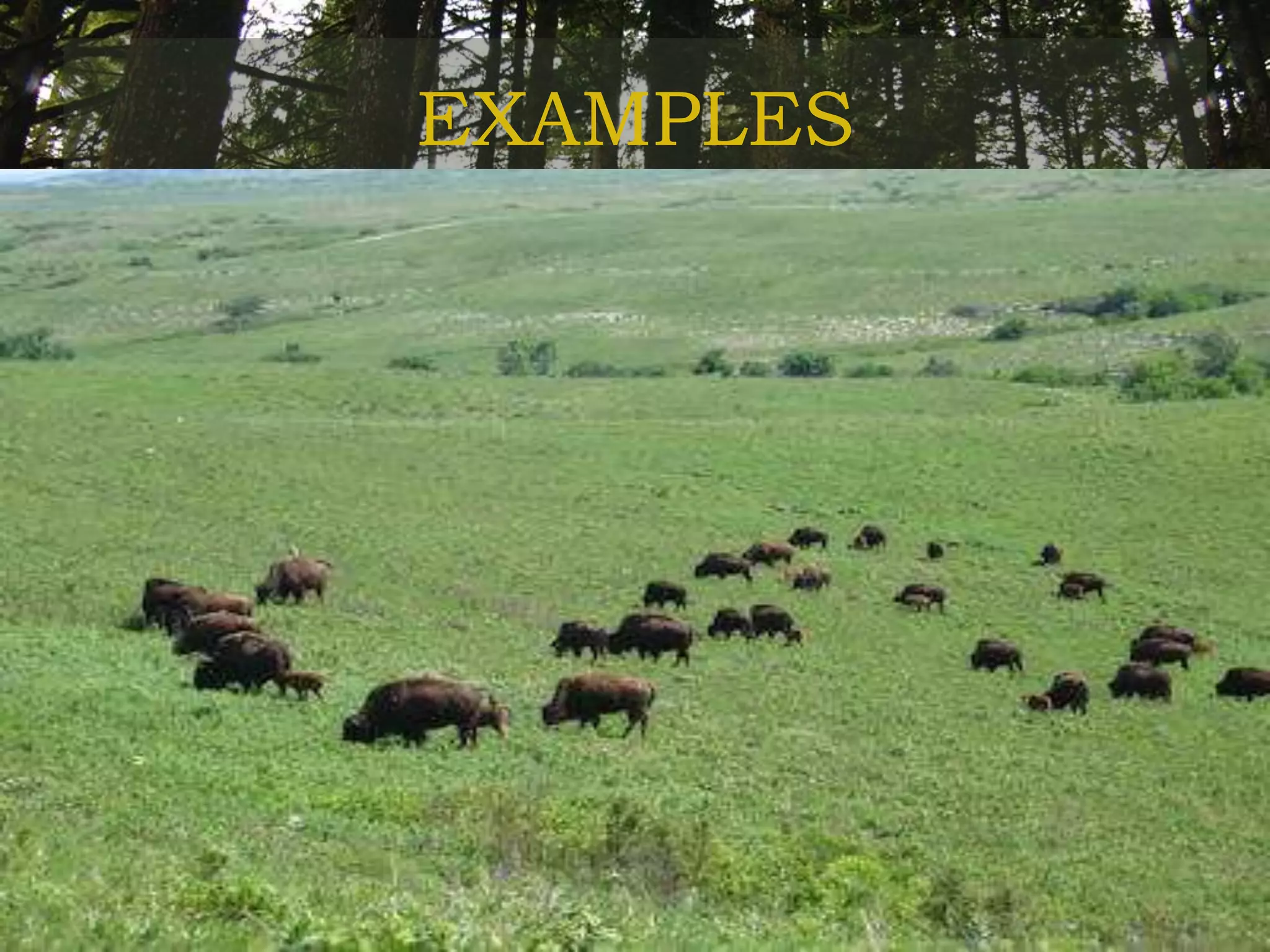
EXAMPLES
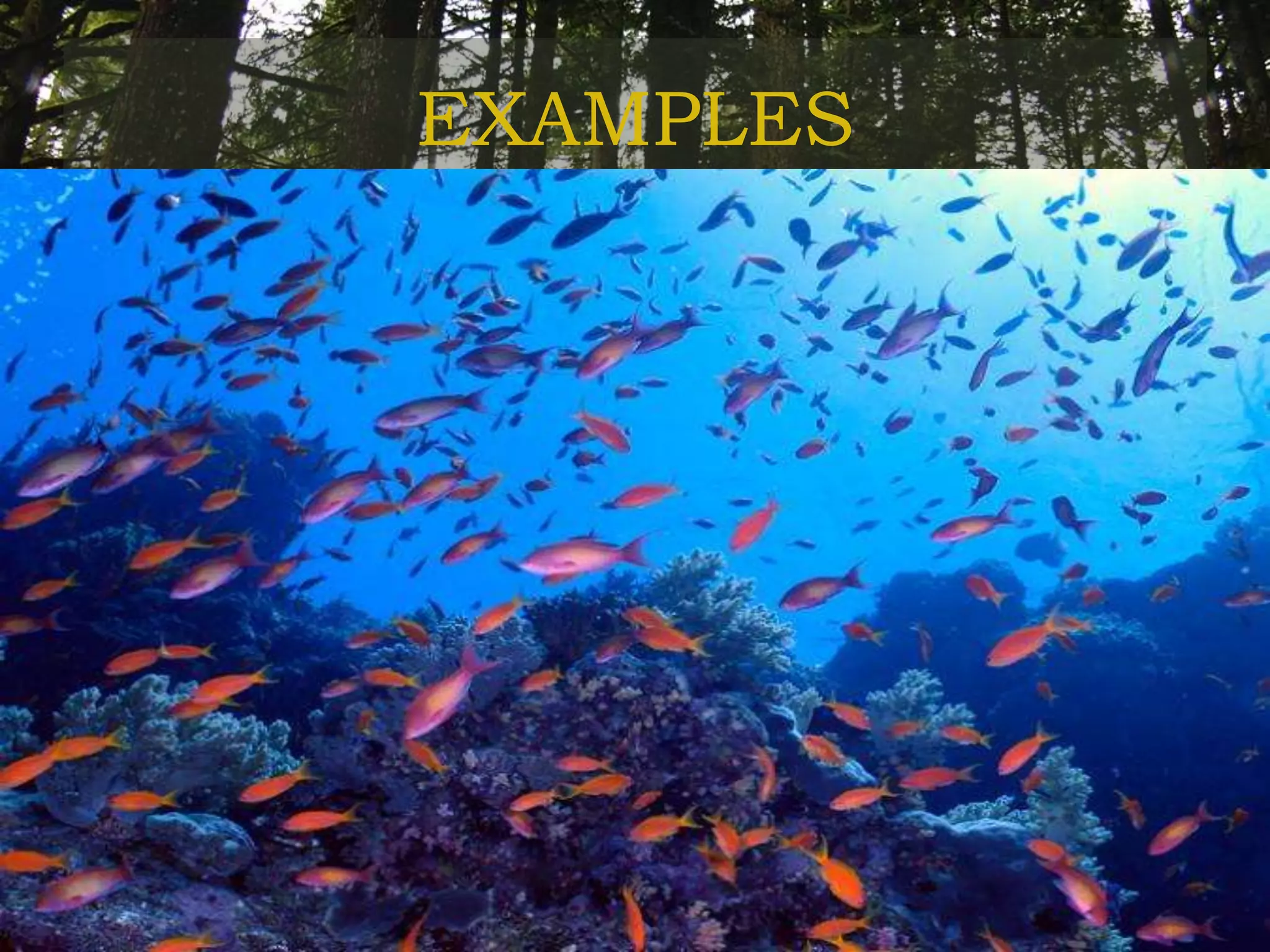
EXAMPLES
EXAMPLES
STRUCTURE AND FUNCTIONS
    OF AN ECOSYSTEM
 STRUCTURE
      An ecosystem usually consists of :
• Biotic components
• Abiotic components
• Interaction between them
• Source of energy
STRUCTURE AND FUNCTIONS
    OF AN ECOSYSTEM
FUNCTIONS
 In an ecosystem there are two processes
  proceeding simultaneously:
    1 . Energy flow
    2 . Biogeochemical cycle
Functions
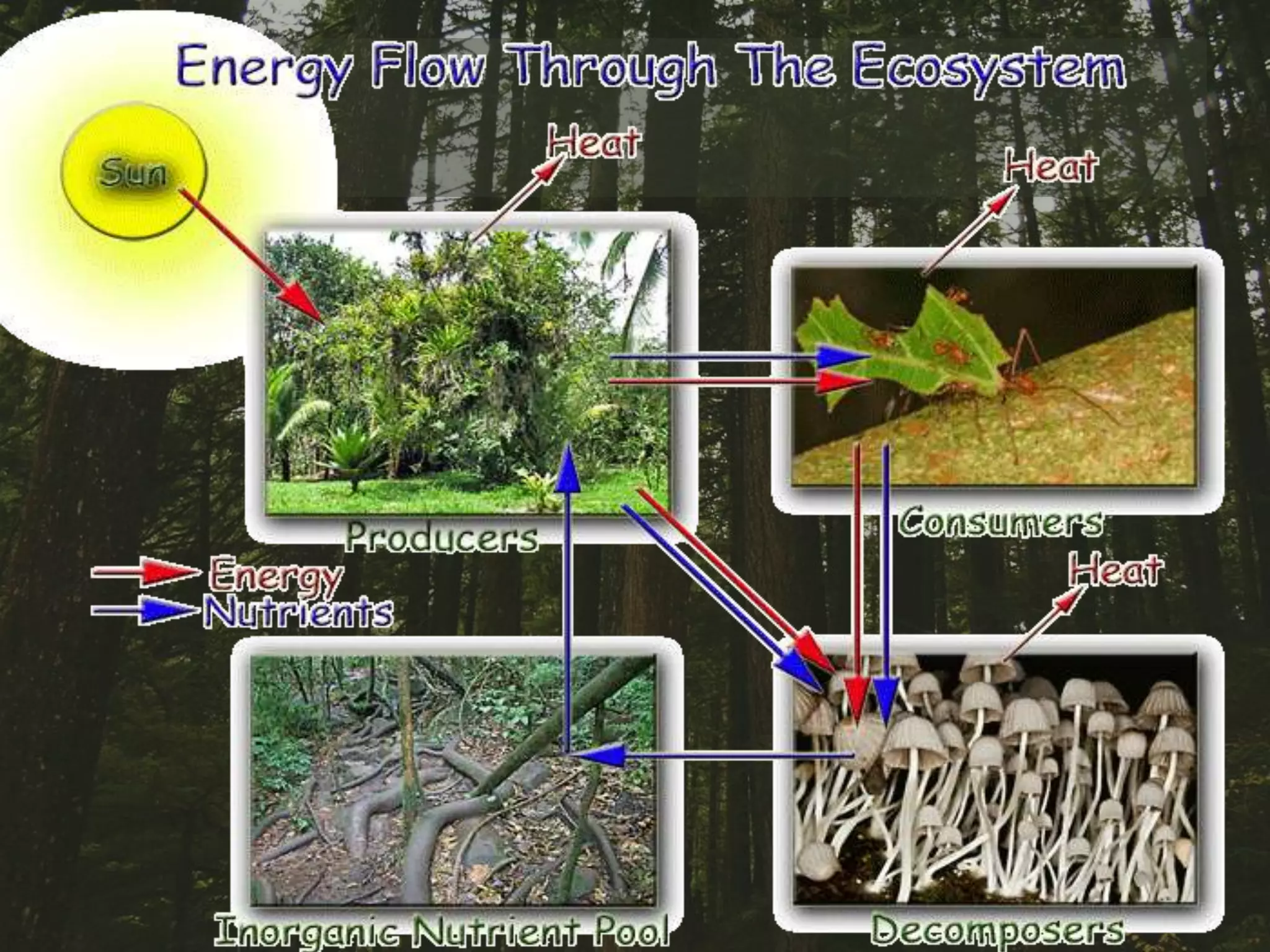
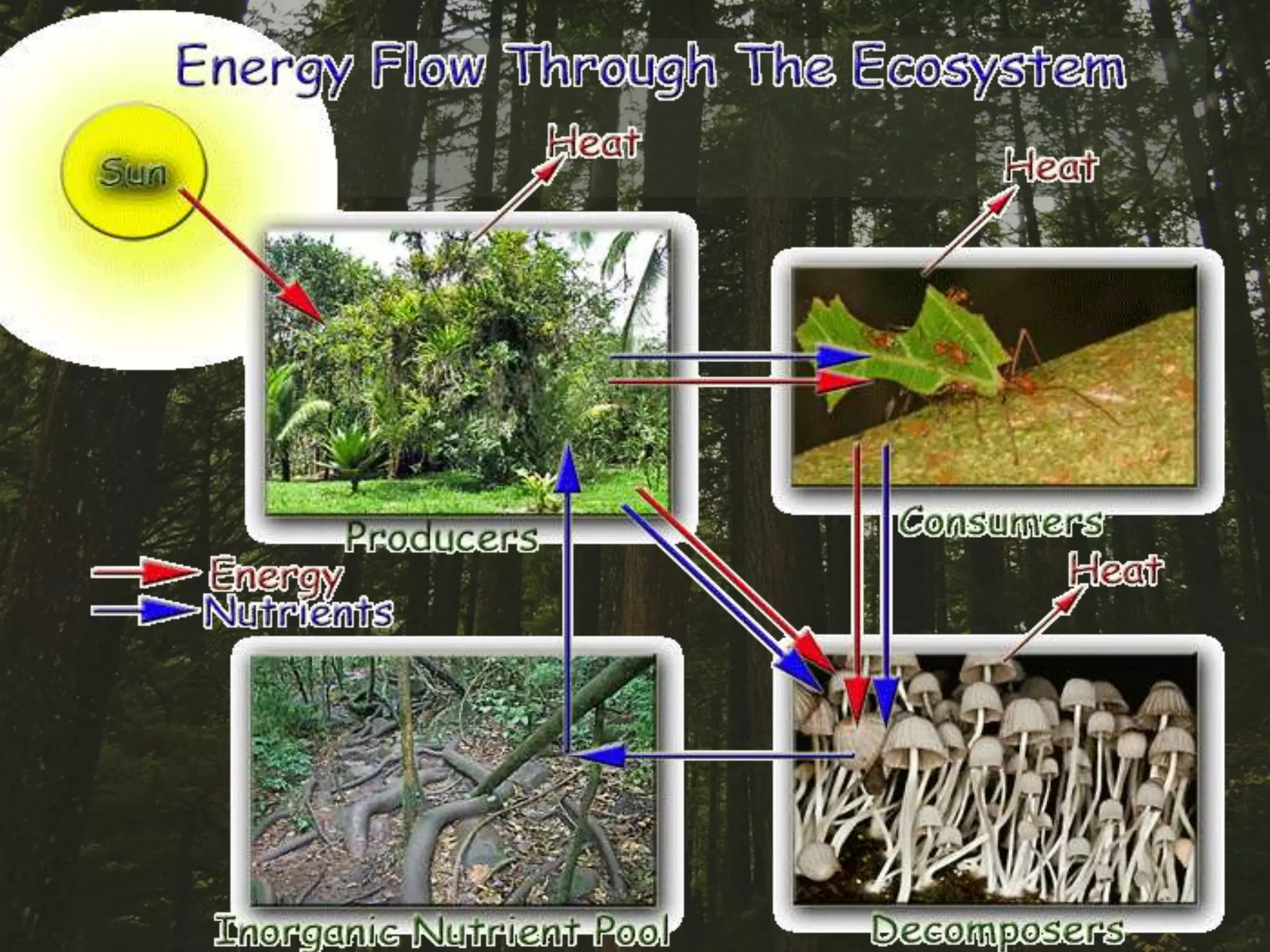
 Energy flow
• The energy flow is in a single direction
  and is non-cyclic.
• Energy cannot be used indefinitely and is
  continuously being lost to the environment
  in the form of heat of being used by the
  organism for its processes such as
  digestion, respiration,etc.
Functions
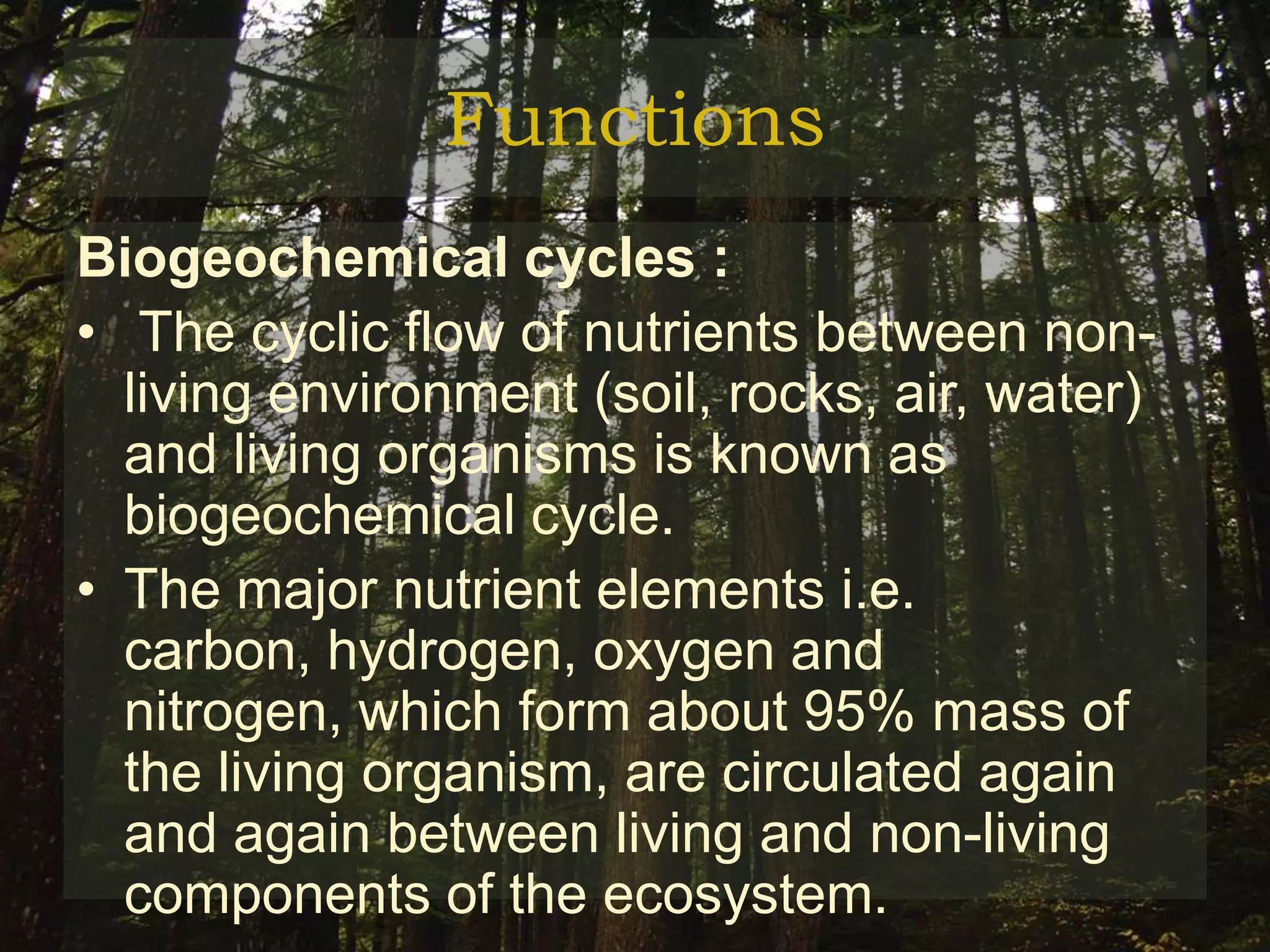
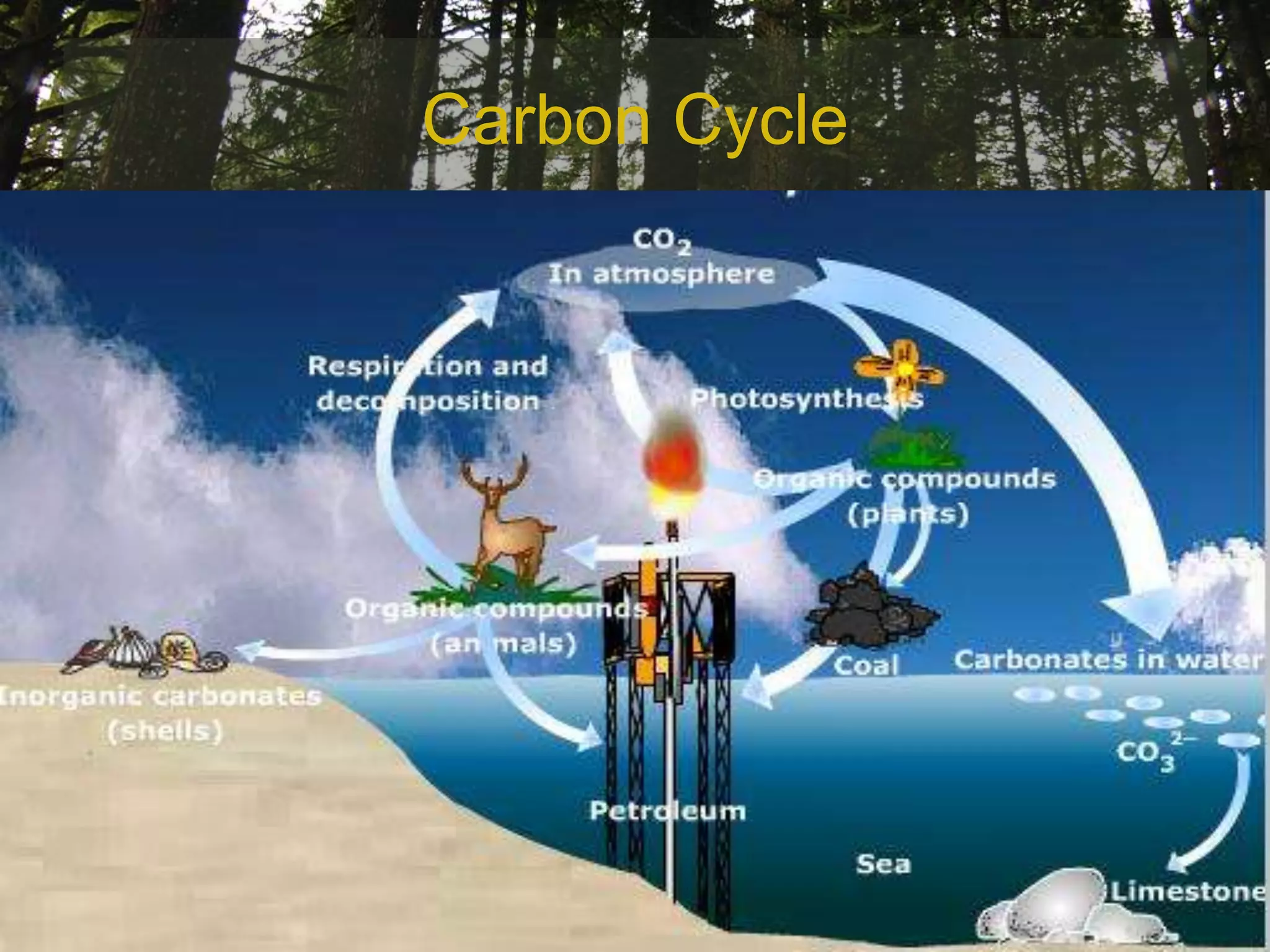
Biogeochemical cycles :
• The cyclic flow of nutrients between non-
  living environment (soil, rocks, air, water)
  and living organisms is known as
  biogeochemical cycle.
• The major nutrient elements i.e.

  carbon, hydrogen, oxygen and
  nitrogen, which form about 95% mass of
  the living organism, are circulated again
  and again between living and non-living
  components of the ecosystem.
Carbon Cycle
BIOTIC COMPONENETS OF AN
        ECOSYSTEM

• Producers
• Consumers
            o Primary consumers
            o Secondary consumers
            o Tertiary consumers
• Decomposers
Producers
• In an ecosystem, producers are those
  organisms that use photosynthesis to
  capture energy by using sunlight, water
  and carbon dioxide to create
  carbohydrates, and then use that energy
  to create more complex molecules like
  proteins, lipids and starches that are
  crucial to life processes.
• Producers, which are mostly green
  plants, are also called autotrophs.
Producers
• Role:
 Producers funnel into the ecosystem the
  energy needed for its biological processes.
• Shaping the ecosystem :
    The efficiency of the producers in adding
  energy to the ecosystem determines how
  robust that ecosystem will be.
    Efficient producers can enable an
  ecosystem to support secondary, tertiary or
  even quaternary consumers.
Consumers
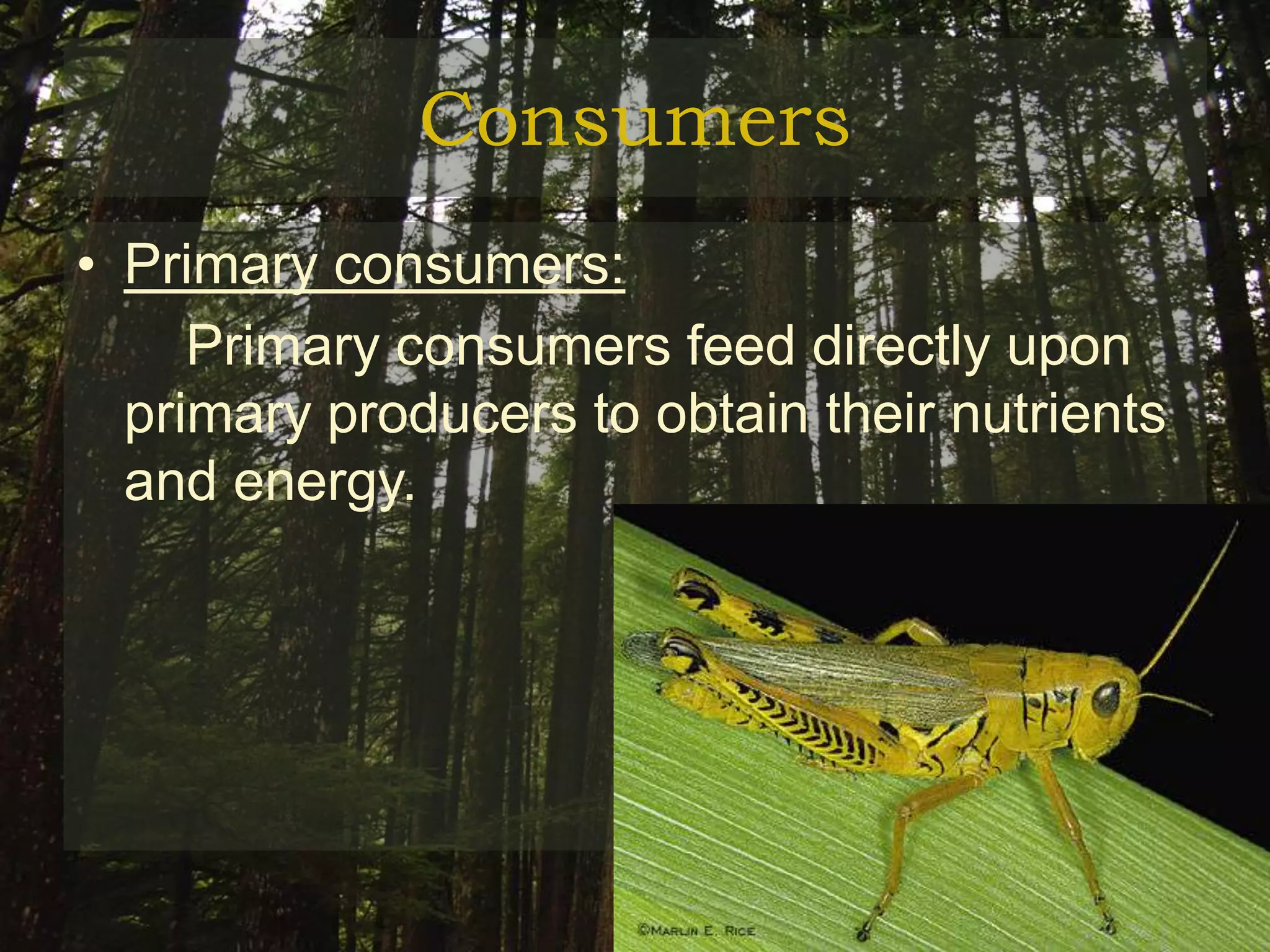
• Primary consumers:
     Primary consumers feed directly upon
  primary producers to obtain their nutrients
  and energy.
Consumers
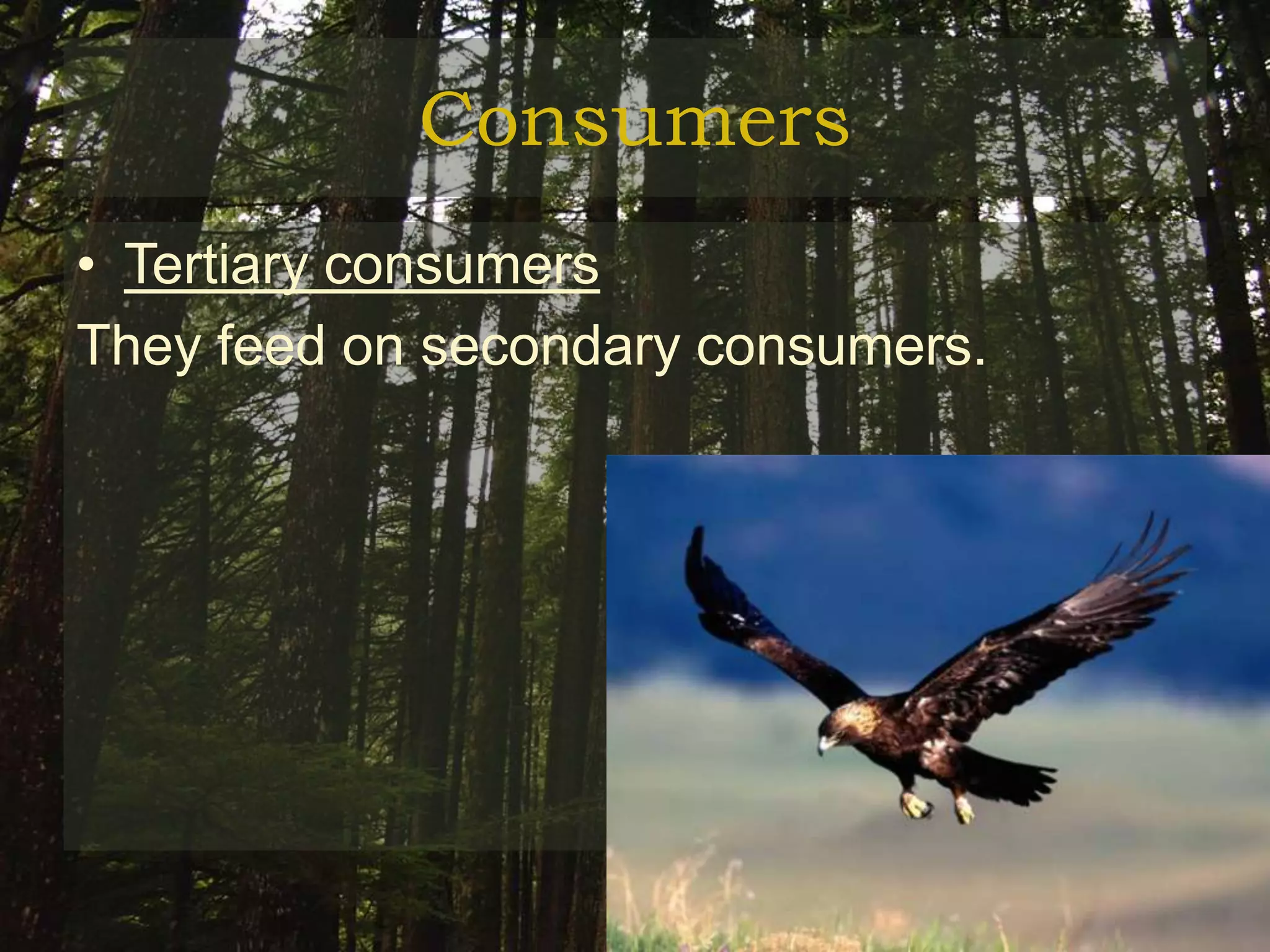
• Tertiary consumers
They feed on secondary consumers.
Decomposers
• Decomposers are the organisms that
  clean up after the producers and
  consumers.
• They obtain their own energy by breaking
  down the remains of the producers and
  consumers.
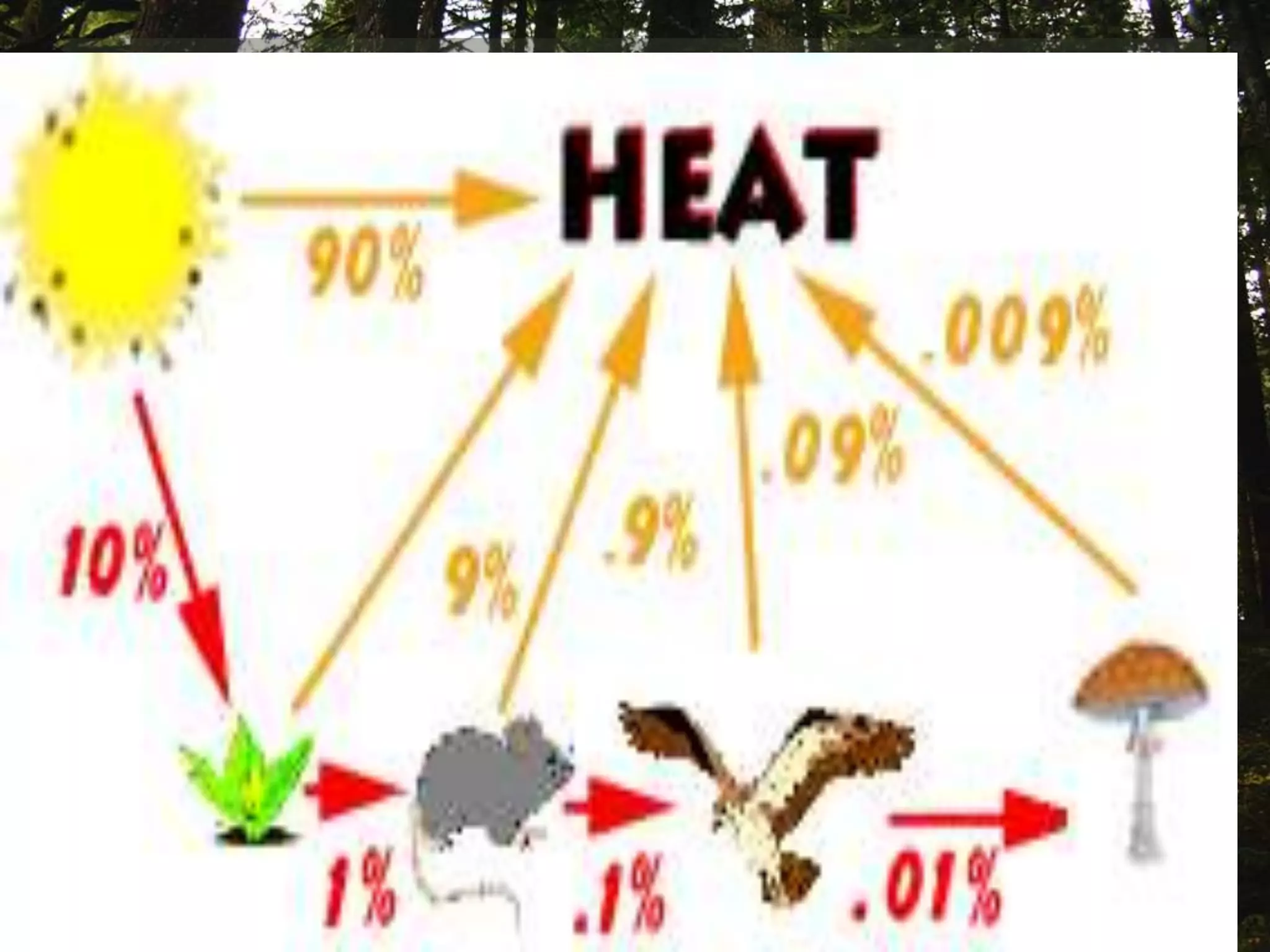
ENERGY FLOW
• Each organism requires energy for
  survival.
• On average about 10 percent of net
  energy production at one level is passed
  on to the next level.
• Energy is not recycled during
  decomposition, but rather is
  released, mostly as heat .
ECOLOGICAL SUCCESSION
• The process by which the structure of a
  biological community evolves over time is
  called as ecological succession.
• There are two different types of ecological
  succession:
       1. Primary succession
       2.Secondary succession
Primary Succession
• Primary succession occurs when all
  previous living organisms have been
  removed from an area.
• Thus, organisms that enter into the
  uninhabited area start the process of
  ecological succession.
Secondary Succession
• It is set in motion by disturbances in the
  environment which are insufficient to wipe
  out the previously existing species.
Climax Communities
• The relative end point of ecological
  successions referred to as climax
  communities.
• The climax community is an environmental
  system in which there is little or
  extraordinarily slow change.
FOOD CHAIN
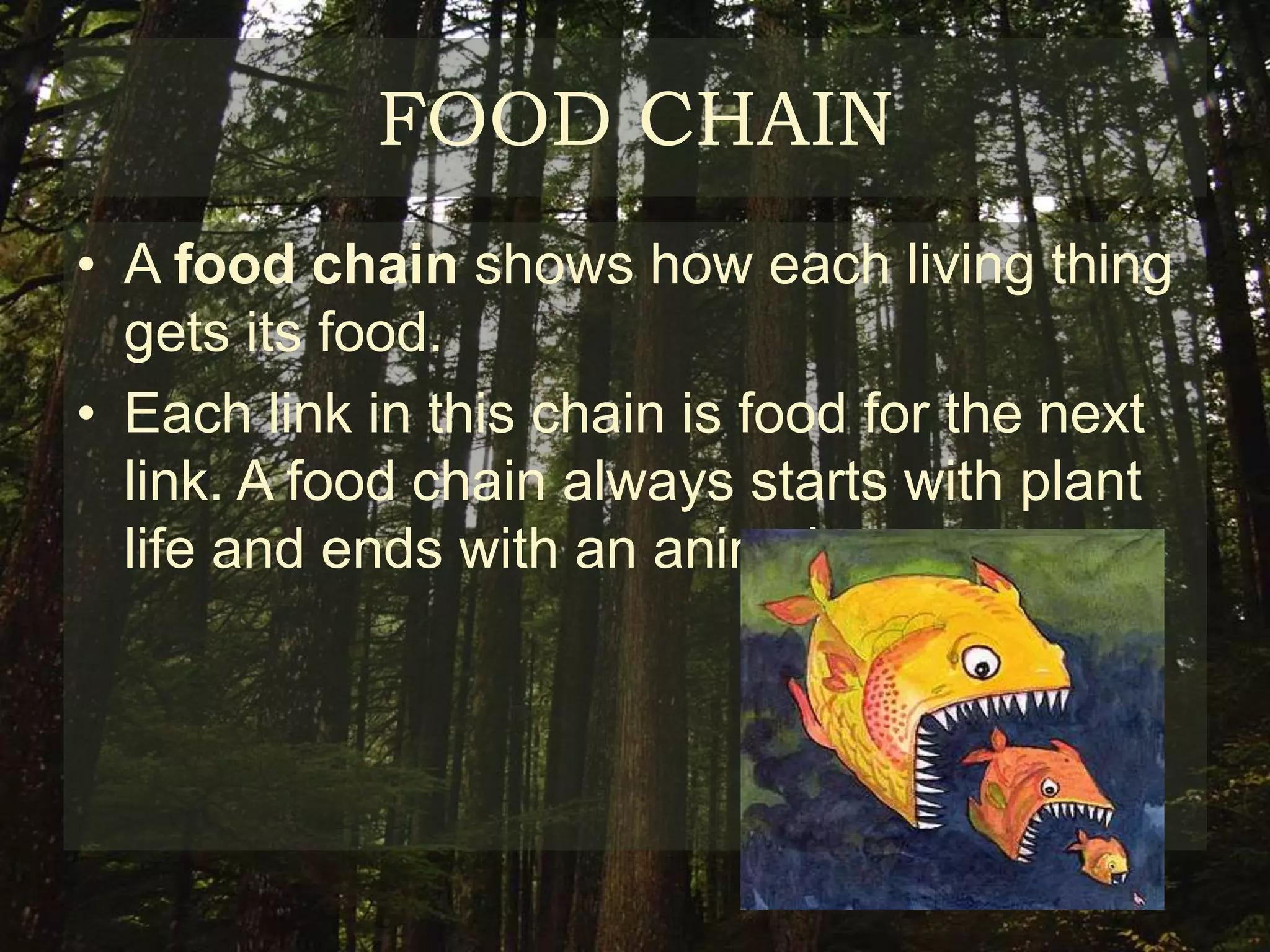
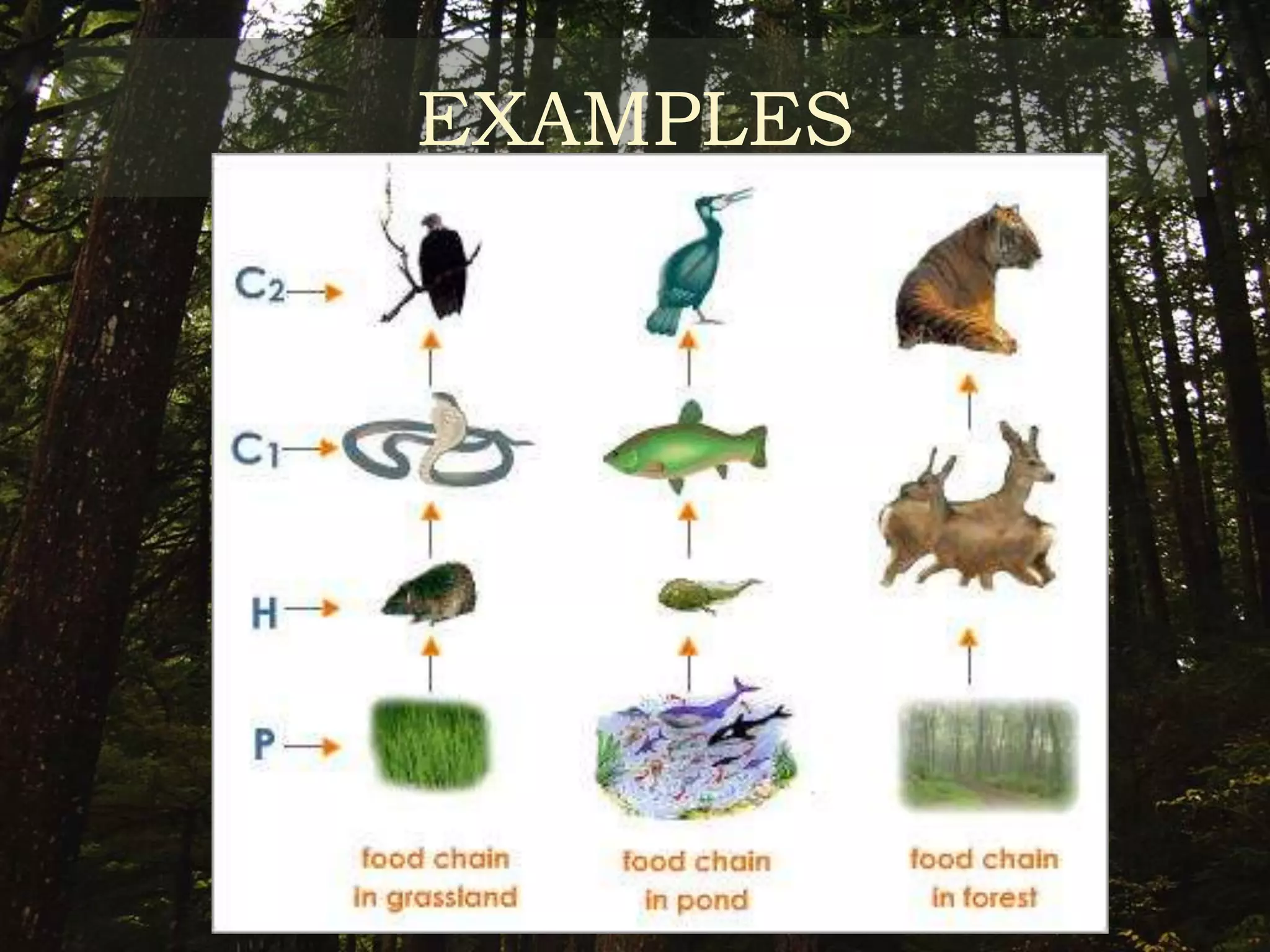
• A food chain shows how each living thing
  gets its food.
• Each link in this chain is food for the next
  link. A food chain always starts with plant
  life and ends with an animal.
EXAMPLES
Characteristics of food chains
1. There are more herbivores than
  carnivores.
2. The further along the food chain you
  go, the less food (and hence energy)
  remains available.
3. Most food chains have no more than four
  or five links.
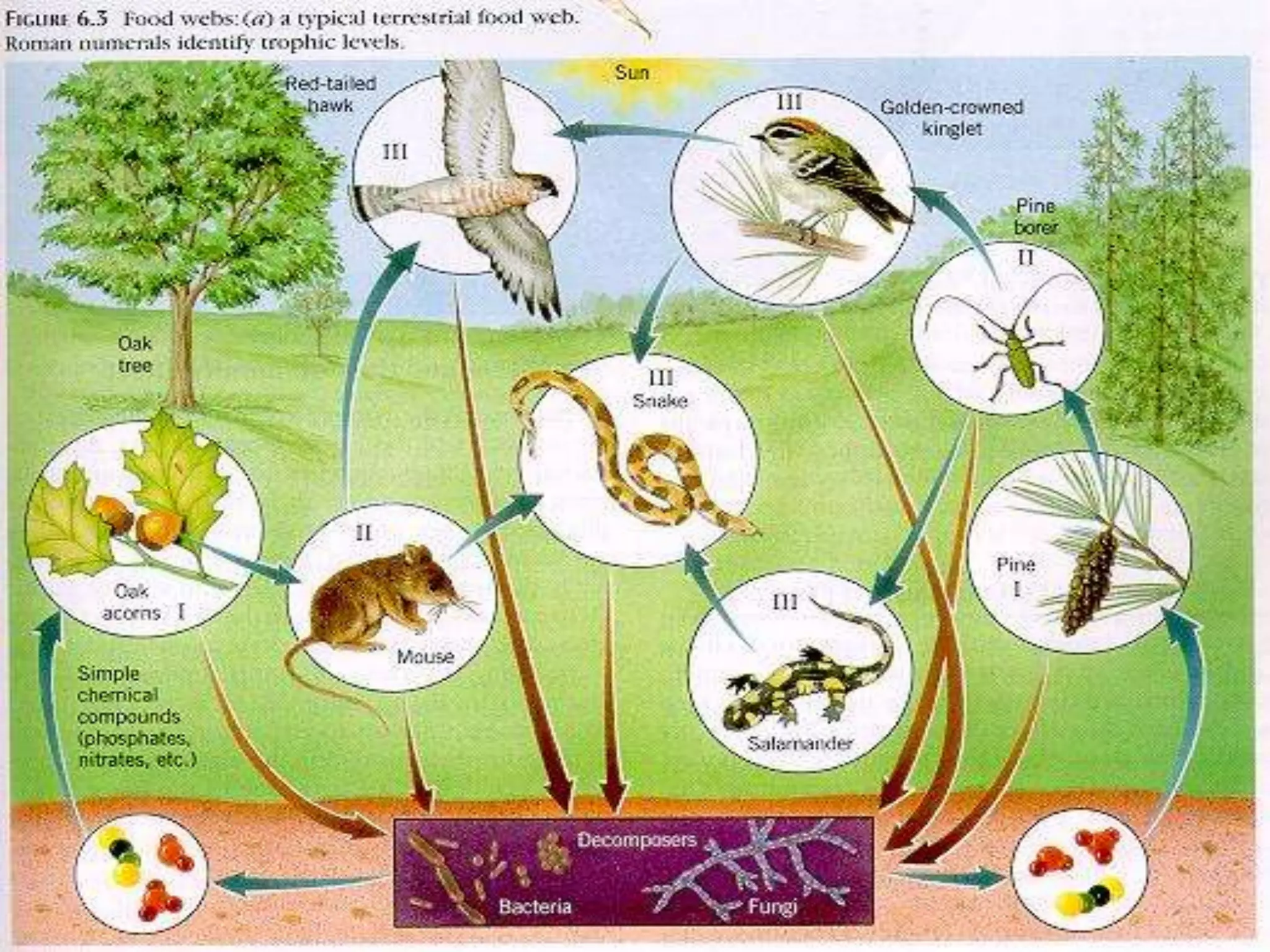
FOOD WEB
• Most animals are part of more than one
  food chain and eat more than one kind of
  food in order to meet their food and energy
  requirements. These interconnected food
  chain form a food web.
• A food web differs from a food chain in that
  the latter shows only a portion of the food
  web involving a simple, linear series of
  species connected by feeding links
Example
ECOLOGICAL PYRAMIDS
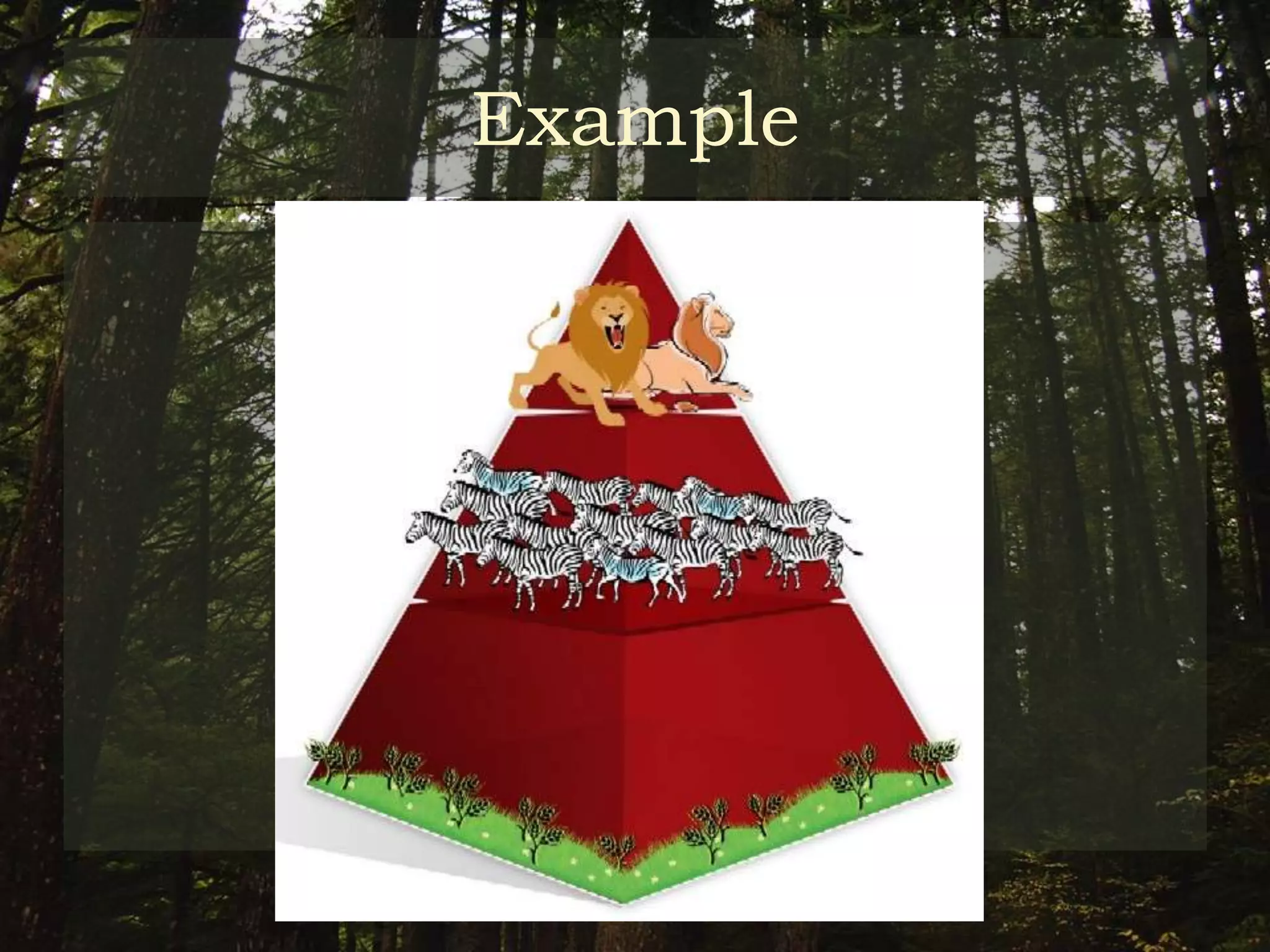
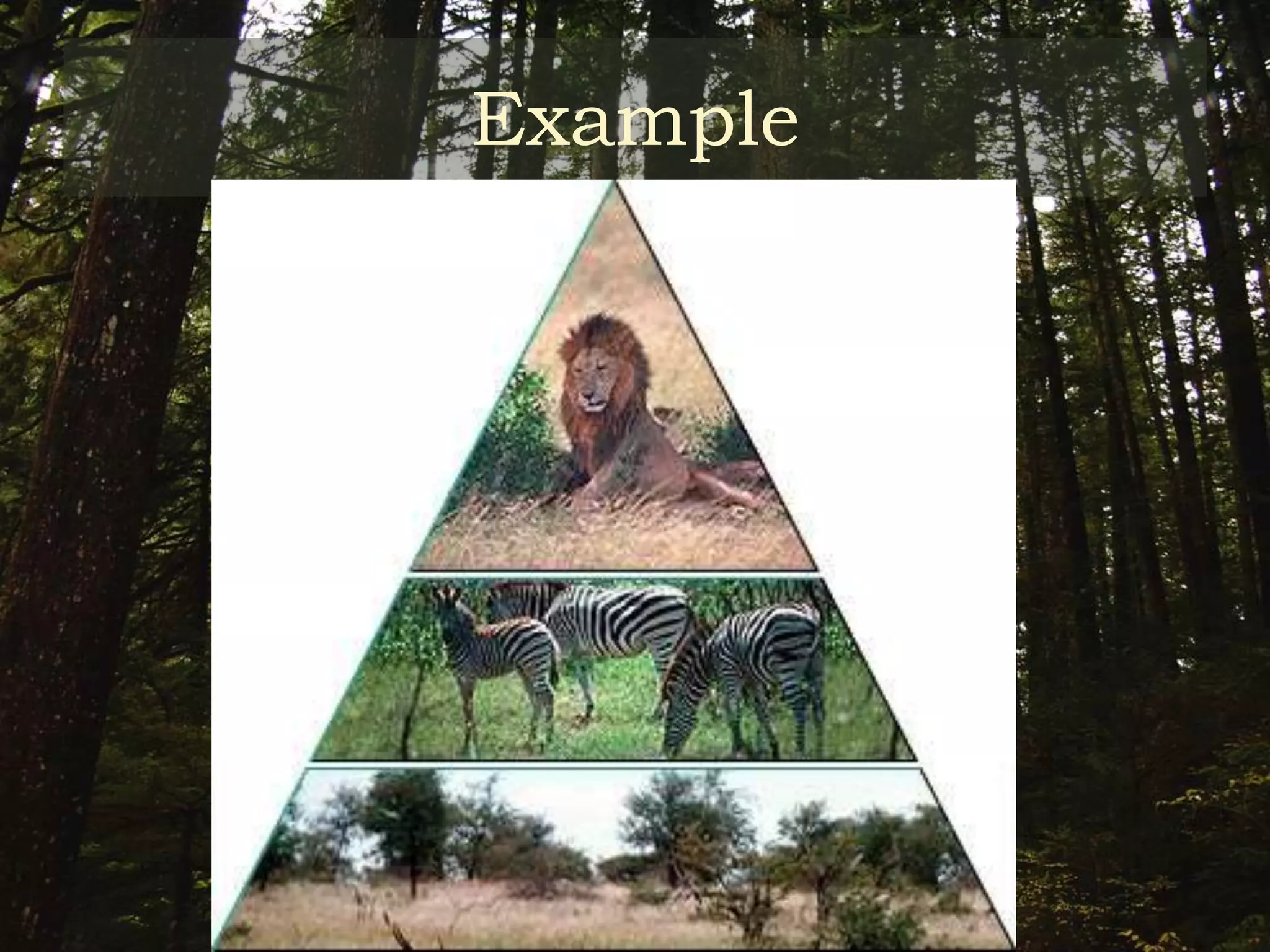
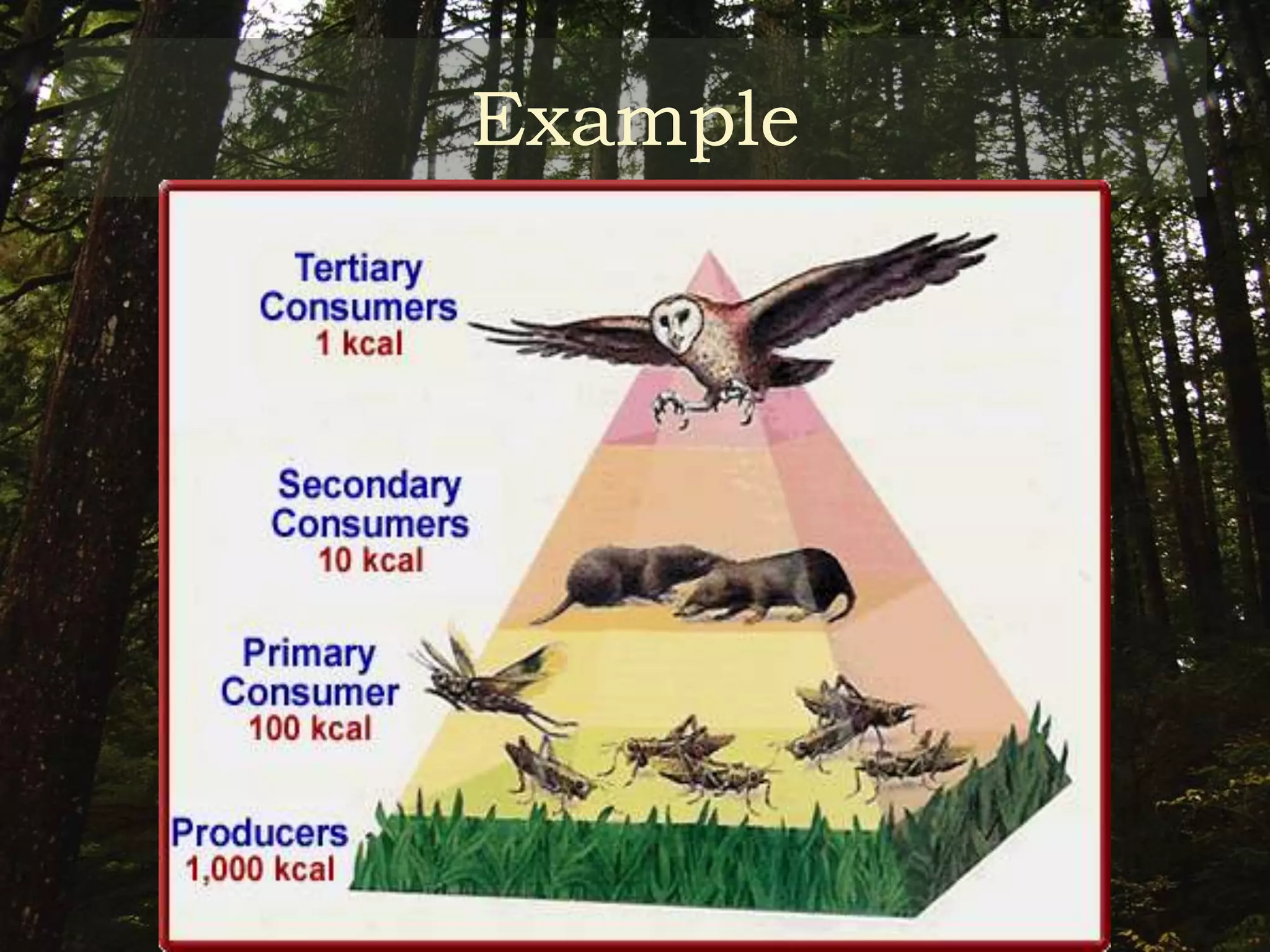
• An ecological pyramid is an illustration of
  the reduction in energy as you move
  through each feeding (trophic) level in an
  ecosystem.
Example
ECOLOGICAL PYRAMIDS
There are three ways an ecological
  pyramid can be represented.
1. Pyramid of Numbers can be generated by
  counting all the organisms at the different
  feeding levels.
Example
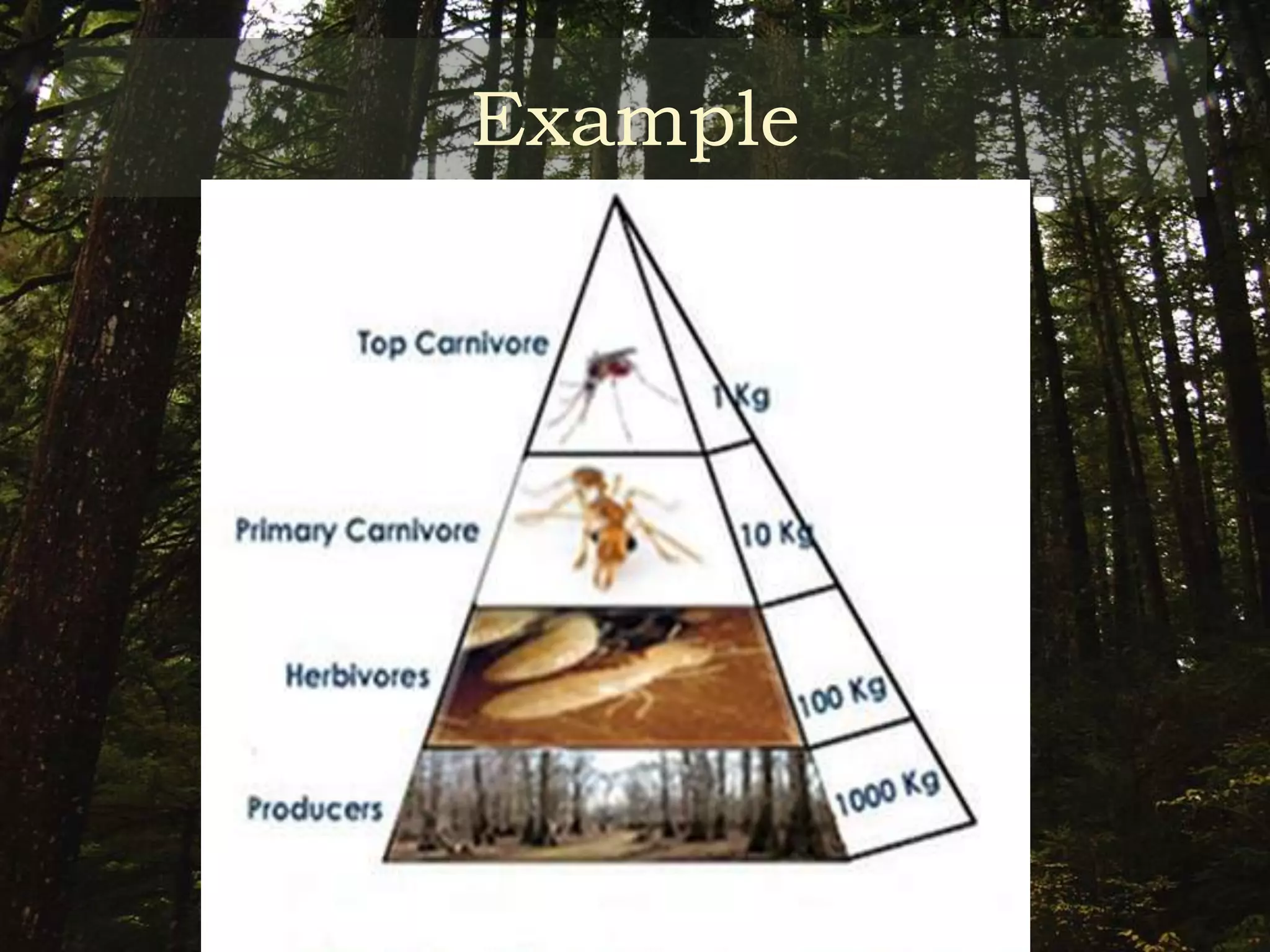
• Pyramid of Biomass where organisms are
  collected from each feeding level, dried
  and then weighed. This dry weight
  (biomass) represents the amount of
  organic matter (available energy) of the
  organisms.
Example
• Pyramid of Energy Flow This approach
  necessitates measuring the caloric value
  of the different organisms that make up
  the community
Example
Summary
•   Concept of an ecosystem
•   Structure and function of an ecosystem
•   Producers,consumers and decomposers.
•   Energy flow
•   Ecological succession
•   Food chains and food webs
•   Ecological pyramids
THANK YOU

Ecosystem and its features final

  • 1.
  • 2.
    WHAT IS ANECOSYSTEM? • The term ecosystem was coined in 1930 by Roy Clapham, to denote the physical and biological components of an environment considered in relation to each other as a unit. • Ecosystem means a dynamic complex of plant, animal and micro-organism communities and their non-living environment interacting as a functional unit.
  • 3.
  • 4.
  • 5.
  • 6.
    STRUCTURE AND FUNCTIONS OF AN ECOSYSTEM STRUCTURE An ecosystem usually consists of : • Biotic components • Abiotic components • Interaction between them • Source of energy
  • 7.
    STRUCTURE AND FUNCTIONS OF AN ECOSYSTEM FUNCTIONS In an ecosystem there are two processes proceeding simultaneously: 1 . Energy flow 2 . Biogeochemical cycle
  • 8.
    Functions Energy flow •The energy flow is in a single direction and is non-cyclic. • Energy cannot be used indefinitely and is continuously being lost to the environment in the form of heat of being used by the organism for its processes such as digestion, respiration,etc.
  • 10.
    Functions Biogeochemical cycles : •The cyclic flow of nutrients between non- living environment (soil, rocks, air, water) and living organisms is known as biogeochemical cycle. • The major nutrient elements i.e. carbon, hydrogen, oxygen and nitrogen, which form about 95% mass of the living organism, are circulated again and again between living and non-living components of the ecosystem.
  • 12.
  • 13.
    BIOTIC COMPONENETS OFAN ECOSYSTEM • Producers • Consumers o Primary consumers o Secondary consumers o Tertiary consumers • Decomposers
  • 14.
    Producers • In anecosystem, producers are those organisms that use photosynthesis to capture energy by using sunlight, water and carbon dioxide to create carbohydrates, and then use that energy to create more complex molecules like proteins, lipids and starches that are crucial to life processes. • Producers, which are mostly green plants, are also called autotrophs.
  • 15.
    Producers • Role: Producersfunnel into the ecosystem the energy needed for its biological processes. • Shaping the ecosystem : The efficiency of the producers in adding energy to the ecosystem determines how robust that ecosystem will be. Efficient producers can enable an ecosystem to support secondary, tertiary or even quaternary consumers.
  • 16.
    Consumers • Primary consumers: Primary consumers feed directly upon primary producers to obtain their nutrients and energy.
  • 17.
    Consumers • Tertiary consumers Theyfeed on secondary consumers.
  • 18.
    Decomposers • Decomposers arethe organisms that clean up after the producers and consumers. • They obtain their own energy by breaking down the remains of the producers and consumers.
  • 19.
    ENERGY FLOW • Eachorganism requires energy for survival. • On average about 10 percent of net energy production at one level is passed on to the next level. • Energy is not recycled during decomposition, but rather is released, mostly as heat .
  • 21.
    ECOLOGICAL SUCCESSION • Theprocess by which the structure of a biological community evolves over time is called as ecological succession. • There are two different types of ecological succession: 1. Primary succession 2.Secondary succession
  • 22.
    Primary Succession • Primarysuccession occurs when all previous living organisms have been removed from an area. • Thus, organisms that enter into the uninhabited area start the process of ecological succession.
  • 23.
    Secondary Succession • Itis set in motion by disturbances in the environment which are insufficient to wipe out the previously existing species.
  • 24.
    Climax Communities • Therelative end point of ecological successions referred to as climax communities. • The climax community is an environmental system in which there is little or extraordinarily slow change.
  • 25.
    FOOD CHAIN • Afood chain shows how each living thing gets its food. • Each link in this chain is food for the next link. A food chain always starts with plant life and ends with an animal.
  • 26.
  • 27.
    Characteristics of foodchains 1. There are more herbivores than carnivores. 2. The further along the food chain you go, the less food (and hence energy) remains available. 3. Most food chains have no more than four or five links.
  • 28.
    FOOD WEB • Mostanimals are part of more than one food chain and eat more than one kind of food in order to meet their food and energy requirements. These interconnected food chain form a food web. • A food web differs from a food chain in that the latter shows only a portion of the food web involving a simple, linear series of species connected by feeding links
  • 29.
  • 30.
    ECOLOGICAL PYRAMIDS • Anecological pyramid is an illustration of the reduction in energy as you move through each feeding (trophic) level in an ecosystem.
  • 31.
  • 32.
    ECOLOGICAL PYRAMIDS There arethree ways an ecological pyramid can be represented. 1. Pyramid of Numbers can be generated by counting all the organisms at the different feeding levels.
  • 33.
  • 34.
    • Pyramid ofBiomass where organisms are collected from each feeding level, dried and then weighed. This dry weight (biomass) represents the amount of organic matter (available energy) of the organisms.
  • 35.
  • 36.
    • Pyramid ofEnergy Flow This approach necessitates measuring the caloric value of the different organisms that make up the community
  • 37.
  • 38.
    Summary • Concept of an ecosystem • Structure and function of an ecosystem • Producers,consumers and decomposers. • Energy flow • Ecological succession • Food chains and food webs • Ecological pyramids
  • 39.