
CHAPTER 14: ECOSYSTEM
GIRISH VAMANRAO TONAPI
 It is a dynamic system which includes both organisms
biotic component and abiotic environment influencing
the properties of each other and both are necessary
for the maintenance of life.
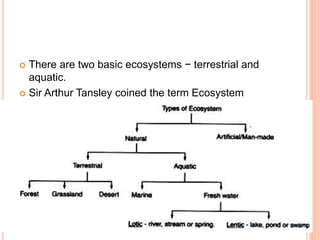
 There are two basic ecosystems − terrestrial and
aquatic.
 Sir Arthur Tansley coined the term Ecosystem
STRUCTURE OF ECOSYSTEM
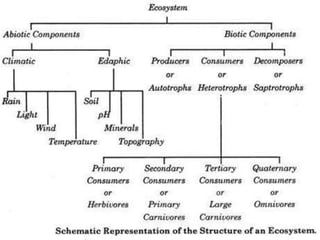
 The interactions between the various biotic and abiotic factors
of an ecosystem lead to the maintenance of the ecosystem.
 Stratification is the vertical distribution of the different species
occupying the different levels. For example, trees occur at a
higher level then shrubs.
 The various aspects taken into consideration to study the
functioning of ecosystem are:
 Productivity
 Decomposition
 Energy flow
 Nutrient cycling
PRODUCTIVITY
 A constant supply of sunlight is required for the proper
functioning of any ecosystem.
 The amount of biomass produced per unit area over a time
period by plants during photosynthesis is defined as
the primary productivity.
 It is expressed as weight or energy
 Productivity can be mainly divided into gross primary
productivity (GPP) and net primary productivity (NPP). GPP is
the rate of production of organic matter during photosynthesis.
 NPP is the amount of energy left in the producers after
utilization of some energy for respiration
 NPP = GPP − Respiratory losses (R)
 Secondary productivity is defined as the rate of
formation of new organic matter by consumers.
 Primary productivity depends upon
 type of plant species inhabiting a particular area
 photosynthetic capacity of plants
 nutrient availability
DECOMPOSITION
 It is the process of breakdown of complex organic matter into
inorganic substances such as carbon dioxide, water, nutrients, etc.
 STEPS
 Fragmentation − Breaking down of detritus (dead plant and animal
remains, faecal matter) into smaller particles by detritivores
(decomposers)
 Leaching - Process by which these inorganic matters enter the soil
 Mineralization − Process by which humus further degrades to
release minerals into the soil
 Catabolism − Process by which detritus is degraded into
simpler inorganic substances by bacterial and fungal enzymes
 Humification − Accumulation of humus in the soil. Humus is
resistant to microbial action and decomposes at an extremely
slow rate. It acts as a reservoir of nutrients.
ENERGY FLOW
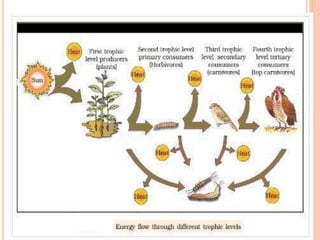
 Sun is the sole source of energy for all ecosystems on the
earth.
 Plants and other photosynthetic organisms utilize less than
50% of the solar radiation known as the photosynthetically
active radiation (PAR).
 In an ecosystem, plants are called producers and all animals
depend upon the plants directly or indirectly for their food.
Hence, they are known as consumers or heterotrophs.
 The consumers can be further divided into primary consumers
(herbivores), secondary consumers (primary carnivores), and
tertiary consumers (secondary carnivores).
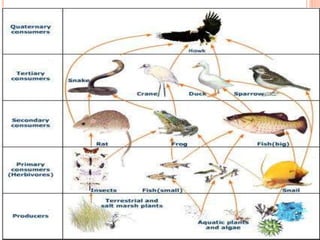
 Food chain − The energy flow among the various constituent
animals is known as the food chain.
 Food web − The interconnection of the various food chains is
called the food web.
 Trophic level − Every organism occupies a specific level in
their food chain known as the trophic level.
 Standing crop − Each trophic level contains a certain amount
of living material at a certain time known as the standing crop.
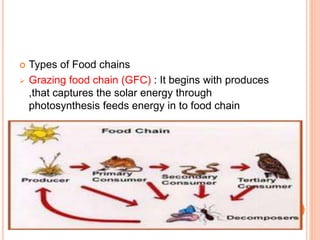
 Types of Food chains
 Grazing food chain (GFC) : It begins with produces
,that captures the solar energy through
photosynthesis feeds energy in to food chain
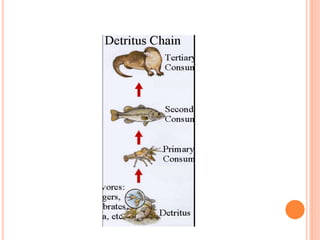
 Detritus food chain ( DFC) : It begins with dead
organic matter and decomposes and so it is less
dependent on solar energy. The dead organic
matter is broken down into simple nutrients by
microorganisms like fungi and bacteria. This type of
food chain is found in forest ecosystem.
ECOLOGICAL PYRAMIDS
 The concept of ecological pyramid was developed by Charles
Elton; these pyramids are also known as Eltonian pyramids.
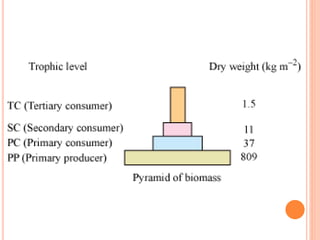
 The pyramids are a graphical representation which depicts the
number of organisms, biomass and productivity at each trophic
level.
 All ecological pyramids begin at the bottom with the produces
and proceed through different trophic levels.
 Ecological pyramids are of 3 types:
 Pyramid of number
 Pyramid of biomass
 Pyramid of energy
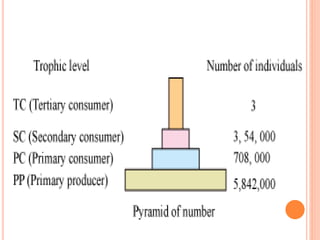
Pyramid of number
 The pyramid of numbers depicts the relationship in terms of
the number of producers, herbivores and the carnivores at
their successive trophic levels.
 There is a decrease in the number of individuals from the lower
to the higher trophic levels. The number pyramid varies from
ecosystem to ecosystem
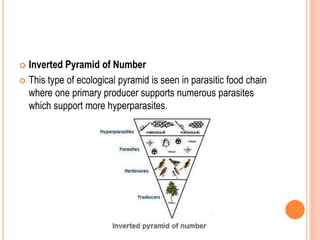
 Inverted Pyramid of Number
 This type of ecological pyramid is seen in parasitic food chain
where one primary producer supports numerous parasites
which support more hyperparasites.
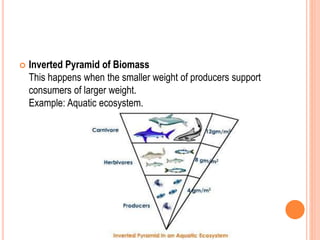
 Inverted Pyramid of Biomass
This happens when the smaller weight of producers support
consumers of larger weight.
Example: Aquatic ecosystem.
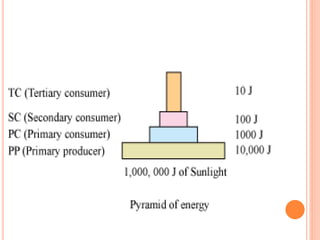
Pyramid of energy
 The pyramid of energy or the energy pyramid describes the
overall nature of the ecosystem.
 During the flow of energy from organism to other, there is
considerable loss of energy in the form of heat.
 The primary producers like the autotrophs there is more
amount of energy available.
 The least energy is available in the tertiary consumers. Thus,
shorter food chain has more amount of energy available even
at the highest trophic level
 However, the pyramid of energy is always upright.
NUTRIENT CYCLING
 The amount of nutrients present in the soil at a given time is
known as the standing state.
 Nutrients are never lost from the ecosystem. They are only
recycled from one state to another.
 The movement of nutrients through the various components of
the ecosystem is called nutrient cycling or biogeochemical
cycles. They are of two types:
 Gaseous − Reservoir for these types of cycles exist in the
atmosphere.
 Sedimentary − Reservoir for these types of cycles exist in
the earth’s crust.
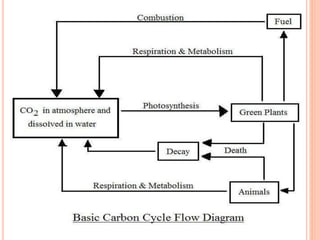
Carbon Cycle
 About 49% of the dry weight of living organisms is made up of
carbon.
 The ocean reserves and fossil fuels regulate the amount of
CO2 in the atmosphere.
 Plants absorb CO2 from the atmosphere for photosynthesis, of
which a certain amount is released back through respiratory
activities.
 A major amount of CO2 is contributed by the decomposers who
contribute to the CO2 pool by processing dead and decaying
matter.
 The amount of CO2 in the atmosphere has been increased
considerably by human activities such as burning of fossil
fuels, deforestation.
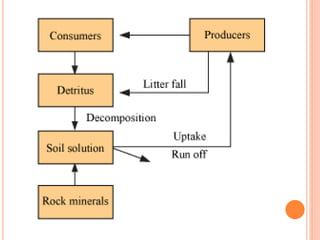
PHOSPHORUS CYCLE
 Phosphorus is an important constituent of cell membranes,
nucleic acids, and cellular energy transfer systems.
 Rocks contain phosphorus in the form of phosphate.
 When rocks are weathered, some of the phosphate gets
dissolved in the soil solution and is absorbed by plants.
 The consumers get their phosphorus from the plants.
 Phosphorus returns back to the soil by the action of
phosphate-solubilising bacteria on dead organisms
ECOLOGICAL SUCCESSION
 The composition of all ecosystems keeps on changing with
change in their environment. These changes finally lead to the
climax community.
 Climax community − It is the community which is in
equilibrium with its environment. Gradual and fairly predictable
change in the species’ composition of a given area is called
ecological succession.
 Sere(s) − It is the sequence of communities that successively
change in a given environment. The transitional communities
are called seral stages or seral communities.
 Succession happens in areas where no life forms ever existed
as in bare rocks, cool lava, etc. (primary succession), or in
areas which have lost all life forms due to destructions and
floods (secondary succession).
 Primary succession takes hundreds to thousands of years as
developing soil on bare rocks is a slow process. Secondary
succession is faster than primary succession since the nature
does not have to start from scratch.
 During succession, any disturbances (natural/man-made) can
convert a particular seral stage to an earlier one.
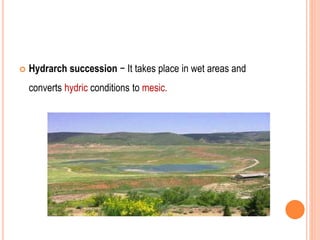
 Hydrarch succession − It takes place in wet areas and
converts hydric conditions to mesic.
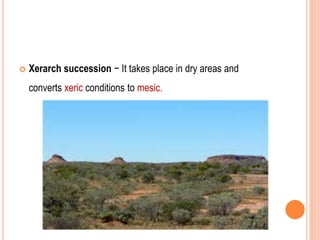
 Xerarch succession − It takes place in dry areas and
converts xeric conditions to mesic.
 Pioneer species − These are the species that first invade a
bare area. On land, these could be lichens that secrete
enzymes to dissolve the rock surfaces for soil formation while
in water, pioneer species could be phytoplanktons.
 The ultimate result of all successions is a climax community, a
mesic
ECOSYSTEM SERVICES:
The products of ecosystem processes are named as ecosystem
services.
 Healthy forest ecosystems purify air and water.
 Mitigate droughts and flood.
 Cycle nutrients.
 Generates fertile soil.
 Provide wildlife habitat.
 Maintain biodiversity.
 Pollinate crops.
 Provide storage site for carbon
 Provides aesthetic, cultural and spiritual values
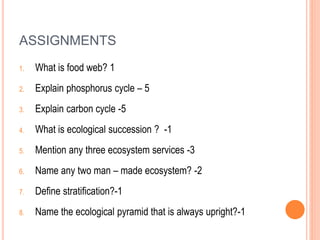
ASSIGNMENTS
1. What is food web? 1
2. Explain phosphorus cycle – 5
3. Explain carbon cycle -5
4. What is ecological succession ? -1
5. Mention any three ecosystem services -3
6. Name any two man – made ecosystem? -2
7. Define stratification?-1
8. Name the ecological pyramid that is always upright?-1
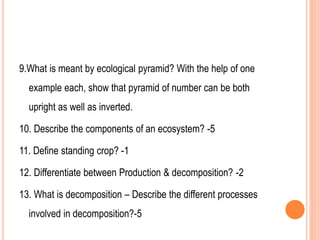
9.What is meant by ecological pyramid? With the help of one
example each, show that pyramid of number can be both
upright as well as inverted.
10. Describe the components of an ecosystem? -5
11. Define standing crop? -1
12. Differentiate between Production & decomposition? -2
13. What is decomposition – Describe the different processes
involved in decomposition?-5
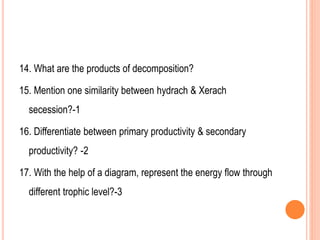
14. What are the products of decomposition?
15. Mention one similarity between hydrach & Xerach
secession?-1
16. Differentiate between primary productivity & secondary
productivity? -2
17. With the help of a diagram, represent the energy flow through
different trophic level?-3
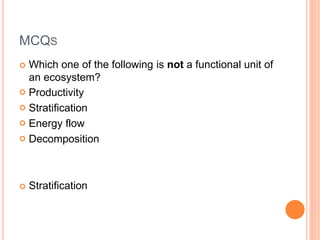
MCQS
 Which one of the following is not a functional unit of
an ecosystem?
 Productivity
 Stratification
 Energy flow
 Decomposition
 Stratification
 Which one of the following is not a gaseous
biogeochemical cycle in ecosystem?
 Nitrogen cycle
 Carbon cycle
 Sulphur cycle
 Sulphur cycle
 Identify the possible link "A" in the following food
chain: Plant → insect → frog → "A" → Eagle
 Cobra
 Parrot
 Rabbit
 wolf
 Cobra
 The type of ecosystem with the highest mean plant
productivity is
 Tropical rain forest
 Temperate grassland
 Desert
 Tundra
Tropical rain forest
 In an aquatic ecosystem, the trophic level
equivalent to cows in grasslands is
 Nekton
 Zooplankton
 Phytoplankton
 Benthos
 Zooplankton
 Trophic levels in ecosystem is formed by :
 only herbivores
 only plants
 only bacteria
 Organisms linked in food chain
Ecosystem

Ecosystem

  • 1.
  • 2.
     It isa dynamic system which includes both organisms biotic component and abiotic environment influencing the properties of each other and both are necessary for the maintenance of life.
  • 3.
     There aretwo basic ecosystems − terrestrial and aquatic.  Sir Arthur Tansley coined the term Ecosystem
  • 5.
    STRUCTURE OF ECOSYSTEM The interactions between the various biotic and abiotic factors of an ecosystem lead to the maintenance of the ecosystem.  Stratification is the vertical distribution of the different species occupying the different levels. For example, trees occur at a higher level then shrubs.
  • 6.
     The variousaspects taken into consideration to study the functioning of ecosystem are:  Productivity  Decomposition  Energy flow  Nutrient cycling
  • 7.
    PRODUCTIVITY  A constantsupply of sunlight is required for the proper functioning of any ecosystem.  The amount of biomass produced per unit area over a time period by plants during photosynthesis is defined as the primary productivity.
  • 8.
     It isexpressed as weight or energy  Productivity can be mainly divided into gross primary productivity (GPP) and net primary productivity (NPP). GPP is the rate of production of organic matter during photosynthesis.  NPP is the amount of energy left in the producers after utilization of some energy for respiration  NPP = GPP − Respiratory losses (R)
  • 9.
     Secondary productivityis defined as the rate of formation of new organic matter by consumers.  Primary productivity depends upon  type of plant species inhabiting a particular area  photosynthetic capacity of plants  nutrient availability
  • 10.
    DECOMPOSITION  It isthe process of breakdown of complex organic matter into inorganic substances such as carbon dioxide, water, nutrients, etc.  STEPS  Fragmentation − Breaking down of detritus (dead plant and animal remains, faecal matter) into smaller particles by detritivores (decomposers)  Leaching - Process by which these inorganic matters enter the soil  Mineralization − Process by which humus further degrades to release minerals into the soil
  • 11.
     Catabolism −Process by which detritus is degraded into simpler inorganic substances by bacterial and fungal enzymes  Humification − Accumulation of humus in the soil. Humus is resistant to microbial action and decomposes at an extremely slow rate. It acts as a reservoir of nutrients.
  • 12.
    ENERGY FLOW  Sunis the sole source of energy for all ecosystems on the earth.  Plants and other photosynthetic organisms utilize less than 50% of the solar radiation known as the photosynthetically active radiation (PAR).  In an ecosystem, plants are called producers and all animals depend upon the plants directly or indirectly for their food. Hence, they are known as consumers or heterotrophs.
  • 13.
     The consumerscan be further divided into primary consumers (herbivores), secondary consumers (primary carnivores), and tertiary consumers (secondary carnivores).
  • 14.
     Food chain− The energy flow among the various constituent animals is known as the food chain.  Food web − The interconnection of the various food chains is called the food web.  Trophic level − Every organism occupies a specific level in their food chain known as the trophic level.  Standing crop − Each trophic level contains a certain amount of living material at a certain time known as the standing crop.
  • 15.
     Types ofFood chains  Grazing food chain (GFC) : It begins with produces ,that captures the solar energy through photosynthesis feeds energy in to food chain
  • 16.
     Detritus foodchain ( DFC) : It begins with dead organic matter and decomposes and so it is less dependent on solar energy. The dead organic matter is broken down into simple nutrients by microorganisms like fungi and bacteria. This type of food chain is found in forest ecosystem.
  • 20.
    ECOLOGICAL PYRAMIDS  Theconcept of ecological pyramid was developed by Charles Elton; these pyramids are also known as Eltonian pyramids.  The pyramids are a graphical representation which depicts the number of organisms, biomass and productivity at each trophic level.  All ecological pyramids begin at the bottom with the produces and proceed through different trophic levels.
  • 21.
     Ecological pyramidsare of 3 types:  Pyramid of number  Pyramid of biomass  Pyramid of energy
  • 22.
    Pyramid of number The pyramid of numbers depicts the relationship in terms of the number of producers, herbivores and the carnivores at their successive trophic levels.  There is a decrease in the number of individuals from the lower to the higher trophic levels. The number pyramid varies from ecosystem to ecosystem
  • 24.
     Inverted Pyramidof Number  This type of ecological pyramid is seen in parasitic food chain where one primary producer supports numerous parasites which support more hyperparasites.
  • 26.
     Inverted Pyramidof Biomass This happens when the smaller weight of producers support consumers of larger weight. Example: Aquatic ecosystem.
  • 27.
    Pyramid of energy The pyramid of energy or the energy pyramid describes the overall nature of the ecosystem.  During the flow of energy from organism to other, there is considerable loss of energy in the form of heat.  The primary producers like the autotrophs there is more amount of energy available.
  • 28.
     The leastenergy is available in the tertiary consumers. Thus, shorter food chain has more amount of energy available even at the highest trophic level  However, the pyramid of energy is always upright.
  • 30.
    NUTRIENT CYCLING  Theamount of nutrients present in the soil at a given time is known as the standing state.  Nutrients are never lost from the ecosystem. They are only recycled from one state to another.
  • 31.
     The movementof nutrients through the various components of the ecosystem is called nutrient cycling or biogeochemical cycles. They are of two types:  Gaseous − Reservoir for these types of cycles exist in the atmosphere.  Sedimentary − Reservoir for these types of cycles exist in the earth’s crust.
  • 32.
    Carbon Cycle  About49% of the dry weight of living organisms is made up of carbon.  The ocean reserves and fossil fuels regulate the amount of CO2 in the atmosphere.  Plants absorb CO2 from the atmosphere for photosynthesis, of which a certain amount is released back through respiratory activities.
  • 33.
     A majoramount of CO2 is contributed by the decomposers who contribute to the CO2 pool by processing dead and decaying matter.  The amount of CO2 in the atmosphere has been increased considerably by human activities such as burning of fossil fuels, deforestation.
  • 35.
    PHOSPHORUS CYCLE  Phosphorusis an important constituent of cell membranes, nucleic acids, and cellular energy transfer systems.  Rocks contain phosphorus in the form of phosphate.  When rocks are weathered, some of the phosphate gets dissolved in the soil solution and is absorbed by plants.  The consumers get their phosphorus from the plants.  Phosphorus returns back to the soil by the action of phosphate-solubilising bacteria on dead organisms
  • 37.
    ECOLOGICAL SUCCESSION  Thecomposition of all ecosystems keeps on changing with change in their environment. These changes finally lead to the climax community.  Climax community − It is the community which is in equilibrium with its environment. Gradual and fairly predictable change in the species’ composition of a given area is called ecological succession.
  • 38.
     Sere(s) −It is the sequence of communities that successively change in a given environment. The transitional communities are called seral stages or seral communities.  Succession happens in areas where no life forms ever existed as in bare rocks, cool lava, etc. (primary succession), or in areas which have lost all life forms due to destructions and floods (secondary succession).
  • 39.
     Primary successiontakes hundreds to thousands of years as developing soil on bare rocks is a slow process. Secondary succession is faster than primary succession since the nature does not have to start from scratch.  During succession, any disturbances (natural/man-made) can convert a particular seral stage to an earlier one.
  • 40.
     Hydrarch succession− It takes place in wet areas and converts hydric conditions to mesic.
  • 41.
     Xerarch succession− It takes place in dry areas and converts xeric conditions to mesic.
  • 42.
     Pioneer species− These are the species that first invade a bare area. On land, these could be lichens that secrete enzymes to dissolve the rock surfaces for soil formation while in water, pioneer species could be phytoplanktons.  The ultimate result of all successions is a climax community, a mesic
  • 43.
    ECOSYSTEM SERVICES: The productsof ecosystem processes are named as ecosystem services.  Healthy forest ecosystems purify air and water.  Mitigate droughts and flood.  Cycle nutrients.  Generates fertile soil.
  • 44.
     Provide wildlifehabitat.  Maintain biodiversity.  Pollinate crops.  Provide storage site for carbon  Provides aesthetic, cultural and spiritual values
  • 45.
    ASSIGNMENTS 1. What isfood web? 1 2. Explain phosphorus cycle – 5 3. Explain carbon cycle -5 4. What is ecological succession ? -1 5. Mention any three ecosystem services -3 6. Name any two man – made ecosystem? -2 7. Define stratification?-1 8. Name the ecological pyramid that is always upright?-1
  • 46.
    9.What is meantby ecological pyramid? With the help of one example each, show that pyramid of number can be both upright as well as inverted. 10. Describe the components of an ecosystem? -5 11. Define standing crop? -1 12. Differentiate between Production & decomposition? -2 13. What is decomposition – Describe the different processes involved in decomposition?-5
  • 47.
    14. What arethe products of decomposition? 15. Mention one similarity between hydrach & Xerach secession?-1 16. Differentiate between primary productivity & secondary productivity? -2 17. With the help of a diagram, represent the energy flow through different trophic level?-3
  • 48.
    MCQS  Which oneof the following is not a functional unit of an ecosystem?  Productivity  Stratification  Energy flow  Decomposition  Stratification
  • 49.
     Which oneof the following is not a gaseous biogeochemical cycle in ecosystem?  Nitrogen cycle  Carbon cycle  Sulphur cycle  Sulphur cycle
  • 50.
     Identify thepossible link "A" in the following food chain: Plant → insect → frog → "A" → Eagle  Cobra  Parrot  Rabbit  wolf  Cobra
  • 51.
     The typeof ecosystem with the highest mean plant productivity is  Tropical rain forest  Temperate grassland  Desert  Tundra Tropical rain forest
  • 52.
     In anaquatic ecosystem, the trophic level equivalent to cows in grasslands is  Nekton  Zooplankton  Phytoplankton  Benthos  Zooplankton
  • 53.
     Trophic levelsin ecosystem is formed by :  only herbivores  only plants  only bacteria  Organisms linked in food chain  Organisms linked in food chain