E-Content
Development
Dr MUSTAFA K
Head of the PG Department of Commerce and Management
Kottakkal Farook Arts & Science College
(Affiliated with University of Calicut)
 Creation of an information rich society.
 Empower to create, receive, share and utilize information.
 High quality meaningful digital content make efficient a virtual teacher.
 E-content development depends upon the quality and the nature of the
content, teachers and the learners.
 It will also depend on the quality and complexity the learning you wish to
create.
 Various instructional design models are available according to our
requirements.
 Most of the models involve the process of analyzing the learner needs and
goals of the instructional material development, development of a delivery
system and content, pilot study of the material developed, implementation,
evaluating, refining the materials etc.
 In designing and development of E-content we have to adopt one of the
instructional design models based on our requirements.
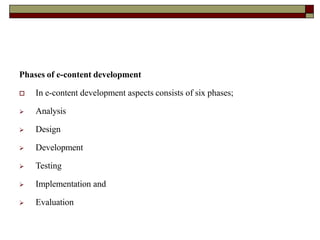
Phases of e-content development
 In e-content development aspects consists of six phases;
 Analysis
 Design
 Development
 Testing
 Implementation and
 Evaluation
1. The Analysis Phase:
 It is the most important as it identifies area's in our current situation.
 This phase accountability considered by the views of subject experts,
target audiences, objectives and its goals.
 In this phase, we must know the audience, and their skill, budget of the e-
content, delivery methods and its constraints with due dates.
2. The Design Phase:
 It involves the complete design of the learning solution.
 It helps to plan of an e-content preparation.
 In this phase, we must know the planning, use of relevant software;
required skills; creative and innovative interactions of subject contents
like texts, pictures, videos and suitable animations.
3. The Development Phase:
 It concerns the actual production of the e-content design.
 It helps to create the e-content by mixing of texts, audio, video,
animations, references, blogs, links, and MCQs (multiple choice
questions) with some programming specifications like home, exit, next
etc.
4. The Testing phase:
 It helps to administer the e-content in the actual educational field.
 In this phase, we must test the spelling mistakes, content errors, clarity of
pictures, relevant videos, appropriate audios, timing of animations, and
hyperlinks.
5. The Implementation Phase:
 It helps to administer the e-content to the target audience.
 This phase explains how to install and how to use it and their difficulties
experienced while using e-content.
 It checks the product accuracy and quality maintenance.
6. The Evaluation Phase:
 It helps to satisfy the e-content and its effectiveness.
 This phase considers feedback from both learners and instructors.
 After the feed back reactions, the e-content is designed again as post-
production for effective delivery of e-content.
THANK YOU
mustafapsmo@gmail.com

E-Content Development-PPT.pptx

  • 1.
    E-Content Development Dr MUSTAFA K Headof the PG Department of Commerce and Management Kottakkal Farook Arts & Science College (Affiliated with University of Calicut)
  • 2.
     Creation ofan information rich society.  Empower to create, receive, share and utilize information.  High quality meaningful digital content make efficient a virtual teacher.  E-content development depends upon the quality and the nature of the content, teachers and the learners.
  • 3.
     It willalso depend on the quality and complexity the learning you wish to create.  Various instructional design models are available according to our requirements.  Most of the models involve the process of analyzing the learner needs and goals of the instructional material development, development of a delivery system and content, pilot study of the material developed, implementation, evaluating, refining the materials etc.  In designing and development of E-content we have to adopt one of the instructional design models based on our requirements.
  • 4.
    Phases of e-contentdevelopment  In e-content development aspects consists of six phases;  Analysis  Design  Development  Testing  Implementation and  Evaluation
  • 5.
    1. The AnalysisPhase:  It is the most important as it identifies area's in our current situation.  This phase accountability considered by the views of subject experts, target audiences, objectives and its goals.  In this phase, we must know the audience, and their skill, budget of the e- content, delivery methods and its constraints with due dates.
  • 6.
    2. The DesignPhase:  It involves the complete design of the learning solution.  It helps to plan of an e-content preparation.  In this phase, we must know the planning, use of relevant software; required skills; creative and innovative interactions of subject contents like texts, pictures, videos and suitable animations.
  • 7.
    3. The DevelopmentPhase:  It concerns the actual production of the e-content design.  It helps to create the e-content by mixing of texts, audio, video, animations, references, blogs, links, and MCQs (multiple choice questions) with some programming specifications like home, exit, next etc.
  • 8.
    4. The Testingphase:  It helps to administer the e-content in the actual educational field.  In this phase, we must test the spelling mistakes, content errors, clarity of pictures, relevant videos, appropriate audios, timing of animations, and hyperlinks.
  • 9.
    5. The ImplementationPhase:  It helps to administer the e-content to the target audience.  This phase explains how to install and how to use it and their difficulties experienced while using e-content.  It checks the product accuracy and quality maintenance.
  • 10.
    6. The EvaluationPhase:  It helps to satisfy the e-content and its effectiveness.  This phase considers feedback from both learners and instructors.  After the feed back reactions, the e-content is designed again as post- production for effective delivery of e-content.
  • 11.