B.Ed 4th
Semester
Erstwhile David Hare Training College (BSAEU)
Course: EPC-4(1.4EPC3)
CRITICAL UNDERSTANDING OF ICT
Practicum Topic
Teaching with Multimedia E Content Development by the Student
Dr. Pramod Kumar Yadav
Assistant Professor
Erstwhile David Hare Training College(BSAEU)
Website: www.drpramodyadav.com
Objective:
1. To deliver the content via various media such as LMS, sites , computer etc
2. To increase students’ concentration on particular subject matter in depth learning
3. Helps Learners Retain Knowledge Quickly
4. Makes Learning Material Stand Out
5. Inspires Learners to Take Action
6. Reduces Cognitive Load
7. Makes Learning Engaging
8. Helps Achieve Learning Goals
MULTIMEDIA:
Multimedia is the presentation of text,
pictures, audio, and video with links and
tools that allow the user to navigate,
engage, create, and communicate using a
computer.
Multimedia refers to the computer-
assisted integration of text, drawings, still
and moving images(videos) graphics,
audio, animation, and any other media in
which any type of information can be
expressed, stored, communicated, and
processed digitally.
E-CONTENT: Electronic-content which
is also known as Digital Content refers
to the content or information delivered
over network based electronic devices or
that is made available using computer
network such as INTERNET. With the
help of simple ICT tools like website
blog, google docs, google sheets, ppt,
word a teacher can create e content for
student. Developing your own website is
the best way for any teachers to reach to
their students at all levels, student can
download the e materials, they can also
watch your video or lectures any number
of times over and over again, they can ask
questions online, a teacher can arrange
online test using google forms, testmoz
they can learn, re-learn and check their
progress and can know their exact level
Thus the E content and E learning are
learner centric, teacher should be flexible
enough to the changes but also should be
open for the making the teaching learning
process effective
.
STAGES OF E-CONTENT DESIGN
AND DEVELOPMENTAL PROCESS:
E-content has become a very valuable and
powerful tool of education in this
contemporary education system; it is the
newest method of instruction that can be
used to create an information rich society
where everyone, irrespective of caste,
religion, race, region, gender etc., are
empowered to create, receive, share and
utilize information and knowledge for their
economic, social, cultural and political
upliftment and development. The use of e-
content has transformed teaching in
several ways. In the process of e-learning,
structured and validated e-content serves
as an effective virtual teacher. Today, the
educators are able to generate their own
resources and consequently have more
control over the classroom than they have
had in the past. E-content development is
the heart of teaching learning process.
Although content development plays a key
role in e-learning, All the e-content
materials should focuses on (a) Cognitive
perspective that emphases on the cognitive
processes involved in learning as well as
how the brain works; (b) Emotional
perspective that gravities on the emotional
aspects of learning, like motivation,
engagement, fun, etc.; (c) Behavioural
perspective highlights the skills and
behavioural outcomes of the learning
process, roleplaying, settings of job and
(d) Contextual perspective that concentrate
on the environmental and social aspects
which can stimulate learning. The e-
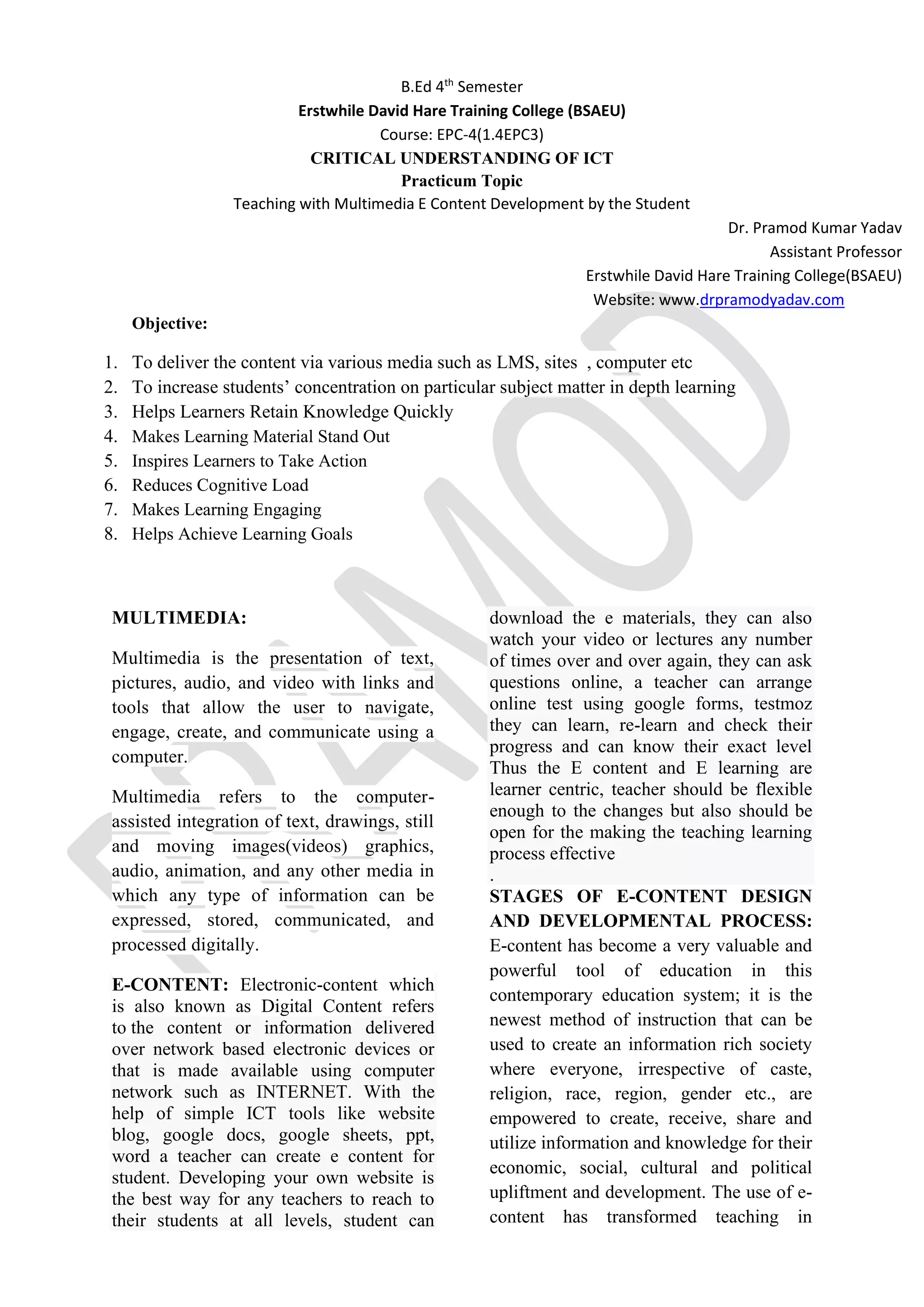
content development aspects comprise of
six stages described as follows
(Nachimuthu, 2012).
Here we discuss some important point which is necessary for E Content development
• Create / Develop/ Design a platform where E content Upload
• Chose content which is related to your subject
• Make ppt , Text, Image, audio Video, animation, Interactive Video, create MCQs / online test related to
content
• Create link and send to student
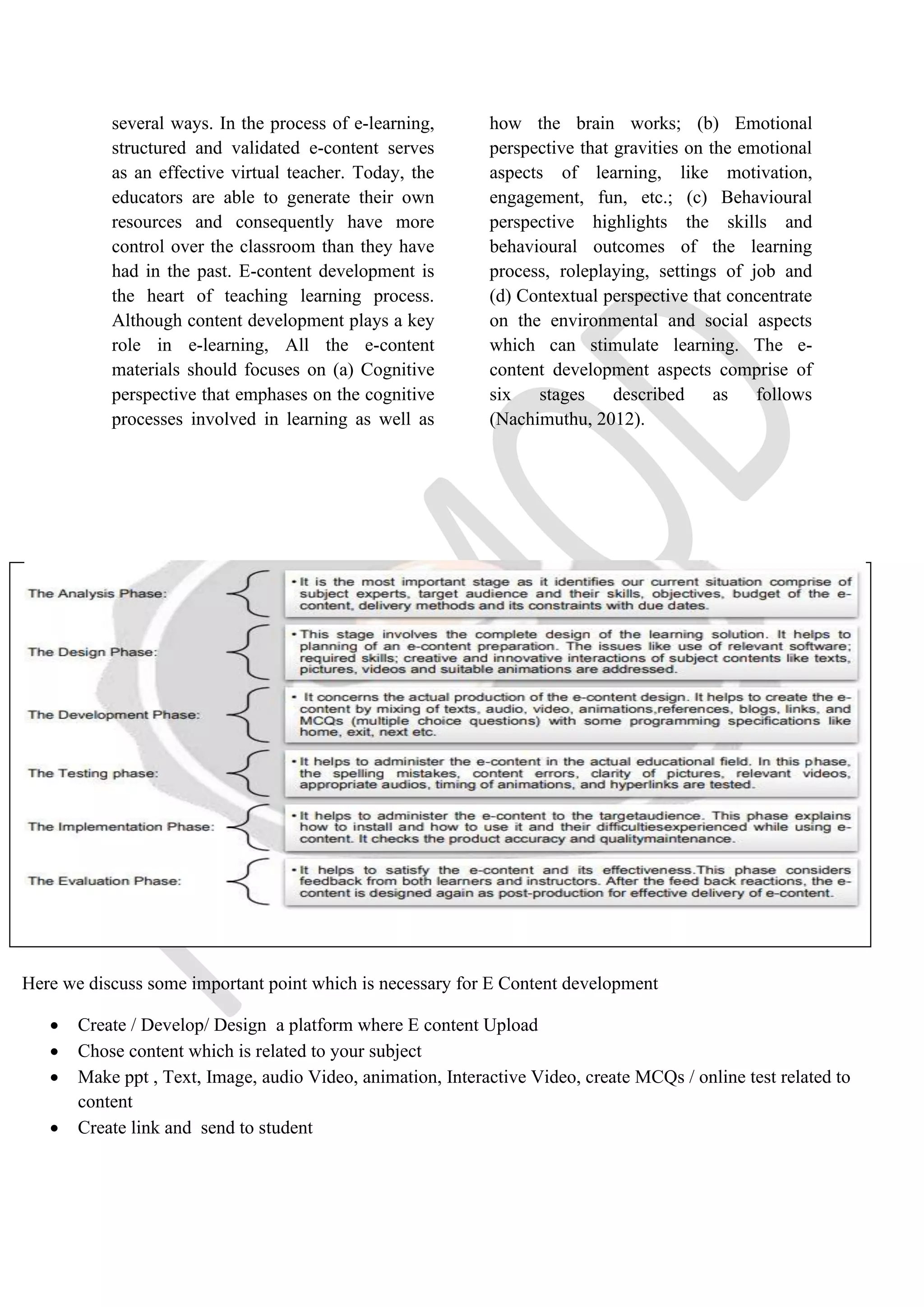
Create / develop/ Design a platform where E content Upload: Here we create a Google Sites platform where
we upload all content. Google site is easy to develop for a teacher. See step by step
Figure: 1: Create different page like this
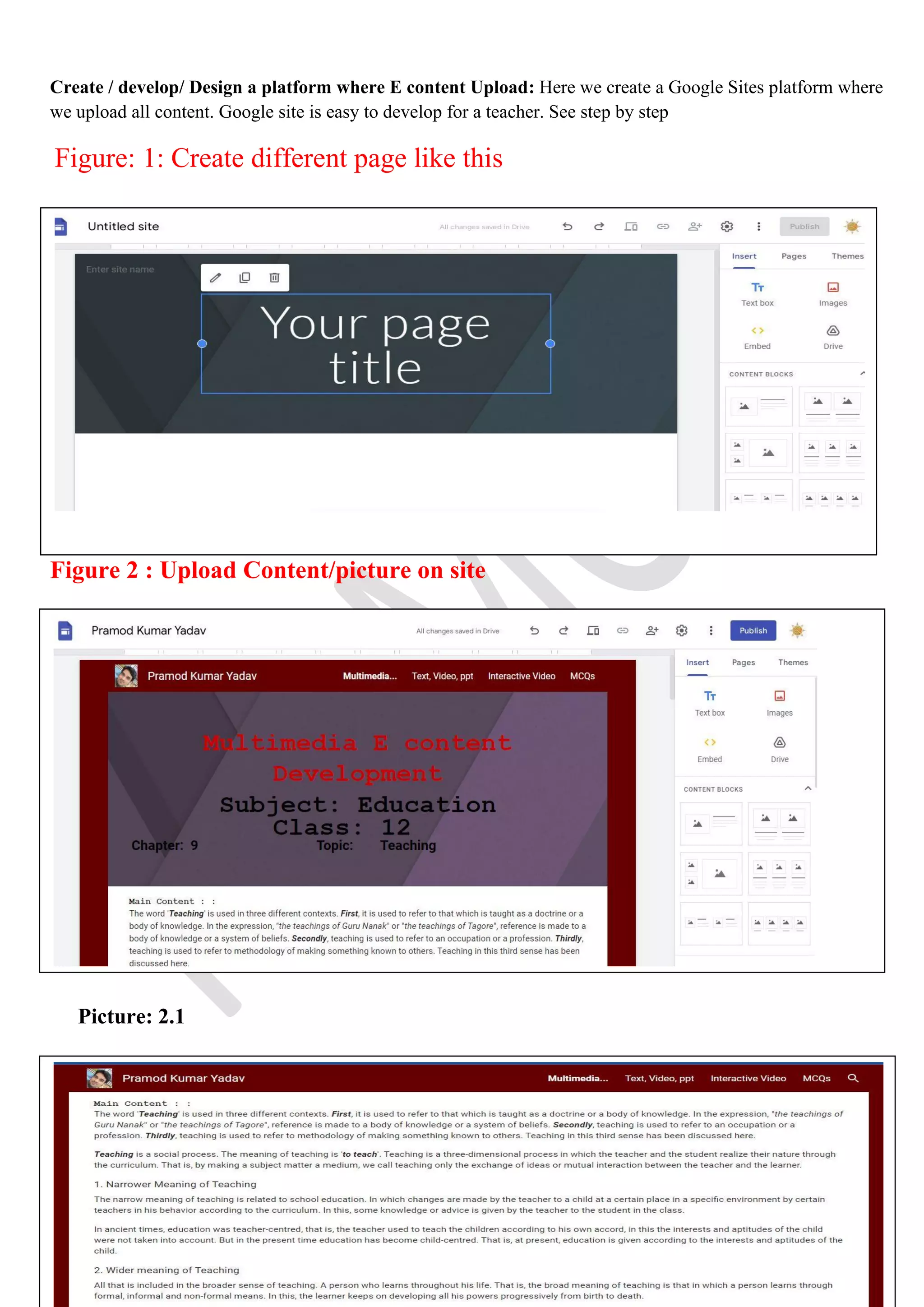
Figure 2 : Upload Content/picture on site
Picture: 2.1
Picture: 2.2
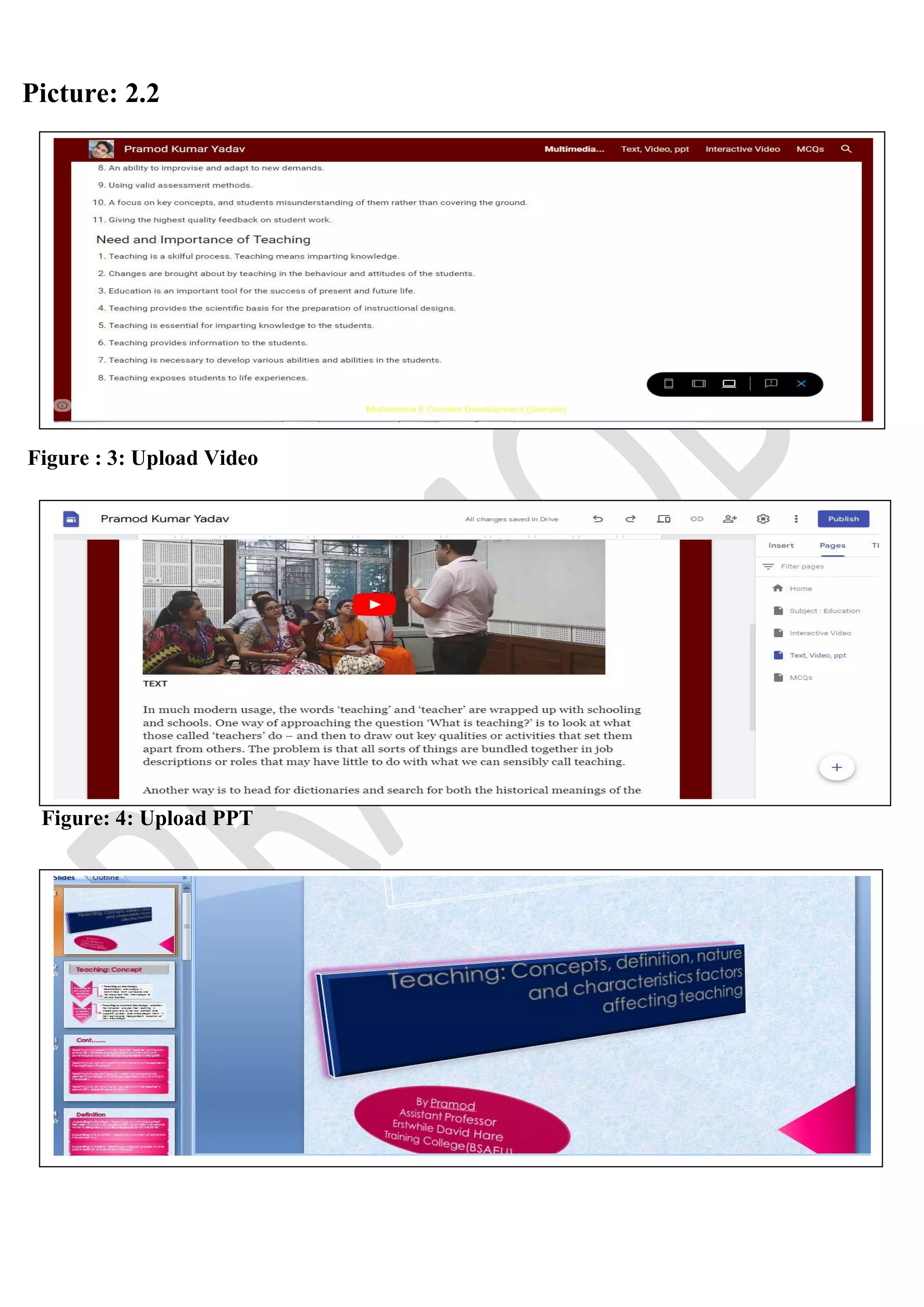
Figure : 3: Upload Video
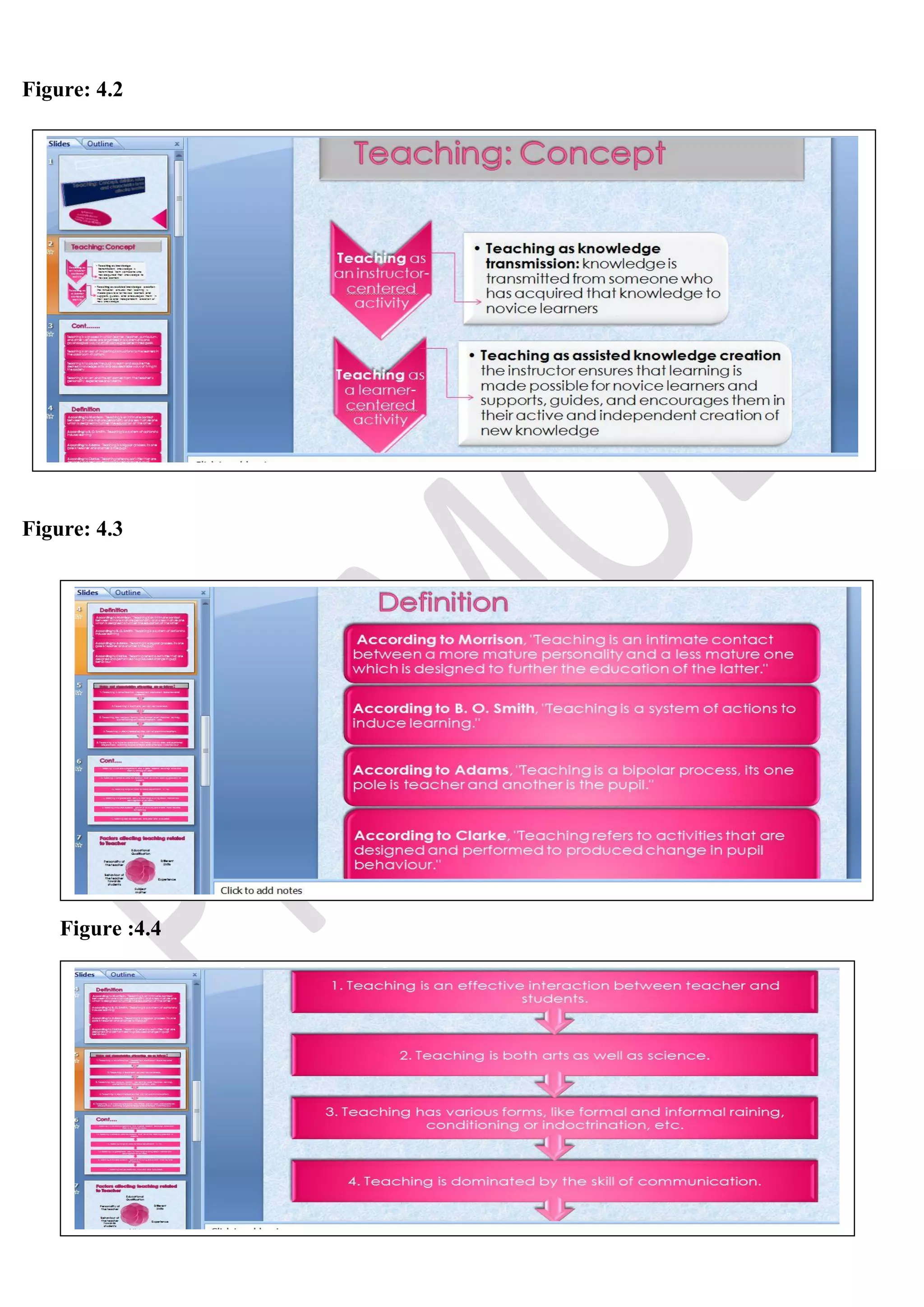
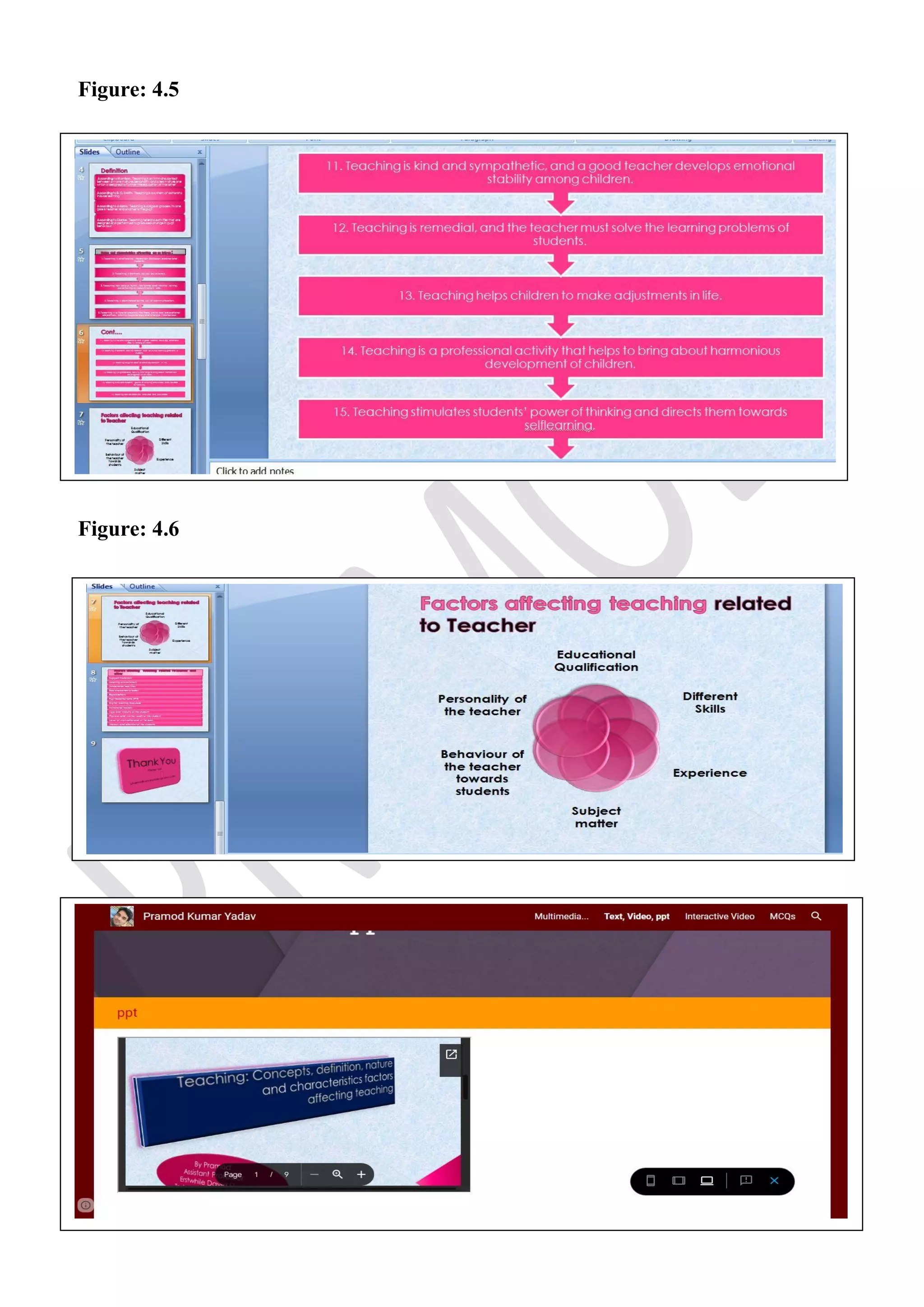
Figure: 4: Upload PPT
Figure: 4.2
Figure: 4.3
Figure :4.4
Figure: 4.5
Figure: 4.6
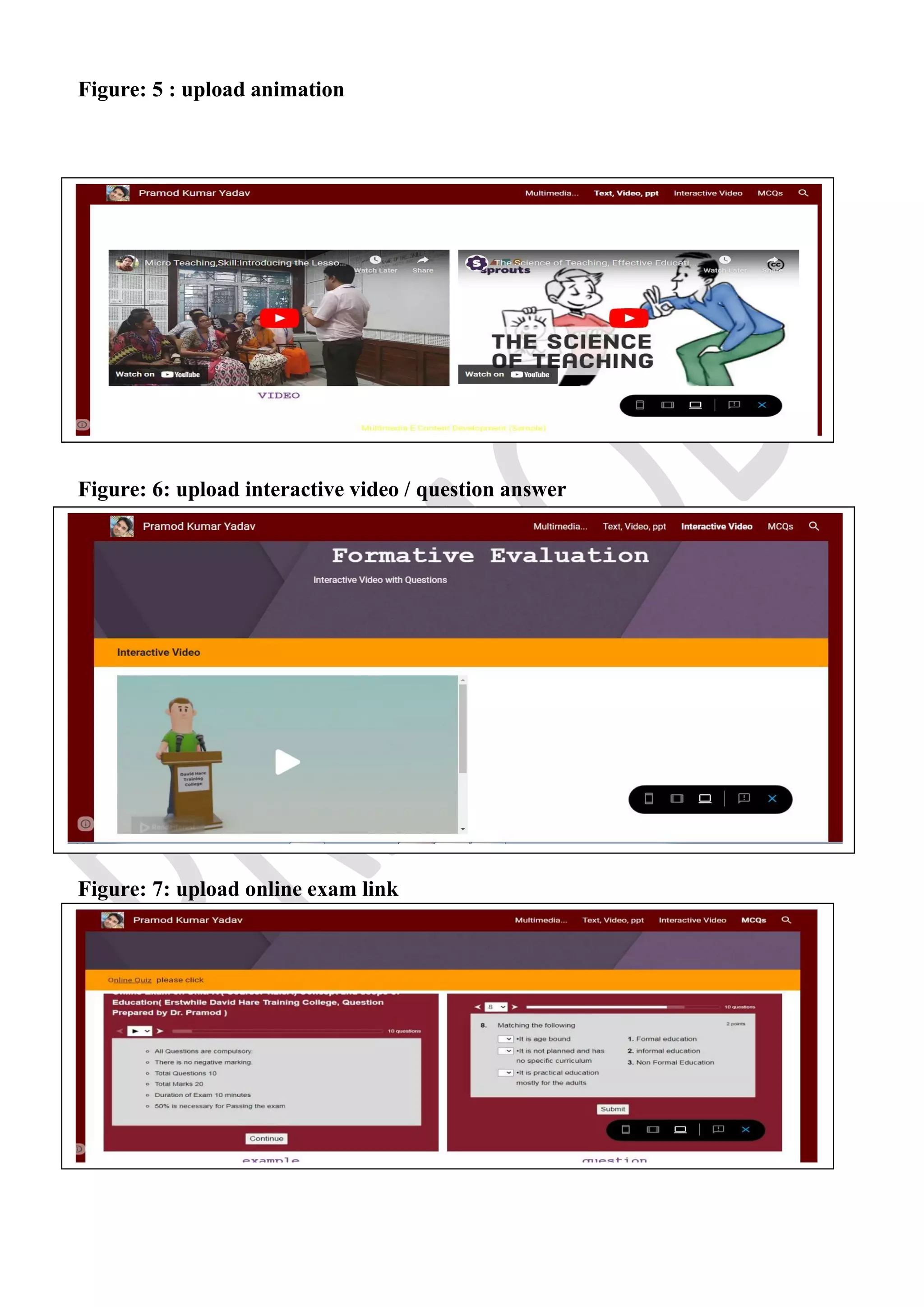
Figure: 5 : upload animation
Figure: 6: upload interactive video / question answer
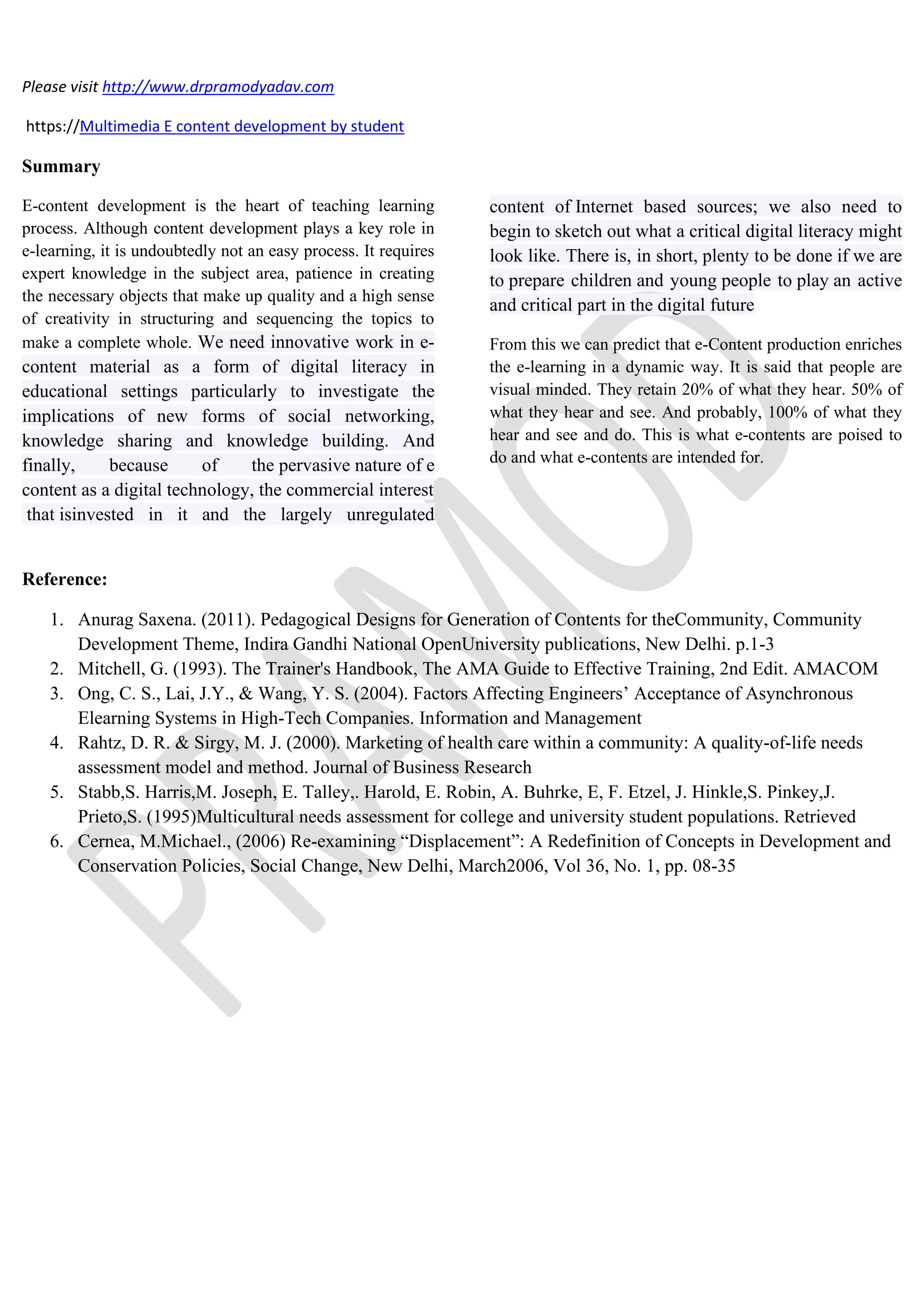
Figure: 7: upload online exam link
Please visit http://www.drpramodyadav.com
https://Multimedia E content development by student
Summary
E-content development is the heart of teaching learning
process. Although content development plays a key role in
e-learning, it is undoubtedly not an easy process. It requires
expert knowledge in the subject area, patience in creating
the necessary objects that make up quality and a high sense
of creativity in structuring and sequencing the topics to
make a complete whole. We need innovative work in e-
content material as a form of digital literacy in
educational settings particularly to investigate the
implications of new forms of social networking,
knowledge sharing and knowledge building. And
finally, because of the pervasive nature of e
content as a digital technology, the commercial interest
that isinvested in it and the largely unregulated
content of Internet based sources; we also need to
begin to sketch out what a critical digital literacy might
look like. There is, in short, plenty to be done if we are
to prepare children and young people to play an active
and critical part in the digital future
From this we can predict that e-Content production enriches
the e-learning in a dynamic way. It is said that people are
visual minded. They retain 20% of what they hear. 50% of
what they hear and see. And probably, 100% of what they
hear and see and do. This is what e-contents are poised to
do and what e-contents are intended for.
Reference:
1. Anurag Saxena. (2011). Pedagogical Designs for Generation of Contents for theCommunity, Community
Development Theme, Indira Gandhi National OpenUniversity publications, New Delhi. p.1-3
2. Mitchell, G. (1993). The Trainer's Handbook, The AMA Guide to Effective Training, 2nd Edit. AMACOM
3. Ong, C. S., Lai, J.Y., & Wang, Y. S. (2004). Factors Affecting Engineers’ Acceptance of Asynchronous
Elearning Systems in High-Tech Companies. Information and Management
4. Rahtz, D. R. & Sirgy, M. J. (2000). Marketing of health care within a community: A quality-of-life needs
assessment model and method. Journal of Business Research
5. Stabb,S. Harris,M. Joseph, E. Talley,. Harold, E. Robin, A. Buhrke, E, F. Etzel, J. Hinkle,S. Pinkey,J.
Prieto,S. (1995)Multicultural needs assessment for college and university student populations. Retrieved
6. Cernea, M.Michael., (2006) Re-examining “Displacement”: A Redefinition of Concepts in Development and
Conservation Policies, Social Change, New Delhi, March2006, Vol 36, No. 1, pp. 08-35

Multimidia E content development .pdf

  • 1.
    B.Ed 4th Semester Erstwhile DavidHare Training College (BSAEU) Course: EPC-4(1.4EPC3) CRITICAL UNDERSTANDING OF ICT Practicum Topic Teaching with Multimedia E Content Development by the Student Dr. Pramod Kumar Yadav Assistant Professor Erstwhile David Hare Training College(BSAEU) Website: www.drpramodyadav.com Objective: 1. To deliver the content via various media such as LMS, sites , computer etc 2. To increase students’ concentration on particular subject matter in depth learning 3. Helps Learners Retain Knowledge Quickly 4. Makes Learning Material Stand Out 5. Inspires Learners to Take Action 6. Reduces Cognitive Load 7. Makes Learning Engaging 8. Helps Achieve Learning Goals MULTIMEDIA: Multimedia is the presentation of text, pictures, audio, and video with links and tools that allow the user to navigate, engage, create, and communicate using a computer. Multimedia refers to the computer- assisted integration of text, drawings, still and moving images(videos) graphics, audio, animation, and any other media in which any type of information can be expressed, stored, communicated, and processed digitally. E-CONTENT: Electronic-content which is also known as Digital Content refers to the content or information delivered over network based electronic devices or that is made available using computer network such as INTERNET. With the help of simple ICT tools like website blog, google docs, google sheets, ppt, word a teacher can create e content for student. Developing your own website is the best way for any teachers to reach to their students at all levels, student can download the e materials, they can also watch your video or lectures any number of times over and over again, they can ask questions online, a teacher can arrange online test using google forms, testmoz they can learn, re-learn and check their progress and can know their exact level Thus the E content and E learning are learner centric, teacher should be flexible enough to the changes but also should be open for the making the teaching learning process effective . STAGES OF E-CONTENT DESIGN AND DEVELOPMENTAL PROCESS: E-content has become a very valuable and powerful tool of education in this contemporary education system; it is the newest method of instruction that can be used to create an information rich society where everyone, irrespective of caste, religion, race, region, gender etc., are empowered to create, receive, share and utilize information and knowledge for their economic, social, cultural and political upliftment and development. The use of e- content has transformed teaching in
  • 2.
    several ways. Inthe process of e-learning, structured and validated e-content serves as an effective virtual teacher. Today, the educators are able to generate their own resources and consequently have more control over the classroom than they have had in the past. E-content development is the heart of teaching learning process. Although content development plays a key role in e-learning, All the e-content materials should focuses on (a) Cognitive perspective that emphases on the cognitive processes involved in learning as well as how the brain works; (b) Emotional perspective that gravities on the emotional aspects of learning, like motivation, engagement, fun, etc.; (c) Behavioural perspective highlights the skills and behavioural outcomes of the learning process, roleplaying, settings of job and (d) Contextual perspective that concentrate on the environmental and social aspects which can stimulate learning. The e- content development aspects comprise of six stages described as follows (Nachimuthu, 2012). Here we discuss some important point which is necessary for E Content development • Create / Develop/ Design a platform where E content Upload • Chose content which is related to your subject • Make ppt , Text, Image, audio Video, animation, Interactive Video, create MCQs / online test related to content • Create link and send to student
  • 3.
    Create / develop/Design a platform where E content Upload: Here we create a Google Sites platform where we upload all content. Google site is easy to develop for a teacher. See step by step Figure: 1: Create different page like this Figure 2 : Upload Content/picture on site Picture: 2.1
  • 4.
    Picture: 2.2 Figure :3: Upload Video Figure: 4: Upload PPT
  • 5.
  • 6.
  • 7.
    Figure: 5 :upload animation Figure: 6: upload interactive video / question answer Figure: 7: upload online exam link
  • 8.
    Please visit http://www.drpramodyadav.com https://MultimediaE content development by student Summary E-content development is the heart of teaching learning process. Although content development plays a key role in e-learning, it is undoubtedly not an easy process. It requires expert knowledge in the subject area, patience in creating the necessary objects that make up quality and a high sense of creativity in structuring and sequencing the topics to make a complete whole. We need innovative work in e- content material as a form of digital literacy in educational settings particularly to investigate the implications of new forms of social networking, knowledge sharing and knowledge building. And finally, because of the pervasive nature of e content as a digital technology, the commercial interest that isinvested in it and the largely unregulated content of Internet based sources; we also need to begin to sketch out what a critical digital literacy might look like. There is, in short, plenty to be done if we are to prepare children and young people to play an active and critical part in the digital future From this we can predict that e-Content production enriches the e-learning in a dynamic way. It is said that people are visual minded. They retain 20% of what they hear. 50% of what they hear and see. And probably, 100% of what they hear and see and do. This is what e-contents are poised to do and what e-contents are intended for. Reference: 1. Anurag Saxena. (2011). Pedagogical Designs for Generation of Contents for theCommunity, Community Development Theme, Indira Gandhi National OpenUniversity publications, New Delhi. p.1-3 2. Mitchell, G. (1993). The Trainer's Handbook, The AMA Guide to Effective Training, 2nd Edit. AMACOM 3. Ong, C. S., Lai, J.Y., & Wang, Y. S. (2004). Factors Affecting Engineers’ Acceptance of Asynchronous Elearning Systems in High-Tech Companies. Information and Management 4. Rahtz, D. R. & Sirgy, M. J. (2000). Marketing of health care within a community: A quality-of-life needs assessment model and method. Journal of Business Research 5. Stabb,S. Harris,M. Joseph, E. Talley,. Harold, E. Robin, A. Buhrke, E, F. Etzel, J. Hinkle,S. Pinkey,J. Prieto,S. (1995)Multicultural needs assessment for college and university student populations. Retrieved 6. Cernea, M.Michael., (2006) Re-examining “Displacement”: A Redefinition of Concepts in Development and Conservation Policies, Social Change, New Delhi, March2006, Vol 36, No. 1, pp. 08-35