CMS, LMS                     &   LCMS
               the systems supporting elearning


Michael M. Grant 2011
course
management
system
 is different from
                content
            management
                 system
Course
Management
        Systems
course management system
Defined
A CMS is Internet-based software that manages student enrollment, tracks student
performance, and creates and distributes course content. 


                                     From http://thejournal.com/Articles/2004/10/01/Course-Management-Systems-and-the-Reinvention-of-Instruction.aspx?p=1
Features
     of CMSs
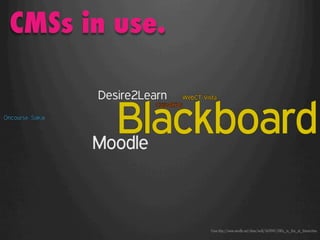
CMSs in use.


               From http://www.wordle.net/show/wrdl/1674941/CMSs_in_Use_at_Universities
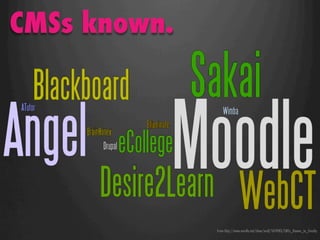
CMSs known.


              From http://www.wordle.net/show/wrdl/1674983/CMSs_Known_to_Faculty
behind
the scenes
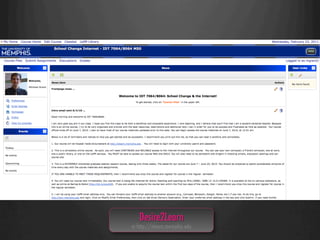
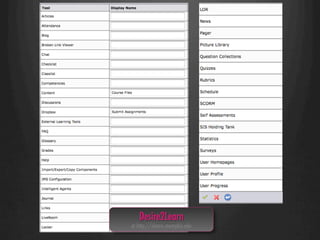
Desire2Learn
at http://elearn.memphis.edu
Desire2Learn
at http://elearn.memphis.edu
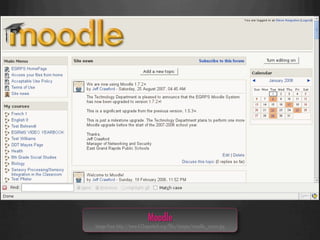
Moodle
Image from http://www.k12opentech.org/files/images/moodle_screen.jpg
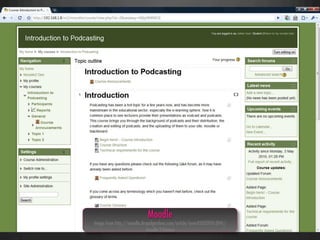
Moodle
Image from http://moodle.drupalgardens.com/article/mon-05032010-2041/
                            moodle-2-themes
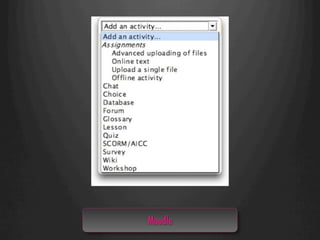
Moodle
Issues
    with CMSs
Content
Management
         Systems
content management system
Defined
A content management system (CMS) is a program used to create a framework for the
content of a Web site. CMSs are deployed primarily for interactive use by a potentially
large number of contributors.

The content managed includes computer files, image media, audio files, electronic
documents and web content.


                                                              From http://www.prlog.org/10056268-cutting-edge-content-management.html
Functions
      of CMSs
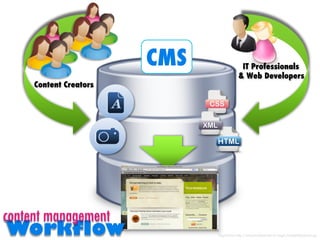
CMS                  IT Professionals
                                            & Web Developers
     Content Creators


content management
Workflow                      Adapted from http://www.patrickpetersen.nl/images/cmspatrickpetersen.jpg
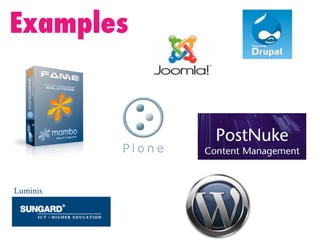
Examples


Luminis
behind
the scenes
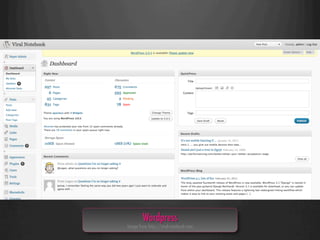
Wordpress
Image from http://viral-notebook.com
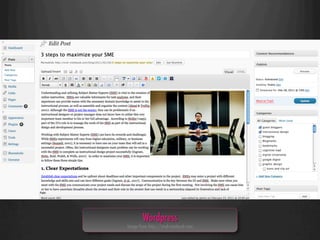
Wordpress
Image from http://viral-notebook.com
learning
management
system
        versus
              learning
               content
           management
                system
LMS & LCMS
    Defined
An LMS …
An LMS is a system designed to automate the administration of training  
events. LMS functionality includes user registration, tracking courses in a catalog,
and recording data from learners; it also has reporting  features for analysis
purposes. An LMS is typically designed to handle courses by multiple publishers
and providers. It usually doesn’t include  its own authoring capabilities; instead, it
focuses on managing courses created by a variety of other sources.         


                                       Adapted from http://www.nettskolen.com/forskning/Definition%20of%20Terms.pdf, http://www.astd.org/LC/glossary.htm &
                                                http://www3.imperial.ac.uk/ict/services/teachingandresearchservices/elearning/aboutelearning/elearningglossary
An LCMS …
 An LCMS is a system used primarily for development, maintenance, tagging, and
 storage of instructional content. During development, it is used to import and
 store assets that will be used to create a learning object; and create and store
 content objects. The LCMS may have workflow process functionality and the
 ability to tag assets and content objects with metadata. If set up to work with
 dynamic delivery, an LCMS will assemble the proper assets on-the-fly to create a
 learning object. While many LCMS can deliver content, they usually do not have
 the administrative functionality of an LMS. Many LCMS can export content in a
 variety of different formats.


     Adapted from Deborah Adams (2010, personal communication), http://www.nettskolen.com/forskning/Definition%20of%20Terms.pdf, http://www.informetica.com/article/lms-vs-lcms-vs-the-informetica-
                                                                                        lcms-117.asp,  http://www.astd.org/LC/glossary.htm & http://www.checkpoint-elearning.com/article/4465.html
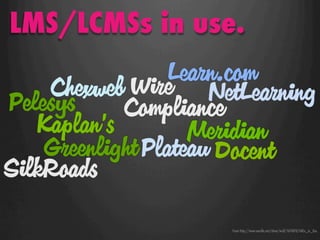
LMS/LCMSs in use.


                From http://www.wordle.net/show/wrdl/1674870/LMSs_in_Use
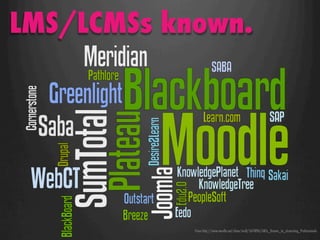
LMS/LCMSs known.


            From http://www.wordle.net/show/wrdl/1674896/LMSs_Known_to_eLearning_Professionals
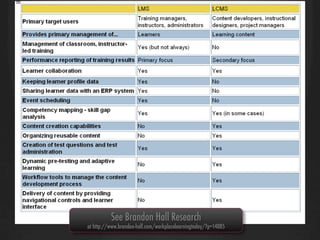
What’s the
  difference?


           See Brandon Hall Research
 at http://www.brandon-hall.com/workplacelearningtoday/?p=14085
See Brandon Hall Research
at http://www.brandon-hall.com/workplacelearningtoday/?p=14085
Issues to
     consider …
References
       & Acknowledgements
 Brandon Hall Research. (n.d.). LMS and LCMS demystified. Brandon-hall.com. Retrieved
 from http://www.brandon-hall.com/free_resources/lms_and_lcms.shtml

 Dabbagh, N. & Bannan-Ritland, B. (2005). Online learning: Concepts, strategies, and
 applications. Upper Saddle River, NJ: Pearson Merrill Prentice Hall.

 Helion-Prime Solutions Ltd. (2008). Cutting edge content management. PRlog.org.
 Retrieved from http://www.prlog.org/10056268-cutting-edge-content-management.html

 Mott, J. & Wiley, D. (2009). Open for learning: The CMS and the open learning network.
 Education, 15(2). Retrieved from http://hdl.lib.byu.edu/1877/2121
 Wang, H., & Gearhart, D.L. (2006). Designing and developing web-based instruction.
 Upper Saddle River, NJ: Pearson Merrill Prentice Hall.

 Special thanks to Deborah Adams, Matt McClean, Chuck Hodges, Nancy Leininger, Bill
 Brescia, Elizabeth Boling, Ward Cates, MJ Bishop, David Wiley, Kevin Thorn, Kevin Oliver,
 Yuri Quintana, Robin Navel, Joan Davis, David Lindenberg, Mindy Fisher, Corey Johnson,
 Dennis Charksy, Michael Barbour, and Tom Hergert for contributing to this presentation.
Michael M. Grant 2011

CMS, LMS & LCMS

  • 1.
    CMS, LMS & LCMS the systems supporting elearning Michael M. Grant 2011
  • 2.
    course management system is differentfrom content management system
  • 3.
  • 4.
    course management system Defined ACMS is Internet-based software that manages student enrollment, tracks student performance, and creates and distributes course content.  From http://thejournal.com/Articles/2004/10/01/Course-Management-Systems-and-the-Reinvention-of-Instruction.aspx?p=1
  • 5.
    Features of CMSs
  • 6.
    CMSs in use. From http://www.wordle.net/show/wrdl/1674941/CMSs_in_Use_at_Universities
  • 7.
    CMSs known. From http://www.wordle.net/show/wrdl/1674983/CMSs_Known_to_Faculty
  • 8.
  • 9.
  • 10.
  • 11.
  • 12.
  • 13.
  • 14.
    Issues with CMSs
  • 15.
  • 16.
    content management system Defined Acontent management system (CMS) is a program used to create a framework for the content of a Web site. CMSs are deployed primarily for interactive use by a potentially large number of contributors. The content managed includes computer files, image media, audio files, electronic documents and web content. From http://www.prlog.org/10056268-cutting-edge-content-management.html
  • 17.
    Functions of CMSs
  • 18.
    CMS IT Professionals & Web Developers Content Creators content management Workflow Adapted from http://www.patrickpetersen.nl/images/cmspatrickpetersen.jpg
  • 19.
  • 20.
  • 21.
  • 22.
  • 23.
    learning management system versus learning content management system
  • 24.
    LMS & LCMS Defined
  • 25.
    An LMS … AnLMS is a system designed to automate the administration of training   events. LMS functionality includes user registration, tracking courses in a catalog, and recording data from learners; it also has reporting  features for analysis purposes. An LMS is typically designed to handle courses by multiple publishers and providers. It usually doesn’t include  its own authoring capabilities; instead, it focuses on managing courses created by a variety of other sources.          Adapted from http://www.nettskolen.com/forskning/Definition%20of%20Terms.pdf, http://www.astd.org/LC/glossary.htm & http://www3.imperial.ac.uk/ict/services/teachingandresearchservices/elearning/aboutelearning/elearningglossary
  • 26.
    An LCMS … An LCMS is a system used primarily for development, maintenance, tagging, and storage of instructional content. During development, it is used to import and store assets that will be used to create a learning object; and create and store content objects. The LCMS may have workflow process functionality and the ability to tag assets and content objects with metadata. If set up to work with dynamic delivery, an LCMS will assemble the proper assets on-the-fly to create a learning object. While many LCMS can deliver content, they usually do not have the administrative functionality of an LMS. Many LCMS can export content in a variety of different formats. Adapted from Deborah Adams (2010, personal communication), http://www.nettskolen.com/forskning/Definition%20of%20Terms.pdf, http://www.informetica.com/article/lms-vs-lcms-vs-the-informetica- lcms-117.asp,  http://www.astd.org/LC/glossary.htm & http://www.checkpoint-elearning.com/article/4465.html
  • 27.
    LMS/LCMSs in use. From http://www.wordle.net/show/wrdl/1674870/LMSs_in_Use
  • 28.
    LMS/LCMSs known. From http://www.wordle.net/show/wrdl/1674896/LMSs_Known_to_eLearning_Professionals
  • 29.
    What’s the difference? See Brandon Hall Research at http://www.brandon-hall.com/workplacelearningtoday/?p=14085
  • 30.
    See Brandon HallResearch at http://www.brandon-hall.com/workplacelearningtoday/?p=14085
  • 31.
    Issues to consider …
  • 32.
    References & Acknowledgements Brandon Hall Research. (n.d.). LMS and LCMS demystified. Brandon-hall.com. Retrieved from http://www.brandon-hall.com/free_resources/lms_and_lcms.shtml Dabbagh, N. & Bannan-Ritland, B. (2005). Online learning: Concepts, strategies, and applications. Upper Saddle River, NJ: Pearson Merrill Prentice Hall. Helion-Prime Solutions Ltd. (2008). Cutting edge content management. PRlog.org. Retrieved from http://www.prlog.org/10056268-cutting-edge-content-management.html Mott, J. & Wiley, D. (2009). Open for learning: The CMS and the open learning network. Education, 15(2). Retrieved from http://hdl.lib.byu.edu/1877/2121 Wang, H., & Gearhart, D.L. (2006). Designing and developing web-based instruction. Upper Saddle River, NJ: Pearson Merrill Prentice Hall. Special thanks to Deborah Adams, Matt McClean, Chuck Hodges, Nancy Leininger, Bill Brescia, Elizabeth Boling, Ward Cates, MJ Bishop, David Wiley, Kevin Thorn, Kevin Oliver, Yuri Quintana, Robin Navel, Joan Davis, David Lindenberg, Mindy Fisher, Corey Johnson, Dennis Charksy, Michael Barbour, and Tom Hergert for contributing to this presentation.
  • 33.

Editor's Notes

  • #5 Content creation and managementUser managementAssessment toolsCommunication toolsContent organization & navigation(Dabbagh & Bannan-Ritland, 2005; Wang & Gearhart, 2006)
  • #8 CMSs emphasize faculty dissemination tools over student processing toolsCMSs engender an instructional structure of traditional face-to-face instructionImpedes student-centered learning/constructivist strategies (Mott & Wiley, 2009)Interface is independent of content/template-based
  • #10 A content management system (CMS) is a program used to create a framework for the content of a Web site. CMSs are deployed primarily for interactive use by a potentially large number of contributors.The content managed includes computer files, image media, audio files, electronic documents and web content.(PRlog.org, 2008)http://www.prlog.org/10056268-cutting-edge-content-management.html
  • #11 Through roles and approvals content can be displayed publicly or private (in development)Through a taxonomy, content is tagged (metadata) for searching and reuseOften multiple versions can be tracked for historiesWith a CSS template/XML, content is separated from display
  • #13 DrupalPostNukeJoomla!MamboPloneWordpress
  • #15 Learning Management SystemLMS manage learners and keep track of their progress and performance.LMSs can often manage the scheduling, registrations and administration of learning options, including self-paced and instructor led.More global reporting.Learning Content Management SystemLCMS creates content and the delivery of content.Most recently, approximately 80% of LCMS contained LMS capabilities, too.Includes content creation, collaboration tools, RLOsMore granular reporting
  • #20 Brandon Hall Research (n.d.) presents a comparison chart (http://www.brandon-hall.com/free_resources/lms_and_lcms.shtml) for differences. They also report that 74% of LCMSs include LMS functionality.Learning Management SystemLMS manage learners and keep track of their progress and performance (Brandon Hall Research, n.d.).LMSs can often manage the scheduling, registrations and administration of learning options, including self-paced and instructor led.More global reporting.Learning Content Management SystemLCMS creates content and the delivery of content.Includes content creation, collaboration tools, RLOsMore granular reportingI’m not sure it matters any more…Except a lot of people will call WebCT/Blackboard an LMS/LCMS, which it’s not
  • #21 Integration with existing systems (e.g., HR, KM)Integration from previous LMS/LCMS (…hence SCORM)Analytics and granularity of reportingIntegration with external authoring systems (e.g., reporting)Pedagogical framework (explicit or covert)Granularity of content creationMetadata/taggingContent reuse, content repository