Catalyzing Communities to Prevent Obesity:
A Systems Approach

Christina Economos, PhD
Associate Professor
New Balance Chair in Childhood Nutrition
Director, ChildObesity180
October 10, 2013
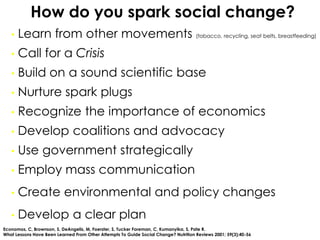
How do you spark social change?
•

Learn from other movements (tobacco, recycling, seat belts, breastfeeding)

•

Call for a Crisis

•

Build on a sound scientific base

•

Nurture spark plugs

•

Recognize the importance of economics

•

Develop coalitions and advocacy

•

Use government strategically

•

Employ mass communication

•

Create environmental and policy changes

•

Develop a clear plan

Economos, C, Brownson, S, DeAngelis, M, Foerster, S, Tucker Foreman, C, Kumanyika, S, Pate R.
What Lessons Have Been Learned From Other Attempts To Guide Social Change? Nutrition Reviews 2001; 59(3):40-56
Shape Up Somerville:
Eat Smart. Play Hard.
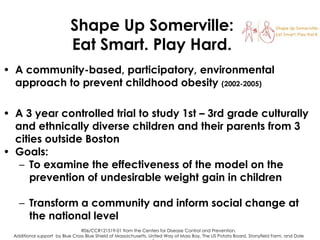
• A community-based, participatory, environmental
approach to prevent childhood obesity (2002-2005)
• A 3 year controlled trial to study 1st – 3rd grade culturally
and ethnically diverse children and their parents from 3
cities outside Boston
• Goals:
– To examine the effectiveness of the model on the
prevention of undesirable weight gain in children
– Transform a community and inform social change at
the national level
R06/CCR121519-01 from the Centers for Disease Control and Prevention.
Additional support by Blue Cross Blue Shield of Massachusetts, United Way of Mass Bay, The US Potato Board, Stonyfield Farm, and Dole
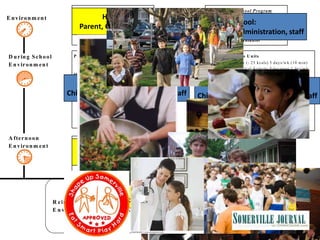
E a rly M o rn in g
E n v iro n m en t

D u r in g S c h o o l
E n v ir o n m e n t

A t H om e

B efore S ch ool P rogram

Home:
Parent, Child, Family

S afe R outes to S ch ool M ap s
 W alking to S chool (-30 k cals)
H ealth ier H om e B reakfast
 Fiber,  S ugar,  F at
A p p rop riate P ortion Sizes

H ealth ier Sch ool B reakfast
 Fiber,  S ugar,  F at
A ppropriate P ortion Sizes
In creased F resh F ru its
B reakfast C oordin ator (~25 kcals)

School:
Child, teachers, administration, staff

P h ysical A ctivity E q u ip m en t for R ecess


P hysical A ctivity (- 25 kcals) 5 days/w k (10 m in)
N utrition & P hysical A ctivity E ducation 1 day/w k
(30 m in)

P hysical A ctivity (- 25 k cals)

H ealth ier S ch ool L u n ch
Fiber,
S ugar,
F at
Increased Fresh Fruits & V egetables
A ppropriate P ortion Sizes
Im proved P resentation and A tm osphere
S ocial M arketing in C afeteria
A lternative “H ealthier” A L a C arte Item s
N ew F ood S ervice E quipm ent

School:
Child, teachers, administration, staff

A fte r n o o n
E n v ir o n m e n t

A t h om e
S afe R ou tes to S ch ool M ap s
 W alking H om e (-30 k cals)
H ealth y H o m e S n ack
 F iber,  S ugar,  F at

School:
Child, teachers, administration, staff
P rofession al D evelop m en t
H ealth ier F u n d raisin g A ltern atives

T eachers
A dm inistrators
F ood S ervice Staff
P E T eachers

A fter S ch ool P rogram
C u rricu lu m :
C ook in g L esson s
P h ysical A ctivity (-30 k cals)
N u trition E d u cation
P rofession al D evelop m en t

Home:
Parent, Child, Family

R e in f o r c in g
E n v ir o n m e n t s

C lassroom M icro U n its

Community:
After school programs

H om e E n viron m en t (~ 15 k cal)
P a ren t N ew sletter w / co u p on s
G row th R ep orts
 S creen T im e
P ro m otion al G ifts

Home:
Parent, Child, Family

Community: Ethnic groups

C om m u n ity E n viron m en t
C om m u n ity “C h am p ion s”
R estau ran t P articip ation
P ed iatrician T rain in g & S u p p ort
C om m u n ity T V A p p earan ces
E th n ic G rou p O u trea ch
C om m u n ity P A R esou rce G u id e
C om m u n ity E ven ts

Health Care System

Community: Restaurants

Local Government
Media
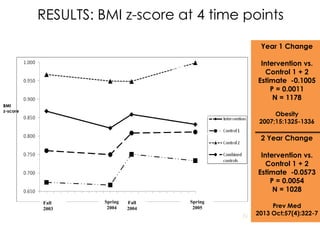
RESULTS: BMI z-score at 4 time points
Year 1 Change
Year 1 Change
Intervention vs. Control 1 + 2
Estimate -0.1005

BMI
z-score

Intervention vs.
Control 1 + 2
Estimate -0.1005
P = 0.0011
N = 1178

P = 0.0011

Obesity
2007;15:1325-1336

N = 1178

2 Year Change
Intervention vs.
Control 1 + 2
Estimate -0.0573
P = 0.0054
N = 1028

Fall
2003

Spring
2004

Fall
2004

Spring
2005

Prev Med
2013 Oct;57(4):322-7

N = 922
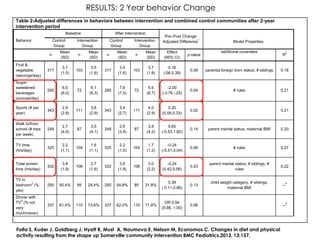
RESULTS: 2 Year behavior Change
Table 2-Adjusted differences in behaviors between intervention and combined control communities after 2-year
intervention period
Baseline
Behavior

Control
Group

After Intervention

Intervention
Group

Control
Group

Intervention
Group

Pre–Post Change:
1
Adjusted Difference

Model Properties
additional covariates

R2

0.09

parental foreign born status, # siblings

0.18

-2.00
(-3.76,-.25)

0.04

# rules

0.21

4.0
(2.9)

0.20
(0.06,0.33)

0.02

87

3.9
(4.2)

0.65
(-0.53,1.82)

0.14

parent marital status, maternal BMI

0.20

2.2
(1.0)

104

1.7
(1.2)

-0.24
(-0.51,0.04)

0.06

# rules

0.27

332

3.9
(1.9)

106

3.0
(2.2)

-0.24
(0.42,0.06)

0.03

parent marital status, # siblings, #
rules

0.22

29.4%

250

54.8%

85

31.8%

0.39
( 0.11,0.89)

0.13

child weight category, # siblings,
maternal BMI

--4

73.6%

337

62.0%

110

71.8%

OR 0.94
(0.88, 1.00)

0.06

n

Mean
(SD)

n

Mean
(SD)

n

Mean
(SD)

n

Mean
(SD)

Effect
(95% CI)

p-value

Fruit &
vegetable
(servings/day)

317

3.1
(1.5)

103

3.5
(1.6)

317

3.4
(1.6)

103

3.7
(1.8)

0.16
(-06,0.38)

Sugarsweetened
beverages
(ounces/day)

265

6.5
(6.0)

72

6.1
(6.3)

265

7.6
(7.0)

72

5.5
(6.7)

Sports (# per
year)

343

2.9
(2.8)

111

3.6
(2.9)

343

3.4
(2.7)

111

Walk to/from
school (# trips
per week)

248

2.7
(4.0)

87

3.5
(4.1)

248

2.6
(3.9)

TV time
(hrs/day)

325

2.2
(1.1)

104

1.6
(1.1)

325

Total screen
time (hrs/day)

332

3.8
(1.8)

106

2.7
(1.6)

TV in
bedroom2 (%
yes)

250

50.4%

85

Dinner with
TV3 (% not
very
much/never)

337

61.4%

110

0.21

Folta S, Kuder J, Goldberg J, Hyatt R, Must A, Naumova E, Nelson M, Economos C. Changes in diet and physical
activity resulting from the shape up Somerville community intervention BMC Pediatrics.2013, 13:157.

--4
Using a Systems-Oriented Approach
• Developing an understanding of the whole system is a critical
first step in tackling the problem more effectively

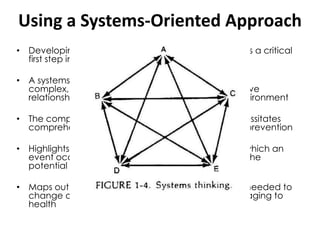
• A systems perspective recognizes that a
complex, reciprocal, interdependent, and interactive
relationship exists between individuals and their environment
• The complex, multifaceted etiology of obesity necessitates
comprehensive systematic approaches to obesity prevention
• Highlights the importance of the circumstances in which an
event occurs (the context), in order to understand the
potential implementation and impact
• Maps out the processes and mechanisms that are needed to
change and alter the social relations that are damaging to
health
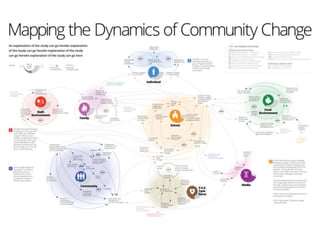
The Dynamics of Community Change:
The Shape Up Somerville Experience
• To describe the key aspects and dynamics of social
change within the community of Somerville over 10 years
• Retrospective examination of the SUS model using a
systems perspective in an effort to create a framework
that may help guide future community-based childhood
obesity prevention interventions
– qualitative systems analysis informed by individual and
group interviews with key SUS stakeholders and researchers

• To illustrate through the integration of the socioecological model (determinants) and community-based
participatory research methods (approach) by visualizing
the process using a systems perspective (process).
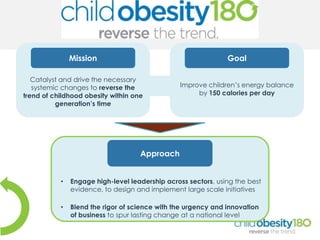
Mission

Goal

Catalyst and drive the necessary
systemic changes to reverse the
trend of childhood obesity within one
generation’s time

Improve children’s energy balance
by 150 calories per day

Approach
•

Engage high-level leadership across sectors, using the best
evidence, to design and implement large scale initiatives

•

Blend the rigor of science with the urgency and innovation
of business to spur lasting change at a national level
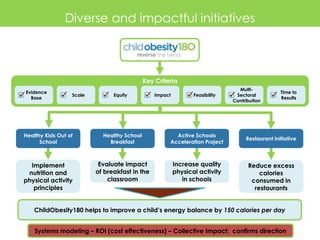
Diverse and impactful initiatives

Key Criteria



Evidence
Base



Scale



Equity



Impact



Feasibility

Healthy Kids Out of
School

Healthy School
Breakfast

Active Schools
Acceleration Project

Implement
nutrition and
physical activity
principles

Evaluate impact
of breakfast in the
classroom

Increase quality
physical activity
in schools

MultiSectoral
Contribution





Time to
Results

Restaurant Initiative

Reduce excess
calories
consumed in
restaurants

ChildObesity180 helps to improve a child’s energy balance by 150 calories per day
Systems modeling – ROI (cost effectiveness) – Collective Impact: confirms direction
Accelerating the Movement
Increase quality physical activity
in schools as a means to combat
childhood obesity and evoke the
beneficial health, behavioral, and
academic outcomes that follow.
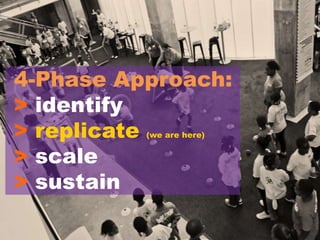
4-Phase Approach:
> identify
> replicate
> scale
> sustain
(we are here)
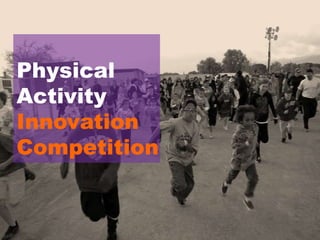
Physical
Activity
Innovation
Competition
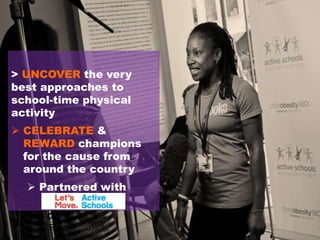
> UNCOVER the very
best approaches to
school-time physical
activity
 CELEBRATE &
REWARD champions
for the cause from
around the country
 Partnered with
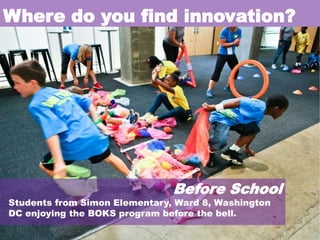
Where do you find innovation?

Fresh Approaches to All School Activity

Students at Red Hawk Elementary participate
in an all-school movement break.
Where do you find innovation?

In the Classroom

Student at PS 102 in East Harlem demonstrate
a Just Move classroom break.
Where do you find innovation?

Before School

Students from Simon Elementary, Ward 8, Washington
DC enjoying the BOKS program before the bell.
Where do you find innovation?

Fresh Challenges

Kids in Corona, CA accept the challenge to run or walk
100 miles over the school year in the 100 Mile Club.
Where do you find innovation?

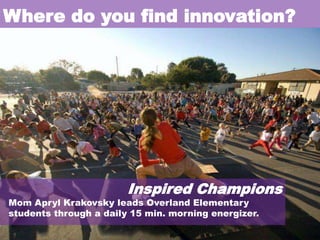
Inspired Champions

Mom Apryl Krakovsky leads Overland Elementary
students through a daily 15 min. morning energizer.
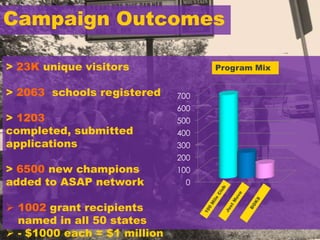
Campaign Outcomes
> 23K unique visitors
> 2063 schools registered
> 1203
completed, submitted
applications
> 6500 new champions
added to ASAP network
 1002 grant recipients
named in all 50 states
 - $1000 each = $1 million

Program Mix
700
600
500

400
300
200
100
0
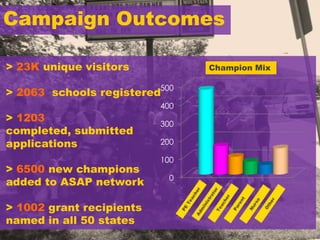
Campaign Outcomes
> 23K unique visitors

Champion Mix

> 2063 schools registered500
> 1203
completed, submitted
applications
> 6500 new champions
added to ASAP network
> 1002 grant recipients
named in all 50 states

400
300
200
100
0
Evaluating Impact
OBJECTIVE:

Gain understanding of PE/PA
environment before / after ASAP program
implementation

STUDY DESIGN:
• Survey among all 1000 ASAP schools: baseline,
mid-course, year-end
• Physical Activity questions related to:
• Support / Policy
• Opportunities / # minutes/day
• PE teacher professional development
• Implementation of ASAP program
• Student fitness assessment
Evaluating Impact
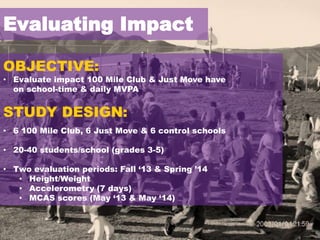
OBJECTIVE:

• Evaluate impact 100 Mile Club & Just Move have
on school-time & daily MVPA

STUDY DESIGN:
• 6 100 Mile Club, 6 Just Move & 6 control schools
• 20-40 students/school (grades 3-5)
• Two evaluation periods: Fall ‘13 & Spring ’14
• Height/Weight
• Accelerometry (7 days)
• MCAS scores (May ‘13 & May ‘14)
What’s Next?
Create 10X impact
From 1,000 to 10,000 schools
www.childobesity180.org

Economos

  • 1.
    Catalyzing Communities toPrevent Obesity: A Systems Approach Christina Economos, PhD Associate Professor New Balance Chair in Childhood Nutrition Director, ChildObesity180 October 10, 2013
  • 2.
    How do youspark social change? • Learn from other movements (tobacco, recycling, seat belts, breastfeeding) • Call for a Crisis • Build on a sound scientific base • Nurture spark plugs • Recognize the importance of economics • Develop coalitions and advocacy • Use government strategically • Employ mass communication • Create environmental and policy changes • Develop a clear plan Economos, C, Brownson, S, DeAngelis, M, Foerster, S, Tucker Foreman, C, Kumanyika, S, Pate R. What Lessons Have Been Learned From Other Attempts To Guide Social Change? Nutrition Reviews 2001; 59(3):40-56
  • 3.
    Shape Up Somerville: EatSmart. Play Hard. • A community-based, participatory, environmental approach to prevent childhood obesity (2002-2005) • A 3 year controlled trial to study 1st – 3rd grade culturally and ethnically diverse children and their parents from 3 cities outside Boston • Goals: – To examine the effectiveness of the model on the prevention of undesirable weight gain in children – Transform a community and inform social change at the national level R06/CCR121519-01 from the Centers for Disease Control and Prevention. Additional support by Blue Cross Blue Shield of Massachusetts, United Way of Mass Bay, The US Potato Board, Stonyfield Farm, and Dole
  • 4.
    E a rlyM o rn in g E n v iro n m en t D u r in g S c h o o l E n v ir o n m e n t A t H om e B efore S ch ool P rogram Home: Parent, Child, Family S afe R outes to S ch ool M ap s  W alking to S chool (-30 k cals) H ealth ier H om e B reakfast  Fiber,  S ugar,  F at A p p rop riate P ortion Sizes H ealth ier Sch ool B reakfast  Fiber,  S ugar,  F at A ppropriate P ortion Sizes In creased F resh F ru its B reakfast C oordin ator (~25 kcals) School: Child, teachers, administration, staff P h ysical A ctivity E q u ip m en t for R ecess  P hysical A ctivity (- 25 kcals) 5 days/w k (10 m in) N utrition & P hysical A ctivity E ducation 1 day/w k (30 m in) P hysical A ctivity (- 25 k cals) H ealth ier S ch ool L u n ch Fiber, S ugar, F at Increased Fresh Fruits & V egetables A ppropriate P ortion Sizes Im proved P resentation and A tm osphere S ocial M arketing in C afeteria A lternative “H ealthier” A L a C arte Item s N ew F ood S ervice E quipm ent School: Child, teachers, administration, staff A fte r n o o n E n v ir o n m e n t A t h om e S afe R ou tes to S ch ool M ap s  W alking H om e (-30 k cals) H ealth y H o m e S n ack  F iber,  S ugar,  F at School: Child, teachers, administration, staff P rofession al D evelop m en t H ealth ier F u n d raisin g A ltern atives T eachers A dm inistrators F ood S ervice Staff P E T eachers A fter S ch ool P rogram C u rricu lu m : C ook in g L esson s P h ysical A ctivity (-30 k cals) N u trition E d u cation P rofession al D evelop m en t Home: Parent, Child, Family R e in f o r c in g E n v ir o n m e n t s C lassroom M icro U n its Community: After school programs H om e E n viron m en t (~ 15 k cal) P a ren t N ew sletter w / co u p on s G row th R ep orts  S creen T im e P ro m otion al G ifts Home: Parent, Child, Family Community: Ethnic groups C om m u n ity E n viron m en t C om m u n ity “C h am p ion s” R estau ran t P articip ation P ed iatrician T rain in g & S u p p ort C om m u n ity T V A p p earan ces E th n ic G rou p O u trea ch C om m u n ity P A R esou rce G u id e C om m u n ity E ven ts Health Care System Community: Restaurants Local Government Media
  • 5.
    RESULTS: BMI z-scoreat 4 time points Year 1 Change Year 1 Change Intervention vs. Control 1 + 2 Estimate -0.1005 BMI z-score Intervention vs. Control 1 + 2 Estimate -0.1005 P = 0.0011 N = 1178 P = 0.0011 Obesity 2007;15:1325-1336 N = 1178 2 Year Change Intervention vs. Control 1 + 2 Estimate -0.0573 P = 0.0054 N = 1028 Fall 2003 Spring 2004 Fall 2004 Spring 2005 Prev Med 2013 Oct;57(4):322-7 N = 922
  • 6.
    RESULTS: 2 Yearbehavior Change Table 2-Adjusted differences in behaviors between intervention and combined control communities after 2-year intervention period Baseline Behavior Control Group After Intervention Intervention Group Control Group Intervention Group Pre–Post Change: 1 Adjusted Difference Model Properties additional covariates R2 0.09 parental foreign born status, # siblings 0.18 -2.00 (-3.76,-.25) 0.04 # rules 0.21 4.0 (2.9) 0.20 (0.06,0.33) 0.02 87 3.9 (4.2) 0.65 (-0.53,1.82) 0.14 parent marital status, maternal BMI 0.20 2.2 (1.0) 104 1.7 (1.2) -0.24 (-0.51,0.04) 0.06 # rules 0.27 332 3.9 (1.9) 106 3.0 (2.2) -0.24 (0.42,0.06) 0.03 parent marital status, # siblings, # rules 0.22 29.4% 250 54.8% 85 31.8% 0.39 ( 0.11,0.89) 0.13 child weight category, # siblings, maternal BMI --4 73.6% 337 62.0% 110 71.8% OR 0.94 (0.88, 1.00) 0.06 n Mean (SD) n Mean (SD) n Mean (SD) n Mean (SD) Effect (95% CI) p-value Fruit & vegetable (servings/day) 317 3.1 (1.5) 103 3.5 (1.6) 317 3.4 (1.6) 103 3.7 (1.8) 0.16 (-06,0.38) Sugarsweetened beverages (ounces/day) 265 6.5 (6.0) 72 6.1 (6.3) 265 7.6 (7.0) 72 5.5 (6.7) Sports (# per year) 343 2.9 (2.8) 111 3.6 (2.9) 343 3.4 (2.7) 111 Walk to/from school (# trips per week) 248 2.7 (4.0) 87 3.5 (4.1) 248 2.6 (3.9) TV time (hrs/day) 325 2.2 (1.1) 104 1.6 (1.1) 325 Total screen time (hrs/day) 332 3.8 (1.8) 106 2.7 (1.6) TV in bedroom2 (% yes) 250 50.4% 85 Dinner with TV3 (% not very much/never) 337 61.4% 110 0.21 Folta S, Kuder J, Goldberg J, Hyatt R, Must A, Naumova E, Nelson M, Economos C. Changes in diet and physical activity resulting from the shape up Somerville community intervention BMC Pediatrics.2013, 13:157. --4
  • 7.
    Using a Systems-OrientedApproach • Developing an understanding of the whole system is a critical first step in tackling the problem more effectively • A systems perspective recognizes that a complex, reciprocal, interdependent, and interactive relationship exists between individuals and their environment • The complex, multifaceted etiology of obesity necessitates comprehensive systematic approaches to obesity prevention • Highlights the importance of the circumstances in which an event occurs (the context), in order to understand the potential implementation and impact • Maps out the processes and mechanisms that are needed to change and alter the social relations that are damaging to health
  • 8.
    The Dynamics ofCommunity Change: The Shape Up Somerville Experience • To describe the key aspects and dynamics of social change within the community of Somerville over 10 years • Retrospective examination of the SUS model using a systems perspective in an effort to create a framework that may help guide future community-based childhood obesity prevention interventions – qualitative systems analysis informed by individual and group interviews with key SUS stakeholders and researchers • To illustrate through the integration of the socioecological model (determinants) and community-based participatory research methods (approach) by visualizing the process using a systems perspective (process).
  • 10.
    Mission Goal Catalyst and drivethe necessary systemic changes to reverse the trend of childhood obesity within one generation’s time Improve children’s energy balance by 150 calories per day Approach • Engage high-level leadership across sectors, using the best evidence, to design and implement large scale initiatives • Blend the rigor of science with the urgency and innovation of business to spur lasting change at a national level
  • 11.
    Diverse and impactfulinitiatives Key Criteria  Evidence Base  Scale  Equity  Impact  Feasibility Healthy Kids Out of School Healthy School Breakfast Active Schools Acceleration Project Implement nutrition and physical activity principles Evaluate impact of breakfast in the classroom Increase quality physical activity in schools MultiSectoral Contribution   Time to Results Restaurant Initiative Reduce excess calories consumed in restaurants ChildObesity180 helps to improve a child’s energy balance by 150 calories per day Systems modeling – ROI (cost effectiveness) – Collective Impact: confirms direction
  • 12.
    Accelerating the Movement Increasequality physical activity in schools as a means to combat childhood obesity and evoke the beneficial health, behavioral, and academic outcomes that follow.
  • 13.
    4-Phase Approach: > identify >replicate > scale > sustain (we are here)
  • 14.
  • 15.
    > UNCOVER thevery best approaches to school-time physical activity  CELEBRATE & REWARD champions for the cause from around the country  Partnered with
  • 16.
    Where do youfind innovation? Fresh Approaches to All School Activity Students at Red Hawk Elementary participate in an all-school movement break.
  • 17.
    Where do youfind innovation? In the Classroom Student at PS 102 in East Harlem demonstrate a Just Move classroom break.
  • 18.
    Where do youfind innovation? Before School Students from Simon Elementary, Ward 8, Washington DC enjoying the BOKS program before the bell.
  • 19.
    Where do youfind innovation? Fresh Challenges Kids in Corona, CA accept the challenge to run or walk 100 miles over the school year in the 100 Mile Club.
  • 20.
    Where do youfind innovation? Inspired Champions Mom Apryl Krakovsky leads Overland Elementary students through a daily 15 min. morning energizer.
  • 21.
    Campaign Outcomes > 23Kunique visitors > 2063 schools registered > 1203 completed, submitted applications > 6500 new champions added to ASAP network  1002 grant recipients named in all 50 states  - $1000 each = $1 million Program Mix 700 600 500 400 300 200 100 0
  • 22.
    Campaign Outcomes > 23Kunique visitors Champion Mix > 2063 schools registered500 > 1203 completed, submitted applications > 6500 new champions added to ASAP network > 1002 grant recipients named in all 50 states 400 300 200 100 0
  • 23.
    Evaluating Impact OBJECTIVE: Gain understandingof PE/PA environment before / after ASAP program implementation STUDY DESIGN: • Survey among all 1000 ASAP schools: baseline, mid-course, year-end • Physical Activity questions related to: • Support / Policy • Opportunities / # minutes/day • PE teacher professional development • Implementation of ASAP program • Student fitness assessment
  • 24.
    Evaluating Impact OBJECTIVE: • Evaluateimpact 100 Mile Club & Just Move have on school-time & daily MVPA STUDY DESIGN: • 6 100 Mile Club, 6 Just Move & 6 control schools • 20-40 students/school (grades 3-5) • Two evaluation periods: Fall ‘13 & Spring ’14 • Height/Weight • Accelerometry (7 days) • MCAS scores (May ‘13 & May ‘14)
  • 25.
    What’s Next? Create 10Ximpact From 1,000 to 10,000 schools www.childobesity180.org

Editor's Notes

  • #22 Number of visits to the grant website – Between 2/28/13 – 5/1/13 (open submission window): 35K total visits; 23K unique visits.Number of initiated applications (including those that were completed and those that were not) – 2063 total started applications (includes those that followed through and those that did not complete). 1 application = 1 school
  • #23 Other – Wellness coordinators, librarians, health teachers, guidance counselors, secretaries, special educators, teacher’s aid, etc
  • #24 BASELINE SURVEYGain understanding of PE/PA environment before introduction of ASAP program, existing levels of PA, other programs or affiliations, Existing leadership, existing requirements and policies for PA etc?Understand needs of school to be successful with a new PA programUnderstand if the ASAP program will substitute/replace PA minutes or add additional minutes·         MIDCOURSE PROGRESS  Understand progress made/successes/challenges encountered during implementationBasic implementation metrics, frequency of activity, reach of student population, Verification of funds usage - How has first installment of funding been spent? Has it helped to execute program goals?This report is required for disbursement of 2nd grant installment, in some cases if implementation is unsatisfactory, we may work with the school and withhold second check until we see progress.  ·         YEAR END SURVEYUnderstand progress in implementing program over the school year, has reach / frequency / minutes MVPA gone up?Understand changes made to PE/PA environments as a result of ASAP program additionHow many minutes of PA has this program added?Were materials & training effective in supporting program implementation?How many students were reached with the ASAP program?Do schools plan to implement the ASAP program again the following year?Understand barriers to implementation, and how ASAP can support in overcoming these