“Unequal Childhoods, Unequal
Adulthoods: Small Moments
and Large Consequences”
Annette Lareau
Stanley I. Sheerr Professor
University of Pennsylvania
University of Virginia
April 9, 2015
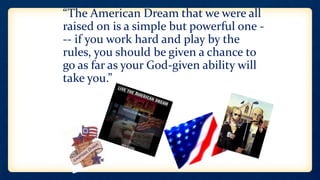
• “The American Dream that we were all
raised on is a simple but powerful one -
-- if you work hard and play by the
rules, you should be given a chance to
go as far as your God-given ability will
take you.”
Sociological research
Social origins: life paths
Powerful findings,
But focus is on outcomes=>less on processes
Need attention to key moments
Contingencies
Things might have turned out differently
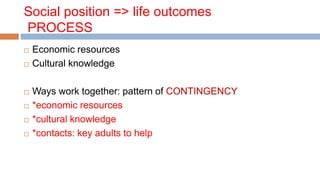
Social position => life outcomes
PROCESS
 Economic resources
 Cultural knowledge
 Ways work together: pattern of CONTINGENCY
 *economic resources
 *cultural knowledge
 *contacts: key adults to help
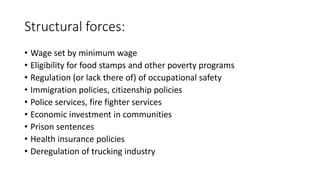
Structural forces:
• Wage set by minimum wage
• Eligibility for food stamps and other poverty programs
• Regulation (or lack there of) of occupational safety
• Immigration policies, citizenship policies
• Police services, fire fighter services
• Economic investment in communities
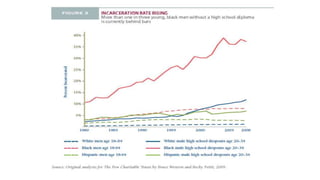
• Prison sentences
• Health insurance policies
• Deregulation of trucking industry
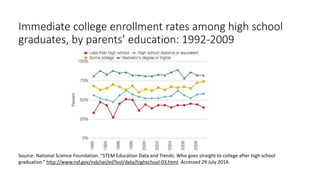
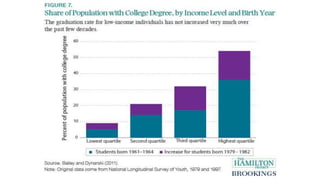
Immediate college enrollment rates among high school
graduates, by parents’ education: 1992-2009
Source: National Science Foundation. “STEM Education Data and Trends: Who goes straight to college after high school
graduation.” http://www.nsf.gov/nsb/sei/edTool/data/highschool-03.html. Accessed 29 July 2014.
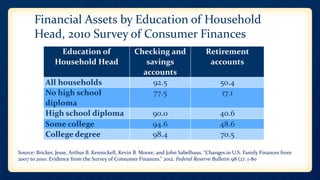
Financial Assets by Education of Household
Head, 2010 Survey of Consumer Finances
Education of
Household Head
Checking and
savings
accounts
Retirement
accounts
All households 92.5 50.4
No high school
diploma
77.5 17.1
High school diploma 90.0 40.6
Some college 94.6 48.6
College degree 98.4 70.5
Source: Bricker, Jesse, Arthur B. Kennickell, Kevin B. Moore, and John Sabelhaus. “Changes in U.S. Family Finances from
2007 to 2010: Evidence from the Survey of Consumer Finances.” 2012. Federal Reserve Bulletin 98 (2): 1-80
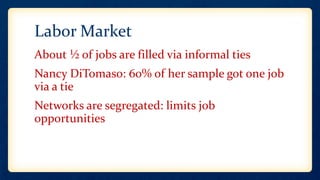
Labor Market
About ½ of jobs are filled via informal ties
Nancy DiTomaso: 60% of her sample got one job
via a tie
Networks are segregated: limits job
opportunities
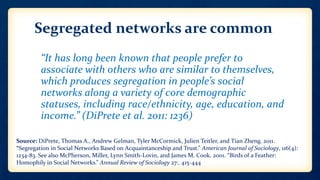
Segregated networks are common
• “It has long been known that people prefer to
associate with others who are similar to themselves,
which produces segregation in people’s social
networks along a variety of core demographic
statuses, including race/ethnicity, age, education, and
income.” (DiPrete et al. 2011: 1236)
Source: DiPrete, Thomas A., Andrew Gelman, Tyler McCormick, Julien Teitler, and Tian Zheng. 2011.
“Segregation in Social Networks Based on Acquaintanceship and Trust.” American Journal of Sociology, 116(4):
1234-83. See also McPherson, Miller, Lynn Smith-Lovin, and James M. Cook. 2001. “Birds of a Feather:
Homophily in Social Networks.” Annual Review of Sociology 27:. 415-444
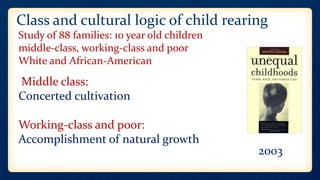
Class and cultural logic of child rearing
Study of 88 families: 10 year old children
middle-class, working-class and poor
White and African-American
Middle class:
Concerted cultivation
Working-class and poor:
Accomplishment of natural growth
2003
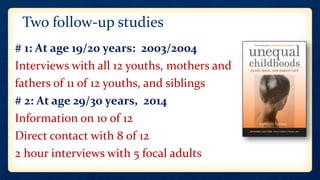
Two follow-up studies
• # 1: At age 19/20 years: 2003/2004
• Interviews with all 12 youths, mothers and
• fathers of 11 of 12 youths, and siblings
• # 2: At age 29/30 years, 2014
• Information on 10 of 12
• Direct contact with 8 of 12
• 2 hour interviews with 5 focal adults
Relationship:
• Holiday card with a bill tucked into it for many of the
12 youths
• Gifts at weddings and births of babies
• Gift cards at holidays for families with kids who are
struggling economically
• Some have terminated (see Lareau 2011), but rest
greeted warmly
• 2nd edition) but, if not, greeted warmly
Definition of social class
Middle-class: one parent is employed in a position that
either entails substantial managerial authority or
which centrally draws upon highly complex,
educationally certified (i.e. college level) skills. [BA+]
Working-class: at least one parent is employed in a
position with little or no managerial authority and which
does not draw on highly complex, educationally certified
skills. [usually high school grad or high school drop-out]
Poor: parents not in the labor force in regular, continuous
basis
Character of Institutions
•Many unwritten rules
•Eroding public services
•*example: Decline in high school counselors
•But working-class youth more dependent on
these services than middle-class youth
Conceptual tools: cultural capital
• culture as a resource which can yield profits
• *provides access to scarce rewards
• *is subject to monopolization
• *under certain conditions, may be transmitted
from one generation to the next
• In Bourdieu’s work and others, knowledge is key
• But not sufficiently developed in literature
Harold McAllister
African-American, poor family
When 10:
Lived with mother, two sisters, brother, and assorted cousins in public housing
Mother received AFDC
Father was mechanic (never married); Harold visited regularly
Large, rich extended family network: many family gatherings
Loved basketball
Vacation Bible study, but otherwise no organized activities; played with friends
outside
Good student, no disciplinary issues (didn’t do homework)
lNot a source of information about possible jobs
Harold McAllister: Overview
The Historical and Social
Structural Context
 Residence
 School
 Work
 Incarceration
 Child support
Going forward:
=>Ability to realize life goals
Pathway had numerous
branching points or
contingencies.
Other pathways possible, but
depended on a combination of:
 Economic factors
 Cultural knowledge
 Adults available to help
Harold McAllister
1. Federal housing policy: public
housing torn down
*Rental housing: substandard
2. Urban school district: few
counselors
* Cumbersome district transfer
process
3. Workplaces: ambiguous
criteria for promotion
4. Child support policies
5. Mass incarceration
6. Police
* Network fell apart
 Lost housing, moved around
 Substandard housing moved in with Dad
 School
*college prep program
*basketball team
*attendance
 Applied for numerous jobs, passed up: quit
 Baby’s momma, DNA, pays child support
 Running streets: arrests
Police
 Extended family shattered
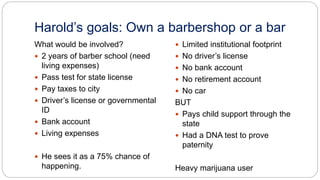
Harold’s goals: Own a barbershop or a bar
What would be involved?
 2 years of barber school (need
living expenses)
 Pass test for state license
 Pay taxes to city
 Driver’s license or governmental
ID
 Bank account
 Living expenses
 He sees it as a 75% chance of
happening.
 Limited institutional footprint
 No driver’s license
 No bank account
 No retirement account
 No car
BUT
 Pays child support through the
state
 Had a DNA test to prove
paternity
Heavy marijuana user
Consistent with other studies
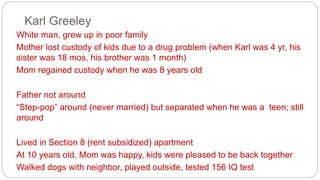
Karl Greeley
White man, grew up in poor family
Mother lost custody of kids due to a drug problem (when Karl was 4 yr, his
sister was 18 mos, his brother was 1 month)
Mom regained custody when he was 8 years old
Father not around
“Step-pop” around (never married) but separated when he was a teen; still
around
Lived in Section 8 (rent subsidized) apartment
At 10 years old, Mom was happy, kids were pleased to be back together
Walked dogs with neighbor, played outside, tested 156 IQ test
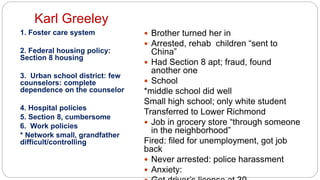
Karl Greeley
1. Foster care system
2. Federal housing policy:
Section 8 housing
3. Urban school district: few
counselors: complete
dependence on the counselor
4. Hospital policies
5. Section 8, cumbersome
6. Work policies
* Network small, grandfather
difficult/controlling
 Brother turned her in
 Arrested, rehab children “sent to
China”
 Had Section 8 apt; fraud, found
another one
 School
*middle school did well
Small high school; only white student
Transferred to Lower Richmond
 Job in grocery store “through someone
in the neighborhood”
Fired: filed for unemployment, got job
back
 Never arrested: police harassment
 Anxiety:
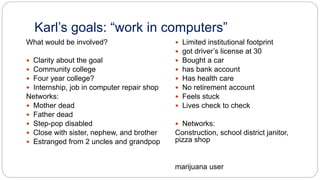
Karl’s goals: “work in computers”
What would be involved?
 Clarity about the goal
 Community college
 Four year college?
 Internship, job in computer repair shop
Networks:
 Mother dead
 Father dead
 Step-pop disabled
 Close with sister, nephew, and brother
 Estranged from 2 uncles and grandpop
 Limited institutional footprint
 got driver’s license at 30
 Bought a car
 has bank account
 Has health care
 No retirement account
 Feels stuck
 Lives check to check
 Networks:
Construction, school district janitor,
pizza shop
marijuana user
If had some of same challenges with upper-
middle-class mother
 Tutors
 Other school
 College preparation
 Lawyers
 Networks of doctors when in
hospital
 Paid for barbershop school
 Down payment on building
 Help with license applications
Taking stock
 Average students
 No major behavior problems
 Mothers strongly wanted
educational success in high
school
 Mothers strongly support paid
work in labor force
 Had hopes and dreams
 Live in a historical context of
federal, state, and local
policies which helped to set
the parameters for their lives
 As grew up, lives unfold
 Economic constraints
 Cultural knowledge
 Adults/networks
Worked together:
Many branching points
Many contingencies
Contributions of sociology
 Live in an unequal society
 Social origins cast a long
shadow for many, but not all,
children
 But: not determined
 Points when it might have
been different
 Harold: mechanic
 Karl: computer repair person
 Need to unpack the interaction
of structural forces, historical
moments, and biography
 Need to highlight key moments
 Some moments are more
consequential than others
 Cultural knowledge is often the
lynchpin, but interwoven with
other important factors

Lareau_Slides

  • 1.
    “Unequal Childhoods, Unequal Adulthoods:Small Moments and Large Consequences” Annette Lareau Stanley I. Sheerr Professor University of Pennsylvania University of Virginia April 9, 2015
  • 2.
    • “The AmericanDream that we were all raised on is a simple but powerful one - -- if you work hard and play by the rules, you should be given a chance to go as far as your God-given ability will take you.”
  • 3.
    Sociological research Social origins:life paths Powerful findings, But focus is on outcomes=>less on processes Need attention to key moments Contingencies Things might have turned out differently
  • 4.
    Social position =>life outcomes PROCESS  Economic resources  Cultural knowledge  Ways work together: pattern of CONTINGENCY  *economic resources  *cultural knowledge  *contacts: key adults to help
  • 5.
    Structural forces: • Wageset by minimum wage • Eligibility for food stamps and other poverty programs • Regulation (or lack there of) of occupational safety • Immigration policies, citizenship policies • Police services, fire fighter services • Economic investment in communities • Prison sentences • Health insurance policies • Deregulation of trucking industry
  • 7.
    Immediate college enrollmentrates among high school graduates, by parents’ education: 1992-2009 Source: National Science Foundation. “STEM Education Data and Trends: Who goes straight to college after high school graduation.” http://www.nsf.gov/nsb/sei/edTool/data/highschool-03.html. Accessed 29 July 2014.
  • 9.
    Financial Assets byEducation of Household Head, 2010 Survey of Consumer Finances Education of Household Head Checking and savings accounts Retirement accounts All households 92.5 50.4 No high school diploma 77.5 17.1 High school diploma 90.0 40.6 Some college 94.6 48.6 College degree 98.4 70.5 Source: Bricker, Jesse, Arthur B. Kennickell, Kevin B. Moore, and John Sabelhaus. “Changes in U.S. Family Finances from 2007 to 2010: Evidence from the Survey of Consumer Finances.” 2012. Federal Reserve Bulletin 98 (2): 1-80
  • 10.
    Labor Market About ½of jobs are filled via informal ties Nancy DiTomaso: 60% of her sample got one job via a tie Networks are segregated: limits job opportunities
  • 11.
    Segregated networks arecommon • “It has long been known that people prefer to associate with others who are similar to themselves, which produces segregation in people’s social networks along a variety of core demographic statuses, including race/ethnicity, age, education, and income.” (DiPrete et al. 2011: 1236) Source: DiPrete, Thomas A., Andrew Gelman, Tyler McCormick, Julien Teitler, and Tian Zheng. 2011. “Segregation in Social Networks Based on Acquaintanceship and Trust.” American Journal of Sociology, 116(4): 1234-83. See also McPherson, Miller, Lynn Smith-Lovin, and James M. Cook. 2001. “Birds of a Feather: Homophily in Social Networks.” Annual Review of Sociology 27:. 415-444
  • 12.
    Class and culturallogic of child rearing Study of 88 families: 10 year old children middle-class, working-class and poor White and African-American Middle class: Concerted cultivation Working-class and poor: Accomplishment of natural growth 2003
  • 13.
    Two follow-up studies •# 1: At age 19/20 years: 2003/2004 • Interviews with all 12 youths, mothers and • fathers of 11 of 12 youths, and siblings • # 2: At age 29/30 years, 2014 • Information on 10 of 12 • Direct contact with 8 of 12 • 2 hour interviews with 5 focal adults
  • 14.
    Relationship: • Holiday cardwith a bill tucked into it for many of the 12 youths • Gifts at weddings and births of babies • Gift cards at holidays for families with kids who are struggling economically • Some have terminated (see Lareau 2011), but rest greeted warmly • 2nd edition) but, if not, greeted warmly
  • 15.
    Definition of socialclass Middle-class: one parent is employed in a position that either entails substantial managerial authority or which centrally draws upon highly complex, educationally certified (i.e. college level) skills. [BA+] Working-class: at least one parent is employed in a position with little or no managerial authority and which does not draw on highly complex, educationally certified skills. [usually high school grad or high school drop-out] Poor: parents not in the labor force in regular, continuous basis
  • 16.
    Character of Institutions •Manyunwritten rules •Eroding public services •*example: Decline in high school counselors •But working-class youth more dependent on these services than middle-class youth
  • 17.
    Conceptual tools: culturalcapital • culture as a resource which can yield profits • *provides access to scarce rewards • *is subject to monopolization • *under certain conditions, may be transmitted from one generation to the next • In Bourdieu’s work and others, knowledge is key • But not sufficiently developed in literature
  • 18.
    Harold McAllister African-American, poorfamily When 10: Lived with mother, two sisters, brother, and assorted cousins in public housing Mother received AFDC Father was mechanic (never married); Harold visited regularly Large, rich extended family network: many family gatherings Loved basketball Vacation Bible study, but otherwise no organized activities; played with friends outside Good student, no disciplinary issues (didn’t do homework) lNot a source of information about possible jobs
  • 19.
    Harold McAllister: Overview TheHistorical and Social Structural Context  Residence  School  Work  Incarceration  Child support Going forward: =>Ability to realize life goals Pathway had numerous branching points or contingencies. Other pathways possible, but depended on a combination of:  Economic factors  Cultural knowledge  Adults available to help
  • 20.
    Harold McAllister 1. Federalhousing policy: public housing torn down *Rental housing: substandard 2. Urban school district: few counselors * Cumbersome district transfer process 3. Workplaces: ambiguous criteria for promotion 4. Child support policies 5. Mass incarceration 6. Police * Network fell apart  Lost housing, moved around  Substandard housing moved in with Dad  School *college prep program *basketball team *attendance  Applied for numerous jobs, passed up: quit  Baby’s momma, DNA, pays child support  Running streets: arrests Police  Extended family shattered
  • 21.
    Harold’s goals: Owna barbershop or a bar What would be involved?  2 years of barber school (need living expenses)  Pass test for state license  Pay taxes to city  Driver’s license or governmental ID  Bank account  Living expenses  He sees it as a 75% chance of happening.  Limited institutional footprint  No driver’s license  No bank account  No retirement account  No car BUT  Pays child support through the state  Had a DNA test to prove paternity Heavy marijuana user
  • 22.
  • 23.
    Karl Greeley White man,grew up in poor family Mother lost custody of kids due to a drug problem (when Karl was 4 yr, his sister was 18 mos, his brother was 1 month) Mom regained custody when he was 8 years old Father not around “Step-pop” around (never married) but separated when he was a teen; still around Lived in Section 8 (rent subsidized) apartment At 10 years old, Mom was happy, kids were pleased to be back together Walked dogs with neighbor, played outside, tested 156 IQ test
  • 24.
    Karl Greeley 1. Fostercare system 2. Federal housing policy: Section 8 housing 3. Urban school district: few counselors: complete dependence on the counselor 4. Hospital policies 5. Section 8, cumbersome 6. Work policies * Network small, grandfather difficult/controlling  Brother turned her in  Arrested, rehab children “sent to China”  Had Section 8 apt; fraud, found another one  School *middle school did well Small high school; only white student Transferred to Lower Richmond  Job in grocery store “through someone in the neighborhood” Fired: filed for unemployment, got job back  Never arrested: police harassment  Anxiety:
  • 25.
    Karl’s goals: “workin computers” What would be involved?  Clarity about the goal  Community college  Four year college?  Internship, job in computer repair shop Networks:  Mother dead  Father dead  Step-pop disabled  Close with sister, nephew, and brother  Estranged from 2 uncles and grandpop  Limited institutional footprint  got driver’s license at 30  Bought a car  has bank account  Has health care  No retirement account  Feels stuck  Lives check to check  Networks: Construction, school district janitor, pizza shop marijuana user
  • 26.
    If had someof same challenges with upper- middle-class mother  Tutors  Other school  College preparation  Lawyers  Networks of doctors when in hospital  Paid for barbershop school  Down payment on building  Help with license applications
  • 27.
    Taking stock  Averagestudents  No major behavior problems  Mothers strongly wanted educational success in high school  Mothers strongly support paid work in labor force  Had hopes and dreams  Live in a historical context of federal, state, and local policies which helped to set the parameters for their lives  As grew up, lives unfold  Economic constraints  Cultural knowledge  Adults/networks Worked together: Many branching points Many contingencies
  • 28.
    Contributions of sociology Live in an unequal society  Social origins cast a long shadow for many, but not all, children  But: not determined  Points when it might have been different  Harold: mechanic  Karl: computer repair person  Need to unpack the interaction of structural forces, historical moments, and biography  Need to highlight key moments  Some moments are more consequential than others  Cultural knowledge is often the lynchpin, but interwoven with other important factors

Editor's Notes

  • #3 This quote is from President Bill Clinton’s 1993 speech to the Democratic Leadership Council. It is cited in Jennifer Hochschild’s book Facing Up to the American Dream, p. 18. http://www.shopralph.com/book.html http://www.usrelocationservices.com/index.html http://www.reform-america.net/immigration082707.html http://theamericandream.wordpress.com/2007/09/17/fd/?referer=sphere_related_content/
  • #4 http://www.shopralph.com/book.html http://www.usrelocationservices.com/index.html http://www.reform-america.net/immigration082707.html http://theamericandream.wordpress.com/2007/09/17/fd/?referer=sphere_related_content/
  • #8  In 2001, 39% of students whose parents had less than a high school education enrolled in college immediately after high school completion, compared with 81% of students whose parents had a bachelor’s degree or higher (National Science Foundation).
  • #9 http://www.brookings.edu/research/reports/2013/06/13-facts-higher-education “College graduation rates have increased dramatically over the past few decades, but most of these increases have been achieved by high-income Americans. Figure 7 shows the change in graduation rates for individuals born between 1961 and 1964 and those born between 1979 and 1982. The graduation rates are reported separately for children in each quartile of the income distribution. In every income quartile, the proportion graduating from college increased, but the size of that increase varied considerably. While the highest income quartile saw an 18 percentage-point increase in the graduation rate between these birth cohorts, the lowest income quartile saw only a 4 percentage-point increase. This graduation-rate gap may have important implications for social mobility and inequality. Given the importance of a college degree in today’s labor market, rising disparities in college completion portend rising disparities in outcomes in the future.”
  • #10  The SCF defines transaction accounts as “a category comprising checking, savings, and money market deposit accounts; money market mutual funds; and call or cash accounts at brokerages” (Bricker et al. 2012: 46). Additionally, in the SCF “a household unit is divided into a “primary economic unit” (PEU)—the family—and everyone else in the household. The PEU is intended to be the economically dominant single person or couple (whether married or living together as partners) and all other persons in the household who are financially interdependent with that economically dominant person or couple” (Bricker et al. 2012: 76)