1
Pediatric Obesity
Monica Castro, Claudia Chandler & Jennifer Hanks
2
Assessment
Interventions
Values
Preventions + Promotions
1
2
3
4
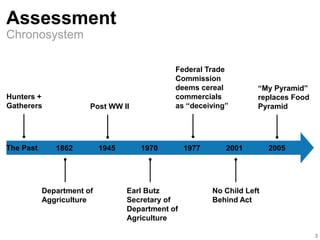
Assessment
3
Chronosystem
The Past 1862 1945 1970 1977 2001 2005
Hunters +
Gatherers
Department of
Aggriculture
Post WW II
Federal Trade
Commission
deems cereal
commercials
as “deceiving”
“My Pyramid”
replaces Food
Pyramid
Earl Butz
Secretary of
Department of
Agriculture
No Child Left
Behind Act
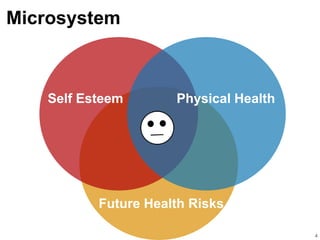
Microsystem
4
Self Esteem Physical Health
Future Health Risks
5
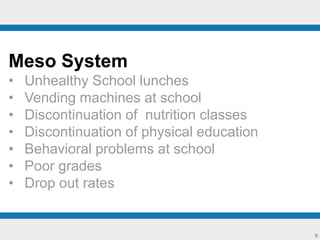
Meso System
• Unhealthy School lunches
• Vending machines at school
• Discontinuation of nutrition classes
• Discontinuation of physical education
• Behavioral problems at school
• Poor grades
• Drop out rates
6
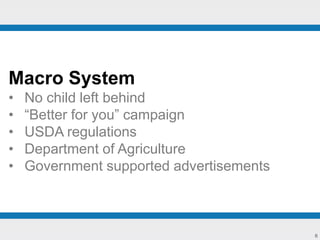
Macro System
• No child left behind
• “Better for you” campaign
• USDA regulations
• Department of Agriculture
• Government supported advertisements
7
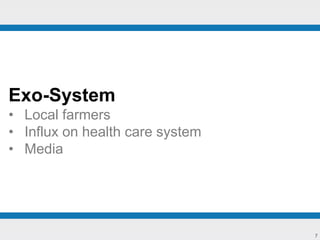
Exo-System
• Local farmers
• Influx on health care system
• Media
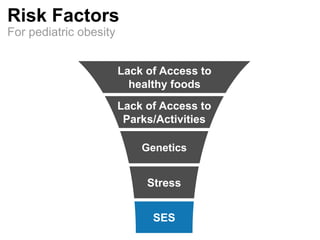
Risk Factors
For pediatric obesity
Stress
SES
Lack of Access to
Parks/Activities
Genetics
Lack of Access to
healthy foods
9
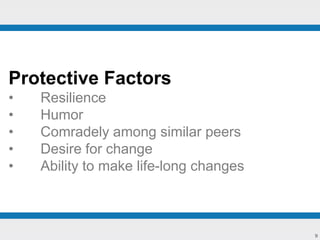
Protective Factors
• Resilience
• Humor
• Comradely among similar peers
• Desire for change
• Ability to make life-long changes
10
Assessment
Interventions
Values
Preventions + Promotions
1
2
3
4
Interventions
11
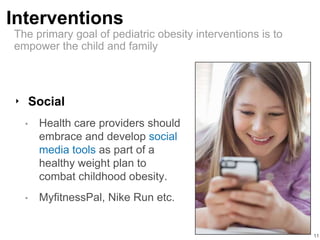
‣ Social
• Health care providers should
embrace and develop social
media tools as part of a
healthy weight plan to
combat childhood obesity.
• MyfitnessPal, Nike Run etc.
The primary goal of pediatric obesity interventions is to
empower the child and family
Interventions
‣ Organizational + Community
• A systematic review of childhood obesity prevention
programs found that community-based intervention
programs that incorporate schools and focus on both
diet and physical activity are more effective at
preventing obesity in children.
12
Focusing on the community is especially important for children
since they generally have little or no control over their environment
13
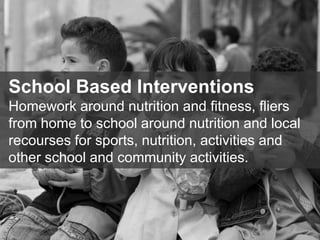
School Based Interventions
Homework around nutrition and fitness, fliers
from home to school around nutrition and local
recourses for sports, nutrition, activities and
other school and community activities.
Interventions
14
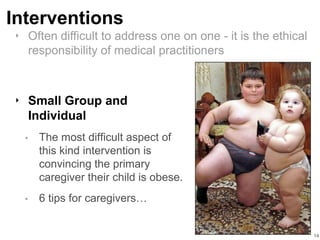
‣ Small Group and
Individual
• The most difficult aspect of
this kind intervention is
convincing the primary
caregiver their child is obese.
• 6 tips for caregivers…
‣ Often difficult to address one on one - it is the ethical
responsibility of medical practitioners
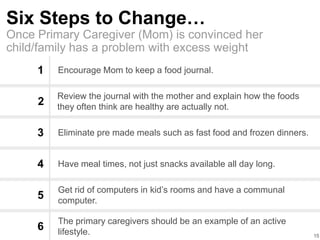
Six Steps to Change…
15
Once Primary Caregiver (Mom) is convinced her
child/family has a problem with excess weight
1
2
3
4
Review the journal with the mother and explain how the foods
they often think are healthy are actually not.
Eliminate pre made meals such as fast food and frozen dinners.
Have meal times, not just snacks available all day long.
Get rid of computers in kid’s rooms and have a communal
computer.
5
Encourage Mom to keep a food journal.
The primary caregivers should be an example of an active
lifestyle.
6
16
Assessment
Values
Interventions
Preventions + Promotions
1
2
3
4
Preventions + Promotions
‣ Primary
• Develop and incorporate more educational components
about proper nutrition, the importance of regular exercise,
and the dangers of tobacco, alcohol and other drugs into
existing systems of information communication.
• Education and legislation about a proper diet are paramount
in preventing pediatric obesity.
• Regular exams and screening tests to monitor risk factors
for illness such as BMI calculations, food journals,
questionnaires and literature in doctor’s offices and school
health offices about a healthy height and weight ratio.
• Controlling known hazardous junk food at home and at
school.
17
Primary prevention measures include activities that help
avoid a given health care problem
Preventions + Promotions
‣ Secondary
• Research shows these method’s don’t work as well.
• Examples of suggested interventions and preventions
include targeting preschool institutions, schools and
after-school activities as a setting for influencing
already poor diet and physical activity.
18
Secondary prevention would identify and treat
asymptomatic children who have already developed or
are developing risk factors for obesity
Preventions + Promotions
‣ Universal
• Suggestions for universal preventative measures
include modification of policies to reduce exposure to
environmental causes of obesity for example regulating
food marketing, regulating laws around food labels and
approaching city planners to assure every citizen has
access to healthy, low cost natural foods.
19
Universal interventions target general population groups
without reference to those at particular risk
Preventions + Promotions
‣ Selective
• High risk prevention strategies have been poorly tested
and no confirmed beneficial effects. In this case,
Intervention and secondary prevention would be the
best choice.
20
Selective programs target those at higher than average
risk for any problem
Preventions + Promotions
‣ Indicated
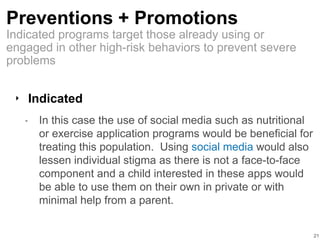
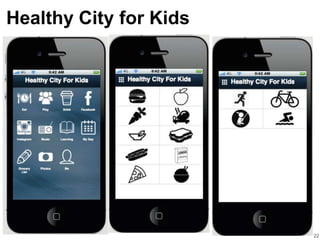
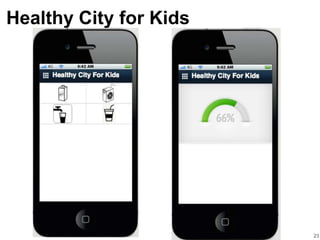
• In this case the use of social media such as nutritional
or exercise application programs would be beneficial for
treating this population. Using social media would also
lessen individual stigma as there is not a face-to-face
component and a child interested in these apps would
be able to use them on their own in private or with
minimal help from a parent.
21
Indicated programs target those already using or
engaged in other high-risk behaviors to prevent severe
problems
Healthy City for Kids
22
Healthy City for Kids
23
24
Assessment
Use this area to provide an optional section subtitle or explanation
Interventions
Highlight the current section if using agenda slides as section breaks
Values
Use this area to provide an optional section subtitle or explanation
Preventions + Promotions
Use this area to provide an optional section subtitle or explanation
1
2
3
4
Personal Values
‣ Self Determination
• Programs developed within the school system from an
early start to emphasize the importance of accepting
and tolerating differences amongst peers. Promoting
determination within children to have accepting
attitudes.
• School groups as well as community groups that
involve the family as a whole to develop and or
acknowledge strengths from within to have self-
determination for healthy living.
25
Personal Values
‣ Caring and Compassion
• With help from individuals who have dealt with
weight problems (obesity to be specific) using them
in community support groups to talk about different
ways of showing love (besides food) and the
importance of children developing healthy coping
strategies (avoiding emotional eating).
• Promoting self-validation.
26
Personal Values
27
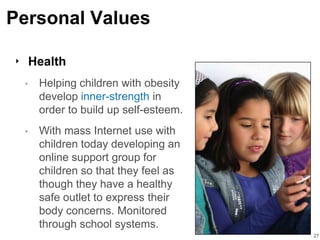
‣ Health
• Helping children with obesity
develop inner-strength in
order to build up self-esteem.
• With mass Internet use with
children today developing an
online support group for
children so that they feel as
though they have a healthy
safe outlet to express their
body concerns. Monitored
through school systems.
28
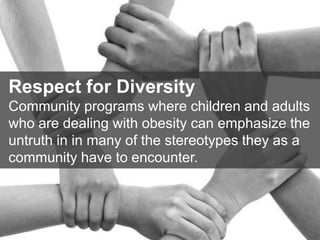
Respect for Diversity
Community programs where children and adults
who are dealing with obesity can emphasize the
untruth in in many of the stereotypes they as a
community have to encounter.
Relational Values
‣ Participating + Collaboration
• Collaboration between all involved child/parent and
doctor needs to be put in place, in order to develop a
plan in overall healthy living. Should be a team effort on
all counts so that all parties are motivated.
29
Collective Values
30
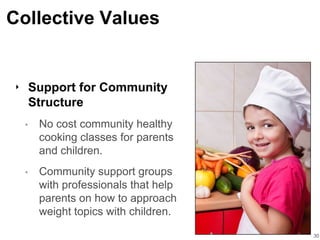
‣ Support for Community
Structure
• No cost community healthy
cooking classes for parents
and children.
• Community support groups
with professionals that help
parents on how to approach
weight topics with children.
Collective Values
‣ Social Justice and Accountability
• Improvement on better access to healthy foods within
communities, especially lower income communities.
• Accesses to educational class (again more within lower
income communities) that teach parents what children
shouldn’t eat too much of along with giving parents
healthy alternatives to give their children.
31

Pediatric Obesity

  • 1.
    1 Pediatric Obesity Monica Castro,Claudia Chandler & Jennifer Hanks
  • 2.
  • 3.
    Assessment 3 Chronosystem The Past 18621945 1970 1977 2001 2005 Hunters + Gatherers Department of Aggriculture Post WW II Federal Trade Commission deems cereal commercials as “deceiving” “My Pyramid” replaces Food Pyramid Earl Butz Secretary of Department of Agriculture No Child Left Behind Act
  • 4.
    Microsystem 4 Self Esteem PhysicalHealth Future Health Risks
  • 5.
    5 Meso System • UnhealthySchool lunches • Vending machines at school • Discontinuation of nutrition classes • Discontinuation of physical education • Behavioral problems at school • Poor grades • Drop out rates
  • 6.
    6 Macro System • Nochild left behind • “Better for you” campaign • USDA regulations • Department of Agriculture • Government supported advertisements
  • 7.
    7 Exo-System • Local farmers •Influx on health care system • Media
  • 8.
    Risk Factors For pediatricobesity Stress SES Lack of Access to Parks/Activities Genetics Lack of Access to healthy foods
  • 9.
    9 Protective Factors • Resilience •Humor • Comradely among similar peers • Desire for change • Ability to make life-long changes
  • 10.
  • 11.
    Interventions 11 ‣ Social • Healthcare providers should embrace and develop social media tools as part of a healthy weight plan to combat childhood obesity. • MyfitnessPal, Nike Run etc. The primary goal of pediatric obesity interventions is to empower the child and family
  • 12.
    Interventions ‣ Organizational +Community • A systematic review of childhood obesity prevention programs found that community-based intervention programs that incorporate schools and focus on both diet and physical activity are more effective at preventing obesity in children. 12 Focusing on the community is especially important for children since they generally have little or no control over their environment
  • 13.
    13 School Based Interventions Homeworkaround nutrition and fitness, fliers from home to school around nutrition and local recourses for sports, nutrition, activities and other school and community activities.
  • 14.
    Interventions 14 ‣ Small Groupand Individual • The most difficult aspect of this kind intervention is convincing the primary caregiver their child is obese. • 6 tips for caregivers… ‣ Often difficult to address one on one - it is the ethical responsibility of medical practitioners
  • 15.
    Six Steps toChange… 15 Once Primary Caregiver (Mom) is convinced her child/family has a problem with excess weight 1 2 3 4 Review the journal with the mother and explain how the foods they often think are healthy are actually not. Eliminate pre made meals such as fast food and frozen dinners. Have meal times, not just snacks available all day long. Get rid of computers in kid’s rooms and have a communal computer. 5 Encourage Mom to keep a food journal. The primary caregivers should be an example of an active lifestyle. 6
  • 16.
  • 17.
    Preventions + Promotions ‣Primary • Develop and incorporate more educational components about proper nutrition, the importance of regular exercise, and the dangers of tobacco, alcohol and other drugs into existing systems of information communication. • Education and legislation about a proper diet are paramount in preventing pediatric obesity. • Regular exams and screening tests to monitor risk factors for illness such as BMI calculations, food journals, questionnaires and literature in doctor’s offices and school health offices about a healthy height and weight ratio. • Controlling known hazardous junk food at home and at school. 17 Primary prevention measures include activities that help avoid a given health care problem
  • 18.
    Preventions + Promotions ‣Secondary • Research shows these method’s don’t work as well. • Examples of suggested interventions and preventions include targeting preschool institutions, schools and after-school activities as a setting for influencing already poor diet and physical activity. 18 Secondary prevention would identify and treat asymptomatic children who have already developed or are developing risk factors for obesity
  • 19.
    Preventions + Promotions ‣Universal • Suggestions for universal preventative measures include modification of policies to reduce exposure to environmental causes of obesity for example regulating food marketing, regulating laws around food labels and approaching city planners to assure every citizen has access to healthy, low cost natural foods. 19 Universal interventions target general population groups without reference to those at particular risk
  • 20.
    Preventions + Promotions ‣Selective • High risk prevention strategies have been poorly tested and no confirmed beneficial effects. In this case, Intervention and secondary prevention would be the best choice. 20 Selective programs target those at higher than average risk for any problem
  • 21.
    Preventions + Promotions ‣Indicated • In this case the use of social media such as nutritional or exercise application programs would be beneficial for treating this population. Using social media would also lessen individual stigma as there is not a face-to-face component and a child interested in these apps would be able to use them on their own in private or with minimal help from a parent. 21 Indicated programs target those already using or engaged in other high-risk behaviors to prevent severe problems
  • 22.
  • 23.
  • 24.
    24 Assessment Use this areato provide an optional section subtitle or explanation Interventions Highlight the current section if using agenda slides as section breaks Values Use this area to provide an optional section subtitle or explanation Preventions + Promotions Use this area to provide an optional section subtitle or explanation 1 2 3 4
  • 25.
    Personal Values ‣ SelfDetermination • Programs developed within the school system from an early start to emphasize the importance of accepting and tolerating differences amongst peers. Promoting determination within children to have accepting attitudes. • School groups as well as community groups that involve the family as a whole to develop and or acknowledge strengths from within to have self- determination for healthy living. 25
  • 26.
    Personal Values ‣ Caringand Compassion • With help from individuals who have dealt with weight problems (obesity to be specific) using them in community support groups to talk about different ways of showing love (besides food) and the importance of children developing healthy coping strategies (avoiding emotional eating). • Promoting self-validation. 26
  • 27.
    Personal Values 27 ‣ Health •Helping children with obesity develop inner-strength in order to build up self-esteem. • With mass Internet use with children today developing an online support group for children so that they feel as though they have a healthy safe outlet to express their body concerns. Monitored through school systems.
  • 28.
    28 Respect for Diversity Communityprograms where children and adults who are dealing with obesity can emphasize the untruth in in many of the stereotypes they as a community have to encounter.
  • 29.
    Relational Values ‣ Participating+ Collaboration • Collaboration between all involved child/parent and doctor needs to be put in place, in order to develop a plan in overall healthy living. Should be a team effort on all counts so that all parties are motivated. 29
  • 30.
    Collective Values 30 ‣ Supportfor Community Structure • No cost community healthy cooking classes for parents and children. • Community support groups with professionals that help parents on how to approach weight topics with children.
  • 31.
    Collective Values ‣ SocialJustice and Accountability • Improvement on better access to healthy foods within communities, especially lower income communities. • Accesses to educational class (again more within lower income communities) that teach parents what children shouldn’t eat too much of along with giving parents healthy alternatives to give their children. 31