+


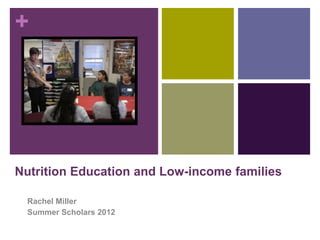
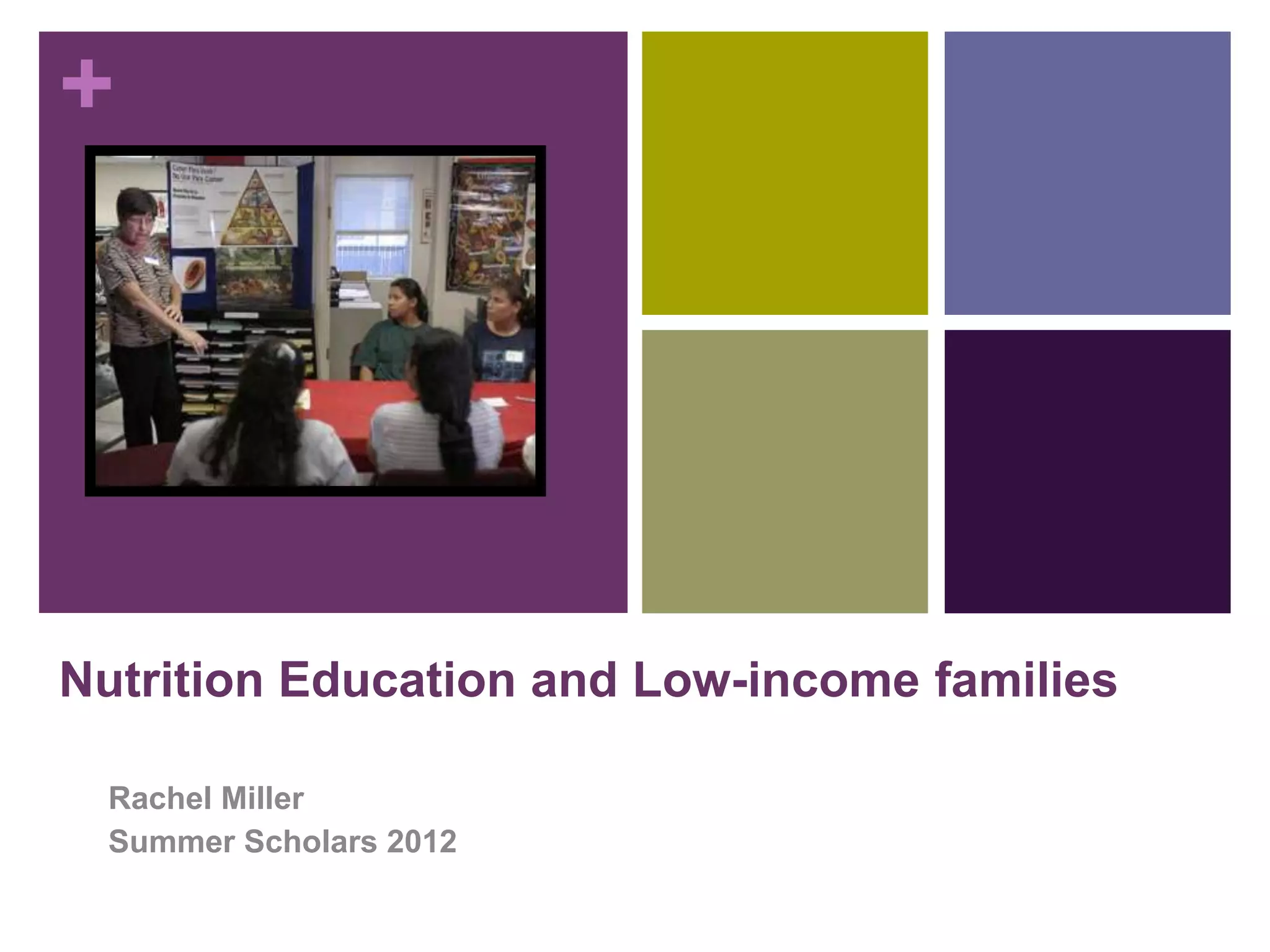
Nutrition Education and Low-income families

  Rachel Miller
  Summer Scholars 2012
+
    Method:
       Literature review

       Interviews:
             Sue Snider: Expanded Food Nutrition Education Program
              (EFNEP), Supplemental Nutrition Assistance Program- Education
              (SNAP-Ed), University of Delaware


             Tricia Jefferson: YMCA-Delaware


             Jennifer Barr: Moms Moving Forward- Christiana Care Hospital,
              registered Dietician


                                                                      Google images
+
    Importance of research:

       To analyze the effectiveness of nutrition education programs

       Obesity has more than tripled in the last 25 years: 8.7%-27.4%

       Overweight: 36.9%-62.0%


                                                            Google images
+
    Importance of research


     Limited   access to healthy resources
       Limited understanding or concern for
        mealtime behaviors,
    portion sizing, healthy living


                                          Google images
+
    Importance of Research
     Economic    concerns outweigh health
     Time/   job conflicts
     Stigma   & health care professionals


                                             Google images
+
    Research Goal


    Low income hunger-obesity paradox
    How will nutrition education programs
     effectively deal with this problem?


                                        Google images
+
    Research questions:

       How are low-income neighborhoods affected by poor nutrition?

       What are nutrition programs aimed at low income families
        trying to accomplish?

       What is the relationship between these programs and low-
        income individuals in the community?

       Do these programs meet the nutritional needs of low-income
        communities?


                                                          Google images
+
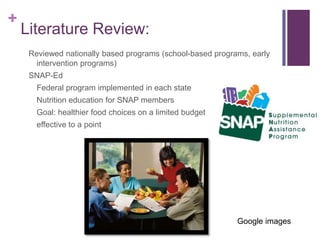
    Literature Review:
     Reviewed nationally based programs (school-based programs, early
       intervention programs)
     SNAP-Ed
       Federal program implemented in each state
       Nutrition education for SNAP members
       Goal: healthier food choices on a limited budget
       effective to a point


                                                            Google images
+
    Literature Review
     Expanded Food and Nutrition Education Program


     (EFNEP)
      Help low-income individuals
       attain a healthy lifestyle
      adult and youth programs


                                                     Google images
+
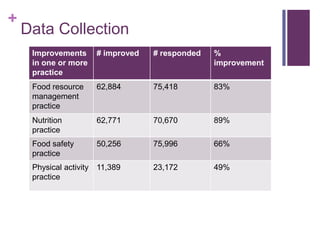
    Data Collection
     Improvements        # improved   # responded   %
     in one or more                                 improvement
     practice
     Food resource       62,884       75,418        83%
     management
     practice
     Nutrition           62,771       70,670        89%
     practice
     Food safety         50,256       75,996        66%
     practice
     Physical activity   11,389       23,172        49%
     practice
+
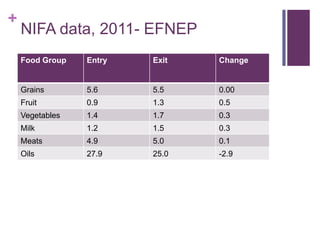
    NIFA data, 2011- EFNEP
    Food Group   Entry   Exit   Change


    Grains       5.6     5.5    0.00
    Fruit        0.9     1.3    0.5
    Vegetables   1.4     1.7    0.3
    Milk         1.2     1.5    0.3
    Meats        4.9     5.0    0.1
    Oils         27.9    25.0   -2.9
+ Literature Review:
    Nutrition Education aimed at toddlers (NEAT). Early
     intervention program
        1. expand knowledge of food safety- hand washing, chocking
         prevention, etc
        2. increase knowledge of self-regulation for toddler: portion setting,
         meal time behavior, hunger/ fullness
        3. increase knowledge of managing family meals with toddlers –
         parent/ toddler relations surrounding food


        Slight improvements (proper food prep, mealtime interaction, portion
         sizing, food safety) but no significant long term diet changes


                                                                       Google images
+
    Interviews
         Sue Snider: Expanded Food Nutrition Education Program
          (EFNEP), Supplemental Nutrition Assistance Program- Education
          (SNAP-Ed), University of Delaware


         Tricia Jefferson: YMCA-Delaware


         Jennifer Barr: Moms Moving Forward- Christiana Care
          Hospital, registered Dietician


                                                                  Google images
+
    Interviews:
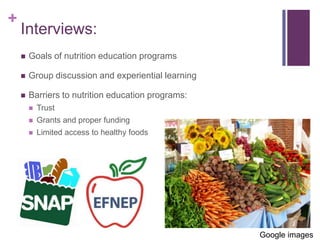
       Goals of nutrition education programs

       Group discussion and experiential learning

       Barriers to nutrition education programs:
           Trust
           Grants and proper funding
           Limited access to healthy foods


                                                     Google images
+
    Conclusions:


       Need proper funding for programs and expert financial planning

       Attentive staff: experts and paraprofessionals- help gain trust
        among community members

       Must be discussion based and include experiential learning/
        activities- the more hands-on the better

       Discuss the importance of appropriate meal time behaviors,
        portion sizing, children setting their own preferences

       Learning the value of accessing healthy foods


                                                                     Google images
+
    Conclusions


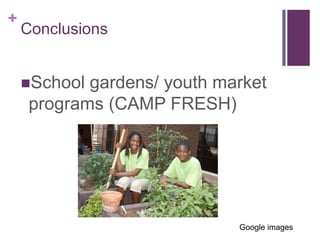
    School gardens/ youth market
     programs (CAMP FRESH)


                             Google images
+
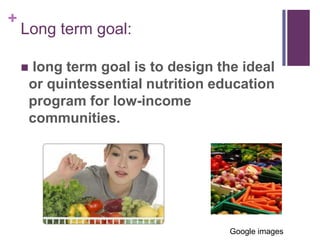
    Long term goal:

       long term goal is to design the ideal
        or quintessential nutrition education
        program for low-income
        communities.


                                      Google images
+
    Thank you!


    Dr. Bahira Trask

    Faculty advisor

                       Google images
+ References
    "About SNAP-Ed." National Institute of Food and Agriculture (NIFA). N.p., n.d. Web. 12 July

    2012. http://www.nifa.usda.gov/nea/food/fsne/about

    Arnold, C. G., &Sobal, J. (2000). Food practices and nutrition knowledge after graduating the expanded food and
     nutrition education program. Journal of Nutrition Education, 32(3), 130-138. Retrieved June 30, 2012, from the
     Psycinfo database.

    CHANCE. (n.d.). FNEC Home. Retrieved July 22, 2012, from
     http://www.fnec.cornell.edu/Our_Initiatives/CHANCE.cfm

    Camp FRESH at Christiana Care Health System. (n.d.). Christiana Care Health System. Retrieved July 23, 2012,
     from http://www.christianacare.org/campfresh

    Chaney, M. (1945). Integrating Nutrition Education and Activities in the School Program. Nutrition Education, 35,
     728-731. Retrieved July 2, 2012, from the Web of Science database.

    "Child Nutrition and WIC Reauthorization Act of 2004 « Food Research & Action Center." Food Research & Action
     Center. N.p., n.d. Web. 12 July 2012. <http://frac.org/leg-act-center/legislative-successes/child-nutrition-and-wic-
     reauthorization-act-of-2004/>.

    Dammann, K. W., & Smith, C. (2009). Factors affecting low-income women's food

    choices and the perceived impact of dietary intake and socioeconomic status on their health and weight. Journal of
     Nutrition Education and Behavior , 41(4), 242-253. Retrieved June 22, 2012, from the psycinfo database.

    Expanded Food and Nutrition Education Program (EFNEP) . (n.d.). National Institute of Food and Agriculture
     (NIFA). Retrieved July 2, 2012, from http://www.csrees.usda.gov/nea/food/efnep/efnep.html

    Gleason, P. (1995). Participation in the national school lunch program and the school breakfast program. The
     American Journal of Clinical Nutrition, 61(1), 2135-2205. Retrieved July 1, 2012, from the psycinfo database.

    Gostin, L. (2007). Law as a tool to facilitate healthier lifestyles and prevent obesity. Journal of the American Medical
     Association, 297(1), 87-90. Retrieved June 22, 2012, from the Psycinfo database.
+
    References continued
       Hammerschmidt, P., Tackett, W., Golzynski, M., &Golzynski, D. (2011). Barriers to and facilitators of healthful eating and
        physical activity in low-income schools. Journal of Nutrition Education and Behavior , 43(1), 63-68. Retrieved June 23, 2012,
        from the Psycinfo database.

       Lent, M., Hill, T., Dollahite, J., Wolfe, W., &Dickin, K. L. (2012). Healthy children, healthy families: parents making a difference!
        a curriculum integrating key nutrition, physical activity, and parenting practices to help prevent childhood obesity . Journal of
        Nutrition Education and Behavior , 44(1), 90-92. Retrieved July 2, 2012, from the Web of Science database.

       Nord, M., & Parker, L. (2010). How adequately are food needs of children in low-income households being met?. Children and
        Youth Services Review, 32(9), 1175-1185. Retrieved June 22, 2012, from the Psycinfo database.

       Horodynski, M. O., &Hoerr, S. (2004). Nutrition education aimed at toddlers- a pilot program for rural, low-income families.
        Family Community Health, 37(2), 103-113.

       Omar, M., Coleman, G., &Hoerr, S. (2001). Healthy eating for rural low-income toddlers: caregivers' perceptions. Journal of
        Community Health Nursing, 18(2), 93-106. Retrieved July 2, 2012, from the Psycinfo database.

       Parmer, S., Salisbury-Glennon, J., Shannon, D., &Struempler, B. (2009). School gardens: an experiential learning approach for
        a nutrition education program toincrease fruit and vegetable knowledge, preference, and consumption among second-grade
        students . Journal of Nutrition Education and Behavior , 41(3), 212-217. Retrieved July 23, 2012, from the Web of Science
        database.

       Singh, G. K., Siahpush, M., Hiatt, R. A., &Timsina, L. R. (2011). Dramatic increases in obesity and overweight prevalence and
        body mass index among ethnic-immigrant and social class groups in the united states, 1976-2008. Journal of Community
        Health, 36(1), 94-110. Retrieved July 2, 2012, from the Web of Science database.

       Vartanian, T., Houser, L., &Harkness, J. (2011). Food stamps and dependency: disentangling the short-term and long-term
        economic effects of food stamp receipt and low income for young mothers. Journal of Sociology & Social Welfare, 38(4), 101-
        119. Retrieved July 2, 2012, from the Web of Science database.

       Wilfley, Densie E.; Kass, Andrea.; Kolko, Rachel P.; Stein, Richard I.. In Child and adolescent

       therapy: Cognitive-behavioral procedures (4th ed), by Wilfey, Denise E., Kass, Andrea E., Kolko, Rachel P., Stein, Richard I.
        283-323. New York, NY, US: Guilford Press, 2012.

Summer scholars presentation

  • 1.
    + Nutrition Education andLow-income families Rachel Miller Summer Scholars 2012
  • 2.
    + Method:  Literature review  Interviews:  Sue Snider: Expanded Food Nutrition Education Program (EFNEP), Supplemental Nutrition Assistance Program- Education (SNAP-Ed), University of Delaware  Tricia Jefferson: YMCA-Delaware  Jennifer Barr: Moms Moving Forward- Christiana Care Hospital, registered Dietician Google images
  • 3.
    + Importance of research:  To analyze the effectiveness of nutrition education programs  Obesity has more than tripled in the last 25 years: 8.7%-27.4%  Overweight: 36.9%-62.0% Google images
  • 4.
    + Importance of research  Limited access to healthy resources  Limited understanding or concern for mealtime behaviors, portion sizing, healthy living Google images
  • 5.
    + Importance of Research  Economic concerns outweigh health  Time/ job conflicts  Stigma & health care professionals Google images
  • 6.
    + Research Goal Low income hunger-obesity paradox How will nutrition education programs effectively deal with this problem? Google images
  • 7.
    + Research questions:  How are low-income neighborhoods affected by poor nutrition?  What are nutrition programs aimed at low income families trying to accomplish?  What is the relationship between these programs and low- income individuals in the community?  Do these programs meet the nutritional needs of low-income communities? Google images
  • 8.
    + Literature Review: Reviewed nationally based programs (school-based programs, early intervention programs) SNAP-Ed Federal program implemented in each state Nutrition education for SNAP members Goal: healthier food choices on a limited budget effective to a point Google images
  • 9.
    + Literature Review Expanded Food and Nutrition Education Program (EFNEP) Help low-income individuals attain a healthy lifestyle adult and youth programs Google images
  • 10.
    + Data Collection Improvements # improved # responded % in one or more improvement practice Food resource 62,884 75,418 83% management practice Nutrition 62,771 70,670 89% practice Food safety 50,256 75,996 66% practice Physical activity 11,389 23,172 49% practice
  • 11.
    + NIFA data, 2011- EFNEP Food Group Entry Exit Change Grains 5.6 5.5 0.00 Fruit 0.9 1.3 0.5 Vegetables 1.4 1.7 0.3 Milk 1.2 1.5 0.3 Meats 4.9 5.0 0.1 Oils 27.9 25.0 -2.9
  • 12.
    + Literature Review:  Nutrition Education aimed at toddlers (NEAT). Early intervention program  1. expand knowledge of food safety- hand washing, chocking prevention, etc  2. increase knowledge of self-regulation for toddler: portion setting, meal time behavior, hunger/ fullness  3. increase knowledge of managing family meals with toddlers – parent/ toddler relations surrounding food  Slight improvements (proper food prep, mealtime interaction, portion sizing, food safety) but no significant long term diet changes Google images
  • 13.
    + Interviews  Sue Snider: Expanded Food Nutrition Education Program (EFNEP), Supplemental Nutrition Assistance Program- Education (SNAP-Ed), University of Delaware  Tricia Jefferson: YMCA-Delaware  Jennifer Barr: Moms Moving Forward- Christiana Care Hospital, registered Dietician Google images
  • 14.
    + Interviews:  Goals of nutrition education programs  Group discussion and experiential learning  Barriers to nutrition education programs:  Trust  Grants and proper funding  Limited access to healthy foods Google images
  • 15.
    + Conclusions:  Need proper funding for programs and expert financial planning  Attentive staff: experts and paraprofessionals- help gain trust among community members  Must be discussion based and include experiential learning/ activities- the more hands-on the better  Discuss the importance of appropriate meal time behaviors, portion sizing, children setting their own preferences  Learning the value of accessing healthy foods Google images
  • 16.
    + Conclusions School gardens/ youth market programs (CAMP FRESH) Google images
  • 17.
    + Long term goal:  long term goal is to design the ideal or quintessential nutrition education program for low-income communities. Google images
  • 18.
    + Thank you! Dr. Bahira Trask Faculty advisor Google images
  • 19.
    + References  "About SNAP-Ed." National Institute of Food and Agriculture (NIFA). N.p., n.d. Web. 12 July  2012. http://www.nifa.usda.gov/nea/food/fsne/about  Arnold, C. G., &Sobal, J. (2000). Food practices and nutrition knowledge after graduating the expanded food and nutrition education program. Journal of Nutrition Education, 32(3), 130-138. Retrieved June 30, 2012, from the Psycinfo database.  CHANCE. (n.d.). FNEC Home. Retrieved July 22, 2012, from http://www.fnec.cornell.edu/Our_Initiatives/CHANCE.cfm  Camp FRESH at Christiana Care Health System. (n.d.). Christiana Care Health System. Retrieved July 23, 2012, from http://www.christianacare.org/campfresh  Chaney, M. (1945). Integrating Nutrition Education and Activities in the School Program. Nutrition Education, 35, 728-731. Retrieved July 2, 2012, from the Web of Science database.  "Child Nutrition and WIC Reauthorization Act of 2004 « Food Research & Action Center." Food Research & Action Center. N.p., n.d. Web. 12 July 2012. <http://frac.org/leg-act-center/legislative-successes/child-nutrition-and-wic- reauthorization-act-of-2004/>.  Dammann, K. W., & Smith, C. (2009). Factors affecting low-income women's food  choices and the perceived impact of dietary intake and socioeconomic status on their health and weight. Journal of Nutrition Education and Behavior , 41(4), 242-253. Retrieved June 22, 2012, from the psycinfo database.  Expanded Food and Nutrition Education Program (EFNEP) . (n.d.). National Institute of Food and Agriculture (NIFA). Retrieved July 2, 2012, from http://www.csrees.usda.gov/nea/food/efnep/efnep.html  Gleason, P. (1995). Participation in the national school lunch program and the school breakfast program. The American Journal of Clinical Nutrition, 61(1), 2135-2205. Retrieved July 1, 2012, from the psycinfo database.  Gostin, L. (2007). Law as a tool to facilitate healthier lifestyles and prevent obesity. Journal of the American Medical Association, 297(1), 87-90. Retrieved June 22, 2012, from the Psycinfo database.
  • 20.
    + References continued  Hammerschmidt, P., Tackett, W., Golzynski, M., &Golzynski, D. (2011). Barriers to and facilitators of healthful eating and physical activity in low-income schools. Journal of Nutrition Education and Behavior , 43(1), 63-68. Retrieved June 23, 2012, from the Psycinfo database.  Lent, M., Hill, T., Dollahite, J., Wolfe, W., &Dickin, K. L. (2012). Healthy children, healthy families: parents making a difference! a curriculum integrating key nutrition, physical activity, and parenting practices to help prevent childhood obesity . Journal of Nutrition Education and Behavior , 44(1), 90-92. Retrieved July 2, 2012, from the Web of Science database.  Nord, M., & Parker, L. (2010). How adequately are food needs of children in low-income households being met?. Children and Youth Services Review, 32(9), 1175-1185. Retrieved June 22, 2012, from the Psycinfo database.  Horodynski, M. O., &Hoerr, S. (2004). Nutrition education aimed at toddlers- a pilot program for rural, low-income families. Family Community Health, 37(2), 103-113.  Omar, M., Coleman, G., &Hoerr, S. (2001). Healthy eating for rural low-income toddlers: caregivers' perceptions. Journal of Community Health Nursing, 18(2), 93-106. Retrieved July 2, 2012, from the Psycinfo database.  Parmer, S., Salisbury-Glennon, J., Shannon, D., &Struempler, B. (2009). School gardens: an experiential learning approach for a nutrition education program toincrease fruit and vegetable knowledge, preference, and consumption among second-grade students . Journal of Nutrition Education and Behavior , 41(3), 212-217. Retrieved July 23, 2012, from the Web of Science database.  Singh, G. K., Siahpush, M., Hiatt, R. A., &Timsina, L. R. (2011). Dramatic increases in obesity and overweight prevalence and body mass index among ethnic-immigrant and social class groups in the united states, 1976-2008. Journal of Community Health, 36(1), 94-110. Retrieved July 2, 2012, from the Web of Science database.  Vartanian, T., Houser, L., &Harkness, J. (2011). Food stamps and dependency: disentangling the short-term and long-term economic effects of food stamp receipt and low income for young mothers. Journal of Sociology & Social Welfare, 38(4), 101- 119. Retrieved July 2, 2012, from the Web of Science database.  Wilfley, Densie E.; Kass, Andrea.; Kolko, Rachel P.; Stein, Richard I.. In Child and adolescent  therapy: Cognitive-behavioral procedures (4th ed), by Wilfey, Denise E., Kass, Andrea E., Kolko, Rachel P., Stein, Richard I. 283-323. New York, NY, US: Guilford Press, 2012.