Developing Sustainable Family-Centered
Obesity Interventions:
What Can We Learn from Developmental Psychology
and Implementation Science
PRINCIPAL INVESTIGATORS:

CO-INVESTIGATORS

Kirsten K. Davison, PhD (PI)
Janine M. Jurkowski, PhD, MPH (PI)

Hal Lawson (co-I),
Sibylle Kranz (co-I)
Lawrence Schell (co-I)
Glenn Deane (co-I)

Funded by NIH R24 MD004865
Davison et al. (2013). A childhood obesity intervention developed by families for families: results
from a pilot study. International Journal of Behavioral Nutrition and Physical Activity, Jan 5;10:3.
Key challenges of family-based childhood
obesity interventions
• Reaching families
• Passive refusals (consent but don’t show up)
• Parents not interested if don’t see immediate need
• Priorities for intervention do not match family priorities
Possible strategies
• Maintain contact with families over time
• Partner with organizations that reach families
• Use electronic means to collect data
• Build intervention into other appointments
• Design programs around the needs and interests of
families
• Ask families members what they hope to gain from
participating
Goals
1. Utilize community-based participatory research
(CBPR) to develop and pilot test a family-centered
obesity prevention program for children enrolled in
Head Start.
2. Incorporate the resulting intervention into systems of
care (e.g., Head Start, WIC, pediatric care).
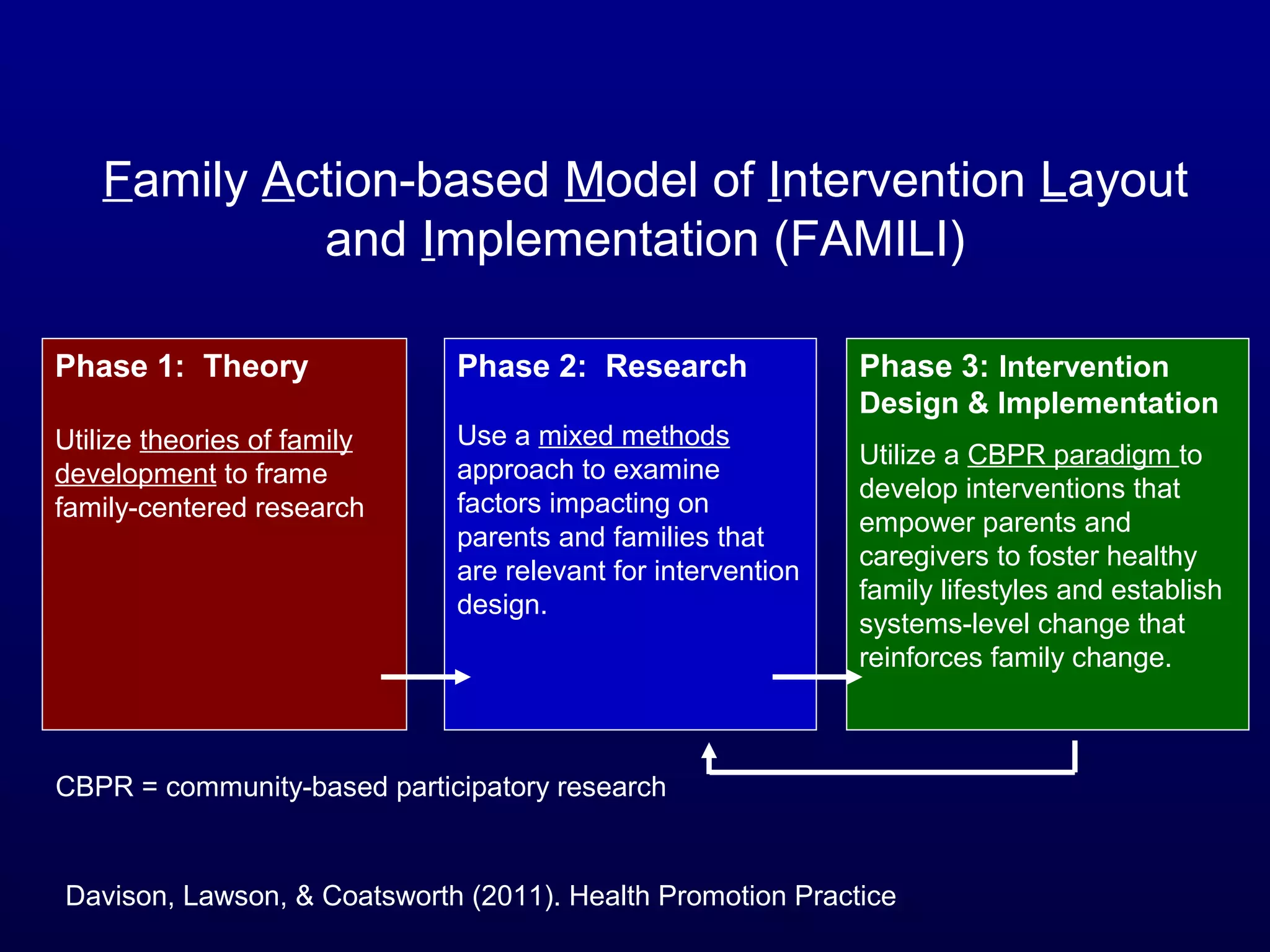
Family Action-based Model of Intervention Layout
and Implementation (FAMILI)
Phase 1: Theory

Phase 2: Research

Phase 3: Intervention
Design & Implementation

Utilize theories of family
development to frame
family-centered research

Use a mixed methods
approach to examine
factors impacting on
parents and families that
are relevant for intervention
design.

Utilize a CBPR paradigm to
develop interventions that
empower parents and
caregivers to foster healthy
family lifestyles and establish
systems-level change that
reinforces family change.

CBPR = community-based participatory research

Davison, Lawson, & Coatsworth (2011). Health Promotion Practice
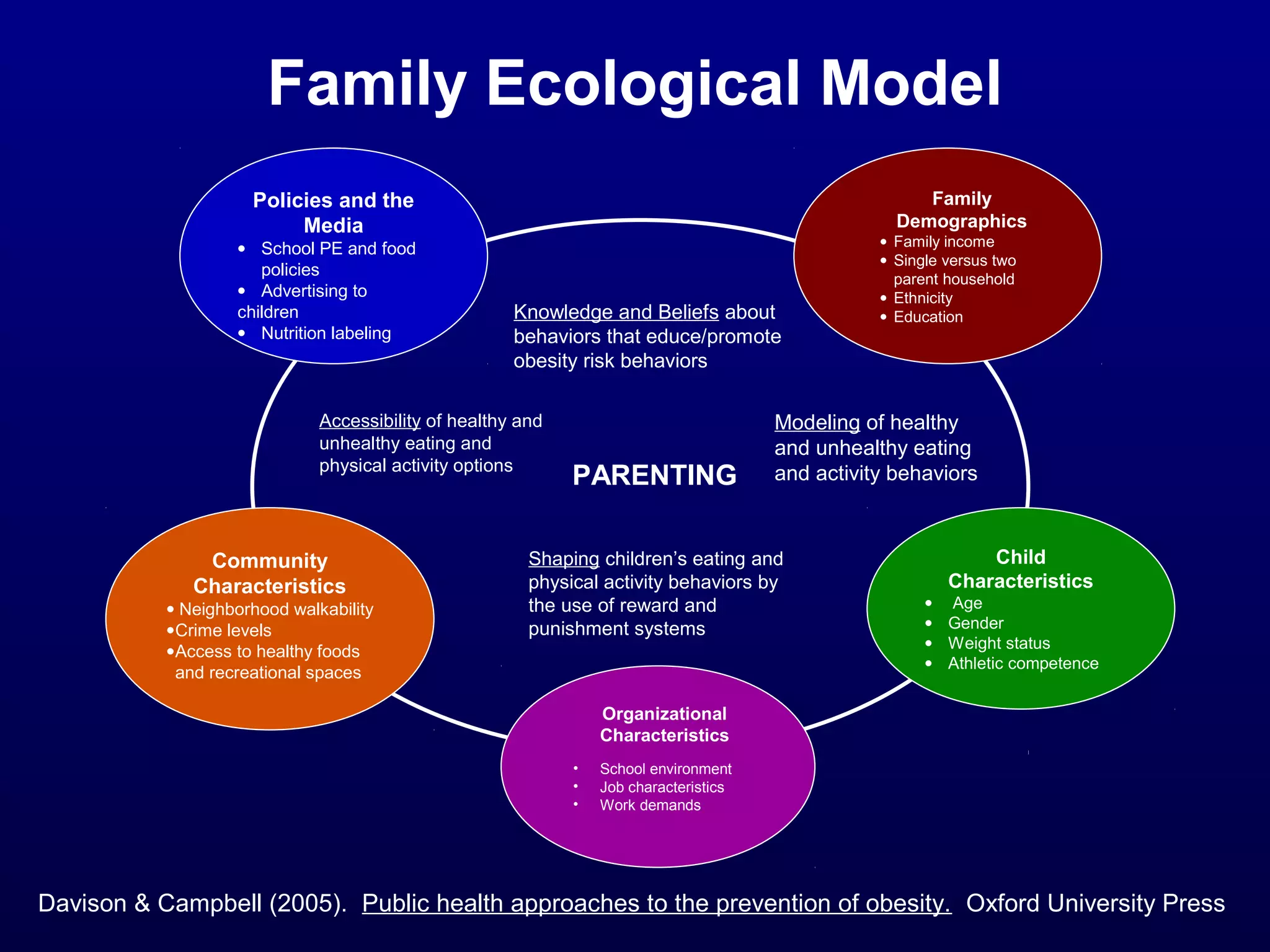
Family Ecological Model
Family
Demographics

Policies and the
Media

• School PE and food
policies
• Advertising to
children
• Nutrition labeling

Knowledge and Beliefs about
behaviors that educe/promote
obesity risk behaviors

Accessibility of healthy and
unhealthy eating and
physical activity options

Community
Characteristics

• Neighborhood walkability
•Crime levels
•Access to healthy foods
and recreational spaces

PARENTING

• Family income
• Single versus two
parent household
• Ethnicity
• Education

Modeling of healthy
and unhealthy eating
and activity behaviors

Shaping children’s eating and
physical activity behaviors by
the use of reward and
punishment systems

Child
Characteristics

• Age
• Gender
• Weight status
• Athletic competence

Organizational
Characteristics
•
•
•

School environment
Job characteristics
Work demands

Davison & Campbell (2005). Public health approaches to the prevention of obesity. Oxford University Press
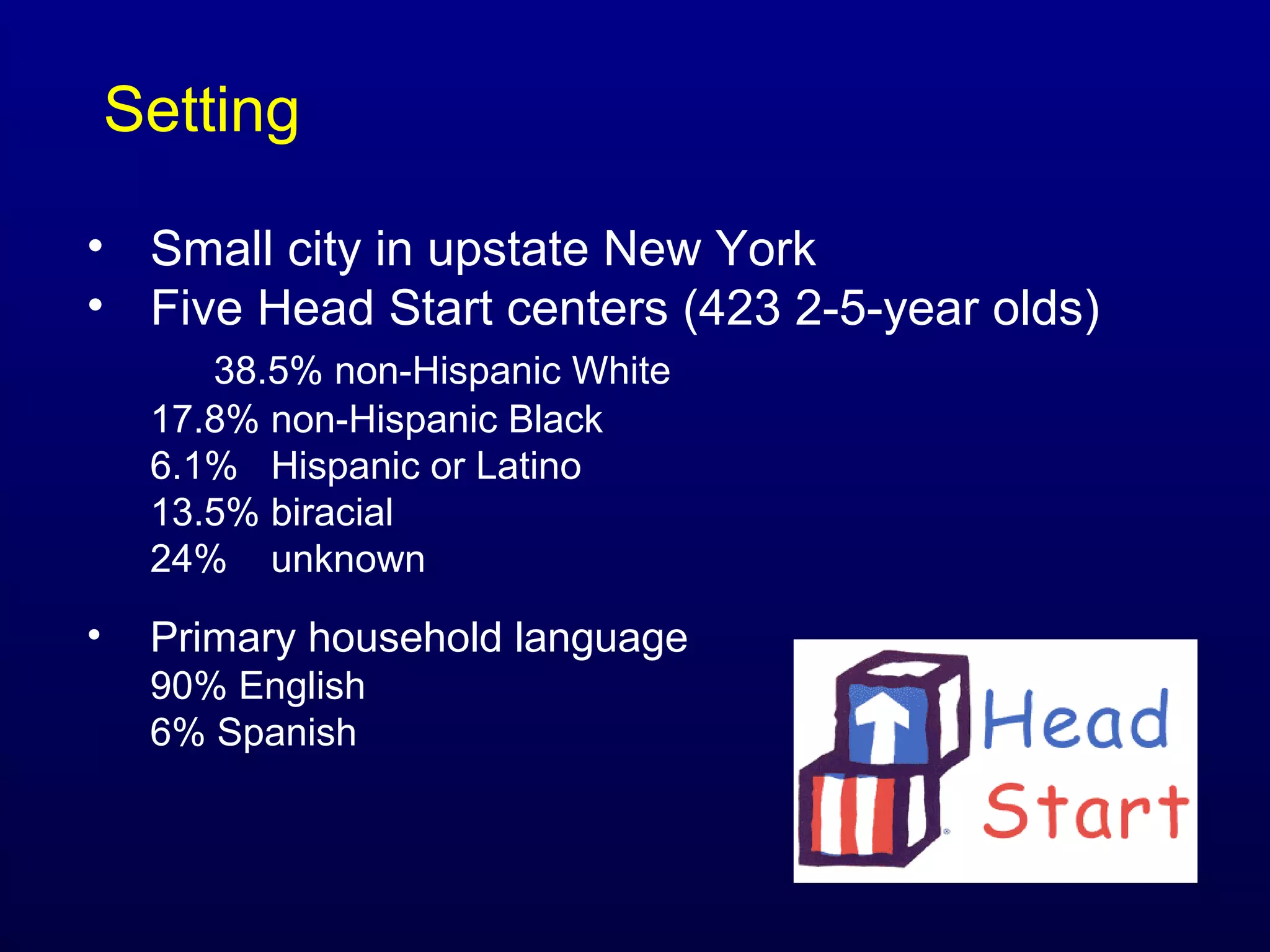
Setting
• Small city in upstate New York
• Five Head Start centers (423 2-5-year olds)
38.5% non-Hispanic White
17.8% non-Hispanic Black
6.1% Hispanic or Latino
13.5% biracial
24% unknown

•

Primary household language
90% English
6% Spanish
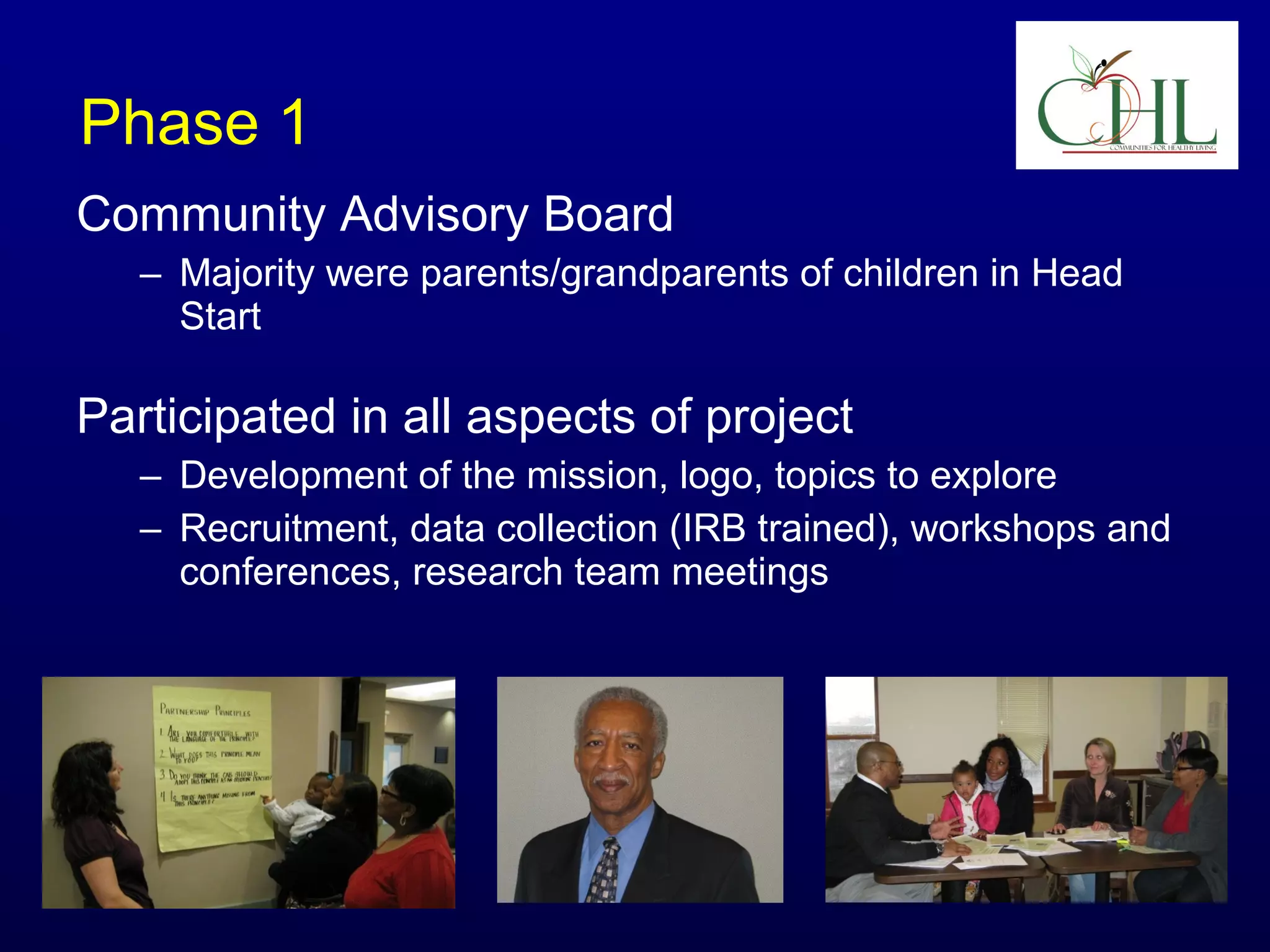
Phase 1
Community Advisory Board
– Majority were parents/grandparents of children in Head
Start

Participated in all aspects of project
– Development of the mission, logo, topics to explore
– Recruitment, data collection (IRB trained), workshops and
conferences, research team meetings
Phase 2
Community Assessment
–
–
–
–
–
–
–

Focus groups
Key informant interviews
Photovoice
24 hour dietary recall (children); Sibylle Kranz
7-day accelerometery (children); Karin Pfeiffer
Surveys, follow-up interview
Behavioral observation in centers

Findings were presented to the community in two town hall
meetings. Solicited ideas on what the program should entail.
What did we learn?
Children
• Watched TV extensively; a coping strategy
• Excessive consumption of sugar-sweetened beverages
• 35% overweight or obese; 14% met PA recommendations
Parents
• failed to recognize when their children were overweight
• didn’t like how physicians interacted with them
• wanted
•
to gain advocacy skills
•
to connect with other parents
•
the program to be center-based
•
their children to gain something from the program
What did we learn?
Children
• watched TV extensively; a coping strategy
• excessive consumption of sugar-sweetened beverages
• 35% overweight or obese; 14% met PA recommendations
Parents
• Failed to recognize when their children were overweight
• Didn’t like how physicians interacted with them
• Wanted
•
to gain advocacy skills
•
to connect with other parents
•
the program to be center-based
•
their children to gain something from the program
What did we learn?
Community
• No where to send parents concerned about their child’s
weight
• Some programs available in community to promote
healthy living, but underutilized
Phase 3
The CHL program
Multiple components
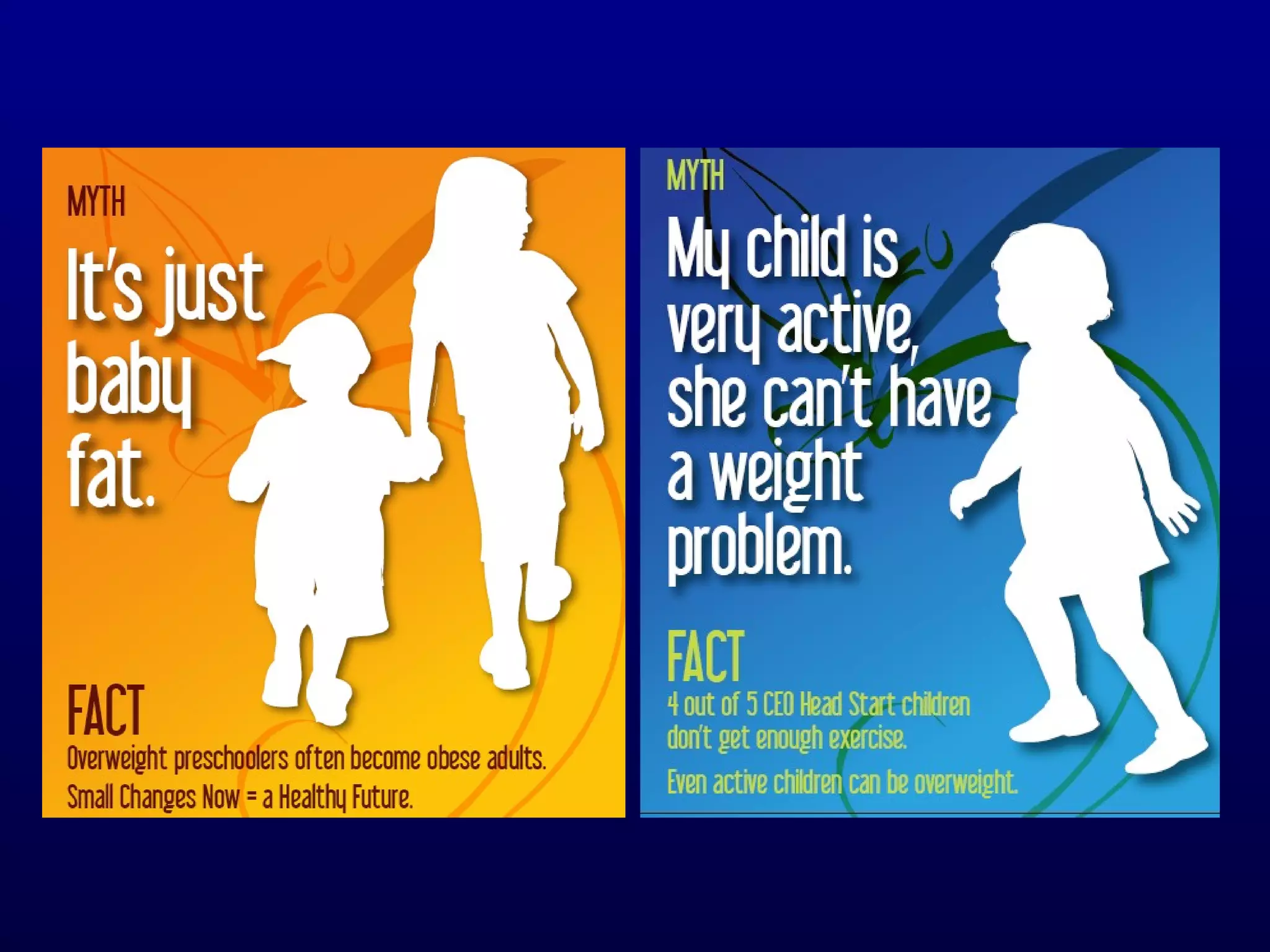
1. Health communication campaign
2. BMI letters sent home
3. Family coffee hour with nutrition counseling
4. Parent’s Connect for Family Wellness program
Phase 3
The CHL program
Multiple components
1. Health communication campaign
2. BMI letters sent home
3. Family coffee hour with nutrition counseling
4. Parent’s Connect for Family Wellness program
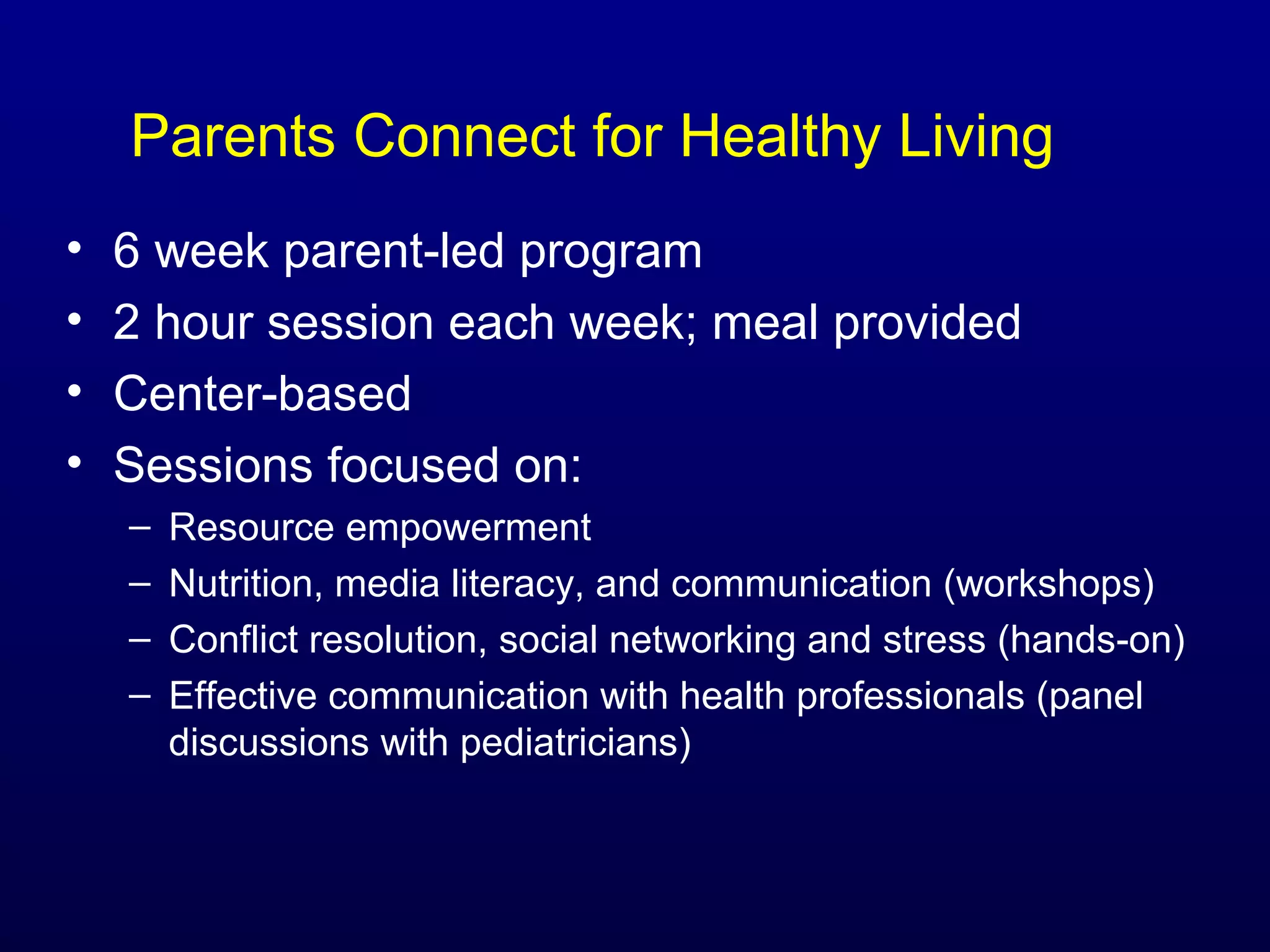
Parents Connect for Healthy Living
•
•
•
•

6 week parent-led program
2 hour session each week; meal provided
Center-based
Sessions focused on:
–
–
–
–

Resource empowerment
Nutrition, media literacy, and communication (workshops)
Conflict resolution, social networking and stress (hands-on)
Effective communication with health professionals (panel
discussions with pediatricians)
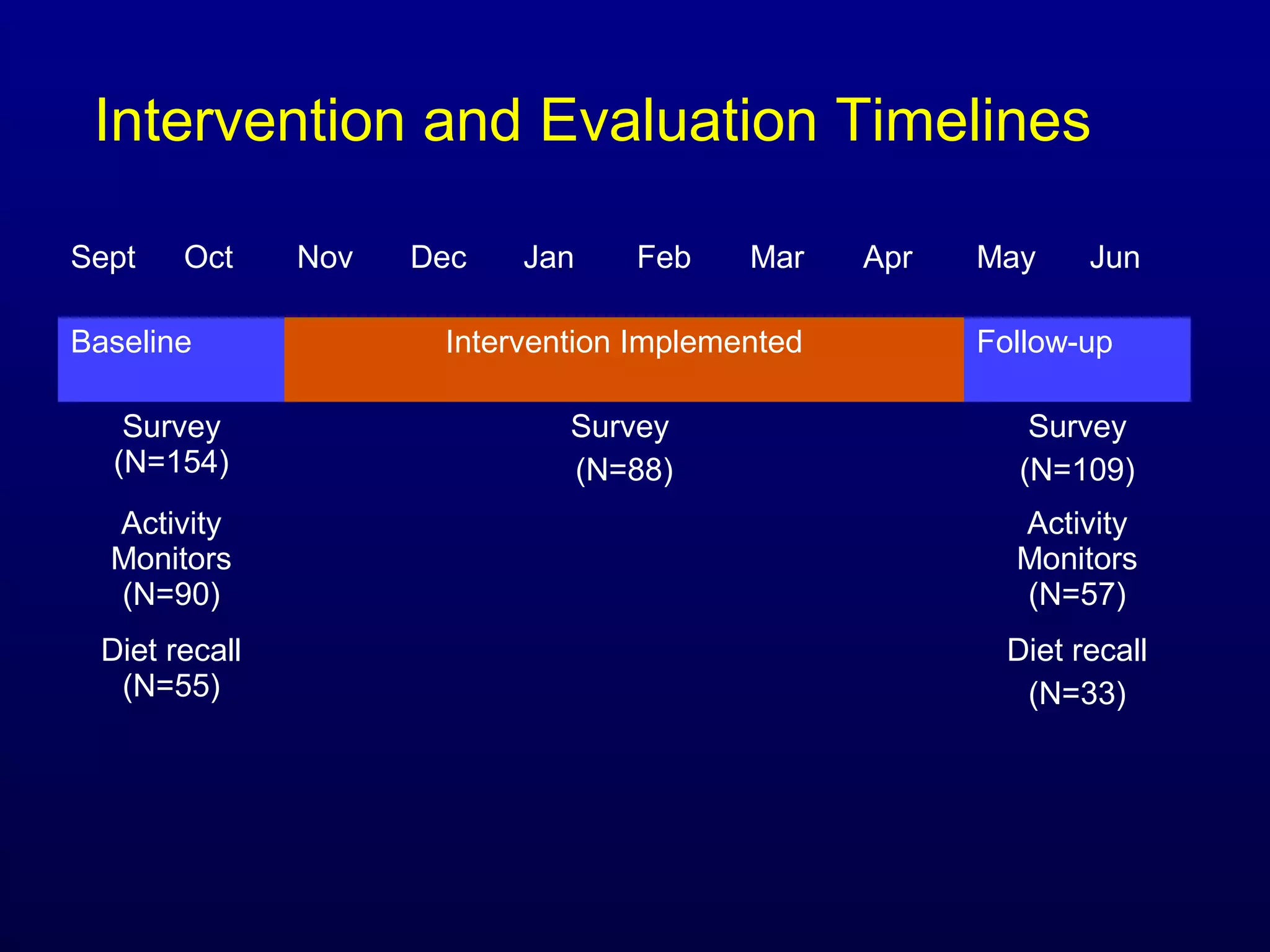
Intervention and Evaluation Timelines
Sept

Oct

Baseline
Survey
(N=154)

Nov

Dec

Jan

Feb

Mar

Intervention Implemented
Survey
(N=88)

Apr

May

Jun

Follow-up
Survey
(N=109)

Activity
Monitors
(N=90)

Activity
Monitors
(N=57)

Diet recall
(N=55)

Diet recall
(N=33)
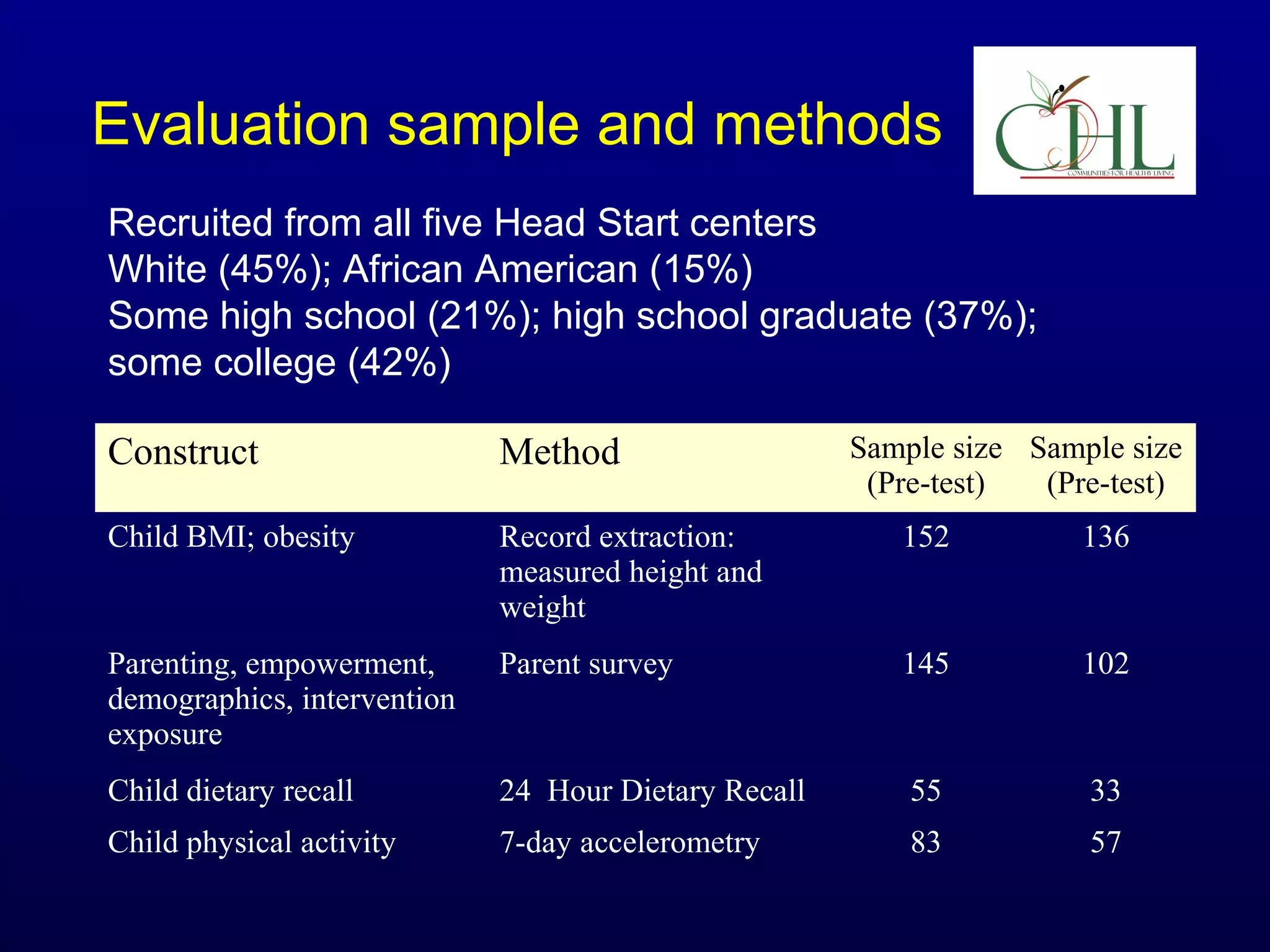
Evaluation sample and methods
Recruited from all five Head Start centers
White (45%); African American (15%)
Some high school (21%); high school graduate (37%);
some college (42%)
Construct

Method

Child BMI; obesity

Record extraction:
measured height and
weight

152

136

Parenting, empowerment,
demographics, intervention
exposure

Parent survey

145

102

Child dietary recall

24 Hour Dietary Recall

55

33

Child physical activity

7-day accelerometry

83

57

Sample size Sample size
(Pre-test)
(Pre-test)
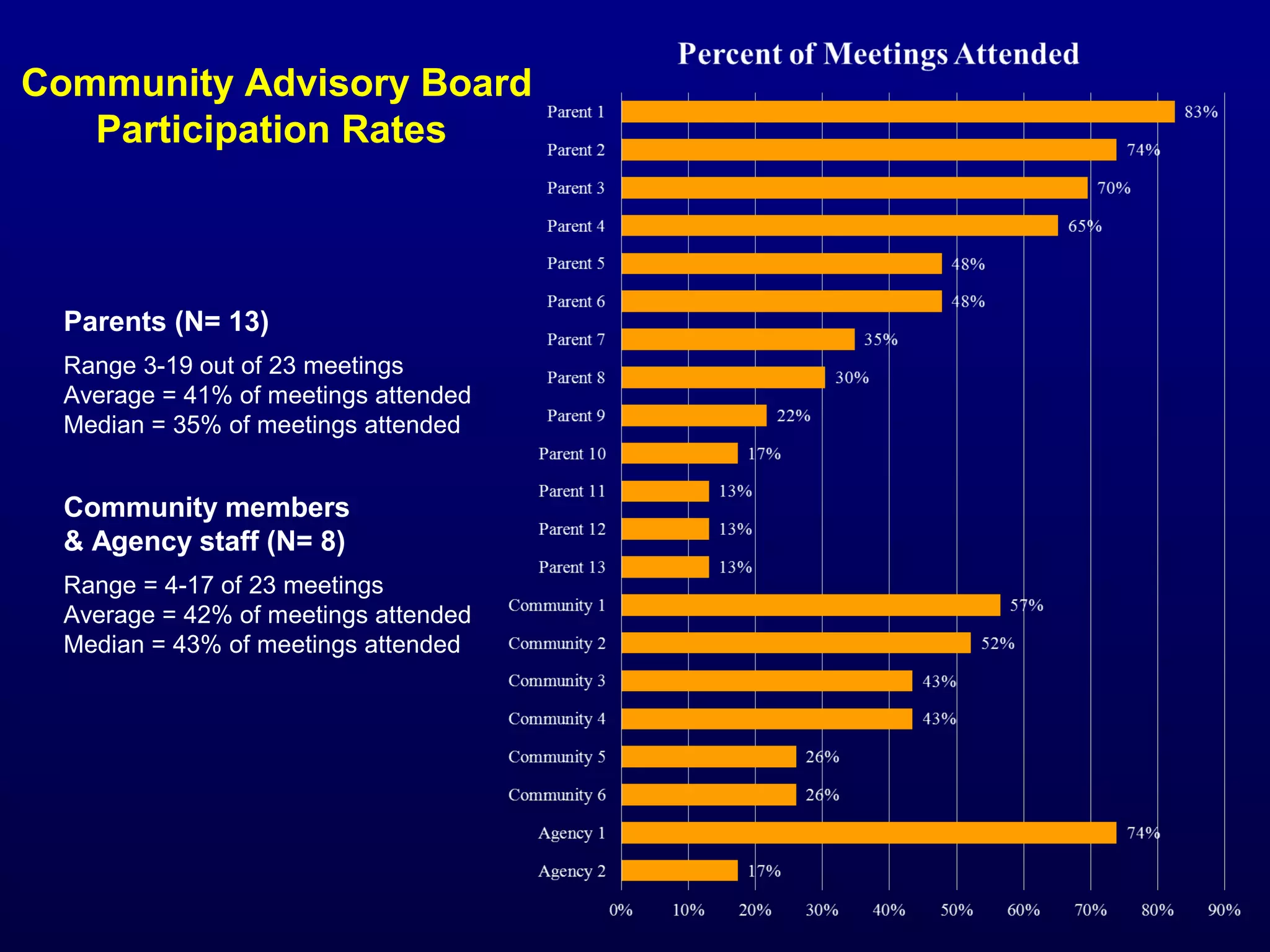
Community Advisory Board
Participation Rates

Parents (N= 13)
Range 3-19 out of 23 meetings
Average = 41% of meetings attended
Median = 35% of meetings attended

Community members
& Agency staff (N= 8)
Range = 4-17 of 23 meetings
Average = 42% of meetings attended
Median = 43% of meetings attended
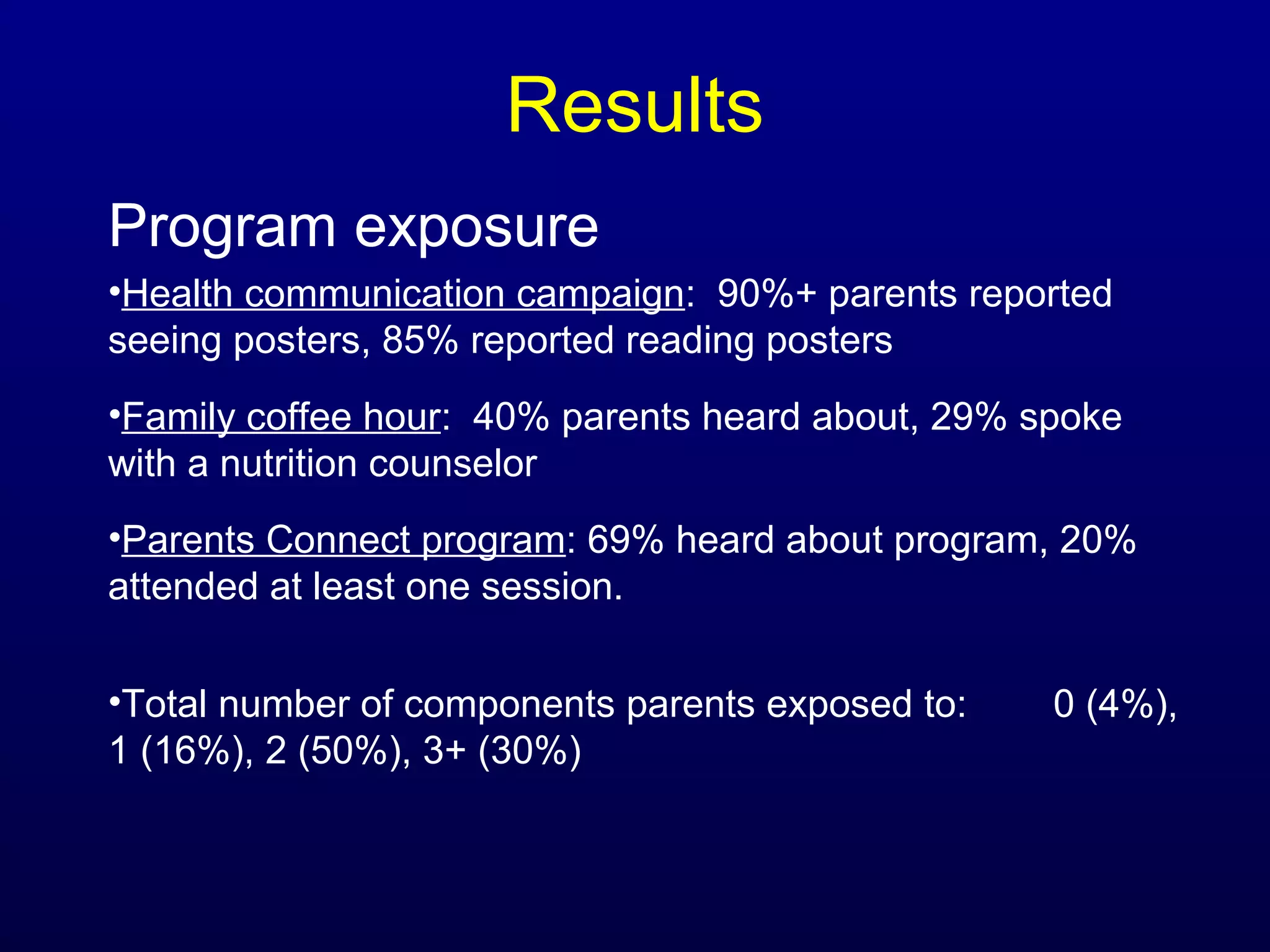
Results
Program exposure
•Health communication campaign: 90%+ parents reported
seeing posters, 85% reported reading posters
•Family coffee hour: 40% parents heard about, 29% spoke
with a nutrition counselor
•Parents Connect program: 69% heard about program, 20%
attended at least one session.
•Total number of components parents exposed to:
1 (16%), 2 (50%), 3+ (30%)

0 (4%),
Results
Pre-post intervention differences
in child and parent outcomes
• Paired t-tests examined pre-post intervention change in
measures of:
– child BMI, dietary intake, and physical activity
– food, physical activity, and screen-related parenting,
parent resource empowerment
• Performed as intent to treat analyses
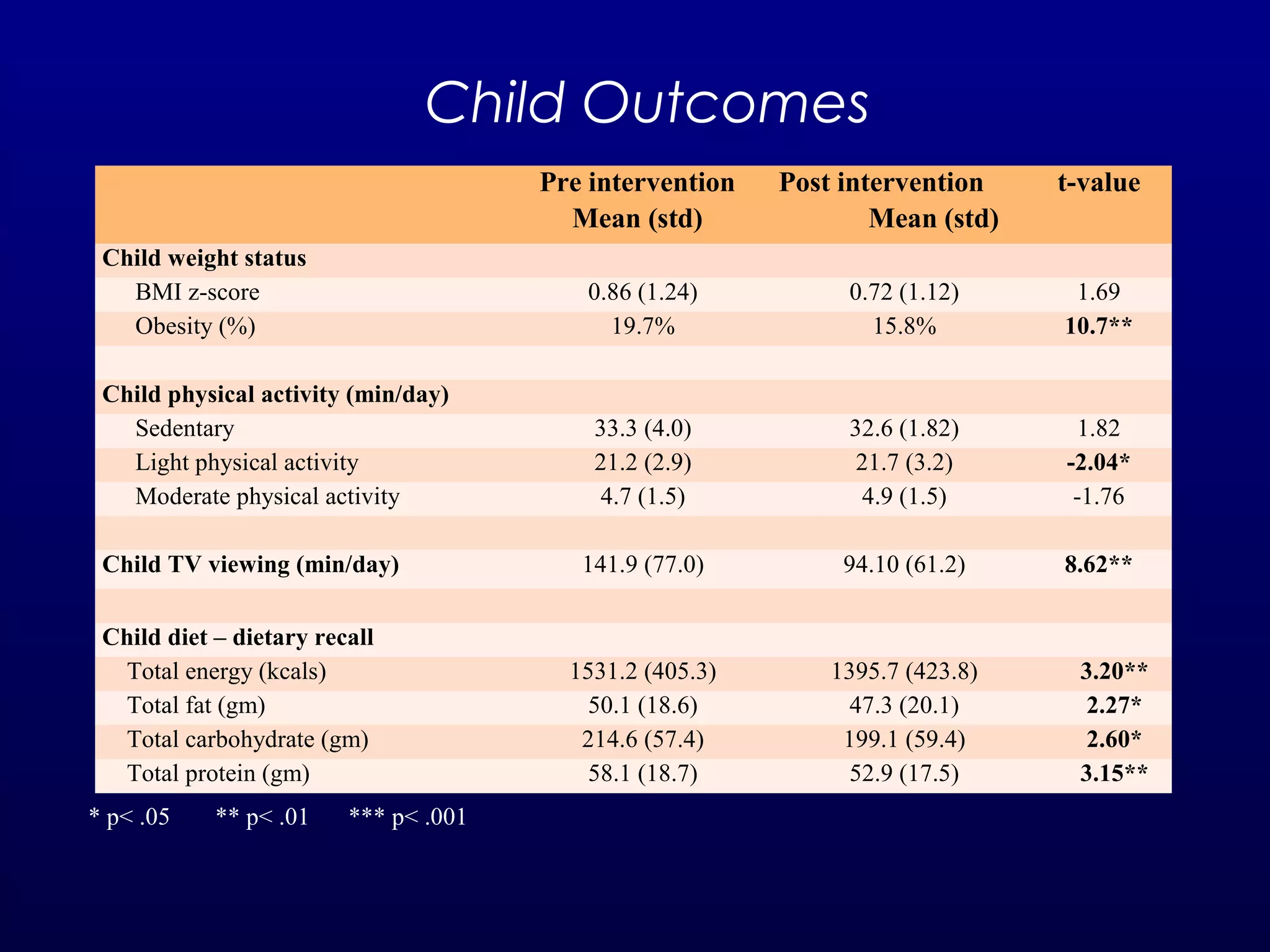
Child Outcomes
Pre intervention
Mean (std)
Child weight status
BMI z-score
Obesity (%)

Child TV viewing (min/day)
Child diet – dietary recall
    Total energy (kcals)
    Total fat (gm)
    Total carbohydrate (gm)
    Total protein (gm)
* p< .05 

** p< .01

 *** p< .001

t-value

0.72 (1.12)
15.8%

 
1.69
10.7**

33.3 (4.0)
21.2 (2.9)
4.7 (1.5)

32.6 (1.82)
21.7 (3.2)
4.9 (1.5)

 
1.82
-2.04*
-1.76

141.9 (77.0)

94.10 (61.2)

8.62**

0.86 (1.24)
19.7%

Child physical activity (min/day)
Sedentary
Light physical activity
Moderate physical activity

Post intervention
Mean (std)

1531.2 (405.3)
50.1 (18.6)
214.6 (57.4)
58.1 (18.7)

1395.7 (423.8)
47.3 (20.1)
199.1 (59.4)
52.9 (17.5)

 
3.20**
2.27*
2.60*
3.15**
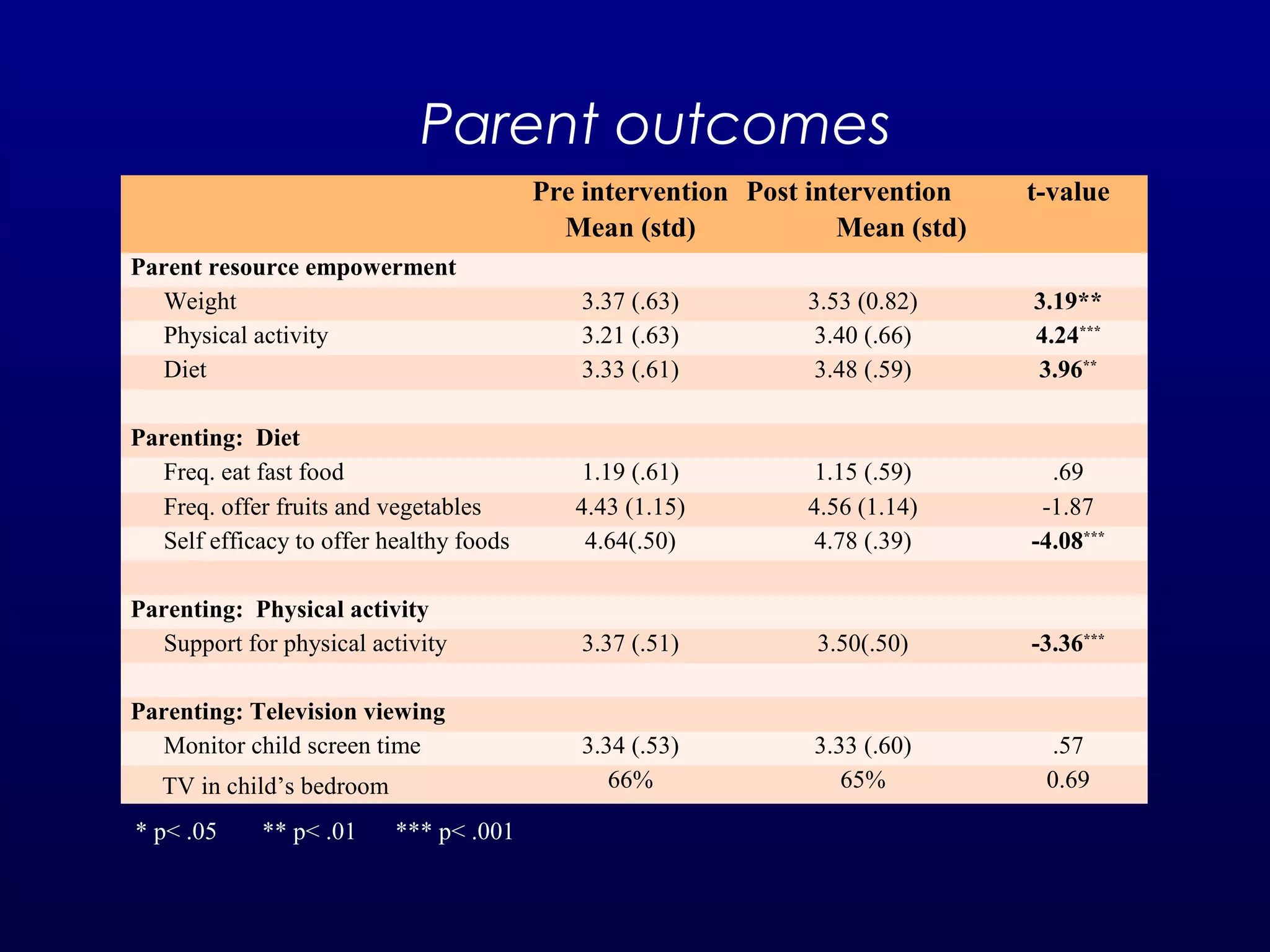
Parent outcomes
Pre intervention Post intervention
Mean (std)
Mean (std)

t-value

Parent resource empowerment
Weight 
Physical activity
Diet

3.37 (.63)
3.21 (.63)
3.33 (.61)

3.53 (0.82)
3.40 (.66)
3.48 (.59)

3.19**
4.24***
3.96**

Parenting: Diet
Freq. eat fast food
Freq. offer fruits and vegetables
Self efficacy to offer healthy foods

1.19 (.61)
4.43 (1.15)
4.64(.50)

1.15 (.59)
4.56 (1.14)
4.78 (.39)

.69
-1.87
-4.08***

Parenting: Physical activity
Support for physical activity

3.37 (.51)

3.50(.50)

-3.36***

3.34 (.53)
66%

3.33 (.60)
65%

.57
0.69

Parenting: Television viewing
Monitor child screen time
TV in child’s bedroom
* p< .05 

** p< .01

 *** p< .001
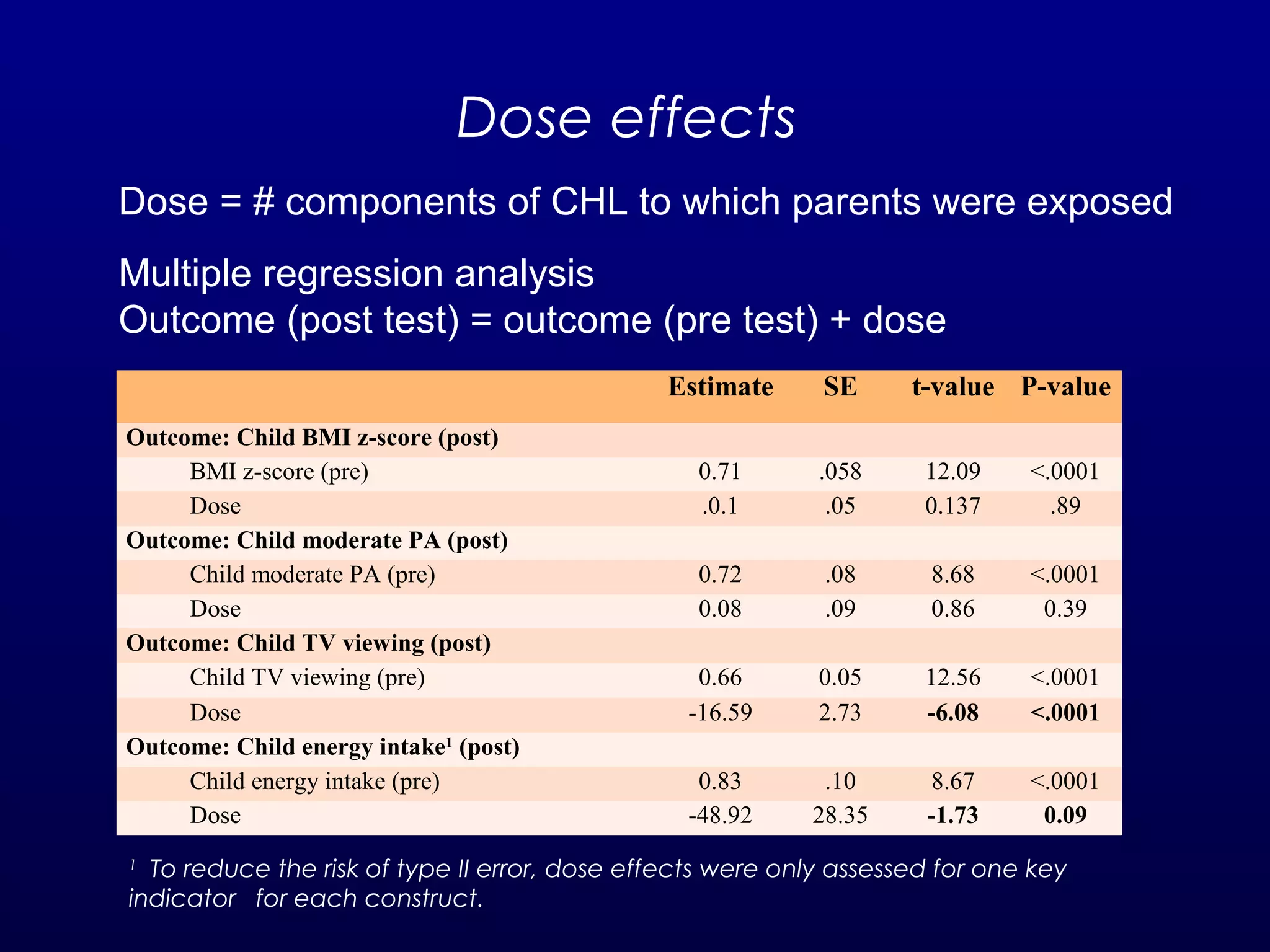
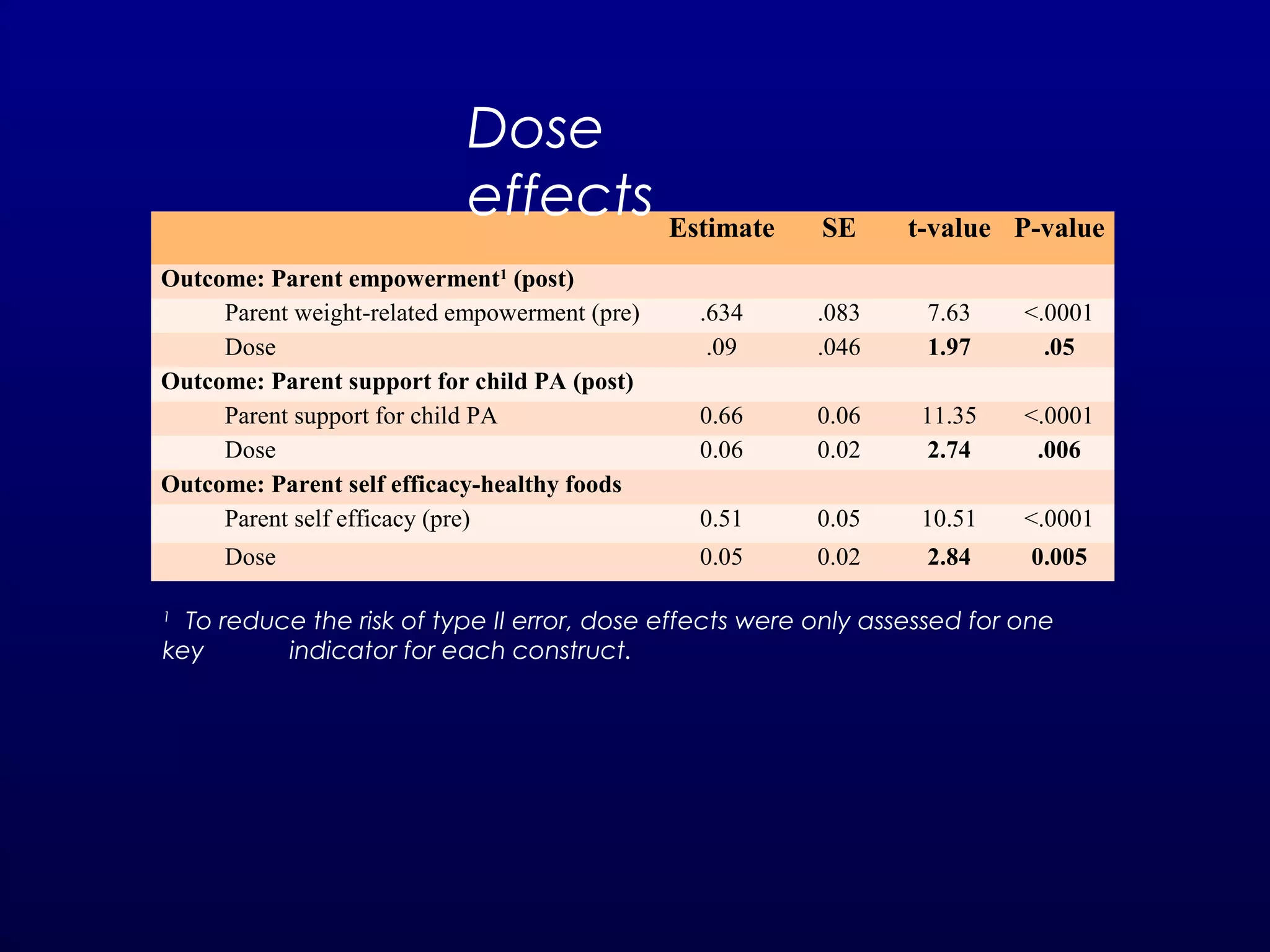
Dose effects
Dose = # components of CHL to which parents were exposed
Multiple regression analysis
Outcome (post test) = outcome (pre test) + dose
Estimate
Outcome: Child BMI z-score (post)
BMI z-score (pre)
Dose
Outcome: Child moderate PA (post)
Child moderate PA (pre)
Dose
Outcome: Child TV viewing (post)
Child TV viewing (pre)
Dose
Outcome: Child energy intake1 (post)
Child energy intake (pre)
Dose

SE

t-value P-value

0.71
.0.1

.058
.05

12.09
0.137

<.0001
.89

0.72
0.08

.08
.09

8.68
0.86

<.0001
0.39

0.66
-16.59

0.05
2.73

12.56
-6.08

<.0001
<.0001

0.83
-48.92

.10
28.35

8.67
-1.73

<.0001
0.09

To reduce the risk of type II error, dose effects were only assessed for one key
indicator for each construct.
1
Dose
effects Estimate
Outcome: Parent empowerment1 (post)
Parent weight-related empowerment (pre)
Dose
Outcome: Parent support for child PA (post)
Parent support for child PA
Dose 
Outcome: Parent self efficacy-healthy foods
Parent self efficacy (pre)
Dose

SE

t-value P-value

.634
.09

.083
.046

7.63
1.97

<.0001
.05

0.66
0.06

0.06
0.02

11.35
2.74

<.0001
.006

0.51

0.05

10.51

<.0001

0.05

0.02

2.84

0.005

To reduce the risk of type II error, dose effects were only assessed for one
key
indicator for each construct.
1
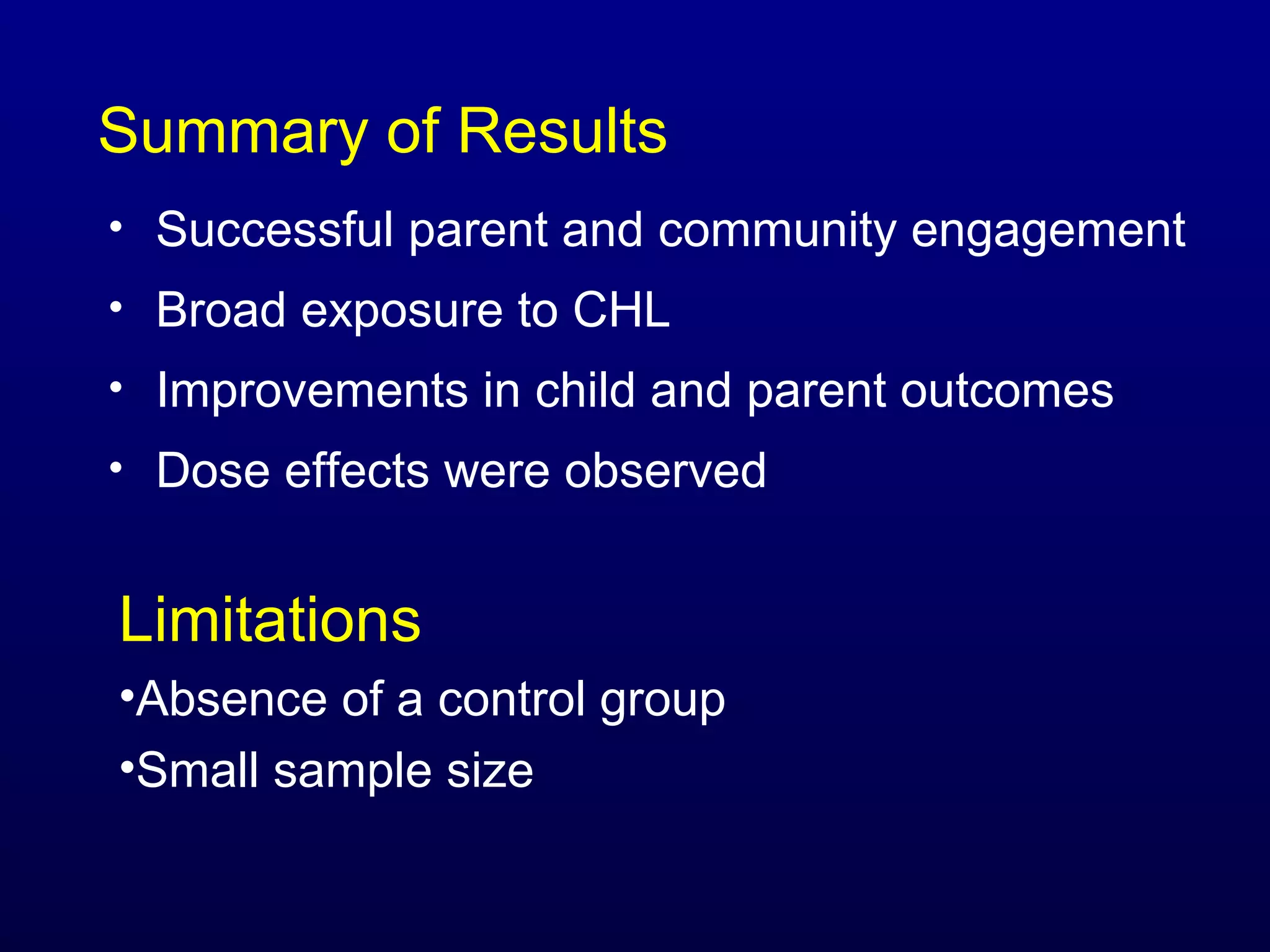
Summary of Results
• Successful parent and community engagement
• Broad exposure to CHL
• Improvements in child and parent outcomes
• Dose effects were observed

Limitations
•Absence of a control group
•Small sample size
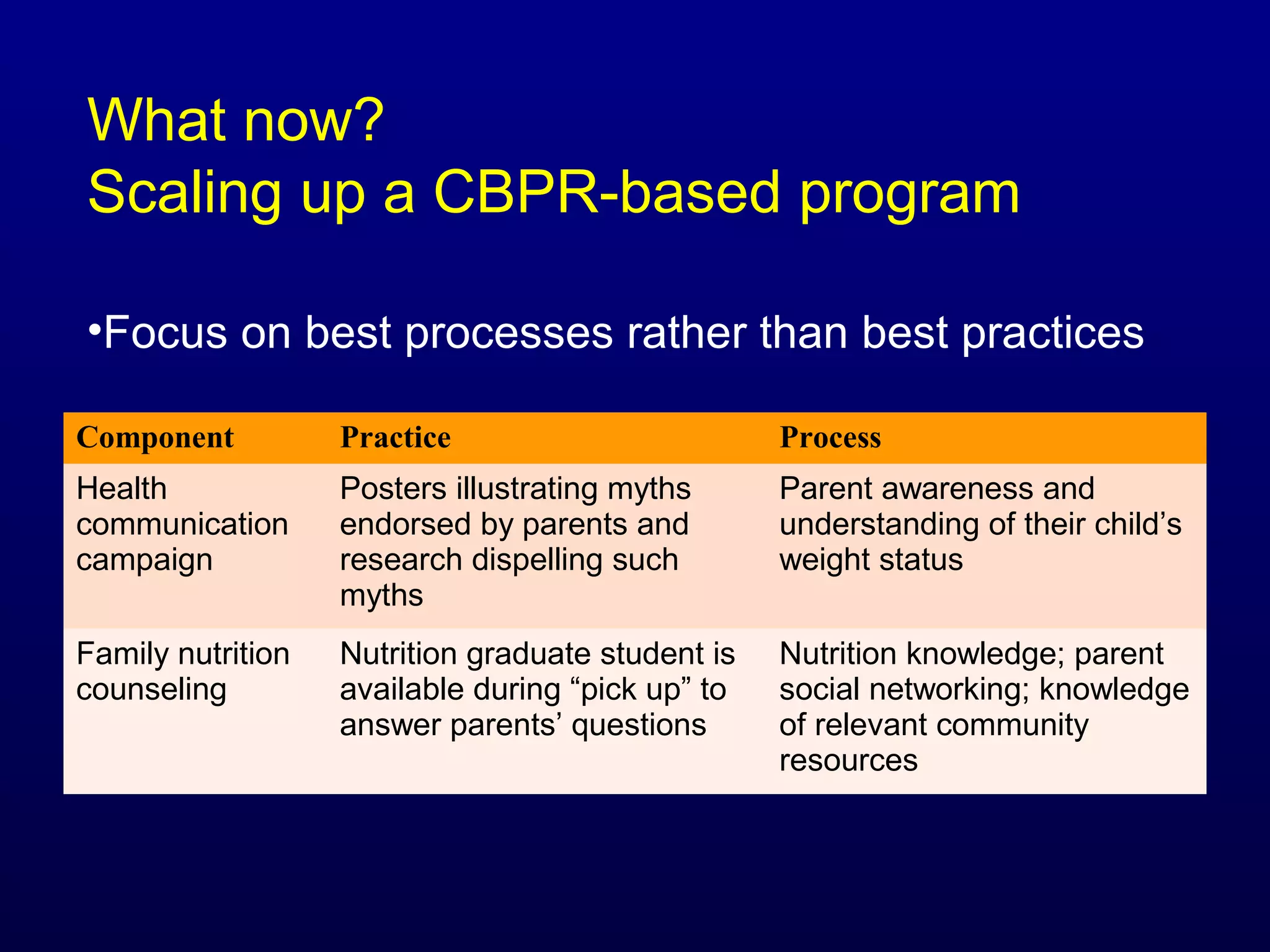
What now?
Scaling up a CBPR-based program
•Focus on best processes rather than best practices
Component

Practice

Process

Health
communication
campaign

Posters illustrating myths
endorsed by parents and
research dispelling such
myths

Parent awareness and
understanding of their child’s
weight status

Family nutrition
counseling

Nutrition graduate student is
available during “pick up” to
answer parents’ questions

Nutrition knowledge; parent
social networking; knowledge
of relevant community
resources
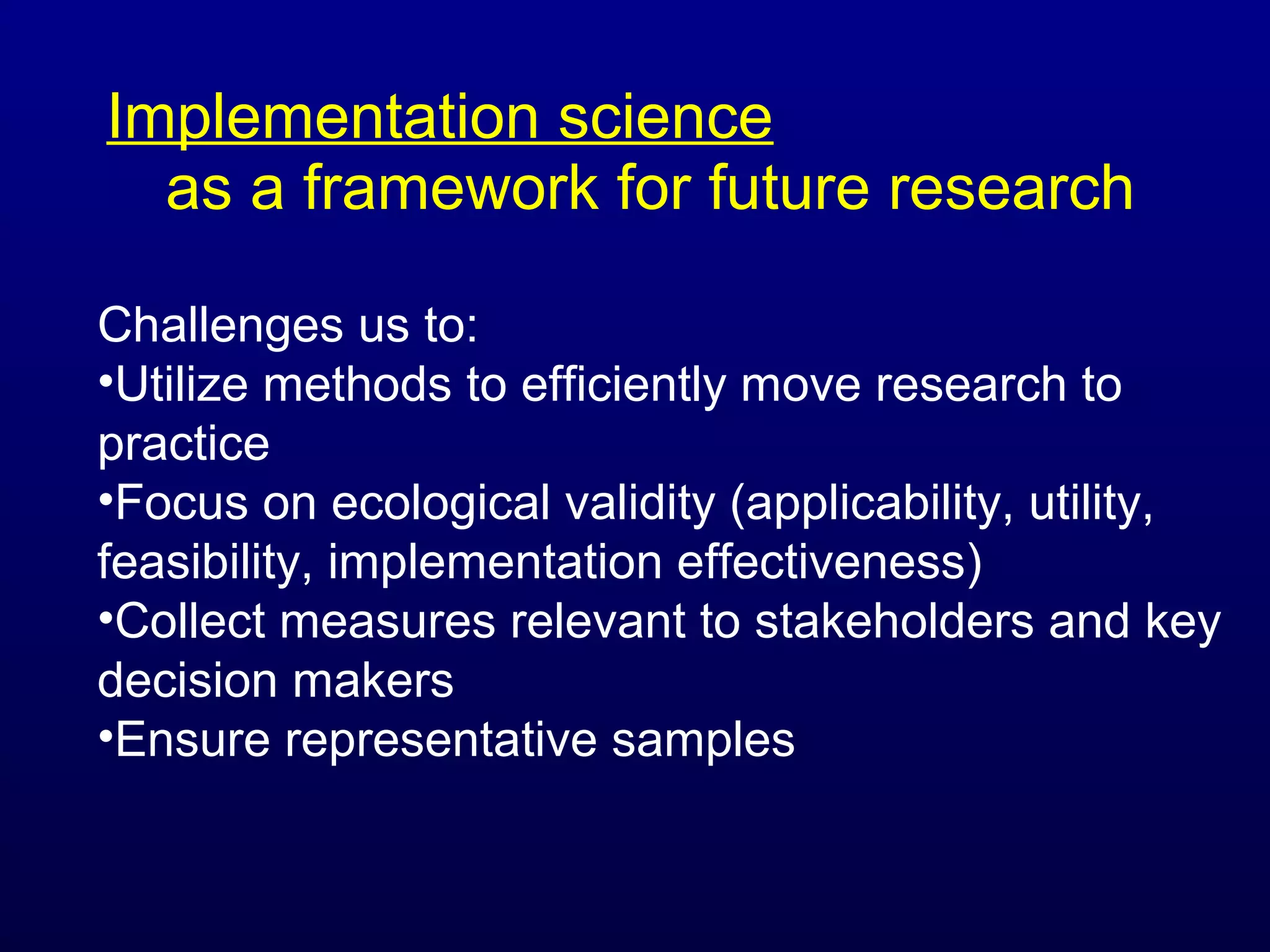
Implementation science
as a framework for future research
Challenges us to:
•Utilize methods to efficiently move research to
practice
•Focus on ecological validity (applicability, utility,
feasibility, implementation effectiveness)
•Collect measures relevant to stakeholders and key
decision makers
•Ensure representative samples

Kirsten Davison, Ph.D. - "Developing Sustainable Family-Centered Obesity Interventions"

  • 1.
    Developing Sustainable Family-Centered ObesityInterventions: What Can We Learn from Developmental Psychology and Implementation Science PRINCIPAL INVESTIGATORS: CO-INVESTIGATORS Kirsten K. Davison, PhD (PI) Janine M. Jurkowski, PhD, MPH (PI) Hal Lawson (co-I), Sibylle Kranz (co-I) Lawrence Schell (co-I) Glenn Deane (co-I) Funded by NIH R24 MD004865 Davison et al. (2013). A childhood obesity intervention developed by families for families: results from a pilot study. International Journal of Behavioral Nutrition and Physical Activity, Jan 5;10:3.
  • 2.
    Key challenges offamily-based childhood obesity interventions • Reaching families • Passive refusals (consent but don’t show up) • Parents not interested if don’t see immediate need • Priorities for intervention do not match family priorities
  • 3.
    Possible strategies • Maintaincontact with families over time • Partner with organizations that reach families • Use electronic means to collect data • Build intervention into other appointments • Design programs around the needs and interests of families • Ask families members what they hope to gain from participating
  • 4.
    Goals 1. Utilize community-basedparticipatory research (CBPR) to develop and pilot test a family-centered obesity prevention program for children enrolled in Head Start. 2. Incorporate the resulting intervention into systems of care (e.g., Head Start, WIC, pediatric care).
  • 5.
    Family Action-based Modelof Intervention Layout and Implementation (FAMILI) Phase 1: Theory Phase 2: Research Phase 3: Intervention Design & Implementation Utilize theories of family development to frame family-centered research Use a mixed methods approach to examine factors impacting on parents and families that are relevant for intervention design. Utilize a CBPR paradigm to develop interventions that empower parents and caregivers to foster healthy family lifestyles and establish systems-level change that reinforces family change. CBPR = community-based participatory research Davison, Lawson, & Coatsworth (2011). Health Promotion Practice
  • 6.
    Family Ecological Model Family Demographics Policiesand the Media • School PE and food policies • Advertising to children • Nutrition labeling Knowledge and Beliefs about behaviors that educe/promote obesity risk behaviors Accessibility of healthy and unhealthy eating and physical activity options Community Characteristics • Neighborhood walkability •Crime levels •Access to healthy foods and recreational spaces PARENTING • Family income • Single versus two parent household • Ethnicity • Education Modeling of healthy and unhealthy eating and activity behaviors Shaping children’s eating and physical activity behaviors by the use of reward and punishment systems Child Characteristics • Age • Gender • Weight status • Athletic competence Organizational Characteristics • • • School environment Job characteristics Work demands Davison & Campbell (2005). Public health approaches to the prevention of obesity. Oxford University Press
  • 7.
    Setting • Small cityin upstate New York • Five Head Start centers (423 2-5-year olds) 38.5% non-Hispanic White 17.8% non-Hispanic Black 6.1% Hispanic or Latino 13.5% biracial 24% unknown • Primary household language 90% English 6% Spanish
  • 8.
    Phase 1 Community AdvisoryBoard – Majority were parents/grandparents of children in Head Start Participated in all aspects of project – Development of the mission, logo, topics to explore – Recruitment, data collection (IRB trained), workshops and conferences, research team meetings
  • 9.
    Phase 2 Community Assessment – – – – – – – Focusgroups Key informant interviews Photovoice 24 hour dietary recall (children); Sibylle Kranz 7-day accelerometery (children); Karin Pfeiffer Surveys, follow-up interview Behavioral observation in centers Findings were presented to the community in two town hall meetings. Solicited ideas on what the program should entail.
  • 10.
    What did welearn? Children • Watched TV extensively; a coping strategy • Excessive consumption of sugar-sweetened beverages • 35% overweight or obese; 14% met PA recommendations Parents • failed to recognize when their children were overweight • didn’t like how physicians interacted with them • wanted • to gain advocacy skills • to connect with other parents • the program to be center-based • their children to gain something from the program
  • 11.
    What did welearn? Children • watched TV extensively; a coping strategy • excessive consumption of sugar-sweetened beverages • 35% overweight or obese; 14% met PA recommendations Parents • Failed to recognize when their children were overweight • Didn’t like how physicians interacted with them • Wanted • to gain advocacy skills • to connect with other parents • the program to be center-based • their children to gain something from the program
  • 12.
    What did welearn? Community • No where to send parents concerned about their child’s weight • Some programs available in community to promote healthy living, but underutilized
  • 13.
    Phase 3 The CHLprogram Multiple components 1. Health communication campaign 2. BMI letters sent home 3. Family coffee hour with nutrition counseling 4. Parent’s Connect for Family Wellness program
  • 15.
    Phase 3 The CHLprogram Multiple components 1. Health communication campaign 2. BMI letters sent home 3. Family coffee hour with nutrition counseling 4. Parent’s Connect for Family Wellness program
  • 16.
    Parents Connect forHealthy Living • • • • 6 week parent-led program 2 hour session each week; meal provided Center-based Sessions focused on: – – – – Resource empowerment Nutrition, media literacy, and communication (workshops) Conflict resolution, social networking and stress (hands-on) Effective communication with health professionals (panel discussions with pediatricians)
  • 17.
    Intervention and EvaluationTimelines Sept Oct Baseline Survey (N=154) Nov Dec Jan Feb Mar Intervention Implemented Survey (N=88) Apr May Jun Follow-up Survey (N=109) Activity Monitors (N=90) Activity Monitors (N=57) Diet recall (N=55) Diet recall (N=33)
  • 18.
    Evaluation sample andmethods Recruited from all five Head Start centers White (45%); African American (15%) Some high school (21%); high school graduate (37%); some college (42%) Construct Method Child BMI; obesity Record extraction: measured height and weight 152 136 Parenting, empowerment, demographics, intervention exposure Parent survey 145 102 Child dietary recall 24 Hour Dietary Recall 55 33 Child physical activity 7-day accelerometry 83 57 Sample size Sample size (Pre-test) (Pre-test)
  • 19.
    Community Advisory Board ParticipationRates Parents (N= 13) Range 3-19 out of 23 meetings Average = 41% of meetings attended Median = 35% of meetings attended Community members & Agency staff (N= 8) Range = 4-17 of 23 meetings Average = 42% of meetings attended Median = 43% of meetings attended
  • 20.
    Results Program exposure •Health communicationcampaign: 90%+ parents reported seeing posters, 85% reported reading posters •Family coffee hour: 40% parents heard about, 29% spoke with a nutrition counselor •Parents Connect program: 69% heard about program, 20% attended at least one session. •Total number of components parents exposed to: 1 (16%), 2 (50%), 3+ (30%) 0 (4%),
  • 21.
    Results Pre-post intervention differences inchild and parent outcomes • Paired t-tests examined pre-post intervention change in measures of: – child BMI, dietary intake, and physical activity – food, physical activity, and screen-related parenting, parent resource empowerment • Performed as intent to treat analyses
  • 22.
    Child Outcomes Pre intervention Mean(std) Child weight status BMI z-score Obesity (%) Child TV viewing (min/day) Child diet – dietary recall     Total energy (kcals)     Total fat (gm)     Total carbohydrate (gm)     Total protein (gm) * p< .05  ** p< .01  *** p< .001 t-value 0.72 (1.12) 15.8%   1.69 10.7** 33.3 (4.0) 21.2 (2.9) 4.7 (1.5) 32.6 (1.82) 21.7 (3.2) 4.9 (1.5)   1.82 -2.04* -1.76 141.9 (77.0) 94.10 (61.2) 8.62** 0.86 (1.24) 19.7% Child physical activity (min/day) Sedentary Light physical activity Moderate physical activity Post intervention Mean (std) 1531.2 (405.3) 50.1 (18.6) 214.6 (57.4) 58.1 (18.7) 1395.7 (423.8) 47.3 (20.1) 199.1 (59.4) 52.9 (17.5)   3.20** 2.27* 2.60* 3.15**
  • 23.
    Parent outcomes Pre interventionPost intervention Mean (std) Mean (std) t-value Parent resource empowerment Weight  Physical activity Diet 3.37 (.63) 3.21 (.63) 3.33 (.61) 3.53 (0.82) 3.40 (.66) 3.48 (.59) 3.19** 4.24*** 3.96** Parenting: Diet Freq. eat fast food Freq. offer fruits and vegetables Self efficacy to offer healthy foods 1.19 (.61) 4.43 (1.15) 4.64(.50) 1.15 (.59) 4.56 (1.14) 4.78 (.39) .69 -1.87 -4.08*** Parenting: Physical activity Support for physical activity 3.37 (.51) 3.50(.50) -3.36*** 3.34 (.53) 66% 3.33 (.60) 65% .57 0.69 Parenting: Television viewing Monitor child screen time TV in child’s bedroom * p< .05  ** p< .01  *** p< .001
  • 24.
    Dose effects Dose =# components of CHL to which parents were exposed Multiple regression analysis Outcome (post test) = outcome (pre test) + dose Estimate Outcome: Child BMI z-score (post) BMI z-score (pre) Dose Outcome: Child moderate PA (post) Child moderate PA (pre) Dose Outcome: Child TV viewing (post) Child TV viewing (pre) Dose Outcome: Child energy intake1 (post) Child energy intake (pre) Dose SE t-value P-value 0.71 .0.1 .058 .05 12.09 0.137 <.0001 .89 0.72 0.08 .08 .09 8.68 0.86 <.0001 0.39 0.66 -16.59 0.05 2.73 12.56 -6.08 <.0001 <.0001 0.83 -48.92 .10 28.35 8.67 -1.73 <.0001 0.09 To reduce the risk of type II error, dose effects were only assessed for one key indicator for each construct. 1
  • 25.
    Dose effects Estimate Outcome: Parentempowerment1 (post) Parent weight-related empowerment (pre) Dose Outcome: Parent support for child PA (post) Parent support for child PA Dose  Outcome: Parent self efficacy-healthy foods Parent self efficacy (pre) Dose SE t-value P-value .634 .09 .083 .046 7.63 1.97 <.0001 .05 0.66 0.06 0.06 0.02 11.35 2.74 <.0001 .006 0.51 0.05 10.51 <.0001 0.05 0.02 2.84 0.005 To reduce the risk of type II error, dose effects were only assessed for one key indicator for each construct. 1
  • 26.
    Summary of Results •Successful parent and community engagement • Broad exposure to CHL • Improvements in child and parent outcomes • Dose effects were observed Limitations •Absence of a control group •Small sample size
  • 27.
    What now? Scaling upa CBPR-based program •Focus on best processes rather than best practices Component Practice Process Health communication campaign Posters illustrating myths endorsed by parents and research dispelling such myths Parent awareness and understanding of their child’s weight status Family nutrition counseling Nutrition graduate student is available during “pick up” to answer parents’ questions Nutrition knowledge; parent social networking; knowledge of relevant community resources
  • 28.
    Implementation science as aframework for future research Challenges us to: •Utilize methods to efficiently move research to practice •Focus on ecological validity (applicability, utility, feasibility, implementation effectiveness) •Collect measures relevant to stakeholders and key decision makers •Ensure representative samples