A Look at the 2010 Dietary Guidelines: Putting Guidelines into Practice March 4, 2011 Erin Laurie, MS, RD, LD Consultant Dietitian and Adjunct Instructor 785-893-2757 [email_address]
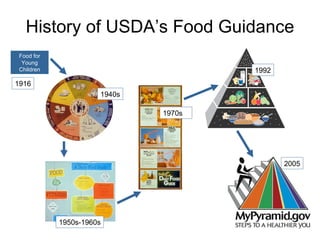
History of USDA’s Food Guidance 1940s 1950s-1960s 1970s 1992 2005 Food for Young Children 1916
2010 Dietary Guidelines:  A New Perspective DG Advisory Committee used Nutrition Evidence Based Library Nutrition Evidence Library Targeted toward an overweight and obese population Contains a “Call to Action” including changes to food environment; expanding nutrition education; access to fruits and vegetables, and healthful products
Overarching Themes 1.  Maintain calorie balance over time to achieve and sustain a healthy weight.  2. Focus on consuming nutrient-dense foods and beverages
Key Differences from 2005 *Emphasis on maintaining a healthy body weight throughout the lifecycle  * Proper nutrition for children. * Information on specific eating patterns such as the USDA Food Intake Pattern, DASH, vegetarian eating patterns * Acknowledges the influence of consumers’ broader food and physical activity environment and its impact on Americans’ food, beverage and physical activity choices. There is recognition that improvements to the environment must be coordinated among all sectors of influence. * A  shift to directional intake (vs. specific quantities) for various food groups
Key Differences from 2005 *A  key recommendation on seafood intake * I nclusion of research on eating behaviors (e.g., breakfast, snacking, etc.) and the influence of screen time on body weight *  foods to reduce due to their sodium, saturated fat, cholesterol, trans fat and added sugars content- SoFAs *  a focus on nutrients of public health concern (vs. intakes below recommended levels) such as potassium, dietary fiber, calcium and vitamin D  *  a new guidance on alcohol consumption by breastfeeding women *  an appendix table of key consumer behaviors and potential strategies for professionals to use in implementing the  Dietary Guidelines
Key Recommendations  with Evidence Balancing Calories to Manage Weight Foods and Food Components to Reduce Foods and Nutrients to Increase Building Healthy Eating Patterns
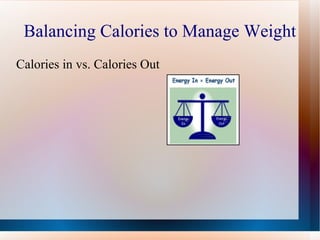
Balancing Calories to Manage Weight Calories in vs. Calories Out
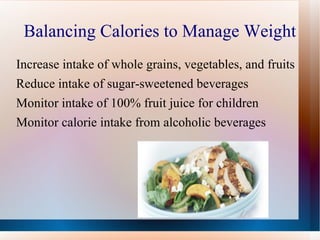
Balancing Calories to Manage Weight Increase intake of whole grains, vegetables, and fruits Reduce intake of sugar-sweetened beverages Monitor intake of 100% fruit juice for children Monitor calorie intake from alcoholic beverages
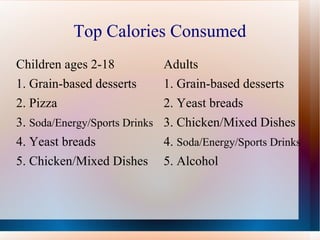
Top Calories Consumed Children ages 2-18 1. Grain-based desserts 2. Pizza 3.  Soda/Energy/Sports Drinks 4. Yeast breads 5. Chicken/Mixed Dishes Adults 1. Grain-based desserts 2. Yeast breads 3. Chicken/Mixed Dishes 4.  Soda/Energy/Sports Drinks 5. Alcohol
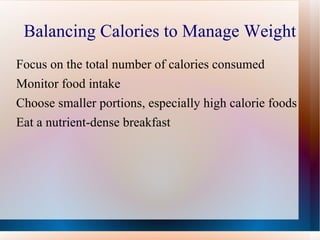
Balancing Calories to Manage Weight Focus on the total number of calories consumed Monitor food intake Choose smaller portions, especially high calorie foods Eat a nutrient-dense breakfast
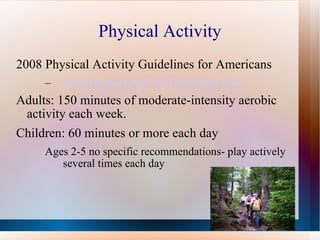
Physical Activity 2008 Physical Activity Guidelines for Americans 2008 Physical Activity Guidelines Link Adults: 150 minutes of moderate-intensity aerobic activity each week.  Children: 60 minutes or more each day Ages 2-5 no specific recommendations- play actively several times each day
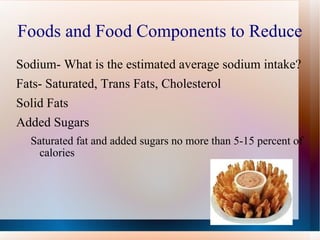
Foods and Food Components to Reduce Sodium- What is the estimated average sodium intake? Fats- Saturated, Trans Fats, Cholesterol Solid Fats Added Sugars Saturated fat and added sugars no more than 5-15 percent of calories
Foods and Food Components to Reduce Refined Grains Provide some vitamins and minerals Commonly provide excess calories  Many high in added fats and/or added sugars Alcohol Women- Up to 1 drink per day Men- Up to 2 drinks per day
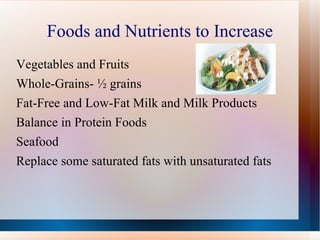
Foods and Nutrients to Increase Vegetables and Fruits Whole-Grains- ½ grains  Fat-Free and Low-Fat Milk and Milk Products Balance in Protein Foods Seafood Replace some saturated fats with unsaturated fats
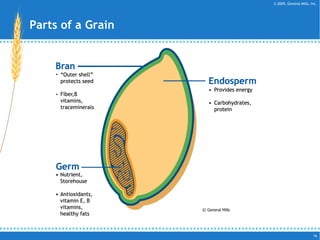
© General Mills Parts of a Grain
Nutrients of Concern Potassium Fiber Calcium Vitamin D Iron- women of childbearing years/pregnant Folate- women of childbearing years/pregnant B12 – Americans over 50
Building Healthy Eating Patterns Focus on nutrient-dense foods Remember that beverages count Follow food safety principles Consider the role of supplements and fortified foods Vitamin D Folic Acid Vitamin B12 Iron supplements for pregnant women
Helping Americans  Make Healthy Choices Everyone has a role in the movement to make America healthy. Influencers of Food Choices
Call to Action 1. Ensure that all Americans have access to nutritious foods and opportunities for physical activity 2. Facilitate individual behavior change through environmental strategies. 3. Set the stage for lifelong healthy eating, physical activity, and weight management behaviors.
Helping Americans  Make Healthy Choices Keep the following insights in mind when shaping messages  •  Messages that are  short, to-the-point and action-oriented  are more likely to be believed and absorbed. •  Messages that  indicate the uniqueness of each person or family’s needs  connect with parents more than generalized statements. •  Messages that  imply the consumer has control over their family’s situation , and it is within their power to make a change, are also impactful. •  Parents want to know the  benefit of doing something , particularly if the task seems time-consuming or difficult, like counting calories and monitoring portions. •  American parents are  looking for “how to” education  on the topic, particularly in the case of serving nutrient-rich foods and beverages more often.  Messages and information should not just provide a goal to strive for, but should be instructional
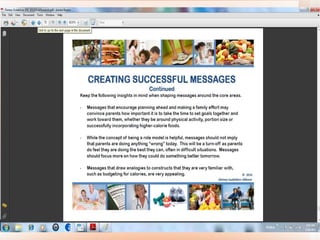
Helping Americans Make Healthy Choices M essages that  encourage planning ahead and making a family effort  may convince parents how important it is to take the time to set goals together and work toward them, whether they be around physical activity, portion size or successfully incorporating higher-calorie foods. •  While the concept of being a role model is helpful,  messages should not imply that parents are doing anything “wrong” today . This will be a turn-off as parents do feel they are doing the best they can, often in difficult situations.  Messages should focus more on how they could do something better tomorrow. •  Messages that  draw analogies to constructs that they are very familiar with, such as budgeting for calories, are very appealing.
Top Messages
Thoughts for Consideration If DGA are viewed as all-or-nothing goals, little room to embrace or celebrate small changes  Consumer messages around nutrition and especially weight loss need to be simple and focused on specific population groups. The “one size fits all” consumer message leads to confusion and noncompliance.
Resources Dietary Guidelines:  www.dietaryguidelines.gov Consumer Materials available on or before April 27 International Food Information Council: www.foodinsight.org MyPyramid:   www.mypyramid.gov DASH Eating Plan: http://www.nhlbi.nih.gov/health/public/heart/hbp/dash/new_dash.pdf Bell Institute of Health and Nutrition: www.bellinstitute.org American Dietetic Association www.eatright.org
Thank you! -Kansas Wheat Proudly Sponsors this Session- You are invited to the  National Festival of Breads June 25, 2011 at Wichita Airport Hilton  Visit  www.nationalfestivalofbreads.com
Questions? Erin Laurie, MS, RD, LD Consultant Dietitian and Adjunct Instructor 785-893-2757 [email_address]

Dietary Guidelines Presentation

  • 1.
    A Look atthe 2010 Dietary Guidelines: Putting Guidelines into Practice March 4, 2011 Erin Laurie, MS, RD, LD Consultant Dietitian and Adjunct Instructor 785-893-2757 [email_address]
  • 2.
    History of USDA’sFood Guidance 1940s 1950s-1960s 1970s 1992 2005 Food for Young Children 1916
  • 3.
    2010 Dietary Guidelines: A New Perspective DG Advisory Committee used Nutrition Evidence Based Library Nutrition Evidence Library Targeted toward an overweight and obese population Contains a “Call to Action” including changes to food environment; expanding nutrition education; access to fruits and vegetables, and healthful products
  • 4.
    Overarching Themes 1. Maintain calorie balance over time to achieve and sustain a healthy weight. 2. Focus on consuming nutrient-dense foods and beverages
  • 5.
    Key Differences from2005 *Emphasis on maintaining a healthy body weight throughout the lifecycle * Proper nutrition for children. * Information on specific eating patterns such as the USDA Food Intake Pattern, DASH, vegetarian eating patterns * Acknowledges the influence of consumers’ broader food and physical activity environment and its impact on Americans’ food, beverage and physical activity choices. There is recognition that improvements to the environment must be coordinated among all sectors of influence. * A shift to directional intake (vs. specific quantities) for various food groups
  • 6.
    Key Differences from2005 *A key recommendation on seafood intake * I nclusion of research on eating behaviors (e.g., breakfast, snacking, etc.) and the influence of screen time on body weight * foods to reduce due to their sodium, saturated fat, cholesterol, trans fat and added sugars content- SoFAs * a focus on nutrients of public health concern (vs. intakes below recommended levels) such as potassium, dietary fiber, calcium and vitamin D * a new guidance on alcohol consumption by breastfeeding women * an appendix table of key consumer behaviors and potential strategies for professionals to use in implementing the Dietary Guidelines
  • 7.
    Key Recommendations with Evidence Balancing Calories to Manage Weight Foods and Food Components to Reduce Foods and Nutrients to Increase Building Healthy Eating Patterns
  • 8.
    Balancing Calories toManage Weight Calories in vs. Calories Out
  • 9.
    Balancing Calories toManage Weight Increase intake of whole grains, vegetables, and fruits Reduce intake of sugar-sweetened beverages Monitor intake of 100% fruit juice for children Monitor calorie intake from alcoholic beverages
  • 10.
    Top Calories ConsumedChildren ages 2-18 1. Grain-based desserts 2. Pizza 3. Soda/Energy/Sports Drinks 4. Yeast breads 5. Chicken/Mixed Dishes Adults 1. Grain-based desserts 2. Yeast breads 3. Chicken/Mixed Dishes 4. Soda/Energy/Sports Drinks 5. Alcohol
  • 11.
    Balancing Calories toManage Weight Focus on the total number of calories consumed Monitor food intake Choose smaller portions, especially high calorie foods Eat a nutrient-dense breakfast
  • 12.
    Physical Activity 2008Physical Activity Guidelines for Americans 2008 Physical Activity Guidelines Link Adults: 150 minutes of moderate-intensity aerobic activity each week. Children: 60 minutes or more each day Ages 2-5 no specific recommendations- play actively several times each day
  • 13.
    Foods and FoodComponents to Reduce Sodium- What is the estimated average sodium intake? Fats- Saturated, Trans Fats, Cholesterol Solid Fats Added Sugars Saturated fat and added sugars no more than 5-15 percent of calories
  • 14.
    Foods and FoodComponents to Reduce Refined Grains Provide some vitamins and minerals Commonly provide excess calories Many high in added fats and/or added sugars Alcohol Women- Up to 1 drink per day Men- Up to 2 drinks per day
  • 15.
    Foods and Nutrientsto Increase Vegetables and Fruits Whole-Grains- ½ grains Fat-Free and Low-Fat Milk and Milk Products Balance in Protein Foods Seafood Replace some saturated fats with unsaturated fats
  • 16.
    © General MillsParts of a Grain
  • 17.
    Nutrients of ConcernPotassium Fiber Calcium Vitamin D Iron- women of childbearing years/pregnant Folate- women of childbearing years/pregnant B12 – Americans over 50
  • 18.
    Building Healthy EatingPatterns Focus on nutrient-dense foods Remember that beverages count Follow food safety principles Consider the role of supplements and fortified foods Vitamin D Folic Acid Vitamin B12 Iron supplements for pregnant women
  • 19.
    Helping Americans Make Healthy Choices Everyone has a role in the movement to make America healthy. Influencers of Food Choices
  • 20.
    Call to Action1. Ensure that all Americans have access to nutritious foods and opportunities for physical activity 2. Facilitate individual behavior change through environmental strategies. 3. Set the stage for lifelong healthy eating, physical activity, and weight management behaviors.
  • 21.
    Helping Americans Make Healthy Choices Keep the following insights in mind when shaping messages • Messages that are short, to-the-point and action-oriented are more likely to be believed and absorbed. • Messages that indicate the uniqueness of each person or family’s needs connect with parents more than generalized statements. • Messages that imply the consumer has control over their family’s situation , and it is within their power to make a change, are also impactful. • Parents want to know the benefit of doing something , particularly if the task seems time-consuming or difficult, like counting calories and monitoring portions. • American parents are looking for “how to” education on the topic, particularly in the case of serving nutrient-rich foods and beverages more often. Messages and information should not just provide a goal to strive for, but should be instructional
  • 22.
    Helping Americans MakeHealthy Choices M essages that encourage planning ahead and making a family effort may convince parents how important it is to take the time to set goals together and work toward them, whether they be around physical activity, portion size or successfully incorporating higher-calorie foods. • While the concept of being a role model is helpful, messages should not imply that parents are doing anything “wrong” today . This will be a turn-off as parents do feel they are doing the best they can, often in difficult situations. Messages should focus more on how they could do something better tomorrow. • Messages that draw analogies to constructs that they are very familiar with, such as budgeting for calories, are very appealing.
  • 23.
  • 24.
    Thoughts for ConsiderationIf DGA are viewed as all-or-nothing goals, little room to embrace or celebrate small changes Consumer messages around nutrition and especially weight loss need to be simple and focused on specific population groups. The “one size fits all” consumer message leads to confusion and noncompliance.
  • 25.
    Resources Dietary Guidelines: www.dietaryguidelines.gov Consumer Materials available on or before April 27 International Food Information Council: www.foodinsight.org MyPyramid: www.mypyramid.gov DASH Eating Plan: http://www.nhlbi.nih.gov/health/public/heart/hbp/dash/new_dash.pdf Bell Institute of Health and Nutrition: www.bellinstitute.org American Dietetic Association www.eatright.org
  • 26.
    Thank you! -KansasWheat Proudly Sponsors this Session- You are invited to the National Festival of Breads June 25, 2011 at Wichita Airport Hilton Visit www.nationalfestivalofbreads.com
  • 27.
    Questions? Erin Laurie,MS, RD, LD Consultant Dietitian and Adjunct Instructor 785-893-2757 [email_address]

Editor's Notes

  • #3 USDA has had a long history with food guidance dating back into the early 20 th century. Looking back over this history, many different food guides have been used. They represented health and nutrition concerns of the time when they were introduced. For example, In the 1940’s the wartime food guide promoted eating foods that provided the vitamins and minerals needed to prevent deficiencies. In the 1950’s-1960’s the 7 food groups were simplified into a “Food for Fitness” guide, which was commonly called “The Basic Four.” By the later 1970’s, concerns about dietary excess lead USDA to issue “The Hassle-Free Daily Food Guide,” which included a “caution” group of fats, sweets, and alcohol In the 1980s first dietary guidelines released. All of these food guides preceded the introduction of the original Food Guide Pyramid in 1992. NOTE TO PRESENTER: The food guides pictured above are-- 1916: Food for Young Children 1940s (1946): National Food Guide (commonly called “The Basic Seven”) 1950s-1960s (1956): Food for Fitness—A Daily Food Guide (commonly called “The Basic Four”) 1970s (1979): Hassle-Free Guide to a Better Diet 1992: Food Guide Pyramid 2005: MyPyramid
  • #4 This 7 th edition changes to address 2 and older who are at increased risk for chronic disease. 1/3 of all adults are obese with 72% of men overweight or obese and 64% of women are overweight or obese. 32% of ages 2-19 are overweight or obese The 13 member DG Advisory Committee made up of nutrition and health science authorities used a newly developed, state of the art, web-based electronic system and methodology, known as the Nutrition Evidence Library to answer scientific questions posed.
  • #6 Key differences include an emphasis on maintaining a healthy body weight throughout the lifecycle and on proper nutrition for children. Information on specific eating patterns, including vegetarian adaptations, is included for the first time. Chapter 6 of the 2010 policy report acknowledges the influence of consumers’ broader food and physical activity environment and its impact on Americans’ food, beverage and physical activity choices. There is recognition that improvements to the environment must be coordinated among all sectors of influence. Other differences include: · a shift to directional intake (vs. specific quantities) for various food groups; · a key recommendation on seafood intake; · inclusion of research on eating behaviors (e.g., breakfast, snacking, etc.) and the influence of screen time on body weight; · lists of specific foods to reduce due to their sodium, saturated fat, cholesterol, trans fat and added sugars content; · a focus on nutrients of public health concern (vs. intakes below recommended levels) such as potassium, dietary fiber, calcium and vitamin D; · a new guidance on alcohol consumption by breastfeeding women; and · an appendix table of key consumer behaviors and potential strategies for professionals to use in implementing the Dietary Guidelines .
  • #9 Strong evidence shows that there is no optimal proportion of macronutrients that can facilitate weight loss or assist in maintaining weight. The critical issue whether the eating pattern is reduced in calories and the individual is able to maintain a reduced calorie intake over time. The total number of calories consumed is the essential factor relevant to body weight.
  • #10 See page 16 of DG report. A dietary pattern low in calorie density is characterized by a relatively high intake of vegetables, fruits, and fiber and lower intake of total fat, saturated fat, and added sugars. Strong evidence shows that eating patterns that are low in calorie density improve weight loss and weight maintenance, and also may be associated with lower risk of Type 2 diabetes in adults.
  • #11 Not a fruit or vegetable to be had! In fact besides fruit juice and fried potatoes not even in the top 25 sources!
  • #12 Breakfast- not eating breakfast has been associated with excess body weight especially in children. Consuming breakfast also is associated with weight loss and maintenance as well as improved nutrient intake.
  • #13 Strong evidence supports that regular participation in physical activity helps people maintain a healthy weight and prevent weight gain.
  • #14 Even in the absence of overweight consuming too much sodium, solid fats,, saturated and trans fats, cholesterol, added sugars, and alcohol increases risk of chronic disease 3,400 mg of sodium Sodium- a strong body of evidence in adults shows that as sodium intake decreases so does blood pressure. Moderate evidence in children shows the same result. Fats- the type of fats consumed are more important in influencing the risk of CVD than the total fat in the diet. Saturated fats- strong evidence indicates that higher intake of most dietary saturated fatty acids is associated with higher levels of blood total cholesterol and LDL. . Look to replace some saturated fats with unsaturated sources. Trans fats- a number of studies have observed that increased trans fatty acids increase risk of CVD due in part with elevations in LDL. Cholesterol- dietary cholesterol has been shown to raise blood LDL in some individuals. However, this effect is reduced when saturated fat intake is low. The potential negative effect of dietary cholesterol is relatively small compared to those of saturated fat and trans fat. Solid fats refer to the foods or ingredients themselves such as shortening or hydrogenated oils, butter, animal fats. These are discussed apart of saturated, trans fat and cholesterol b/c these are abundant in the American diet and contribute to significant excess calorie consumption. Reducing these will in turn reduce calories and saturated, trans fat. Added sugars and solid fats are consumed in excessive amounts- 800 kcal a day- without contributing important nutrients to the diet. Foods themselves with higher added sugars or added solid fats don't contribute to weight gain; however, with increased consumption it is more difficult to also eat foods with sufficient fiber and essential vits and minerals.
  • #15 Strong evidence shows moderate alcohol consumption associated with lower risk of CVD and all cause mortality among middle aged and in older adults may help to keep cognitive function intake with age. However not encouraging to start drinking as moderate intake is also associated with increase risk of breast cancer, violence, drowning, and injuries from falls and motor vehicle accidents.
  • #16 See pages 35-40- highlighted areas
  • #17 Talking Points: A grain kernel or seed consists of three parts: The Outer Shell is a coarse layer. It is called the bran and it protects the grain. The Inside layer of the grain is known as the endosperm. The Middle layer is the germ. It’s a small but important part of the grain that sprouts when planted. Background: Bran: contains fiber, B vitamins, protein, and trace minerals. Endosperm: this “energy storehouse” contains mostly carbohydrate and some protein and small amounts of B vitamins. Germ: contains B vitamins, vitamin E, trace minerals, and phytonutrients (substances in plants that have health-protective effects).
  • #18 See key recommendations
  • #19 A healthy eating pattern is not a rigid prescription. Can use USDA Food Patterns and vegetarian adpations of USDA food pattern, and the DASH eating pattern as templates to meet the DG Supplments and fortified foods- page 49. No sufficient evidence to support recommenation for or against a daily MVI to prevent chronic disease. Note: A fundemental premise of the DG is that nutrients should come from foods. .
  • #20 http://www.cnpp.usda.gov/Publications/DietaryGuidelines/2010/PolicyDoc/Chapter6.pdf
  • #22 Research done by the Dietary Guidelines Alliance ADA, IFIC, Produce for Better Health, National Cattlemen's Beef Association, Pork Producers, Society for Nutrition Educaiton to name a few