Economic Development
Definition
Progress in an economy, or the qualitative measure of this.
Economic development usually refers to the adoption of
new technologies, transition from agriculture-based to
industry-based economy, and general improvement in
living standards.
 economic development area (EDA)
An area selected by local or state authorities to
receive assistance from government-sponsored
economic programs. Assistance may take the
form of tax incentives or low-interest loans for
businesses that locate or expand in the area.
 Economic development
Is the development of economic wealth of
countries, regions or communities for the well-
being for their inhabitants. From a policy
perspective, economic development can be
defined as efforts that seek to improve the
economic well-being and quality of life for a
community by creating and/retaining jobs and
supporting or growing incomes and tax base.
Overview
 There are significant differences between
economic growth and economic development.
The term "economic growth" refers to the
increase (or growth) of a specific measure such
as real national income, gross domestic product,
or per capita income. National income or
product is commonly expressed in terms of a
measure of the aggregate value-added output of
the domestic economy called gross domestic
product (GDP).When the GDP of a nation rises
economists refer to it as economic growth.
 The term "economic development," on the other
hand, implies much more. It typically refers to
improvements in a variety of indicators such as
literacy rates, life expectancy, and poverty rates.
GDP is a specific measure of economic welfare
that does not take into account important
aspects such as leisure time, environmental
quality, freedom, or social justice. Economic
growth of any specific measure is not a sufficient
definition of economic development
LOCAL DEVELOPMENT
 There term “ economic development” is
often used in a regional sense as well (e. g., a
mayor might say that “we need to promote
the economic development f our city”).In this
sense, economic development focuses on the
recruitment of business operations to a
region, assisting in the expansion or retention
of business operations within a region or
assisting in the start –up of new business
within a region
 In addition to economic models, the needs of
constituency groups guide economic developer's
actions. For example, a local economic developer
working out of a mayor's office may act towards
decreasing unemployment by attracting businesses
with large labor needs (call centers).The economic
developer working for the chamber of commerce
dominated by banks, real estate agents and utilities will
recruit manufacturers with large capital investments
(steel and chemical plants).The economic developer
working for the state manufacturers association will
lobby for more workforce training money.The
economic developer working for a university will
concentrate on business start-ups, specifically those
based on intellectual property developed by the
university (biotech).
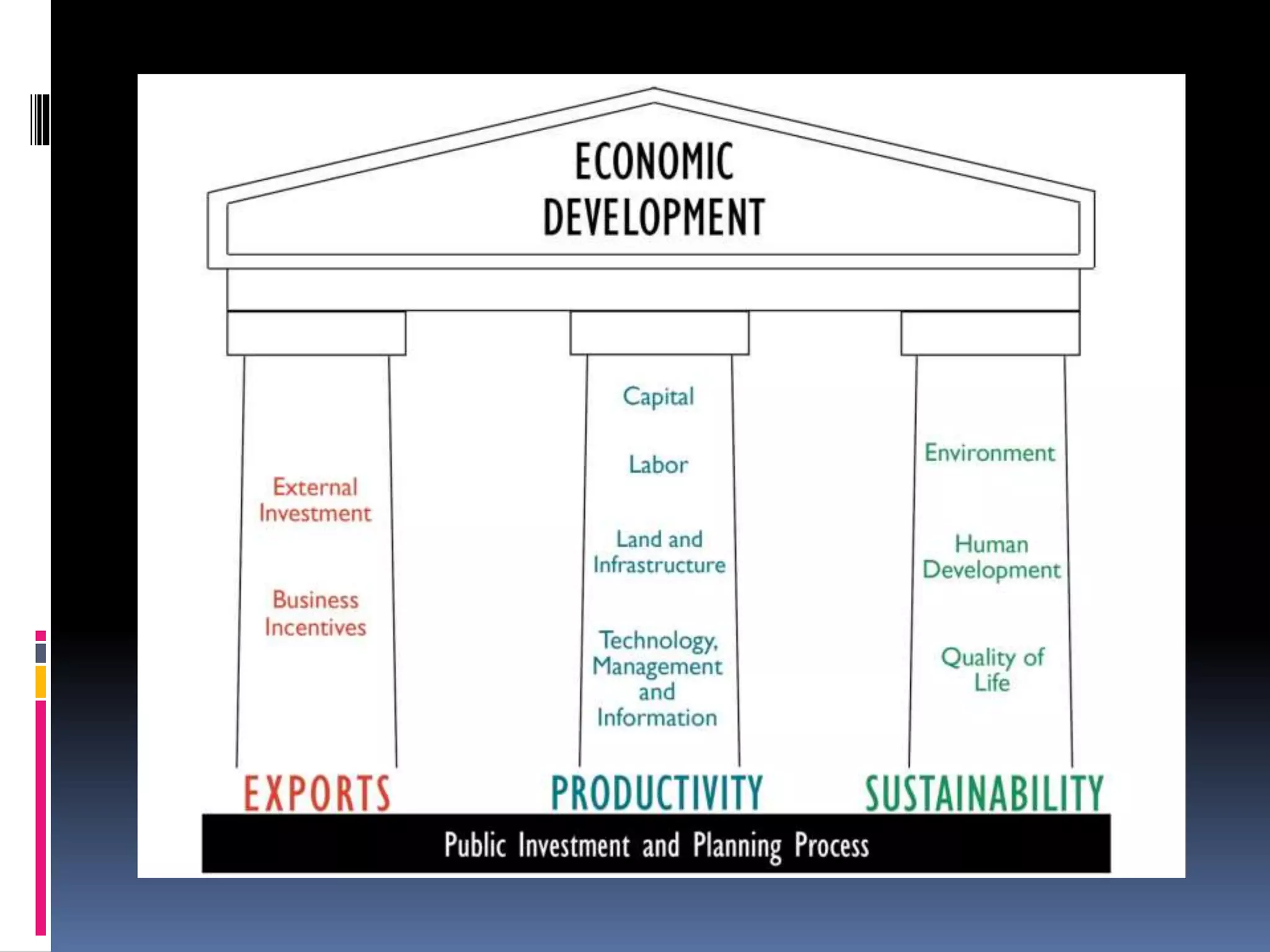
 In its broadest sense, economic development encompasses
three major areas:
 1) Policies that governments undertake to meet broad
economic objectives such as price stability, high employment,
expanded tax base, and sustainable growth. Such efforts
include monetary and fiscal policies, regulation of financial
institutions, trade, and tax policies.
 2) Policies and programs to provide infrastructure and services
such as highways, parks, affordable housing, crime prevention,
and educational programs and projects.
 3) Policies and programs explicitly directed at job creation and
retention through specific efforts in business finance,
marketing, neighborhood development, small business start-
up and development, business retention and expansion,
technology transfer, workforce training and real estate
development.This third category is a primary focus of
economic development professionals.
Economic developers Economic development, which is thus essentially economics on
a social level, has evolved into a professional industry of highly
specialized practitioners.The practitioners have two key roles:
one is to provide leadership in policy-making, and the other is
to administer policy, programs, and projects. Economic
development practitioners generally work in public offices on
the state, regional, or municipal level, or in public-private
partnerships organizations that may be partially funded by
local, regional, state, or federal tax money.These economic
development organizations (EDOs) function as individual
entities and in some cases as departments of local
governments.Their role is to seek out new economic
opportunities and retain their existing business wealth.
Economic Development

Economic Development

  • 1.
    Economic Development Definition Progress inan economy, or the qualitative measure of this. Economic development usually refers to the adoption of new technologies, transition from agriculture-based to industry-based economy, and general improvement in living standards.
  • 2.
     economic developmentarea (EDA) An area selected by local or state authorities to receive assistance from government-sponsored economic programs. Assistance may take the form of tax incentives or low-interest loans for businesses that locate or expand in the area.
  • 3.
     Economic development Isthe development of economic wealth of countries, regions or communities for the well- being for their inhabitants. From a policy perspective, economic development can be defined as efforts that seek to improve the economic well-being and quality of life for a community by creating and/retaining jobs and supporting or growing incomes and tax base.
  • 4.
    Overview  There aresignificant differences between economic growth and economic development. The term "economic growth" refers to the increase (or growth) of a specific measure such as real national income, gross domestic product, or per capita income. National income or product is commonly expressed in terms of a measure of the aggregate value-added output of the domestic economy called gross domestic product (GDP).When the GDP of a nation rises economists refer to it as economic growth.
  • 5.
     The term"economic development," on the other hand, implies much more. It typically refers to improvements in a variety of indicators such as literacy rates, life expectancy, and poverty rates. GDP is a specific measure of economic welfare that does not take into account important aspects such as leisure time, environmental quality, freedom, or social justice. Economic growth of any specific measure is not a sufficient definition of economic development
  • 6.
    LOCAL DEVELOPMENT  Thereterm “ economic development” is often used in a regional sense as well (e. g., a mayor might say that “we need to promote the economic development f our city”).In this sense, economic development focuses on the recruitment of business operations to a region, assisting in the expansion or retention of business operations within a region or assisting in the start –up of new business within a region
  • 7.
     In additionto economic models, the needs of constituency groups guide economic developer's actions. For example, a local economic developer working out of a mayor's office may act towards decreasing unemployment by attracting businesses with large labor needs (call centers).The economic developer working for the chamber of commerce dominated by banks, real estate agents and utilities will recruit manufacturers with large capital investments (steel and chemical plants).The economic developer working for the state manufacturers association will lobby for more workforce training money.The economic developer working for a university will concentrate on business start-ups, specifically those based on intellectual property developed by the university (biotech).
  • 8.
     In itsbroadest sense, economic development encompasses three major areas:  1) Policies that governments undertake to meet broad economic objectives such as price stability, high employment, expanded tax base, and sustainable growth. Such efforts include monetary and fiscal policies, regulation of financial institutions, trade, and tax policies.  2) Policies and programs to provide infrastructure and services such as highways, parks, affordable housing, crime prevention, and educational programs and projects.  3) Policies and programs explicitly directed at job creation and retention through specific efforts in business finance, marketing, neighborhood development, small business start- up and development, business retention and expansion, technology transfer, workforce training and real estate development.This third category is a primary focus of economic development professionals.
  • 9.
    Economic developers Economicdevelopment, which is thus essentially economics on a social level, has evolved into a professional industry of highly specialized practitioners.The practitioners have two key roles: one is to provide leadership in policy-making, and the other is to administer policy, programs, and projects. Economic development practitioners generally work in public offices on the state, regional, or municipal level, or in public-private partnerships organizations that may be partially funded by local, regional, state, or federal tax money.These economic development organizations (EDOs) function as individual entities and in some cases as departments of local governments.Their role is to seek out new economic opportunities and retain their existing business wealth.