National Income 
By- 
Roopak Malik & Raneesh Choudhary
What is National Income? 
• National income measures the total value 
of goods and services produced within the 
economy over a period of time.
Why is national income important? 
• Measuring the level and rate of growth of national 
income is important to economists when they are 
considering: 
– Economic growth and where a country is in the business 
cycle 
– Changes to average living standards of the population 
– Looking at the distribution of national income (i.e. 
measuring income and wealth inequalities)
NATIONAL INCOME CONCEPTS 
• Gross domestic product (GDP) is defined as 
"an aggregate measure of production equal to 
the sum of the gross values added of all 
resident institutional units engaged in 
production 
• Gross national product (GNP) is the market 
value of all the productsand services 
produced in one year by labor and property 
supplied by the citizens of a country.
• Personal Income (PI) 
Personal Income i s the total money income 
received by individuals and households of a 
country from all possible sources before direct 
taxes. 
• Per Capita Income (PCI) 
Per Capita Income of a country is derived by dividing 
the national income of the country by the total 
population of a country.
National Income: 
Concept and Measurement 
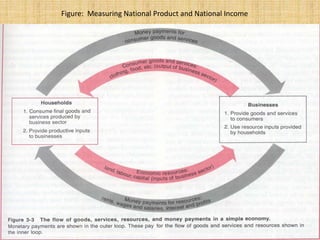
• Production of goods and service generates income and income give 
rise to demand for goods and service, demand give rise to 
expenditure, and expenditure give further rise to production of 
goods and service. there is a circular flow of production, income and 
expenditure. 
• On the basis of these flows, national income can be analysed at 
1. as a flow of goods and services 
2. as a flow of incomes 
3. as a flow of expenditure on goods and services.
Figure: Measuring National Product and National Income
A. Product Method 
(a) Final product approach 
• The final product approach involves estimation of the market value of 
final goods and services produced in the economy in a given period.
Steps in Final Product Approach: 
(i) The market value of all final goods and service produced within the 
country gives the estimate of Gross Domestic Product at Market 
Price (GDP at MP) 
(ii) The addition of net factor income from abroad in GDP at 
MP gives Gross National Product at Market Price 
(GNP at MP). 
(iii) The deduction of depreciation from Gross National 
Product at market price (GNP at MP) MP provides 
Net National Product at market Price (NNP at MP). 
(iv) The deduction of net indirect taxes from NNP at MP give 
Net National Product at Factor Cost (NNP at FC)
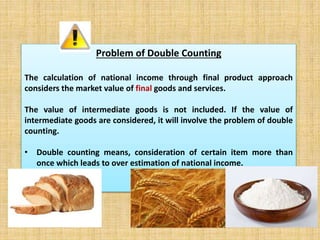
Problem of Double Counting 
The calculation of national income through final product approach 
considers the market value of final goods and services. 
The value of intermediate goods is not included. If the value of 
intermediate goods are considered, it will involve the problem of double 
counting. 
• Double counting means, consideration of certain item more than 
once which leads to over estimation of national income.
B. Income Method 
• It is the sum of all income derived from providing the factors of 
production. 
• It includes wages and salaries, rent, interest and profits within a 
country in a given year.
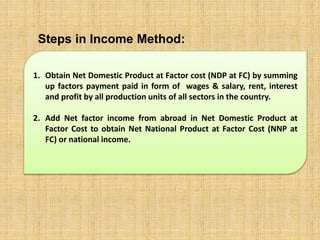
Steps in Income Method: 
1. Obtain Net Domestic Product at Factor cost (NDP at FC) by summing 
up factors payment paid in form of wages & salary, rent, interest 
and profit by all production units of all sectors in the country. 
2. Add Net factor income from abroad in Net Domestic Product at 
Factor Cost to obtain Net National Product at Factor Cost (NNP at 
FC) or national income.
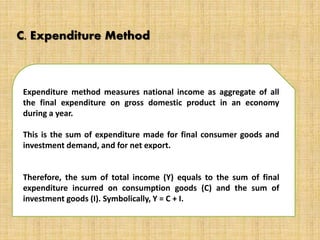
C. Expenditure Method 
Expenditure method measures national income as aggregate of all 
the final expenditure on gross domestic product in an economy 
during a year. 
This is the sum of expenditure made for final consumer goods and 
investment demand, and for net export. 
Therefore, the sum of total income (Y) equals to the sum of final 
expenditure incurred on consumption goods (C) and the sum of 
investment goods (I). Symbolically, Y = C + I.
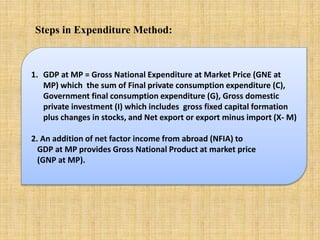
Steps in Expenditure Method: 
1. GDP at MP = Gross National Expenditure at Market Price (GNE at 
MP) which the sum of Final private consumption expenditure (C), 
Government final consumption expenditure (G), Gross domestic 
private investment (I) which includes gross fixed capital formation 
plus changes in stocks, and Net export or export minus import (X- M) 
2. An addition of net factor income from abroad (NFIA) to 
GDP at MP provides Gross National Product at market price 
(GNP at MP).
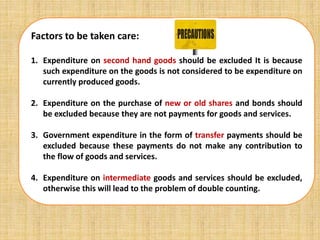
Factors to be taken care: 
1. Expenditure on second hand goods should be excluded It is because 
such expenditure on the goods is not considered to be expenditure on 
currently produced goods. 
2. Expenditure on the purchase of new or old shares and bonds should 
be excluded because they are not payments for goods and services. 
3. Government expenditure in the form of transfer payments should be 
excluded because these payments do not make any contribution to 
the flow of goods and services. 
4. Expenditure on intermediate goods and services should be excluded, 
otherwise this will lead to the problem of double counting.
Is the measurement of NI is an easy 
task? 
• There are challenges of measuring NI, some of 
them are as follows: 
1. Simon Kuznet’s difficulties (Definition of the 
term Nation, Method to be used, Stage of 
economic activity, Types of goods and 
services) 
2. Problem of double counting 
3. Transfer payments 
4. Income generated by foreign firms 
5. Calculation of depreciation.
What are the uses of national income 
statistics? 
• Formulation of economic policies 
• Studying economic structure 
• Inter- sectoral comparisons 
• Indicator of economic welfare 
• Making international comparisons
Thank you.

NATIONAL INCOME PPT

  • 1.
    National Income By- Roopak Malik & Raneesh Choudhary
  • 2.
    What is NationalIncome? • National income measures the total value of goods and services produced within the economy over a period of time.
  • 3.
    Why is nationalincome important? • Measuring the level and rate of growth of national income is important to economists when they are considering: – Economic growth and where a country is in the business cycle – Changes to average living standards of the population – Looking at the distribution of national income (i.e. measuring income and wealth inequalities)
  • 4.
    NATIONAL INCOME CONCEPTS • Gross domestic product (GDP) is defined as "an aggregate measure of production equal to the sum of the gross values added of all resident institutional units engaged in production • Gross national product (GNP) is the market value of all the productsand services produced in one year by labor and property supplied by the citizens of a country.
  • 5.
    • Personal Income(PI) Personal Income i s the total money income received by individuals and households of a country from all possible sources before direct taxes. • Per Capita Income (PCI) Per Capita Income of a country is derived by dividing the national income of the country by the total population of a country.
  • 6.
    National Income: Conceptand Measurement • Production of goods and service generates income and income give rise to demand for goods and service, demand give rise to expenditure, and expenditure give further rise to production of goods and service. there is a circular flow of production, income and expenditure. • On the basis of these flows, national income can be analysed at 1. as a flow of goods and services 2. as a flow of incomes 3. as a flow of expenditure on goods and services.
  • 7.
    Figure: Measuring NationalProduct and National Income
  • 8.
    A. Product Method (a) Final product approach • The final product approach involves estimation of the market value of final goods and services produced in the economy in a given period.
  • 9.
    Steps in FinalProduct Approach: (i) The market value of all final goods and service produced within the country gives the estimate of Gross Domestic Product at Market Price (GDP at MP) (ii) The addition of net factor income from abroad in GDP at MP gives Gross National Product at Market Price (GNP at MP). (iii) The deduction of depreciation from Gross National Product at market price (GNP at MP) MP provides Net National Product at market Price (NNP at MP). (iv) The deduction of net indirect taxes from NNP at MP give Net National Product at Factor Cost (NNP at FC)
  • 10.
    Problem of DoubleCounting The calculation of national income through final product approach considers the market value of final goods and services. The value of intermediate goods is not included. If the value of intermediate goods are considered, it will involve the problem of double counting. • Double counting means, consideration of certain item more than once which leads to over estimation of national income.
  • 11.
    B. Income Method • It is the sum of all income derived from providing the factors of production. • It includes wages and salaries, rent, interest and profits within a country in a given year.
  • 12.
    Steps in IncomeMethod: 1. Obtain Net Domestic Product at Factor cost (NDP at FC) by summing up factors payment paid in form of wages & salary, rent, interest and profit by all production units of all sectors in the country. 2. Add Net factor income from abroad in Net Domestic Product at Factor Cost to obtain Net National Product at Factor Cost (NNP at FC) or national income.
  • 13.
    C. Expenditure Method Expenditure method measures national income as aggregate of all the final expenditure on gross domestic product in an economy during a year. This is the sum of expenditure made for final consumer goods and investment demand, and for net export. Therefore, the sum of total income (Y) equals to the sum of final expenditure incurred on consumption goods (C) and the sum of investment goods (I). Symbolically, Y = C + I.
  • 14.
    Steps in ExpenditureMethod: 1. GDP at MP = Gross National Expenditure at Market Price (GNE at MP) which the sum of Final private consumption expenditure (C), Government final consumption expenditure (G), Gross domestic private investment (I) which includes gross fixed capital formation plus changes in stocks, and Net export or export minus import (X- M) 2. An addition of net factor income from abroad (NFIA) to GDP at MP provides Gross National Product at market price (GNP at MP).
  • 15.
    Factors to betaken care: 1. Expenditure on second hand goods should be excluded It is because such expenditure on the goods is not considered to be expenditure on currently produced goods. 2. Expenditure on the purchase of new or old shares and bonds should be excluded because they are not payments for goods and services. 3. Government expenditure in the form of transfer payments should be excluded because these payments do not make any contribution to the flow of goods and services. 4. Expenditure on intermediate goods and services should be excluded, otherwise this will lead to the problem of double counting.
  • 16.
    Is the measurementof NI is an easy task? • There are challenges of measuring NI, some of them are as follows: 1. Simon Kuznet’s difficulties (Definition of the term Nation, Method to be used, Stage of economic activity, Types of goods and services) 2. Problem of double counting 3. Transfer payments 4. Income generated by foreign firms 5. Calculation of depreciation.
  • 17.
    What are theuses of national income statistics? • Formulation of economic policies • Studying economic structure • Inter- sectoral comparisons • Indicator of economic welfare • Making international comparisons
  • 18.

Editor's Notes

  • #5 GDP: MEASURED IN market prices.