Ecology
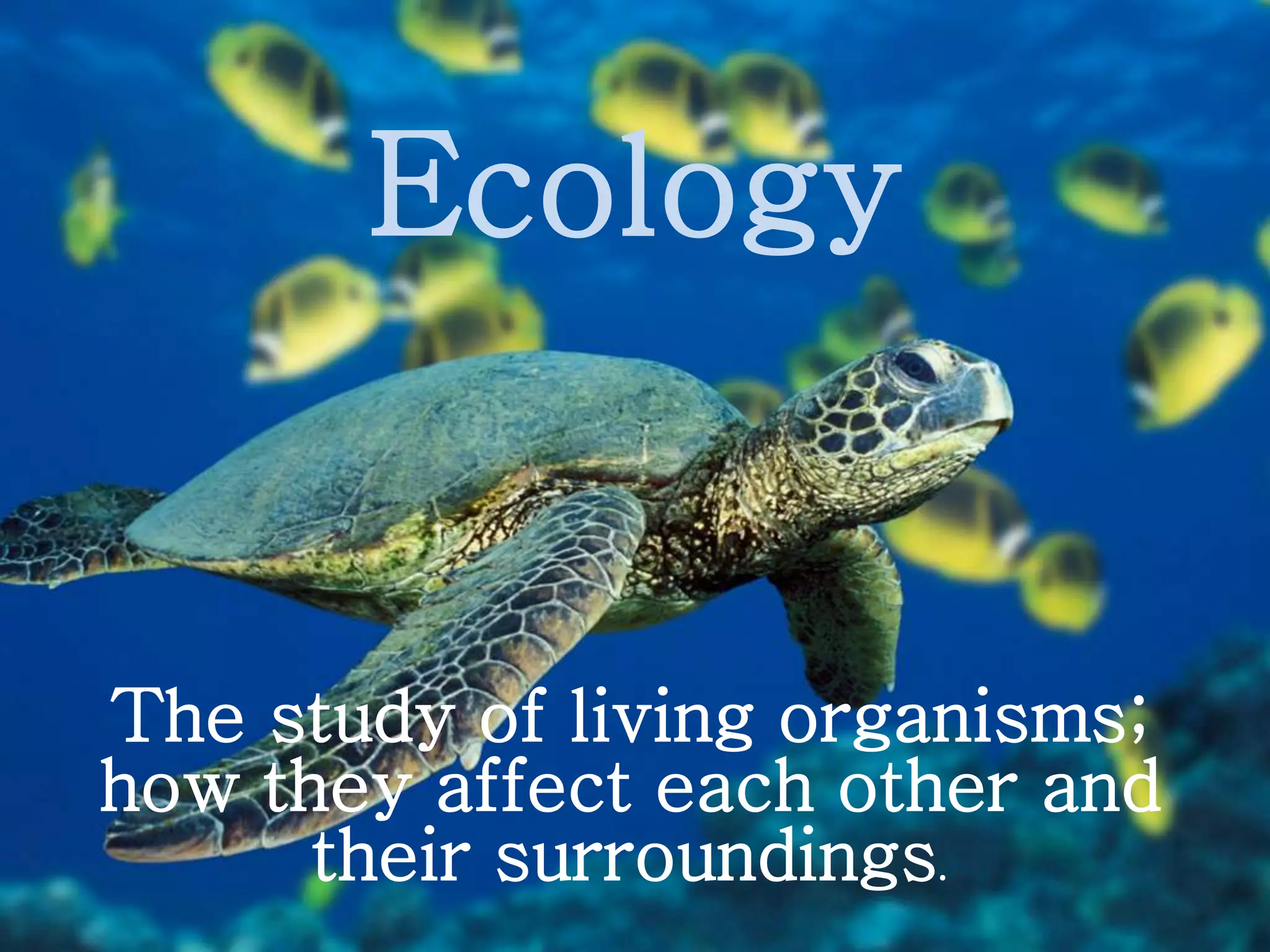
The study of living organisms;
how they affect each other and
their surroundings.
Terms to learn before we start.
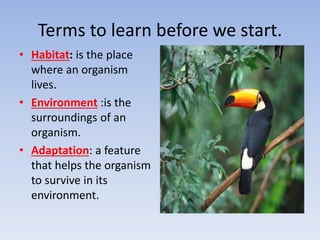
• Habitat: is the place
where an organism
lives.
• Environment :is the
surroundings of an
organism.
• Adaptation: a feature
that helps the organism
to survive in its
environment.
Adaptation
A body part, body covering, or behavior that
helps an animal survive in its environment.
• Behavior
The actions of an animal.
• Camouflage
A colour or shape in an animal's body covering that helps it
blend into its environment.
• Environment
Everything that surrounds and affects a living thing. The
environment includes non-living things, such as water and
air, as well as other living things.
• Mimicry
An adaptation in which an otherwise harmless animal looks
like a harmful animal in order to protect itself.
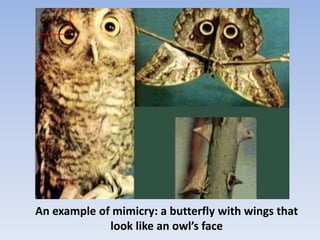
An example of mimicry: a butterfly with wings that
look like an owl’s face
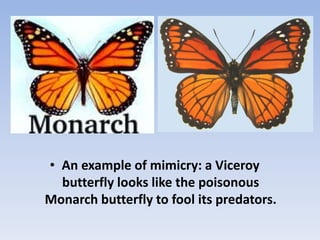
• An example of mimicry: a Viceroy
butterfly looks like the poisonous
Monarch butterfly to fool its predators.
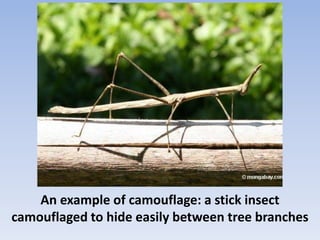
An example of camouflage: a stick insect
camouflaged to hide easily between tree branches
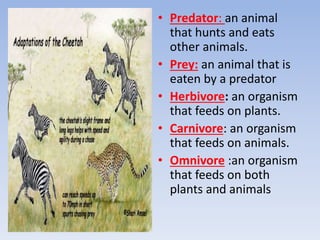
• Predator: an animal
that hunts and eats
other animals.
• Prey: an animal that is
eaten by a predator
• Herbivore: an organism
that feeds on plants.
• Carnivore: an organism
that feeds on animals.
• Omnivore :an organism
that feeds on both
plants and animals
Energy flow, food chains & food webs
• The main source of
energy for all living things
is the ……………
• This energy is captured by
…………………..
• Producer: an organism
that can make its own
food
• Consumer: an organism
that feeds on other
organisms.
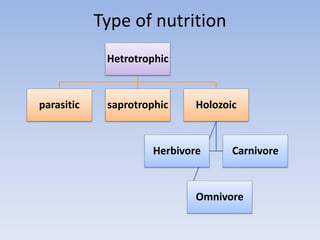
Type of nutrition
Hetrotrophic
parasitic saprotrophic Holozoic
Herbivore Carnivore
Omnivore
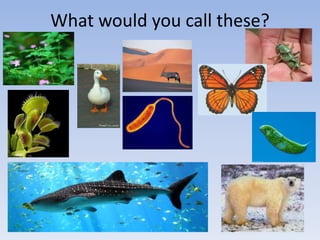
What would you call these?
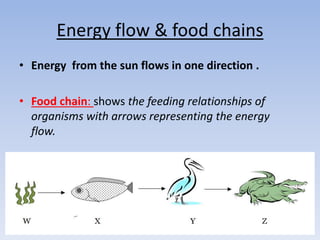
Energy flow & food chains
• Energy from the sun flows in one direction .
• Food chain: shows the feeding relationships of
organisms with arrows representing the energy
flow.
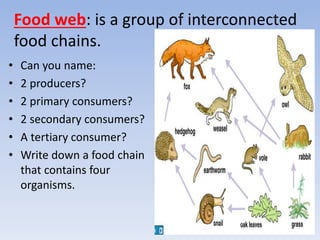
Food web: is a group of interconnected
food chains.
• Can you name:
• 2 producers?
• 2 primary consumers?
• 2 secondary consumers?
• A tertiary consumer?
• Write down a food chain
that contains four
organisms.
More terms!!!
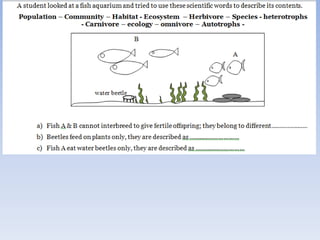
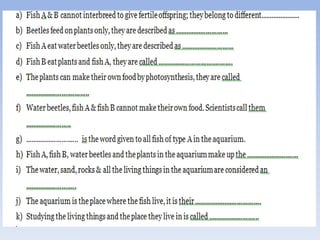
• Population: the number of organisms of the
same species in one area.
• Community: all the different populations
present in one area.
• Ecosystem: a system containing all non-living
and living things in the same area.
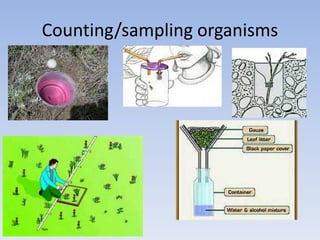
Counting/sampling organisms
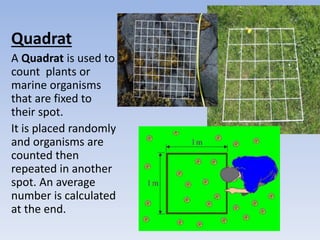
Quadrat
A Quadrat is used to
count plants or
marine organisms
that are fixed to
their spot.
It is placed randomly
and organisms are
counted then
repeated in another
spot. An average
number is calculated
at the end.
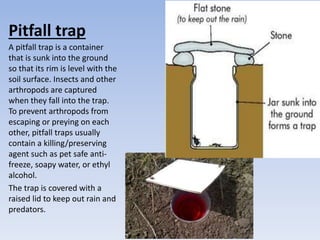
Pitfall trap
A pitfall trap is a container
that is sunk into the ground
so that its rim is level with the
soil surface. Insects and other
arthropods are captured
when they fall into the trap.
To prevent arthropods from
escaping or preying on each
other, pitfall traps usually
contain a killing/preserving
agent such as pet safe anti-
freeze, soapy water, or ethyl
alcohol.
The trap is covered with a
raised lid to keep out rain and
predators.
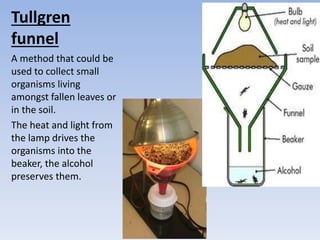
Tullgren
funnel
A method that could be
used to collect small
organisms living
amongst fallen leaves or
in the soil.
The heat and light from
the lamp drives the
organisms into the
beaker, the alcohol
preserves them.
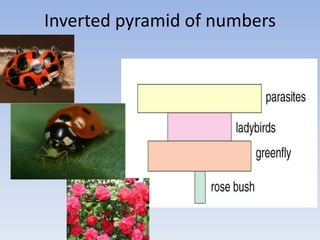
Inverted pyramid of numbers
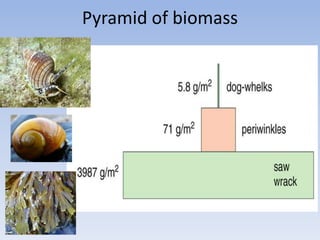
Pyramid of biomass
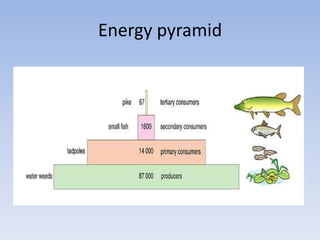
Energy pyramid
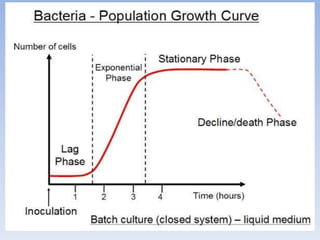
Population curve
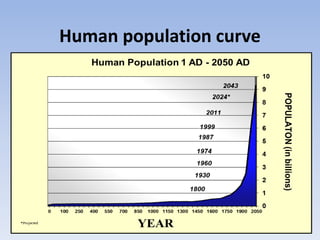
Human population curve
Factors affecting size of population
1. Availability of food
2. Presence of predators
3. Spread of disease
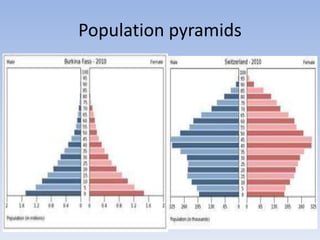
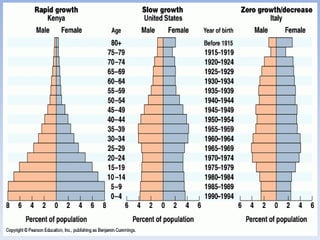
Population pyramids
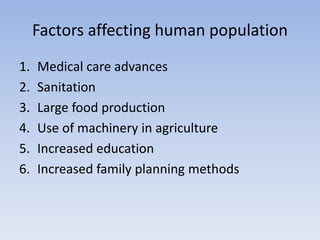
Factors affecting human population
1. Medical care advances
2. Sanitation
3. Large food production
4. Use of machinery in agriculture
5. Increased education
6. Increased family planning methods
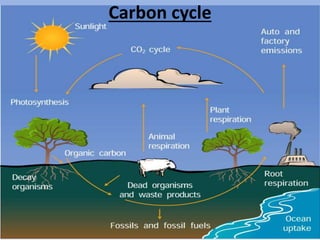
Carbon cycle
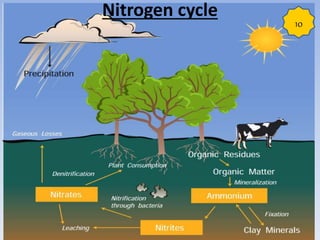
Nitrogen cycle
10

Ecology2018

  • 1.
    Ecology The study ofliving organisms; how they affect each other and their surroundings.
  • 2.
    Terms to learnbefore we start. • Habitat: is the place where an organism lives. • Environment :is the surroundings of an organism. • Adaptation: a feature that helps the organism to survive in its environment.
  • 3.
    Adaptation A body part,body covering, or behavior that helps an animal survive in its environment. • Behavior The actions of an animal. • Camouflage A colour or shape in an animal's body covering that helps it blend into its environment. • Environment Everything that surrounds and affects a living thing. The environment includes non-living things, such as water and air, as well as other living things. • Mimicry An adaptation in which an otherwise harmless animal looks like a harmful animal in order to protect itself.
  • 4.
    An example ofmimicry: a butterfly with wings that look like an owl’s face
  • 5.
    • An exampleof mimicry: a Viceroy butterfly looks like the poisonous Monarch butterfly to fool its predators.
  • 6.
    An example ofcamouflage: a stick insect camouflaged to hide easily between tree branches
  • 7.
    • Predator: ananimal that hunts and eats other animals. • Prey: an animal that is eaten by a predator • Herbivore: an organism that feeds on plants. • Carnivore: an organism that feeds on animals. • Omnivore :an organism that feeds on both plants and animals
  • 8.
    Energy flow, foodchains & food webs • The main source of energy for all living things is the …………… • This energy is captured by ………………….. • Producer: an organism that can make its own food • Consumer: an organism that feeds on other organisms.
  • 9.
    Type of nutrition Hetrotrophic parasiticsaprotrophic Holozoic Herbivore Carnivore Omnivore
  • 10.
    What would youcall these?
  • 11.
    Energy flow &food chains • Energy from the sun flows in one direction . • Food chain: shows the feeding relationships of organisms with arrows representing the energy flow.
  • 12.
    Food web: isa group of interconnected food chains. • Can you name: • 2 producers? • 2 primary consumers? • 2 secondary consumers? • A tertiary consumer? • Write down a food chain that contains four organisms.
  • 13.
    More terms!!! • Population:the number of organisms of the same species in one area. • Community: all the different populations present in one area. • Ecosystem: a system containing all non-living and living things in the same area.
  • 16.
  • 17.
    Quadrat A Quadrat isused to count plants or marine organisms that are fixed to their spot. It is placed randomly and organisms are counted then repeated in another spot. An average number is calculated at the end.
  • 18.
    Pitfall trap A pitfalltrap is a container that is sunk into the ground so that its rim is level with the soil surface. Insects and other arthropods are captured when they fall into the trap. To prevent arthropods from escaping or preying on each other, pitfall traps usually contain a killing/preserving agent such as pet safe anti- freeze, soapy water, or ethyl alcohol. The trap is covered with a raised lid to keep out rain and predators.
  • 19.
    Tullgren funnel A method thatcould be used to collect small organisms living amongst fallen leaves or in the soil. The heat and light from the lamp drives the organisms into the beaker, the alcohol preserves them.
  • 20.
  • 21.
  • 22.
  • 23.
  • 24.
  • 25.
    Factors affecting sizeof population 1. Availability of food 2. Presence of predators 3. Spread of disease
  • 26.
  • 28.
    Factors affecting humanpopulation 1. Medical care advances 2. Sanitation 3. Large food production 4. Use of machinery in agriculture 5. Increased education 6. Increased family planning methods
  • 30.
  • 31.