Ecology
Learning objectives:
Develop your knowledge and
understanding of:
– Terms used in ecology
– Biotic and abiotic factors: Food
chains and webs
– Special feeding relationships
(symbiosis)
– Soil - Edaphic factor
– Cycles of nature/Ecological Cycles
– Sampling techniques
Terms in ecology
Learning objectives:
Develop your knowledge and understanding of:
– Define specific terms used in ecology
– Discuss the impact of abiotic factors on the
distribution of living organisms.
– Discuss adaptations of organisms to thrive in
various environments.
Terms in ecology
Learning objectives:
• Define specific terms used in
ecology.
• Discuss the impact of abiotic
factors on the distribution of
living organisms.
• Discuss adaptations of
organisms to thrive in various
environments.
WHAT IS ECOLOGY?
Ecology- the scientific study of
interactions between organisms
and their environments, focusing
on energy transfer
Ecology is a science of relationships
among living and non-living things
WHAT DO YOU MEAN BY ENVIRONMENT?
The environment is made
up of two factors:
• Biotic factors- all
living organisms
inhabiting the Earth
• Abiotic factors- nonliving
parts of the
environment (i.e.
temperature, soil, light,
moisture, air currents,
pH, salinity)
Biosphere
Ecosystem
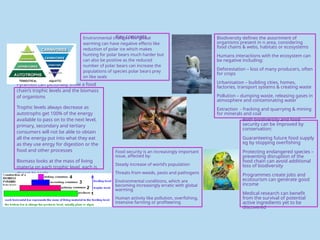
Community
Population
Organism
Ecosystems have levels of organisation:
1)Individuals – an organism of a species eg
magpie
2)Population – all organisms of a species in a
specific habitat eg flock of magpie in the
park
3)Community – all the populations in a given
habitat eg all the species in the park
4)Ecosystem - the community of organisms
and the abiotic conditions affecting the
habitat eg all the species and the non-living
aspects of the park
Ecosystem
▪ All biotic (living) and
abiotic (non-living)
components and
their interactions
with each other.
▪ These interactions
occur in a defined
area, however, this
area is not limited by
size (e.g. forest,
meadow, log).
Ecosystem
▪ Ecosystems are
characterized by flow of
energy through food
webs, production and
decomposition of
organic matter, and
cycling of nutrient
elements.
Trophic Level
▪ Trophic levels are
the feeding
position in a food
chain such as
primary producers,
herbivore, primary
carnivore, etc.
▪ Green plants form
the first trophic
level, the
producers.
Trophic Levels
▪ Herbivores form
the second trophic
level.
▪ Carnivores form
the third and even
the fourth trophic
levels.
Pyramid of Energy Flow
▪ A pyramid of
energy flow
displays how
energy is
distributed within
a food chain.
▪ It displays the
amount of energy
absorbed at each
level, the amount of
energy that is
consumed by the
higher trophic level
and the amount of
energy lost to heat
and death.
Consumers
▪ All the organisms that can
not make their own food
(and need producers) are
called heterotrophs.
▪ In an ecosystem
heterotrophs are called
consumers because they
depend on others. They
obtain food by eating
other organisms.
Producers
▪ Organisms, such
as plants, that
produce their own
food are called
autotrophs.
▪ They are called
producers
because all of the
species of the
ecosystem
depend on them.
Decomposers
▪ Decomposers and
scavengers break
down dead plants
and animals.
▪ They also break down
the waste eliminated
by other organisms.
Detritivores
▪ Organisms that
recycle decomposing
organic material,
returning it into the
food chain.
▪ E.g. Earthworms eat
rotting plant leaves
and other debris.
Dung beetles eat
feces.
Organism - any unicellular or
multicellular form exhibiting all of the
characteristics of life, an individual.
•The lowest level of organization
POPULATION
✔ a group of
organisms of one
species living in the
same place at the same
time that interbreed
✔Produce fertile offspring
✔Compete with each other
for resources (food,
mates, shelter, etc.)
Community - several interacting
populations that inhabit a common
environment and are interdependent.
Ecosystem - populations in a
community and the abiotic factors
with which they interact (ex.
marine, terrestrial)
Ecosystems are complex, depicting
organisms relationships with biotic and
abiotic factors and their environments
Examples include a desert or a marsh
Biosphere - life supporting portions
of Earth composed of air, land,
fresh water, and salt water.
• The highest level of organization
Habitat vs. Niche
Niche - the role a species plays in
a community; its total way of life
Habitat- the place in which an
organism lives out its life
Habitat vs. Niche
A niche is determined by the
tolerance limitations of an
organism, or a limiting factor.
Limiting factor- any biotic or
abiotic factor that restricts the
existence of organisms in a
specific environment.
Examples of limiting factors -
• Amount of water
• Amount of food
• Temperature
• Amount of space
• Availability of mates
Habitat vs. Niche
Biotic and abiotic factors
Learning objectives:
• Identify the position of producers and consumers in a food
chain
• Identify food chains from the following habitats: terrestrial
and aquatic (marine and freshwater)
• Identify herbivores, carnivores and omnivores
• Identify predator prey relationships in a habitat
• Describe adaptations of both predator and prey
• Construct food chains and webs with no less than four
trophic levels
• Explain the role of decomposers
• Explain the flow of energy in food chains and webs
• Construct the types of ecological pyramids.
• State the limitations of each type of pyramid.
Key concepts
Biotic factors include
• Availability of food – directly affects population
sizes, dictating ability to survive and reproduce
• Predators – interdependence between predators
needing food and prey thriving in their absence
• Pathogens – can cause natural selection by killing
off a subsection of a population or community
• Competition for resources – food, mates, water or
territory/space can be competed for by members
of a population or a community
Key concepts
Abiotic factors include
• Light intensity – affects photosynthesis rate and thus plant
growth and food availability.
• Moisture levels – affect both animals and plants directly as
they require water for life
• Temperature – can affect species migration and changes like
global warming can change habitats
• Soil/water pH – can affect distribution of plants which can
affect other organisms
• Climate conditions – some organisms are specialised to deal
with specific environments and changes like global warming
can make a habitat unviable
Food chain- simple diagram that
shows how matter and energy move
through an ecosystem from on
organism to another
• Food chains consist of two main
groups of organisms
1.Producer e.g.(aquatic)
phytoplankton, mosses
2. Consumer
Niche
Producer- all
autotrophs (plants),
they trap energy
from the sun
• Bottom of the food
chain
Producer (trophic level 1)
Primary consumer (trophic level 2)
Secondary consumer (trophic level 3)
Tertiary consumer (trophic level 4)
Trophic Levels
Limited to 4 trophic levels due to
a decrease in energy from one
level to the next.
Loss of Energy at Trophic Levels
Used by organisms for respiration,
growth, reproduction.
Loss in the form of heat and
excretory products urine, faeces.
NB. ~ 10% is transferred at each level
For you to do:
• Constructing food chains:
• 1. Aquatic ( marine ,
freshwater)
• 2. Terrestrial
Special feeding techniques
(symbiosis)
Learning objectives:
• Describe
parasitism,
mutualism and
commensalism,
providing suitable
examples
Feeding Relationships
Consumer- all heterotrophs:
they ingest food containing the
sun’s energy
□Herbivores
□Carnivores
□Omnivores
□Decomposers
Feeding Relationships
CONSUMERS
1.Primary consumers
• Eat plants
• Herbivores
• Secondary, tertiary
… consumers
• Prey animals
• Carnivores
Feeding Relationships
Consumer-Carnivores-eat meat
• Predators
– Hunt prey
animals for food.
Feeding Relationships
Consumer- Carnivores- eat meat
• Scavengers
– Feed on
dead animals
Feeding Relationships
Consumer- Omnivores -eat both
plants and animals
Feeding Relationships
Consumer-
Decomposers
• Breakdown the
complex compounds
of dead and decaying
plants and animals
into simpler
molecules that can
be absorbed
Trophic Levels
• Each link in a food chain is known
as a trophic level.
• Trophic levels represent a feeding
step in the transfer of energy
and matter in an ecosystem.
Soil – Edaphic factors
Learning objectives:
• State the major components of
the soil
• State the importance of soil to
living organisms
Sampling techniques
Learning objectives:
• Carryout simple ecological
• study using appropriate
collecting and sampling
methods
Cycles of nature/ecological
cycles
Learning objectives:
– Explain the importance of
reusing materials
– The Carbon Cycle
The carbon cycle – carbon moves between the
atmosphere to photosynthesisers & the sea,
predators and rocks before being returned to
the environment by decay, respiration or
human activity
Key concepts
Environmental changes like global
warming can have negative effects like
reduction of polar ice which makes
hunting for polar bears much harder but
can also be positive as the reduced
number of polar bears can increase the
populations of species polar bears prey
on like seals
Food security is an increasingly important
issue, affected by:
Steady increase of world’s population
Threats from weeds, pests and pathogens
Environmental conditions, which are
becoming increasingly erratic with global
warming
Human activity like pollution, overfishing,
intensive farming or profiteering
Biodiversity defines the assortment of
organisms present in n area, considering
food chains & webs, habitats or ecosystems
Humans interactions with the ecosystem can
be negative including:
Deforestation – loss of many producers, often
for crops
Urbanisation – building cities, homes,
factories, transport systems & creating waste
Pollution – dumping waste, releasing gases in
atmosphere and contaminating water
Extraction - fracking and quarrying & mining
for minerals and coal
Pyramids can pictorially show a food
chain’s trophic levels and the biomass
of organisms
Trophic levels always decrease as
autotrophs get 100% of the energy
available to pass on to the next level,
primary, secondary and tertiary
consumers will not be able to obtain
all the energy put into what they eat
as they use enrgy for digestion or the
food and other processes
Biomass looks at the mass of living
materia on each trophic level, each is
drawn to scale
Both biodiversity and food
security can be improved by
conservation:
Guaranteeing future food supply
eg by stopping overfishing
Protecting endangered species –
preventing disruption of the
food chain can avoid additional
loss of biodiversity
Programmes create jobs and
ecotourism can generate good
income
Medical research can benefit
from the survival of potential
active ingredients yet to be
discovered
Past exam questions
Plants absorb atmospheric carbon dioxide for use during
photosynthesis which uses carbon to produce glucose
which is either used for respiration or eaten by a woodland
herbivore/omnivore. This herbivore/omnivore may then be
eaten by a predator, transferring what energy isn’t lost
from respiration. As organisms along the food chain
excrete or die detritivores decompose the non-living matter
which releases carbon dioxide back into the atmosphere
generate carbon dioxide from respiration
1) Concerns about the health of the cow after
eating the GM rye grass
2) Concerns about the effect on the ecosystem
The desired gene is identified in a high sugar producing plant and
removed using enzymes then inserted into the rye grass genome
using more enzymes
Past exam questions
Group 2
measured
using only
whole
number,
making their
data less
accurate
Too little
variation in
the numbers
despite the
changing
oxygen
levels
The sewage will contain decomposing
bacteria which will use more oxygen for
respiration, depleting levels in this part of the
river
More councils composting could reduce
landfills and produce fertilisers to
provide more plants with the nutrients
and fund the scheme through fertiliser
sales
Freshwater louse
Past exam questions
Decomposers respire, releasing
carbon dioxide from digested
waste or dead organisms
1) Increased rate of decay with higher
temperatures because detritivores
are more active in hotter conditions
2) Leaves from region B were decayed
more rapidly in higher temperatures
Deforestation disrupts the carbon cycle, removing
photosynthesisers which would normally take
more carbon dioxide from the atmosphere and
release more oxygen into it. Additional carbon is
released by the burning of wood, decomposition
of dead matter and additional pastoral farming
could release more carbon through waste gas and
excrement. Increased respiration of farm animals
and decomposers with the decreased
photosynthesis will lead to less oxygen in the
atmosphere and less carbon.
1) Rate of decay increased by higher
temperatures
2) Rate of decay increased by higher
oxygen concentrations
1) Trees are cut down to produce
lumber
2) Trees may be cleared for urban
development
Past exam questions
The section would be measured using tape
to locate (an) appropriate quadrant(s) to
sample. These quadrants can then be used
to determine the proportioning of the area
to the sample so cover can be estimated
1) Potamogeton plants are taller so they
outcompete the Nitel plants for light
2) Taller plants are likely to have long roots for
support so Potamogeton plants may also
outcompete the Nitel plants for soil
nutrients
4 limpets + 2 barnacles = 6 animals
Only 1 species was observed
Temperature
Predators
Staying in the shade will help the gazelle to
stay cool and avoid water loss through sweat
Using less oxygen means less water is
release fro aerobic respiration and less
breathing to facilitate respiration means
less water lis ost through exhalation
Glossary
Rates of decay can be affected by:
• Oxygen availability for respiration
• Temperature conditions as reactions require warmth but enzymes are likely
to denature over 50o
C
• Water concentrations, moist conditions increase the rate of decomposition
but too much water in soil can reduce the oxygen content causing less
efficient anaerobic reactions which release methane
• Concentration of decomposers as higher concentrations increase the rate
of decomposition and digestion
Predator prey
population size
relationships
Efficiency of
energy transfer
through trophic
levels can be
calculated
energy available/transferred to the next level
Efficiency = ------------------------------------------------------------- x 100
energy that was available to the previous level
Glossary
Kite diagrams show abundance
and distribution of organisms
Distribution of organisms in an area
can be investigated using transects to
measure along a gradient and
quadrants to get a random sample of
percentage cover, population density
and population size
number in 1st sample x number in 2nd sample
Population
size
= ------------------------------------------------------------------------------
number in 2nd sample previously marked in 1st sample
Distribution of animals can also be examined by using catch and release
methods including using a pooter, a pitfall trap or an insect net

Dont touchmeeeeeeeeeeeeeeeeeeeeeeeeeeeeee

  • 1.
    Ecology Learning objectives: Develop yourknowledge and understanding of: – Terms used in ecology – Biotic and abiotic factors: Food chains and webs – Special feeding relationships (symbiosis) – Soil - Edaphic factor – Cycles of nature/Ecological Cycles – Sampling techniques
  • 2.
    Terms in ecology Learningobjectives: Develop your knowledge and understanding of: – Define specific terms used in ecology – Discuss the impact of abiotic factors on the distribution of living organisms. – Discuss adaptations of organisms to thrive in various environments.
  • 3.
    Terms in ecology Learningobjectives: • Define specific terms used in ecology. • Discuss the impact of abiotic factors on the distribution of living organisms. • Discuss adaptations of organisms to thrive in various environments.
  • 4.
    WHAT IS ECOLOGY? Ecology-the scientific study of interactions between organisms and their environments, focusing on energy transfer Ecology is a science of relationships among living and non-living things
  • 5.
    WHAT DO YOUMEAN BY ENVIRONMENT? The environment is made up of two factors: • Biotic factors- all living organisms inhabiting the Earth • Abiotic factors- nonliving parts of the environment (i.e. temperature, soil, light, moisture, air currents, pH, salinity)
  • 6.
  • 7.
    Ecosystems have levelsof organisation: 1)Individuals – an organism of a species eg magpie 2)Population – all organisms of a species in a specific habitat eg flock of magpie in the park 3)Community – all the populations in a given habitat eg all the species in the park 4)Ecosystem - the community of organisms and the abiotic conditions affecting the habitat eg all the species and the non-living aspects of the park
  • 8.
    Ecosystem ▪ All biotic(living) and abiotic (non-living) components and their interactions with each other. ▪ These interactions occur in a defined area, however, this area is not limited by size (e.g. forest, meadow, log).
  • 9.
    Ecosystem ▪ Ecosystems are characterizedby flow of energy through food webs, production and decomposition of organic matter, and cycling of nutrient elements.
  • 10.
    Trophic Level ▪ Trophiclevels are the feeding position in a food chain such as primary producers, herbivore, primary carnivore, etc. ▪ Green plants form the first trophic level, the producers.
  • 11.
    Trophic Levels ▪ Herbivoresform the second trophic level. ▪ Carnivores form the third and even the fourth trophic levels.
  • 12.
    Pyramid of EnergyFlow ▪ A pyramid of energy flow displays how energy is distributed within a food chain. ▪ It displays the amount of energy absorbed at each level, the amount of energy that is consumed by the higher trophic level and the amount of energy lost to heat and death.
  • 13.
    Consumers ▪ All theorganisms that can not make their own food (and need producers) are called heterotrophs. ▪ In an ecosystem heterotrophs are called consumers because they depend on others. They obtain food by eating other organisms.
  • 14.
    Producers ▪ Organisms, such asplants, that produce their own food are called autotrophs. ▪ They are called producers because all of the species of the ecosystem depend on them.
  • 15.
    Decomposers ▪ Decomposers and scavengersbreak down dead plants and animals. ▪ They also break down the waste eliminated by other organisms.
  • 16.
    Detritivores ▪ Organisms that recycledecomposing organic material, returning it into the food chain. ▪ E.g. Earthworms eat rotting plant leaves and other debris. Dung beetles eat feces.
  • 17.
    Organism - anyunicellular or multicellular form exhibiting all of the characteristics of life, an individual. •The lowest level of organization
  • 18.
    POPULATION ✔ a groupof organisms of one species living in the same place at the same time that interbreed ✔Produce fertile offspring ✔Compete with each other for resources (food, mates, shelter, etc.)
  • 19.
    Community - severalinteracting populations that inhabit a common environment and are interdependent.
  • 21.
    Ecosystem - populationsin a community and the abiotic factors with which they interact (ex. marine, terrestrial)
  • 22.
    Ecosystems are complex,depicting organisms relationships with biotic and abiotic factors and their environments Examples include a desert or a marsh
  • 23.
    Biosphere - lifesupporting portions of Earth composed of air, land, fresh water, and salt water. • The highest level of organization
  • 24.
    Habitat vs. Niche Niche- the role a species plays in a community; its total way of life Habitat- the place in which an organism lives out its life
  • 25.
    Habitat vs. Niche Aniche is determined by the tolerance limitations of an organism, or a limiting factor. Limiting factor- any biotic or abiotic factor that restricts the existence of organisms in a specific environment.
  • 26.
    Examples of limitingfactors - • Amount of water • Amount of food • Temperature • Amount of space • Availability of mates Habitat vs. Niche
  • 27.
    Biotic and abioticfactors Learning objectives: • Identify the position of producers and consumers in a food chain • Identify food chains from the following habitats: terrestrial and aquatic (marine and freshwater) • Identify herbivores, carnivores and omnivores • Identify predator prey relationships in a habitat • Describe adaptations of both predator and prey • Construct food chains and webs with no less than four trophic levels • Explain the role of decomposers • Explain the flow of energy in food chains and webs • Construct the types of ecological pyramids. • State the limitations of each type of pyramid.
  • 28.
    Key concepts Biotic factorsinclude • Availability of food – directly affects population sizes, dictating ability to survive and reproduce • Predators – interdependence between predators needing food and prey thriving in their absence • Pathogens – can cause natural selection by killing off a subsection of a population or community • Competition for resources – food, mates, water or territory/space can be competed for by members of a population or a community
  • 29.
    Key concepts Abiotic factorsinclude • Light intensity – affects photosynthesis rate and thus plant growth and food availability. • Moisture levels – affect both animals and plants directly as they require water for life • Temperature – can affect species migration and changes like global warming can change habitats • Soil/water pH – can affect distribution of plants which can affect other organisms • Climate conditions – some organisms are specialised to deal with specific environments and changes like global warming can make a habitat unviable
  • 30.
    Food chain- simplediagram that shows how matter and energy move through an ecosystem from on organism to another
  • 31.
    • Food chainsconsist of two main groups of organisms 1.Producer e.g.(aquatic) phytoplankton, mosses 2. Consumer
  • 32.
    Niche Producer- all autotrophs (plants), theytrap energy from the sun • Bottom of the food chain
  • 34.
    Producer (trophic level1) Primary consumer (trophic level 2) Secondary consumer (trophic level 3) Tertiary consumer (trophic level 4)
  • 35.
    Trophic Levels Limited to4 trophic levels due to a decrease in energy from one level to the next.
  • 36.
    Loss of Energyat Trophic Levels Used by organisms for respiration, growth, reproduction. Loss in the form of heat and excretory products urine, faeces. NB. ~ 10% is transferred at each level
  • 37.
    For you todo: • Constructing food chains: • 1. Aquatic ( marine , freshwater) • 2. Terrestrial
  • 39.
    Special feeding techniques (symbiosis) Learningobjectives: • Describe parasitism, mutualism and commensalism, providing suitable examples
  • 40.
    Feeding Relationships Consumer- allheterotrophs: they ingest food containing the sun’s energy □Herbivores □Carnivores □Omnivores □Decomposers
  • 41.
    Feeding Relationships CONSUMERS 1.Primary consumers •Eat plants • Herbivores • Secondary, tertiary … consumers • Prey animals • Carnivores
  • 42.
    Feeding Relationships Consumer-Carnivores-eat meat •Predators – Hunt prey animals for food.
  • 43.
    Feeding Relationships Consumer- Carnivores-eat meat • Scavengers – Feed on dead animals
  • 44.
    Feeding Relationships Consumer- Omnivores-eat both plants and animals
  • 45.
    Feeding Relationships Consumer- Decomposers • Breakdownthe complex compounds of dead and decaying plants and animals into simpler molecules that can be absorbed
  • 46.
    Trophic Levels • Eachlink in a food chain is known as a trophic level. • Trophic levels represent a feeding step in the transfer of energy and matter in an ecosystem.
  • 47.
    Soil – Edaphicfactors Learning objectives: • State the major components of the soil • State the importance of soil to living organisms
  • 48.
    Sampling techniques Learning objectives: •Carryout simple ecological • study using appropriate collecting and sampling methods
  • 49.
    Cycles of nature/ecological cycles Learningobjectives: – Explain the importance of reusing materials – The Carbon Cycle
  • 50.
    The carbon cycle– carbon moves between the atmosphere to photosynthesisers & the sea, predators and rocks before being returned to the environment by decay, respiration or human activity
  • 51.
    Key concepts Environmental changeslike global warming can have negative effects like reduction of polar ice which makes hunting for polar bears much harder but can also be positive as the reduced number of polar bears can increase the populations of species polar bears prey on like seals Food security is an increasingly important issue, affected by: Steady increase of world’s population Threats from weeds, pests and pathogens Environmental conditions, which are becoming increasingly erratic with global warming Human activity like pollution, overfishing, intensive farming or profiteering Biodiversity defines the assortment of organisms present in n area, considering food chains & webs, habitats or ecosystems Humans interactions with the ecosystem can be negative including: Deforestation – loss of many producers, often for crops Urbanisation – building cities, homes, factories, transport systems & creating waste Pollution – dumping waste, releasing gases in atmosphere and contaminating water Extraction - fracking and quarrying & mining for minerals and coal Pyramids can pictorially show a food chain’s trophic levels and the biomass of organisms Trophic levels always decrease as autotrophs get 100% of the energy available to pass on to the next level, primary, secondary and tertiary consumers will not be able to obtain all the energy put into what they eat as they use enrgy for digestion or the food and other processes Biomass looks at the mass of living materia on each trophic level, each is drawn to scale Both biodiversity and food security can be improved by conservation: Guaranteeing future food supply eg by stopping overfishing Protecting endangered species – preventing disruption of the food chain can avoid additional loss of biodiversity Programmes create jobs and ecotourism can generate good income Medical research can benefit from the survival of potential active ingredients yet to be discovered
  • 52.
    Past exam questions Plantsabsorb atmospheric carbon dioxide for use during photosynthesis which uses carbon to produce glucose which is either used for respiration or eaten by a woodland herbivore/omnivore. This herbivore/omnivore may then be eaten by a predator, transferring what energy isn’t lost from respiration. As organisms along the food chain excrete or die detritivores decompose the non-living matter which releases carbon dioxide back into the atmosphere generate carbon dioxide from respiration 1) Concerns about the health of the cow after eating the GM rye grass 2) Concerns about the effect on the ecosystem The desired gene is identified in a high sugar producing plant and removed using enzymes then inserted into the rye grass genome using more enzymes
  • 53.
    Past exam questions Group2 measured using only whole number, making their data less accurate Too little variation in the numbers despite the changing oxygen levels The sewage will contain decomposing bacteria which will use more oxygen for respiration, depleting levels in this part of the river More councils composting could reduce landfills and produce fertilisers to provide more plants with the nutrients and fund the scheme through fertiliser sales Freshwater louse
  • 54.
    Past exam questions Decomposersrespire, releasing carbon dioxide from digested waste or dead organisms 1) Increased rate of decay with higher temperatures because detritivores are more active in hotter conditions 2) Leaves from region B were decayed more rapidly in higher temperatures Deforestation disrupts the carbon cycle, removing photosynthesisers which would normally take more carbon dioxide from the atmosphere and release more oxygen into it. Additional carbon is released by the burning of wood, decomposition of dead matter and additional pastoral farming could release more carbon through waste gas and excrement. Increased respiration of farm animals and decomposers with the decreased photosynthesis will lead to less oxygen in the atmosphere and less carbon. 1) Rate of decay increased by higher temperatures 2) Rate of decay increased by higher oxygen concentrations 1) Trees are cut down to produce lumber 2) Trees may be cleared for urban development
  • 55.
    Past exam questions Thesection would be measured using tape to locate (an) appropriate quadrant(s) to sample. These quadrants can then be used to determine the proportioning of the area to the sample so cover can be estimated 1) Potamogeton plants are taller so they outcompete the Nitel plants for light 2) Taller plants are likely to have long roots for support so Potamogeton plants may also outcompete the Nitel plants for soil nutrients 4 limpets + 2 barnacles = 6 animals Only 1 species was observed Temperature Predators Staying in the shade will help the gazelle to stay cool and avoid water loss through sweat Using less oxygen means less water is release fro aerobic respiration and less breathing to facilitate respiration means less water lis ost through exhalation
  • 56.
    Glossary Rates of decaycan be affected by: • Oxygen availability for respiration • Temperature conditions as reactions require warmth but enzymes are likely to denature over 50o C • Water concentrations, moist conditions increase the rate of decomposition but too much water in soil can reduce the oxygen content causing less efficient anaerobic reactions which release methane • Concentration of decomposers as higher concentrations increase the rate of decomposition and digestion Predator prey population size relationships Efficiency of energy transfer through trophic levels can be calculated energy available/transferred to the next level Efficiency = ------------------------------------------------------------- x 100 energy that was available to the previous level
  • 57.
    Glossary Kite diagrams showabundance and distribution of organisms Distribution of organisms in an area can be investigated using transects to measure along a gradient and quadrants to get a random sample of percentage cover, population density and population size number in 1st sample x number in 2nd sample Population size = ------------------------------------------------------------------------------ number in 2nd sample previously marked in 1st sample Distribution of animals can also be examined by using catch and release methods including using a pooter, a pitfall trap or an insect net

Editor's Notes

  • #1 Ask for own definition. NOTES.
  • #2 Ask for own definition. NOTES.
  • #3 Ask for own definition. NOTES.
  • #27 Ask for own definition. NOTES.
  • #39 Ask for own definition. NOTES.
  • #47 Ask for own definition. NOTES.
  • #48 Ask for own definition. NOTES.
  • #49 Ask for own definition. NOTES.