Lesson Overview   What is Ecology?


                                     Lesson Overview
                                      3.1 What Is Ecology?
Lesson Overview           What is Ecology?


  THINK ABOUT IT
     How is Earth, in a scientific sense, a
     “living planet”?
Lesson Overview         What is Ecology?


  Studying Our Living Planet
     What is ecology?
Lesson Overview          What is Ecology?


  Studying Our Living Planet
     What is ecology?

     Ecology is the scientific study of interactions among organisms and
     between organisms and their physical environment.
Lesson Overview          What is Ecology?


  Studying Our Living Planet
     The biosphere consists of all life on
     Earth and all parts of the Earth in
     which life exists, including land,
     water, and the atmosphere.

     The biosphere extends from about 8
     km above Earth’s surface to as far
     as 11 km below the surface of the
     ocean.
Lesson Overview         What is Ecology?


  The Science of Ecology
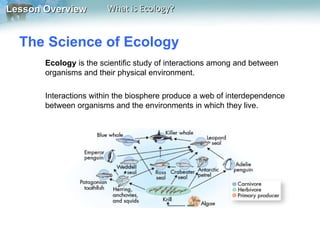
       Ecology is the scientific study of interactions among and between
       organisms and their physical environment.

       Interactions within the biosphere produce a web of interdependence
       between organisms and the environments in which they live.
Lesson Overview        What is Ecology?


  The Science of Ecology
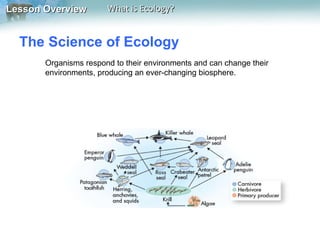
       Organisms respond to their environments and can change their
       environments, producing an ever-changing biosphere.
Lesson Overview        What is Ecology?


  Ecology and Economics
       Economics is concerned with interactions based on money.

       Economics and ecology share the same word root. Indeed, human
       economics and ecology are linked. Humans live within the biosphere
       and depend on ecological processes to provide such essentials as food
       and drinkable water that can be bought and sold for money.
Lesson Overview         What is Ecology?


  Levels of Organization
       Ecological studies may focus on levels of organization that include
       the following:

       Individual organism
Lesson Overview         What is Ecology?


  Levels of Organization
       Ecological studies may focus on levels of organization that include
       the following:

       Population—a group of individuals that belong to the same
       species and live in the same area
Lesson Overview         What is Ecology?


  Levels of Organization
       Ecological studies may focus on levels of organization that include
       the following:

       Community—an assemblage of different populations that live
       together in a defined area
Lesson Overview         What is Ecology?


  Levels of Organization
       Ecological studies may focus on levels of organization that
       include the following:

       Ecosystem—all the organisms that live in a place, together
       with their physical environment
Lesson Overview          What is Ecology?


  Levels of Organization
       Ecological studies may focus
       on levels of organization that
       include the following:

       Biome—a group of
       ecosystems that share similar
       climates and typical organisms
Lesson Overview          What is Ecology?


  Levels of Organization
       Ecological studies may focus on
       levels of organization that include
       the following:

       Biosphere—our entire planet,
       with all its organisms and
       physical environments
Lesson Overview          What is Ecology?


  Biotic and Abiotic Factors
     What are biotic and abiotic factors?
Lesson Overview           What is Ecology?


  Biotic and Abiotic Factors
     What are biotic and abiotic factors?

     The biological influences on organisms are called biotic factors. Physical
     components of an ecosystem are called abiotic factors.
Lesson Overview         What is Ecology?


  Biotic Factors
       A biotic factor is any living part of the environment with which an
       organism might interact, including animals, plants, mushrooms and
       bacteria.

       Biotic factors relating to a bullfrog might include algae it eats as a
       tadpole, the herons that eat bullfrogs, and other species competing for
       food or space.
Lesson Overview          What is Ecology?


  Abiotic Factors
       An abiotic factor is any nonliving part of the environment, such as
       sunlight, heat, precipitation, humidity, wind or water currents, soil type,
       etc.

       For example, a bullfrog could be affected by abiotic factors such as
       water availability, temperature, and humidity.
Lesson Overview         What is Ecology?


  Biotic and Abiotic Factors Together
       The difference between abiotic and biotic factors is not always clear.
       Abiotic factors can be influenced by the activities of organisms and vice
       versa.

       For example, pond muck contains nonliving particles, and also contains
       mold and decomposing plant material that serve as food for bacteria
       and fungi.
Lesson Overview         What is Ecology?


  Biotic and Abiotic Factors Together
       In addition, trees and shrubs affect the amount of sunlight the shoreline
       receives, the range of temperatures it experiences, the humidity of the
       air, and even the chemical conditions of the soil.

       A dynamic mix of biotic and abiotic factors shapes every environment.
Lesson Overview         What is Ecology?


  Ecological Methods
     What methods are used in ecological studies?
Lesson Overview          What is Ecology?


  Ecological Methods
     What methods are used in ecological studies?

     Regardless of their tools, modern ecologists use three methods in their
     work: observation, experimentation, and modeling. Each of these
     approaches relies on scientific methodology to guide inquiry.
Lesson Overview          What is Ecology?


  Observation
       Observation is often the first step in asking ecological questions.

       Questions may form the first step in designing experiments and
       models.
Lesson Overview          What is Ecology?


  Experimentation
       Experiments can be used to test hypotheses.

       An ecologist may set up an artificial environment in a laboratory or
       greenhouse, or carefully alter conditions in selected parts of natural
       ecosystems.
Lesson Overview         What is Ecology?


  Modeling
       Many ecological events occur over such long periods of time or over
       such large distances that they are difficult to study directly.

       Ecologists make models to help them understand these phenomena.

B10vrv2031

  • 1.
    Lesson Overview What is Ecology? Lesson Overview 3.1 What Is Ecology?
  • 2.
    Lesson Overview What is Ecology? THINK ABOUT IT How is Earth, in a scientific sense, a “living planet”?
  • 3.
    Lesson Overview What is Ecology? Studying Our Living Planet What is ecology?
  • 4.
    Lesson Overview What is Ecology? Studying Our Living Planet What is ecology? Ecology is the scientific study of interactions among organisms and between organisms and their physical environment.
  • 5.
    Lesson Overview What is Ecology? Studying Our Living Planet The biosphere consists of all life on Earth and all parts of the Earth in which life exists, including land, water, and the atmosphere. The biosphere extends from about 8 km above Earth’s surface to as far as 11 km below the surface of the ocean.
  • 6.
    Lesson Overview What is Ecology? The Science of Ecology Ecology is the scientific study of interactions among and between organisms and their physical environment. Interactions within the biosphere produce a web of interdependence between organisms and the environments in which they live.
  • 7.
    Lesson Overview What is Ecology? The Science of Ecology Organisms respond to their environments and can change their environments, producing an ever-changing biosphere.
  • 8.
    Lesson Overview What is Ecology? Ecology and Economics Economics is concerned with interactions based on money. Economics and ecology share the same word root. Indeed, human economics and ecology are linked. Humans live within the biosphere and depend on ecological processes to provide such essentials as food and drinkable water that can be bought and sold for money.
  • 9.
    Lesson Overview What is Ecology? Levels of Organization Ecological studies may focus on levels of organization that include the following: Individual organism
  • 10.
    Lesson Overview What is Ecology? Levels of Organization Ecological studies may focus on levels of organization that include the following: Population—a group of individuals that belong to the same species and live in the same area
  • 11.
    Lesson Overview What is Ecology? Levels of Organization Ecological studies may focus on levels of organization that include the following: Community—an assemblage of different populations that live together in a defined area
  • 12.
    Lesson Overview What is Ecology? Levels of Organization Ecological studies may focus on levels of organization that include the following: Ecosystem—all the organisms that live in a place, together with their physical environment
  • 13.
    Lesson Overview What is Ecology? Levels of Organization Ecological studies may focus on levels of organization that include the following: Biome—a group of ecosystems that share similar climates and typical organisms
  • 14.
    Lesson Overview What is Ecology? Levels of Organization Ecological studies may focus on levels of organization that include the following: Biosphere—our entire planet, with all its organisms and physical environments
  • 15.
    Lesson Overview What is Ecology? Biotic and Abiotic Factors What are biotic and abiotic factors?
  • 16.
    Lesson Overview What is Ecology? Biotic and Abiotic Factors What are biotic and abiotic factors? The biological influences on organisms are called biotic factors. Physical components of an ecosystem are called abiotic factors.
  • 17.
    Lesson Overview What is Ecology? Biotic Factors A biotic factor is any living part of the environment with which an organism might interact, including animals, plants, mushrooms and bacteria. Biotic factors relating to a bullfrog might include algae it eats as a tadpole, the herons that eat bullfrogs, and other species competing for food or space.
  • 18.
    Lesson Overview What is Ecology? Abiotic Factors An abiotic factor is any nonliving part of the environment, such as sunlight, heat, precipitation, humidity, wind or water currents, soil type, etc. For example, a bullfrog could be affected by abiotic factors such as water availability, temperature, and humidity.
  • 19.
    Lesson Overview What is Ecology? Biotic and Abiotic Factors Together The difference between abiotic and biotic factors is not always clear. Abiotic factors can be influenced by the activities of organisms and vice versa. For example, pond muck contains nonliving particles, and also contains mold and decomposing plant material that serve as food for bacteria and fungi.
  • 20.
    Lesson Overview What is Ecology? Biotic and Abiotic Factors Together In addition, trees and shrubs affect the amount of sunlight the shoreline receives, the range of temperatures it experiences, the humidity of the air, and even the chemical conditions of the soil. A dynamic mix of biotic and abiotic factors shapes every environment.
  • 21.
    Lesson Overview What is Ecology? Ecological Methods What methods are used in ecological studies?
  • 22.
    Lesson Overview What is Ecology? Ecological Methods What methods are used in ecological studies? Regardless of their tools, modern ecologists use three methods in their work: observation, experimentation, and modeling. Each of these approaches relies on scientific methodology to guide inquiry.
  • 23.
    Lesson Overview What is Ecology? Observation Observation is often the first step in asking ecological questions. Questions may form the first step in designing experiments and models.
  • 24.
    Lesson Overview What is Ecology? Experimentation Experiments can be used to test hypotheses. An ecologist may set up an artificial environment in a laboratory or greenhouse, or carefully alter conditions in selected parts of natural ecosystems.
  • 25.
    Lesson Overview What is Ecology? Modeling Many ecological events occur over such long periods of time or over such large distances that they are difficult to study directly. Ecologists make models to help them understand these phenomena.