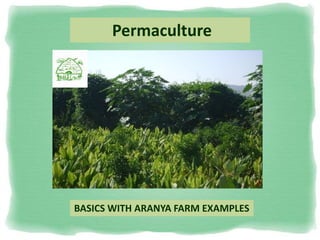
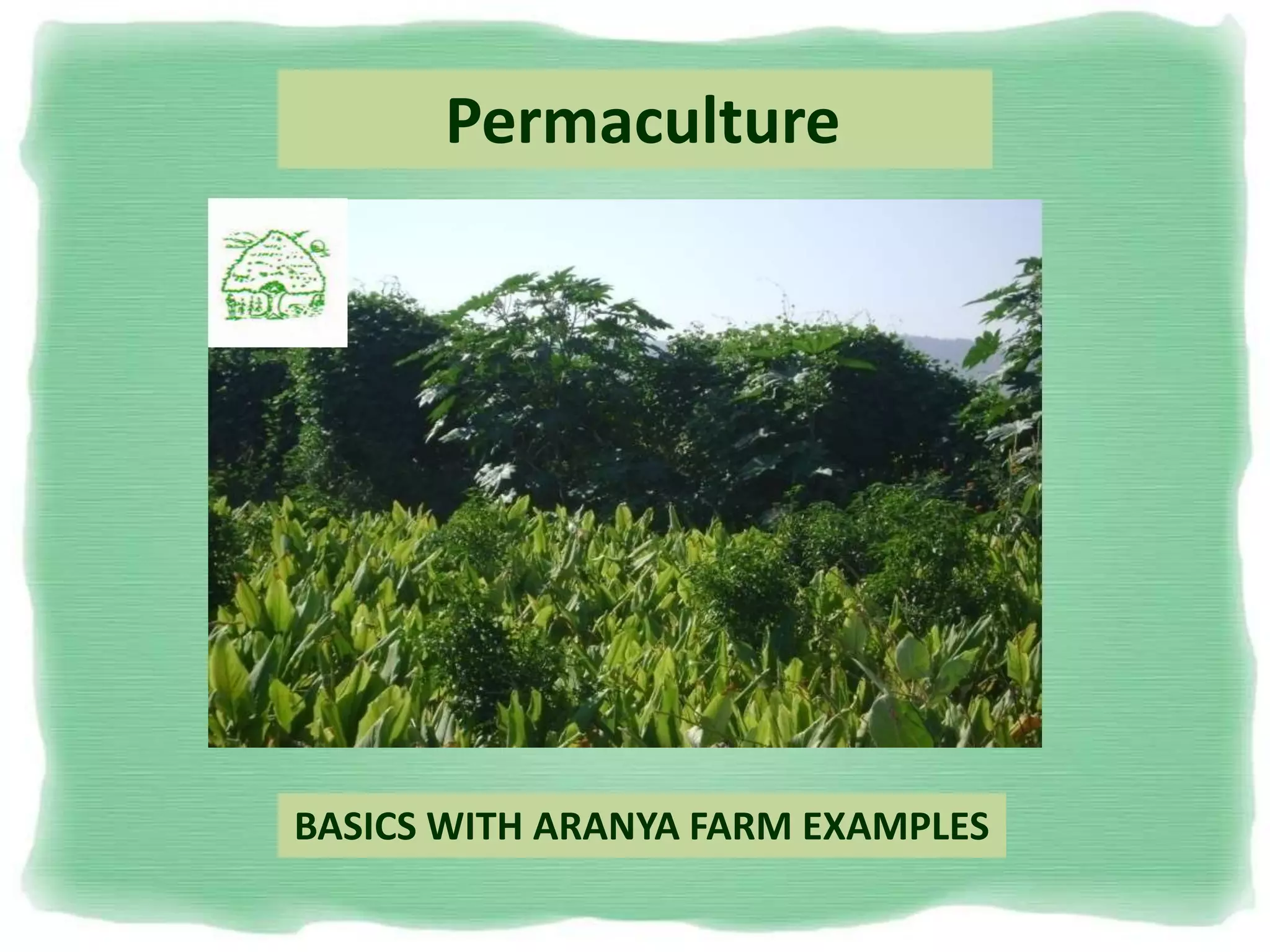
Permaculture
BASICS WITH ARANYA FARM EXAMPLES
The well known Permaculture Philosophy……
“The philosophy behind permaculture is one of the
working with, rather than against, nature; of
protracted and thoughtful observation rather than
protracted and thoughtless action; of looking at system
in all their functions, rather than asking only one yield
of them; and of allowing systems to demonstrate their
own evolution”
- BILL MOLLISON
PERMACULTURE
 Permaculture - A theory of ecological design ,attempts to develop
sustainable human settlements & agricultural systems modeled
from natural ecosystems
 A comprehensive design process, permaculture is apart from
other developmental approaches
Core values :
• Care of the Earth: Provision for all life systems to continue and
multiply
• Care of People: Provision for people to access those resources
necessary for their existence
• Setting Limits to Population and Consumption: By governing our
own needs, we can set resources aside to further the above principles
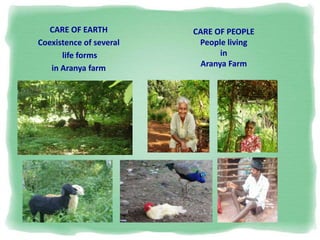
CARE OF EARTH
Coexistence of several
life forms
in Aranya farm
CARE OF PEOPLE
People living
in
Aranya Farm
 Permaculture is not a fixed system
 It is not a gardening association, an architects group,
ethical
banking institution or farmers federation
 it does not tell people what to do
 It does not say "what to put where“
 Rather, it encourages people to think, to observe
and to plan
 It encourages people to live in harmony with nature
to imitate and learn from nature
Sustainable designs
• Permaculture design emphasizes patterns of
landscape, function, and species assemblies
• Where does this (element) go?
• How can it be placed for the maximum benefit of the
system?
• The central idea is Maximizing useful connections
between components and synergy of the final
design
• The whole becoming greater than the sum of its
parts
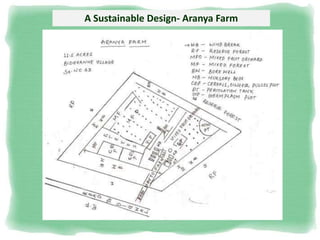
A Sustainable Design- Aranya Farm
Aranya Farm Description
• Aranya farm - 4.5 ha, Since 1997
• Location- Biddakanne Village,Zaheerabad,AP,India
• Land component –Soil : Laterite soil major,1/4th black soil
Slope : gentle slope N-S,E-S
• Water component- well source
• Tree component- 90 % Perennial trees,10 % Annuals/crops
Aranya Farm - Different Components
 Wind break
 Live Fence
 Reserve Forest
 Mixed Fruit Orchard
 Mixed Forest
 Open Well
 Bore well with Motor
 Nursery beds
 Cereals Oilseeds Pulses Plot
 Percolation tank
 Germplasm Plot
 Live Fence
 Compost Heap
 Nursery
 Fodder crop Area
 Thatched hut
 3 People
Aranya Farm – Different species
 PERRENIALS
 FOOD
FRUIT TREES
Mango,Sapota,Papaya,Gauva,Pineapple,Sitaphal,Bher,Kalajam
un,Jackfruit,Amla,Citrus,Cashewnut,Phalsa,Fig,Star Fruit,
Passion Fruit e.t.c.
OTHERS
Moringa, Indian Almond, Tamarind, Curry Leaf e.t.c.
 WOOD
Teak,Pongamia,Eucalyptus,Rosewood,Sandal
wood,SilverOak,Bamboo,Casuarina,Terminalia
 GREEN LEAF MANURE
Albezia ,Glyricidia,Pongamia,Dalbergia,Subabul
 UTILITY
Neem,Cassia,Caesalpinia,Shikakai,Soapnut,Palms,Kalimi,Karo
nda,Tipu Exotic
Other - Cactus
Aranya Farm – Different Species
 FIELD CROPS-
 Wheat,Sorghum,Lentil,Linseed,ChickPea,Safflower,
Turmeric,Greengram,Horsegram,Blackgram,pegion
pea,Cowpea,Sorrel,putti,mustard,Sesamum,Foxtail
Millet, ado Millet, Little Millet e.t.c
 VEGETABLES-
 Tomato, Egg plant,Clusterbean,Frenchbean,Chilly
e.t.c
 Leafy – Spinach,Fenugreek,Coriander,Mint,Hibiscus
variety
 Creeper –
Coccinia,Bittergourd,Bottlegourd,Ridgegourd,snake
gourd e.t.c
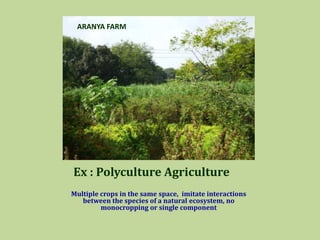
Ex : Polyculture Agriculture
Multiple crops in the same space, imitate interactions
between the species of a natural ecosystem, no
monocropping or single component
ARANYA FARM
 It is a way of
• Looking at a whole system or problem
• Observing how the parts relate
• Planning to mend inefficient systems by
applying ideas learned from long-term
sustainable working systems
• Seeing connections between key parts
Modern permaculture is a system design tool
Holmgren's 12 design principles
1) Observe and interact
2) Catch and store energy
3) Obtain a yield
4) Apply self-regulation and accept feedback
5) Use and value renewable resources and services
6) Produce no waste
7) Design from patterns to details
8) Integrate rather than segregate
9) Use small and slow solutions
10)Use and value diversity
11)Use edges and value the marginal
12)Creatively use and respond to change
Patterns
• Permaculture design focuses heavily upon
natural patterns
• Everything, the wind, the waves and the
Earth moving around the Sun, form
patterns
• One has to develop an awareness of the
patterns that exist in nature & how they
can be used to satisfy the specific design
needs of a specific site
 EDGE EFFECT in ecology is the effect of the placing side by
side of contrasting environments on an ecosystem
 ZONES are a way of organizing design elements in a human
environment on the basis of the frequency of human use
and plant or animal needs
 LAYERS are one of the tools used to design functional
ecosystems that are both sustainable and of direct benefit to
man
Seven principles of permaculture
1. Conservation
2. Stacking functions
3. Repeating functions
4. Reciprocity
5. Appropriate scale
6. Diversity
7. Give away the surplus
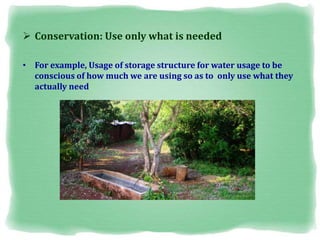
 Conservation: Use only what is needed
• For example, Usage of storage structure for water usage to be
conscious of how much we are using so as to only use what they
actually need
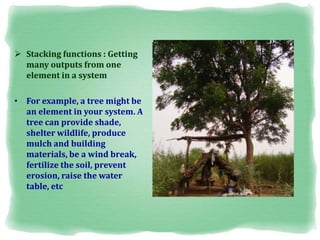
 Stacking functions : Getting
many outputs from one
element in a system
• For example, a tree might be
an element in your system. A
tree can provide shade,
shelter wildlife, produce
mulch and building
materials, be a wind break,
fertilize the soil, prevent
erosion, raise the water
table, etc
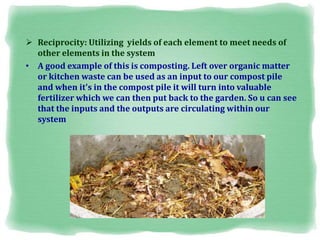
 Reciprocity: Utilizing yields of each element to meet needs of
other elements in the system
• A good example of this is composting. Left over organic matter
or kitchen waste can be used as an input to our compost pile
and when it's in the compost pile it will turn into valuable
fertilizer which we can then put back to the garden. So u can see
that the inputs and the outputs are circulating within our
system
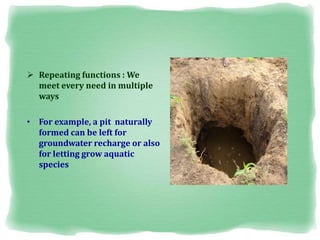
 Repeating functions : We
meet every need in multiple
ways
• For example, a pit naturally
formed can be left for
groundwater recharge or also
for letting grow aquatic
species
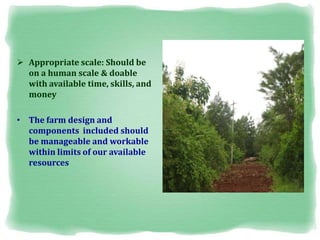
 Appropriate scale: Should be
on a human scale & doable
with available time, skills, and
money
• The farm design and
components included should
be manageable and workable
within limits of our available
resources
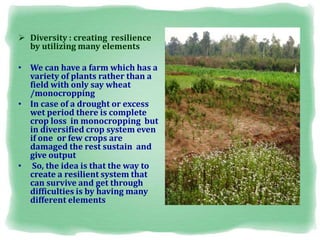
 Diversity : creating resilience
by utilizing many elements
• We can have a farm which has a
variety of plants rather than a
field with only say wheat
/monocropping
• In case of a drought or excess
wet period there is complete
crop loss in monocropping but
in diversified crop system even
if one or few crops are
damaged the rest sustain and
give output
• So, the idea is that the way to
create a resilient system that
can survive and get through
difficulties is by having many
different elements
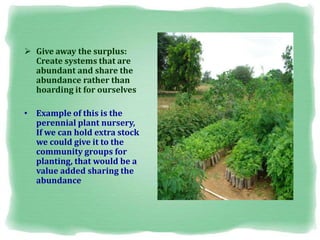
 Give away the surplus:
Create systems that are
abundant and share the
abundance rather than
hoarding it for ourselves
• Example of this is the
perennial plant nursery,
If we can hold extra stock
we could give it to the
community groups for
planting, that would be a
value added sharing the
abundance
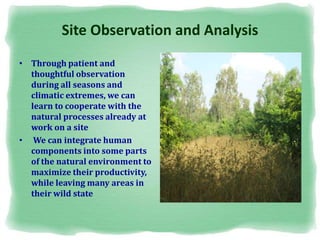
Site Observation and Analysis
• Through patient and
thoughtful observation
during all seasons and
climatic extremes, we can
learn to cooperate with the
natural processes already at
work on a site
• We can integrate human
components into some parts
of the natural environment to
maximize their productivity,
while leaving many areas in
their wild state
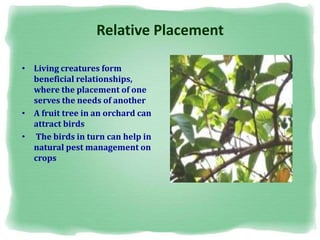
Relative Placement
• Living creatures form
beneficial relationships,
where the placement of one
serves the needs of another
• A fruit tree in an orchard can
attract birds
• The birds in turn can help in
natural pest management on
crops
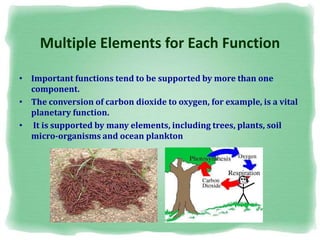
Multiple Elements for Each Function
• Important functions tend to be supported by more than one
component.
• The conversion of carbon dioxide to oxygen, for example, is a vital
planetary function.
• It is supported by many elements, including trees, plants, soil
micro-organisms and ocean plankton
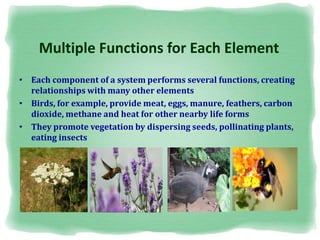
Multiple Functions for Each Element
• Each component of a system performs several functions, creating
relationships with many other elements
• Birds, for example, provide meat, eggs, manure, feathers, carbon
dioxide, methane and heat for other nearby life forms
• They promote vegetation by dispersing seeds, pollinating plants,
eating insects
Using Biological Resources
• In Nature life builds upon itself to create more
life.
• Things feed upon one another in the animal,
insect, plant and microbial realms
• The life in a system increases over time as energy
from the sun is captured and stored in living
tissue, and as inert minerals are converted into
organic compounds
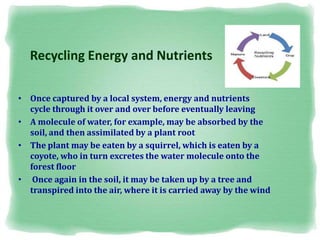
Recycling Energy and Nutrients
• Once captured by a local system, energy and nutrients
cycle through it over and over before eventually leaving
• A molecule of water, for example, may be absorbed by the
soil, and then assimilated by a plant root
• The plant may be eaten by a squirrel, which is eaten by a
coyote, who in turn excretes the water molecule onto the
forest floor
• Once again in the soil, it may be taken up by a tree and
transpired into the air, where it is carried away by the wind
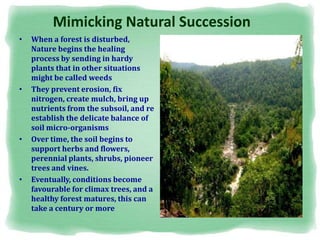
Mimicking Natural Succession
• When a forest is disturbed,
Nature begins the healing
process by sending in hardy
plants that in other situations
might be called weeds
• They prevent erosion, fix
nitrogen, create mulch, bring up
nutrients from the subsoil, and re
establish the delicate balance of
soil micro-organisms
• Over time, the soil begins to
support herbs and flowers,
perennial plants, shrubs, pioneer
trees and vines.
• Eventually, conditions become
favourable for climax trees, and a
healthy forest matures, this can
take a century or more
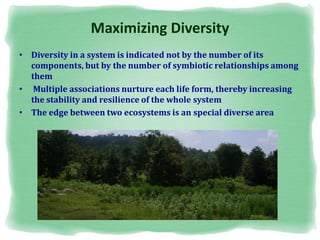
Maximizing Diversity
• Diversity in a system is indicated not by the number of its
components, but by the number of symbiotic relationships among
them
• Multiple associations nurture each life form, thereby increasing
the stability and resilience of the whole system
• The edge between two ecosystems is an special diverse area
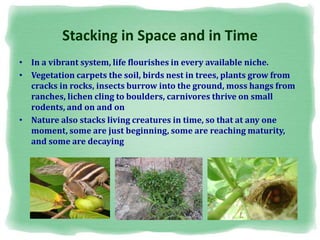
Stacking in Space and in Time
• In a vibrant system, life flourishes in every available niche.
• Vegetation carpets the soil, birds nest in trees, plants grow from
cracks in rocks, insects burrow into the ground, moss hangs from
ranches, lichen cling to boulders, carnivores thrive on small
rodents, and on and on
• Nature also stacks living creatures in time, so that at any one
moment, some are just beginning, some are reaching maturity,
and some are decaying
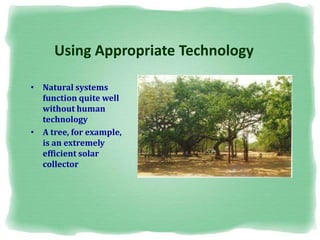
Using Appropriate Technology
• Natural systems
function quite well
without human
technology
• A tree, for example,
is an extremely
efficient solar
collector
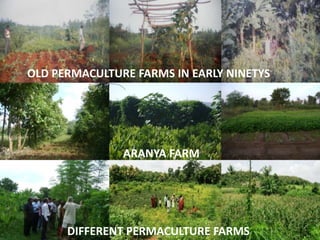
OLD PERMACULTURE FARMS IN EARLY NINETYS
DIFFERENT PERMACULTURE FARMS
ARANYA FARM
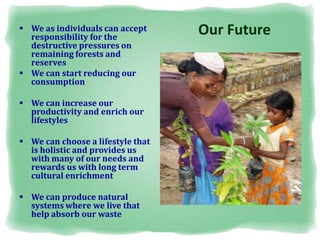
Our Future We as individuals can accept
responsibility for the
destructive pressures on
remaining forests and
reserves
 We can start reducing our
consumption
 We can increase our
productivity and enrich our
lifestyles
 We can choose a lifestyle that
is holistic and provides us
with many of our needs and
rewards us with long term
cultural enrichment
 We can produce natural
systems where we live that
help absorb our waste
"If you are not part of the solution, you are part of the problem" - Mollison
“ When enough people lead the leaders will follow “
THANK YOU

Perma theory & live examples

  • 1.
  • 2.
    The well knownPermaculture Philosophy…… “The philosophy behind permaculture is one of the working with, rather than against, nature; of protracted and thoughtful observation rather than protracted and thoughtless action; of looking at system in all their functions, rather than asking only one yield of them; and of allowing systems to demonstrate their own evolution” - BILL MOLLISON
  • 3.
    PERMACULTURE  Permaculture -A theory of ecological design ,attempts to develop sustainable human settlements & agricultural systems modeled from natural ecosystems  A comprehensive design process, permaculture is apart from other developmental approaches Core values : • Care of the Earth: Provision for all life systems to continue and multiply • Care of People: Provision for people to access those resources necessary for their existence • Setting Limits to Population and Consumption: By governing our own needs, we can set resources aside to further the above principles
  • 4.
    CARE OF EARTH Coexistenceof several life forms in Aranya farm CARE OF PEOPLE People living in Aranya Farm
  • 5.
     Permaculture isnot a fixed system  It is not a gardening association, an architects group, ethical banking institution or farmers federation  it does not tell people what to do  It does not say "what to put where“  Rather, it encourages people to think, to observe and to plan  It encourages people to live in harmony with nature to imitate and learn from nature
  • 6.
    Sustainable designs • Permaculturedesign emphasizes patterns of landscape, function, and species assemblies • Where does this (element) go? • How can it be placed for the maximum benefit of the system? • The central idea is Maximizing useful connections between components and synergy of the final design • The whole becoming greater than the sum of its parts
  • 7.
  • 8.
    Aranya Farm Description •Aranya farm - 4.5 ha, Since 1997 • Location- Biddakanne Village,Zaheerabad,AP,India • Land component –Soil : Laterite soil major,1/4th black soil Slope : gentle slope N-S,E-S • Water component- well source • Tree component- 90 % Perennial trees,10 % Annuals/crops
  • 9.
    Aranya Farm -Different Components  Wind break  Live Fence  Reserve Forest  Mixed Fruit Orchard  Mixed Forest  Open Well  Bore well with Motor  Nursery beds  Cereals Oilseeds Pulses Plot  Percolation tank  Germplasm Plot  Live Fence  Compost Heap  Nursery  Fodder crop Area  Thatched hut  3 People
  • 10.
    Aranya Farm –Different species  PERRENIALS  FOOD FRUIT TREES Mango,Sapota,Papaya,Gauva,Pineapple,Sitaphal,Bher,Kalajam un,Jackfruit,Amla,Citrus,Cashewnut,Phalsa,Fig,Star Fruit, Passion Fruit e.t.c. OTHERS Moringa, Indian Almond, Tamarind, Curry Leaf e.t.c.  WOOD Teak,Pongamia,Eucalyptus,Rosewood,Sandal wood,SilverOak,Bamboo,Casuarina,Terminalia  GREEN LEAF MANURE Albezia ,Glyricidia,Pongamia,Dalbergia,Subabul  UTILITY Neem,Cassia,Caesalpinia,Shikakai,Soapnut,Palms,Kalimi,Karo nda,Tipu Exotic Other - Cactus
  • 11.
    Aranya Farm –Different Species  FIELD CROPS-  Wheat,Sorghum,Lentil,Linseed,ChickPea,Safflower, Turmeric,Greengram,Horsegram,Blackgram,pegion pea,Cowpea,Sorrel,putti,mustard,Sesamum,Foxtail Millet, ado Millet, Little Millet e.t.c  VEGETABLES-  Tomato, Egg plant,Clusterbean,Frenchbean,Chilly e.t.c  Leafy – Spinach,Fenugreek,Coriander,Mint,Hibiscus variety  Creeper – Coccinia,Bittergourd,Bottlegourd,Ridgegourd,snake gourd e.t.c
  • 12.
    Ex : PolycultureAgriculture Multiple crops in the same space, imitate interactions between the species of a natural ecosystem, no monocropping or single component ARANYA FARM
  • 13.
     It isa way of • Looking at a whole system or problem • Observing how the parts relate • Planning to mend inefficient systems by applying ideas learned from long-term sustainable working systems • Seeing connections between key parts Modern permaculture is a system design tool
  • 14.
    Holmgren's 12 designprinciples 1) Observe and interact 2) Catch and store energy 3) Obtain a yield 4) Apply self-regulation and accept feedback 5) Use and value renewable resources and services 6) Produce no waste 7) Design from patterns to details 8) Integrate rather than segregate 9) Use small and slow solutions 10)Use and value diversity 11)Use edges and value the marginal 12)Creatively use and respond to change
  • 15.
    Patterns • Permaculture designfocuses heavily upon natural patterns • Everything, the wind, the waves and the Earth moving around the Sun, form patterns • One has to develop an awareness of the patterns that exist in nature & how they can be used to satisfy the specific design needs of a specific site
  • 16.
     EDGE EFFECTin ecology is the effect of the placing side by side of contrasting environments on an ecosystem  ZONES are a way of organizing design elements in a human environment on the basis of the frequency of human use and plant or animal needs  LAYERS are one of the tools used to design functional ecosystems that are both sustainable and of direct benefit to man
  • 17.
    Seven principles ofpermaculture 1. Conservation 2. Stacking functions 3. Repeating functions 4. Reciprocity 5. Appropriate scale 6. Diversity 7. Give away the surplus
  • 18.
     Conservation: Useonly what is needed • For example, Usage of storage structure for water usage to be conscious of how much we are using so as to only use what they actually need
  • 19.
     Stacking functions: Getting many outputs from one element in a system • For example, a tree might be an element in your system. A tree can provide shade, shelter wildlife, produce mulch and building materials, be a wind break, fertilize the soil, prevent erosion, raise the water table, etc
  • 20.
     Reciprocity: Utilizingyields of each element to meet needs of other elements in the system • A good example of this is composting. Left over organic matter or kitchen waste can be used as an input to our compost pile and when it's in the compost pile it will turn into valuable fertilizer which we can then put back to the garden. So u can see that the inputs and the outputs are circulating within our system
  • 21.
     Repeating functions: We meet every need in multiple ways • For example, a pit naturally formed can be left for groundwater recharge or also for letting grow aquatic species
  • 22.
     Appropriate scale:Should be on a human scale & doable with available time, skills, and money • The farm design and components included should be manageable and workable within limits of our available resources
  • 23.
     Diversity :creating resilience by utilizing many elements • We can have a farm which has a variety of plants rather than a field with only say wheat /monocropping • In case of a drought or excess wet period there is complete crop loss in monocropping but in diversified crop system even if one or few crops are damaged the rest sustain and give output • So, the idea is that the way to create a resilient system that can survive and get through difficulties is by having many different elements
  • 24.
     Give awaythe surplus: Create systems that are abundant and share the abundance rather than hoarding it for ourselves • Example of this is the perennial plant nursery, If we can hold extra stock we could give it to the community groups for planting, that would be a value added sharing the abundance
  • 25.
    Site Observation andAnalysis • Through patient and thoughtful observation during all seasons and climatic extremes, we can learn to cooperate with the natural processes already at work on a site • We can integrate human components into some parts of the natural environment to maximize their productivity, while leaving many areas in their wild state
  • 26.
    Relative Placement • Livingcreatures form beneficial relationships, where the placement of one serves the needs of another • A fruit tree in an orchard can attract birds • The birds in turn can help in natural pest management on crops
  • 27.
    Multiple Elements forEach Function • Important functions tend to be supported by more than one component. • The conversion of carbon dioxide to oxygen, for example, is a vital planetary function. • It is supported by many elements, including trees, plants, soil micro-organisms and ocean plankton
  • 28.
    Multiple Functions forEach Element • Each component of a system performs several functions, creating relationships with many other elements • Birds, for example, provide meat, eggs, manure, feathers, carbon dioxide, methane and heat for other nearby life forms • They promote vegetation by dispersing seeds, pollinating plants, eating insects
  • 29.
    Using Biological Resources •In Nature life builds upon itself to create more life. • Things feed upon one another in the animal, insect, plant and microbial realms • The life in a system increases over time as energy from the sun is captured and stored in living tissue, and as inert minerals are converted into organic compounds
  • 30.
    Recycling Energy andNutrients • Once captured by a local system, energy and nutrients cycle through it over and over before eventually leaving • A molecule of water, for example, may be absorbed by the soil, and then assimilated by a plant root • The plant may be eaten by a squirrel, which is eaten by a coyote, who in turn excretes the water molecule onto the forest floor • Once again in the soil, it may be taken up by a tree and transpired into the air, where it is carried away by the wind
  • 31.
    Mimicking Natural Succession •When a forest is disturbed, Nature begins the healing process by sending in hardy plants that in other situations might be called weeds • They prevent erosion, fix nitrogen, create mulch, bring up nutrients from the subsoil, and re establish the delicate balance of soil micro-organisms • Over time, the soil begins to support herbs and flowers, perennial plants, shrubs, pioneer trees and vines. • Eventually, conditions become favourable for climax trees, and a healthy forest matures, this can take a century or more
  • 32.
    Maximizing Diversity • Diversityin a system is indicated not by the number of its components, but by the number of symbiotic relationships among them • Multiple associations nurture each life form, thereby increasing the stability and resilience of the whole system • The edge between two ecosystems is an special diverse area
  • 33.
    Stacking in Spaceand in Time • In a vibrant system, life flourishes in every available niche. • Vegetation carpets the soil, birds nest in trees, plants grow from cracks in rocks, insects burrow into the ground, moss hangs from ranches, lichen cling to boulders, carnivores thrive on small rodents, and on and on • Nature also stacks living creatures in time, so that at any one moment, some are just beginning, some are reaching maturity, and some are decaying
  • 34.
    Using Appropriate Technology •Natural systems function quite well without human technology • A tree, for example, is an extremely efficient solar collector
  • 35.
    OLD PERMACULTURE FARMSIN EARLY NINETYS DIFFERENT PERMACULTURE FARMS ARANYA FARM
  • 36.
    Our Future Weas individuals can accept responsibility for the destructive pressures on remaining forests and reserves  We can start reducing our consumption  We can increase our productivity and enrich our lifestyles  We can choose a lifestyle that is holistic and provides us with many of our needs and rewards us with long term cultural enrichment  We can produce natural systems where we live that help absorb our waste
  • 37.
    "If you arenot part of the solution, you are part of the problem" - Mollison “ When enough people lead the leaders will follow “ THANK YOU