GreenPoint Rated and Green Materials Katy Hollbacher, P.E. | beyondefficiency.org May 16, 2009
Today’s Presentation: Considering individual choices in context of the project as a whole Verification & testing: choosing a green material is not enough!  Example material-related measures in GreenPoint Rated
Who Is Build It Green? Drive policy development — partner with government to establish credible and accessible green building policies that promote private sector innovation and provide consistent guidelines statewide.  Increase supply of green homes —train building professionals on latest best practices and connect green product suppliers with consumers.  Stimulate consumer demand —build awareness of the benefits of green building by providing GreenPoint Rated as a trustworthy, recognized brand for green homes. Mission is to promote healthy, energy- and resource-efficient buildings in California.
What Is Green Building? “ Whole-Systems” approach for designing and constructing buildings that: are integrated into the building site  consume less energy and water are durable and easier to maintain use resource efficient techniques and materials are healthier, safer, and more comfortable Green=SMART
Traditional vs. Green Approach Traditional: how much more does it cost to install a 92% instead of 80% AFUE furnace? Greener: how much more does it cost to operate and maintain an 80% instead of 92% AFUE furnace over 20 years? Think lifecycle cost, not upfront cost Think  value , not cost
The Whole-Systems Approach What is a ‘truly green’ heating system? Insulation is installed properly, and levels exceed code Air sealing techniques minimize heat loss at doors, elec. outlets, attic hatches, etc… Windows are dual-pane and low-E Ductwork and furnace have been sized and designed with appropriate manuals System has been tested for proper performance Furnace is properly maintained over its lifetime…
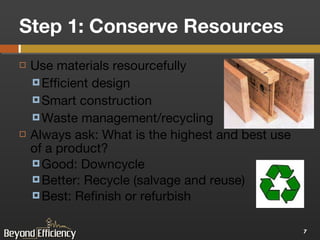
Step 1: Conserve Resources Use materials resourcefully Efficient design  Smart construction Waste management/recycling Always ask: What is the highest and best use of a product? Good: Downcycle Better: Recycle (salvage and reuse) Best: Refinish or refurbish
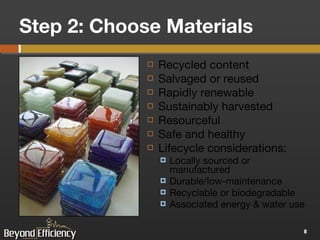
Step 2: Choose Materials Recycled content Salvaged or reused Rapidly renewable Sustainably harvested Resourceful Safe and healthy Lifecycle considerations: Locally sourced or manufactured Durable/low-maintenance  Recyclable or biodegradable Associated energy & water use
Beyond Product and Material Selection… Defining a product as “green” is not straightforward A product is often just one component of a larger system Rarely is there a ‘greenest’ choice; depends on specific situation  “ Green Products” can be used in dumb ways! What Makes a Product Green?  http://tinyurl.com/ber2ko
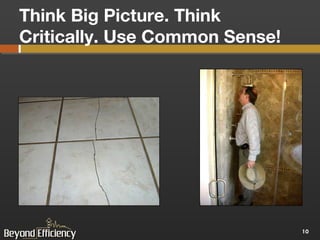
Think Big Picture. Think Critically. Use Common Sense!
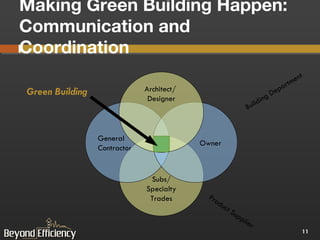
Making Green Building Happen: Communication and Coordination Green Building Building Department Product Supplier Subs/ Specialty Trades General  Contractor Owner Architect/  Designer
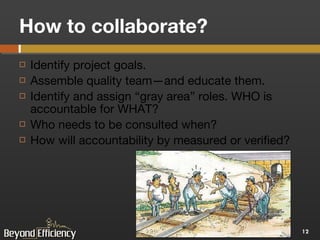
How to collaborate? Identify project goals.  Assemble quality team—and educate them. Identify and assign “gray area” roles. WHO is accountable for WHAT? Who needs to be consulted when? How will accountability by measured or verified?
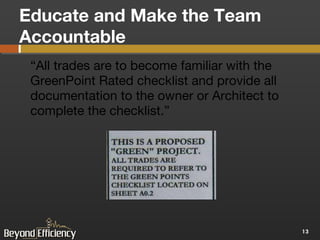
Educate and Make the Team Accountable “ All trades are to become familiar with the GreenPoint Rated checklist and provide all documentation to the owner or Architect to complete the checklist.”
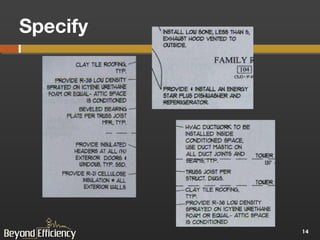
Specify
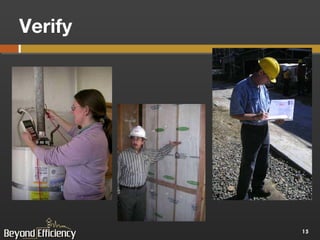
Verify
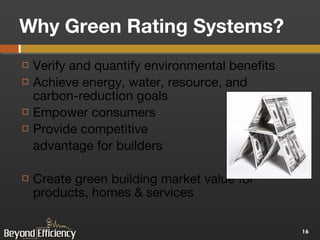
Why Green Rating Systems? Verify and quantify environmental benefits Achieve energy, water, resource, and carbon-reduction goals Empower consumers Provide competitive  advantage for builders Create green building market value for products, homes & services
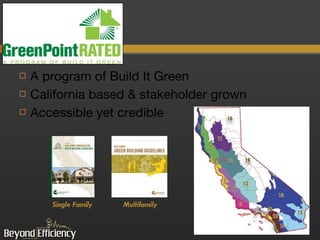
A program of Build It Green California based & stakeholder grown Accessible yet credible Single Family Multifamily
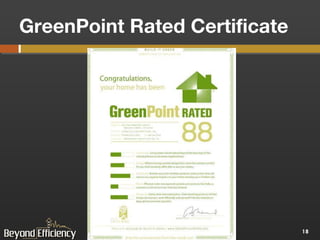
GreenPoint Rated Certificate
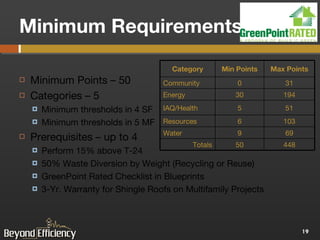
Minimum Requirements  Minimum Points – 50 Categories – 5  Minimum thresholds in 4 SF Minimum thresholds in 5 MF Prerequisites – up to 4 Perform 15% above T-24 50% Waste Diversion by Weight (Recycling or Reuse) GreenPoint Rated Checklist in Blueprints 3-Yr. Warranty for Shingle Roofs on Multifamily Projects Category Min Points Max Points Community 0 31 Energy 30 194 IAQ/Health 5 51 Resources 6 103 Water 9 69 Totals 50 448
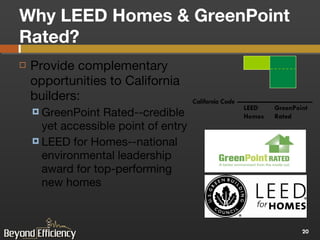
Why LEED Homes & GreenPoint Rated? Provide complementary opportunities to California builders: GreenPoint Rated--credible yet accessible point of entry LEED for Homes--national environmental leadership award for top-performing new homes California Code GreenPoint Rated  LEED Homes
Collaboration: Memorandum of Understanding Cross-training of GreenPoint Raters and LEED for Homes Raters and Representatives Dual branding with equivalency tool Cross-referrals to steer projects towards the most appropriate rating system
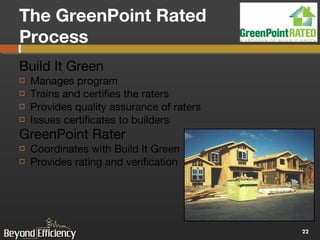
The GreenPoint Rated  Process Build It Green Manages program  Trains and certifies the raters Provides quality assurance of raters Issues certificates to builders GreenPoint Rater Coordinates with Build It Green  Provides rating and verification
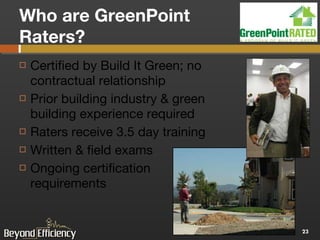
Who are GreenPoint Raters? Certified by Build It Green; no contractual relationship Prior building industry & green building experience required Raters receive 3.5 day training Written & field exams Ongoing certification requirements
GreenPoint Checklists Accompany guidelines and provide a tool to track green features of a project Define specific metrics for achieving green building measures Uses: Do-it-yourself assessment Communication tool for project team Policy tool for municipality and builder Basis for third-party verified projects
Verification Methods Four ways to verify each measure: Rater Manual defines the recommended methods  Balance between rigor and excessive burden Plan Review Rough Inspection Final Inspection Documentation
Material-related GPR measures How do specific materials help earn points in GreenPoint Rated? Are environmentally preferable Improve durability or reduce maintenance requirements (eg overhangs) Contribute to energy or water efficiency Improve air quality (eg hard surfaces in entryways) Are part of a resource-efficient system…  or not used at all!
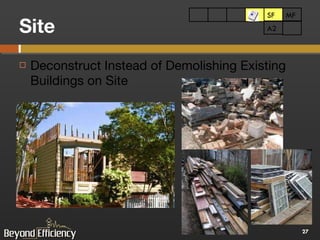
Site Deconstruct Instead of Demolishing Existing Buildings on Site SF MF SF MF A2
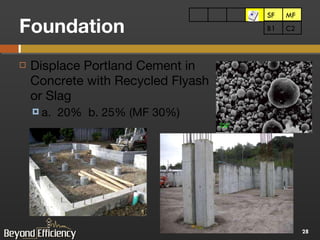
Foundation Displace Portland Cement in Concrete with Recycled Flyash or Slag a.  20%  b. 25% (MF 30%) SF MF SF MF C2 B1
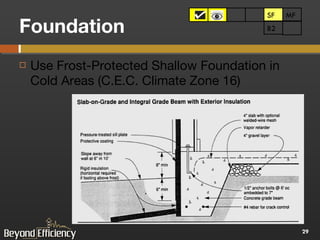
Foundation Use Frost-Protected Shallow Foundation in Cold Areas (C.E.C. Climate Zone 16) SF MF SF B2
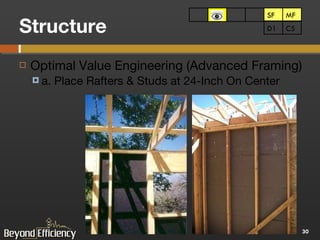
Structure Optimal Value Engineering (Advanced Framing) a. Place Rafters & Studs at 24-Inch On Center SF MF SF C5 D1
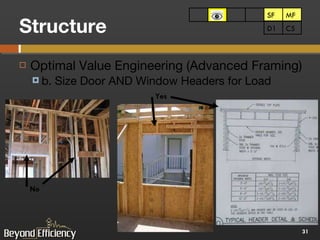
Structure Optimal Value Engineering (Advanced Framing) b. Size Door AND Window Headers for Load SF MF SF C5 D1 Yes No
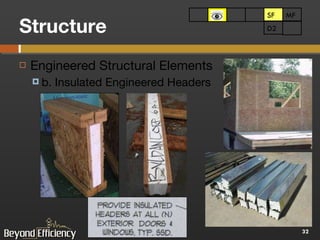
Structure Engineered Structural Elements b. Insulated Engineered Headers SF MF SF D2
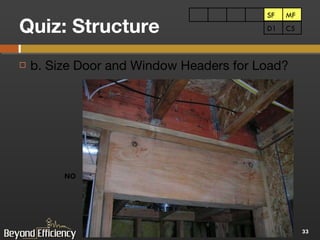
Quiz: Structure b. Size Door and Window Headers for Load? SF MF SF C5 D1 NO
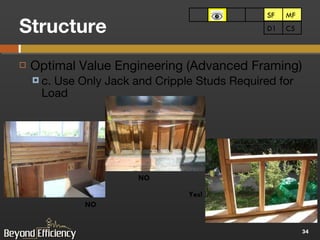
Structure Optimal Value Engineering (Advanced Framing) c. Use Only Jack and Cripple Studs Required for Load SF MF SF C5 D1 NO Yes! NO
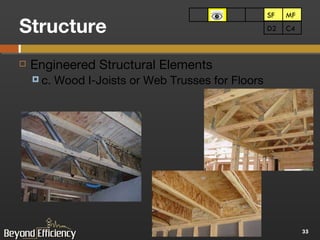
Structure SF MF SF MF C4 D2 Engineered Structural Elements c. Wood I-Joists or Web Trusses for Floors
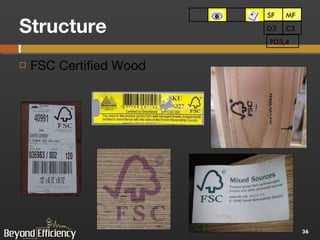
Structure FSC Certified Wood SF MF SF MF PD3,4 D3 C3
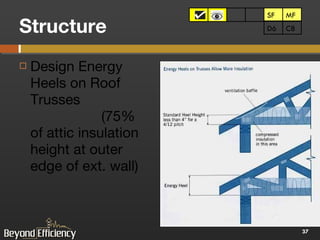
Structure Design Energy Heels on Roof Trusses  (75% of attic insulation height at outer edge of ext. wall) MF MF C8 D6 SF
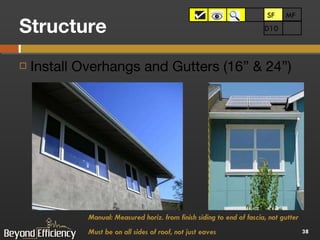
Structure Install Overhangs and Gutters (16” & 24”) SF SF MF D10 Manual: Measured horiz. from finish siding to end of fascia, not gutter Must be on all sides of roof, not just eaves
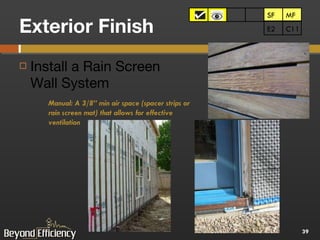
Exterior Finish Install a Rain Screen Wall System SF MF SF MF C11 E2 Manual: A 3/8” min air space (spacer strips or rain screen mat) that allows for effective ventilation
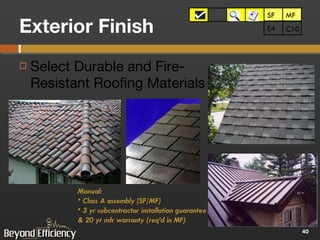
Exterior Finish Select Durable and Fire-Resistant Roofing Materials SF MF SF MF C10 E4 Manual:  Class A assembly (SF/MF) 3 yr subcontractor installation guarantee & 20 yr mfr warranty (req’d in MF)
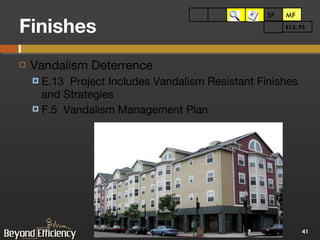
Finishes Vandalism Deterrence E.13  Project Includes Vandalism Resistant Finishes and Strategies F.5  Vandalism Management Plan SF MF SF MF E13, F5
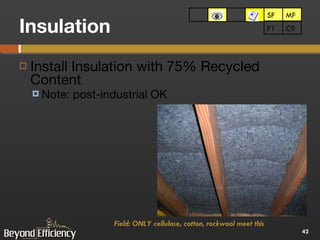
Insulation Install Insulation with 75% Recycled Content Note: post-industrial OK SF MF SF MF C9 F1 Field: ONLY cellulose, cotton, rockwool meet this
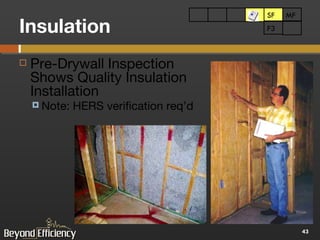
Insulation SF MF SF M F3 Pre-Drywall Inspection Shows Quality Insulation Installation Note: HERS verification req’d
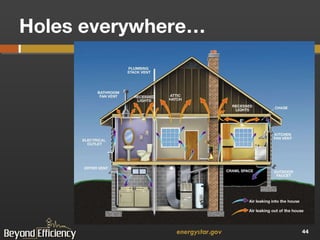
Holes everywhere… energystar.gov
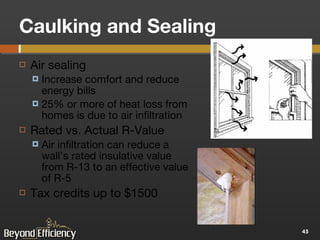
Caulking and Sealing  Air sealing Increase comfort and reduce energy bills 25% or more of heat loss from homes is due to air infiltration Rated vs. Actual R-Value Air infiltration can reduce a wall's rated insulative value from R-13 to an effective value of R-5 Tax credits up to $1500
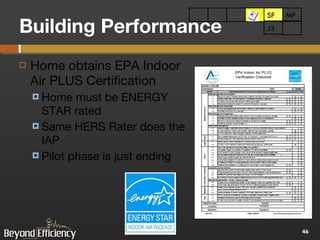
Building Performance Home obtains EPA Indoor Air PLUS Certification Home must be ENERGY STAR rated Same HERS Rater does the IAP Pilot phase is just ending SF MF SF J3
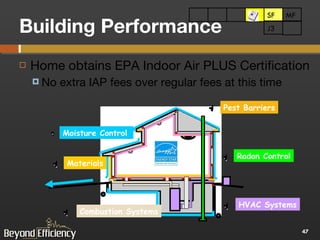
Building Performance Home obtains EPA Indoor Air PLUS Certification No extra IAP fees over regular fees at this time SF MF SF J3 + Materials Moisture Control  + Pest Barriers + Combustion Systems + HVAC Systems + Radon Control +
EPA Indoor Air PLUS  “ Specifications were developed based on best available science and information about risks associated with indoor air quality problems, and balanced with practical issues of cost, builder production process compatibility, and enforceability”   epa.gov/iaq/indoorairplus
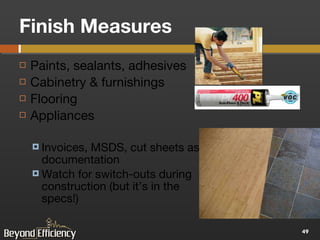
Finish Measures Paints, sealants, adhesives Cabinetry & furnishings Flooring Appliances Invoices, MSDS, cut sheets as documentation Watch for switch-outs during construction (but it’s in the specs!)
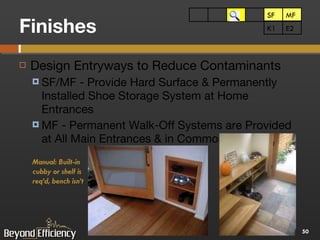
Finishes Design Entryways to Reduce Contaminants SF/MF - Provide Hard Surface & Permanently Installed Shoe Storage System at Home Entrances MF - Permanent Walk-Off Systems are Provided at All Main Entrances & in Common Areas  SF MF SF MF E2 K1 Manual: Built-in cubby or shelf is req’d, bench isn’t
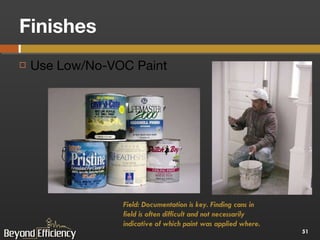
Finishes Use Low/No-VOC Paint Field: Documentation is key. Finding cans in field is often difficult and not necessarily indicative of which paint was applied where.
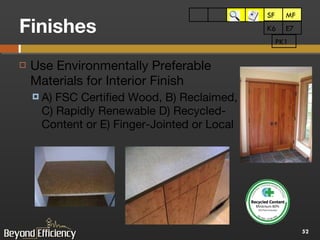
Finishes Use Environmentally Preferable Materials for Interior Finish A) FSC Certified Wood, B) Reclaimed, C) Rapidly Renewable D) Recycled-Content or E) Finger-Jointed or Local SF MF SF MF E7 K6 PK1
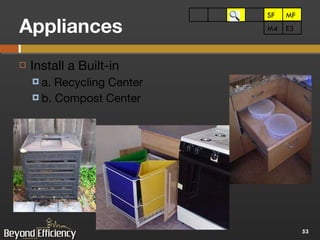
Appliances Install a Built-in a. Recycling Center b. Compost Center MF MF E3 M4 SF
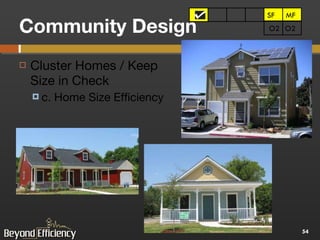
Community Design Cluster Homes / Keep Size in Check c. Home Size Efficiency  SF SF MF O2 O2
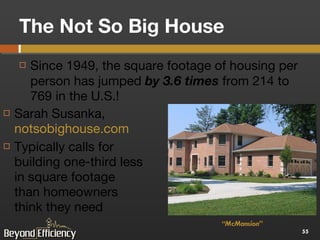
The Not So Big House Since 1949, the square footage of housing per person has jumped  by 3.6 times  from 214 to 769 in the U.S.! Sarah Susanka,  notsobighouse.com Typically calls for building one-third less in square footage than homeowners think they need “ McMansion”
Market Trends: Small Is In? Living small: Defying trend, some homeowners make more of less square footage MarketWatch.com:  tinyurl.com/livingsmall 2009 Forecast: Smaller Single-family Home Trend Will Continue Trulia.com:  tinyurl.com/smallertrend
Homework? Ask an architect or builder friend if you can review a few old sets of plans Practical exercise: Review plans with a critical eye regarding material use How is this project doing a good job? What can be improved? Where do you require more info to make an honest assessment?
Questions… beyondefficiency.org

Green point rated and green materials

  • 1.
    GreenPoint Rated andGreen Materials Katy Hollbacher, P.E. | beyondefficiency.org May 16, 2009
  • 2.
    Today’s Presentation: Consideringindividual choices in context of the project as a whole Verification & testing: choosing a green material is not enough! Example material-related measures in GreenPoint Rated
  • 3.
    Who Is BuildIt Green? Drive policy development — partner with government to establish credible and accessible green building policies that promote private sector innovation and provide consistent guidelines statewide. Increase supply of green homes —train building professionals on latest best practices and connect green product suppliers with consumers. Stimulate consumer demand —build awareness of the benefits of green building by providing GreenPoint Rated as a trustworthy, recognized brand for green homes. Mission is to promote healthy, energy- and resource-efficient buildings in California.
  • 4.
    What Is GreenBuilding? “ Whole-Systems” approach for designing and constructing buildings that: are integrated into the building site consume less energy and water are durable and easier to maintain use resource efficient techniques and materials are healthier, safer, and more comfortable Green=SMART
  • 5.
    Traditional vs. GreenApproach Traditional: how much more does it cost to install a 92% instead of 80% AFUE furnace? Greener: how much more does it cost to operate and maintain an 80% instead of 92% AFUE furnace over 20 years? Think lifecycle cost, not upfront cost Think value , not cost
  • 6.
    The Whole-Systems ApproachWhat is a ‘truly green’ heating system? Insulation is installed properly, and levels exceed code Air sealing techniques minimize heat loss at doors, elec. outlets, attic hatches, etc… Windows are dual-pane and low-E Ductwork and furnace have been sized and designed with appropriate manuals System has been tested for proper performance Furnace is properly maintained over its lifetime…
  • 7.
    Step 1: ConserveResources Use materials resourcefully Efficient design Smart construction Waste management/recycling Always ask: What is the highest and best use of a product? Good: Downcycle Better: Recycle (salvage and reuse) Best: Refinish or refurbish
  • 8.
    Step 2: ChooseMaterials Recycled content Salvaged or reused Rapidly renewable Sustainably harvested Resourceful Safe and healthy Lifecycle considerations: Locally sourced or manufactured Durable/low-maintenance Recyclable or biodegradable Associated energy & water use
  • 9.
    Beyond Product andMaterial Selection… Defining a product as “green” is not straightforward A product is often just one component of a larger system Rarely is there a ‘greenest’ choice; depends on specific situation “ Green Products” can be used in dumb ways! What Makes a Product Green? http://tinyurl.com/ber2ko
  • 10.
    Think Big Picture.Think Critically. Use Common Sense!
  • 11.
    Making Green BuildingHappen: Communication and Coordination Green Building Building Department Product Supplier Subs/ Specialty Trades General Contractor Owner Architect/ Designer
  • 12.
    How to collaborate?Identify project goals. Assemble quality team—and educate them. Identify and assign “gray area” roles. WHO is accountable for WHAT? Who needs to be consulted when? How will accountability by measured or verified?
  • 13.
    Educate and Makethe Team Accountable “ All trades are to become familiar with the GreenPoint Rated checklist and provide all documentation to the owner or Architect to complete the checklist.”
  • 14.
  • 15.
  • 16.
    Why Green RatingSystems? Verify and quantify environmental benefits Achieve energy, water, resource, and carbon-reduction goals Empower consumers Provide competitive advantage for builders Create green building market value for products, homes & services
  • 17.
    A program ofBuild It Green California based & stakeholder grown Accessible yet credible Single Family Multifamily
  • 18.
  • 19.
    Minimum Requirements Minimum Points – 50 Categories – 5 Minimum thresholds in 4 SF Minimum thresholds in 5 MF Prerequisites – up to 4 Perform 15% above T-24 50% Waste Diversion by Weight (Recycling or Reuse) GreenPoint Rated Checklist in Blueprints 3-Yr. Warranty for Shingle Roofs on Multifamily Projects Category Min Points Max Points Community 0 31 Energy 30 194 IAQ/Health 5 51 Resources 6 103 Water 9 69 Totals 50 448
  • 20.
    Why LEED Homes& GreenPoint Rated? Provide complementary opportunities to California builders: GreenPoint Rated--credible yet accessible point of entry LEED for Homes--national environmental leadership award for top-performing new homes California Code GreenPoint Rated LEED Homes
  • 21.
    Collaboration: Memorandum ofUnderstanding Cross-training of GreenPoint Raters and LEED for Homes Raters and Representatives Dual branding with equivalency tool Cross-referrals to steer projects towards the most appropriate rating system
  • 22.
    The GreenPoint Rated Process Build It Green Manages program Trains and certifies the raters Provides quality assurance of raters Issues certificates to builders GreenPoint Rater Coordinates with Build It Green Provides rating and verification
  • 23.
    Who are GreenPointRaters? Certified by Build It Green; no contractual relationship Prior building industry & green building experience required Raters receive 3.5 day training Written & field exams Ongoing certification requirements
  • 24.
    GreenPoint Checklists Accompanyguidelines and provide a tool to track green features of a project Define specific metrics for achieving green building measures Uses: Do-it-yourself assessment Communication tool for project team Policy tool for municipality and builder Basis for third-party verified projects
  • 25.
    Verification Methods Fourways to verify each measure: Rater Manual defines the recommended methods Balance between rigor and excessive burden Plan Review Rough Inspection Final Inspection Documentation
  • 26.
    Material-related GPR measuresHow do specific materials help earn points in GreenPoint Rated? Are environmentally preferable Improve durability or reduce maintenance requirements (eg overhangs) Contribute to energy or water efficiency Improve air quality (eg hard surfaces in entryways) Are part of a resource-efficient system… or not used at all!
  • 27.
    Site Deconstruct Insteadof Demolishing Existing Buildings on Site SF MF SF MF A2
  • 28.
    Foundation Displace PortlandCement in Concrete with Recycled Flyash or Slag a. 20% b. 25% (MF 30%) SF MF SF MF C2 B1
  • 29.
    Foundation Use Frost-ProtectedShallow Foundation in Cold Areas (C.E.C. Climate Zone 16) SF MF SF B2
  • 30.
    Structure Optimal ValueEngineering (Advanced Framing) a. Place Rafters & Studs at 24-Inch On Center SF MF SF C5 D1
  • 31.
    Structure Optimal ValueEngineering (Advanced Framing) b. Size Door AND Window Headers for Load SF MF SF C5 D1 Yes No
  • 32.
    Structure Engineered StructuralElements b. Insulated Engineered Headers SF MF SF D2
  • 33.
    Quiz: Structure b.Size Door and Window Headers for Load? SF MF SF C5 D1 NO
  • 34.
    Structure Optimal ValueEngineering (Advanced Framing) c. Use Only Jack and Cripple Studs Required for Load SF MF SF C5 D1 NO Yes! NO
  • 35.
    Structure SF MFSF MF C4 D2 Engineered Structural Elements c. Wood I-Joists or Web Trusses for Floors
  • 36.
    Structure FSC CertifiedWood SF MF SF MF PD3,4 D3 C3
  • 37.
    Structure Design EnergyHeels on Roof Trusses (75% of attic insulation height at outer edge of ext. wall) MF MF C8 D6 SF
  • 38.
    Structure Install Overhangsand Gutters (16” & 24”) SF SF MF D10 Manual: Measured horiz. from finish siding to end of fascia, not gutter Must be on all sides of roof, not just eaves
  • 39.
    Exterior Finish Installa Rain Screen Wall System SF MF SF MF C11 E2 Manual: A 3/8” min air space (spacer strips or rain screen mat) that allows for effective ventilation
  • 40.
    Exterior Finish SelectDurable and Fire-Resistant Roofing Materials SF MF SF MF C10 E4 Manual: Class A assembly (SF/MF) 3 yr subcontractor installation guarantee & 20 yr mfr warranty (req’d in MF)
  • 41.
    Finishes Vandalism DeterrenceE.13 Project Includes Vandalism Resistant Finishes and Strategies F.5 Vandalism Management Plan SF MF SF MF E13, F5
  • 42.
    Insulation Install Insulationwith 75% Recycled Content Note: post-industrial OK SF MF SF MF C9 F1 Field: ONLY cellulose, cotton, rockwool meet this
  • 43.
    Insulation SF MFSF M F3 Pre-Drywall Inspection Shows Quality Insulation Installation Note: HERS verification req’d
  • 44.
  • 45.
    Caulking and Sealing Air sealing Increase comfort and reduce energy bills 25% or more of heat loss from homes is due to air infiltration Rated vs. Actual R-Value Air infiltration can reduce a wall's rated insulative value from R-13 to an effective value of R-5 Tax credits up to $1500
  • 46.
    Building Performance Homeobtains EPA Indoor Air PLUS Certification Home must be ENERGY STAR rated Same HERS Rater does the IAP Pilot phase is just ending SF MF SF J3
  • 47.
    Building Performance Homeobtains EPA Indoor Air PLUS Certification No extra IAP fees over regular fees at this time SF MF SF J3 + Materials Moisture Control + Pest Barriers + Combustion Systems + HVAC Systems + Radon Control +
  • 48.
    EPA Indoor AirPLUS “ Specifications were developed based on best available science and information about risks associated with indoor air quality problems, and balanced with practical issues of cost, builder production process compatibility, and enforceability” epa.gov/iaq/indoorairplus
  • 49.
    Finish Measures Paints,sealants, adhesives Cabinetry & furnishings Flooring Appliances Invoices, MSDS, cut sheets as documentation Watch for switch-outs during construction (but it’s in the specs!)
  • 50.
    Finishes Design Entrywaysto Reduce Contaminants SF/MF - Provide Hard Surface & Permanently Installed Shoe Storage System at Home Entrances MF - Permanent Walk-Off Systems are Provided at All Main Entrances & in Common Areas SF MF SF MF E2 K1 Manual: Built-in cubby or shelf is req’d, bench isn’t
  • 51.
    Finishes Use Low/No-VOCPaint Field: Documentation is key. Finding cans in field is often difficult and not necessarily indicative of which paint was applied where.
  • 52.
    Finishes Use EnvironmentallyPreferable Materials for Interior Finish A) FSC Certified Wood, B) Reclaimed, C) Rapidly Renewable D) Recycled-Content or E) Finger-Jointed or Local SF MF SF MF E7 K6 PK1
  • 53.
    Appliances Install aBuilt-in a. Recycling Center b. Compost Center MF MF E3 M4 SF
  • 54.
    Community Design ClusterHomes / Keep Size in Check c. Home Size Efficiency SF SF MF O2 O2
  • 55.
    The Not SoBig House Since 1949, the square footage of housing per person has jumped by 3.6 times from 214 to 769 in the U.S.! Sarah Susanka, notsobighouse.com Typically calls for building one-third less in square footage than homeowners think they need “ McMansion”
  • 56.
    Market Trends: SmallIs In? Living small: Defying trend, some homeowners make more of less square footage MarketWatch.com: tinyurl.com/livingsmall 2009 Forecast: Smaller Single-family Home Trend Will Continue Trulia.com: tinyurl.com/smallertrend
  • 57.
    Homework? Ask anarchitect or builder friend if you can review a few old sets of plans Practical exercise: Review plans with a critical eye regarding material use How is this project doing a good job? What can be improved? Where do you require more info to make an honest assessment?
  • 58.

Editor's Notes

  • #7 GreenPoint Rated Verification Methods A furnace is just one component of the home’s heating system. Programmable thermostats Occupant habits Homeowner awareness; lifestyle
  • #9 GreenPoint Rated Verification Methods
  • #10 GreenPoint Rated Verification Methods Defining a product as “green” is not often straightforward since green building is a whole-systems approach to designing, constructing, operating and maintaining buildings. Often, a specific product is just one component of a larger system. To accurately assess the true greenness of a product, consideration must be given not only to particular environmental and health impacts of a product from its manufacturing, use, and disposal phases—but also to how the product is utilized within the larger system. The greenest choice for YOU depends on many factors. We always talk about durability being a keystone of green building. But without looking at true lifecycle costs, it only tells part of the story. Look at metal: it takes a lot of energy to produce; but most metal has high recyclability value, so in theory could be “infinitely” recycled, thus greatly reducing the lifecycle cost. Have realistic expectations of what “durable” means. Everything needs some sort of maintenance, though many people now expect something to function perfectly without ever touching it. Rather than looking at maintenance as a chore, look at it as a way of loving & appreciating your materials, reconnecting with your home. Must ensure it’s detailed properly to ensure durability and good performance, coordinate with whoever is doing the detailing. And then ensure it’s installed properly (and tested where applicable)
  • #14 Get the Competitive EdgeGet the Competitive Edge Get the Competitive Edge
  • #15 Get the Competitive EdgeGet the Competitive Edge Get the Competitive Edge Put it in the specifications and contracts. You cannot over communicate this stuff. You also can use this to provide accountability to your rater, judge, lawyer homeowner etc.
  • #17 Tool used to score greenness of a building Considers green measures above code Requires a certain level for basic certification Prerequisite measures Minimum points in various categories and overall Note: not all systems require third-party inspection and verification
  • #19 GreenPoint Rated Verification Methods Certificate provides overall score and qualitative measure of home’s performance in 5 categories. Builder gets to use program logo in marketing materials. Build It Green and Stopwaste.org are currently hosting media events to promote GreenPoint Rated projects in Alameda county
  • #21 GreenPoint Rated Verification Methods
  • #23 GreenPoint Rated Verification Methods
  • #25 GreenPoint Rated Verification Methods
  • #26 Verification MethodsResource Conservation © Build It Green 2008
  • #28 GreenPoint Rated Verification Methods Benefits: Reduces landfill deposits Helps local charitable organizations Donations can be tax deductible
  • #30 GreenPoint Rated Verification Methods
  • #32 GreenPoint Rated Verification Methods Rule of thumb in maximum non-bearing header size is 2x6 on edge (really would prefer 2x4 or edge or even flat)
  • #33 GreenPoint Rated Verification Methods
  • #34 GreenPoint Rated Verification Methods Answer No, header is not needed as there is no load above. Red beam carries all the load. Rule of thumb in maximum non-bearing header size is 4x4
  • #35 GreenPoint Rated Verification Methods Wrong window schedule? Bad coordination?
  • #36 GreenPoint Rated Verification Methods
  • #37 GreenPoint Rated Verification Methods
  • #38 GreenPoint Rated Verification Methods
  • #39 GreenPoint Rated Verification Methods Measurement is 16 and 24 inches. Measure is from wall horizontally to outer edge of fascia board (not to gutter, as it may be temporary) CMHC has done a study on the direct correlation between roof overhangs and building longevity and durability.
  • #40 GreenPoint Rated Verification Methods
  • #41 GreenPoint Rated Verification Methods
  • #43 GreenPoint Rated Verification Methods
  • #44 GreenPoint Rated Verification Methods Benefits: Improves comfort Decreases heating and cooling requirements Saves money Can make a home quieter
  • #45 Prepared by: Build It Green Green Building 101 - 21 June 2008
  • #48 GreenPoint Rated Verification Methods www.energystar.gov/index.cfm?c=bldrs_lenders_raters.nh_iap
  • #50 GreenPoint Rated Verification Methods
  • #54 GreenPoint Rated Verification Methods What about material use/waste AFTER occupancy? Think full lifecycle
  • #55 GreenPoint Rated Verification Methods