Cities and Biodiversity Outlook - presented to Central Valley Café ScientifiqueMadhusudan Katti
Slides from a presentation of the UN Converntion on Biodiversity commissioned Cities and Biodiversity Outlook. Madhusudan Katti, one of the lead authors of the CBO, presented this to the Central Valley Café Scientifíque, on 3 December 2012, in Fresno, California.
Cities and Biodiversity Outlook - presented to Central Valley Café ScientifiqueMadhusudan Katti
Slides from a presentation of the UN Converntion on Biodiversity commissioned Cities and Biodiversity Outlook. Madhusudan Katti, one of the lead authors of the CBO, presented this to the Central Valley Café Scientifíque, on 3 December 2012, in Fresno, California.
Elizabeth Smith, ssociate National Program Director, Sustainable and Healthy Communities Research Program, US EPA was the keynote speaker at the Commission for Environmental Cooperation's Joint Public Advisory Committee meeting in December 2012 in Merida, Mexico.
O Prof. Timothy Beatley trabalha com o conceito da RESILIÊNCIA URBANA, conceito este que assenta na prevenção do risco no planeamento urbano, da mitigação do risco nas intervenções durante catástrofes e eventos extremos e da regeneração dos sistemas urbanos. Trata-se de um conceito extremamente actual, poderoso e politicamente oportuno. A sua visão é contagiosa e geradora de consensos.
Presentation by Beria Leimona, Rachman Pasha, Tony Setiawan, Suyanto, and Bruno Verbist. This is a case study of a RUPES Project at Sumberjaya Watershed, Lampung Province, Indonesia.
Philadelphia Water Department, Green City Clean Waters ProgramNew Jersey Future
This slide deck is from the City of Newark's trip to the Philadelphia to learn from the city's water department's green infrastructure program in September 2017.
This project describes how an ecovillage is beneficial to the environment. It also gives awareness to people that there is a Hawaii Ecovillage founded in Big Island.
Elizabeth Smith, ssociate National Program Director, Sustainable and Healthy Communities Research Program, US EPA was the keynote speaker at the Commission for Environmental Cooperation's Joint Public Advisory Committee meeting in December 2012 in Merida, Mexico.
O Prof. Timothy Beatley trabalha com o conceito da RESILIÊNCIA URBANA, conceito este que assenta na prevenção do risco no planeamento urbano, da mitigação do risco nas intervenções durante catástrofes e eventos extremos e da regeneração dos sistemas urbanos. Trata-se de um conceito extremamente actual, poderoso e politicamente oportuno. A sua visão é contagiosa e geradora de consensos.
Presentation by Beria Leimona, Rachman Pasha, Tony Setiawan, Suyanto, and Bruno Verbist. This is a case study of a RUPES Project at Sumberjaya Watershed, Lampung Province, Indonesia.
Philadelphia Water Department, Green City Clean Waters ProgramNew Jersey Future
This slide deck is from the City of Newark's trip to the Philadelphia to learn from the city's water department's green infrastructure program in September 2017.
This project describes how an ecovillage is beneficial to the environment. It also gives awareness to people that there is a Hawaii Ecovillage founded in Big Island.
Sáng kiến kinh nghiệm: Phát triển tư duy cho học sinh qua hệ thống câu hỏi và...Học Tập Long An
Sáng kiến kinh nghiệm “ Phát triển tư duy cho học sinh qua hệ thống câu hỏi và bài tập hóa học góp phần tích cực vào việc nâng cao chất lượng toàn diện của học sinh, quý thầy cô có kinh nghiệm trong giảng dạy.
Giá 10k, liên hệ page để mua tài liệu www.facebook.com/garmentspace
Giá 10k, liên hệ page để mua tài liệu www.facebook.com/garmentspace
Giá 10k, liên hệ page để mua tài liệu www.facebook.com/garmentspace
Giá 10k, liên hệ page để mua tài liệu www.facebook.com/garmentspace Giá 10k, liên hệ page để mua tài liệu www.facebook.com/garmentspace
Giá 10k, liên hệ page để mua tài liệu www.facebook.com/garmentspace Giá 10k, liên hệ page để mua tài liệu www.facebook.com/garmentspace
Giá 10k, liên hệ page để mua tài liệu www.facebook.com/garmentspace Giá 10k, liên hệ page để mua tài liệu www.facebook.com/garmentspace
Giá 10k, liên hệ page để mua tài liệu www.facebook.com/garmentspace Giá 10k, liên hệ page để mua tài liệu www.facebook.com/garmentspace
Giá 10k, liên hệ page để mua tài liệu www.facebook.com/garmentspace Giá 10k, liên hệ page để mua tài liệu www.facebook.com/garmentspace
Giá 10k, liên hệ page để mua tài liệu www.facebook.com/garmentspace
Top 20 Things Successful People Do All the TimeBrian Sullivan
Successful people have a certain mindset. They develop specific habits to tackle problems and everyday life. After 50 years and many hard lessons, I decided to share 20 things successful people in my life have done.
To obtain a foundational understanding of how the Internet of Things applies to your business, begin by exploring the answers to five key questions. To learn more, check out our special Internet of Things section in Deloitte Review Issue 17: http://deloi.tt/1TwfcmI
A quick presentation share that makes the argument that the future of education is increasingly digital, but the aims and foundational core of education remains the same.
Whether you’re fooled by a push/pull door or you unexpectedly run into an academic lecturer outside of class, the best advice we can give you? Embrace the awkward! We’ve put together the most common awkward student moments you’re likely to run into during university life and added some handy tips on how to embrace them.
Building or redesigning an intranet in 2016? Most intranet managers have an idea of where they want to go, but few have a formalized strategy and roadmap.
Your strategy is a plan about how to take action.
This presentation from intranet expert Steve Bynghall gives you a highly practical framework to derive and articulate your intranet strategy. Whether you’re part of a team with a new intranet project or the business owner of a stale and stagnant intranet, you'll find this presentation valuable..
Highlights:
What is an intranet strategy and why do you need one?
The importance of being objective: the discovery phase
Research sources: data inputs, stakeholder analysis, other sources
Formalizing the strategy and action plan
Communicating and socializing the strategy
Each one of us is called to greatness. We can have a significant impact on the world around us—if we so choose.
This is a stylization of an article by Robin Sharma, "11 Reminders for Your Greatness in 2016". Do check his web site - www.robinsharma.com
This presentation is designed to stand alone, without having to be presented in person. Enjoy
It's too confusing to define love, but some classic social psychology studies can help explain the feeling of attraction.
Download presentation: https://slideshop.com/PowerPoint-Attraction
More themed slides: http://slideshop.com/Themed-Slides
10 Practical Ways to Be More Efficient at WorkWeekdone.com
Efficiency has always been an ongoing process that you will keep fine tuning for the rest of your life. However, when it comes down to being efficient at work, there are whole industries coming up with solutions. We at Weekdone gathered the 10 best ways to be more efficient at work that we believe to be simple, practical and proven to make you more efficient at work.
UX, ethnography and possibilities: for Libraries, Museums and ArchivesNed Potter
These slides are adapted from a talk I gave at the Welsh Government's Marketing Awards for the LAM sector, in 2017.
It offers a primer on UX - User Experience - and how ethnography and design might be used in the library, archive and museum worlds to better understand our users. All good marketing starts with audience insight.
The presentation covers the following:
1) An introduction to UX
2) Ethnography, with definitions and examples of 7 ethnographic techniques
3) User-centred design and Design Thinking
4) Examples of UX-led changes made at institutions in the UK and Scandinavia
5) Next Steps - if you'd like to try out UX at your own organisation
The experts' roundtable on ASEAN circular economy
Session 2: Agriculture, Forestry and Tehnology Adoption
By Dr. Michael Brady, Center for International Forestry Research (CIFOR), Bogor
Ending the era of landfills and waste discharges to waterways by converting biomass and organic waste into green fuels, power and products can also create prosperity and valuable jobs for many of the world\'s poor that are forced to survive by scavenging through landfill waste
The Sustainable Future
In this issue of On Common Ground, we present the many approaches that REALTORS®, home builders, school of cials, environmentalists, public officials and concerned citizens are using to shape communities into sustainable human environments — communities that make better use of our resources and reduce the damage we leave behind.
Mastering Sustainable Living: Your Comprehensive Guide to Greener Choices in ...Muhammad Hashim
Discover the ultimate guide to embracing sustainable living in 2024! Dive into practical tips and eco-friendly practices covering energy, transportation, food, housing, waste reduction, consumerism, technology, and advocacy. From solar power to smart home solutions, learn how to make a positive impact on the planet while enhancing your quality of life.
Promoting Affordability Through Sustainable Built EnvironmentJIT KUMAR GUPTA
Paper tries to define that sustainability makes a commercial sense and looking at the life cycle cost sustainable development makes all building affordable in the real sense of the term
In this issue of On Common Ground, we present the many approaches that REALTORS®, home builders, school of cials, environmentalists, public officials and concerned citizens are using to shape communities into sustainable human environments — communities that make better use of our resources and reduce the damage we leave behind.
2. Introduction
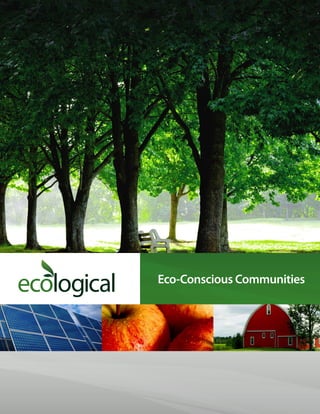
Ecological is a regenerative land development firm that
specializes in creating unique, eco-agro communities
that are built in harmony with their natural surroundings.
Our mission is to achieve a new standard of development
that does not merely sustain the environment but
actually repairs and strengthens our communities’
ecological, economic and social systems.
3. The End of Conventional,
Unsustainable Development
Throughout the past decade, development has typically been viewed as a negative
force in towns across the country. The conventional approach to development has been
characterized by the following attributes:
• Conventional cookie-cutter subdivisions
• Suburban sprawl
• Unsustainable “McMansions”
• Depletion of natural resources and ecological systems
The heavy ecological footprint and lack of connectivity fostered by conventional
“As Americans seek out cheaper, (relatively) development has degraded the fundamental sustainability of our communities
smaller, greener living options, new home by discouraging social interactions, draining natural resources and proving highly
sizes are falling for the first time in living
expensive to maintain.
memory. ‘After a long run-up in median home
size, peaking at 2,309 square feet in 2007,
home sizes shrank to 2,091 square feet in
2009. It’s the largest decline ever seen’ said Municipalities and communities have realized that the high financial and
NAHB chief economist David Crowe.” ecological costs of conventional developments are unsustainable and thus
- National Association of Home Builders no longer desirable.
Wall Street Journal
The New Standard for Healthy
Living: Eco-Agro Communities
Consumers are looking for a return to core values—a connection to the
land, access to locally produced food, a healthier lifestyle and a traditional
neighborhood community with a more welcoming aesthetic.
Ecological’s eco-agro communities are the future of healthy living. Our
master plans use sustainable planning techniques to address individual, “ In Seattle, a hotbed of green-building
activity, new homes with green certification
community, environmental and economic longevity by ensuring they strive
sell for 8.5% more per square foot than
to achieve the following: comparable non-green ones, according to a
report from GreenWorks Realty. They also sell
Preserve, restore and regenerate natural systems 22% quicker.”
Wildlife Habitat, Green Infrastructure, Open Space, Access to Nature - CNNMoney.com
Connect to local food
Farmer’s Markets, Orchards, Community Gardens
Create communities and promote social interaction
Trail Systems, Community Barns, Recreation
Construct smaller energy efficient green homes
High Quality Construction and Classic Design, Low-Impact, Low-Maintenance,
Healthy Indoor Air Quality, Local Vernacular
Develop in areas of existing irreplaceable infrastructure “The number of operating farmers markets
Distinguished School Districts, Access to Mass Transit and Strong Job Markets, in US since 1994 has increased from 1,755
Main Streets / Downtowns to 6,132, with a 16% increase from 2009 to
2010.”
- USDA Farmers Market Growth
4. The Path to Eco-Agro
Communities
It Begins With Process
Ecological approaches each project with a collaborative design process. By
engaging local stakeholders and regulators from the onset, Ecological aligns
the needs of the land with the community’s values and municipal goals.
We follow a holistic process that begins with understanding the ecology of the
land as well as the values of the community. We actively engage stakeholders,
local residents and municipal regulators through design charrettes, personal
interviews and larger community meetings to help us create a “story of place”.
Employing a cooperative and inclusive approach to development
allows Ecological to address the underlying needs of the community
and the municipality, coordinate a shared project vision and bring it
productively and efficiently through the comprehensive process.
Environmental Health
Ecological’s designs improve a site’s soil health, water quality and wildlife habitat
through the protection and regeneration of natural systems. In addition to
restoring these environmental systems, we blend site sensitive homes into the
landscape that are generally smaller, healthier and highly energy efficient.
Key components of an Ecological project may include:
“US commercial and residential buildings
• Land preservation through easements, covenants, codes and/or restrictions are responsible for 38% of the nation’s CO2
emissions and 9.5% of the world’s total energy
• Wildlife habitat restoration and invasive species management consumption. Green buildings, on average,
• Native, drought resistant planting/landscaping use 33% less energy than conventional ones.
Existing green buildings in the US effectively
• Reduction or elimination of pesticides and fertilizers
reduce CO2 emissions in an equivalence of
• Newly constructed wetlands to treat stormwater and wastewater taking 208,000 cars off the road every year.”
• Locally sourced and sustainable construction materials - Greg Kats, USGBC, and The Sustainable
• Improved indoor air quality Building Task Force
• Environmental education programs that encourage land stewardship
Ecological uses principles of regenerative design to improve the
quality of the land so that it is healthier than before development.
5. Economic Health
Ecological’s master plans employ classical design and traditional
neighborhood planning to create communities with a unique sense of
place. These tenants foster evolving and enduring neighborhoods that
generate and maintain value for both the residents and the municipality.
• Timeless design
• Homes that retain value and resist market volatility
• Reduced maintenance costs due to high quality construction and
innovative design
Additionally, municipalities enjoy the benefits of consistent sources of
tax ratables and improved infrastructure that requires less service and
maintenance.
“Prairie Crossing, a conservation community
near Chicago, has created value in the
marketplace through innovative design
and amenities-homes are selling for 33%
higher than comparable homes in area.
That premium can be attributed, in part, In creating a place, we are not only creating value for the residents and
to the project’s high level of amenities, community as a whole, but we are also providing the municipality with
conservation ethic and open space. “ much needed tax revenues and diminishing its service burden.
- ULI “Smart Growth: Myth and Fact”
Social Health
Ecological’s mandate is to encourage social interaction by creating communities
that not only reconnect residents with nature, but that also provide opportunities
for interpersonal exchanges. Ecological strives to build neighborhood
relationships through common amenities such as:
• Community orchards and gardens
• Nature trails
• Common barns, social gatherings and agricultural activities
Our projects also include educational programs that teach residents and the
public about the development’s many unique ecological features:
• Guided nature walks
• Handbooks for residents describing the ecological features of the land
and their homes
• Environmental lecture series
“Social connectedness is one of the
most powerful determinants of our well-
being. The more integrated we are with
Social health is just as vital in creating a well-balanced community our community, the less likely we are to
as environmental and economic sustainability. experience colds, heart attacks, strokes,
cancer, depression and premature death of
all sorts.”
- Robert Putnam, “Bowling Alone”
6. Mine Brook Road
Basking Ridge, New Jersey
Ecological’s most recent project is currently underway in Bernards Township, NJ, and
it serves as a prime example of the eco-agro communities we strive to develop.
The 89-acre site is one of the last remaining parcels in a town that had become a
fighting ground to prevent conventional development. Ecological approached the
township and the neighboring residents to fully engage them in the design process.
As a result, we collaborated with the town to design a project that protects
and enhances all of the attributes of the land that were most important to the
community and the environment.
• Land preservation - More than 70% open space preserved without any
public funding
• Ground Water Recharge and Soil Health – Natural stormwater management
systems that improve soil and habitat health, create new wetlands and
naturally treat road runoff before it is returned to the ecosystem
• Sustainable Agriculture – Easily-accessible agricultural uses on-site that
encourage community participation in sustainable, organic farming and
greater understanding of our relationship to the land
• Green Building and Energy Efficient Design – Homes will be built to
stringent green building standards
• Viewshed Protection – The most significant viewsheds into the property will
be preserved through a 200 ft. setback and a design that creates vast swaths
of meadow
• Natural Resource Enhancement – The existing woodlands and hedgerows
will be preserved and enhanced; new wetlands will be constructed to improve
water quality, provide areas for habitat and increase groundwater recharge
Preserve Open Space by
Clustering Homes
We strive to preserve as much open
space as possible in our projects.
Where applicable, we use a hamlet
design technique to cluster homes
around a courtyard, while still
maintaining a grand viewshed from
the back of the home. In addition to
pastoral open space such as woodlands
and common meadows that ensure
a sense of privacy, much of the open
space is integrated into the community
experience through organic food
gardens, orchards and walking trails.
7. Willow School
Gladstone, New Jersey
The Willow School is a notable example of how our design team is able to
integrate regenerative design features into a project that improves all systems,
from the surrounding site, to the building, to the educational curriculum taught
to the children. Our vision for the project was well ahead of its time. The Willow
School became the first LEED-Gold project in the Northeast, the second LEED-
rated building in New Jersey, and by phase two of the project earned a platinum
level-rating, the highest rating possible. As the lead environmental planners, site
designers and landscape architects for this project, the design team played an
integral role in helping this institution become a national model for both holistic
education and regenerative design and development.
Sustainable design elements used in the project include but are
not limited to:
• Native and drought resistant landscaping that does not require irrigation
• Rainwater harvesting, storage and reuse as the school’s wastewater supply
• Improved habitat for birds, butterflies and small mammals
• Heat-island effect reduction by providing shade for 33% of all non-roof
impervious surfaces using existing and newly planted trees
• Site management practices that restore native plant species, improve
biomass, reduce runoff and result in a more diverse ecosystem
• Constructed wetlands to manage stormwater and to treat human waste to
recreational use water standards before being allowed to infiltrate the aquifer
The students learn in a new way that incorporates their everyday environment
into their education and helps them to fully understand the consequences of
what might seemingly be their most insignificant actions—things as simple as
turning on a light or flushing a toilet.
Wetland Stormwater
Management
We employ passive stormwater
management systems that use
vegetated swales planted with native
species to treat stormwater through
natural biological processes. Restored
and constructed wetlands are designed
to temporarily hold rainfall and give it
time to infiltrate and refill local aquifers.
These wetlands and raingardens serve
as outdoor classrooms, new areas of
wildlife habitat and are a vital means of
improving local water quality.
8. Ecological’s Team includes the foremost financial, regulatory and
environmental experts in the world.
• Anthony Sblendorio, CEO and Co-Founder
Founder of Back to Nature
• Joseph J. Grano, Jr., Chairman and Co-Founder
Former Chairman & CEO of UBS PaineWebber
• Governor George E. Pataki, Board Member and Co-Founder
Former Governor of New York
• James M. Orphanides, Partner
Former Chairman & CEO of First American Title Insurance Company
• William G. Reed, Board Member
Founding Board Member of U.S. Green Building Council (USGBC)
For more information about Ecological’s approach
to development, visit us at:
www.ecologicalgroup.com
267 Broadway, Floor 3
New York, NY 10007
212.354.1560 Phone
646.625.5414 Fax
development@ecologicalgroup.com
Printed on recycled paper using soy inks.