INDOOR ENVIRONMENTAL QUALITY
OBJECTIVES – Learn the basics Indoor Environmental Quality:Why is IEQ important?What are Indoor Pollutants?What are VOCs?Strategies to Improve IAQMaterials Selection Attributes for Occupant HealthLEED and GreenPointcredits related to materials & indoor healthThird-Party Product Certifications Ventilation, HVAC Systems, and IAQ
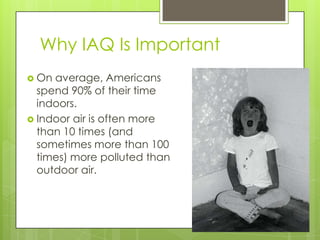
Why IAQ Is ImportantOn average, Americans spend 90% of their time indoors.Indoor air is often more than 10 times (and sometimes more than 100 times) more polluted than outdoor air.
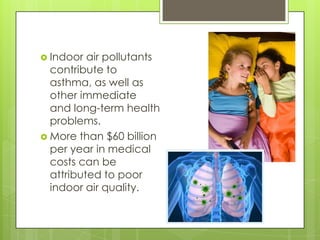
Indoor air pollutants contribute to asthma, as well as other immediate and long-term health problems.More than $60 billion per year in medical costs can be attributed to poor indoor air quality.
IAQ improvements could reduce health care costs and work losses from allergies and asthma by 18-25%. (Source: EPA)
Indoor PollutantsVOCs (volatile organic compounds) from building materials, finishes, and furnishingsVarious toxic chemicals from cleaning products, solvents, pesticides, herbicides, fertilizers, “air fresheners,” dry-cleaned clothes, perfumes, etc.Mold and mildew, biological/microbial pollutantsCarbon monoxide and NO2 (from combustion equip.)Particulates(from wood-burning fireplace, outdoor air pollutants from automobiles, etc.)Tobacco smokeRadonAsbestos, lead (in existing buildings)
VOCsVolatile organic compounds contribute to ground-level ozone (smog) and to indoor pollution. They can off gasfrom materials for years after installation.Types of VOCs include: formaldehyde, benzene, xylene, and toluene.
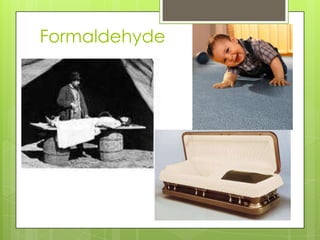
Formaldehyde
VOCsVOCs can cause respiratory, skin, and eye irritation; headaches, nausea, muscle weakness, dizziness, fatigue; and more serious ailments and long-term diseases. Some VOCs are known carcinogens.
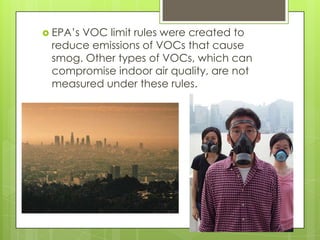
EPA’s VOC limit rules were created to reduce emissions of VOCs that cause smog. Other types of VOCs, which can compromise indoor air quality, are not measured under these rules.
EPA Indoor Air PLUS 13“Specifications were developed based on best available science and information about risks associated with indoor air quality problems, and balanced with practical issues of cost, builder production process compatibility, and enforceability”epa.gov/iaq/indoorairplus
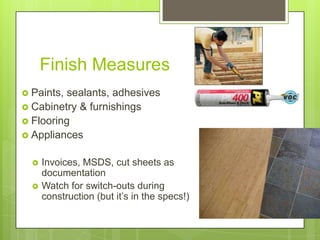
Finish Measures14Paints, sealants, adhesivesCabinetry & furnishingsFlooringAppliancesInvoices, MSDS, cut sheets as documentationWatch for switch-outs during construction (but it’s in the specs!)
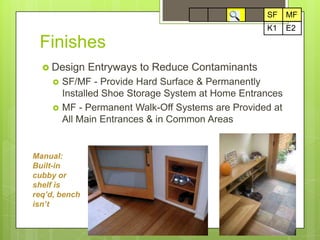
15SFMFSFMFFinishesE2K1Design Entryways to Reduce ContaminantsSF/MF - Provide Hard Surface & Permanently Installed Shoe Storage System at Home EntrancesMF - Permanent Walk-Off Systems are Provided at All Main Entrances & in Common Areas Manual: Built-in cubby or shelf is req’d, bench isn’t
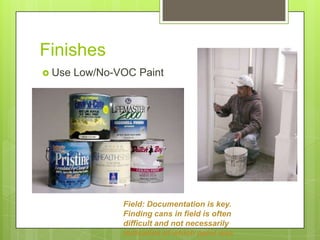
Finishes16Use Low/No-VOC PaintField: Documentation is key. Finding cans in field is often difficult and not necessarily indicative of which paint was applied where.
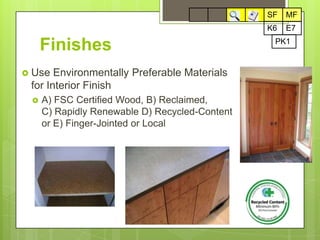
17SFMFSFMFFinishesE7K6PK1Use Environmentally Preferable Materials for Interior FinishA) FSC Certified Wood, B) Reclaimed,        C) Rapidly Renewable D) Recycled-Content or E) Finger-Jointed or Local
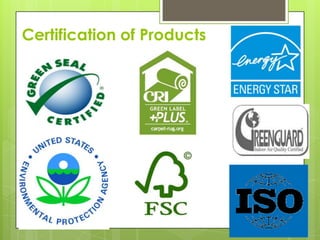
Certification of Products
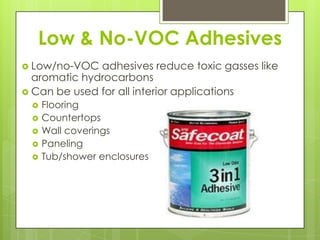
Low & No-VOC AdhesivesLow/no-VOC adhesives reduce toxic gasses like aromatic hydrocarbonsCan be used for all interior applicationsFlooringCountertopsWall coveringsPanelingTub/shower enclosures
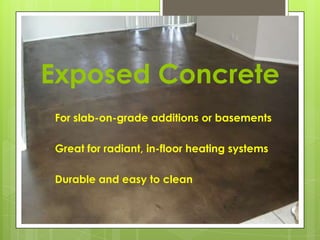
Exposed ConcreteFor slab-on-grade additions or basements
Great for radiant, in-floor heating systems
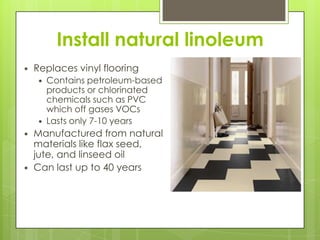
Durable and easy to cleanInstall natural linoleum Replaces vinyl flooring
Contains petroleum-based products or chlorinated chemicals such as PVC which off gases VOCs
Lasts only 7-10 years
Manufactured from natural materials like flax seed, jute, and linseed oil
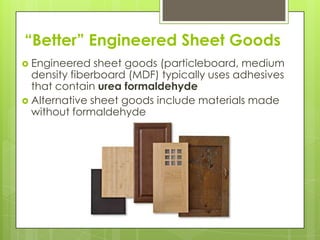
Can last up to 40 years“Better” Engineered Sheet GoodsEngineered sheet goods (particleboard, medium density fiberboard (MDF) typically uses adhesives that contain urea formaldehydeAlternative sheet goods include materials made without formaldehyde
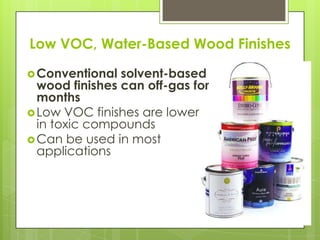
Low VOC, Water-Based Wood FinishesConventional solvent-based wood finishes can off-gas for monthsLow VOC finishes are lower in toxic compoundsCan be used in most applications
Low & No VOC PaintLow/no-VOC products are manufactured without:
Mercury or mercury compounds
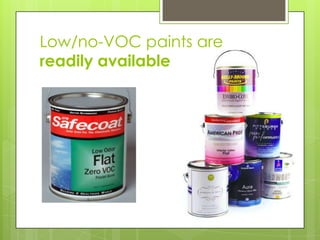
Pigments of lead, cadmium, chromium or their oxidesLow/no-VOC paints are readily available
Flush out prior to occupancyIf solvent-based wood finishes must be used, they should be left to off-gas for 3 to 4 weeks prior to occupancy
Strategies to Improve IAQ1. Source control / pollution prevention2. Improved ventilation3. Air filtering
Materials Selection Attributesfor Occupant HealthLow-VOC / Zero-VOC products (e.g., paints, stains,sealants/coatings, adhesives, solvents, carpeting andpadding, upholstery, etc.)Formaldehyde-free, or no added urea-formaldehyde(e.g., in binders for pressed wood products such as particleboard and MDF; insulation)Mold/moisture resistant, or naturally mold inhibitingFree of hazardous substances, e.g., mercury, arsenic,chromium, lead, BFRs, HFRs, PBDE flameretardants, etc.Naturally fire resistant
Materials Selection Attributes forPublic/Environmental HealthPVC-free materialsFree of hazardous substancesMade of natural materials (e.g., renewable, biodegradable, non-petrochemical)Organically grown materialsLow-pollution and/or carbon-neutral manufacturing processClean-burning fireplace insert and woodstovesNote: The selection of energy-saving products also helps protect     public/environmental health (and thereby also indoor health).Reducing fossil fuel consumption reduces air pollution and the emission of greenhouse gases that cause climate change.
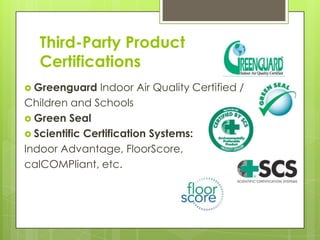
Third-Party Product CertificationsGreenguardIndoor Air Quality Certified /Children and SchoolsGreen SealScientific Certification Systems:Indoor Advantage, FloorScore,calCOMPliant, etc.
Other Product CertificationsMBDC Cradle to CradleCRI (Carpet and Rug Institute)   Green Label Plus
Ventilation, HVAC Systems, and IAQNatural ventilation  (intentional vs. infiltration)Mechanical ventilation (whole-house fans, ventilation systems, exhaust vents, etc.)Heating systems and equipment (sealed-combustion or power-vented equip., high-efficiency filters, radiant heating, etc.)
Construction/RenovationPractices and IAQConstruction IAQ Management (e.g., protectingducts; proper timing for the installation of porous materials; flush-out)Minimizing equipment and vehicle emissions in and around buildingProper ventilation and safety procedures duringinstallation/application of finishes (or polyurethane products), to protect workers as well as occupantsProper disposal of hazardous materials
Operations & Maintenanceissues related to IAQCleaning products and equipmentPesticides / pest managementHVAC air filter replacementMoisture/humidity controlEntryway grates, matsStorage and disposal of hazardous productsAutomobile and lawn maintenance equipment   emissionsAdequate ventilation during repair/maint./renov. work
Other IEQ Issues, Beyond IAQFactors that affect occupant comfort,well-being, and productivity/performance:•Thermal comfort• Daylighting/lighting (ample natural/warm light)• Controllability of lighting, windows, HVAC• Views of the outside/landscape• Acoustics
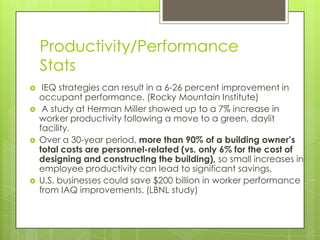
Productivity/Performance StatsIEQ strategies can result in a 6-26 percent improvement in occupant performance. (Rocky Mountain Institute)A study at Herman Miller showed up to a 7% increase in worker productivity following a move to a green, daylitfacility.Over a 30-year period, more than 90% of a building owner’s total costs are personnel-related (vs. only 6% for the cost of designing and constructing the building), so small increases in employee productivity can lead to significant savings.U.S. businesses could save $200 billion in worker performance from IAQ improvements. (LBNL study)
Kidder, Peabody & Co. circa 1865
Bertsch& Cooper, Chicago, 1921
Wright’s Studio Taliesin West Work Spaces 1932
Action Office Herman Miller
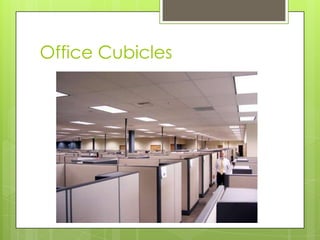
Office Cubicles
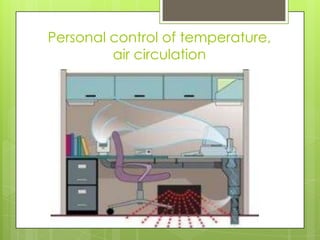
Environmental experience   -     Productivity ImpactThermal comfort - Performance decrease when too hot or too coldAir quality -  Performance decrease in polluted airCirculation of air, air vent location -  Performance decrease in stuffy rooms, or when air blows directly on workerNoise   -   Performance decrease in noisy roomsMechanical vibrations  - Performance decrease by noise and distractionPersonal control of temperature, air circulation  -Performance decrease with no control, perceived or real.
Personal control of temperature, air circulation
Suggested PracticesIAQ Management ProgramReduce Particulates in Air DistributionGreen Cleaning PolicyHigh-Performance Green Cleaning ProgramCustodial Effectiveness AssessmentPurchase of Sustainable Cleaning Products and MaterialsSustainable Cleaning EquipmentIndoor Integrated Pest ManagementOccupant Comfort Survey
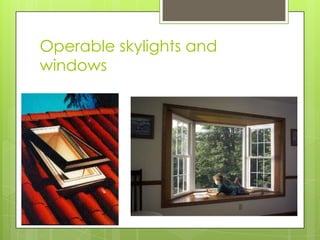
More GreenPoint credits related to IEQConstruction IAQ Management PlanOperable Windows/Skylights Placed for Cross-VentilationVentlessNatural Gas Clothes DryersTwo-week Whole Building Flush-OutFurniture with Environmentally Preferable Attributes
Operable skylights and windows
More GreenPoint credits (Existing Home only) related to IEQMoisture Source Verification and CorrectionRetrofit Crawlspace to Control MoistureRadon Testing and CorrectionCarbon Monoxide Testing and CorrectionLead and Asbestos Testing and RemediationGas Shut-Off Valve
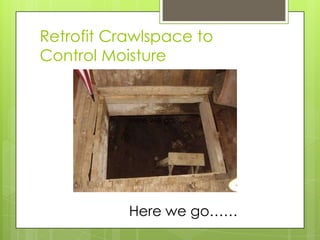
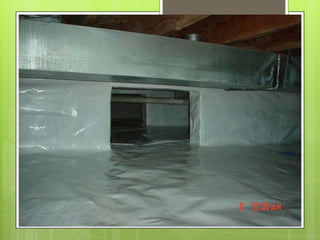
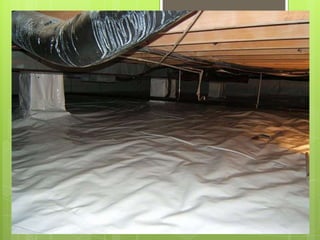
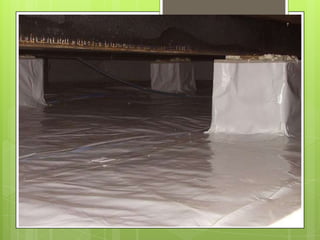
Retrofit Crawlspace to Control MoistureHere we go……Here we go……
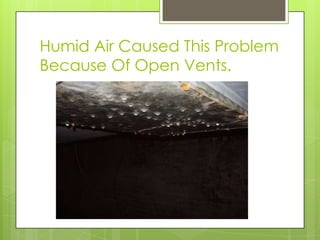
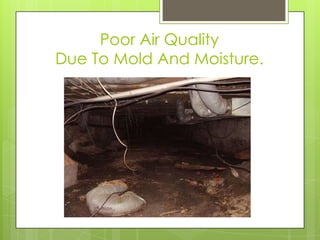
Humid Air Caused This Problem Because Of Open Vents.
Poor Air Quality Due To Mold And Moisture.
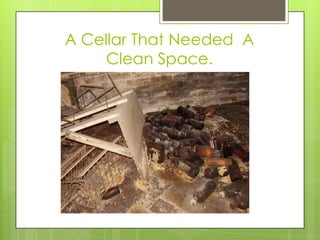
A Cellar That Needed  A Clean Space.
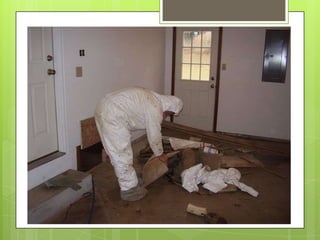
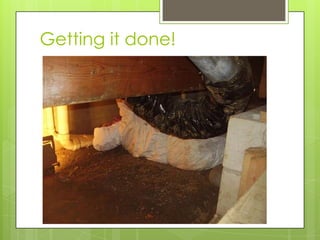
Getting it done!
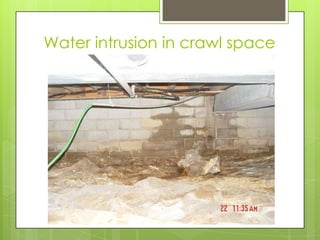
Water intrusion in crawl space
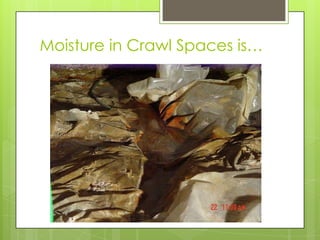
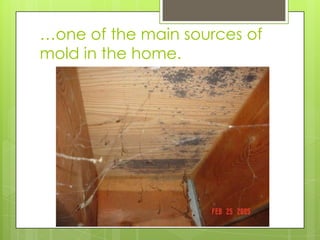
Moisture in Crawl Spaces is…
…one of the main sources of mold in the home.
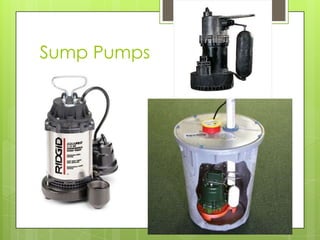
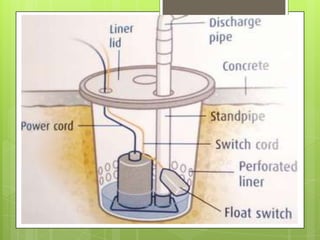
Sump Pumps
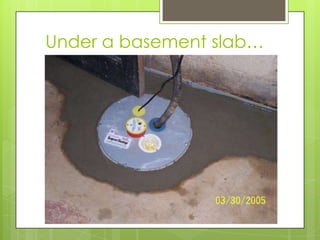
Under a basement slab…
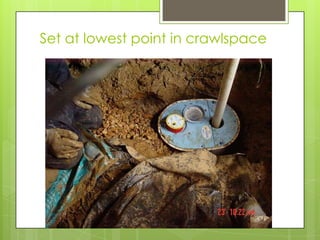
Set at lowest point in crawlspace
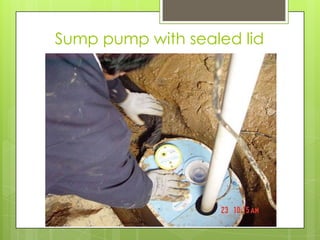
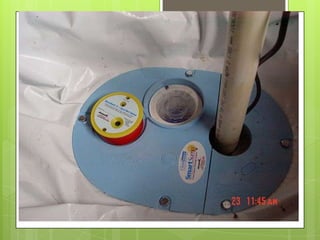
Sump pump with sealed lid
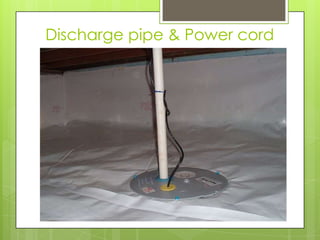
Discharge pipe & Power cord
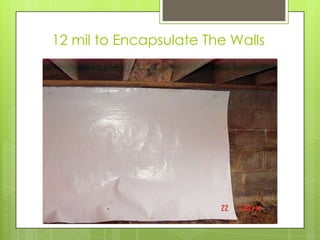
12 mil to Encapsulate The Walls
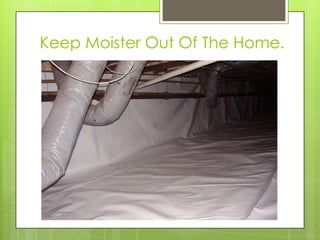
Keep Moister Out Of The Home.

Laney indoor environmental quality edited version may 2010

  • 1.
  • 2.
    OBJECTIVES – Learnthe basics Indoor Environmental Quality:Why is IEQ important?What are Indoor Pollutants?What are VOCs?Strategies to Improve IAQMaterials Selection Attributes for Occupant HealthLEED and GreenPointcredits related to materials & indoor healthThird-Party Product Certifications Ventilation, HVAC Systems, and IAQ
  • 3.
    Why IAQ IsImportantOn average, Americans spend 90% of their time indoors.Indoor air is often more than 10 times (and sometimes more than 100 times) more polluted than outdoor air.
  • 4.
    Indoor air pollutantscontribute to asthma, as well as other immediate and long-term health problems.More than $60 billion per year in medical costs can be attributed to poor indoor air quality.
  • 5.
    IAQ improvements couldreduce health care costs and work losses from allergies and asthma by 18-25%. (Source: EPA)
  • 7.
    Indoor PollutantsVOCs (volatileorganic compounds) from building materials, finishes, and furnishingsVarious toxic chemicals from cleaning products, solvents, pesticides, herbicides, fertilizers, “air fresheners,” dry-cleaned clothes, perfumes, etc.Mold and mildew, biological/microbial pollutantsCarbon monoxide and NO2 (from combustion equip.)Particulates(from wood-burning fireplace, outdoor air pollutants from automobiles, etc.)Tobacco smokeRadonAsbestos, lead (in existing buildings)
  • 8.
    VOCsVolatile organic compoundscontribute to ground-level ozone (smog) and to indoor pollution. They can off gasfrom materials for years after installation.Types of VOCs include: formaldehyde, benzene, xylene, and toluene.
  • 9.
  • 10.
    VOCsVOCs can causerespiratory, skin, and eye irritation; headaches, nausea, muscle weakness, dizziness, fatigue; and more serious ailments and long-term diseases. Some VOCs are known carcinogens.
  • 12.
    EPA’s VOC limitrules were created to reduce emissions of VOCs that cause smog. Other types of VOCs, which can compromise indoor air quality, are not measured under these rules.
  • 13.
    EPA Indoor AirPLUS 13“Specifications were developed based on best available science and information about risks associated with indoor air quality problems, and balanced with practical issues of cost, builder production process compatibility, and enforceability”epa.gov/iaq/indoorairplus
  • 14.
    Finish Measures14Paints, sealants,adhesivesCabinetry & furnishingsFlooringAppliancesInvoices, MSDS, cut sheets as documentationWatch for switch-outs during construction (but it’s in the specs!)
  • 15.
    15SFMFSFMFFinishesE2K1Design Entryways toReduce ContaminantsSF/MF - Provide Hard Surface & Permanently Installed Shoe Storage System at Home EntrancesMF - Permanent Walk-Off Systems are Provided at All Main Entrances & in Common Areas Manual: Built-in cubby or shelf is req’d, bench isn’t
  • 16.
    Finishes16Use Low/No-VOC PaintField:Documentation is key. Finding cans in field is often difficult and not necessarily indicative of which paint was applied where.

  • 17.
    17SFMFSFMFFinishesE7K6PK1Use Environmentally PreferableMaterials for Interior FinishA) FSC Certified Wood, B) Reclaimed, C) Rapidly Renewable D) Recycled-Content or E) Finger-Jointed or Local
  • 18.
  • 19.
    Low & No-VOCAdhesivesLow/no-VOC adhesives reduce toxic gasses like aromatic hydrocarbonsCan be used for all interior applicationsFlooringCountertopsWall coveringsPanelingTub/shower enclosures
  • 20.
    Exposed ConcreteFor slab-on-gradeadditions or basements
  • 21.
    Great for radiant,in-floor heating systems
  • 22.
    Durable and easyto cleanInstall natural linoleum Replaces vinyl flooring
  • 23.
    Contains petroleum-based productsor chlorinated chemicals such as PVC which off gases VOCs
  • 24.
  • 25.
    Manufactured from naturalmaterials like flax seed, jute, and linseed oil
  • 26.
    Can last upto 40 years“Better” Engineered Sheet GoodsEngineered sheet goods (particleboard, medium density fiberboard (MDF) typically uses adhesives that contain urea formaldehydeAlternative sheet goods include materials made without formaldehyde
  • 27.
    Low VOC, Water-BasedWood FinishesConventional solvent-based wood finishes can off-gas for monthsLow VOC finishes are lower in toxic compoundsCan be used in most applications
  • 28.
    Low & NoVOC PaintLow/no-VOC products are manufactured without:
  • 29.
  • 30.
    Pigments of lead,cadmium, chromium or their oxidesLow/no-VOC paints are readily available
  • 31.
    Flush out priorto occupancyIf solvent-based wood finishes must be used, they should be left to off-gas for 3 to 4 weeks prior to occupancy
  • 33.
    Strategies to ImproveIAQ1. Source control / pollution prevention2. Improved ventilation3. Air filtering
  • 34.
    Materials Selection AttributesforOccupant HealthLow-VOC / Zero-VOC products (e.g., paints, stains,sealants/coatings, adhesives, solvents, carpeting andpadding, upholstery, etc.)Formaldehyde-free, or no added urea-formaldehyde(e.g., in binders for pressed wood products such as particleboard and MDF; insulation)Mold/moisture resistant, or naturally mold inhibitingFree of hazardous substances, e.g., mercury, arsenic,chromium, lead, BFRs, HFRs, PBDE flameretardants, etc.Naturally fire resistant
  • 35.
    Materials Selection AttributesforPublic/Environmental HealthPVC-free materialsFree of hazardous substancesMade of natural materials (e.g., renewable, biodegradable, non-petrochemical)Organically grown materialsLow-pollution and/or carbon-neutral manufacturing processClean-burning fireplace insert and woodstovesNote: The selection of energy-saving products also helps protect public/environmental health (and thereby also indoor health).Reducing fossil fuel consumption reduces air pollution and the emission of greenhouse gases that cause climate change.
  • 36.
    Third-Party Product CertificationsGreenguardIndoorAir Quality Certified /Children and SchoolsGreen SealScientific Certification Systems:Indoor Advantage, FloorScore,calCOMPliant, etc.
  • 37.
    Other Product CertificationsMBDCCradle to CradleCRI (Carpet and Rug Institute) Green Label Plus
  • 38.
    Ventilation, HVAC Systems,and IAQNatural ventilation (intentional vs. infiltration)Mechanical ventilation (whole-house fans, ventilation systems, exhaust vents, etc.)Heating systems and equipment (sealed-combustion or power-vented equip., high-efficiency filters, radiant heating, etc.)
  • 39.
    Construction/RenovationPractices and IAQConstructionIAQ Management (e.g., protectingducts; proper timing for the installation of porous materials; flush-out)Minimizing equipment and vehicle emissions in and around buildingProper ventilation and safety procedures duringinstallation/application of finishes (or polyurethane products), to protect workers as well as occupantsProper disposal of hazardous materials
  • 40.
    Operations & Maintenanceissuesrelated to IAQCleaning products and equipmentPesticides / pest managementHVAC air filter replacementMoisture/humidity controlEntryway grates, matsStorage and disposal of hazardous productsAutomobile and lawn maintenance equipment emissionsAdequate ventilation during repair/maint./renov. work
  • 41.
    Other IEQ Issues,Beyond IAQFactors that affect occupant comfort,well-being, and productivity/performance:•Thermal comfort• Daylighting/lighting (ample natural/warm light)• Controllability of lighting, windows, HVAC• Views of the outside/landscape• Acoustics
  • 42.
    Productivity/Performance StatsIEQ strategiescan result in a 6-26 percent improvement in occupant performance. (Rocky Mountain Institute)A study at Herman Miller showed up to a 7% increase in worker productivity following a move to a green, daylitfacility.Over a 30-year period, more than 90% of a building owner’s total costs are personnel-related (vs. only 6% for the cost of designing and constructing the building), so small increases in employee productivity can lead to significant savings.U.S. businesses could save $200 billion in worker performance from IAQ improvements. (LBNL study)
  • 43.
    Kidder, Peabody &Co. circa 1865
  • 44.
  • 45.
    Wright’s Studio TaliesinWest Work Spaces 1932
  • 46.
  • 47.
  • 48.
    Environmental experience - Productivity ImpactThermal comfort - Performance decrease when too hot or too coldAir quality - Performance decrease in polluted airCirculation of air, air vent location - Performance decrease in stuffy rooms, or when air blows directly on workerNoise - Performance decrease in noisy roomsMechanical vibrations - Performance decrease by noise and distractionPersonal control of temperature, air circulation -Performance decrease with no control, perceived or real.
  • 49.
    Personal control oftemperature, air circulation
  • 50.
    Suggested PracticesIAQ ManagementProgramReduce Particulates in Air DistributionGreen Cleaning PolicyHigh-Performance Green Cleaning ProgramCustodial Effectiveness AssessmentPurchase of Sustainable Cleaning Products and MaterialsSustainable Cleaning EquipmentIndoor Integrated Pest ManagementOccupant Comfort Survey
  • 51.
    More GreenPoint creditsrelated to IEQConstruction IAQ Management PlanOperable Windows/Skylights Placed for Cross-VentilationVentlessNatural Gas Clothes DryersTwo-week Whole Building Flush-OutFurniture with Environmentally Preferable Attributes
  • 52.
  • 53.
    More GreenPoint credits(Existing Home only) related to IEQMoisture Source Verification and CorrectionRetrofit Crawlspace to Control MoistureRadon Testing and CorrectionCarbon Monoxide Testing and CorrectionLead and Asbestos Testing and RemediationGas Shut-Off Valve
  • 54.
    Retrofit Crawlspace toControl MoistureHere we go……Here we go……
  • 55.
    Humid Air CausedThis Problem Because Of Open Vents.
  • 56.
    Poor Air QualityDue To Mold And Moisture.
  • 57.
    A Cellar ThatNeeded  A Clean Space.
  • 59.
  • 60.
  • 61.
    Moisture in CrawlSpaces is…
  • 62.
    …one of themain sources of mold in the home.
  • 63.
  • 65.
  • 66.
    Set at lowestpoint in crawlspace
  • 67.
    Sump pump withsealed lid
  • 69.
  • 70.
    12 mil toEncapsulate The Walls
  • 71.
    Keep Moister OutOf The Home.

Editor's Notes

  • #19 International Organization for Standards is used in many categories: ex.ISO14021-1999 Environmental Labels and Declarations for such things as post-consumer content – referenced in LEED Credit 4.1 & 4.2 Recycled ContentGreen Seal is an independent nonprofit organization that promotes the manufacture and sale of environmentally responsible consumer products. GS-36 is a standard that sets VOC limits for commercial adhesives. EQ 4.1GS-11 sets VOC limits for commercial flat and non-flat paints. EQ 4.2 Green Label Plus program form the Carpet and Rug Institute referenced in EQ 4.3 Carpet SystemsEPA referenced in LEED EQ Credits regarding indoor air pollutantsGreenguard Environmental Institutewww.greenguard.orgA non-profit certification organization that conducts laboratory tests on products and materials used in indoor environments, and provides a guide of certified low-emitting products.
  • #21 Finished with expansion joints
  • #22 Production of vinyl flooring can result in the creation of toxic byproducts such as dioxins
  • #23 Urea formaldehyde is a suspected human carcinogenFormaldehyde off-gassing contributes to poor indoor air qualityTo eliminate potential toxinsUse solid wood for stair treads,MDF with formaldehyde-free bindersStraw-based MDF – use for shelving, cabinets, trim and substrate for countertops.Made from agricultural wastesStraw-based particleboardExterior plywood uses phenolic resins that offgas 1/10 as much as interior plywoodInterior plywood typically uses urea formaldehyde glueUse for custom cabinets and shelving
  • #24 Urethane and acrylic are conventional solvent based finishes.
  • #25 Darker colors tend to have higher VOCs due to the concentration of synthetic materials