Taking Notes
How to Synthesize Information from a Source
Mary Alice Osborne
Library Media Specialist
Here are some ways to be an
effective reader of information
List of Reading Strategies:
• Skimming and Scanning
• Looking for Keywords
• Noticing Bold, Italic, and Underlined Words
• Being aware of Headlines
• Using the Table of Contents, Index, Glossary,
and Title page
• Paying attention to picture Captions
• Knowing that sometimes reading every word is
necessary
• Make a Mind Map, Table or Line Diagram
ABC - LOU
Note-taking Strategies
• Abbreviations
• Bullets
• Caveman language
• Lists
• One word for several
• Use your own words
Taken from: School Library Media Activities Monthly Vol. 12, No. 1, Sept. 2006
Abbreviations
• Abbreviations are shortened forms of a word or
phrase
• Use them when you take notes
• Examples:
– Dr. = doctor
– Mrs. = missus
– Mr. = mister
– U.S.A. = United States of America
– CN = China
Bullets
Example of a Bulleted List:
Foods Romans Ate:
• Pizza
• Spaghetti
• Olives
• Tomatoes
• Wine
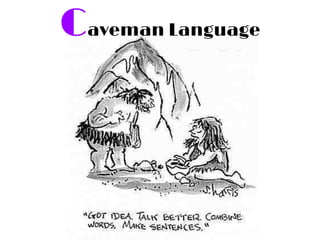
Caveman Language
Lists
We all make lists from time to time:
• Grocery lists
• List of things to bring on vacation
• “To Do” Lists
When doing research you can also make lists:
• List of countries the Romans conquered
• List of weapons used by the Romans
One Word for Several
(Paraphrase)
How to:
• Reread the original passage until you understand it.
• Set the original aside, and write your paraphrase.
• Check your version with the original to make sure that it
accurately expresses all the essential information, but in
a new form.
• Record the source (including the page) in your notes so
that you can credit it easily
Taken from:
https://owl.purdue.edu/owl/research_and_citation/using_research/quoting_paraphr
asing_and_summarizing/paraphrasing.html
Use Your Own Words
Similar to Paraphrasing
• Read the information through
• Without looking at the original material, write
your own version
• Change words that are difficult to words you
understand
Note: You still need to cite the information
THE ORIGINAL PASSAGE:
Students frequently overuse direct quotation in taking notes, and
as a result they overuse quotations in the final [research] paper.
Probably only about 10% of your final manuscript should appear
as directly quoted matter. Therefore, you should strive to limit the
amount of exact transcribing of source materials while taking
notes. Lester, James D. Writing Research Papers. 2nd ed., 1976,
pp. 46-47.
A LEGITIMATE PARAPHRASE:
In research papers, students often quote excessively, failing to
keep quoted material down to a desirable level. Since the problem
usually originates during note taking, it is essential to minimize the
material recorded verbatim (Lester 46-47).
AN ACCEPTABLE SUMMARY:
Students should take just a few notes in direct quotation from
sources to help minimize the amount of quoted material in a
research paper (Lester 46-47).
https://owl.purdue.edu/owl/research_and_citation/using_research/quoting_paraphr
asing_and_summarizing/paraphrasing.html
Synthesize this paragraph
into Notes
Roman men and women originally seem to have worn
a large piece of wool, wrapped around themselves.
After they met people from Greece and Egypt,
around 200 BC, they began to wear linen tunics (like
T-shirts) under their wool robes, which was more
comfortable. On their feet, both men and women
wore leather sandals, or leather boots in cold
weather. In their hair, women wore wooden hair
sticks or wooden combs, which they could also use
to comb their hair.
"Roman Clothing - History for Kids!" Kidipede - History and Science for Kids - Homework Help for
Middle School. 13 Mar. 2009 <http://www.historyforkids.org/learn/romans/clothing/index.htm>.
Bubble Diagram using Bubbl.us
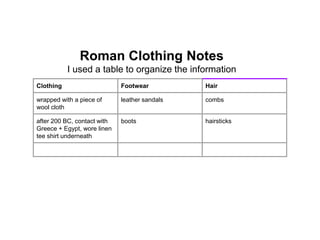
Clothing Footwear Hair
wrapped with a piece of
wool cloth
leather sandals combs
after 200 BC, contact with
Greece + Egypt, wore linen
tee shirt underneath
boots hairsticks
Roman Clothing Notes
I used a table to organize the information
Try it Yourself!
Fact Fragment Frenzy
More ideas for note-taking
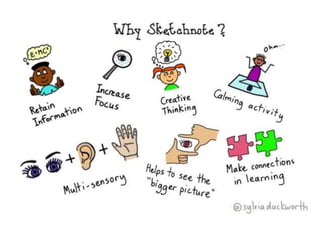
Sketchnoting
Sketchnoting, also commonly referred to
as visual notetaking, is the creative and
graphic process through which an
individual can record their thoughts
with the use of illustrations, symbols,
structures, and texts.
https://www.core77.com/posts/19678/sketchnotes-101-the-basics-of-visual-note-taking-19678
Mind Maps
• Many students find that highlighting helps
them to concentrate and helps them to
understand the text.
• Just deciding what to highlight or underline
encourages you to think critically, make
judgments and formulate your own response
to the text.
Highlighting
Highlighting
1.Read quickly through the text to get an overview
of what it’s about.
2.Now, read it more closely, pausing at the end of
each paragraph to identify the main points. You
may highlight:
1.Sentence or word that sums up an important idea
2.Quotations
3.Statistics
4.Specialized terms
5.Important or useful data
6.Examples or links to other ideas.
3.You could use different colored pens to mark
different kinds of information, but be careful not to
highlight so much that it becomes distracting.

Learning to Take Notes V2.pptx

  • 1.
    Taking Notes How toSynthesize Information from a Source Mary Alice Osborne Library Media Specialist
  • 2.
    Here are someways to be an effective reader of information
  • 3.
    List of ReadingStrategies: • Skimming and Scanning • Looking for Keywords • Noticing Bold, Italic, and Underlined Words • Being aware of Headlines • Using the Table of Contents, Index, Glossary, and Title page • Paying attention to picture Captions • Knowing that sometimes reading every word is necessary • Make a Mind Map, Table or Line Diagram
  • 4.
    ABC - LOU Note-takingStrategies • Abbreviations • Bullets • Caveman language • Lists • One word for several • Use your own words Taken from: School Library Media Activities Monthly Vol. 12, No. 1, Sept. 2006
  • 5.
    Abbreviations • Abbreviations areshortened forms of a word or phrase • Use them when you take notes • Examples: – Dr. = doctor – Mrs. = missus – Mr. = mister – U.S.A. = United States of America – CN = China
  • 6.
    Bullets Example of aBulleted List: Foods Romans Ate: • Pizza • Spaghetti • Olives • Tomatoes • Wine
  • 7.
  • 8.
    Lists We all makelists from time to time: • Grocery lists • List of things to bring on vacation • “To Do” Lists When doing research you can also make lists: • List of countries the Romans conquered • List of weapons used by the Romans
  • 9.
    One Word forSeveral (Paraphrase) How to: • Reread the original passage until you understand it. • Set the original aside, and write your paraphrase. • Check your version with the original to make sure that it accurately expresses all the essential information, but in a new form. • Record the source (including the page) in your notes so that you can credit it easily Taken from: https://owl.purdue.edu/owl/research_and_citation/using_research/quoting_paraphr asing_and_summarizing/paraphrasing.html
  • 10.
    Use Your OwnWords Similar to Paraphrasing • Read the information through • Without looking at the original material, write your own version • Change words that are difficult to words you understand Note: You still need to cite the information
  • 12.
    THE ORIGINAL PASSAGE: Studentsfrequently overuse direct quotation in taking notes, and as a result they overuse quotations in the final [research] paper. Probably only about 10% of your final manuscript should appear as directly quoted matter. Therefore, you should strive to limit the amount of exact transcribing of source materials while taking notes. Lester, James D. Writing Research Papers. 2nd ed., 1976, pp. 46-47. A LEGITIMATE PARAPHRASE: In research papers, students often quote excessively, failing to keep quoted material down to a desirable level. Since the problem usually originates during note taking, it is essential to minimize the material recorded verbatim (Lester 46-47). AN ACCEPTABLE SUMMARY: Students should take just a few notes in direct quotation from sources to help minimize the amount of quoted material in a research paper (Lester 46-47). https://owl.purdue.edu/owl/research_and_citation/using_research/quoting_paraphr asing_and_summarizing/paraphrasing.html
  • 13.
    Synthesize this paragraph intoNotes Roman men and women originally seem to have worn a large piece of wool, wrapped around themselves. After they met people from Greece and Egypt, around 200 BC, they began to wear linen tunics (like T-shirts) under their wool robes, which was more comfortable. On their feet, both men and women wore leather sandals, or leather boots in cold weather. In their hair, women wore wooden hair sticks or wooden combs, which they could also use to comb their hair. "Roman Clothing - History for Kids!" Kidipede - History and Science for Kids - Homework Help for Middle School. 13 Mar. 2009 <http://www.historyforkids.org/learn/romans/clothing/index.htm>.
  • 14.
  • 15.
    Clothing Footwear Hair wrappedwith a piece of wool cloth leather sandals combs after 200 BC, contact with Greece + Egypt, wore linen tee shirt underneath boots hairsticks Roman Clothing Notes I used a table to organize the information
  • 16.
    Try it Yourself! FactFragment Frenzy
  • 17.
    More ideas fornote-taking
  • 18.
    Sketchnoting Sketchnoting, also commonlyreferred to as visual notetaking, is the creative and graphic process through which an individual can record their thoughts with the use of illustrations, symbols, structures, and texts. https://www.core77.com/posts/19678/sketchnotes-101-the-basics-of-visual-note-taking-19678
  • 21.
  • 22.
    • Many studentsfind that highlighting helps them to concentrate and helps them to understand the text. • Just deciding what to highlight or underline encourages you to think critically, make judgments and formulate your own response to the text. Highlighting
  • 23.
    Highlighting 1.Read quickly throughthe text to get an overview of what it’s about. 2.Now, read it more closely, pausing at the end of each paragraph to identify the main points. You may highlight: 1.Sentence or word that sums up an important idea 2.Quotations 3.Statistics 4.Specialized terms 5.Important or useful data 6.Examples or links to other ideas. 3.You could use different colored pens to mark different kinds of information, but be careful not to highlight so much that it becomes distracting.