“ Evolving New E-learning Practices in Traditional Higher Education” International Conference on Networked e-learning for European Universities University of Granada, Spain 25th of November, 2003 Developing eLearning Lessons Pierfranco Ravotto - pfr@tes.mi.it ITSOS “Marie Curie” Cernusco sul Naviglio (MI) ITALY
Why to develop eLearning lessons “…  a new strategic goal for the next decade:  to become the most competitive and dynamic knowledge-based economy in the world, capable of sustainable economic growth with more and better jobs and greater social cohesion .” Lisbon European Council, 23 and 24 march 2000 eLearning  is “the use of new multimedia technologies and the Internet  to improve the quality of learning by facilitating access to resources and services as well as remote exchanges and  collaboration ” eLearning Action Plan, March 2001
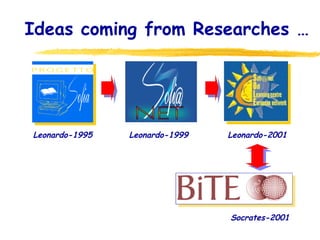
Ideas coming from Researches … Leonardo-1995 Leonardo-1999 Leonardo-2001 Socrates-2001
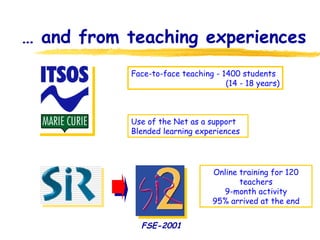
…  and from teaching experiences FSE-2001 Online training for 120 teachers 9-month activity 95% arrived at the end Face-to-face teaching - 1400 students  (14 - 18 years) Use of the Net as a support Blended learning experiences
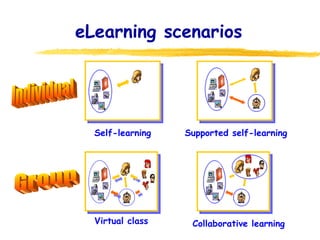
eLearning scenarios Individual Group Supported self-learning Self-learning Virtual class Collaborative learning
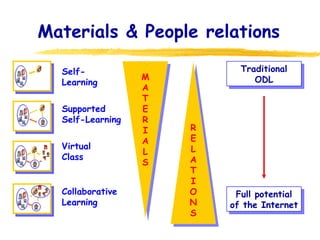
Materials & People relations M A T E R I A L S R E L A T I O N S Traditional ODL Full potential of the Internet Self-Learning Supported Self-Learning Virtual Class Collaborative Learning
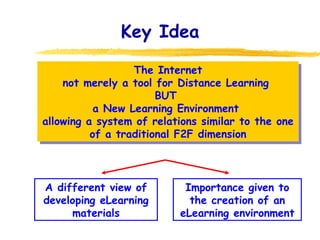
Key Idea The Internet not merely a tool for Distance Learning  BUT  a New Learning Environment  allowing a system of relations similar to the one of a traditional F2F dimension A different view of developing eLearning materials Importance given to the creation of an eLearning environment
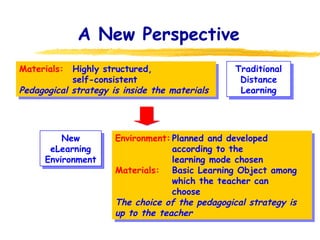
A New Perspective Traditional Distance Learning Materials:  Highly structured,  self-consistent Pedagogical strategy is inside the materials New eLearning Environment Environment: Planned and developed  according to the  learning mode chosen Materials:  Basic Learning Object among  which the teacher can  choose  The choice of the pedagogical strategy is up to the teacher
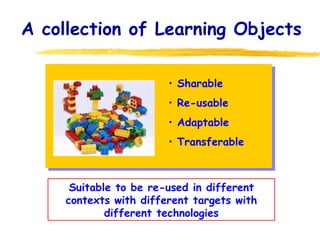
A collection of Learning Objects Suitable to be re-used in different contexts with different targets with different technologies Sharable Re-usable Adaptable Transferable
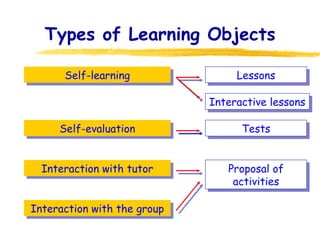
Types of Learning Objects Self-learning Self-evaluation Interaction with tutor Interaction with the group Lessons Interactive lessons Tests Proposal of activities
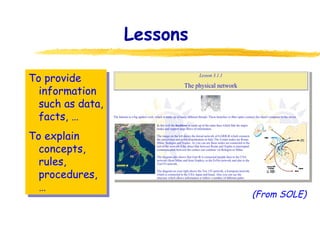
Lessons  To provide information such as data, facts, … To explain concepts, rules, procedures,… (From SOLE)
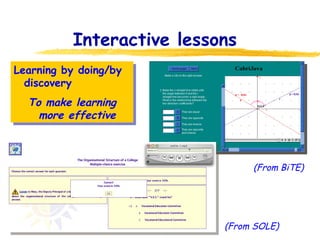
Interactive lessons  Learning by doing/by discovery To make learning more effective (From SOLE) (From BiTE)
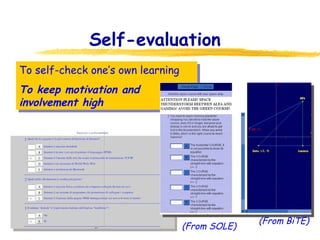
Self-evaluation  To self-check one’s own learning To keep motivation and involvement high (From BiTE) (From SOLE)
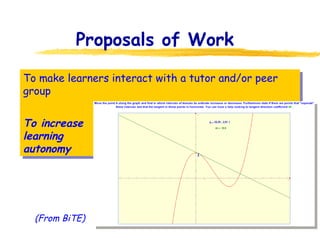
Proposals of Work  To make learners interact with a tutor and/or peer group  To increase  learning  autonomy (From BiTE)
How to prepare such a collection? We need a collection of Learning materials Impossible for a single teacher Very difficult for a school/a college/a university Sharable Re-usable Adaptable Transferable
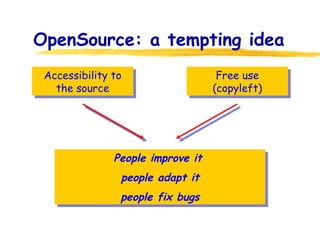
OpenSource: a tempting idea Accessibility to the source Free use (copyleft) People improve it  people adapt it people fix bugs
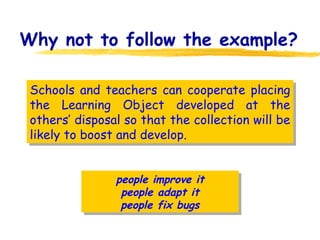
Why not to follow the example? Schools and teachers can cooperate placing the Learning Object developed at the others’ disposal so that the collection will be likely to boost and develop. people improve it people adapt it people fix bugs
ITSOS “Marie Curie” www.tes.mi. it Pierfranco Ravotto [email_address] it   www.tes.mi.it/ pfr   DEVELOPING eLEARNING LESSONS

Developing eLearning Lessons (2003)

  • 1.
    “ Evolving NewE-learning Practices in Traditional Higher Education” International Conference on Networked e-learning for European Universities University of Granada, Spain 25th of November, 2003 Developing eLearning Lessons Pierfranco Ravotto - pfr@tes.mi.it ITSOS “Marie Curie” Cernusco sul Naviglio (MI) ITALY
  • 2.
    Why to developeLearning lessons “… a new strategic goal for the next decade: to become the most competitive and dynamic knowledge-based economy in the world, capable of sustainable economic growth with more and better jobs and greater social cohesion .” Lisbon European Council, 23 and 24 march 2000 eLearning is “the use of new multimedia technologies and the Internet to improve the quality of learning by facilitating access to resources and services as well as remote exchanges and collaboration ” eLearning Action Plan, March 2001
  • 3.
    Ideas coming fromResearches … Leonardo-1995 Leonardo-1999 Leonardo-2001 Socrates-2001
  • 4.
    … andfrom teaching experiences FSE-2001 Online training for 120 teachers 9-month activity 95% arrived at the end Face-to-face teaching - 1400 students (14 - 18 years) Use of the Net as a support Blended learning experiences
  • 5.
    eLearning scenarios IndividualGroup Supported self-learning Self-learning Virtual class Collaborative learning
  • 6.
    Materials & Peoplerelations M A T E R I A L S R E L A T I O N S Traditional ODL Full potential of the Internet Self-Learning Supported Self-Learning Virtual Class Collaborative Learning
  • 7.
    Key Idea TheInternet not merely a tool for Distance Learning BUT a New Learning Environment allowing a system of relations similar to the one of a traditional F2F dimension A different view of developing eLearning materials Importance given to the creation of an eLearning environment
  • 8.
    A New PerspectiveTraditional Distance Learning Materials: Highly structured, self-consistent Pedagogical strategy is inside the materials New eLearning Environment Environment: Planned and developed according to the learning mode chosen Materials: Basic Learning Object among which the teacher can choose The choice of the pedagogical strategy is up to the teacher
  • 9.
    A collection ofLearning Objects Suitable to be re-used in different contexts with different targets with different technologies Sharable Re-usable Adaptable Transferable
  • 10.
    Types of LearningObjects Self-learning Self-evaluation Interaction with tutor Interaction with the group Lessons Interactive lessons Tests Proposal of activities
  • 11.
    Lessons Toprovide information such as data, facts, … To explain concepts, rules, procedures,… (From SOLE)
  • 12.
    Interactive lessons Learning by doing/by discovery To make learning more effective (From SOLE) (From BiTE)
  • 13.
    Self-evaluation Toself-check one’s own learning To keep motivation and involvement high (From BiTE) (From SOLE)
  • 14.
    Proposals of Work To make learners interact with a tutor and/or peer group To increase learning autonomy (From BiTE)
  • 15.
    How to preparesuch a collection? We need a collection of Learning materials Impossible for a single teacher Very difficult for a school/a college/a university Sharable Re-usable Adaptable Transferable
  • 16.
    OpenSource: a temptingidea Accessibility to the source Free use (copyleft) People improve it people adapt it people fix bugs
  • 17.
    Why not tofollow the example? Schools and teachers can cooperate placing the Learning Object developed at the others’ disposal so that the collection will be likely to boost and develop. people improve it people adapt it people fix bugs
  • 18.
    ITSOS “Marie Curie”www.tes.mi. it Pierfranco Ravotto [email_address] it www.tes.mi.it/ pfr DEVELOPING eLEARNING LESSONS