







Epidermolysis Bullosa
Leah M. Gordon, MS, CRNA
WHAT IS EPIDERMOLYSIS BULLOSA (EB)?
Epidermolysis Bullosa is a rare genetic disease characterized by the presence
of extremely fragile skin and recurrent blister formation, resulting from minor
mechanical friction or trauma.
There are many genetic and symptom forms of EB
http://www.debra.org/understanding#sthash.72wmWtmo.dpuf
WHAT IS EPIDERMOLYSIS BULLOSA (EB)?
Internal organs and bodily systems can also be seriously affected by the
disease.
EB is always painful, is often pervasive and debilitating, and is in some cases
lethal before the age of 30.
http://www.debra.org/understanding#sthash.72wmWtmo.dpuf
WHAT IS EPIDERMOLYSIS BULLOSA (EB)?
The disorder occurs in every racial and ethnic group throughout the world
The disorder affects both sexes equally.
http://www.debra.org/understanding#sthash.72wmWtmo.dpuf
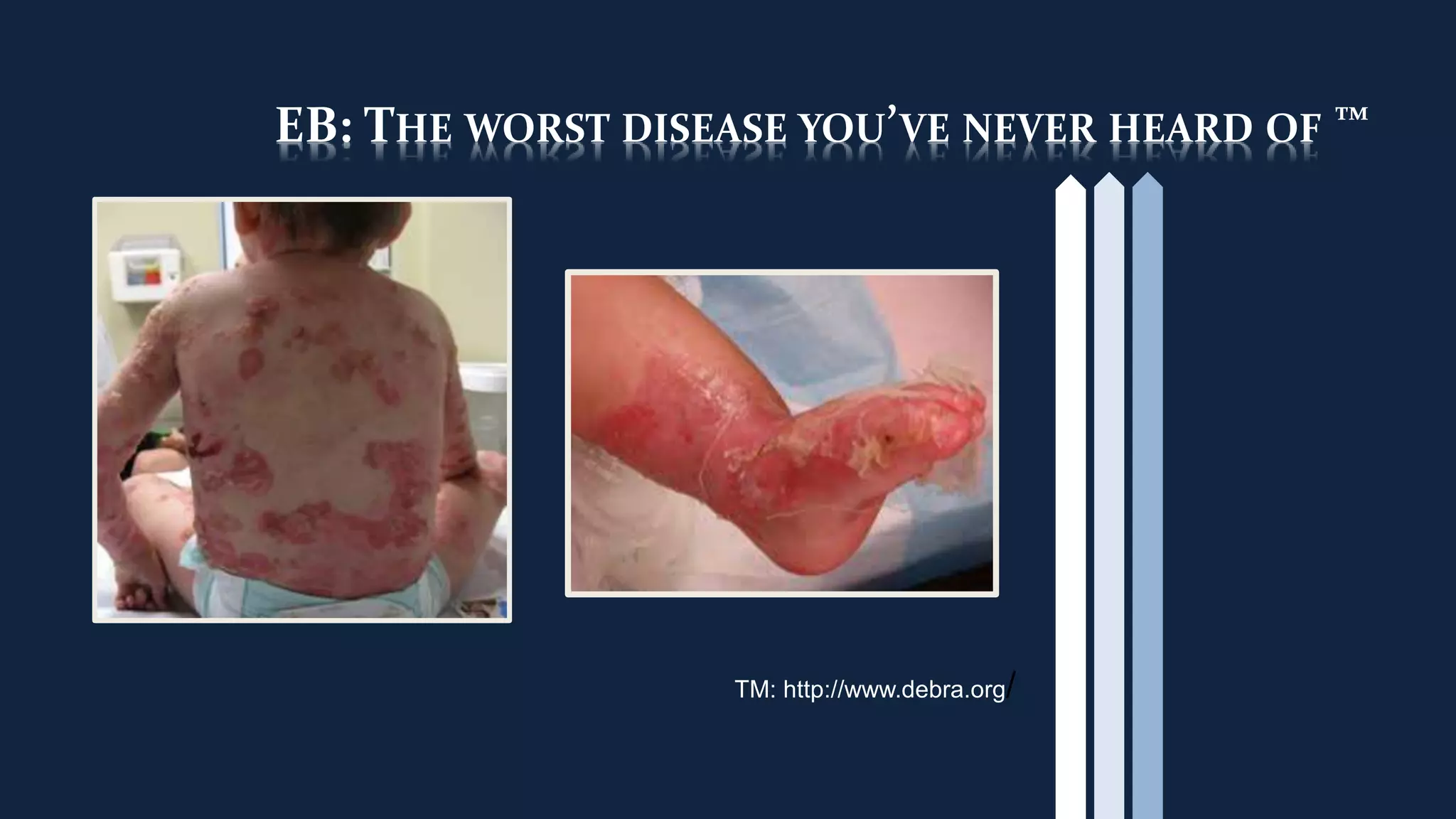
EB: THE WORST DISEASE YOU’VE NEVER HEARD OF ™
TM: http://www.debra.org/
BUTTERFLY CHILDREN
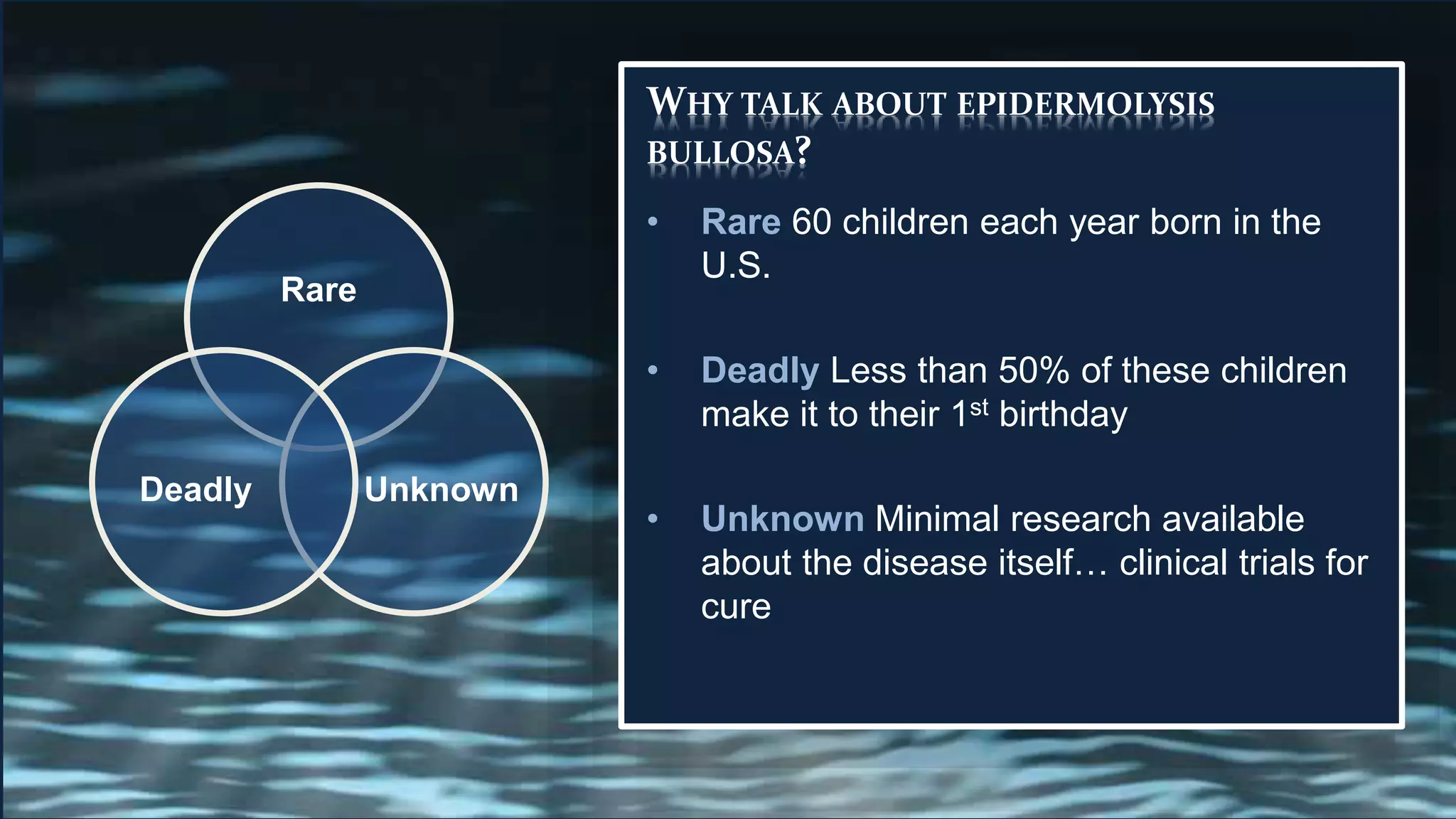
WHY TALK ABOUT EPIDERMOLYSIS
BULLOSA?
• Rare 60 children each year born in the
U.S.
• Deadly Less than 50% of these children
make it to their 1st birthday
• Unknown Minimal research available
about the disease itself… clinical trials for
cure
Rare
UnknownDeadly
TYPES OF EB
There are four main types of epidermolysis bullosa:
• Dystrophic epidermolysis bullosa
• Epidermolysis bullosa simplex
• Junctional epidermolysis bullosa
• Hemidesmosomal epidermolysis bullosa
• Another rare type of epidermolysis bullosa called epidermolysis bullosa
acquisita, is an autoimmune disorder
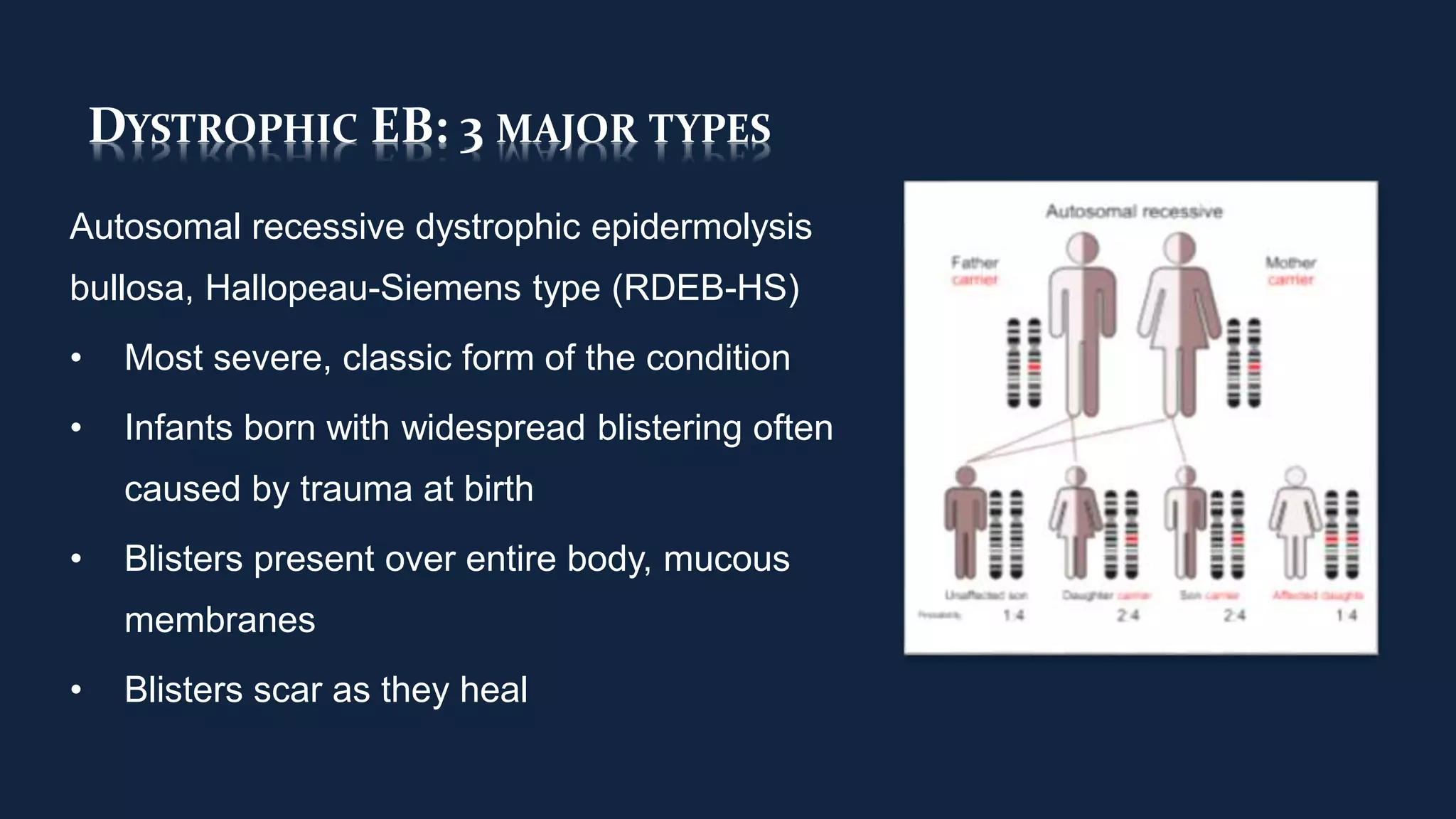
DYSTROPHIC EB: 3 MAJOR TYPES
Autosomal recessive dystrophic epidermolysis
bullosa, Hallopeau-Siemens type (RDEB-HS)
• Most severe, classic form of the condition
• Infants born with widespread blistering often
caused by trauma at birth
• Blisters present over entire body, mucous
membranes
• Blisters scar as they heal
DYSTROPHIC EB: 3 MAJOR TYPES
Autosomal recessive dystrophic epidermolysis bullosa Non-Hallopeau-
Siemens type (non-HS RDEB).
• Somewhat less severe than the classic type and includes a range of
subtypes.
• Blistering is limited to the hands, feet, knees, and elbows in mild cases
• Involves scarring in the areas where blisters occur, but is not as severe
as classic EB
DYSTROPHIC EB: 3 MAJOR TYPES
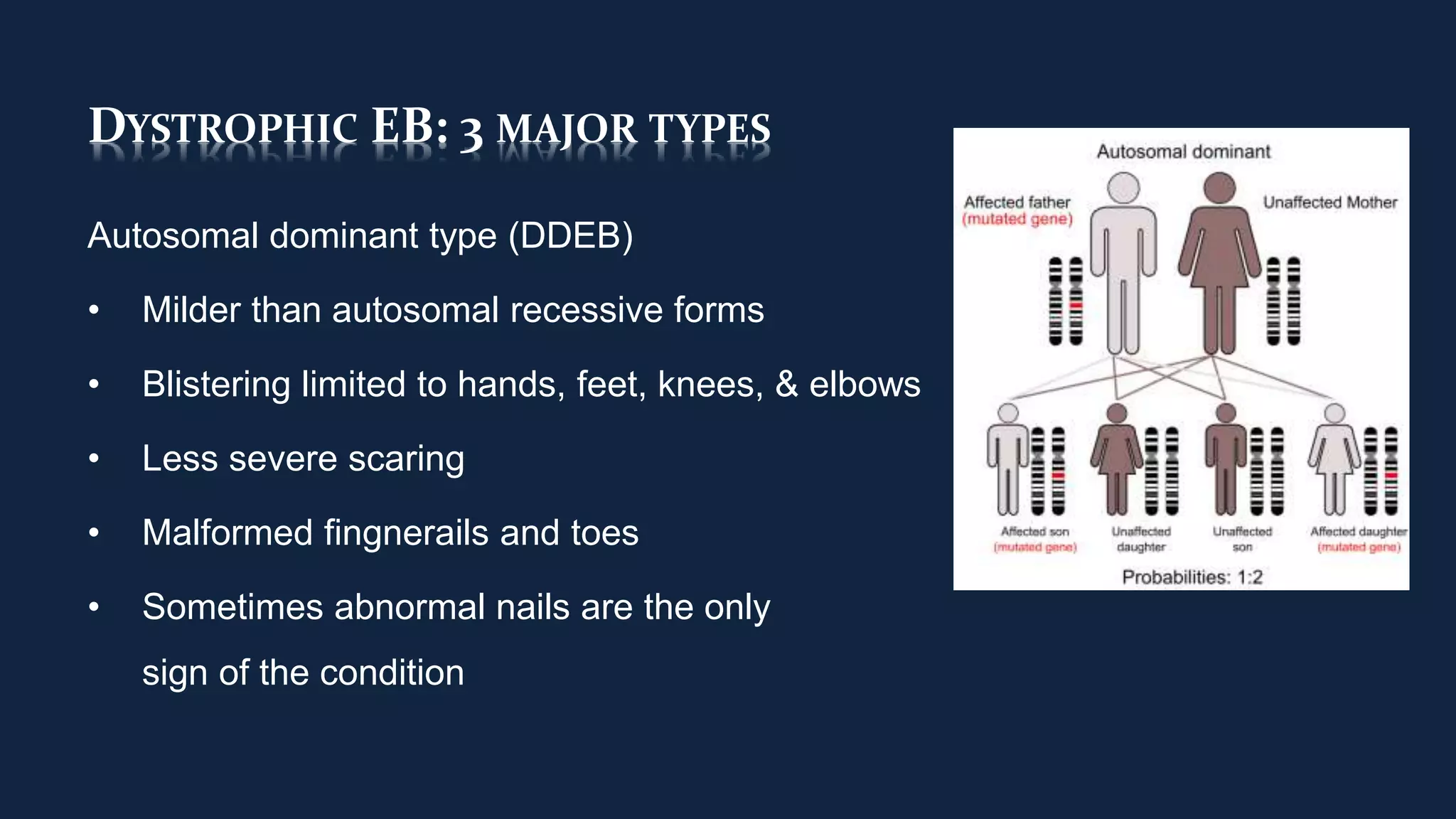
Autosomal dominant type (DDEB)
• Milder than autosomal recessive forms
• Blistering limited to hands, feet, knees, & elbows
• Less severe scaring
• Malformed fingnerails and toes
• Sometimes abnormal nails are the only
sign of the condition
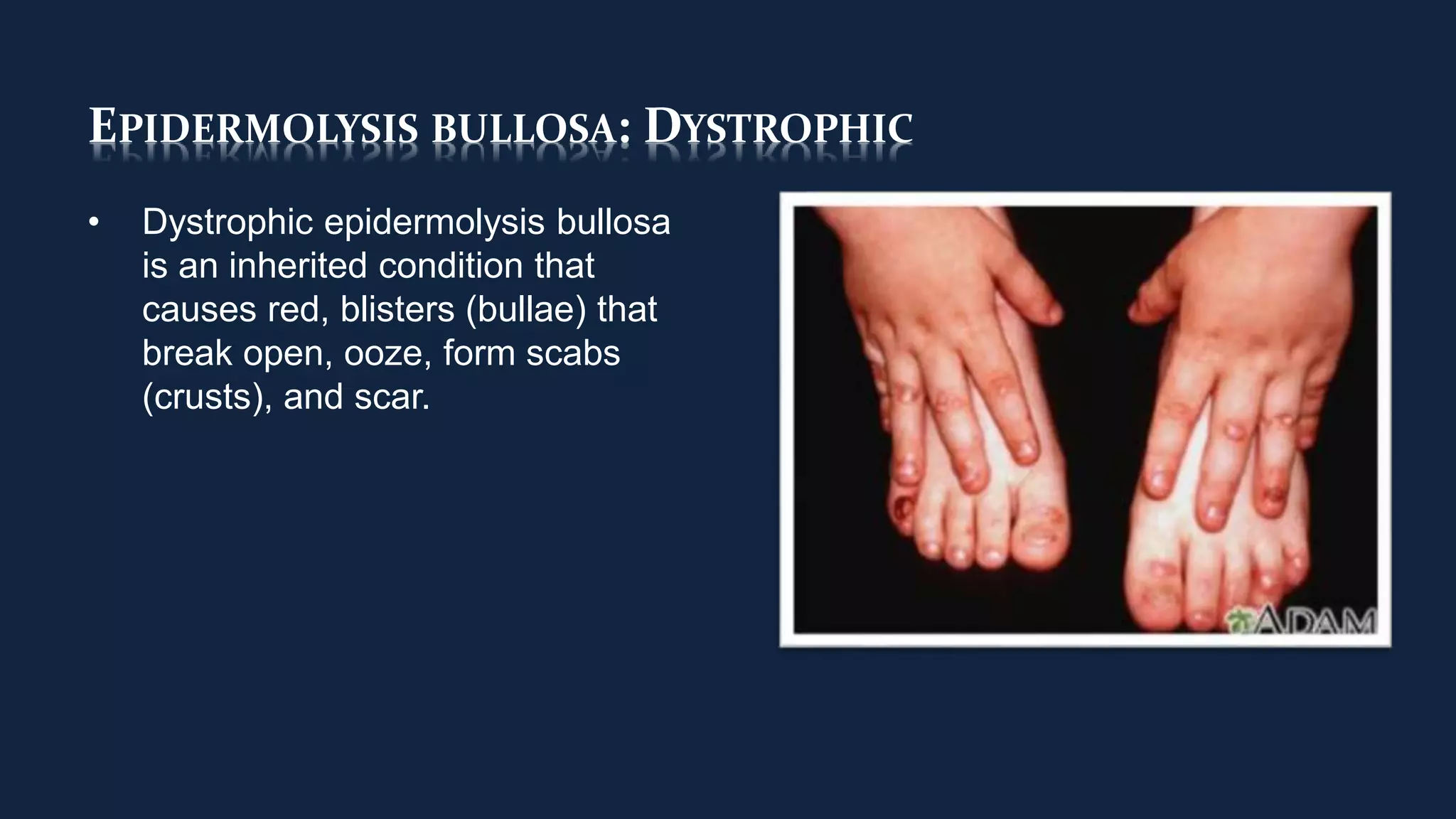
EPIDERMOLYSIS BULLOSA: DYSTROPHIC
• Dystrophic epidermolysis bullosa
is an inherited condition that
causes red, blisters (bullae) that
break open, ooze, form scabs
(crusts), and scar.
EPIDERMOLYSIS BULLOSA: SIMPLEX
Researchers have identified four major
types of epidermolysis bullosa simplex.
Although the types differ in severity,
their features overlap significantly, and
they are caused by mutations in the
same genes. Most researchers now
consider the major forms of this
condition to be part of a single disorder
with a range of signs and symptoms.
• Localized type
• The Dowling-Meara type
• The other generalized type
• Epidermolysis bullosa simplex with
mottled pigmentation
• Ogna type
EPIDERMOLYSIS BULLOSA: JUNCTIONAL
Researchers classify junctional
epidermolysis bullosa into two main
types: Herlitz JEB and non-Herlitz
JEB. Although the types differ in
severity, their features overlap
significantly, and they can be caused
by mutations in the same genes.
• Junctional EB is autosomal
recessesive, meaning both
parents carry the gene
• Fewer than 1 million people in the
world have this form of EB
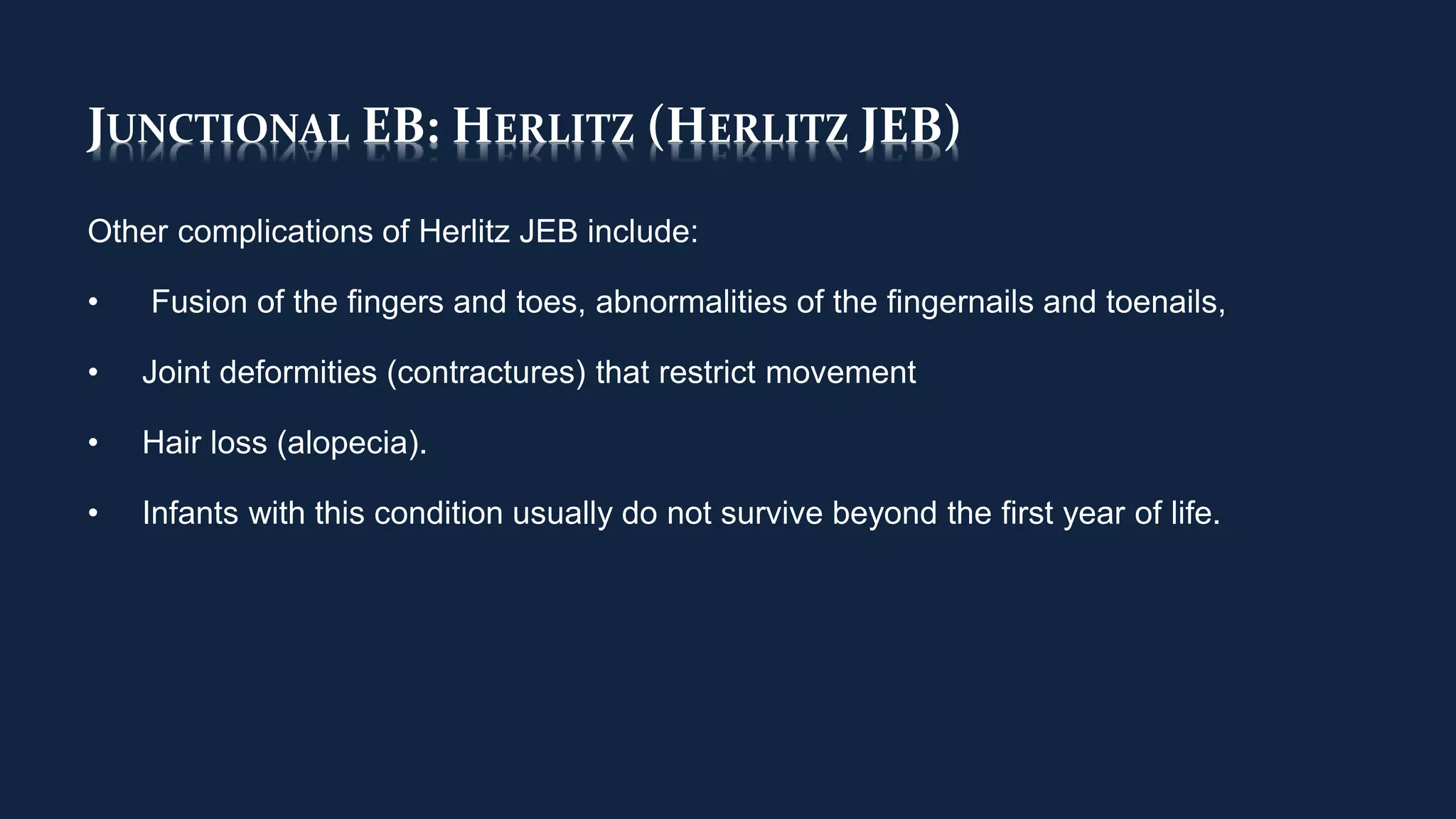
JUNCTIONAL EB: HERLITZ (HERLITZ JEB)
Most severe form
Blistering over large regions of the
body
Affects mucous membranes including
mouth and GI tract
Extensive blistering = scarring &
formation of granulation tissue
JUNCTIONAL EB: HERLITZ (HERLITZ JEB)
Granulation tissue
• Granulation tissue is the appearance of very red fleshy tissue, which is capillary
formation during tissue healing. (More apparent in the perioral region and the nares.)
• Bleeds easily and profusely
• Susceptible to serious infections and loss of necessary proteins, minerals, and fluids.
• Granulation tissue in the airway can lead to a weak, hoarse cry and difficulty
breathing.
JUNCTIONAL EB: HERLITZ (HERLITZ JEB)
Other complications of Herlitz JEB include:
• Fusion of the fingers and toes, abnormalities of the fingernails and toenails,
• Joint deformities (contractures) that restrict movement
• Hair loss (alopecia).
• Infants with this condition usually do not survive beyond the first year of life.
JUNCTIONAL EB: NON-HERLITZ (NON-HERLITZ JEB)
• Milder form of junctional EB
• Blistering is limited and it often improves after the newborn period.
• Other characteristics include alopecia, malformed fingernails and toenails,
and irregular tooth enamel.
• Most affected individuals do not have extensive scarring or granulation tissue
formation, so breathing difficulties and other severe complications are rare.
• Non-Herlitz JEB is typically associated with a normal lifespan.
EPIDERMOLYSIS BULLOSA:HEMIDESMOSOMAL
Variant of EB, does not fit into the
traditional categories of simplex,
dystrophic, or junctional
Newer proposed category by the field
of dermatology
WHAT HAPPENS AT THE SKIN?
• Epidermolysis bullosa simplex (EBS)
involves intra-epidermal skin separation.
• Junctional epidermolysis bullosa (JEB)
involves skin separation in the lamina
lucida or central basement membrane
zone.
• Dystrophic epidermolysis bullosa (DEB)
involves separation of the basement
membrane zone at the sublamina densa.
• A fourth category has been proposed,
called hemidesmosomal epidermolysis
bullosa (HEB), which produces blistering
at the hemidesmosomal level in the most
superior aspect of the basement
membrane zone
WHAT HAPPENS AT THE SKIN?
RARE
DEADLY
UNKNOWN
• University of minnesota is a leader in clinical trials
WHAT IS EPIDERMOLYSIS BULLOSA (EB)?
http://www.debra.org/understanding#sthash.72wmWtmo.dpuf
WHEN WE WORK SMART
We collaborate, build partnerships,
increase productivity and
deliver quality products.
WE PARTNER WITH COMPANIES
FROM AROUND THE WORLD
Together we are inspired to
produce better products
• Location 1
• Location 2
• Location 3
Click on the globe to start
“Thank you Contoso for providing access to the tools I need
to do my job! Beautiful!”
~Contoso Customer, Spokane, Washington
WE ARE COMMITTED TO ACCESSIBILITY AND IMPROVING
OUR CUSTOMER’S USER EXPERIENCE
Our advanced technology enables our customers
to see and hear the beauty around us.
Inspire
Others
Work Smart
Exceptional
Results
THE CORE VALUES
That build our business
OUR FINANCIAL GROWTH IS STABLE AND RISING
Just like the environment we have left behind in our path to produce
exceptional products
0 2 4 6 8
2006
2007
2008
2009
Product Green
Product Red
Product Blue
WE PRESERVE CRYSTAL CLEAR WATERS
The Contoso Corporation takes clean water seriously. Our waste products are tightly
sealed in reinforced containers to ensure that toxins are not released or make their way
into our clean waters.
WE ARE DEDICATED TO MAINTAINING A NATURAL,
SAFE AND GREEN ENVIRONMENT…
so that our children can enjoy the same resources
and beauty that we have for generations.
REFERENCES
• http://ghr.nlm.nih.gov/condition/dystrophic-epidermolysis-bullosa

Eb presentation final

  • 1.
  • 2.
    WHAT IS EPIDERMOLYSISBULLOSA (EB)? Epidermolysis Bullosa is a rare genetic disease characterized by the presence of extremely fragile skin and recurrent blister formation, resulting from minor mechanical friction or trauma. There are many genetic and symptom forms of EB http://www.debra.org/understanding#sthash.72wmWtmo.dpuf
  • 3.
    WHAT IS EPIDERMOLYSISBULLOSA (EB)? Internal organs and bodily systems can also be seriously affected by the disease. EB is always painful, is often pervasive and debilitating, and is in some cases lethal before the age of 30. http://www.debra.org/understanding#sthash.72wmWtmo.dpuf
  • 4.
    WHAT IS EPIDERMOLYSISBULLOSA (EB)? The disorder occurs in every racial and ethnic group throughout the world The disorder affects both sexes equally. http://www.debra.org/understanding#sthash.72wmWtmo.dpuf
  • 5.
    EB: THE WORSTDISEASE YOU’VE NEVER HEARD OF ™ TM: http://www.debra.org/
  • 6.
  • 7.
    WHY TALK ABOUTEPIDERMOLYSIS BULLOSA? • Rare 60 children each year born in the U.S. • Deadly Less than 50% of these children make it to their 1st birthday • Unknown Minimal research available about the disease itself… clinical trials for cure Rare UnknownDeadly
  • 8.
    TYPES OF EB Thereare four main types of epidermolysis bullosa: • Dystrophic epidermolysis bullosa • Epidermolysis bullosa simplex • Junctional epidermolysis bullosa • Hemidesmosomal epidermolysis bullosa • Another rare type of epidermolysis bullosa called epidermolysis bullosa acquisita, is an autoimmune disorder
  • 9.
    DYSTROPHIC EB: 3MAJOR TYPES Autosomal recessive dystrophic epidermolysis bullosa, Hallopeau-Siemens type (RDEB-HS) • Most severe, classic form of the condition • Infants born with widespread blistering often caused by trauma at birth • Blisters present over entire body, mucous membranes • Blisters scar as they heal
  • 10.
    DYSTROPHIC EB: 3MAJOR TYPES Autosomal recessive dystrophic epidermolysis bullosa Non-Hallopeau- Siemens type (non-HS RDEB). • Somewhat less severe than the classic type and includes a range of subtypes. • Blistering is limited to the hands, feet, knees, and elbows in mild cases • Involves scarring in the areas where blisters occur, but is not as severe as classic EB
  • 11.
    DYSTROPHIC EB: 3MAJOR TYPES Autosomal dominant type (DDEB) • Milder than autosomal recessive forms • Blistering limited to hands, feet, knees, & elbows • Less severe scaring • Malformed fingnerails and toes • Sometimes abnormal nails are the only sign of the condition
  • 12.
    EPIDERMOLYSIS BULLOSA: DYSTROPHIC •Dystrophic epidermolysis bullosa is an inherited condition that causes red, blisters (bullae) that break open, ooze, form scabs (crusts), and scar.
  • 13.
    EPIDERMOLYSIS BULLOSA: SIMPLEX Researchershave identified four major types of epidermolysis bullosa simplex. Although the types differ in severity, their features overlap significantly, and they are caused by mutations in the same genes. Most researchers now consider the major forms of this condition to be part of a single disorder with a range of signs and symptoms. • Localized type • The Dowling-Meara type • The other generalized type • Epidermolysis bullosa simplex with mottled pigmentation • Ogna type
  • 14.
    EPIDERMOLYSIS BULLOSA: JUNCTIONAL Researchersclassify junctional epidermolysis bullosa into two main types: Herlitz JEB and non-Herlitz JEB. Although the types differ in severity, their features overlap significantly, and they can be caused by mutations in the same genes. • Junctional EB is autosomal recessesive, meaning both parents carry the gene • Fewer than 1 million people in the world have this form of EB
  • 15.
    JUNCTIONAL EB: HERLITZ(HERLITZ JEB) Most severe form Blistering over large regions of the body Affects mucous membranes including mouth and GI tract Extensive blistering = scarring & formation of granulation tissue
  • 16.
    JUNCTIONAL EB: HERLITZ(HERLITZ JEB) Granulation tissue • Granulation tissue is the appearance of very red fleshy tissue, which is capillary formation during tissue healing. (More apparent in the perioral region and the nares.) • Bleeds easily and profusely • Susceptible to serious infections and loss of necessary proteins, minerals, and fluids. • Granulation tissue in the airway can lead to a weak, hoarse cry and difficulty breathing.
  • 17.
    JUNCTIONAL EB: HERLITZ(HERLITZ JEB) Other complications of Herlitz JEB include: • Fusion of the fingers and toes, abnormalities of the fingernails and toenails, • Joint deformities (contractures) that restrict movement • Hair loss (alopecia). • Infants with this condition usually do not survive beyond the first year of life.
  • 18.
    JUNCTIONAL EB: NON-HERLITZ(NON-HERLITZ JEB) • Milder form of junctional EB • Blistering is limited and it often improves after the newborn period. • Other characteristics include alopecia, malformed fingernails and toenails, and irregular tooth enamel. • Most affected individuals do not have extensive scarring or granulation tissue formation, so breathing difficulties and other severe complications are rare. • Non-Herlitz JEB is typically associated with a normal lifespan.
  • 19.
    EPIDERMOLYSIS BULLOSA:HEMIDESMOSOMAL Variant ofEB, does not fit into the traditional categories of simplex, dystrophic, or junctional Newer proposed category by the field of dermatology
  • 20.
    WHAT HAPPENS ATTHE SKIN? • Epidermolysis bullosa simplex (EBS) involves intra-epidermal skin separation. • Junctional epidermolysis bullosa (JEB) involves skin separation in the lamina lucida or central basement membrane zone. • Dystrophic epidermolysis bullosa (DEB) involves separation of the basement membrane zone at the sublamina densa. • A fourth category has been proposed, called hemidesmosomal epidermolysis bullosa (HEB), which produces blistering at the hemidesmosomal level in the most superior aspect of the basement membrane zone
  • 21.
    WHAT HAPPENS ATTHE SKIN?
  • 22.
  • 23.
  • 24.
    UNKNOWN • University ofminnesota is a leader in clinical trials
  • 26.
    WHAT IS EPIDERMOLYSISBULLOSA (EB)? http://www.debra.org/understanding#sthash.72wmWtmo.dpuf
  • 27.
    WHEN WE WORKSMART We collaborate, build partnerships, increase productivity and deliver quality products.
  • 28.
    WE PARTNER WITHCOMPANIES FROM AROUND THE WORLD Together we are inspired to produce better products • Location 1 • Location 2 • Location 3 Click on the globe to start
  • 29.
    “Thank you Contosofor providing access to the tools I need to do my job! Beautiful!” ~Contoso Customer, Spokane, Washington WE ARE COMMITTED TO ACCESSIBILITY AND IMPROVING OUR CUSTOMER’S USER EXPERIENCE Our advanced technology enables our customers to see and hear the beauty around us.
  • 30.
  • 31.
    OUR FINANCIAL GROWTHIS STABLE AND RISING Just like the environment we have left behind in our path to produce exceptional products 0 2 4 6 8 2006 2007 2008 2009 Product Green Product Red Product Blue
  • 32.
    WE PRESERVE CRYSTALCLEAR WATERS The Contoso Corporation takes clean water seriously. Our waste products are tightly sealed in reinforced containers to ensure that toxins are not released or make their way into our clean waters.
  • 33.
    WE ARE DEDICATEDTO MAINTAINING A NATURAL, SAFE AND GREEN ENVIRONMENT… so that our children can enjoy the same resources and beauty that we have for generations.
  • 34.

Editor's Notes

  • #2 This slide can be used as a background before the presentation begins.
  • #7 Skin is so fragile, it is as though it were the wings of a butterfly
  • #8 Brave children fight a painful condition called Epidermolysis Bullosa which means the skin blisters at every touch or graze Only 20 children in a million are diagnosed with Epidermolysis Bullosa at birth and only nine out of a million survive in the population. (3 million children born each year in the U.S. = 60 children each year, 300 estimated world wide). (135 million babies are born each year in the world) 40,000 babies are born each year in the US with CHD, 1,000,000 world-wide. 10% will die before their 1st birthday world wide. The illness dubbed 'Butterfly Disease' means children are unable to shower or run around too strenuously in case she tears her skin Parents struggle to treat the wounds that never open the same way and often refuse to healA new bone marrow transplant treatment offers hope but some have died undergoing the procedure Read more: http://www.dailymail.co.uk/news/article-2283218/Epidermolysis-Bullosa-Genetic-condition-called-butterfly-disease-means-skin-fragile-breaks-touch.html#ixzz3PqmCTpUn
  • #9 There are several sub-types of EB within the major categories
  • #10 Affected infants are typically born with widespread blistering and areas of missing skin, often caused by trauma during birth. Most often, blisters are present over the whole body and affect mucous membranes such as the moist lining of the mouth and digestive tract. As the blisters heal, they result in severe scarring. Scarring in the mouth and esophagus can make it difficult to chew and swallow food, leading to chronic malnutrition and slow growth. Additional complications of progressive scarring can include fusion of the fingers and toes, loss of fingernails and toenails, joint deformities (contractures) that restrict movement, and eye inflammation leading to vision loss. Additionally, young adults with the classic form of dystrophic epidermolysis bullosa have a very high risk of developing a form of skin cancer called squamous cell carcinoma, which tends to be unusually aggressive and is often life-threatening.
  • #11 Non-Hallopeau-Siemens type (non-HS RDEB). somewhat less severe than the classic type and includes a range of subtypes. Blistering is limited to the hands, feet, knees, and elbows in mild cases, but may be widespread in more severe cases. Affected people often have malformed fingernails and toenails. Non-HS RDEB involves scarring in the areas where blisters occur, but this form of the condition does not cause the severe scarring characteristic of the classic type.
  • #12 The third major type of dystrophic epidermolysis bullosa is known as the autosomal dominant type (DDEB). The signs and symptoms of this condition tend to be milder than those of the autosomal recessive forms, with blistering often limited to the hands, feet, knees, and elbows. The blisters heal with scarring, but it is less severe. Most affected people have malformed fingernails and toenails, and the nails may be lost over time. In the mildest cases, abnormal nails are the only sign of the condition.
  • #13 This picture shows skin lesions (epidermolysis bullosa) over the joints on the hands and feet (interphalangeal joints).
  • #14 Researchers have identified four major types of epidermolysis bullosa simplex. Although the types differ in severity, their features overlap significantly, and they are caused by mutations in the same genes. Most researchers now consider the major forms of this condition to be part of a single disorder with a range of signs and symptoms. The mildest form of epidermolysis bullosa simplex, known as the localized type (formerly called the Weber-Cockayne type), is characterized by skin blistering that begins anytime between childhood and adulthood and is usually limited to the hands and feet. Later in life, skin on the palms of the hands and soles of the feet may thicken and harden (hyperkeratosis). The Dowling-Meara type is the most severe form of epidermolysis bullosa simplex. Extensive, severe blistering can occur anywhere on the body, including the inside of the mouth, and blisters may appear in clusters. Blistering is present from birth and tends to improve with age. Affected individuals also experience abnormal nail growth and hyperkeratosis of the palms and soles. Another form of epidermolysis bullosa simplex, known as the other generalized type (formerly called the Koebner type), is associated with widespread blisters that appear at birth or in early infancy. The blistering tends to be less severe than in the Dowling-Meara type. Epidermolysis bullosa simplex with mottled pigmentation is characterized by patches of darker skin on the trunk, arms, and legs that fade in adulthood. This form of the disorder also involves skin blistering from early infancy, hyperkeratosis of the palms and soles, and abnormal nail growth. In addition to the four major types described above, researchers have identified another skin condition related to epidermolysis bullosa simplex, which they call the Ogna type. It is caused by mutations in a gene that is not associated with the other types of epidermolysis bullosa simplex. It is unclear whether the Ogna type is a subtype of epidermolysis bullosa simplex or represents a separate form of epidermolysis bullosa. Several other variants of epidermolysis bullosa simplex have been proposed, but they appear to be very rare.
  • #15 This picture shows skin lesions (epidermolysis bullosa) over the joints on the hands and feet (interphalangeal joints).
  • #16 Herlitz JEB is the more severe form of the condition. From birth or early infancy, affected individuals have blistering over large regions of the body. Blistering also affects the mucous membranes, such as the moist lining of the mouth and digestive tract, which can make it difficult to eat and digest food. As a result, many affected children have chronic malnutrition and slow growth. The extensive blistering leads to scarring and the formation of red, bumpy patches called granulation tissue. Granulation tissue bleeds easily and profusely, making affected infants susceptible to serious infections and loss of necessary proteins, minerals, and fluids. Additionally, a buildup of granulation tissue in the airway can lead to a weak, hoarse cry and difficulty breathing.
  • #17 Herlitz JEB is the more severe form of the condition. From birth or early infancy, affected individuals have blistering over large regions of the body. Blistering also affects the mucous membranes, such as the moist lining of the mouth and digestive tract, which can make it difficult to eat and digest food. As a result, many affected children have chronic malnutrition and slow growth. The extensive blistering leads to scarring and the formation of red, bumpy patches called granulation tissue. Granulation tissue bleeds easily and profusely, making affected infants susceptible to serious infections and loss of necessary proteins, minerals, and fluids. Additionally, a buildup of granulation tissue in the airway can lead to a weak, hoarse cry and difficulty breathing.
  • #18  Common Manifestations of JEB:  Blisters/erosions Dystrophic nails – The presence of rough, thickened finger or toenails. Atrophic scarring – Depressions in skin as a result of thinning in epidermis or dermis. Granulation tissue is the appearance of very red fleshy tissue, which is capillary formation during tissue healing. (More apparent in the perioral region and the nares.) Scalp abnormalities. Presence of blisters on scalp and/or scarring alopecia (areas of scarring with absence of hair growth). Respiratory tract involvement. May be present in the more severely affected individual. Anemia – A reduced amount of red blood cells and volume of red blood cells, amount of hemoglobin. Hemoglobin is the oxygen carrying portion of the red blood cell. The heme aspect of hemoglobin is the iron compound that makes up the pigment part of the hemoglobin molecule. The globin portion of hemoglobin is made up of protein. (This is more common in the severely affected individual.) Growth retardation and malnourishment. Problems in the soft tissue inside the mouth. Enamel hypoplasia – The presence of underdeveloped enamel upon the teeth. Dental caries is the development of cavities in teeth. Gastrointestinal tract involvement (blisters in mouth, esophagus and/or anal margins). Ocular (eye) involvement. Rare Manifestations of JEB:  Genitourinary tract involvement may include scarring and/or urethral stenosis. Milia – Small skin cysts Pseudosyndactyly – Fusion/ webbing of fingers and/or toes. On rare instances this has been reported in JEB patients.
  • #19 Junctional non-Herlitz EB: Generalized blistering and mucosal involvement may be evident at birth or soon after. Blistering may be mild to severe. Erosions on finger and toenails, nail dystrophy or absence of nails may be evident. Erosions and loss of hair (alopecia) upon the scalp may occur. Granulation tissue around mouth and nares may be seen. There may be some scarring and thinning of the skin on affected areas (atrophic scarring). Warmer climates can exacerbate blistering. Though laryngeal involvement (hoarse cry) may be experienced in early infancy, respiratory distress is a rare occurrence in this type of Junctional EB. The infant may suffer complications such as infection, dehydration, electrolyte imbalances, respiratory, gastrointestinal, and/or genitourinary tract involvement. These complications may lead to death. The milder form of junctional epidermolysis bullosa is called non-Herlitz JEB. The blistering associated with non-Herlitz JEB may be limited to the hands, feet, knees, and elbows, and it often improves after the newborn period. Other characteristic features of this condition include alopecia, malformed fingernails and toenails, and irregular tooth enamel. Most affected individuals do not have extensive scarring or granulation tissue formation, so breathing difficulties and other severe complications are rare. Non-Herlitz JEB is typically associated with a normal lifespan.
  • #20 Traditionally, EB has been divided into three broad categories: (a) the simplex forms demonstrate tissue separation within the basal keratinocytes; (b) the junctional forms depict tissue separation within the lamina lucida of the dermal–epidermal basement membrane; and (c) the dystrophic forms show tissue cleavage below the lamina densa within the upper papillary dermis (Figure 1). We have recently proposed a fourth subtype, the hemidesmosomal variants of EB, in which the tissue separation is at the basal cell/lamina lucida interface at the level of hemidesmosomes (Figure 1) (Pulkkinen and Uitto, 1998). In fact, the hemidesmosomal variants include the following clinical entities: (a) Generalized atrophic benign EB (GABEB) that has been previously included in the category of non-Herlitz junctional EB (JEB); (b) EB with pyloric atresia where tissue separation is either just outside of the plasma membrane of the basal cells or in the low intracellular compartment and has occasionally been referred as "pseudo-junctional" EB; (c) EB with muscular dystrophy which shows low intracellular cytolysis occasionally suggested to belong to the simplex category of EB (Pulkkinen and Uitto, 1998).