D ermo –  E pidermal  J unction   Presented by Adel A. Al-Ghamdi Dermatology Department King Fahd Hospital of university
Introduction  Origin of basement membrane  Function of basement membrane Ultrastructure of DEJ Ubiquitous components of basement membrane epithelial-specific basement membrane components  Scope in some diseases affecting DEJ
Introduction
It is a highly complex form of basement membrane which underlie epithelial & endothelial cells which separate them from each other or from the adjacent connective tissue stroma. It is considered as one of the largest epithelial-mesenchymal junction on the body.  It forms an extensive interface between the dermis & epidermis. It is continuous with the junction between dermis & epidermal appendages.
As all basement membranes, it stains strongly for carbohydrates & anionic sites Periodic acid shifft stain (PAS) The complexity & heterogeneity of DEJ can be appreciated only at electron microscopic level
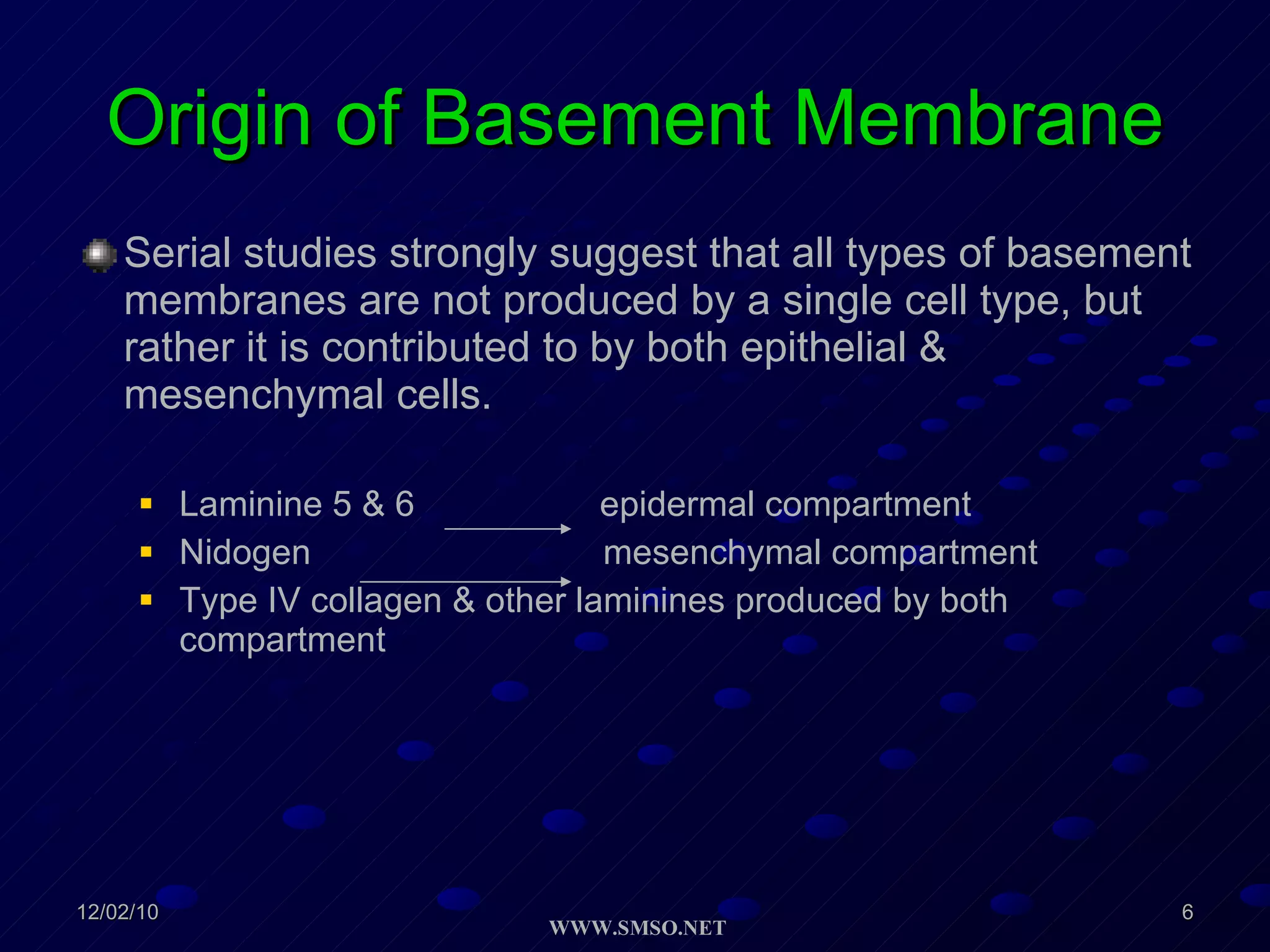
Origin of Basement Membrane Serial studies strongly suggest that all types of basement membranes are not produced by a single cell type, but rather it is contributed to by both epithelial & mesenchymal cells. Laminine 5 & 6  epidermal compartment Nidogen  mesenchymal compartment Type IV collagen & other laminines produced by both compartment
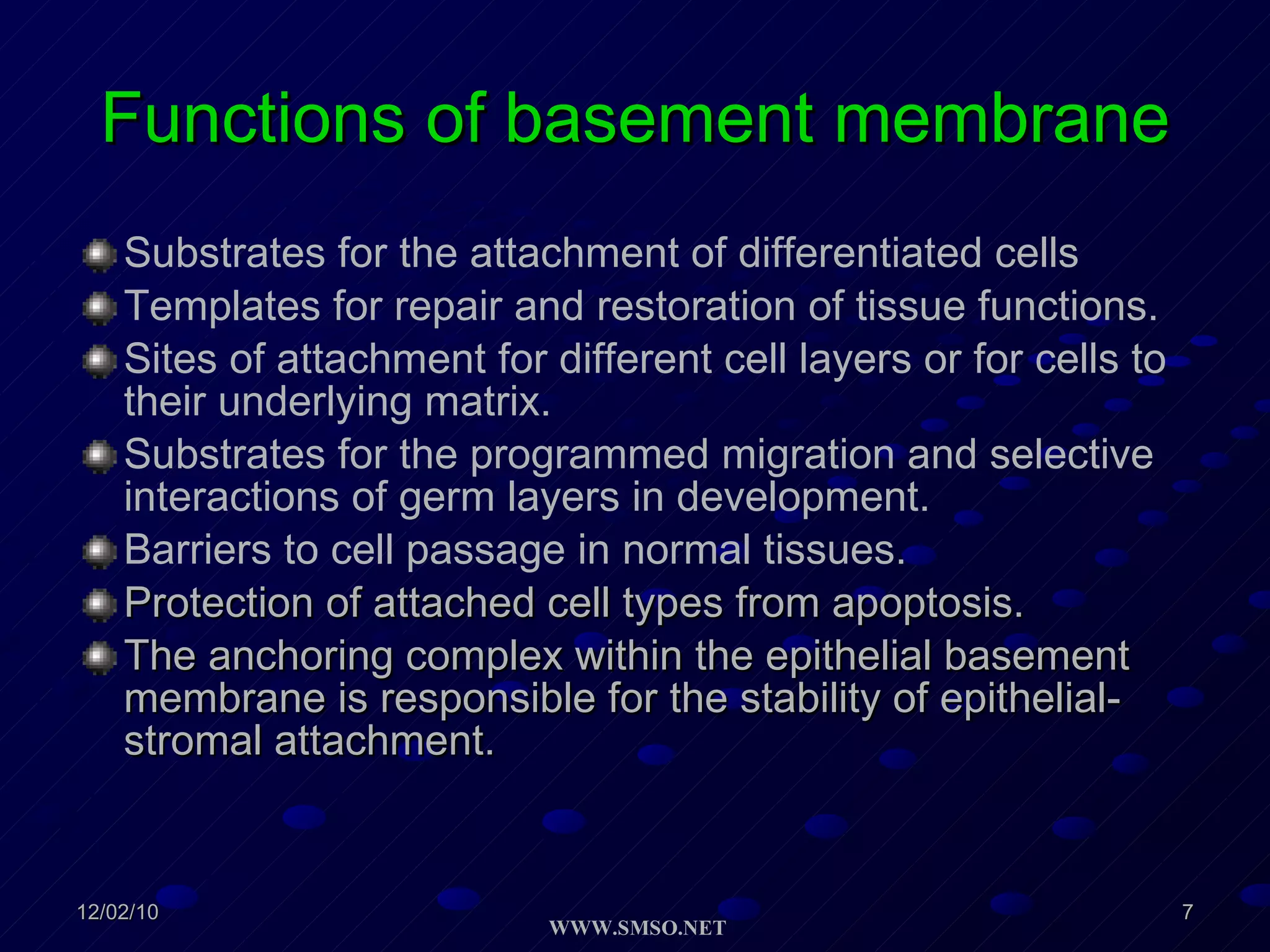
Functions of basement membrane Substrates for the attachment of differentiated cells Templates for repair and restoration of tissue functions. Sites of attachment for different cell layers or for cells to their underlying matrix. Substrates for the programmed migration and selective interactions of germ layers in development. Barriers to cell passage in normal tissues. Protection of attached cell types from apoptosis.  The anchoring complex within the epithelial basement membrane is responsible for the stability of epithelial-stromal attachment.
Ultrastructure of DEJ
WWW.SMSO.NET
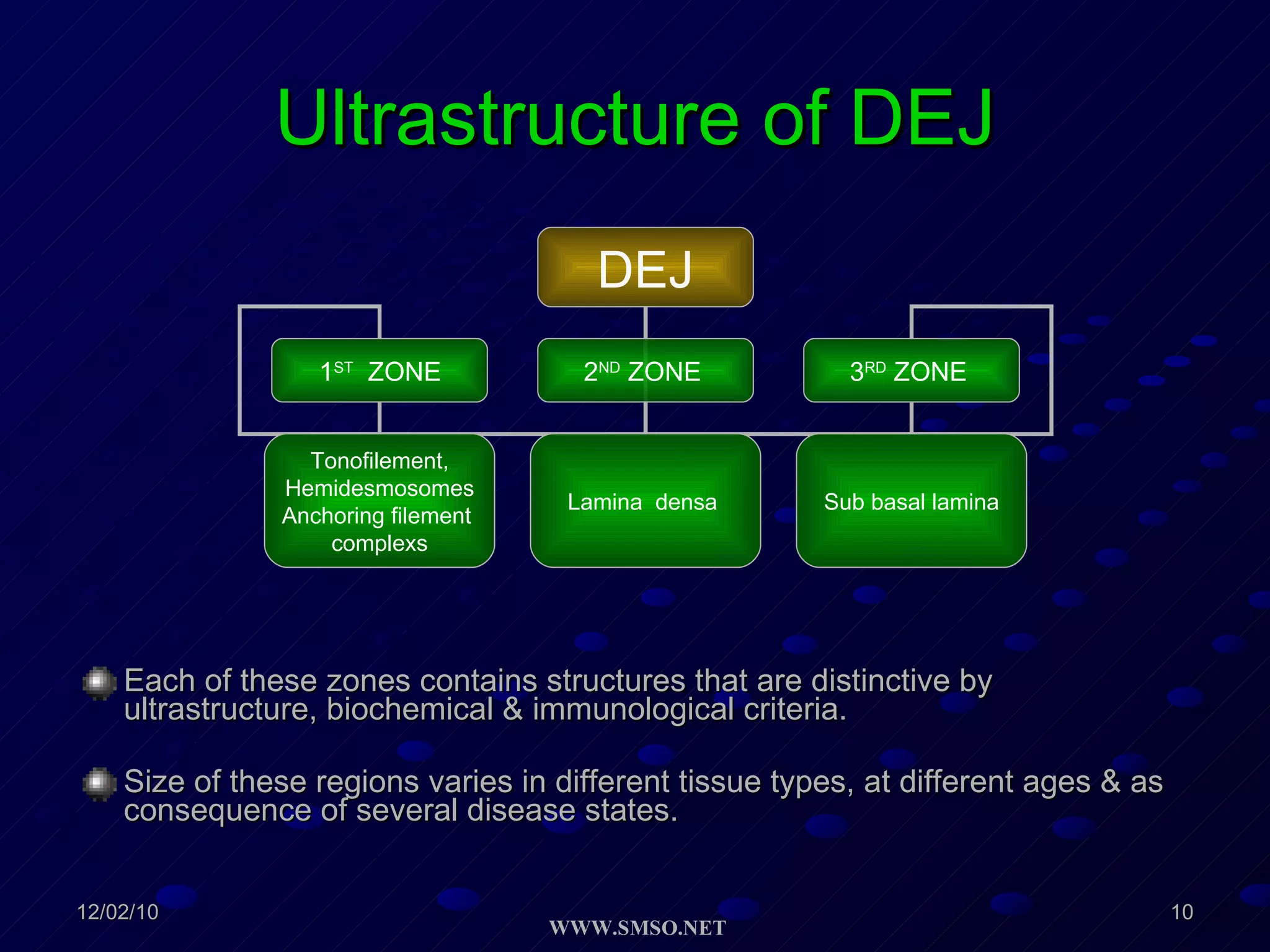
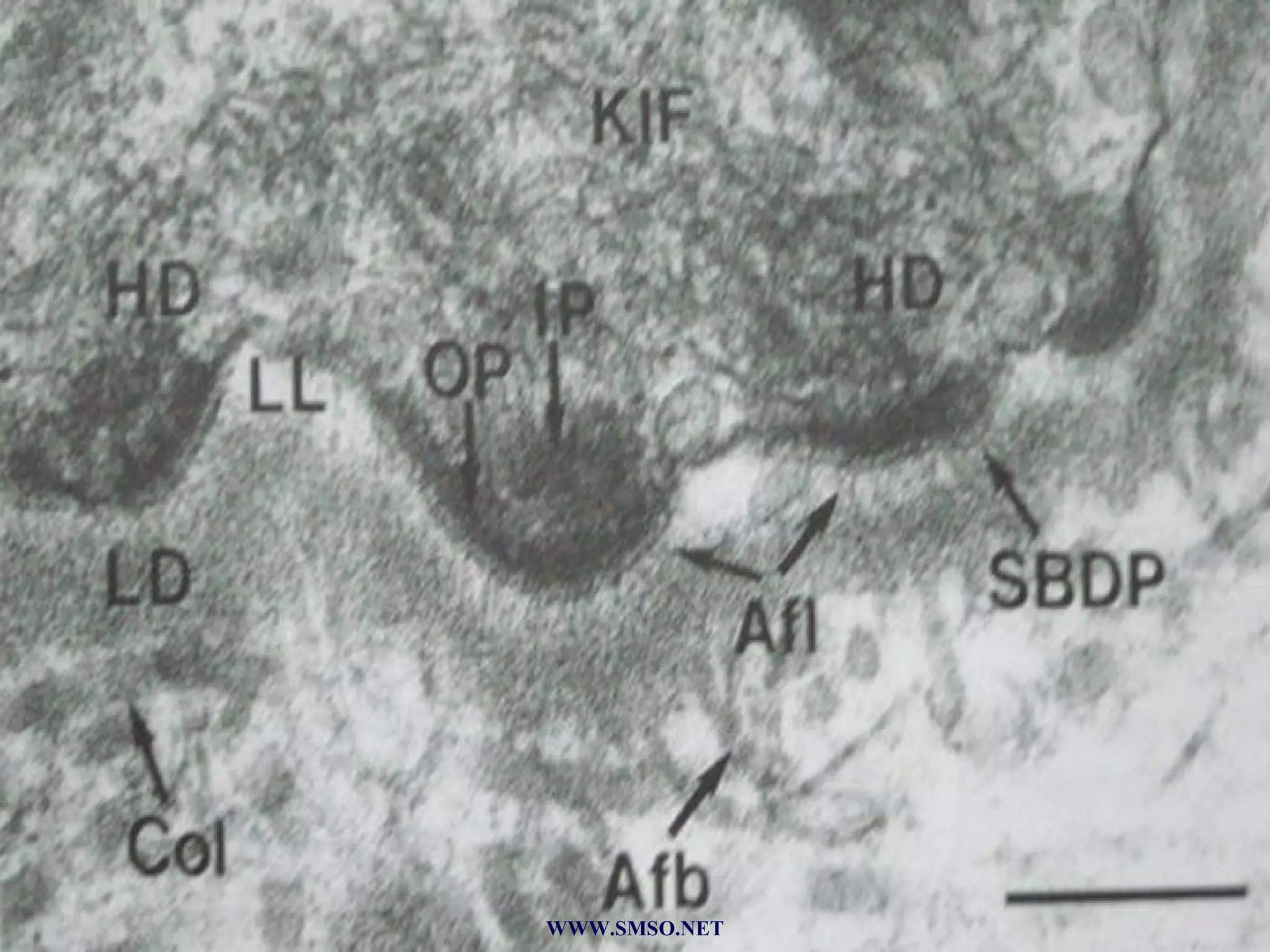
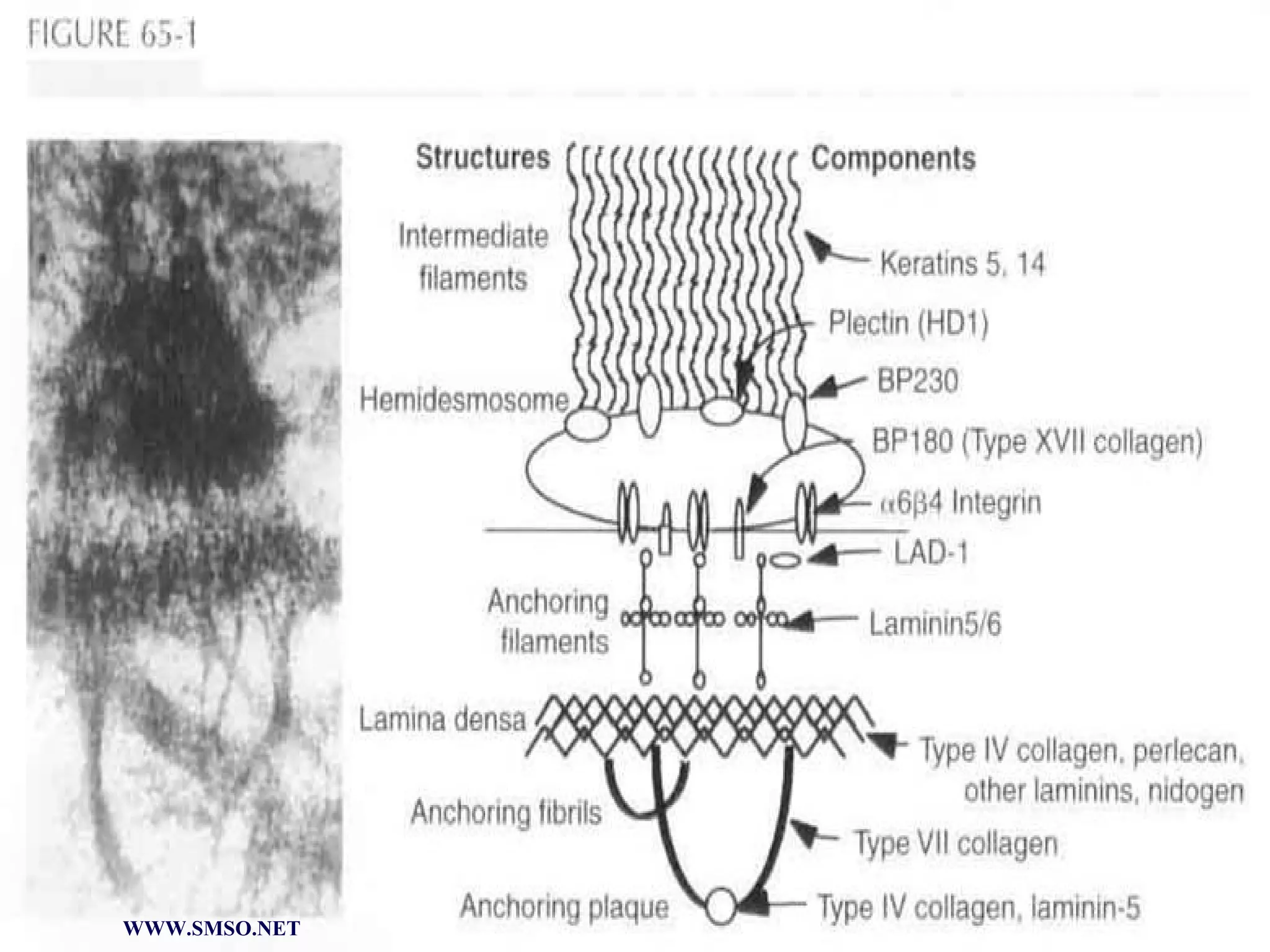
Ultrastructure of DEJ Each of these zones contains structures that are distinctive by ultrastructure, biochemical & immunological criteria. Size of these regions varies in different tissue types, at different ages & as consequence of several disease states. DEJ 1 ST   ZONE   2 ND  ZONE   3 RD  ZONE   Sub basal lamina Lamina  densa   Tonofilement, Hemidesmosomes Anchoring filement  complexs
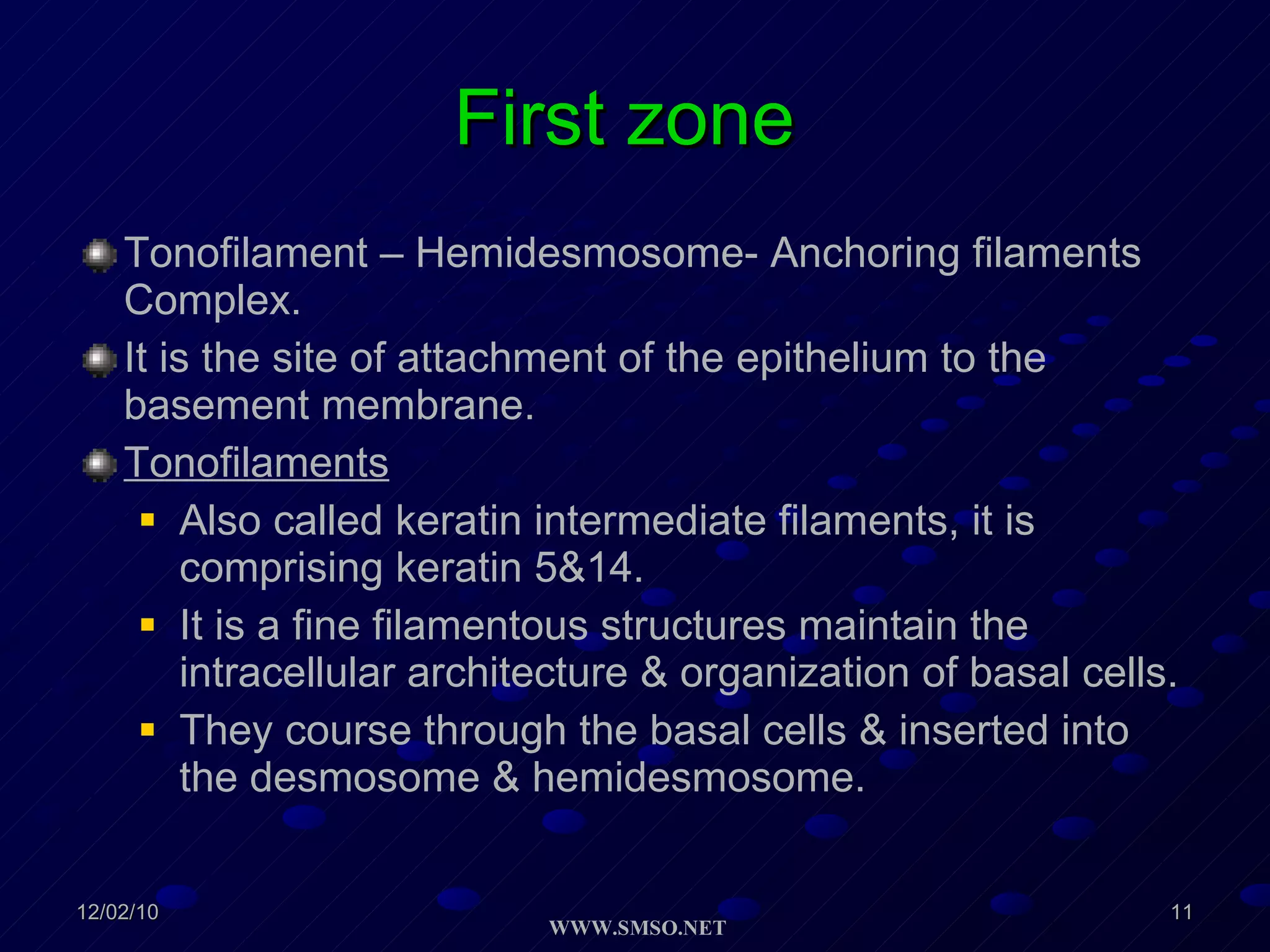
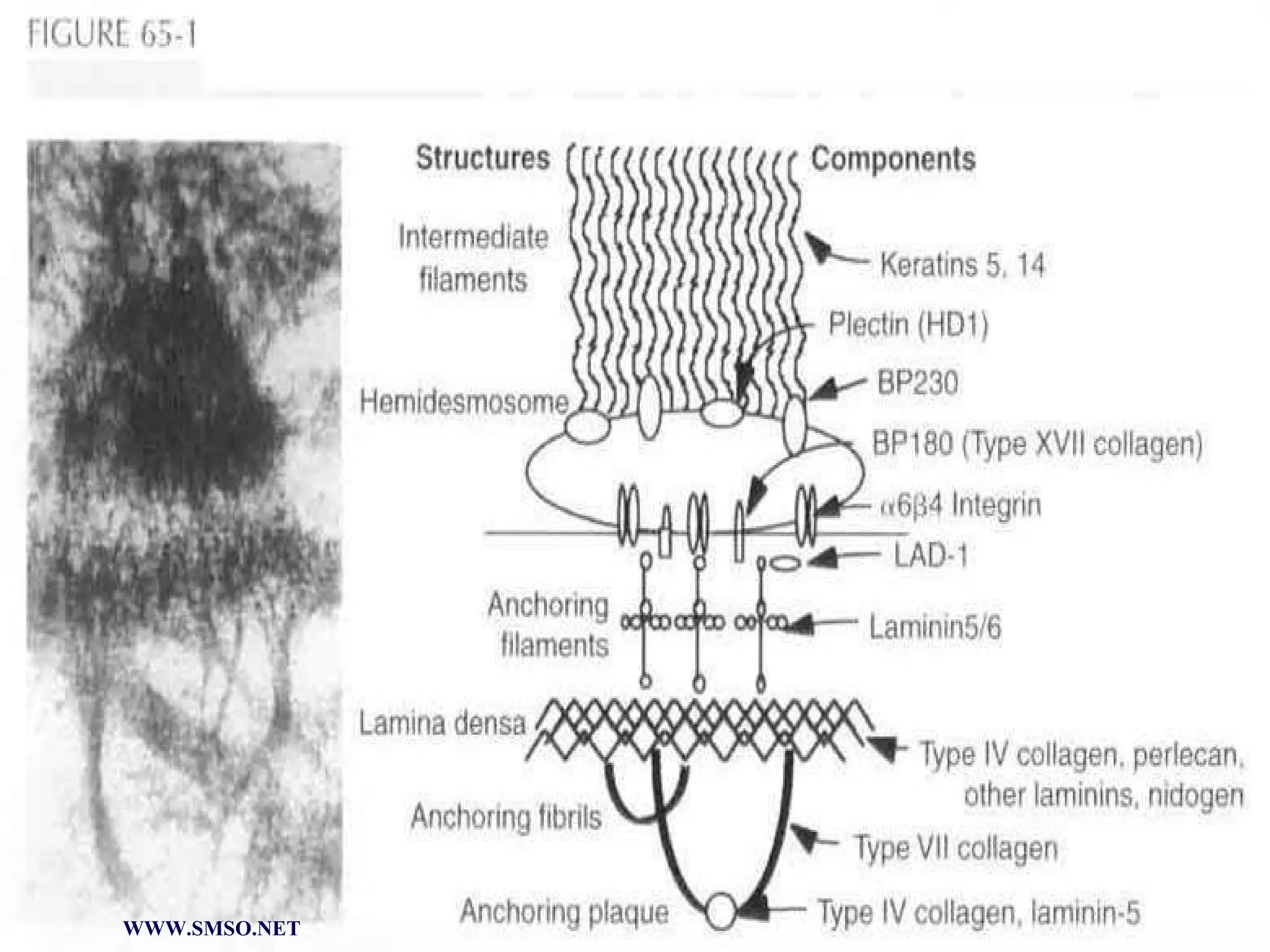
First zone  Tonofilament – Hemidesmosome- Anchoring filaments Complex. It is the site of attachment of the epithelium to the basement membrane. Tonofilaments Also called keratin intermediate filaments, it is comprising keratin 5&14. It is a fine filamentous structures maintain the intracellular architecture & organization of basal cells. They course through the basal cells & inserted into the desmosome & hemidesmosome.
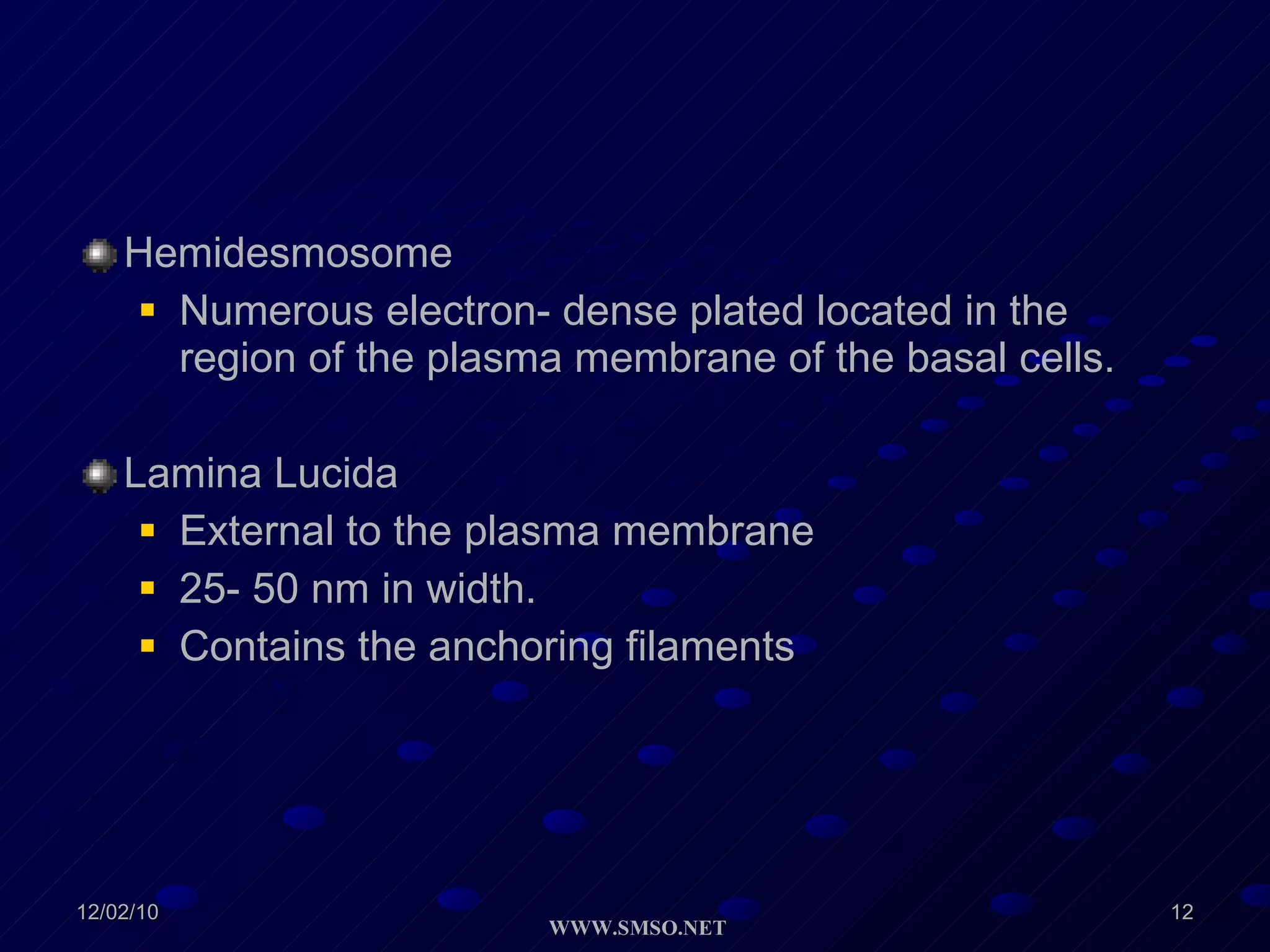
Hemidesmosome Numerous electron- dense plated located in the region of the plasma membrane of the basal cells. Lamina Lucida External to the plasma membrane 25- 50 nm in width. Contains the anchoring filaments
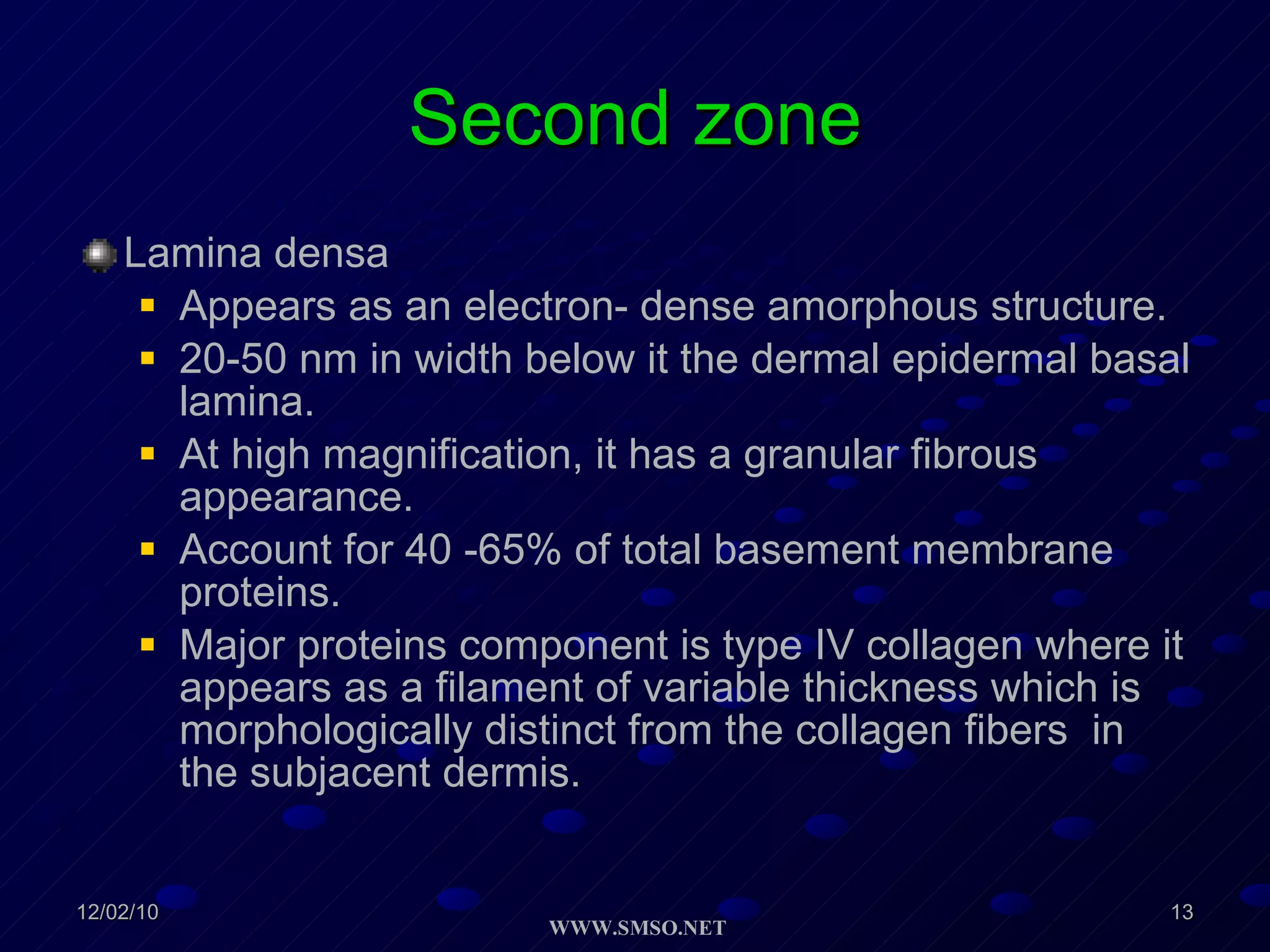
Second zone Lamina densa Appears as an electron- dense amorphous structure. 20-50 nm in width below it the dermal epidermal basal lamina. At high magnification, it has a granular fibrous appearance. Account for 40 -65% of total basement membrane proteins. Major proteins component is type IV collagen where it appears as a filament of variable thickness which is morphologically distinct from the collagen fibers  in the subjacent dermis.
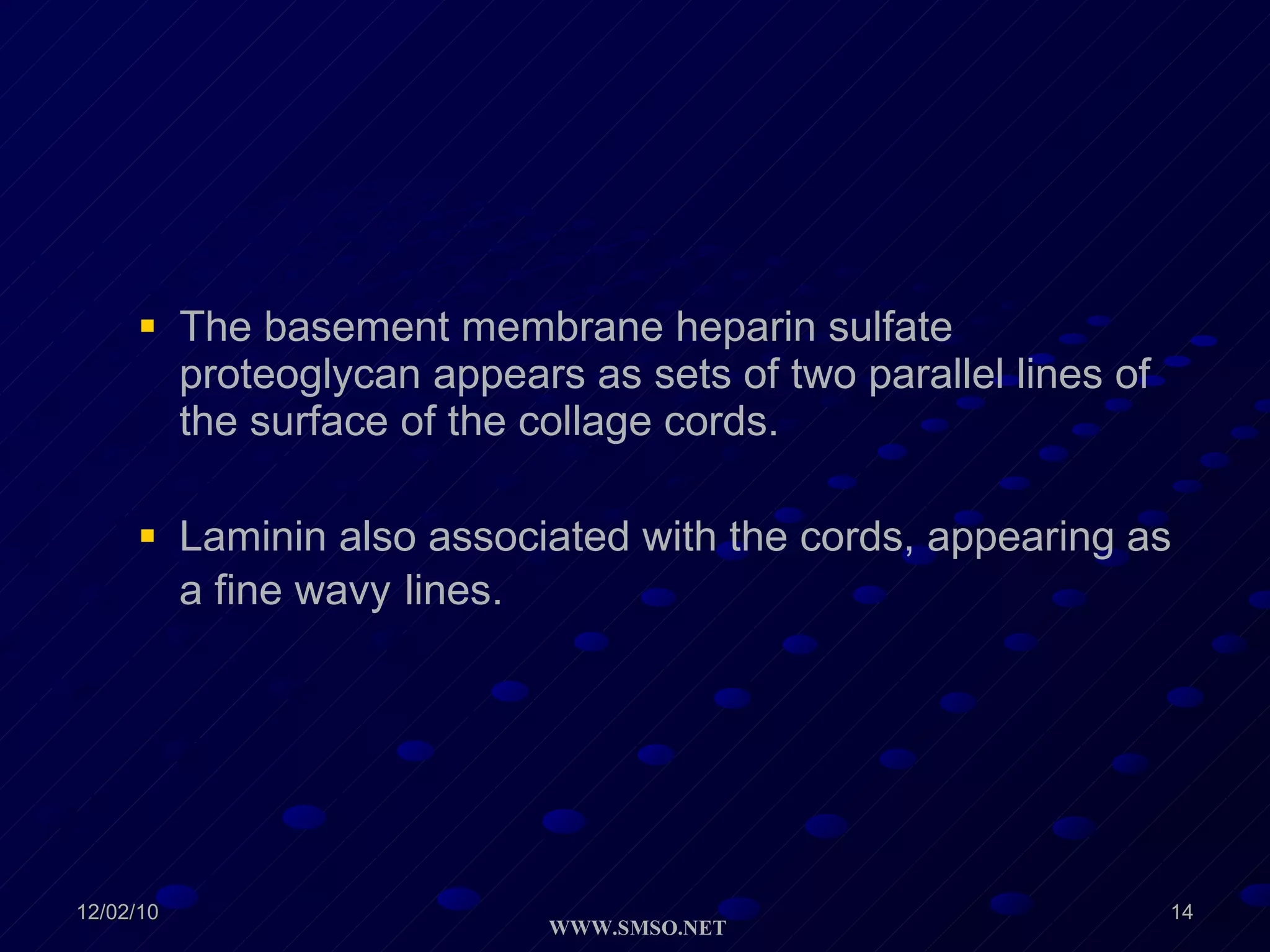
The basement membrane heparin sulfate proteoglycan appears as sets of two parallel lines of the surface of the collage cords. Laminin also associated with the cords, appearing as a fine wavy   lines.
Third zone ( the sub basal lamina) It contains several microfibrillar structures in which  3 of them can be distinguished. Anchoring fibrils It appears as condensed fibrous aggregates  20 - 75 nm in diameter  ( not found in the basement membrane of blood vessels ,smooth muscles). At high resolution, these structures appear to have a nonperiodic cross-striated banding pattern  (positively stained of collagen).
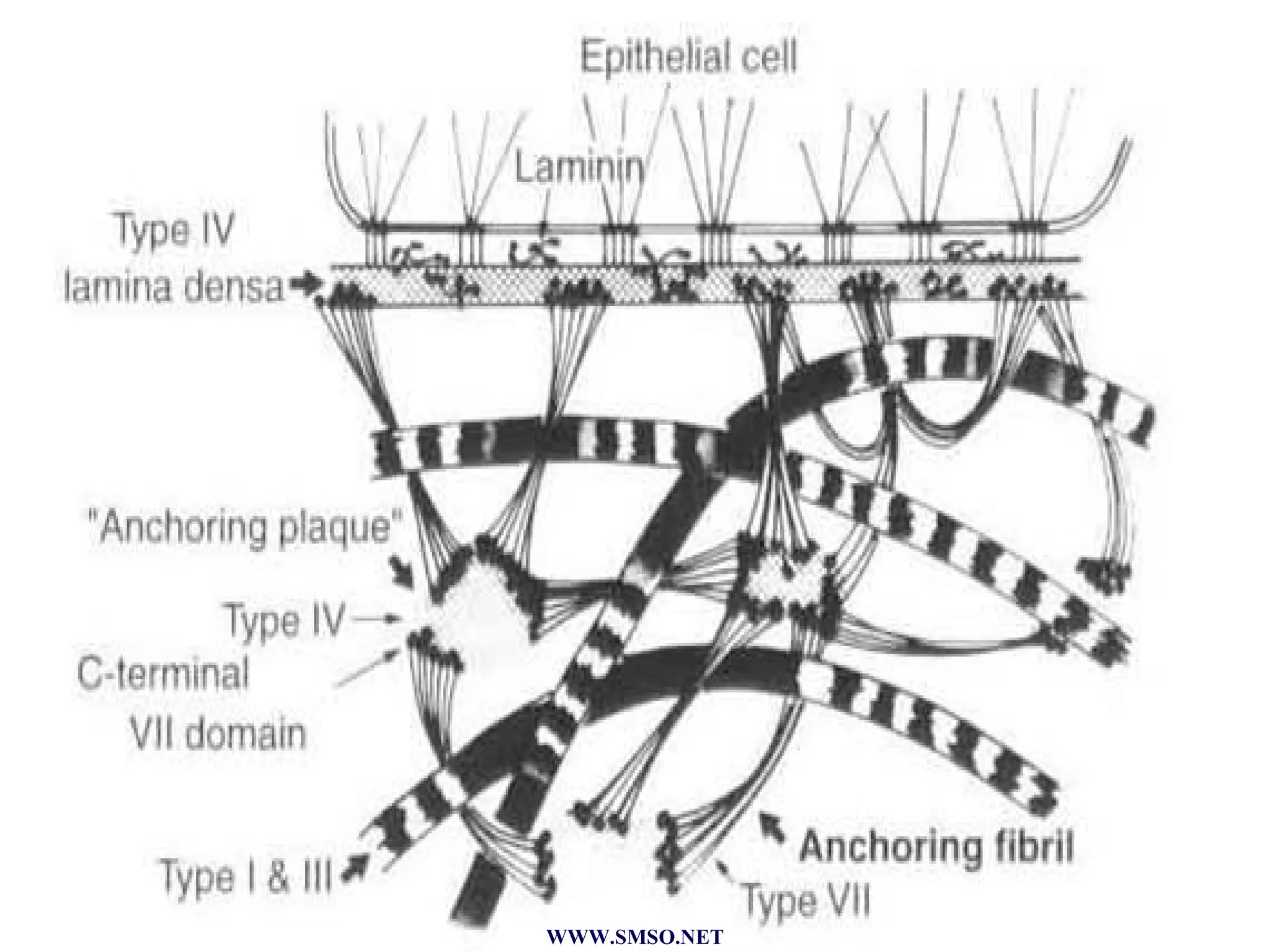
The anchoring fibrils are primarily aggregates of type VII collagen. The proximal end inserts into the basal lamina, & the distal end is integrated into the fibrous network of the dermis. Many of the anchoring fibrils inserted their distal ends into electron-dense amorphous-appearing structures completely independent of lamina densa, known anchoring plaques . (  type IV collagen primarily )
The other 2 types of tubular microfibrils where on the bases of classic histochemical staining procedures, these have been identified as elastic – related fibrils . The microfibrillar component in the absence of amorphous component  known as Oxytalan fibers. The microfibrillar component in the presence of small  amounts of amorphous component known as Elaunin fibers, and in the presence of abundant amorphous component known as Elastic fibers.
In the papillary dermis, oxytalan fibers insert into the basal lamina perpendicular to the basement membrane & extend into the dermis, where they merge with elaunin fibers to form a plexus parallel to the axis of DEJ, where they appear to be continuous with elastic fibers present deep within the reticular dermis. From this distribution of this structure, we can appreciate that DEJ provides a continuous series of attachment among the major connecting tissue component of the reticular dermis & internal cytoskeletons of the basal cells.
WWW.SMSO.NET
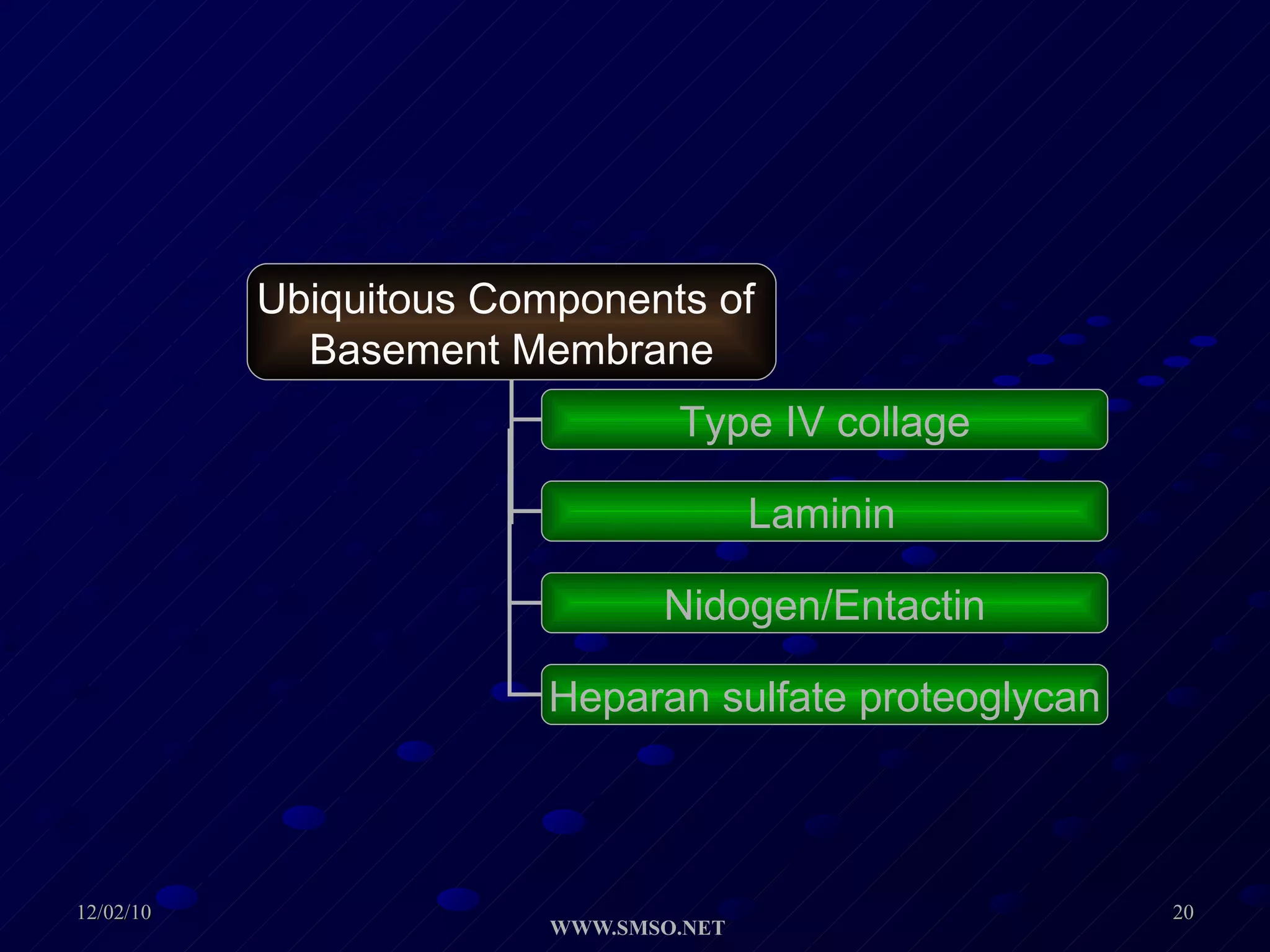
Ubiquitous Components of  Basement Membrane Type IV collage Laminin   Nidogen/Entactin Heparan sulfate proteoglycan
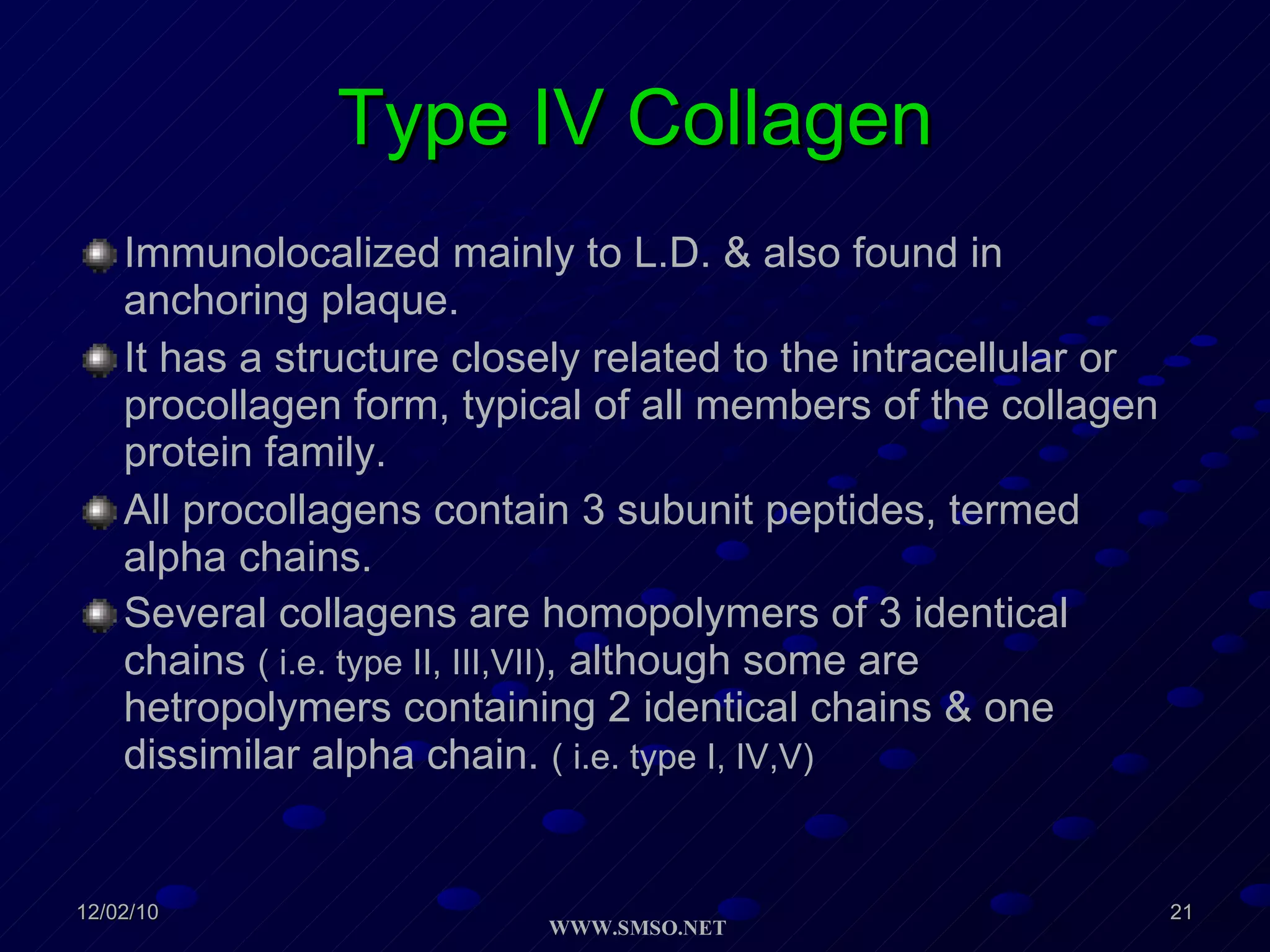
Type IV Collagen Immunolocalized mainly to L.D. & also found in anchoring plaque. It has a structure closely related to the intracellular or procollagen form, typical of all members of the collagen protein family. All procollagens contain 3 subunit peptides, termed alpha chains. Several collagens are homopolymers of 3 identical chains  ( i.e. type II, III,VII) , although some are hetropolymers containing 2 identical chains & one dissimilar alpha chain.  ( i.e. type I, IV,V)
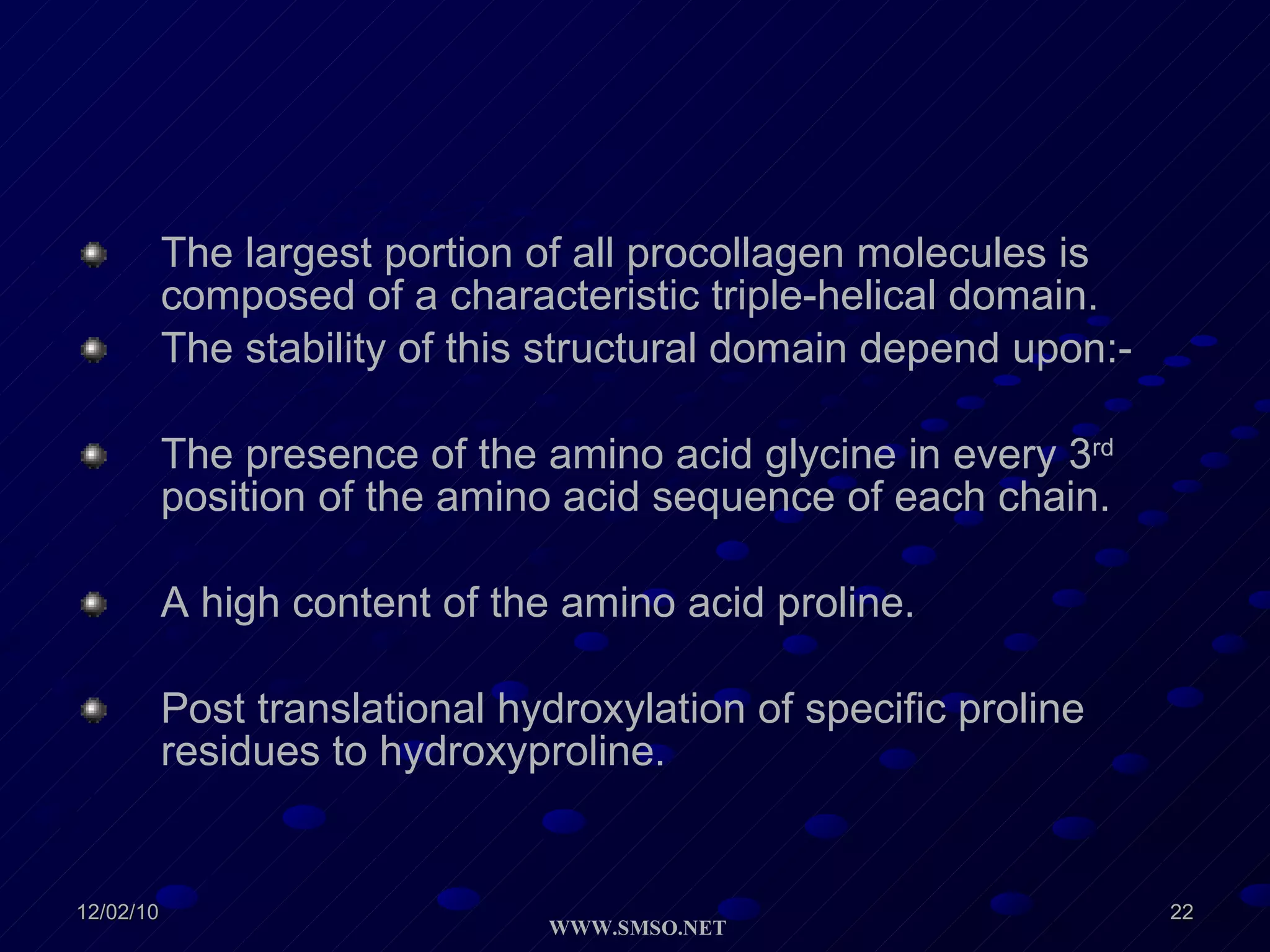
The largest portion of all procollagen molecules is composed of a characteristic triple-helical domain. The stability of this structural domain depend upon:- The presence of the amino acid glycine in every 3 rd  position of the amino acid sequence of each chain. A high content of the amino acid proline. Post translational hydroxylation of specific proline residues to hydroxyproline.
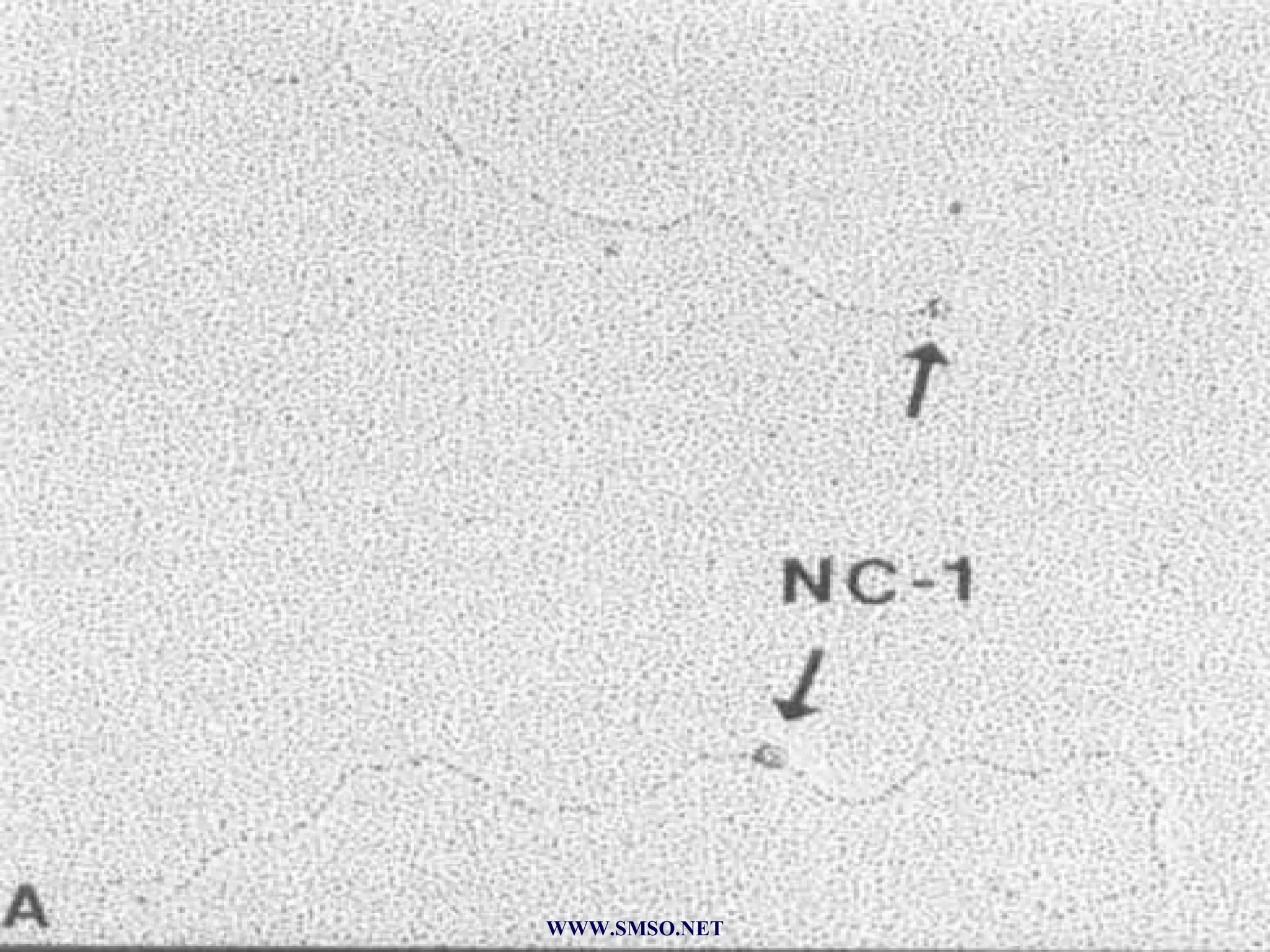
In the content that these criteria are met, the resulting triple-helix structural domain are:- Resistant to non-collagen-specific protease digestion. Has extended, semirigid conformation. Type IV collagen contain both triple-helical & globular domain. The amino terminus of type IV procollagen (NC-I) is globular, similar to the analogous structure of other procollagens.
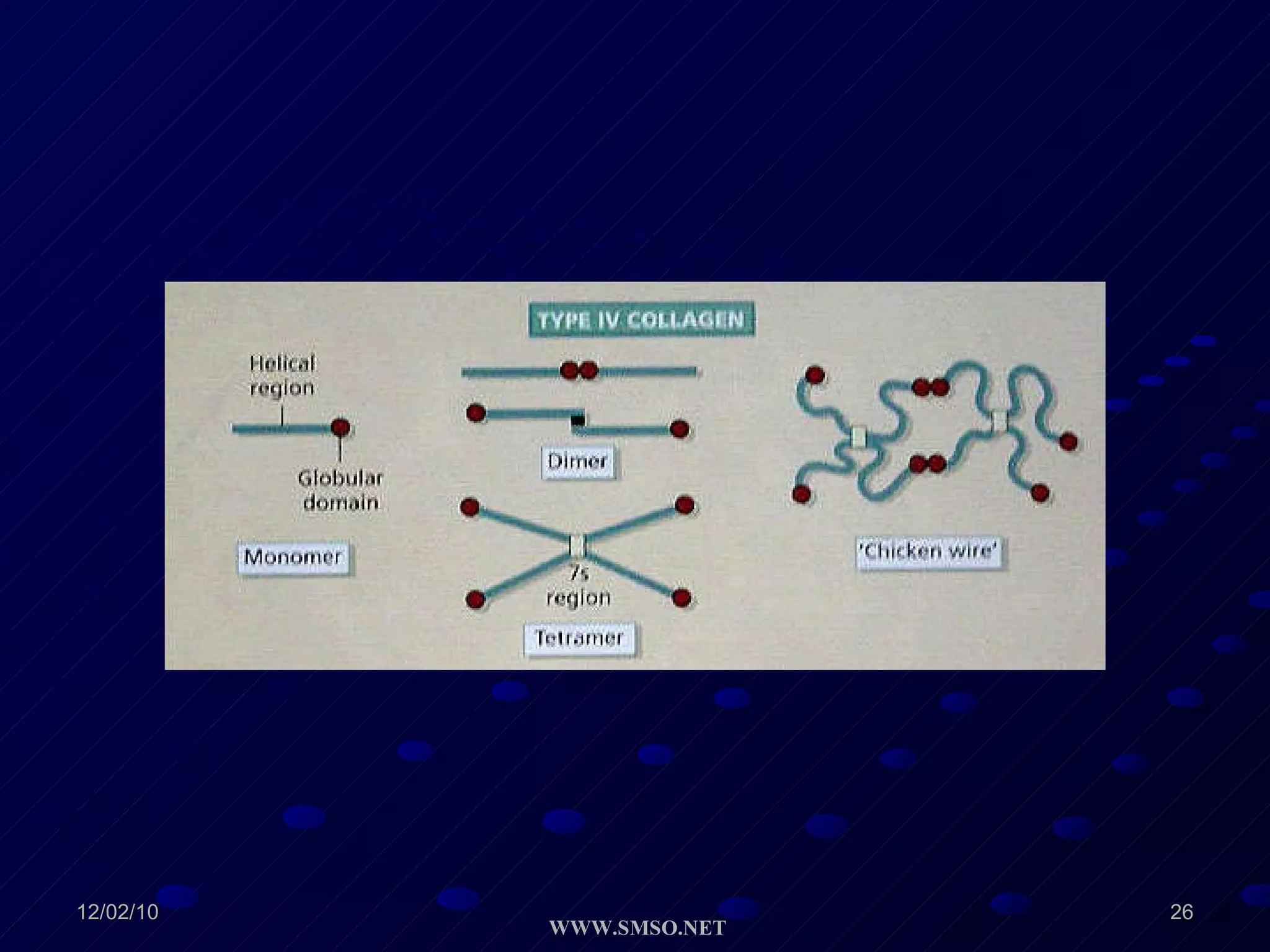
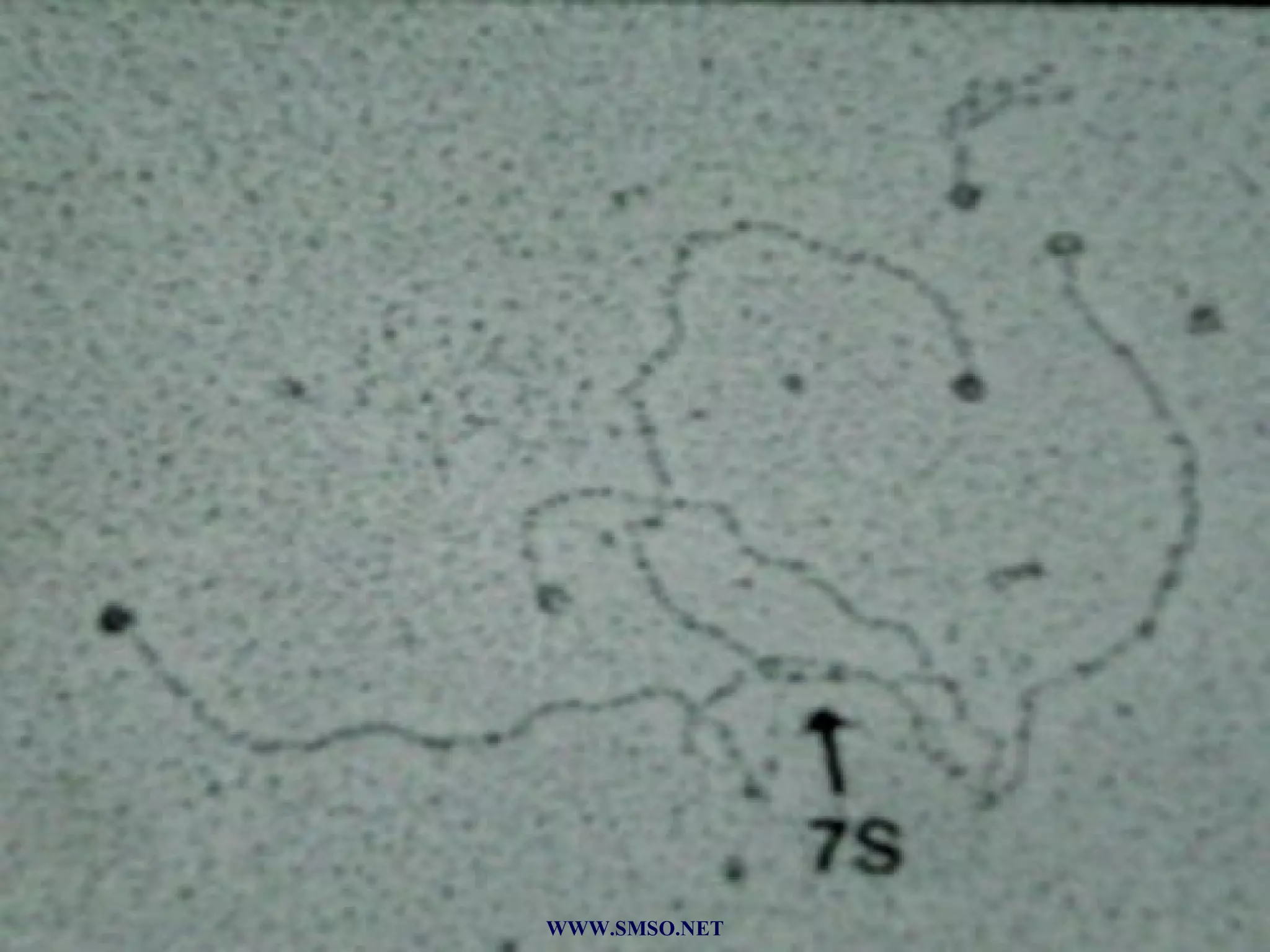
The carboxyl-terminal domain appears to contain a short globular region ( NC-2) preceded by a relatively large second triple helical domain. The triple helical nature of the amino terminus of type IV collagen is unique & has been designated as the 7-S domain. Covalent interactions among 7-S domain of the type IV collagen are the basis for the specialized fiber form characteristic of basement membrane. The major triple helix of type IV collagen measures 330 nm, which is longer than other types of collagens ( types I,II,III,V  = 300nm).
It is not helical throughout its length but contains several specific sites at which glycin is not present in every 3 rd  position. These minor discontinuities in the triple-helical structure result in increased flexibility in the type IV collagen helix & increased its resistance to a variety of proteases.
 
WWW.SMSO.NET
WWW.SMSO.NET
Laminin  Immunolocalized to L.D. It is a member of glycoprotein family with semirigid & extended structures. It is hetrotrimetric molecule, where each laminin isoform consisting of  alpha chain.  Beta chain.  Gamma chain.
At least 7 different laminin isoforms identified but laminins 1, 5, 6,& 7 are known to occur in DEJ which immunolocalized mainly to L.D. By using rotary shadowing technique to allow the electron microscope to visualize the laminin molecule which appear to have an asymmetric cross-like structure  ( 1 long arm & 3 short arms). The long arm is approximately 125 nm in length & the short arms are variable, but the largest measures approximately 80 nm.
The laminin molecule is divided into:- Globular Rodlike section  The 4 extremities of the crosslike structure contain globular domains,& the 3 short arms contain extra domain, approximately 20 nm from their free end. The globular & rodlike domains of laminin have been individually implicated in various functions including Cell attachment & spreading. Aggregation with itself & with other component of the L.D. specially type IV collagen. Neurite outgrowth. Cellular differentiation.
WWW.SMSO.NET
Nidogen / Entactin It is a glycoprotein with dumbbell configuration. It is attached to one of the short arms of laminin at the gamma 1 chain forming a stable complex. Nidogen alone as well as laminin- nidogen complex specifically bind to type IV collagen. Nidogen is localized to the L.D. of basement membrane & along the adjacent cell surface of epithelial cell.
WWW.SMSO.NET
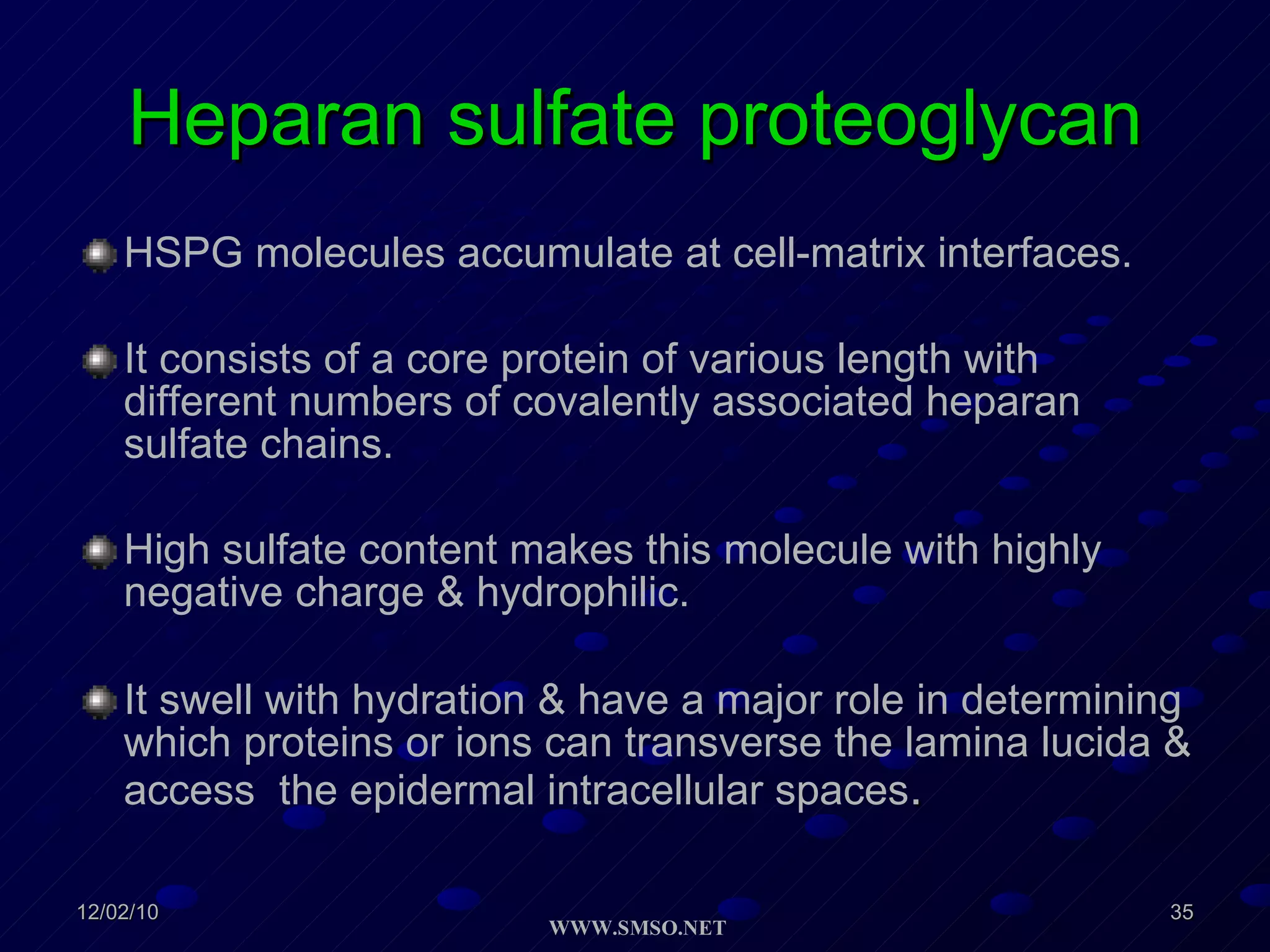
Heparan sulfate proteoglycan HSPG molecules accumulate at cell-matrix interfaces. It consists of a core protein of various length with different numbers of covalently associated heparan sulfate chains. High sulfate content makes this molecule with highly negative charge & hydrophilic. It swell with hydration & have a major role in determining which proteins or ions can transverse the lamina lucida & access  the epidermal intracellular spaces .
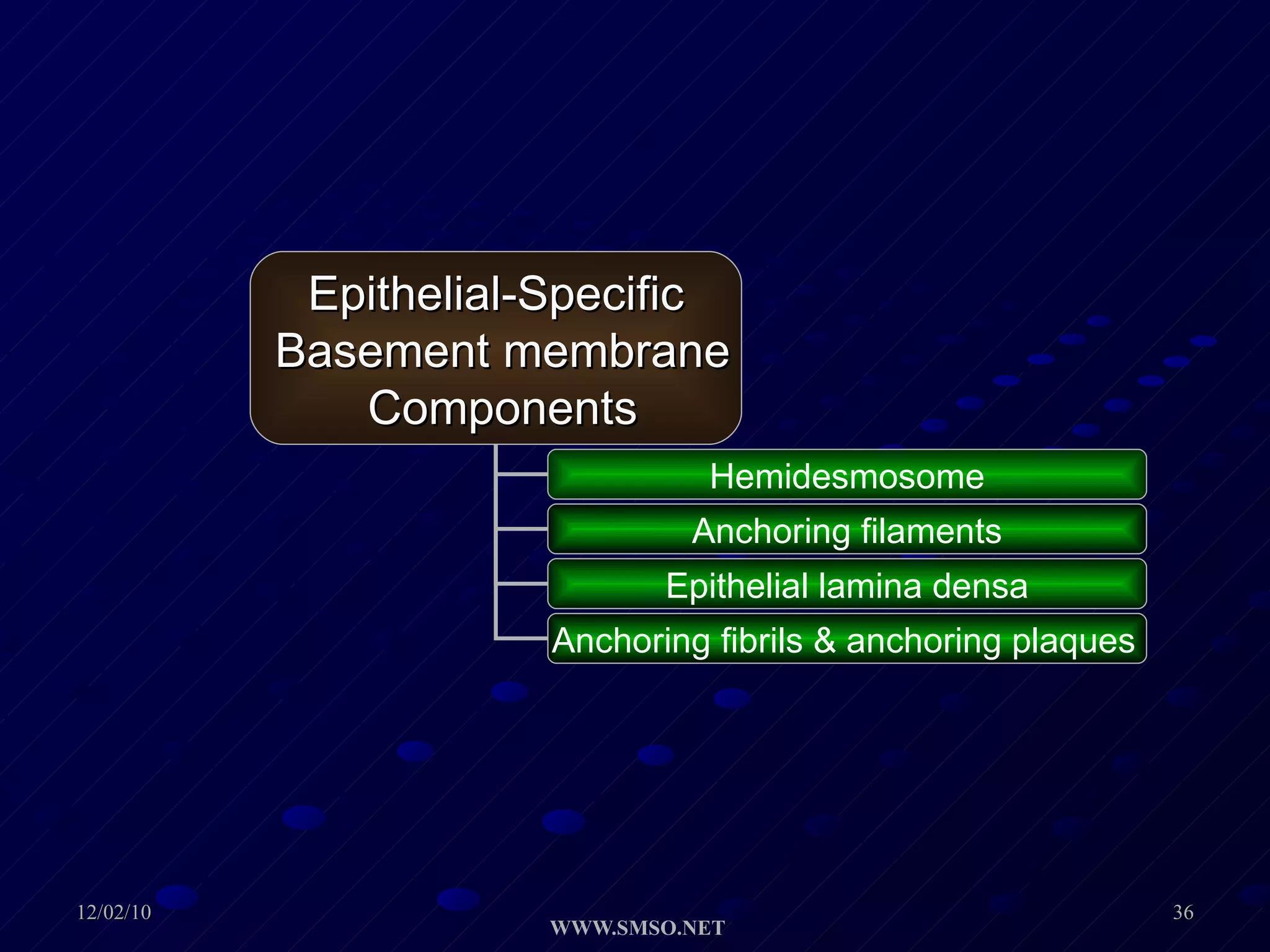
Epithelial-Specific Basement membrane Components Hemidesmosome Anchoring filaments Epithelial lamina densa Anchoring fibrils & anchoring plaques
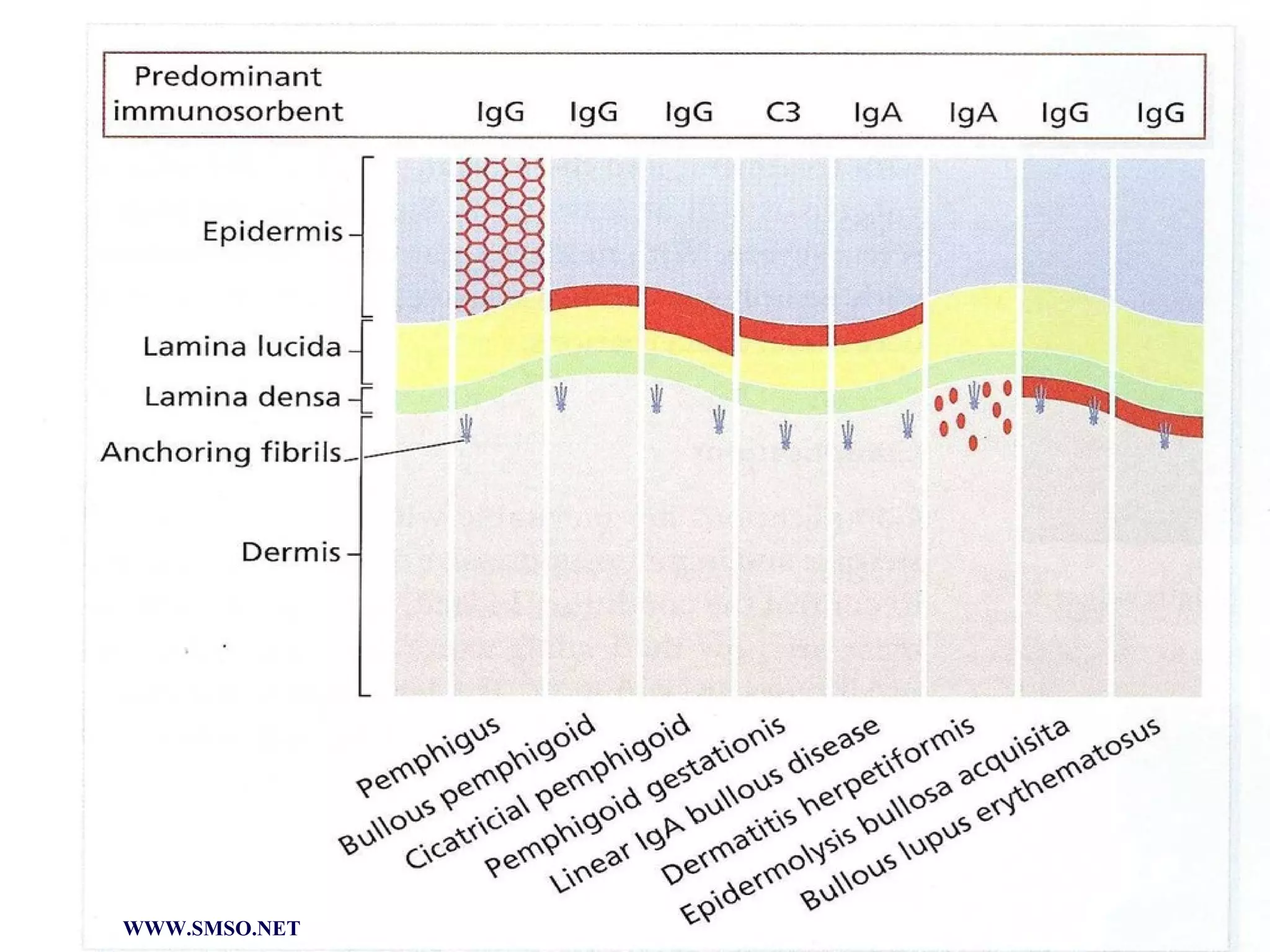
Hemidesmosome  (HD) It is closely resembles ½ of the desmosome seen in cell – cell junction but based on chemical criteria, these 2 structures appear to be immunologically distinctive. Characteristics of HD proteins has been aided by the use of auto-antibodies presented in serum samples of patients with bullous pemphigoid. As result of this, the antigens recognized by these sera identified proteins ranging in mass from 165- 240 kDa.
However, there is fair agreement that;- 230/240-kDa protein  the major antigens recognized  180-kDa protein  by these antibodies 16-kDa protein  These proteins are immunologically & structurally distinct. Monoclonal antibodies have been constructed to both intracellular & extracellular regions of HD.
These monoclonal antibodies identified 3 distinctive proteins 240-kDa protein 180-kDa protein 125-kDa protein
WWW.SMSO.NET
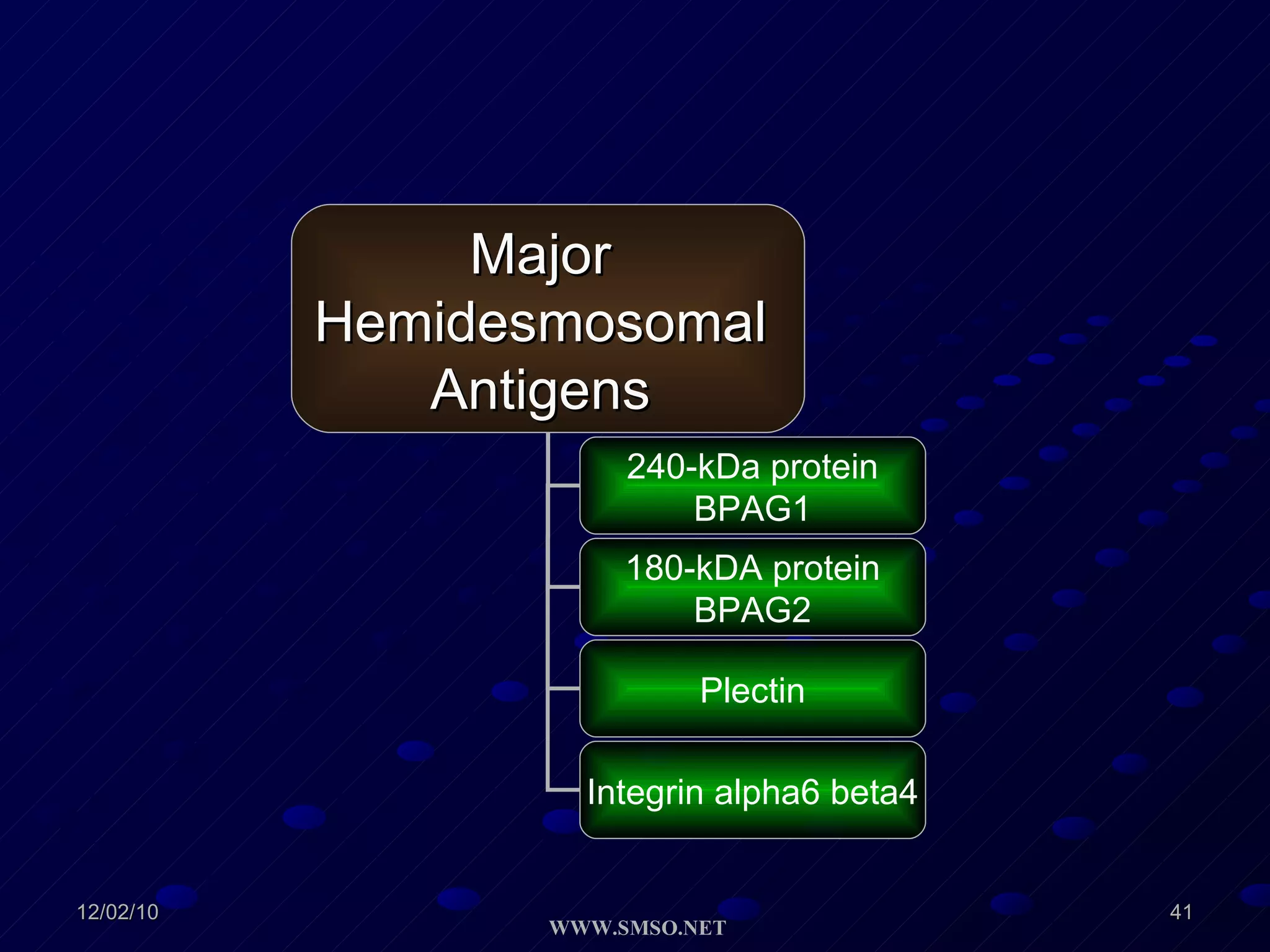
Major  Hemidesmosomal  Antigens  240-kDa protein BPAG1 180-kDA protein BPAG2 Plectin Integrin alpha6 beta4
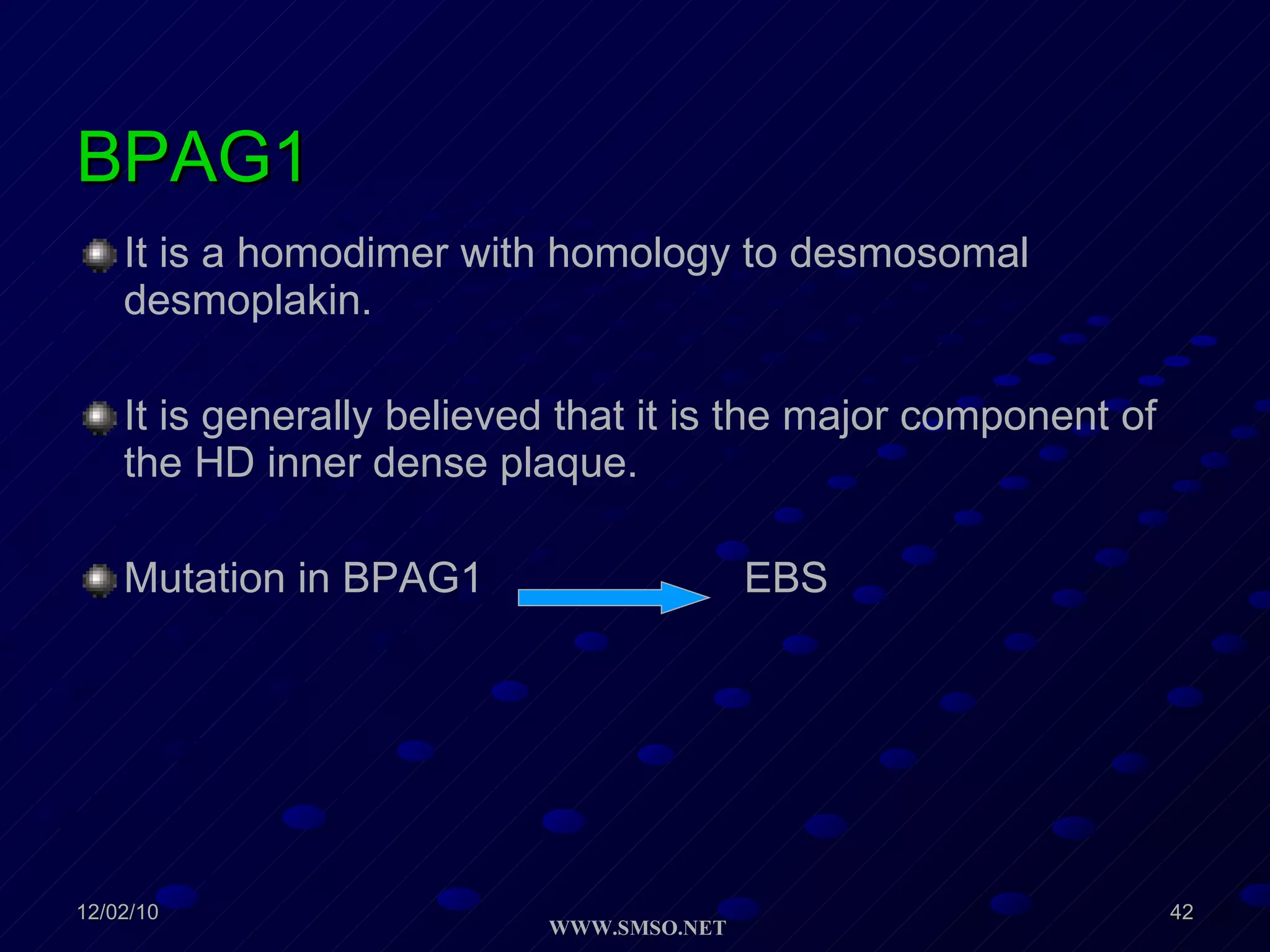
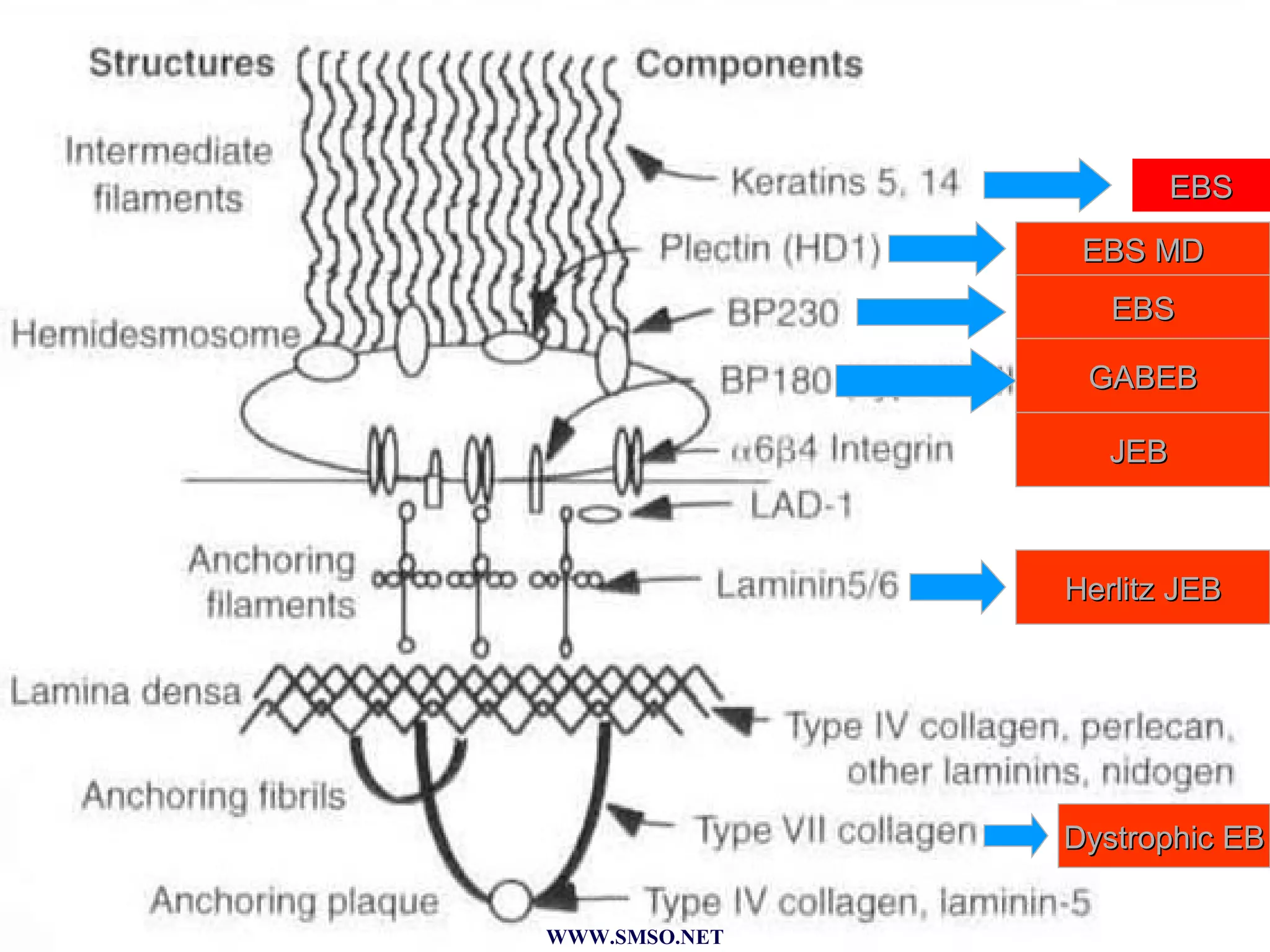
BPAG1 It is a homodimer with homology to desmosomal desmoplakin. It is generally believed that it is the major component of the HD inner dense plaque. Mutation in BPAG1  EBS
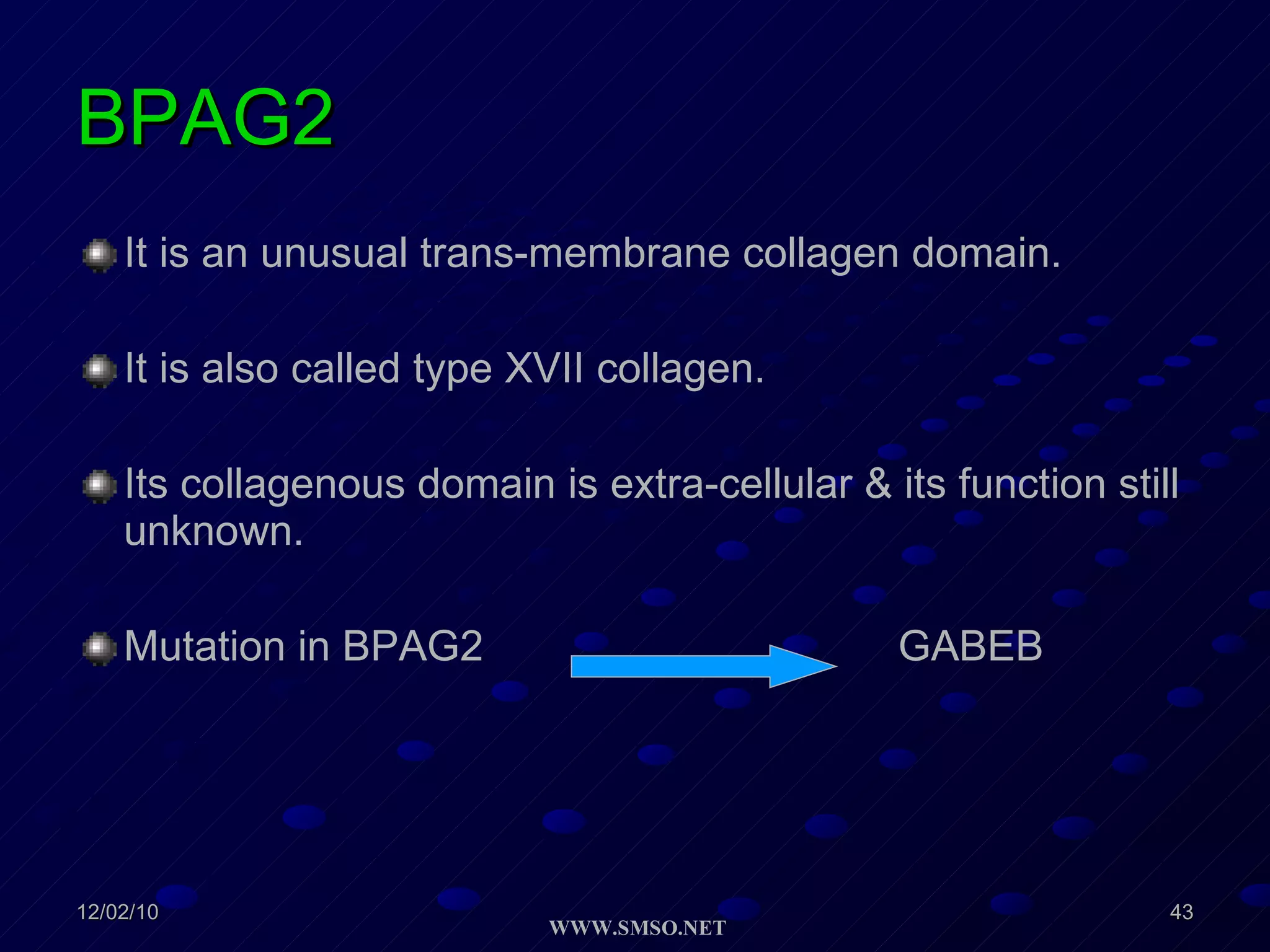
BPAG2 It is an unusual trans-membrane collagen domain. It is also called type XVII collagen. Its collagenous domain is extra-cellular & its function still unknown. Mutation in BPAG2  GABEB
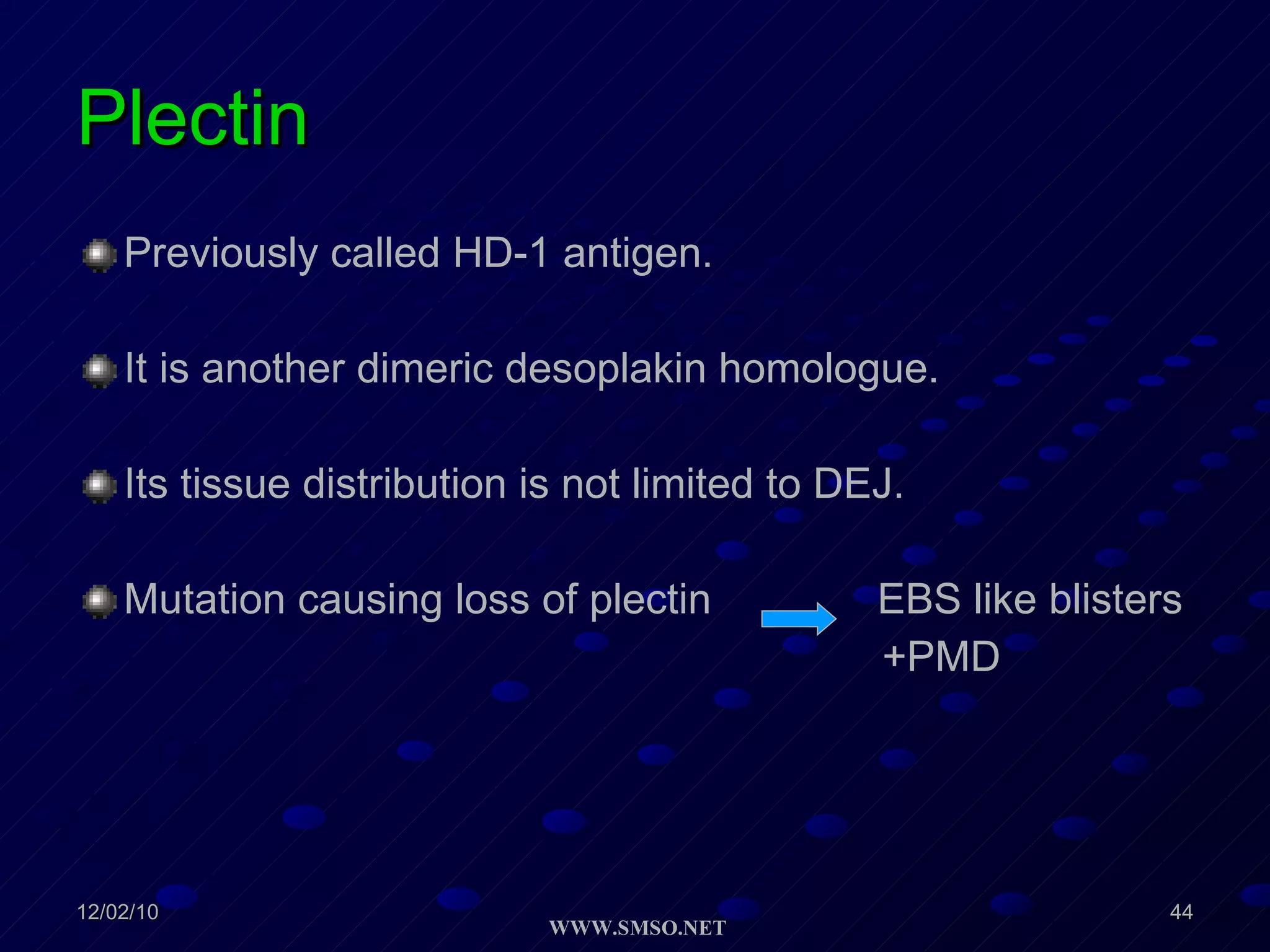
Plectin  Previously called HD-1 antigen. It is another dimeric desoplakin homologue. Its tissue distribution is not limited to DEJ. Mutation causing loss of plectin  EBS like blisters +PMD
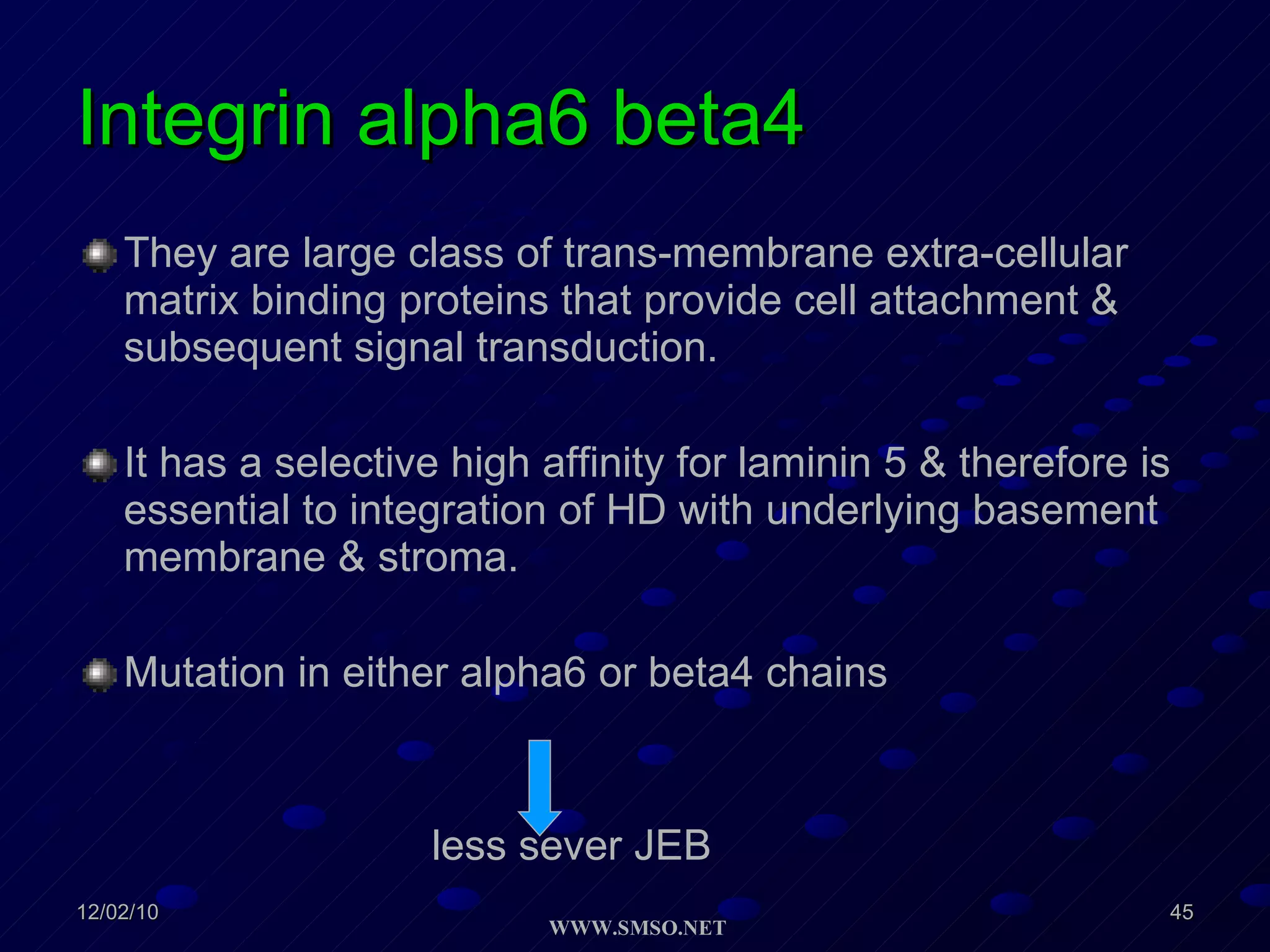
Integrin alpha6 beta4 They are large class of trans-membrane extra-cellular matrix binding proteins that provide cell attachment & subsequent signal transduction. It has a selective high affinity for laminin 5 & therefore is essential to integration of HD with underlying basement membrane & stroma. Mutation in either alpha6 or beta4 chains less sever JEB
Anchoring filaments Series of filaments transversing the lamina lucida from the epidermal basal cells &insert into the lamina densa. Several antigens now appear to be anchoring filament proteins.
WWW.SMSO.NET
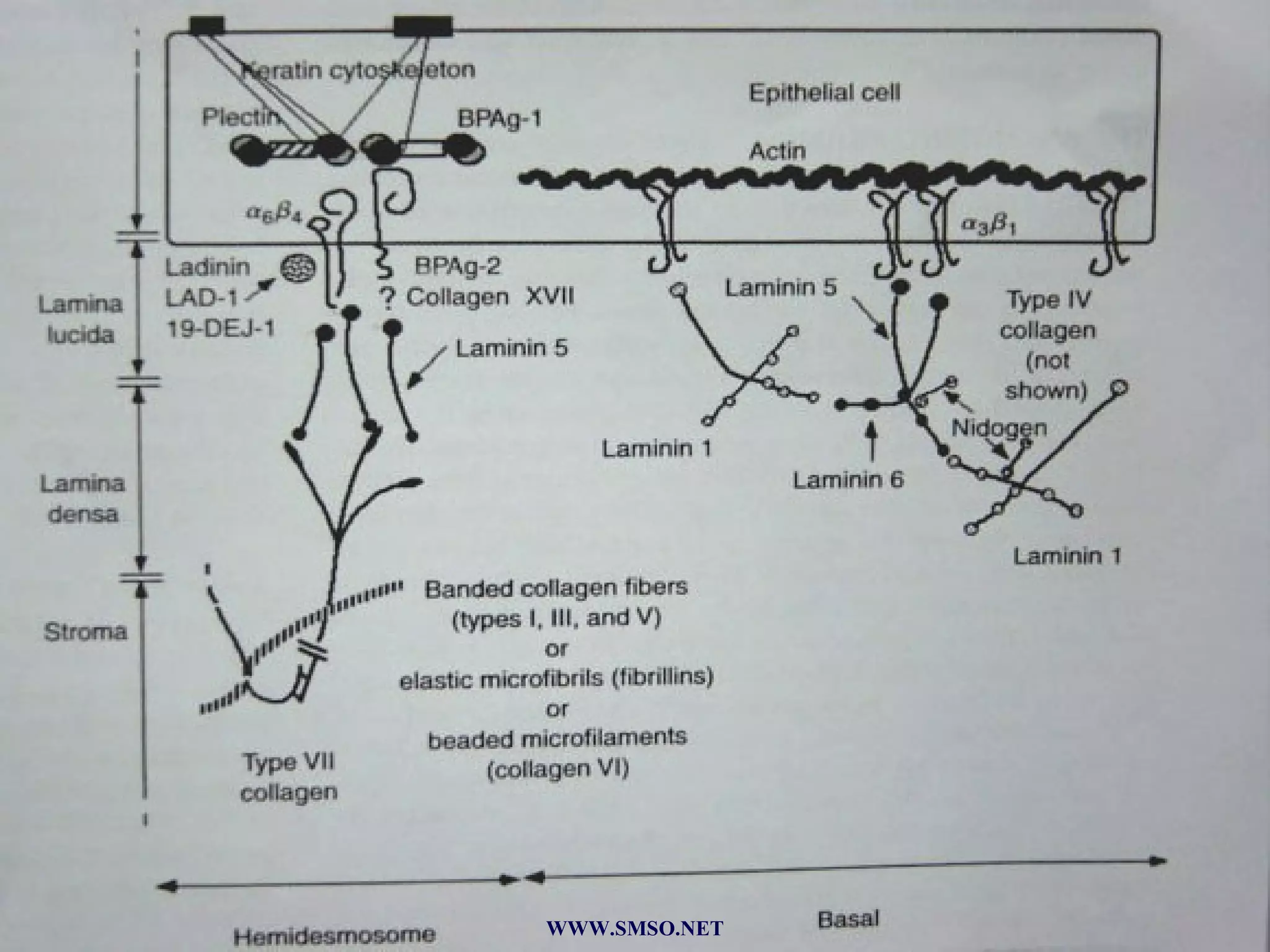
Major Anchoring filament Antigens  Laminin 5 125-kDa 19-DEJ-1 105-kDa Ladinin LAD-1
Laminin 5  (alpha3 beta3 gamma 2) Its general structure as laminin family ( glycoproteins, semirigid & extended structure has an asymmetric cross-like). It has short arms comparing to other laminins. Its shape is consistent with its potential to be the anchoring filament protein. It has a high affinity for integrin alph6 beta4. it also bind to the NC-1 domain of type VII collagen ( the anchoring fibril protein).
Mutation in any of its components will lead to loss of its ability to bridge HD & anchoring fibrils resulting in separation within the lamina lucida  Herlitz JEB
125-kDa protein It is located at the region where intermediate filaments of basal keratinocyte intersect the HD plaque & at the extra-cellular region.
19-DEJ-1 antigen It is localized to the region of the lamina lucida beneath the HD. ? Sulfated ? Proteoglycan. Its role in adhesion not fully studied, but supported by if absent  JEB
105-kDa Antigen It is localized in extra-cellular region but closely associated with the cell surface. If absent  immune-mediated bullous  dermatoses
Ladinin & LAD-1 Their function unknown. Their implication in epithelial adhesion by their identification as ligands for auto-antibodies present in patients with linear IgA bullous dermatosis.
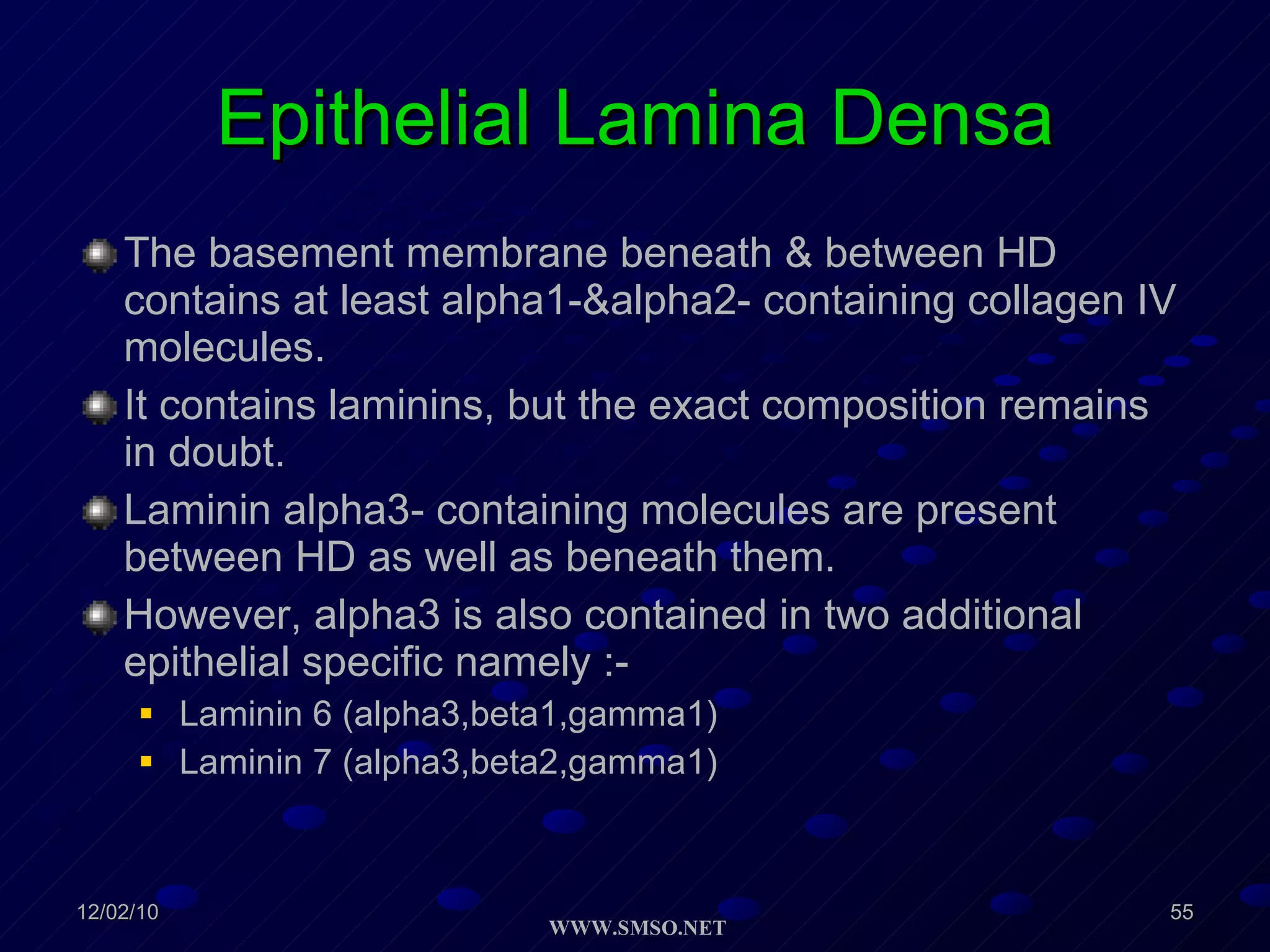
Epithelial Lamina Densa The basement membrane beneath & between HD contains at least alpha1-&alpha2- containing collagen IV molecules. It contains laminins, but the exact composition remains in doubt. Laminin alpha3- containing molecules are present between HD as well as beneath them. However, alpha3 is also contained in two additional epithelial specific namely :- Laminin 6 (alpha3,beta1,gamma1) Laminin 7 (alpha3,beta2,gamma1)
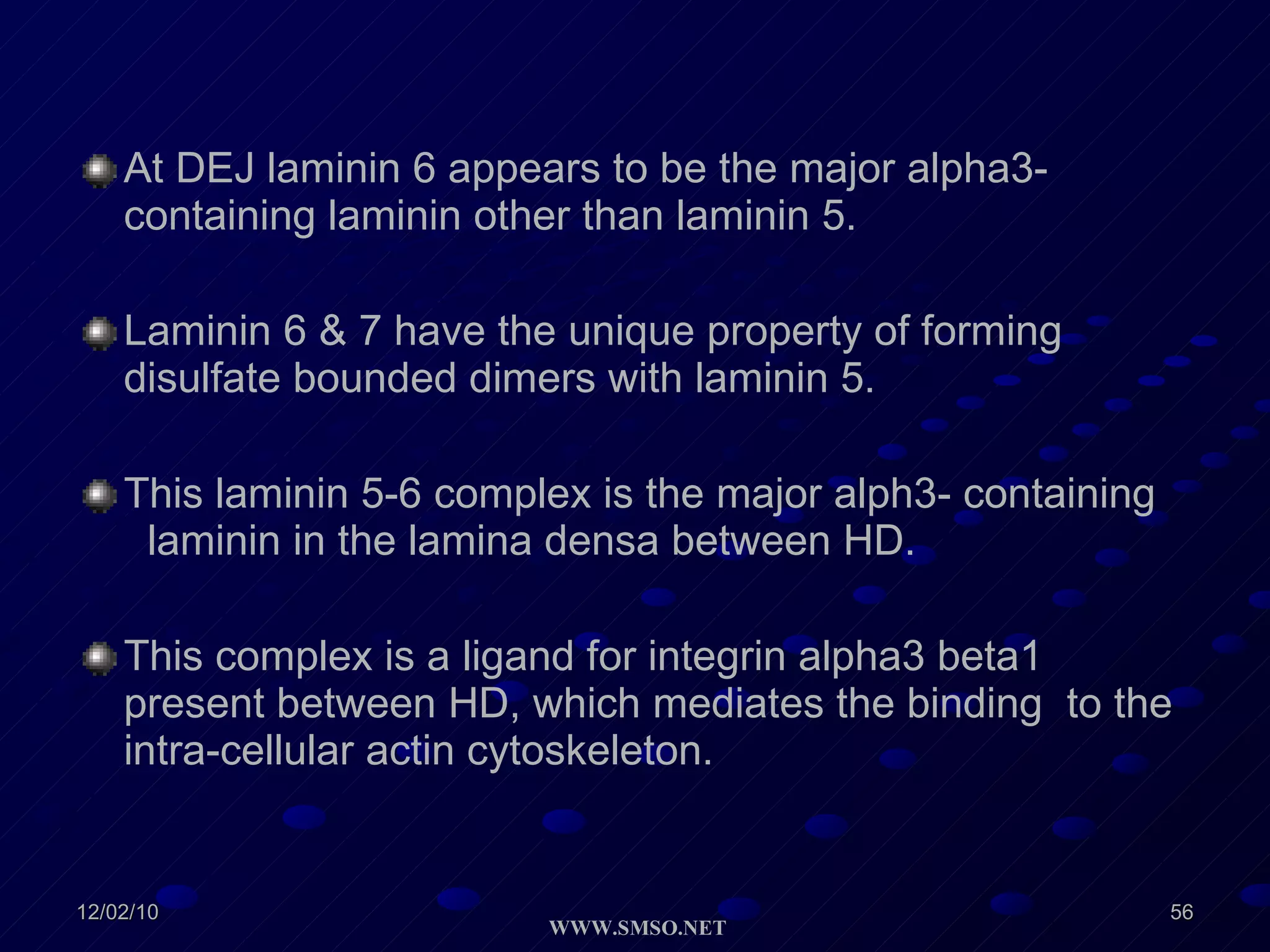
At DEJ laminin 6 appears to be the major alpha3-containing laminin other than laminin 5. Laminin 6 & 7 have the unique property of forming disulfate bounded dimers with laminin 5. This laminin 5-6 complex is the major alph3- containing  laminin in the lamina densa between HD. This complex is a ligand for integrin alpha3 beta1 present between HD, which mediates the binding  to the intra-cellular actin cytoskeleton.
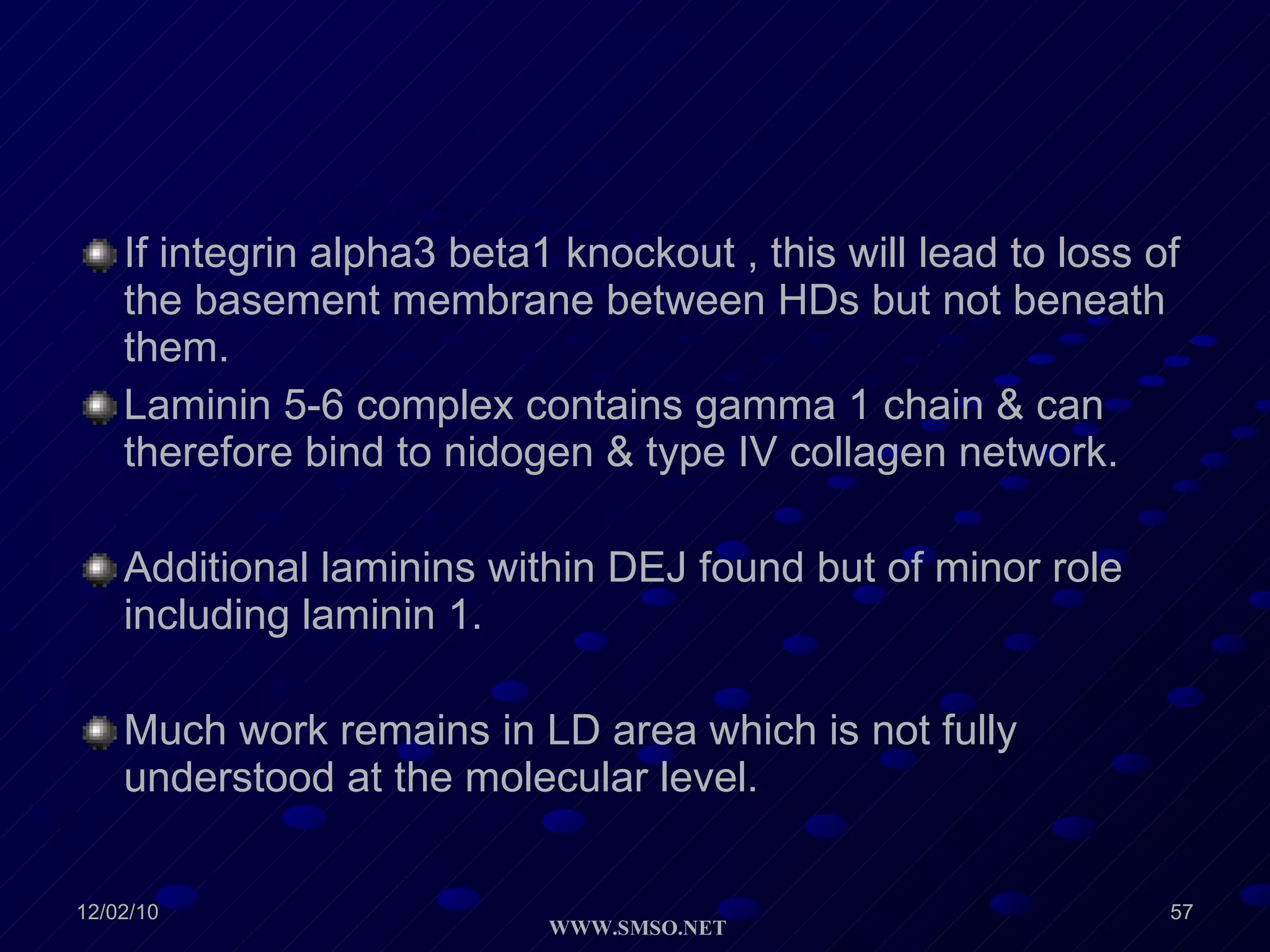
If integrin alpha3 beta1 knockout , this will lead to loss of the basement membrane between HDs but not beneath them. Laminin 5-6 complex contains gamma 1 chain & can therefore bind to nidogen & type IV collagen network. Additional laminins within DEJ found but of minor role including laminin 1. Much work remains in LD area which is not fully understood at the molecular level.
WWW.SMSO.NET
Anchoring fibrils &  Anchoring plaques The major component of the anchoring fibril is type VII collagen. Type VII collagen appears to have a major triple-helical domain is approximately 450 nm in length. Non-triple-helical globular domains exist at the terminal ends of this triple helix,& the N- terminal domain NC-1 is very large & trident-like. Type VII collagen is synthesized & secreted as monomeric protein but rapidly dimerizes through disulfate cross-like at the amino terminals. These structures are proteolytically cleaved after formation of the centrosymmetric dimer.
The dimers then aggregates laterally to form the anchoring fibrils. The complex NC-1 domain binds to laminin 5 & also to components of the lamina densa. The helical domain extends perpendicular from the lamina densa & insert into structures termed anchoring plaques. The anchoring plaques are electron-dense structure composed of type IV collagen & laminin & possible other components.
They are independent of lamina densa , & distributed randomly in the papillary dermis below lamina densa & are inter-related by additional anchoring filaments. Mutation in the gene encoding type VII collagen Sever generalized recessive DEB To date, all mutation known to underlie both recessive & dominants forms of DEB are due to COL7A1 mutation
WWW.SMSO.NET
EBS EBS MD EBS GABEB JEB  Herlitz JEB Dystrophic EB WWW.SMSO.NET
WWW.SMSO.NET
Thank You WWW.SMSO.NET

Dermo epidermal junction

  • 1.
    D ermo – E pidermal J unction Presented by Adel A. Al-Ghamdi Dermatology Department King Fahd Hospital of university
  • 2.
    Introduction Originof basement membrane Function of basement membrane Ultrastructure of DEJ Ubiquitous components of basement membrane epithelial-specific basement membrane components Scope in some diseases affecting DEJ
  • 3.
  • 4.
    It is ahighly complex form of basement membrane which underlie epithelial & endothelial cells which separate them from each other or from the adjacent connective tissue stroma. It is considered as one of the largest epithelial-mesenchymal junction on the body. It forms an extensive interface between the dermis & epidermis. It is continuous with the junction between dermis & epidermal appendages.
  • 5.
    As all basementmembranes, it stains strongly for carbohydrates & anionic sites Periodic acid shifft stain (PAS) The complexity & heterogeneity of DEJ can be appreciated only at electron microscopic level
  • 6.
    Origin of BasementMembrane Serial studies strongly suggest that all types of basement membranes are not produced by a single cell type, but rather it is contributed to by both epithelial & mesenchymal cells. Laminine 5 & 6 epidermal compartment Nidogen mesenchymal compartment Type IV collagen & other laminines produced by both compartment
  • 7.
    Functions of basementmembrane Substrates for the attachment of differentiated cells Templates for repair and restoration of tissue functions. Sites of attachment for different cell layers or for cells to their underlying matrix. Substrates for the programmed migration and selective interactions of germ layers in development. Barriers to cell passage in normal tissues. Protection of attached cell types from apoptosis. The anchoring complex within the epithelial basement membrane is responsible for the stability of epithelial-stromal attachment.
  • 8.
  • 9.
  • 10.
    Ultrastructure of DEJEach of these zones contains structures that are distinctive by ultrastructure, biochemical & immunological criteria. Size of these regions varies in different tissue types, at different ages & as consequence of several disease states. DEJ 1 ST ZONE 2 ND ZONE 3 RD ZONE Sub basal lamina Lamina densa Tonofilement, Hemidesmosomes Anchoring filement complexs
  • 11.
    First zone Tonofilament – Hemidesmosome- Anchoring filaments Complex. It is the site of attachment of the epithelium to the basement membrane. Tonofilaments Also called keratin intermediate filaments, it is comprising keratin 5&14. It is a fine filamentous structures maintain the intracellular architecture & organization of basal cells. They course through the basal cells & inserted into the desmosome & hemidesmosome.
  • 12.
    Hemidesmosome Numerous electron-dense plated located in the region of the plasma membrane of the basal cells. Lamina Lucida External to the plasma membrane 25- 50 nm in width. Contains the anchoring filaments
  • 13.
    Second zone Laminadensa Appears as an electron- dense amorphous structure. 20-50 nm in width below it the dermal epidermal basal lamina. At high magnification, it has a granular fibrous appearance. Account for 40 -65% of total basement membrane proteins. Major proteins component is type IV collagen where it appears as a filament of variable thickness which is morphologically distinct from the collagen fibers in the subjacent dermis.
  • 14.
    The basement membraneheparin sulfate proteoglycan appears as sets of two parallel lines of the surface of the collage cords. Laminin also associated with the cords, appearing as a fine wavy lines.
  • 15.
    Third zone (the sub basal lamina) It contains several microfibrillar structures in which 3 of them can be distinguished. Anchoring fibrils It appears as condensed fibrous aggregates 20 - 75 nm in diameter ( not found in the basement membrane of blood vessels ,smooth muscles). At high resolution, these structures appear to have a nonperiodic cross-striated banding pattern (positively stained of collagen).
  • 16.
    The anchoring fibrilsare primarily aggregates of type VII collagen. The proximal end inserts into the basal lamina, & the distal end is integrated into the fibrous network of the dermis. Many of the anchoring fibrils inserted their distal ends into electron-dense amorphous-appearing structures completely independent of lamina densa, known anchoring plaques . ( type IV collagen primarily )
  • 17.
    The other 2types of tubular microfibrils where on the bases of classic histochemical staining procedures, these have been identified as elastic – related fibrils . The microfibrillar component in the absence of amorphous component known as Oxytalan fibers. The microfibrillar component in the presence of small amounts of amorphous component known as Elaunin fibers, and in the presence of abundant amorphous component known as Elastic fibers.
  • 18.
    In the papillarydermis, oxytalan fibers insert into the basal lamina perpendicular to the basement membrane & extend into the dermis, where they merge with elaunin fibers to form a plexus parallel to the axis of DEJ, where they appear to be continuous with elastic fibers present deep within the reticular dermis. From this distribution of this structure, we can appreciate that DEJ provides a continuous series of attachment among the major connecting tissue component of the reticular dermis & internal cytoskeletons of the basal cells.
  • 19.
  • 20.
    Ubiquitous Components of Basement Membrane Type IV collage Laminin Nidogen/Entactin Heparan sulfate proteoglycan
  • 21.
    Type IV CollagenImmunolocalized mainly to L.D. & also found in anchoring plaque. It has a structure closely related to the intracellular or procollagen form, typical of all members of the collagen protein family. All procollagens contain 3 subunit peptides, termed alpha chains. Several collagens are homopolymers of 3 identical chains ( i.e. type II, III,VII) , although some are hetropolymers containing 2 identical chains & one dissimilar alpha chain. ( i.e. type I, IV,V)
  • 22.
    The largest portionof all procollagen molecules is composed of a characteristic triple-helical domain. The stability of this structural domain depend upon:- The presence of the amino acid glycine in every 3 rd position of the amino acid sequence of each chain. A high content of the amino acid proline. Post translational hydroxylation of specific proline residues to hydroxyproline.
  • 23.
    In the contentthat these criteria are met, the resulting triple-helix structural domain are:- Resistant to non-collagen-specific protease digestion. Has extended, semirigid conformation. Type IV collagen contain both triple-helical & globular domain. The amino terminus of type IV procollagen (NC-I) is globular, similar to the analogous structure of other procollagens.
  • 24.
    The carboxyl-terminal domainappears to contain a short globular region ( NC-2) preceded by a relatively large second triple helical domain. The triple helical nature of the amino terminus of type IV collagen is unique & has been designated as the 7-S domain. Covalent interactions among 7-S domain of the type IV collagen are the basis for the specialized fiber form characteristic of basement membrane. The major triple helix of type IV collagen measures 330 nm, which is longer than other types of collagens ( types I,II,III,V = 300nm).
  • 25.
    It is nothelical throughout its length but contains several specific sites at which glycin is not present in every 3 rd position. These minor discontinuities in the triple-helical structure result in increased flexibility in the type IV collagen helix & increased its resistance to a variety of proteases.
  • 26.
  • 27.
  • 28.
  • 29.
    Laminin Immunolocalizedto L.D. It is a member of glycoprotein family with semirigid & extended structures. It is hetrotrimetric molecule, where each laminin isoform consisting of alpha chain. Beta chain. Gamma chain.
  • 30.
    At least 7different laminin isoforms identified but laminins 1, 5, 6,& 7 are known to occur in DEJ which immunolocalized mainly to L.D. By using rotary shadowing technique to allow the electron microscope to visualize the laminin molecule which appear to have an asymmetric cross-like structure ( 1 long arm & 3 short arms). The long arm is approximately 125 nm in length & the short arms are variable, but the largest measures approximately 80 nm.
  • 31.
    The laminin moleculeis divided into:- Globular Rodlike section The 4 extremities of the crosslike structure contain globular domains,& the 3 short arms contain extra domain, approximately 20 nm from their free end. The globular & rodlike domains of laminin have been individually implicated in various functions including Cell attachment & spreading. Aggregation with itself & with other component of the L.D. specially type IV collagen. Neurite outgrowth. Cellular differentiation.
  • 32.
  • 33.
    Nidogen / EntactinIt is a glycoprotein with dumbbell configuration. It is attached to one of the short arms of laminin at the gamma 1 chain forming a stable complex. Nidogen alone as well as laminin- nidogen complex specifically bind to type IV collagen. Nidogen is localized to the L.D. of basement membrane & along the adjacent cell surface of epithelial cell.
  • 34.
  • 35.
    Heparan sulfate proteoglycanHSPG molecules accumulate at cell-matrix interfaces. It consists of a core protein of various length with different numbers of covalently associated heparan sulfate chains. High sulfate content makes this molecule with highly negative charge & hydrophilic. It swell with hydration & have a major role in determining which proteins or ions can transverse the lamina lucida & access the epidermal intracellular spaces .
  • 36.
    Epithelial-Specific Basement membraneComponents Hemidesmosome Anchoring filaments Epithelial lamina densa Anchoring fibrils & anchoring plaques
  • 37.
    Hemidesmosome (HD)It is closely resembles ½ of the desmosome seen in cell – cell junction but based on chemical criteria, these 2 structures appear to be immunologically distinctive. Characteristics of HD proteins has been aided by the use of auto-antibodies presented in serum samples of patients with bullous pemphigoid. As result of this, the antigens recognized by these sera identified proteins ranging in mass from 165- 240 kDa.
  • 38.
    However, there isfair agreement that;- 230/240-kDa protein the major antigens recognized 180-kDa protein by these antibodies 16-kDa protein These proteins are immunologically & structurally distinct. Monoclonal antibodies have been constructed to both intracellular & extracellular regions of HD.
  • 39.
    These monoclonal antibodiesidentified 3 distinctive proteins 240-kDa protein 180-kDa protein 125-kDa protein
  • 40.
  • 41.
    Major Hemidesmosomal Antigens 240-kDa protein BPAG1 180-kDA protein BPAG2 Plectin Integrin alpha6 beta4
  • 42.
    BPAG1 It isa homodimer with homology to desmosomal desmoplakin. It is generally believed that it is the major component of the HD inner dense plaque. Mutation in BPAG1 EBS
  • 43.
    BPAG2 It isan unusual trans-membrane collagen domain. It is also called type XVII collagen. Its collagenous domain is extra-cellular & its function still unknown. Mutation in BPAG2 GABEB
  • 44.
    Plectin Previouslycalled HD-1 antigen. It is another dimeric desoplakin homologue. Its tissue distribution is not limited to DEJ. Mutation causing loss of plectin EBS like blisters +PMD
  • 45.
    Integrin alpha6 beta4They are large class of trans-membrane extra-cellular matrix binding proteins that provide cell attachment & subsequent signal transduction. It has a selective high affinity for laminin 5 & therefore is essential to integration of HD with underlying basement membrane & stroma. Mutation in either alpha6 or beta4 chains less sever JEB
  • 46.
    Anchoring filaments Seriesof filaments transversing the lamina lucida from the epidermal basal cells &insert into the lamina densa. Several antigens now appear to be anchoring filament proteins.
  • 47.
  • 48.
    Major Anchoring filamentAntigens Laminin 5 125-kDa 19-DEJ-1 105-kDa Ladinin LAD-1
  • 49.
    Laminin 5 (alpha3 beta3 gamma 2) Its general structure as laminin family ( glycoproteins, semirigid & extended structure has an asymmetric cross-like). It has short arms comparing to other laminins. Its shape is consistent with its potential to be the anchoring filament protein. It has a high affinity for integrin alph6 beta4. it also bind to the NC-1 domain of type VII collagen ( the anchoring fibril protein).
  • 50.
    Mutation in anyof its components will lead to loss of its ability to bridge HD & anchoring fibrils resulting in separation within the lamina lucida Herlitz JEB
  • 51.
    125-kDa protein Itis located at the region where intermediate filaments of basal keratinocyte intersect the HD plaque & at the extra-cellular region.
  • 52.
    19-DEJ-1 antigen Itis localized to the region of the lamina lucida beneath the HD. ? Sulfated ? Proteoglycan. Its role in adhesion not fully studied, but supported by if absent JEB
  • 53.
    105-kDa Antigen Itis localized in extra-cellular region but closely associated with the cell surface. If absent immune-mediated bullous dermatoses
  • 54.
    Ladinin & LAD-1Their function unknown. Their implication in epithelial adhesion by their identification as ligands for auto-antibodies present in patients with linear IgA bullous dermatosis.
  • 55.
    Epithelial Lamina DensaThe basement membrane beneath & between HD contains at least alpha1-&alpha2- containing collagen IV molecules. It contains laminins, but the exact composition remains in doubt. Laminin alpha3- containing molecules are present between HD as well as beneath them. However, alpha3 is also contained in two additional epithelial specific namely :- Laminin 6 (alpha3,beta1,gamma1) Laminin 7 (alpha3,beta2,gamma1)
  • 56.
    At DEJ laminin6 appears to be the major alpha3-containing laminin other than laminin 5. Laminin 6 & 7 have the unique property of forming disulfate bounded dimers with laminin 5. This laminin 5-6 complex is the major alph3- containing laminin in the lamina densa between HD. This complex is a ligand for integrin alpha3 beta1 present between HD, which mediates the binding to the intra-cellular actin cytoskeleton.
  • 57.
    If integrin alpha3beta1 knockout , this will lead to loss of the basement membrane between HDs but not beneath them. Laminin 5-6 complex contains gamma 1 chain & can therefore bind to nidogen & type IV collagen network. Additional laminins within DEJ found but of minor role including laminin 1. Much work remains in LD area which is not fully understood at the molecular level.
  • 58.
  • 59.
    Anchoring fibrils & Anchoring plaques The major component of the anchoring fibril is type VII collagen. Type VII collagen appears to have a major triple-helical domain is approximately 450 nm in length. Non-triple-helical globular domains exist at the terminal ends of this triple helix,& the N- terminal domain NC-1 is very large & trident-like. Type VII collagen is synthesized & secreted as monomeric protein but rapidly dimerizes through disulfate cross-like at the amino terminals. These structures are proteolytically cleaved after formation of the centrosymmetric dimer.
  • 60.
    The dimers thenaggregates laterally to form the anchoring fibrils. The complex NC-1 domain binds to laminin 5 & also to components of the lamina densa. The helical domain extends perpendicular from the lamina densa & insert into structures termed anchoring plaques. The anchoring plaques are electron-dense structure composed of type IV collagen & laminin & possible other components.
  • 61.
    They are independentof lamina densa , & distributed randomly in the papillary dermis below lamina densa & are inter-related by additional anchoring filaments. Mutation in the gene encoding type VII collagen Sever generalized recessive DEB To date, all mutation known to underlie both recessive & dominants forms of DEB are due to COL7A1 mutation
  • 62.
  • 63.
    EBS EBS MDEBS GABEB JEB Herlitz JEB Dystrophic EB WWW.SMSO.NET
  • 64.
  • 65.