The Earth’s Rotation, Revolution
Around the Sun, and the Seasons
Earth’s Rotation
• Earth spins around on an
imaginary axis– This is
called rotation.
• The axis of rotation is an
imaginary straight line
through Earth Between the
North and South Poles.
• The axis is currently
inclined at 23.5 from the
plane of Earth’s orbit.
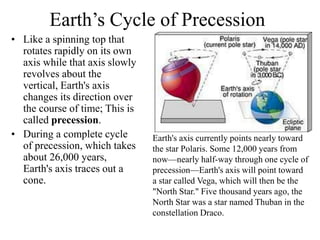
Earth’s Cycle of Precession
• Like a spinning top that
rotates rapidly on its own
axis while that axis slowly
revolves about the
vertical, Earth's axis
changes its direction over
the course of time; This is
called precession.
• During a complete cycle
of precession, which takes
about 26,000 years,
Earth's axis traces out a
cone.
Earth's axis currently points nearly toward
the star Polaris. Some 12,000 years from
now—nearly half-way through one cycle of
precession—Earth's axis will point toward
a star called Vega, which will then be the
"North Star." Five thousand years ago, the
North Star was a star named Thuban in the
constellation Draco.
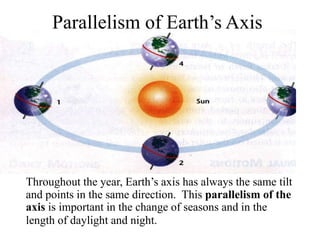
Parallelism of Earth’s Axis
Throughout the year, Earth’s axis has always the same tilt
and points in the same direction. This parallelism of the
axis is important in the change of seasons and in the
length of daylight and night.
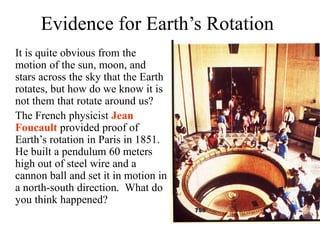
Evidence for Earth’s Rotation
It is quite obvious from the
motion of the sun, moon, and
stars across the sky that the Earth
rotates, but how do we know it is
not them that rotate around us?
The French physicist Jean
Foucault provided proof of
Earth’s rotation in Paris in 1851.
He built a pendulum 60 meters
high out of steel wire and a
cannon ball and set it in motion in
a north-south direction. What do
you think happened?
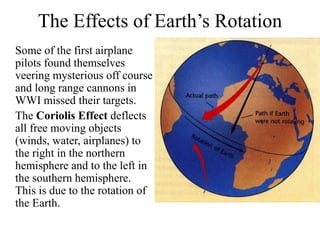
The Effects of Earth’s Rotation
Some of the first airplane
pilots found themselves
veering mysterious off course
and long range cannons in
WWI missed their targets.
The Coriolis Effect deflects
all free moving objects
(winds, water, airplanes) to
the right in the northern
hemisphere and to the left in
the southern hemisphere.
This is due to the rotation of
the Earth.
The Rate of Earth’s Rotation
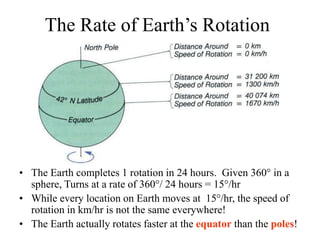
• The Earth completes 1 rotation in 24 hours. Given 360 in a
sphere, Turns at a rate of 360/ 24 hours = 15/hr
• While every location on Earth moves at 15/hr, the speed of
rotation in km/hr is not the same everywhere!
• The Earth actually rotates faster at the equator than the poles!
Earth’s Revolution Around the Sun
The movement of Earth in its orbit around the sun is called
revolution.
Evidence for Earth’s Revolution
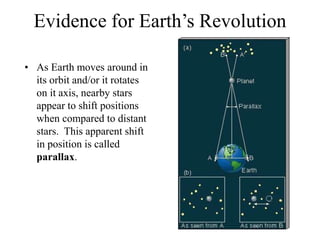
• As Earth moves around in
its orbit and/or it rotates
on it axis, nearby stars
appear to shift positions
when compared to distant
stars. This apparent shift
in position is called
parallax.
Path and Rate of Earth’s Revolution
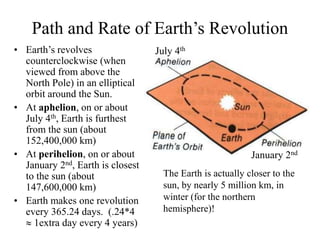
• Earth’s revolves
counterclockwise (when
viewed from above the
North Pole) in an elliptical
orbit around the Sun.
• At aphelion, on or about
July 4th, Earth is furthest
from the sun (about
152,400,000 km)
• At perihelion, on or about
January 2nd, Earth is closest
to the sun (about
147,600,000 km)
• Earth makes one revolution
every 365.24 days. (.24*4
 1extra day every 4 years)
January 2nd
July 4th
The Earth is actually closer to the
sun, by nearly 5 million km, in
winter (for the northern
hemisphere)!
The “Dome” of the Sky
• On the imaginary dome of the sky, the horizon is the rim of the
dome and the zenith is the point straight overhead.
• The altitude of the sun is the vertical angle between the
horizon and the sun.
The 3 Basic Causes of Seasons
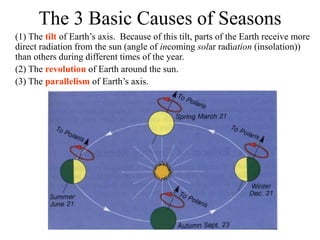
(1) The tilt of Earth’s axis. Because of this tilt, parts of the Earth receive more
direct radiation from the sun (angle of incoming solar radiation (insolation))
than others during different times of the year.
(2) The revolution of Earth around the sun.
(3) The parallelism of Earth’s axis.
Summer Solstice
• On June 21st, the Sun is
directly overhead at the
Tropic of Cancer (23.5° N).
• The number of daylight
hours for the northern
hemisphere is at its
maximum and the sun does
not set in the region within
the arctic circle.
• What season is it in the
southern hemisphere?
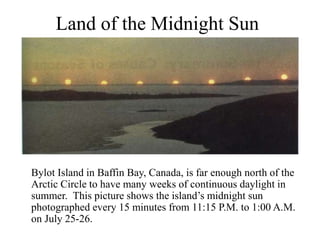
Land of the Midnight Sun
Bylot Island in Baffin Bay, Canada, is far enough north of the
Arctic Circle to have many weeks of continuous daylight in
summer. This picture shows the island’s midnight sun
photographed every 15 minutes from 11:15 P.M. to 1:00 A.M.
on July 25-26.
Winter Solstice
• On December 21st, the sun
is directly overhead at the
Tropic of Capricorn (23.5°
S).
• The sun has reached its
lowest altitude in the
northern hemisphere sky
and the number of
daylight hours is at its
minimum.
• On this date, the sun never
rises within the Arctic
Circle and never sets
within the Antarctic
Circle.
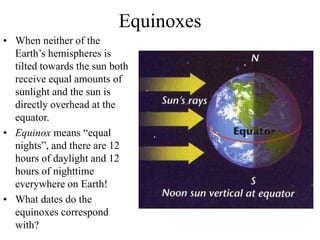
Equinoxes
• When neither of the
Earth’s hemispheres is
tilted towards the sun both
receive equal amounts of
sunlight and the sun is
directly overhead at the
equator.
• Equinox means “equal
nights”, and there are 12
hours of daylight and 12
hours of nighttime
everywhere on Earth!
• What dates do the
equinoxes correspond
with?
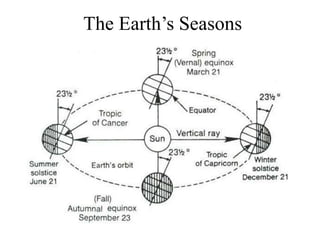
The Earth’s Seasons
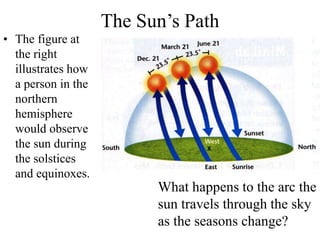
The Sun’s Path
• The figure at
the right
illustrates how
a person in the
northern
hemisphere
would observe
the sun during
the solstices
and equinoxes.
What happens to the arc the
sun travels through the sky
as the seasons change?
6  -earth_s_motions

6 -earth_s_motions

  • 1.
    The Earth’s Rotation,Revolution Around the Sun, and the Seasons
  • 2.
    Earth’s Rotation • Earthspins around on an imaginary axis– This is called rotation. • The axis of rotation is an imaginary straight line through Earth Between the North and South Poles. • The axis is currently inclined at 23.5 from the plane of Earth’s orbit.
  • 3.
    Earth’s Cycle ofPrecession • Like a spinning top that rotates rapidly on its own axis while that axis slowly revolves about the vertical, Earth's axis changes its direction over the course of time; This is called precession. • During a complete cycle of precession, which takes about 26,000 years, Earth's axis traces out a cone. Earth's axis currently points nearly toward the star Polaris. Some 12,000 years from now—nearly half-way through one cycle of precession—Earth's axis will point toward a star called Vega, which will then be the "North Star." Five thousand years ago, the North Star was a star named Thuban in the constellation Draco.
  • 4.
    Parallelism of Earth’sAxis Throughout the year, Earth’s axis has always the same tilt and points in the same direction. This parallelism of the axis is important in the change of seasons and in the length of daylight and night.
  • 5.
    Evidence for Earth’sRotation It is quite obvious from the motion of the sun, moon, and stars across the sky that the Earth rotates, but how do we know it is not them that rotate around us? The French physicist Jean Foucault provided proof of Earth’s rotation in Paris in 1851. He built a pendulum 60 meters high out of steel wire and a cannon ball and set it in motion in a north-south direction. What do you think happened?
  • 6.
    The Effects ofEarth’s Rotation Some of the first airplane pilots found themselves veering mysterious off course and long range cannons in WWI missed their targets. The Coriolis Effect deflects all free moving objects (winds, water, airplanes) to the right in the northern hemisphere and to the left in the southern hemisphere. This is due to the rotation of the Earth.
  • 7.
    The Rate ofEarth’s Rotation • The Earth completes 1 rotation in 24 hours. Given 360 in a sphere, Turns at a rate of 360/ 24 hours = 15/hr • While every location on Earth moves at 15/hr, the speed of rotation in km/hr is not the same everywhere! • The Earth actually rotates faster at the equator than the poles!
  • 8.
    Earth’s Revolution Aroundthe Sun The movement of Earth in its orbit around the sun is called revolution.
  • 9.
    Evidence for Earth’sRevolution • As Earth moves around in its orbit and/or it rotates on it axis, nearby stars appear to shift positions when compared to distant stars. This apparent shift in position is called parallax.
  • 10.
    Path and Rateof Earth’s Revolution • Earth’s revolves counterclockwise (when viewed from above the North Pole) in an elliptical orbit around the Sun. • At aphelion, on or about July 4th, Earth is furthest from the sun (about 152,400,000 km) • At perihelion, on or about January 2nd, Earth is closest to the sun (about 147,600,000 km) • Earth makes one revolution every 365.24 days. (.24*4  1extra day every 4 years) January 2nd July 4th The Earth is actually closer to the sun, by nearly 5 million km, in winter (for the northern hemisphere)!
  • 11.
    The “Dome” ofthe Sky • On the imaginary dome of the sky, the horizon is the rim of the dome and the zenith is the point straight overhead. • The altitude of the sun is the vertical angle between the horizon and the sun.
  • 12.
    The 3 BasicCauses of Seasons (1) The tilt of Earth’s axis. Because of this tilt, parts of the Earth receive more direct radiation from the sun (angle of incoming solar radiation (insolation)) than others during different times of the year. (2) The revolution of Earth around the sun. (3) The parallelism of Earth’s axis.
  • 13.
    Summer Solstice • OnJune 21st, the Sun is directly overhead at the Tropic of Cancer (23.5° N). • The number of daylight hours for the northern hemisphere is at its maximum and the sun does not set in the region within the arctic circle. • What season is it in the southern hemisphere?
  • 14.
    Land of theMidnight Sun Bylot Island in Baffin Bay, Canada, is far enough north of the Arctic Circle to have many weeks of continuous daylight in summer. This picture shows the island’s midnight sun photographed every 15 minutes from 11:15 P.M. to 1:00 A.M. on July 25-26.
  • 15.
    Winter Solstice • OnDecember 21st, the sun is directly overhead at the Tropic of Capricorn (23.5° S). • The sun has reached its lowest altitude in the northern hemisphere sky and the number of daylight hours is at its minimum. • On this date, the sun never rises within the Arctic Circle and never sets within the Antarctic Circle.
  • 16.
    Equinoxes • When neitherof the Earth’s hemispheres is tilted towards the sun both receive equal amounts of sunlight and the sun is directly overhead at the equator. • Equinox means “equal nights”, and there are 12 hours of daylight and 12 hours of nighttime everywhere on Earth! • What dates do the equinoxes correspond with?
  • 17.
  • 18.
    The Sun’s Path •The figure at the right illustrates how a person in the northern hemisphere would observe the sun during the solstices and equinoxes. What happens to the arc the sun travels through the sky as the seasons change?