PRESENTED BY
Manish Sharma

Here we deals with a few case studies in which the applications of the
most common retrofitting schemes are employed to improve the
efficiency and proficiency of either the seismically deficient vulnerable
buildings or earthquake damaged buildings. Since we have a
considerable dearth of experience and experimental data on the
behaviour and response of retrofitted structures, the case studies
presented here are based on the experience obtained by others.
Incidentally, two major earthquakes of March 14 and Sep 19, 1979 hit
a large no. of reinforced concrete buildings in Mexico, some of them
were retrofitted whose efficacy came to be actually judged by the
reoccurrence of an earthquake in the same region in 1985.Similarly
experience has been initially obtained from Turkey earthquake, 1988
in which a large no of buildings were damaged and retrofitted. This
proved to be a good learning opportunity about the behaviour of the
retrofitted structures.
Some of the studies referred here are based on advanced
technological devices like base isolation and supplemental dampers.
INTRODUCTION

METHODS
(i) Qualitative methods (ii) Analytical methods
QUALITATIVE METHODS:
based on the background information available of the
building and its construction site, such as.
– Architectural and structural drawings.
– Past performance of similar buildings under severe
earthquakes.
– Visual inspection report.
– Some non‐destructive test results.
METHODOLOGY FOR SEISMIC RETROFITTING OF RC
BUILDINGS

ANALYTICAL METHODS:
Based on the consideration of the capacity and ductility of
buildings on the basis of available drawings.
 METHODS
– Capacity/Demand(C /D) method.
– Screening method.
– Pushover analysis.
– Nonlinear inelastic analysis etc.
METHODOLOGY FOR SEISMIC RETROFITTING OF RC
BUILDINGS

CASE STUDIES

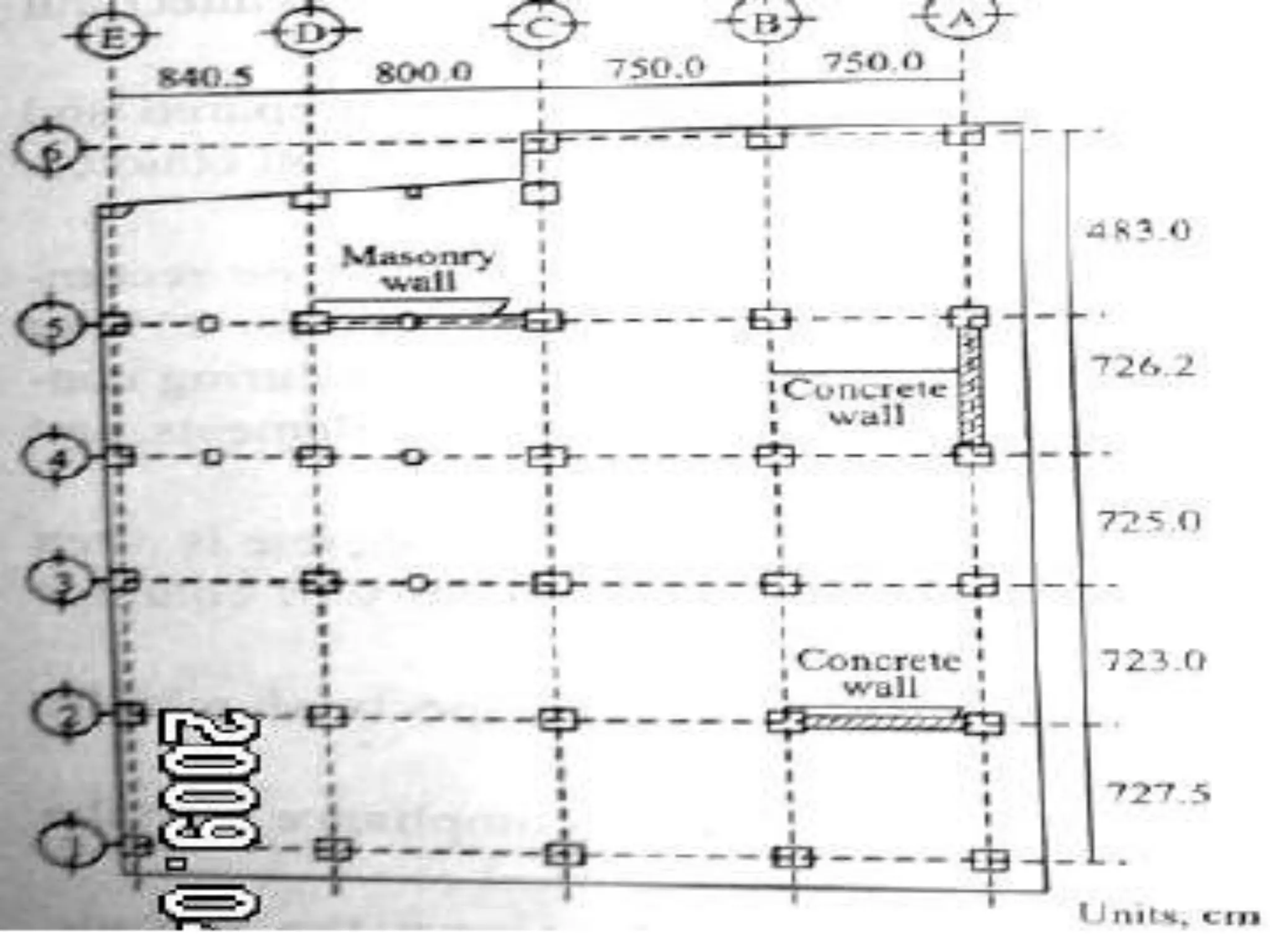
Typical Features of the Building
●Number of Stories – eight stories with basement
●Lateral load resisting system – reinforced concrete frames
●Floor system – two way slab with beams
●Foundation – grid foundation with retaining walls around the
Perimeter.
Features of Damages in Mexico Earthquake, 1979
●Minor cracks in beams and columns
Retrofitting Techniques Employed after Mexico Earthquake, 1979
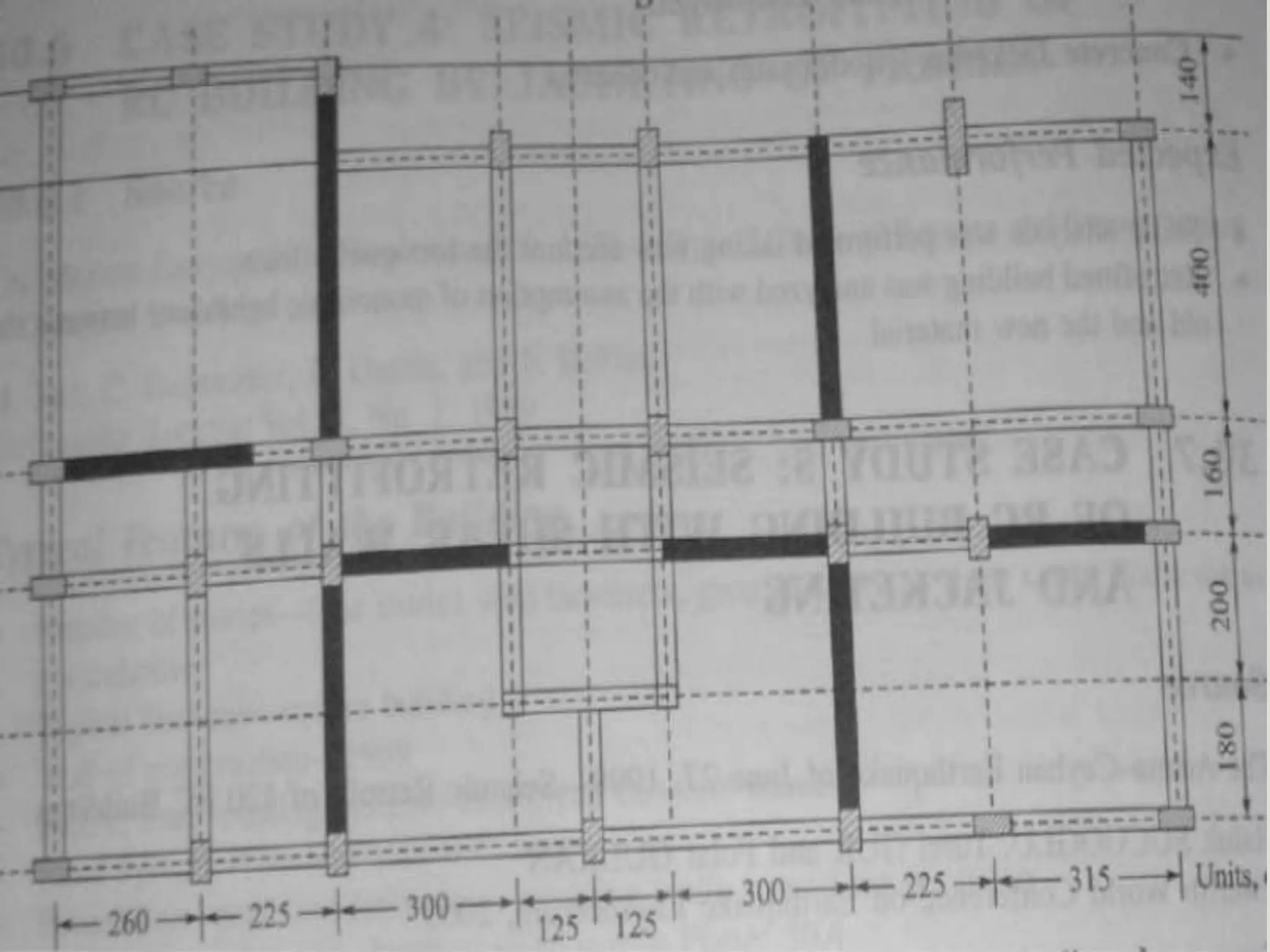
● Addition of concrete shear wall in axis 2 and A.
● Addition of masonry wall in axis 5.
CASE STUDY 1: SEISMIC RETROFITTING OF RC BUILDING WITH
JACKETING AND SHEAR WALLS


• Spalling of the concrete cover and buckled bar at the interface
of the walls and beam‐column joints
• Main reinforcement in the columns located at the ground floor
buckled and crushing of the concrete core occurred.
• Most damaged columns were the columns adjacent to the
added walls.
BEHAVIOUR OF RETROFITTED BUILDING IN MEXICO
EARTHQUAKE, 1985

Minor cracks – Repaired by injecting epoxy resins
Buckled longitudinal reinforcement, broken ties and crushed concrete –
Replacement of new reinforcement welded with the existing bars and new
closed ties were placed.
Severely damaged columns adjacent to added walls – Retrofitted with
encasing in concrete with longitudinal and transverse reinforcements. The
surface was cleaned and moistened before the new concrete was placed.
Other columns – Retrofitted with wire mesh
Damaged concrete wall added – Demolished and replaced with new
concrete Walls with 200 mm in thickness.
RETROFITTING TECHNIQUES EMPLOYED AFTER MEXICO
EARTHQUAKE, 1985

Walls with slight damage –injecting epoxy resins and by
increasing their thickness to 200 mm
Added new walls along the axis 2, 5, 6, E and A
Foundation – The foundation grid was encased to permit the
anchorage to the new longitudinal reinforcement.
Expected Performance
Static and dynamic analysis was performed on the original
undamaged building, match to the distribution of the damage
observed accordingly.

Typical Features of the Building
●Number of stories – twelve
●Lateral load resisting systems – non‐ductile reinforced concrete frames
●Floor system – cast ‐in‐ place concrete joist beam construction with 2.5‐inch
slab
●Foundation system – mat foundation (2.4 m thick) on concrete friction piles
Features of Damages in Mexico Earthquake, 1979
●Extensive damage to first four stories in transverse direction
●The spandrel beams and columns in Frame 1 and 5 experienced diagonal
cracking over much of their length in the first floor.
●The medium column in the fourth storey of Frame 3 suffered cracking and
crushing
●The foundation performed well
CASE STUDY 2: SEISMIC RETROFITTING OF RC BUILDING
WITH BRACING AND SHEAR WALL

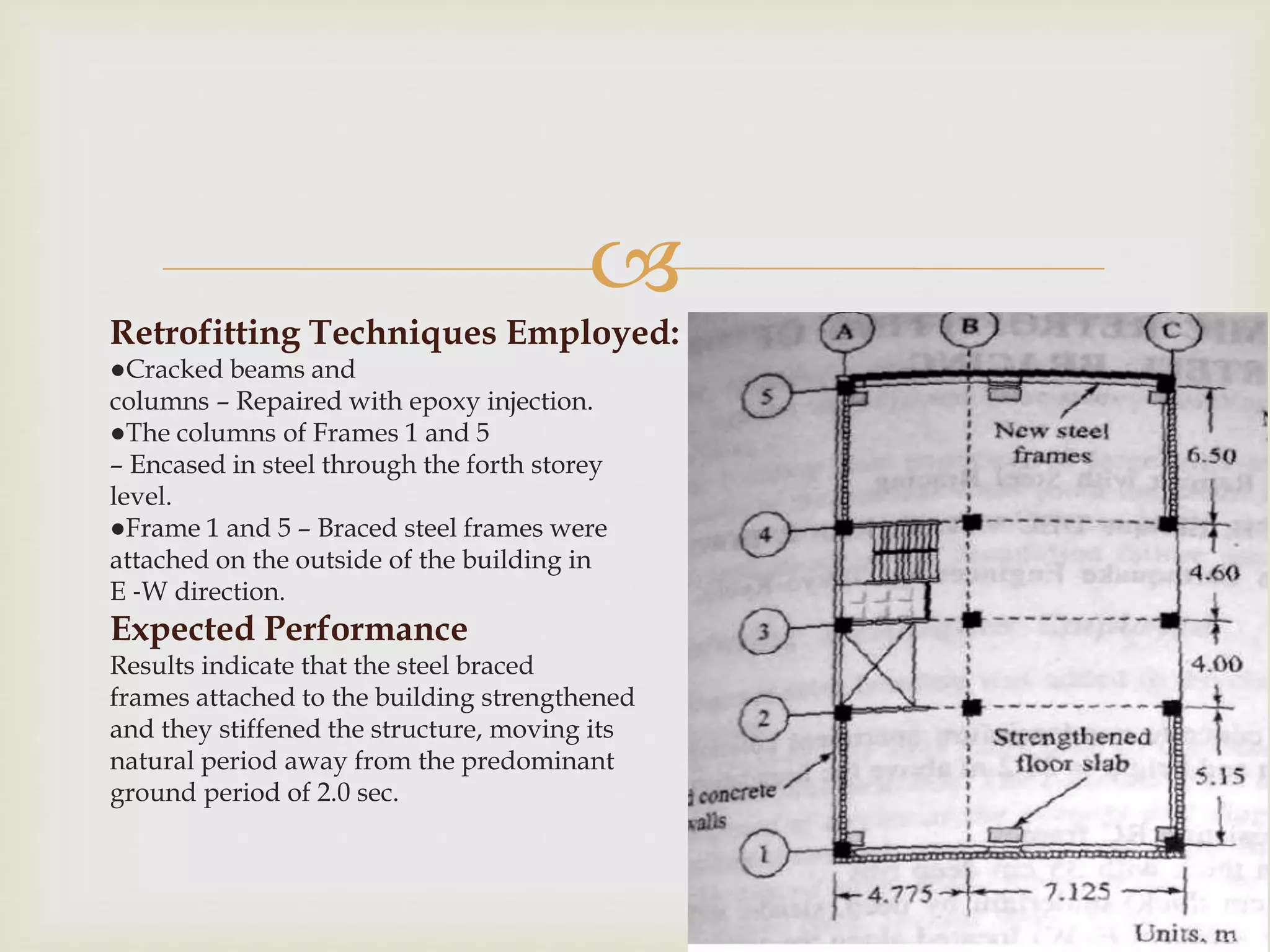
Retrofitting Techniques Employed:
●Cracked beams and
columns – Repaired with epoxy injection.
●The columns of Frames 1 and 5
– Encased in steel through the forth storey
level.
●Frame 1 and 5 – Braced steel frames were
attached on the outside of the building in
E ‐W direction.
Expected Performance
Results indicate that the steel braced
frames attached to the building strengthened
and they stiffened the structure, moving its
natural period away from the predominant
ground period of 2.0 sec.

Typical Features of the Building
●Number of stories –12‐storey reinforced concrete apartment building
●Lateral load resisting systems – moment resisting RC frames
●Floor system – waffle slab 5 cm thick with 35 cm deep ribs
●Foundation system – mat foundation (15 cm thick) underlain by deep,
slender stiffening beams (140 cm x 40 cm N‐S and 140 cm x 30 cm E ‐W)
located along the column lines.
CASE STUDY 3: SEISMIC RETROFITTING OF RC
BUILDING WITH STEEL BRACING

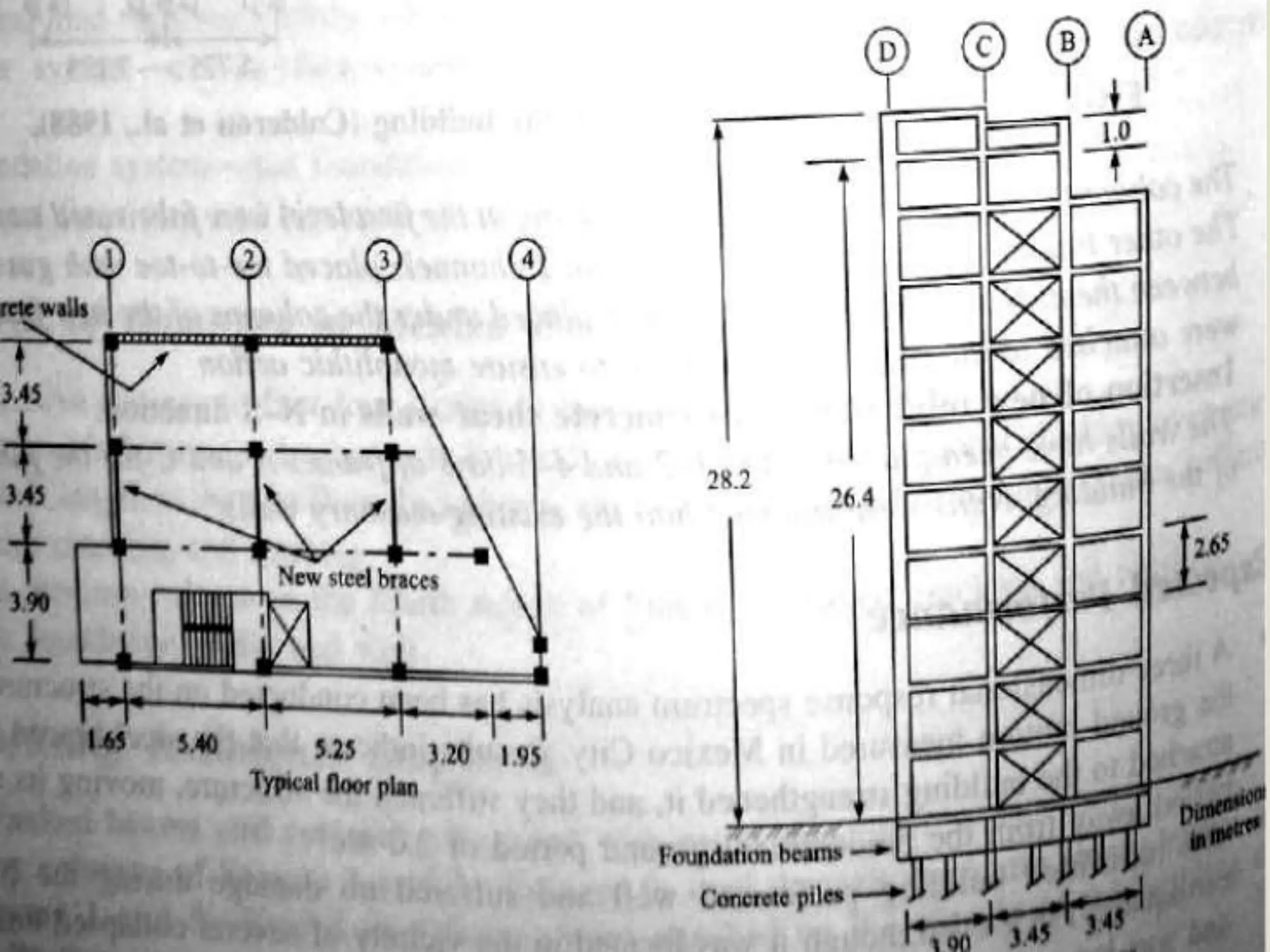
Features of Damages to Mexico Earthquake, 1979
●The building suffered extensive damage at the fourth storey columns
due to pounding against an adjacent four ‐storey building located
approximately 5 cm north of this building.
●The building also experienced large inter ‐storey deformations of its
frame, resulting in damage to the exterior walls (both longitudinal and
transverse).The longitudinal and transverse partition walls were badly
cracked at several levels.
●No indications of the foundation failure were observed.

Retrofitting Techniques Employed:
●Diagonal steel bracing was added to the central bay of
frames 1, 2 and 3 in the transverse direction
●Insertion of new reinforced concrete infill walls of 4 cm thickness
to all bays of the exterior longitudinal frames.
Expected Performance:
●The retrofitted building performed well and it suffered only
minor structural damage during the 1985 Mexico earthquake, even
though the intensity of shaking was much greater than in 1979.


Typical Features of the Building
●Number of stories – four stories with basement, ground floor and
three upper floors
●Year of construction – 1959
●Lateral load resisting system – reinforced concrete frames.
●Floor system – two – way slab with beam.
●Foundation – mat foundation with retaining walls around the
perimeter
CASE STUDY 4: SEISMIC RETROFITTING OF RC BUILDING
BY JACKETING OF FRAMES

Features of Damages in Mexico
Earthquake, 1985
●Severe damage at second floor level columns
●Damage consists of cracks more than 1 mm in width, loss of
material and bars buckled.
●The facade walls suffered extensive cracking
●Short column effect

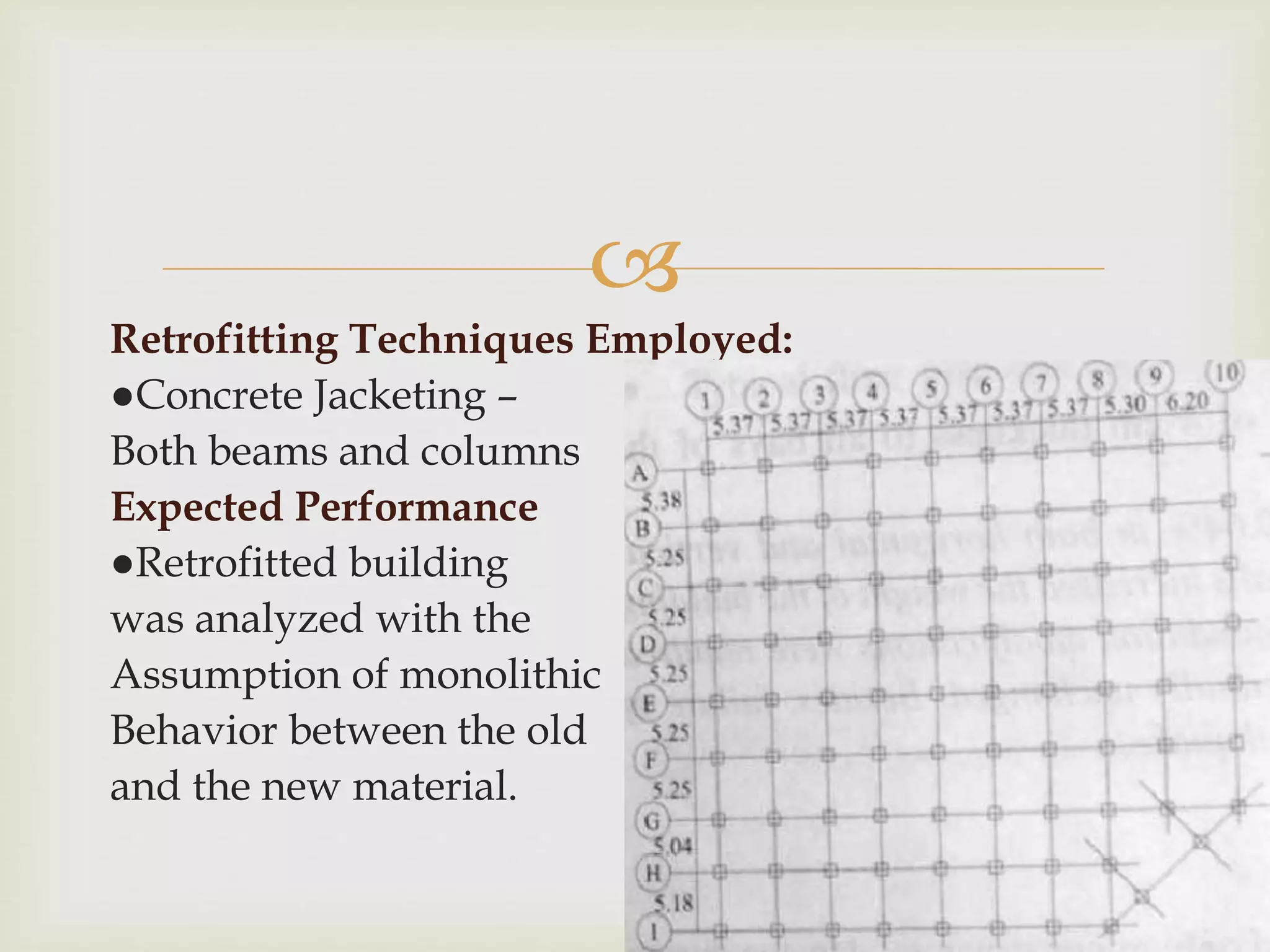
Retrofitting Techniques Employed:
●Concrete Jacketing –
Both beams and columns
Expected Performance
●Retrofitted building
was analyzed with the
Assumption of monolithic
Behavior between the old
and the new material.

Typical Features of the Building
●Number of stories – Eight ‐storey reinforced concrete apartment
building
●Building dimension – floor area 245 m² and storey height is 3.0 m
above the foundation level, including penthouse
●Design and construction – 1984
●Lateral load resisting systems – moment resisting RC frames. A
structural wall around the elevator
●Floor system – concrete slabs in the stories.
●Foundation system – strip foundation in both the direction.
CASE STUDY 5: SEISMIC RETROFITTING OF RC BUILDING
WITH SHEAR WALLS AND JACKETING

Features of Damages in Adana – Ceyhan (Turkey)
Earthquake, 1998
●Building under moderate damage category.
●Extensive damage was observed in beams especially
between the first and fifth floors.
Retrofitting Techniques Employed:
●Damaged columns or columns lacking required vertical load
carrying capacity are jacketed. Where feasible, use of composite
reinforced polymer fabric is recommended.
●Infilling of appropriate frame bays by in situ reinforced concrete
Shear walls with proper anchorage to the existing frame.

Expected Performance
● After adding the shear walls, vibration periods have
reduced.
●Naturally, the reduction in natural vibration periods
after seismic retrofit is due to increase in the stiffness of
buildings.


THANK YOU FOR YOUR ATTENTION

Retrofitting case study of RCC structure

  • 1.
  • 2.
     Here we dealswith a few case studies in which the applications of the most common retrofitting schemes are employed to improve the efficiency and proficiency of either the seismically deficient vulnerable buildings or earthquake damaged buildings. Since we have a considerable dearth of experience and experimental data on the behaviour and response of retrofitted structures, the case studies presented here are based on the experience obtained by others. Incidentally, two major earthquakes of March 14 and Sep 19, 1979 hit a large no. of reinforced concrete buildings in Mexico, some of them were retrofitted whose efficacy came to be actually judged by the reoccurrence of an earthquake in the same region in 1985.Similarly experience has been initially obtained from Turkey earthquake, 1988 in which a large no of buildings were damaged and retrofitted. This proved to be a good learning opportunity about the behaviour of the retrofitted structures. Some of the studies referred here are based on advanced technological devices like base isolation and supplemental dampers. INTRODUCTION
  • 3.
     METHODS (i) Qualitative methods(ii) Analytical methods QUALITATIVE METHODS: based on the background information available of the building and its construction site, such as. – Architectural and structural drawings. – Past performance of similar buildings under severe earthquakes. – Visual inspection report. – Some non‐destructive test results. METHODOLOGY FOR SEISMIC RETROFITTING OF RC BUILDINGS
  • 4.
     ANALYTICAL METHODS: Based onthe consideration of the capacity and ductility of buildings on the basis of available drawings.  METHODS – Capacity/Demand(C /D) method. – Screening method. – Pushover analysis. – Nonlinear inelastic analysis etc. METHODOLOGY FOR SEISMIC RETROFITTING OF RC BUILDINGS
  • 5.
  • 6.
     Typical Features ofthe Building ●Number of Stories – eight stories with basement ●Lateral load resisting system – reinforced concrete frames ●Floor system – two way slab with beams ●Foundation – grid foundation with retaining walls around the Perimeter. Features of Damages in Mexico Earthquake, 1979 ●Minor cracks in beams and columns Retrofitting Techniques Employed after Mexico Earthquake, 1979 ● Addition of concrete shear wall in axis 2 and A. ● Addition of masonry wall in axis 5. CASE STUDY 1: SEISMIC RETROFITTING OF RC BUILDING WITH JACKETING AND SHEAR WALLS
  • 7.
  • 8.
     • Spalling ofthe concrete cover and buckled bar at the interface of the walls and beam‐column joints • Main reinforcement in the columns located at the ground floor buckled and crushing of the concrete core occurred. • Most damaged columns were the columns adjacent to the added walls. BEHAVIOUR OF RETROFITTED BUILDING IN MEXICO EARTHQUAKE, 1985
  • 9.
     Minor cracks –Repaired by injecting epoxy resins Buckled longitudinal reinforcement, broken ties and crushed concrete – Replacement of new reinforcement welded with the existing bars and new closed ties were placed. Severely damaged columns adjacent to added walls – Retrofitted with encasing in concrete with longitudinal and transverse reinforcements. The surface was cleaned and moistened before the new concrete was placed. Other columns – Retrofitted with wire mesh Damaged concrete wall added – Demolished and replaced with new concrete Walls with 200 mm in thickness. RETROFITTING TECHNIQUES EMPLOYED AFTER MEXICO EARTHQUAKE, 1985
  • 10.
     Walls with slightdamage –injecting epoxy resins and by increasing their thickness to 200 mm Added new walls along the axis 2, 5, 6, E and A Foundation – The foundation grid was encased to permit the anchorage to the new longitudinal reinforcement. Expected Performance Static and dynamic analysis was performed on the original undamaged building, match to the distribution of the damage observed accordingly.
  • 11.
     Typical Features ofthe Building ●Number of stories – twelve ●Lateral load resisting systems – non‐ductile reinforced concrete frames ●Floor system – cast ‐in‐ place concrete joist beam construction with 2.5‐inch slab ●Foundation system – mat foundation (2.4 m thick) on concrete friction piles Features of Damages in Mexico Earthquake, 1979 ●Extensive damage to first four stories in transverse direction ●The spandrel beams and columns in Frame 1 and 5 experienced diagonal cracking over much of their length in the first floor. ●The medium column in the fourth storey of Frame 3 suffered cracking and crushing ●The foundation performed well CASE STUDY 2: SEISMIC RETROFITTING OF RC BUILDING WITH BRACING AND SHEAR WALL
  • 12.
     Retrofitting Techniques Employed: ●Crackedbeams and columns – Repaired with epoxy injection. ●The columns of Frames 1 and 5 – Encased in steel through the forth storey level. ●Frame 1 and 5 – Braced steel frames were attached on the outside of the building in E ‐W direction. Expected Performance Results indicate that the steel braced frames attached to the building strengthened and they stiffened the structure, moving its natural period away from the predominant ground period of 2.0 sec.
  • 13.
     Typical Features ofthe Building ●Number of stories –12‐storey reinforced concrete apartment building ●Lateral load resisting systems – moment resisting RC frames ●Floor system – waffle slab 5 cm thick with 35 cm deep ribs ●Foundation system – mat foundation (15 cm thick) underlain by deep, slender stiffening beams (140 cm x 40 cm N‐S and 140 cm x 30 cm E ‐W) located along the column lines. CASE STUDY 3: SEISMIC RETROFITTING OF RC BUILDING WITH STEEL BRACING
  • 14.
     Features of Damagesto Mexico Earthquake, 1979 ●The building suffered extensive damage at the fourth storey columns due to pounding against an adjacent four ‐storey building located approximately 5 cm north of this building. ●The building also experienced large inter ‐storey deformations of its frame, resulting in damage to the exterior walls (both longitudinal and transverse).The longitudinal and transverse partition walls were badly cracked at several levels. ●No indications of the foundation failure were observed.
  • 15.
     Retrofitting Techniques Employed: ●Diagonalsteel bracing was added to the central bay of frames 1, 2 and 3 in the transverse direction ●Insertion of new reinforced concrete infill walls of 4 cm thickness to all bays of the exterior longitudinal frames. Expected Performance: ●The retrofitted building performed well and it suffered only minor structural damage during the 1985 Mexico earthquake, even though the intensity of shaking was much greater than in 1979.
  • 16.
  • 17.
     Typical Features ofthe Building ●Number of stories – four stories with basement, ground floor and three upper floors ●Year of construction – 1959 ●Lateral load resisting system – reinforced concrete frames. ●Floor system – two – way slab with beam. ●Foundation – mat foundation with retaining walls around the perimeter CASE STUDY 4: SEISMIC RETROFITTING OF RC BUILDING BY JACKETING OF FRAMES
  • 18.
     Features of Damagesin Mexico Earthquake, 1985 ●Severe damage at second floor level columns ●Damage consists of cracks more than 1 mm in width, loss of material and bars buckled. ●The facade walls suffered extensive cracking ●Short column effect
  • 19.
     Retrofitting Techniques Employed: ●ConcreteJacketing – Both beams and columns Expected Performance ●Retrofitted building was analyzed with the Assumption of monolithic Behavior between the old and the new material.
  • 20.
     Typical Features ofthe Building ●Number of stories – Eight ‐storey reinforced concrete apartment building ●Building dimension – floor area 245 m² and storey height is 3.0 m above the foundation level, including penthouse ●Design and construction – 1984 ●Lateral load resisting systems – moment resisting RC frames. A structural wall around the elevator ●Floor system – concrete slabs in the stories. ●Foundation system – strip foundation in both the direction. CASE STUDY 5: SEISMIC RETROFITTING OF RC BUILDING WITH SHEAR WALLS AND JACKETING
  • 21.
     Features of Damagesin Adana – Ceyhan (Turkey) Earthquake, 1998 ●Building under moderate damage category. ●Extensive damage was observed in beams especially between the first and fifth floors. Retrofitting Techniques Employed: ●Damaged columns or columns lacking required vertical load carrying capacity are jacketed. Where feasible, use of composite reinforced polymer fabric is recommended. ●Infilling of appropriate frame bays by in situ reinforced concrete Shear walls with proper anchorage to the existing frame.
  • 22.
     Expected Performance ● Afteradding the shear walls, vibration periods have reduced. ●Naturally, the reduction in natural vibration periods after seismic retrofit is due to increase in the stiffness of buildings.
  • 23.
  • 24.
     THANK YOU FORYOUR ATTENTION