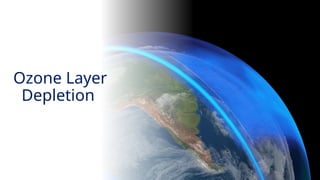
Ozone Layer
Depletion
Introduction to Ozone Layer
Ozone Layer: A
protective layer of gas
in the Earth’s
stratosphere, mainly
composed of ozone
(O₃), that absorbs most
of the sun's harmful
ultraviolet (UV)
radiation.
01
Location: Located in
the lower part of the
stratosphere, around
15 to 35 km above the
Earth’s surface.
02
Importance: Protects
life on Earth by
preventing excessive
amounts of UV-B
radiation, which can
cause skin cancer,
cataracts, and harm
ecosystems.
03
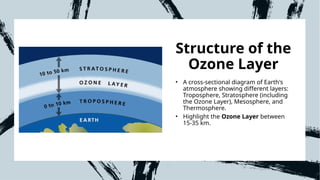
Structure of the
Ozone Layer
• A cross-sectional diagram of Earth's
atmosphere showing different layers:
Troposphere, Stratosphere (including
the Ozone Layer), Mesosphere, and
Thermosphere.
• Highlight the Ozone Layer between
15-35 km.
Discovery of Ozone
Ozone was first discovered by Christian Friedrich Schönbein in 1839. He noticed
a distinct smell (from which the name ozone, derived from the Greek word
"ozein" meaning "to smell," was inspired) during experiments involving electrical
discharges in oxygen.
Schönbein’s work laid the foundation for understanding ozone's role in the
atmosphere.
In 1913, Charles Fabry and Henri Buisson, two French physicists, discovered the
ozone layer in the Earth's stratosphere using UV spectroscopy.
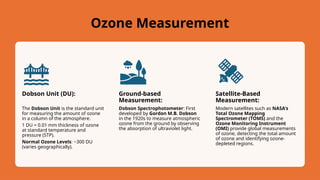
Ozone Measurement
Dobson Unit (DU):
The Dobson Unit is the standard unit
for measuring the amount of ozone
in a column of the atmosphere.
1 DU = 0.01 mm thickness of ozone
at standard temperature and
pressure (STP).
Normal Ozone Levels: ~300 DU
(varies geographically).
Ground-based
Measurement:
Dobson Spectrophotometer: First
developed by Gordon M.B. Dobson
in the 1920s to measure atmospheric
ozone from the ground by observing
the absorption of ultraviolet light.
Satellite-Based
Measurement:
Modern satellites such as NASA's
Total Ozone Mapping
Spectrometer (TOMS) and the
Ozone Monitoring Instrument
(OMI) provide global measurements
of ozone, detecting the total amount
of ozone and identifying ozone-
depleted regions.
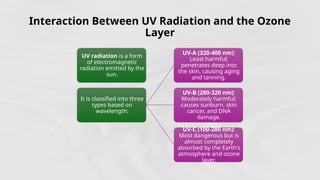
Interaction Between UV Radiation and the Ozone
Layer
UV radiation is a form
of electromagnetic
radiation emitted by the
sun.
It is classified into three
types based on
wavelength:
UV-A (320-400 nm):
Least harmful;
penetrates deep into
the skin, causing aging
and tanning.
UV-B (280-320 nm):
Moderately harmful;
causes sunburn, skin
cancer, and DNA
damage.
UV-C (100-280 nm):
Most dangerous but is
almost completely
absorbed by the Earth's
atmosphere and ozone
layer.
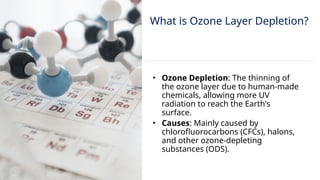
• Ozone Depletion: The thinning of
the ozone layer due to human-made
chemicals, allowing more UV
radiation to reach the Earth's
surface.
• Causes: Mainly caused by
chlorofluorocarbons (CFCs), halons,
and other ozone-depleting
substances (ODS).
What is Ozone Layer Depletion?
Ozone
Layer
Depletion
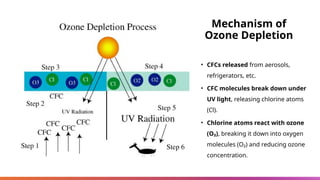
Mechanism of
Ozone Depletion
• CFCs released from aerosols,
refrigerators, etc.
• CFC molecules break down under
UV light, releasing chlorine atoms
(Cl).
• Chlorine atoms react with ozone
(O₃), breaking it down into oxygen
molecules (O₂) and reducing ozone
concentration.
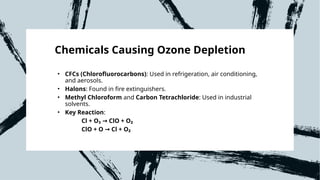
• CFCs (Chlorofluorocarbons): Used in refrigeration, air conditioning,
and aerosols.
• Halons: Found in fire extinguishers.
• Methyl Chloroform and Carbon Tetrachloride: Used in industrial
solvents.
• Key Reaction:
Cl + O₃ ClO + O₂
→
ClO + O Cl + O₂
→
Chemicals Causing Ozone Depletion
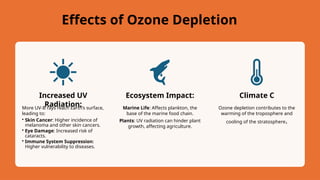
Effects of Ozone Depletion
Increased UV
Radiation:
More UV-B rays reach Earth’s surface,
leading to:
• Skin Cancer: Higher incidence of
melanoma and other skin cancers.
• Eye Damage: Increased risk of
cataracts.
• Immune System Suppression:
Higher vulnerability to diseases.
Ecosystem Impact:
Marine Life: Affects plankton, the
base of the marine food chain.
Plants: UV radiation can hinder plant
growth, affecting agriculture.
Climate C
Ozone depletion contributes to the
warming of the troposphere and
cooling of the stratosphere.
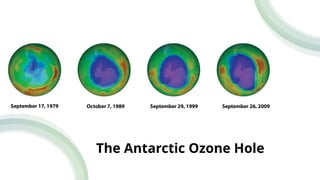
The Antarctic Ozone Hole
Global Response to Ozone Depletion
Montreal Protocol (1987): A global agreement to phase out the
production and consumption of ozone-depleting substances (ODS).
Success: CFC levels have decreased, and signs of ozone recovery have
been observed.
Key Achievements:
Banning major ODS like CFCs, halons.
99% reduction in ODS production globally.
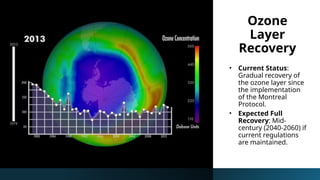
Ozone
Layer
Recovery
• Current Status:
Gradual recovery of
the ozone layer since
the implementation
of the Montreal
Protocol.
• Expected Full
Recovery: Mid-
century (2040-2060) if
current regulations
are maintained.
Avoid Products
Using ODS:
Ensure the use of
products that are
labeled “CFC-free.”
01
Support Policies:
Encourage
adherence to
international
protocols like the
Montreal Protocol.
02
Raise Awareness:
Educate others
about the
importance of
protecting the
ozone layer.
03
What Can We Do?

Ozone layer depletion causes and consequences

  • 1.
  • 2.
    Introduction to OzoneLayer Ozone Layer: A protective layer of gas in the Earth’s stratosphere, mainly composed of ozone (O₃), that absorbs most of the sun's harmful ultraviolet (UV) radiation. 01 Location: Located in the lower part of the stratosphere, around 15 to 35 km above the Earth’s surface. 02 Importance: Protects life on Earth by preventing excessive amounts of UV-B radiation, which can cause skin cancer, cataracts, and harm ecosystems. 03
  • 3.
    Structure of the OzoneLayer • A cross-sectional diagram of Earth's atmosphere showing different layers: Troposphere, Stratosphere (including the Ozone Layer), Mesosphere, and Thermosphere. • Highlight the Ozone Layer between 15-35 km.
  • 4.
    Discovery of Ozone Ozonewas first discovered by Christian Friedrich Schönbein in 1839. He noticed a distinct smell (from which the name ozone, derived from the Greek word "ozein" meaning "to smell," was inspired) during experiments involving electrical discharges in oxygen. Schönbein’s work laid the foundation for understanding ozone's role in the atmosphere. In 1913, Charles Fabry and Henri Buisson, two French physicists, discovered the ozone layer in the Earth's stratosphere using UV spectroscopy.
  • 5.
    Ozone Measurement Dobson Unit(DU): The Dobson Unit is the standard unit for measuring the amount of ozone in a column of the atmosphere. 1 DU = 0.01 mm thickness of ozone at standard temperature and pressure (STP). Normal Ozone Levels: ~300 DU (varies geographically). Ground-based Measurement: Dobson Spectrophotometer: First developed by Gordon M.B. Dobson in the 1920s to measure atmospheric ozone from the ground by observing the absorption of ultraviolet light. Satellite-Based Measurement: Modern satellites such as NASA's Total Ozone Mapping Spectrometer (TOMS) and the Ozone Monitoring Instrument (OMI) provide global measurements of ozone, detecting the total amount of ozone and identifying ozone- depleted regions.
  • 6.
    Interaction Between UVRadiation and the Ozone Layer UV radiation is a form of electromagnetic radiation emitted by the sun. It is classified into three types based on wavelength: UV-A (320-400 nm): Least harmful; penetrates deep into the skin, causing aging and tanning. UV-B (280-320 nm): Moderately harmful; causes sunburn, skin cancer, and DNA damage. UV-C (100-280 nm): Most dangerous but is almost completely absorbed by the Earth's atmosphere and ozone layer.
  • 7.
    • Ozone Depletion:The thinning of the ozone layer due to human-made chemicals, allowing more UV radiation to reach the Earth's surface. • Causes: Mainly caused by chlorofluorocarbons (CFCs), halons, and other ozone-depleting substances (ODS). What is Ozone Layer Depletion?
  • 8.
  • 9.
    Mechanism of Ozone Depletion •CFCs released from aerosols, refrigerators, etc. • CFC molecules break down under UV light, releasing chlorine atoms (Cl). • Chlorine atoms react with ozone (O₃), breaking it down into oxygen molecules (O₂) and reducing ozone concentration.
  • 10.
    • CFCs (Chlorofluorocarbons):Used in refrigeration, air conditioning, and aerosols. • Halons: Found in fire extinguishers. • Methyl Chloroform and Carbon Tetrachloride: Used in industrial solvents. • Key Reaction: Cl + O₃ ClO + O₂ → ClO + O Cl + O₂ → Chemicals Causing Ozone Depletion
  • 11.
    Effects of OzoneDepletion Increased UV Radiation: More UV-B rays reach Earth’s surface, leading to: • Skin Cancer: Higher incidence of melanoma and other skin cancers. • Eye Damage: Increased risk of cataracts. • Immune System Suppression: Higher vulnerability to diseases. Ecosystem Impact: Marine Life: Affects plankton, the base of the marine food chain. Plants: UV radiation can hinder plant growth, affecting agriculture. Climate C Ozone depletion contributes to the warming of the troposphere and cooling of the stratosphere.
  • 12.
  • 13.
    Global Response toOzone Depletion Montreal Protocol (1987): A global agreement to phase out the production and consumption of ozone-depleting substances (ODS). Success: CFC levels have decreased, and signs of ozone recovery have been observed. Key Achievements: Banning major ODS like CFCs, halons. 99% reduction in ODS production globally.
  • 14.
    Ozone Layer Recovery • Current Status: Gradualrecovery of the ozone layer since the implementation of the Montreal Protocol. • Expected Full Recovery: Mid- century (2040-2060) if current regulations are maintained.
  • 15.
    Avoid Products Using ODS: Ensurethe use of products that are labeled “CFC-free.” 01 Support Policies: Encourage adherence to international protocols like the Montreal Protocol. 02 Raise Awareness: Educate others about the importance of protecting the ozone layer. 03 What Can We Do?