Planetary Motion, Eclipses, Tides, & Phases of the Moon
   Rotation – the spinning of a body (an object)
    on its axis
   Orbit – the path that a body takes as it travels
    around another body
   Revolution – one complete trip around an
    orbit.
   Johannes Kepler – ancient astronomer that
    studied how planets move.
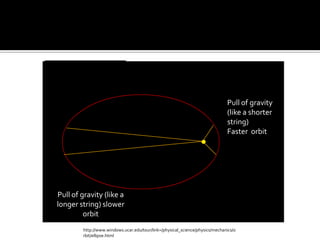
     1st Law – planets do not move in a circle; they
     move in an elongated circle called an ellipse.
     2nd Law – planets move faster when they are
      closer to the sun.
     3rd Law – planets that are farther from the sun take
      longer to orbit the sun
Pull of gravity
                                                                              (like a shorter
                                                                              string)
                                                                              Faster orbit


Pull of gravity (like a
longer string) slower
         orbit
        http://www.windows.ucar.edu/tour/link=/physical_science/physics/mechanics/o
        rbit/ellipse.html
   What allows planets close to the sun to move
    faster and also to keep bodies (like the moon)
    in orbit? Gravity
   24 hours – the time required for Earth to
    rotate once on its axis
     It takes 23 hours & 56 minutes.
     Axis – the imaginary line that runs from the North
     Pole to the South Pole
      ▪ Earth is tilted at 23.5
     Earth spins in which direction?
     Counterclockwise. Therefore the sun rises in
     the east and sets in the west.
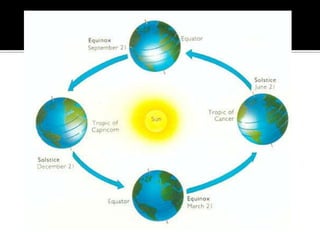
 Seasons are caused by Earth’s tilt and its rotation
  around the sun.
 Equinox – occurs when the sun is directly above the
  equator. The number of daytime hours and
  nighttime hours are equal.
   Vernal equinox – March 21st is the beginning of spring.
   Autumnal equinox – Sept. 23rd is the beginning of Fall.
 Solstice – when the sun is the furthest from the
  equator.
   Summer solstice – beginning of summer – June 22nd
   Winter solstice – beginning of winter – Dec. 22nd
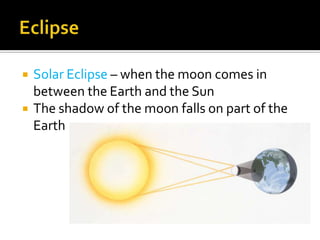
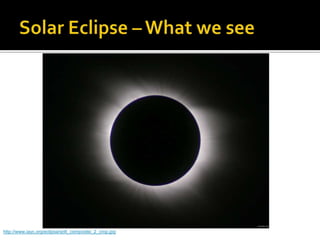
   Solar Eclipse – when the moon comes in
    between the Earth and the Sun
   The shadow of the moon falls on part of the
    Earth
http://www.iayc.org/eclipse/sofi_composite_2_crop.jpg
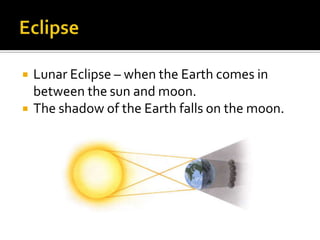
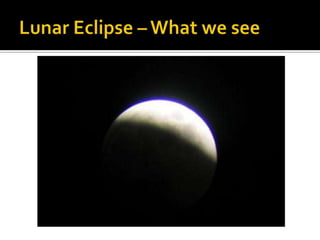
   Lunar Eclipse – when the Earth comes in
    between the sun and moon.
   The shadow of the Earth falls on the moon.
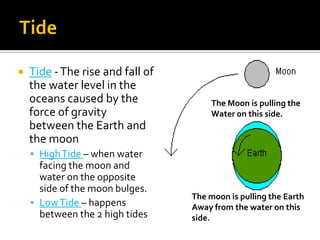
   Tide - The rise and fall of
    the water level in the
    oceans caused by the               The Moon is pulling the
    force of gravity                   Water on this side.
    between the Earth and
    the moon
     High Tide – when water
      facing the moon and
      water on the opposite
      side of the moon bulges.
                                  The moon is pulling the Earth
     Low Tide – happens          Away from the water on this
      between the 2 high tides    side.
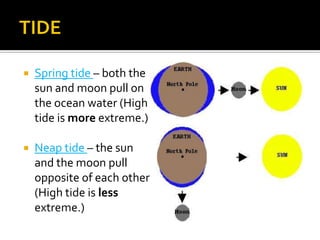
   Spring tide – both the
    sun and moon pull on
    the ocean water (High
    tide is more extreme.)

   Neap tide – the sun
    and the moon pull
    opposite of each other
    (High tide is less
    extreme.)
   Satellite – any natural or man-made object
    that revolves around a planet

   The moon is a satellite of Earth
   Earth only has one satellite.
   Some planets have several, some have none.

   Luna – the name of the Earth’s moon
   Rocks from the moon have been found to be
    4.6 billion years old.
   The moon has no atmosphere, so there is no
    wind & no weather.
   The surface therefore remains unchanged –
    Neil Armstrong’s footprint is still there!
   The moon appears to be the largest object in
    our night sky, but that’s only b/c it’s the
    closest.
   It is only ¼ the size of Earth.
   The sun is 400 times larger than the moon
    even though the sun appears smaller in our
    sky.
   The moon looks bright in the sky, but it does
    not give off its own light. The moon reflects
    light from the sun like a giant mirror.
   We only see the same side of the moon b/c
    the moon rotates on its axis and revolves
    around the Earth at the same speed.
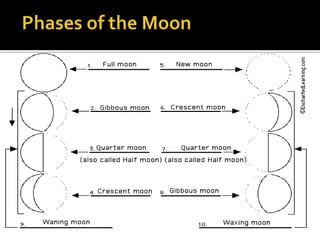
   The Moon seems to change shape as
    different parts of the moon are lit by the sun.
   These are called phases of the moon.


   Demonstration
   Full Moon - when the moon's disk is light
   Gibbous Moon - when we can see roughly ¾ of the
    moon's disk
   Quarter Moon – (half moon) when we can see one half
    of the moon's disk (one-quarter of the entire moon's
    surface)
   Crescent Moon - when we can see only a sliver of the
    moon's disk (the side of the moon facing us)
   New Moon - when the moon's disk is dark (and
    invisible to us)
   Waning Moon - when the moon seems to be getting
    smaller
   Waxing Moon - when the moon seems to be getting
    bigger
Astronomy by jatin
Astronomy by jatin

Astronomy by jatin

  • 1.
    Planetary Motion, Eclipses,Tides, & Phases of the Moon
  • 2.
    Rotation – the spinning of a body (an object) on its axis  Orbit – the path that a body takes as it travels around another body  Revolution – one complete trip around an orbit.
  • 3.
    Johannes Kepler – ancient astronomer that studied how planets move.  1st Law – planets do not move in a circle; they move in an elongated circle called an ellipse.  2nd Law – planets move faster when they are closer to the sun.  3rd Law – planets that are farther from the sun take longer to orbit the sun
  • 4.
    Pull of gravity (like a shorter string) Faster orbit Pull of gravity (like a longer string) slower orbit http://www.windows.ucar.edu/tour/link=/physical_science/physics/mechanics/o rbit/ellipse.html
  • 5.
    What allows planets close to the sun to move faster and also to keep bodies (like the moon) in orbit? Gravity
  • 6.
    24 hours – the time required for Earth to rotate once on its axis  It takes 23 hours & 56 minutes.  Axis – the imaginary line that runs from the North Pole to the South Pole ▪ Earth is tilted at 23.5  Earth spins in which direction? Counterclockwise. Therefore the sun rises in the east and sets in the west.
  • 7.
     Seasons arecaused by Earth’s tilt and its rotation around the sun.  Equinox – occurs when the sun is directly above the equator. The number of daytime hours and nighttime hours are equal.  Vernal equinox – March 21st is the beginning of spring.  Autumnal equinox – Sept. 23rd is the beginning of Fall.  Solstice – when the sun is the furthest from the equator.  Summer solstice – beginning of summer – June 22nd  Winter solstice – beginning of winter – Dec. 22nd
  • 9.
    Solar Eclipse – when the moon comes in between the Earth and the Sun  The shadow of the moon falls on part of the Earth
  • 10.
  • 11.
    Lunar Eclipse – when the Earth comes in between the sun and moon.  The shadow of the Earth falls on the moon.
  • 13.
    Tide - The rise and fall of the water level in the oceans caused by the The Moon is pulling the force of gravity Water on this side. between the Earth and the moon  High Tide – when water facing the moon and water on the opposite side of the moon bulges. The moon is pulling the Earth  Low Tide – happens Away from the water on this between the 2 high tides side.
  • 14.
    Spring tide – both the sun and moon pull on the ocean water (High tide is more extreme.)  Neap tide – the sun and the moon pull opposite of each other (High tide is less extreme.)
  • 15.
    Satellite – any natural or man-made object that revolves around a planet  The moon is a satellite of Earth  Earth only has one satellite.  Some planets have several, some have none.  Luna – the name of the Earth’s moon
  • 16.
    Rocks from the moon have been found to be 4.6 billion years old.  The moon has no atmosphere, so there is no wind & no weather.  The surface therefore remains unchanged – Neil Armstrong’s footprint is still there!  The moon appears to be the largest object in our night sky, but that’s only b/c it’s the closest.
  • 17.
    It is only ¼ the size of Earth.  The sun is 400 times larger than the moon even though the sun appears smaller in our sky.  The moon looks bright in the sky, but it does not give off its own light. The moon reflects light from the sun like a giant mirror.  We only see the same side of the moon b/c the moon rotates on its axis and revolves around the Earth at the same speed.
  • 18.
    The Moon seems to change shape as different parts of the moon are lit by the sun.  These are called phases of the moon.  Demonstration
  • 19.
    Full Moon - when the moon's disk is light  Gibbous Moon - when we can see roughly ¾ of the moon's disk  Quarter Moon – (half moon) when we can see one half of the moon's disk (one-quarter of the entire moon's surface)  Crescent Moon - when we can see only a sliver of the moon's disk (the side of the moon facing us)  New Moon - when the moon's disk is dark (and invisible to us)  Waning Moon - when the moon seems to be getting smaller  Waxing Moon - when the moon seems to be getting bigger