Essential Views of the
Integrated Program
Management Reports
Thomas J.
Coonce
Glen B. Alleman
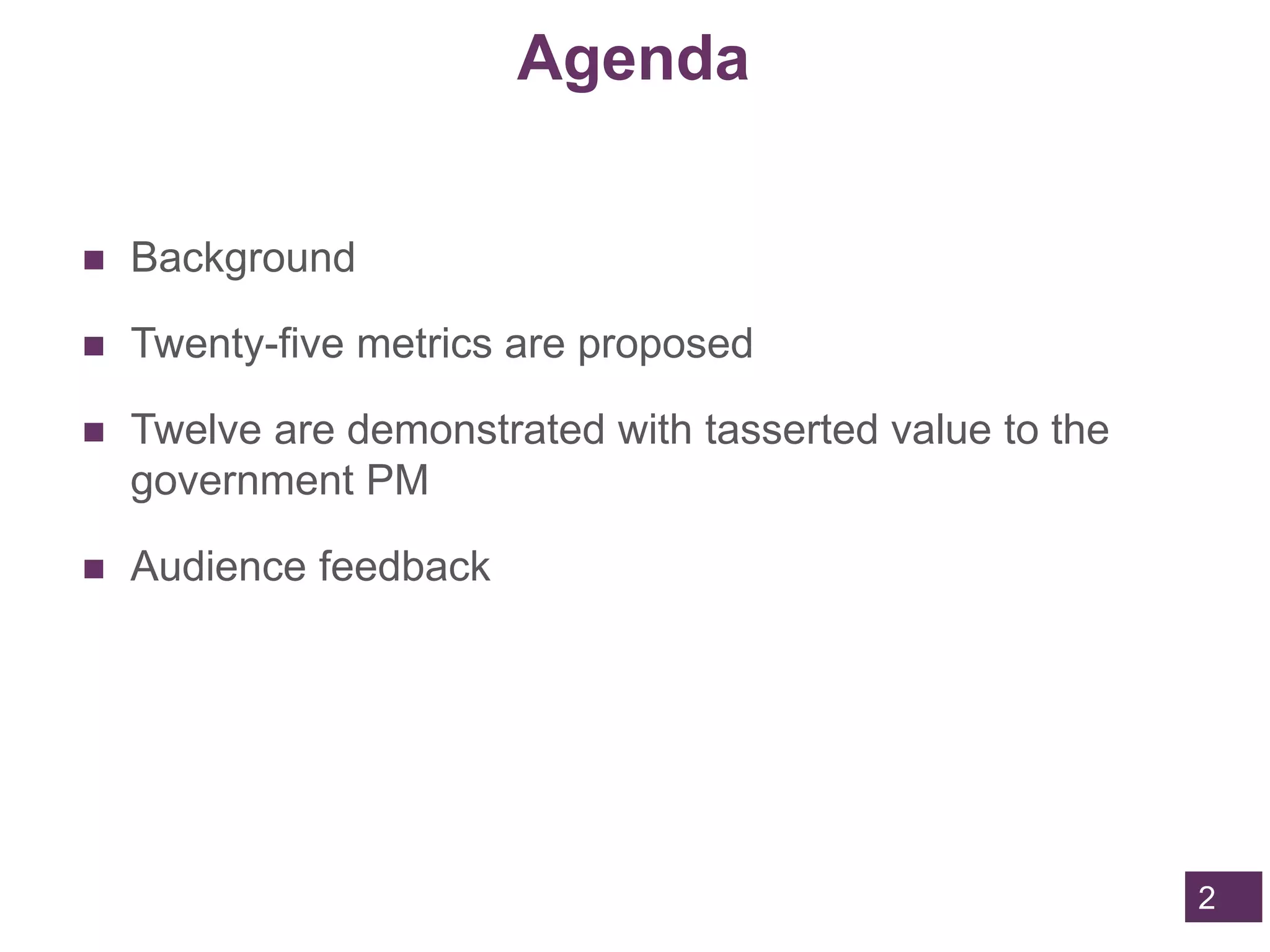
Agenda
 Background
 Twenty-five metrics are proposed
 Twelve are demonstrated with tasserted value to the
government PM
 Audience feedback
2
Background
 When contractually required, DoD acquisition contractors are
obligated to submit IPMRs electronically per Data Item Description
DI-MGMT-81861.
 Government stakeholders must acquire “reader/viewers” of the
data to understand status and help control.
 Several vendors provide multiple metrics/views of these data:
 Some data more useful than others.
 Different users have different interests.
 Easy for the government PM to be overwhelmed"
 Key question is which metric/views are considered “Essential” to
accomplish the stated goal of helping the material developer to
“keep the program green”?
3
Background (Concluded)
 We synthesized research and possible metrics and distilled
them to three fundamental categories
1. Evidence of a credible plan at the outset; one that is based on
technical objectives and deliverables, available staffing and
adjusted for risks
2. Periodic data to ensure that cost and schedule performance are in
line with technical and contract deliverables progress
3. Periodic data (in addition to the technical performance data) that
helps the PM identify current and likely future problem areas so
they can be controlled
 We demonstrate the value of the metrics using a notional
UAV program called the Tactical Situational Awareness
System or TSAS
 Twenty-five metrics/views are proposed; twelve are shown
and discussed in this presentation 4
The Proposed Metrics/Views
5
︎ 1. Key Technical Performance Measures plan(s)
2. Deliverables plan
✔ 3. Summary level of the Integrated Master Schedule (IMS) and proposed
spend plan
4. Labor FTE utilization plan
✔ 5. Schedule health and performance checks
✔ 6. Risk register and mitigation actions
✔ 7. Computation of initial management reserves (MR)
8. Risk burn down plan
✔ 9. Computation of schedule reserves aka margin (SM)
︎
✔
10. TPM plan vs estimated actuals vs cost and schedule performance
metrics (CPI, SPI)
✔ 11. Deliverables plan vs actuals vs CPI, SPI
The Proposed Metrics/Views
6
✔ 12.FTE plan vs actuals
✔ 13.Cumulative BCWS, BCWP, ACWP against IBR spend plan, earned
schedule with percent spent, percent complete, and percent
scheduled (Enhanced Gold Card)
14.Risk burn down plan vs actual
✔ 16.C/S Performance Informed by Risk Burn Down Actuals
17.Schedule heath and schedule performance related data on the “go-
forward” IMS (similar to view # 5)
18.Cumulative BCWS, BCWP, ACWP against IBR spend plan with
Earned Schedule and status dates, percent spent, percent complete,
and percent scheduled (same as # 13)
19.Tornado (or Galaxy) chart that shows the relative percentage of
Budget at Complete to total for any level of WBS
The Proposed Metrics/Views
7
20.Management Reserve usage and balance
21.Sources and uses of MR and Undistributed Budget
22.Updated Risk Register (same as metric/view # 5)
✔ 23.Forecast of EAC and ECD
✔
24.Confidence level of meeting contractor best case, worst case and
most like EACs and ECDs
25.Schedule and cost crucially indices
Periodic Data That Indicates Current and Likely Future Problem Areas
(Concluded)
Six Steps To Creating a Credible PMB
Step` Outcome
❶
Define
WBS
 With SOW, SOO, ConOps, WBS, and other program documents,
develop CWBS of system deliverables and work processes to produce
the program outcomes.
 Develop CWBS Dictionary describing scope of work and Criteria for the
successful delivery of these outcomes.
❷
Build IMP
 Develop Integrated Master Plan (IMP), showing how each system
element in the CWBS moves through the maturation process at each
Program Event.
 Define Measures of Effectiveness (MOE) for each Accomplishment.
 Define Measures of Performance (MOP) for each Criteria.
❸
Identify
Reducible
Risk
 For each key system element in the CWBS, identify reducible risks,
probability of occurrence, mitigation plan, and residual risk in the Risk
Register.
 Risk mitigation activities placed in IMS and PMB to assure probability of
occurrence and probability of impact reduced.
 For risks without mitigation plans, Management Reserve (MR)
(calculated) will be used to handle risk when it becomes an Issue.
8
Step Outcome
❹
Build the IMS
 Arrange Work Packages and Tasks in a logical network of increasing
maturity of the deliverables.
 Define exit criteria for each Work Package to assess planned Physical
Percent Complete to inform BCWP using TPM, MOP, MOE, and Risk
Reduction activities in support of Accomplishments in the IMS.
❺
Adjust for
Irreducible
Risks
 For irreducible risks in the IMS, use Reference Classes for Monte Carlo
Simulation anchored with Most Likely duration to calculate needed
schedule reserve (margin).
 Assign schedule margin tasks in the IMS, to protect the key system
elements, per DI-MGMT-81861 guidance.
❻
Establish PMB
 Using risk adjusted IMS, calculate needed Management Reserve (MR) to
account for the latent risks in the Risk Register.
 With deterministic IMS and its embedded Schedule Reserves and
Management Reserve for latent risk, determine the resulting confidence
level of the PMB.
Six Steps To Creating a Credible PMB
(Concluded)
9
Schedule Health Checks at IBR
10
Value: Provides evidence that the contractor’s initial plan meets quality schedule
standards. Project success is not possible without a quality schedule.
5
Schedule Health Checks at IBR (Concluded)
11
5
The PMB Must Be Adjusted for
Uncertainty
Uncertainty
Reducible Irreducible
Natural Variability
Ambiguity
Known but
un-mitigateable
Probabilistic
Events
Probabilistic
Impacts
Periods of
Exposure
The probability of an
event that we can do
something about
reducing this
probability through
explicit actions.
Statistical range of
natural randomness
characterized by a
historical data and
therefore irreducible
13
Plan at IBR Must Be Adjusted for
Reducible Risks
Value: Showing the Risk Register at the IBR provides evidence that all major risks have been considered and that the
contractor has incorporated plans into the baseline to mitigate those risks. It also provides transparency about risk that
have not been mitigated which can impact the probability of success.
Note Pre and Post Mitigation Risk Scores
14
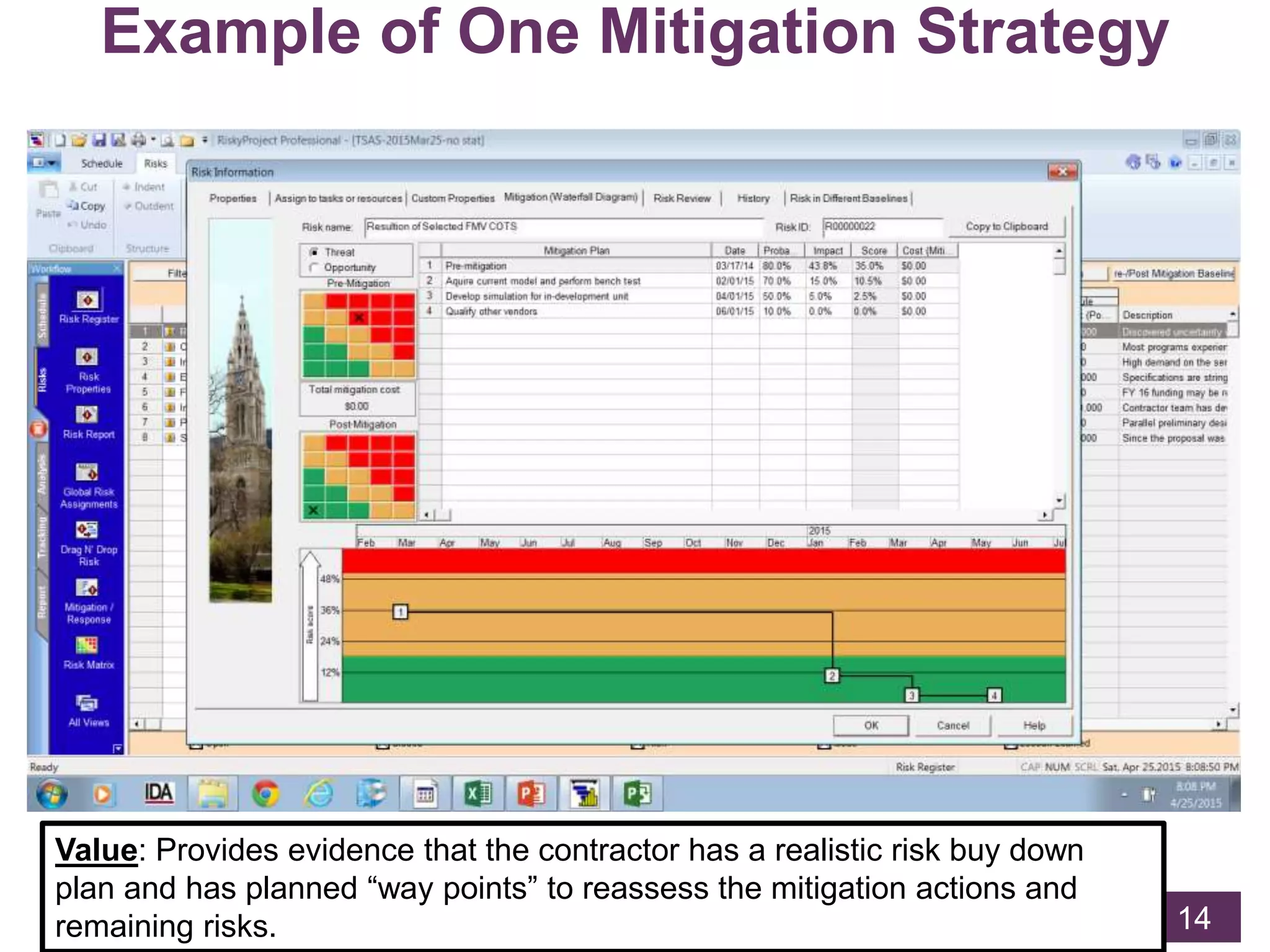
Example of One Mitigation Strategy
14
Value: Provides evidence that the contractor has a realistic risk buy down
plan and has planned “way points” to reassess the mitigation actions and
remaining risks.
Management Reserve Calculation
Principles
 Management reserve (MR) is held for growth within the currently
authorized work scope, for rate changes, and for other program
unknowns. MR is not used to offset accumulated overruns or
underruns and it is not a contingency budget than can be used for
new work or eliminated from the contract price during subsequent
negotiations. The management reserve budget is not included as
part of the Performance Measurement Baseline (PMB).
Source: ACQuipedia
 Operational Definition: Management Reserves (MR) covers in-
scope known reducible risks that were not mitigated. It is for in-
scope work that may or may not materialize.
15
TSAS Monte Carlo Simulation for
Unmitigated Reducible Risks Only
16
7
TSAS Management Reserve Calculation
17
7
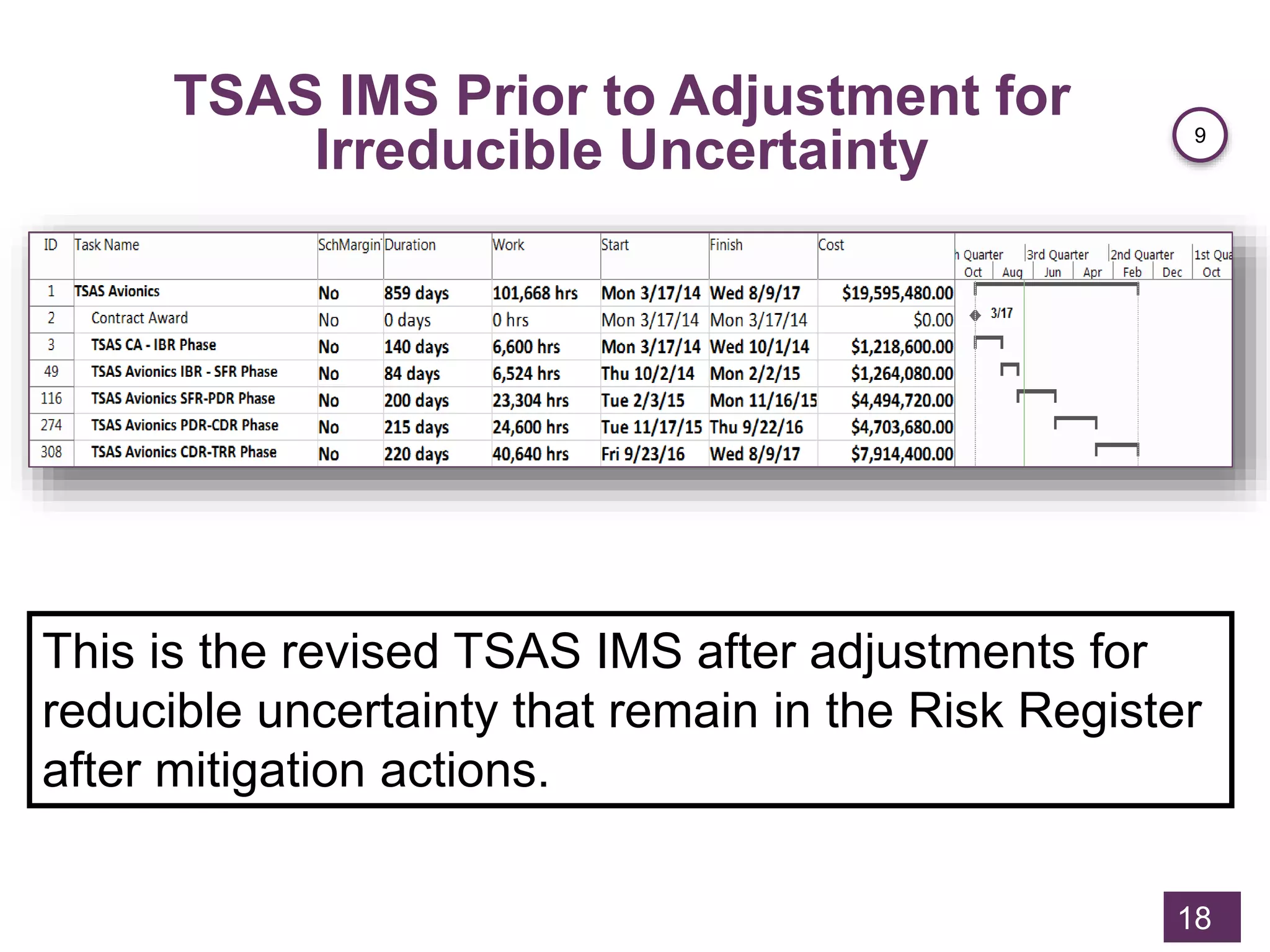
TSAS IMS Prior to Adjustment for
Irreducible Uncertainty
18
This is the revised TSAS IMS after adjustments for
reducible uncertainty that remain in the Risk Register
after mitigation actions.
9
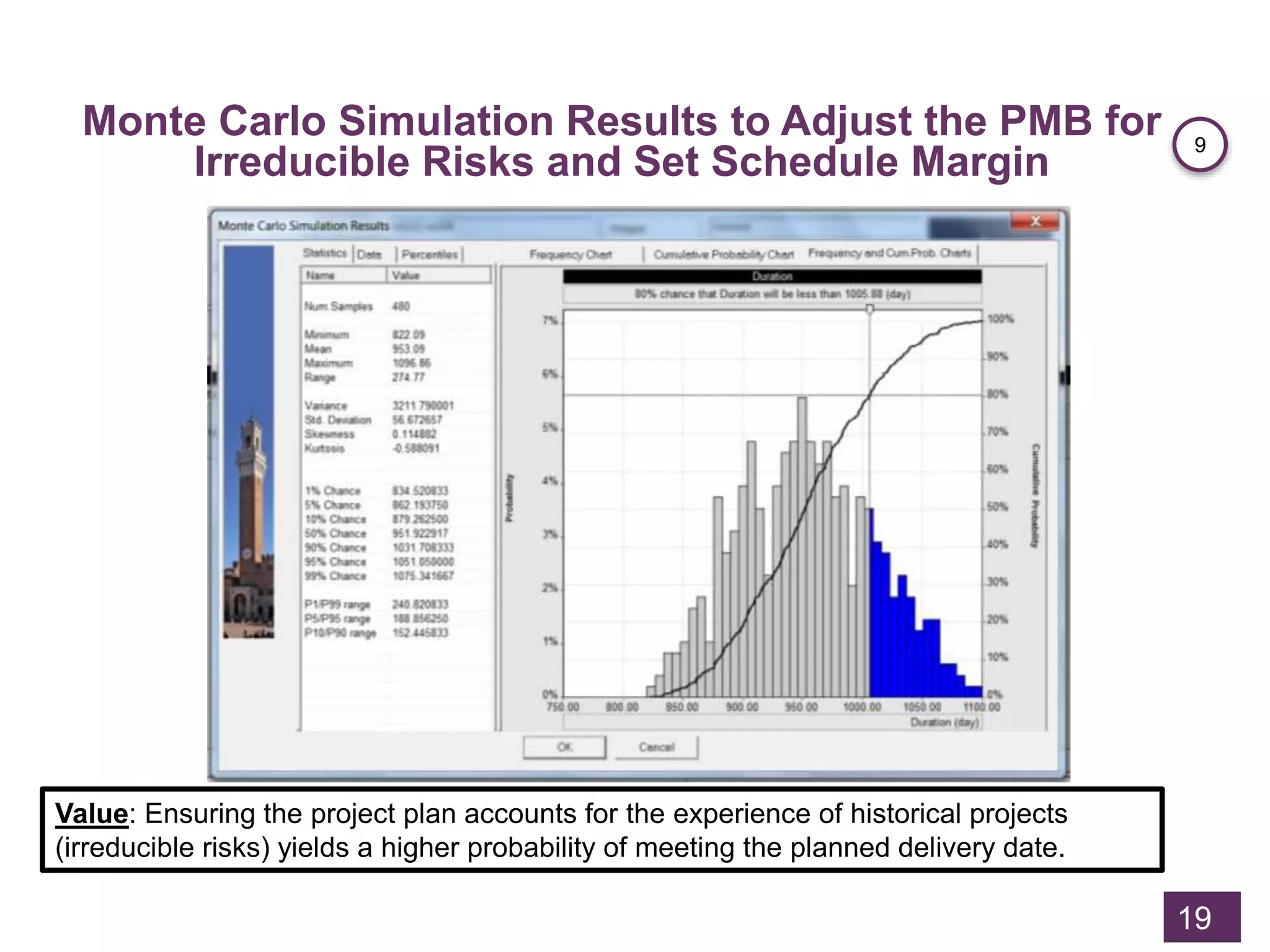
Monte Carlo Simulation Results to Adjust the PMB for
Irreducible Risks and Set Schedule Margin
19
Value: Ensuring the project plan accounts for the experience of historical projects
(irreducible risks) yields a higher probability of meeting the planned delivery date.
9
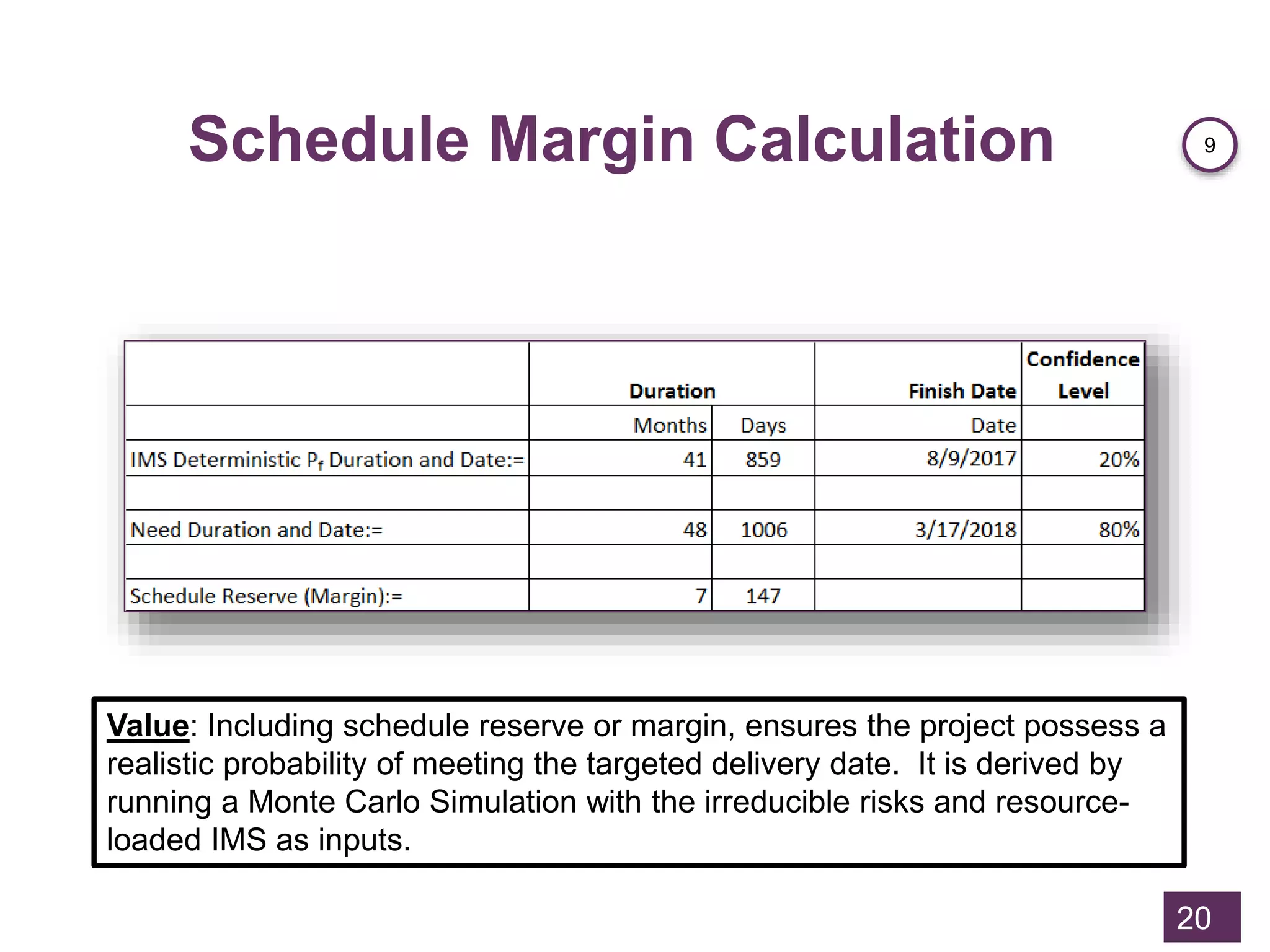
Schedule Margin Calculation
20
Value: Including schedule reserve or margin, ensures the project possess a
realistic probability of meeting the targeted delivery date. It is derived by
running a Monte Carlo Simulation with the irreducible risks and resource-
loaded IMS as inputs.
9
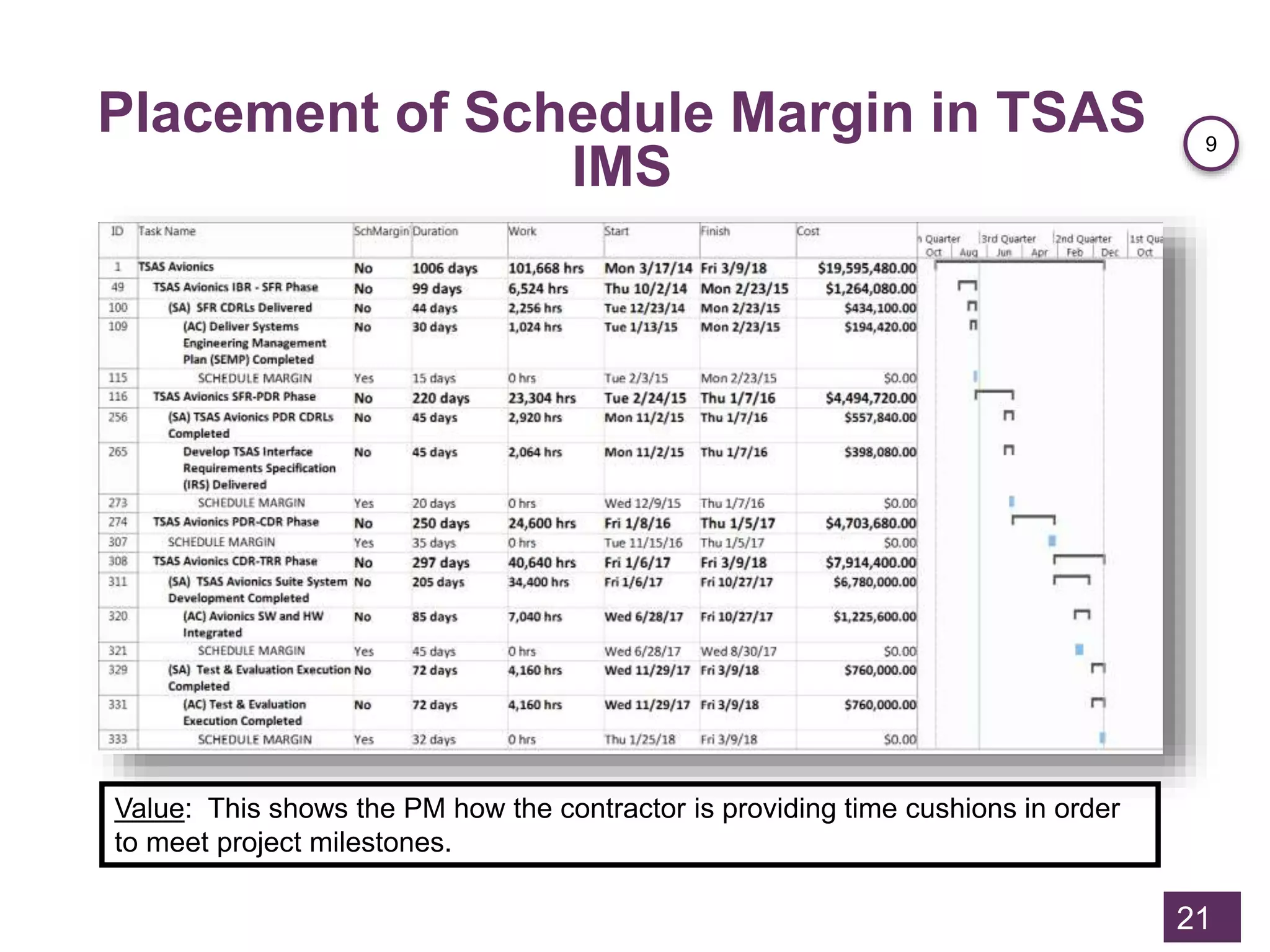
Placement of Schedule Margin in TSAS
IMS
21
Value: This shows the PM how the contractor is providing time cushions in order
to meet project milestones.
9
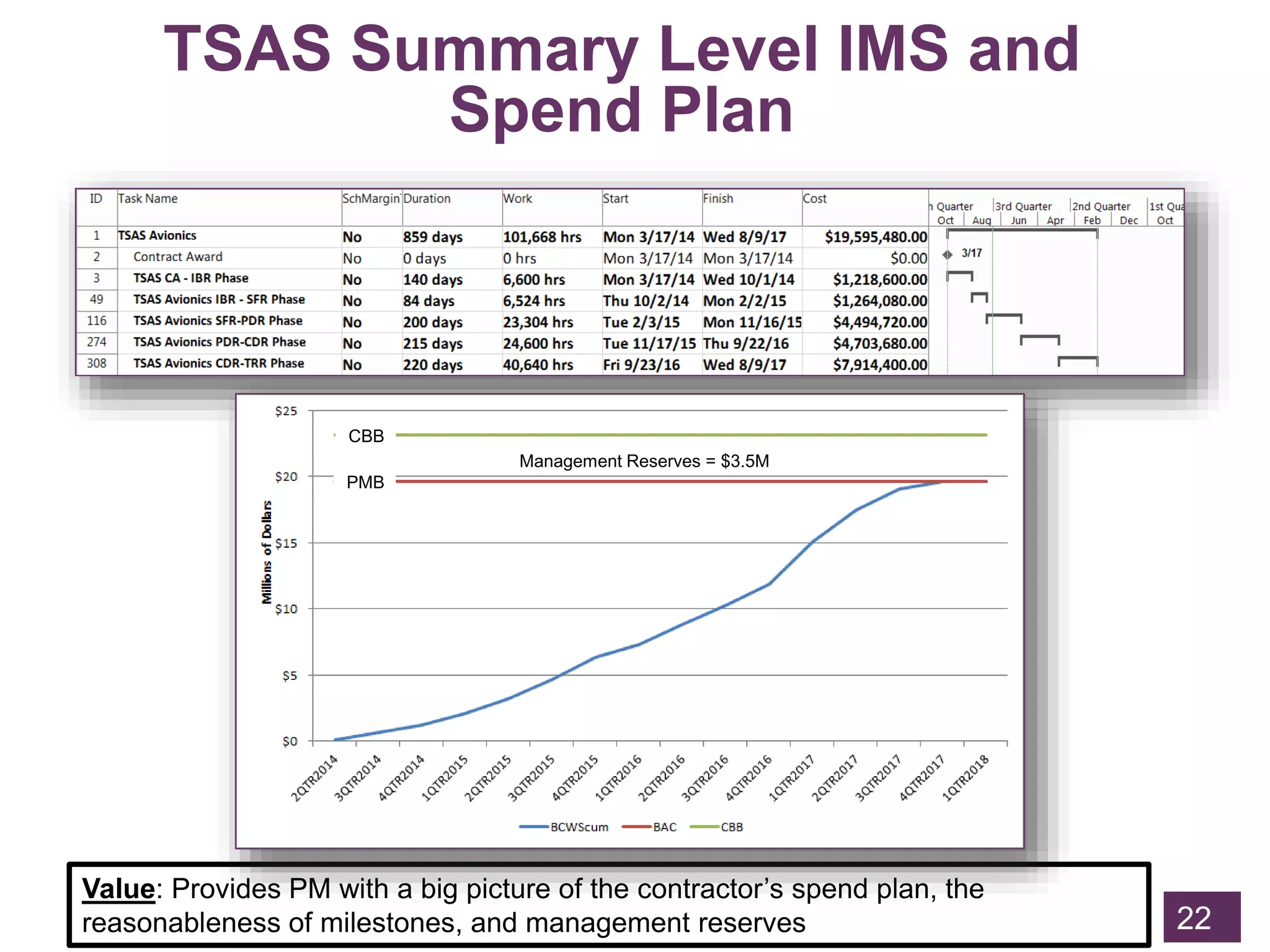
TSAS Summary Level IMS and
Spend Plan
22
Value: Provides PM with a big picture of the contractor’s spend plan, the
reasonableness of milestones, and management reserves
Management Reserves = $3.5M
CBB
PMB
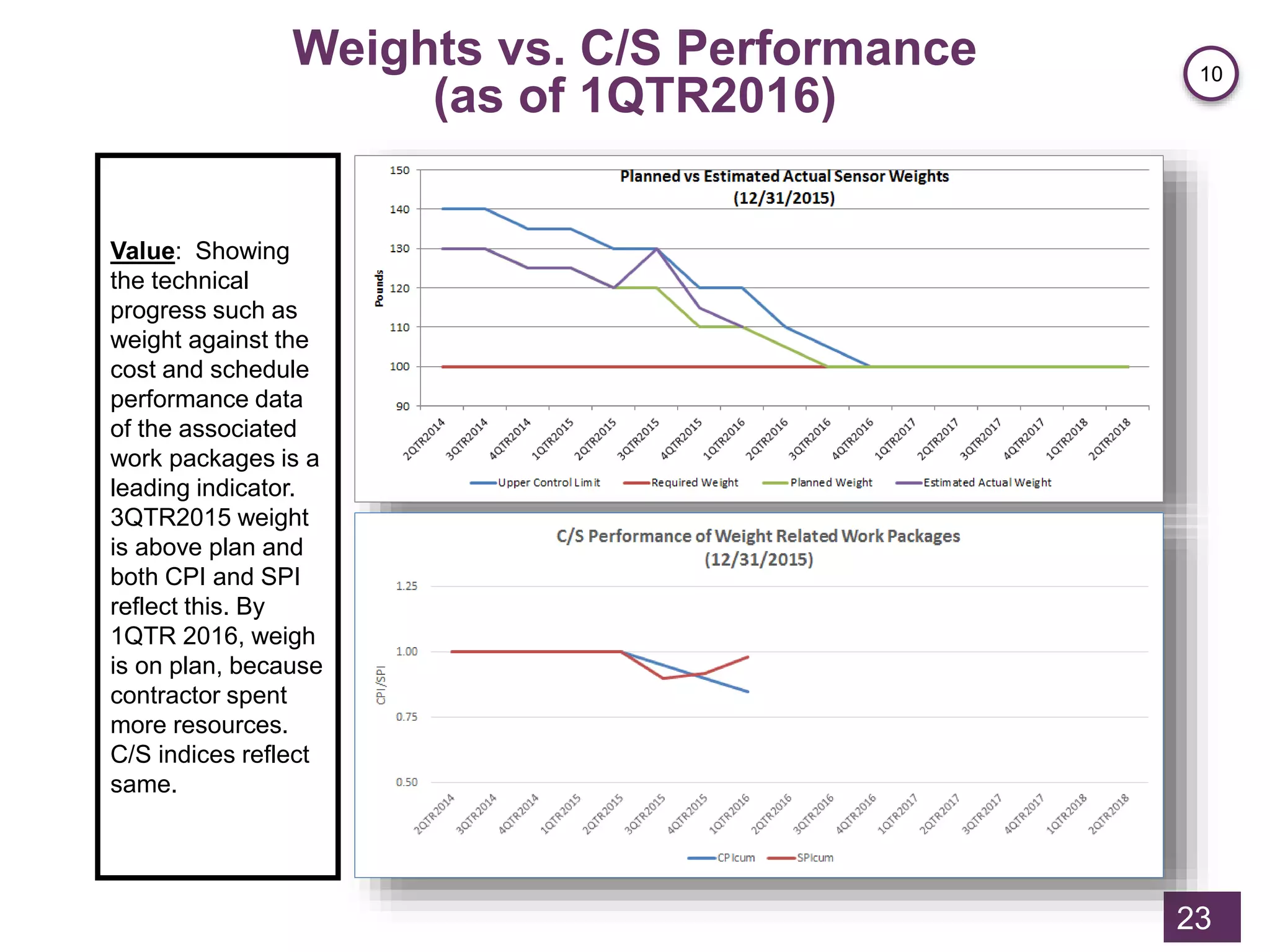
Weights vs. C/S Performance
(as of 1QTR2016)
23
Value: Showing
the technical
progress such as
weight against the
cost and schedule
performance data
of the associated
work packages is a
leading indicator.
3QTR2015 weight
is above plan and
both CPI and SPI
reflect this. By
1QTR 2016, weigh
is on plan, because
contractor spent
more resources.
C/S indices reflect
same.
10
Deliverables and FTEs vs. C/S Performance
(as of 3/31/2015)
24
Value: Showing the deliverables and planned vs
actual personnel helps tell the story of the
negative cost and schedule performance since
labor is usually the largest component of cost.
The contractor is more likely to be meet
technical, cost and schedule objectives if the
right personnel are put on the effort when
planned. These data provide the PM an early
warning signal.
11
12
15
TSAS Full Motion Video (FMV) C/S
Performance Informed by Risk Burn Down
25
Value: Tells PM whether contractor’s mitigation plans were successful and ensures that cost and schedule
performance reflect those actions.
15
Example of Traditional Method of
Forecasting EAC and ECD
26
The Plan: Twelve
month effort for $36K
The Performance at
status date (5/31/2015):
BCWScum = $15K
ACWPcum = $18K
BCWPcum = $12.5K
SPIcum = .833
CPIcum = .694
ES = 124d
SPIt = .824
EAC Forecast: EACcomposite = ACWP + [(BAC-BCWPcum)/(CPIcum × SPIcum)] = $58.6K
ECD Forecast Duration: Status Duration +( PD-ES)/SPIt = 150d + (366-124)/.824 = 444d
ECD Forecast Date: Date Format of (42005+444) = 3/19/2016
Value: Tells PM the final cost and delivery date IF the contractor continues to perform
exactly as it has done in the past (rearward focus). Facilitates problem diagnosis and
discussions with the contractor.
23
Quantification of EACs and ECD From MCS of
Remaining Reducible and Irreducible Risks
27
Value: Tells PM the range of possible final cost and delivery dates and
probabilities of the contractor-stated projected EACs and ECDs based on a
forward focus of the impact of reducible and irreducible remaining risks. Fosters
pro-active management with the contractor.
Best Case
EAC/ECD
Most
Likely
EAC/ECD
Worst
Case
EAC/ECD
(1,100d,$24.1 <96%)
(830d,$17 <1%)
(1,106d,$23.1 <60%)
24
Summary
 Proposed an enhanced set of key, or essential,
program management metrics that a government
program manager ought to have as a minimum to
proactively manage and help control contracted efforts
 Demonstrated selected metrics with a notional UAV
program
 Received suggestions for improvements
28
29 29
Questions
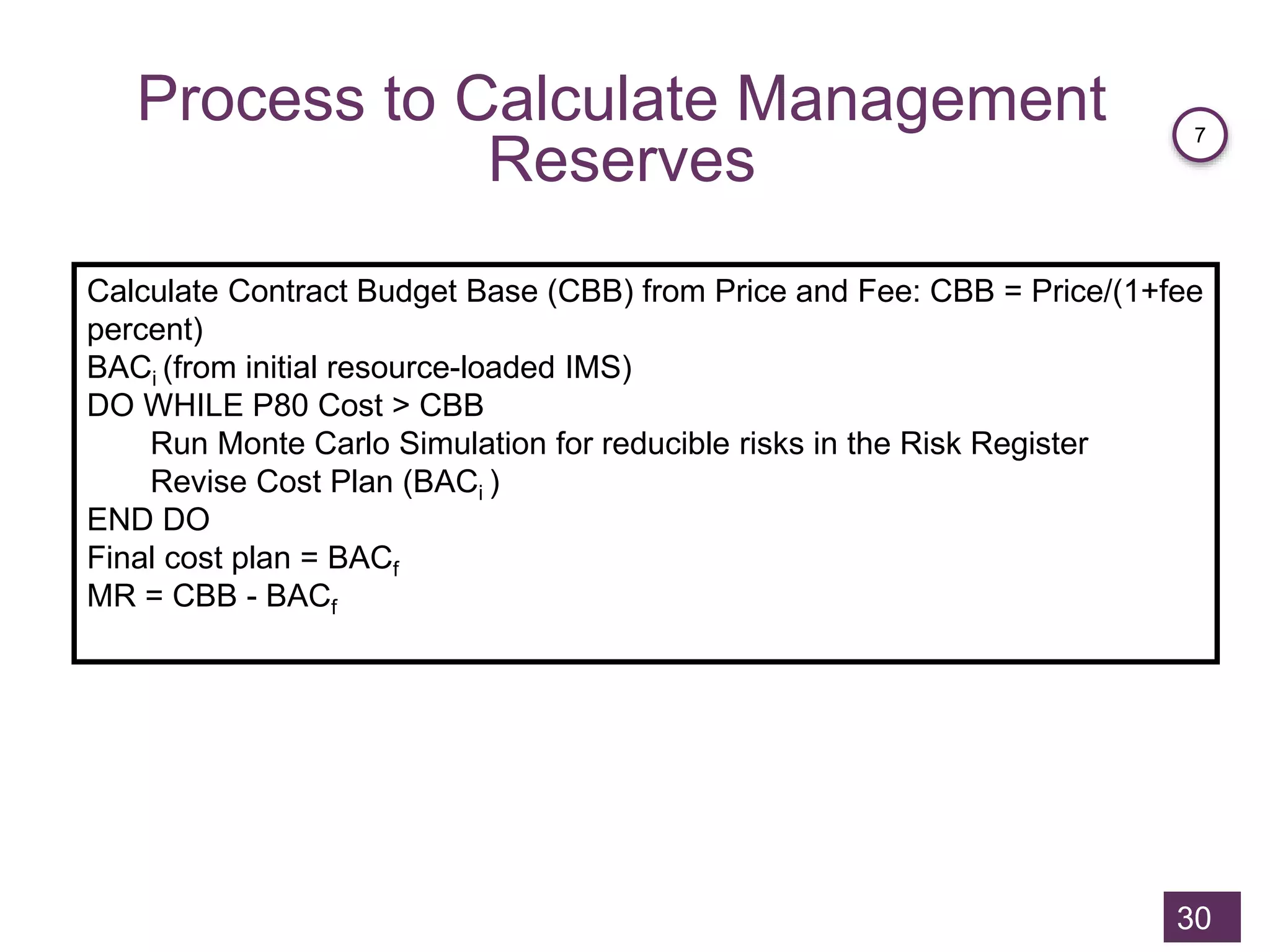
Process to Calculate Management
Reserves
30
Calculate Contract Budget Base (CBB) from Price and Fee: CBB = Price/(1+fee
percent)
BACi (from initial resource-loaded IMS)
DO WHILE P80 Cost > CBB
Run Monte Carlo Simulation for reducible risks in the Risk Register
Revise Cost Plan (BACi )
END DO
Final cost plan = BACf
MR = CBB - BACf
7
Schedule Margin Calculation Steps
31
Create Bottom-up IMS Plan (P) after adjusting for reducible risks
DO WHILE P80 Date > Need Date (contractually required date)
Run Monte Carlo Simulation for Irreducible Uncertainty
Revise IMS Plan (P)
END DO
Pf = PMB Final Finish Date
Schedule Margin = Need Date Duration (P80 duration) – Pf Duration
WHERE
Irreducible Duration Uncertainty is determined from historical data
9
TSAS Risk Burn Down Plan
32
8
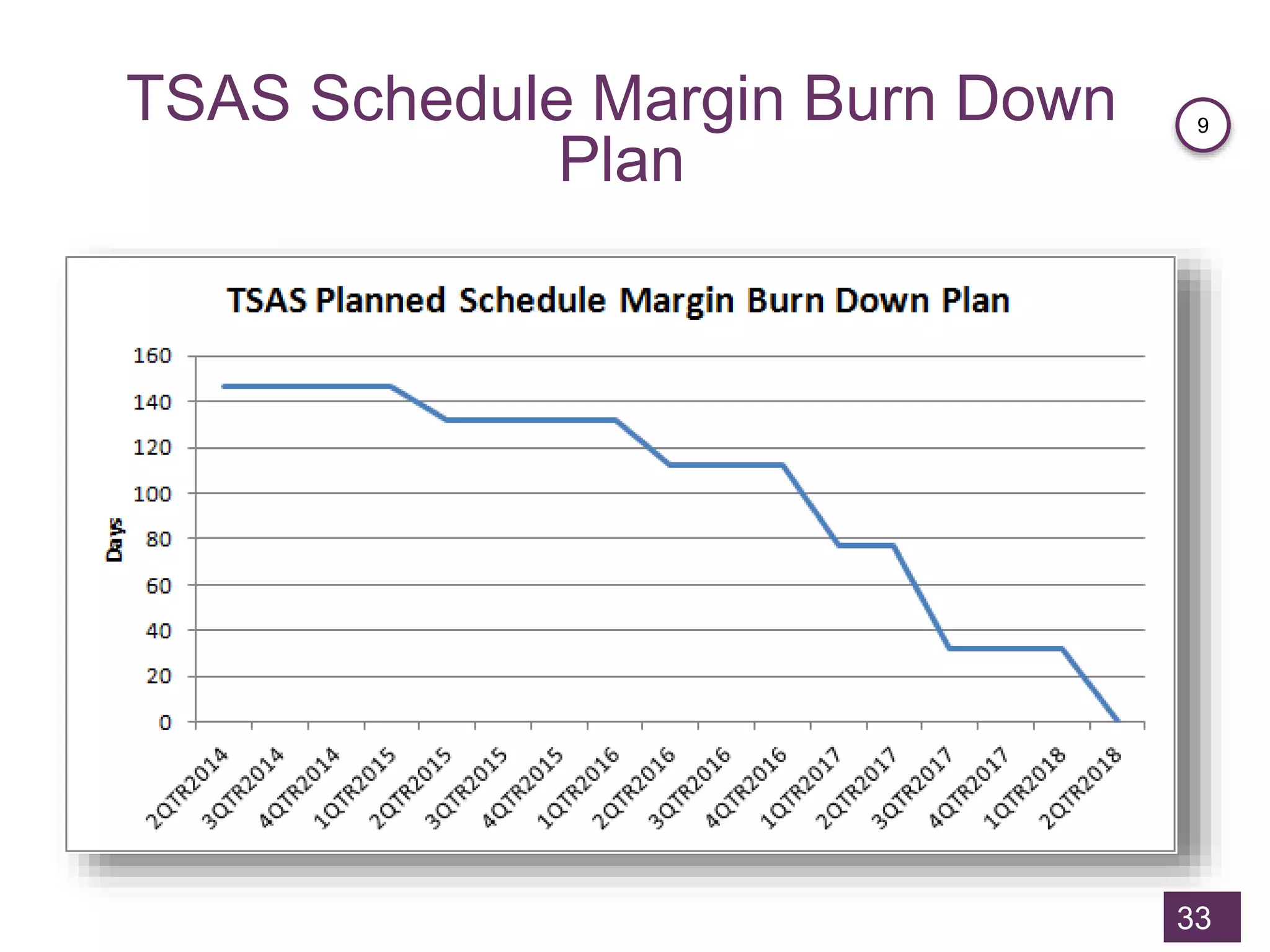
TSAS Schedule Margin Burn Down
Plan
33
9

Essential views of the IPMR

  • 1.
    Essential Views ofthe Integrated Program Management Reports Thomas J. Coonce Glen B. Alleman
  • 2.
    Agenda  Background  Twenty-fivemetrics are proposed  Twelve are demonstrated with tasserted value to the government PM  Audience feedback 2
  • 3.
    Background  When contractuallyrequired, DoD acquisition contractors are obligated to submit IPMRs electronically per Data Item Description DI-MGMT-81861.  Government stakeholders must acquire “reader/viewers” of the data to understand status and help control.  Several vendors provide multiple metrics/views of these data:  Some data more useful than others.  Different users have different interests.  Easy for the government PM to be overwhelmed"  Key question is which metric/views are considered “Essential” to accomplish the stated goal of helping the material developer to “keep the program green”? 3
  • 4.
    Background (Concluded)  Wesynthesized research and possible metrics and distilled them to three fundamental categories 1. Evidence of a credible plan at the outset; one that is based on technical objectives and deliverables, available staffing and adjusted for risks 2. Periodic data to ensure that cost and schedule performance are in line with technical and contract deliverables progress 3. Periodic data (in addition to the technical performance data) that helps the PM identify current and likely future problem areas so they can be controlled  We demonstrate the value of the metrics using a notional UAV program called the Tactical Situational Awareness System or TSAS  Twenty-five metrics/views are proposed; twelve are shown and discussed in this presentation 4
  • 5.
    The Proposed Metrics/Views 5 ︎1. Key Technical Performance Measures plan(s) 2. Deliverables plan ✔ 3. Summary level of the Integrated Master Schedule (IMS) and proposed spend plan 4. Labor FTE utilization plan ✔ 5. Schedule health and performance checks ✔ 6. Risk register and mitigation actions ✔ 7. Computation of initial management reserves (MR) 8. Risk burn down plan ✔ 9. Computation of schedule reserves aka margin (SM) ︎ ✔ 10. TPM plan vs estimated actuals vs cost and schedule performance metrics (CPI, SPI) ✔ 11. Deliverables plan vs actuals vs CPI, SPI
  • 6.
    The Proposed Metrics/Views 6 ✔12.FTE plan vs actuals ✔ 13.Cumulative BCWS, BCWP, ACWP against IBR spend plan, earned schedule with percent spent, percent complete, and percent scheduled (Enhanced Gold Card) 14.Risk burn down plan vs actual ✔ 16.C/S Performance Informed by Risk Burn Down Actuals 17.Schedule heath and schedule performance related data on the “go- forward” IMS (similar to view # 5) 18.Cumulative BCWS, BCWP, ACWP against IBR spend plan with Earned Schedule and status dates, percent spent, percent complete, and percent scheduled (same as # 13) 19.Tornado (or Galaxy) chart that shows the relative percentage of Budget at Complete to total for any level of WBS
  • 7.
    The Proposed Metrics/Views 7 20.ManagementReserve usage and balance 21.Sources and uses of MR and Undistributed Budget 22.Updated Risk Register (same as metric/view # 5) ✔ 23.Forecast of EAC and ECD ✔ 24.Confidence level of meeting contractor best case, worst case and most like EACs and ECDs 25.Schedule and cost crucially indices Periodic Data That Indicates Current and Likely Future Problem Areas (Concluded)
  • 8.
    Six Steps ToCreating a Credible PMB Step` Outcome ❶ Define WBS  With SOW, SOO, ConOps, WBS, and other program documents, develop CWBS of system deliverables and work processes to produce the program outcomes.  Develop CWBS Dictionary describing scope of work and Criteria for the successful delivery of these outcomes. ❷ Build IMP  Develop Integrated Master Plan (IMP), showing how each system element in the CWBS moves through the maturation process at each Program Event.  Define Measures of Effectiveness (MOE) for each Accomplishment.  Define Measures of Performance (MOP) for each Criteria. ❸ Identify Reducible Risk  For each key system element in the CWBS, identify reducible risks, probability of occurrence, mitigation plan, and residual risk in the Risk Register.  Risk mitigation activities placed in IMS and PMB to assure probability of occurrence and probability of impact reduced.  For risks without mitigation plans, Management Reserve (MR) (calculated) will be used to handle risk when it becomes an Issue. 8
  • 9.
    Step Outcome ❹ Build theIMS  Arrange Work Packages and Tasks in a logical network of increasing maturity of the deliverables.  Define exit criteria for each Work Package to assess planned Physical Percent Complete to inform BCWP using TPM, MOP, MOE, and Risk Reduction activities in support of Accomplishments in the IMS. ❺ Adjust for Irreducible Risks  For irreducible risks in the IMS, use Reference Classes for Monte Carlo Simulation anchored with Most Likely duration to calculate needed schedule reserve (margin).  Assign schedule margin tasks in the IMS, to protect the key system elements, per DI-MGMT-81861 guidance. ❻ Establish PMB  Using risk adjusted IMS, calculate needed Management Reserve (MR) to account for the latent risks in the Risk Register.  With deterministic IMS and its embedded Schedule Reserves and Management Reserve for latent risk, determine the resulting confidence level of the PMB. Six Steps To Creating a Credible PMB (Concluded) 9
  • 10.
    Schedule Health Checksat IBR 10 Value: Provides evidence that the contractor’s initial plan meets quality schedule standards. Project success is not possible without a quality schedule. 5
  • 11.
    Schedule Health Checksat IBR (Concluded) 11 5
  • 12.
    The PMB MustBe Adjusted for Uncertainty Uncertainty Reducible Irreducible Natural Variability Ambiguity Known but un-mitigateable Probabilistic Events Probabilistic Impacts Periods of Exposure The probability of an event that we can do something about reducing this probability through explicit actions. Statistical range of natural randomness characterized by a historical data and therefore irreducible 13
  • 13.
    Plan at IBRMust Be Adjusted for Reducible Risks Value: Showing the Risk Register at the IBR provides evidence that all major risks have been considered and that the contractor has incorporated plans into the baseline to mitigate those risks. It also provides transparency about risk that have not been mitigated which can impact the probability of success. Note Pre and Post Mitigation Risk Scores 14
  • 14.
    Example of OneMitigation Strategy 14 Value: Provides evidence that the contractor has a realistic risk buy down plan and has planned “way points” to reassess the mitigation actions and remaining risks.
  • 15.
    Management Reserve Calculation Principles Management reserve (MR) is held for growth within the currently authorized work scope, for rate changes, and for other program unknowns. MR is not used to offset accumulated overruns or underruns and it is not a contingency budget than can be used for new work or eliminated from the contract price during subsequent negotiations. The management reserve budget is not included as part of the Performance Measurement Baseline (PMB). Source: ACQuipedia  Operational Definition: Management Reserves (MR) covers in- scope known reducible risks that were not mitigated. It is for in- scope work that may or may not materialize. 15
  • 16.
    TSAS Monte CarloSimulation for Unmitigated Reducible Risks Only 16 7
  • 17.
    TSAS Management ReserveCalculation 17 7
  • 18.
    TSAS IMS Priorto Adjustment for Irreducible Uncertainty 18 This is the revised TSAS IMS after adjustments for reducible uncertainty that remain in the Risk Register after mitigation actions. 9
  • 19.
    Monte Carlo SimulationResults to Adjust the PMB for Irreducible Risks and Set Schedule Margin 19 Value: Ensuring the project plan accounts for the experience of historical projects (irreducible risks) yields a higher probability of meeting the planned delivery date. 9
  • 20.
    Schedule Margin Calculation 20 Value:Including schedule reserve or margin, ensures the project possess a realistic probability of meeting the targeted delivery date. It is derived by running a Monte Carlo Simulation with the irreducible risks and resource- loaded IMS as inputs. 9
  • 21.
    Placement of ScheduleMargin in TSAS IMS 21 Value: This shows the PM how the contractor is providing time cushions in order to meet project milestones. 9
  • 22.
    TSAS Summary LevelIMS and Spend Plan 22 Value: Provides PM with a big picture of the contractor’s spend plan, the reasonableness of milestones, and management reserves Management Reserves = $3.5M CBB PMB
  • 23.
    Weights vs. C/SPerformance (as of 1QTR2016) 23 Value: Showing the technical progress such as weight against the cost and schedule performance data of the associated work packages is a leading indicator. 3QTR2015 weight is above plan and both CPI and SPI reflect this. By 1QTR 2016, weigh is on plan, because contractor spent more resources. C/S indices reflect same. 10
  • 24.
    Deliverables and FTEsvs. C/S Performance (as of 3/31/2015) 24 Value: Showing the deliverables and planned vs actual personnel helps tell the story of the negative cost and schedule performance since labor is usually the largest component of cost. The contractor is more likely to be meet technical, cost and schedule objectives if the right personnel are put on the effort when planned. These data provide the PM an early warning signal. 11 12 15
  • 25.
    TSAS Full MotionVideo (FMV) C/S Performance Informed by Risk Burn Down 25 Value: Tells PM whether contractor’s mitigation plans were successful and ensures that cost and schedule performance reflect those actions. 15
  • 26.
    Example of TraditionalMethod of Forecasting EAC and ECD 26 The Plan: Twelve month effort for $36K The Performance at status date (5/31/2015): BCWScum = $15K ACWPcum = $18K BCWPcum = $12.5K SPIcum = .833 CPIcum = .694 ES = 124d SPIt = .824 EAC Forecast: EACcomposite = ACWP + [(BAC-BCWPcum)/(CPIcum × SPIcum)] = $58.6K ECD Forecast Duration: Status Duration +( PD-ES)/SPIt = 150d + (366-124)/.824 = 444d ECD Forecast Date: Date Format of (42005+444) = 3/19/2016 Value: Tells PM the final cost and delivery date IF the contractor continues to perform exactly as it has done in the past (rearward focus). Facilitates problem diagnosis and discussions with the contractor. 23
  • 27.
    Quantification of EACsand ECD From MCS of Remaining Reducible and Irreducible Risks 27 Value: Tells PM the range of possible final cost and delivery dates and probabilities of the contractor-stated projected EACs and ECDs based on a forward focus of the impact of reducible and irreducible remaining risks. Fosters pro-active management with the contractor. Best Case EAC/ECD Most Likely EAC/ECD Worst Case EAC/ECD (1,100d,$24.1 <96%) (830d,$17 <1%) (1,106d,$23.1 <60%) 24
  • 28.
    Summary  Proposed anenhanced set of key, or essential, program management metrics that a government program manager ought to have as a minimum to proactively manage and help control contracted efforts  Demonstrated selected metrics with a notional UAV program  Received suggestions for improvements 28
  • 29.
  • 30.
    Process to CalculateManagement Reserves 30 Calculate Contract Budget Base (CBB) from Price and Fee: CBB = Price/(1+fee percent) BACi (from initial resource-loaded IMS) DO WHILE P80 Cost > CBB Run Monte Carlo Simulation for reducible risks in the Risk Register Revise Cost Plan (BACi ) END DO Final cost plan = BACf MR = CBB - BACf 7
  • 31.
    Schedule Margin CalculationSteps 31 Create Bottom-up IMS Plan (P) after adjusting for reducible risks DO WHILE P80 Date > Need Date (contractually required date) Run Monte Carlo Simulation for Irreducible Uncertainty Revise IMS Plan (P) END DO Pf = PMB Final Finish Date Schedule Margin = Need Date Duration (P80 duration) – Pf Duration WHERE Irreducible Duration Uncertainty is determined from historical data 9
  • 32.
    TSAS Risk BurnDown Plan 32 8
  • 33.
    TSAS Schedule MarginBurn Down Plan 33 9