MAKING THE IMPOSSIBLE POSSIBLE
Applying Heliotropic Abundance for creating
Program and Project Management processes
1
2
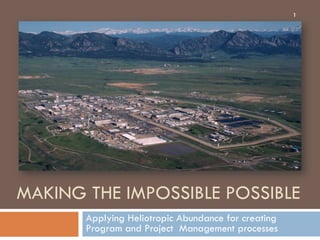
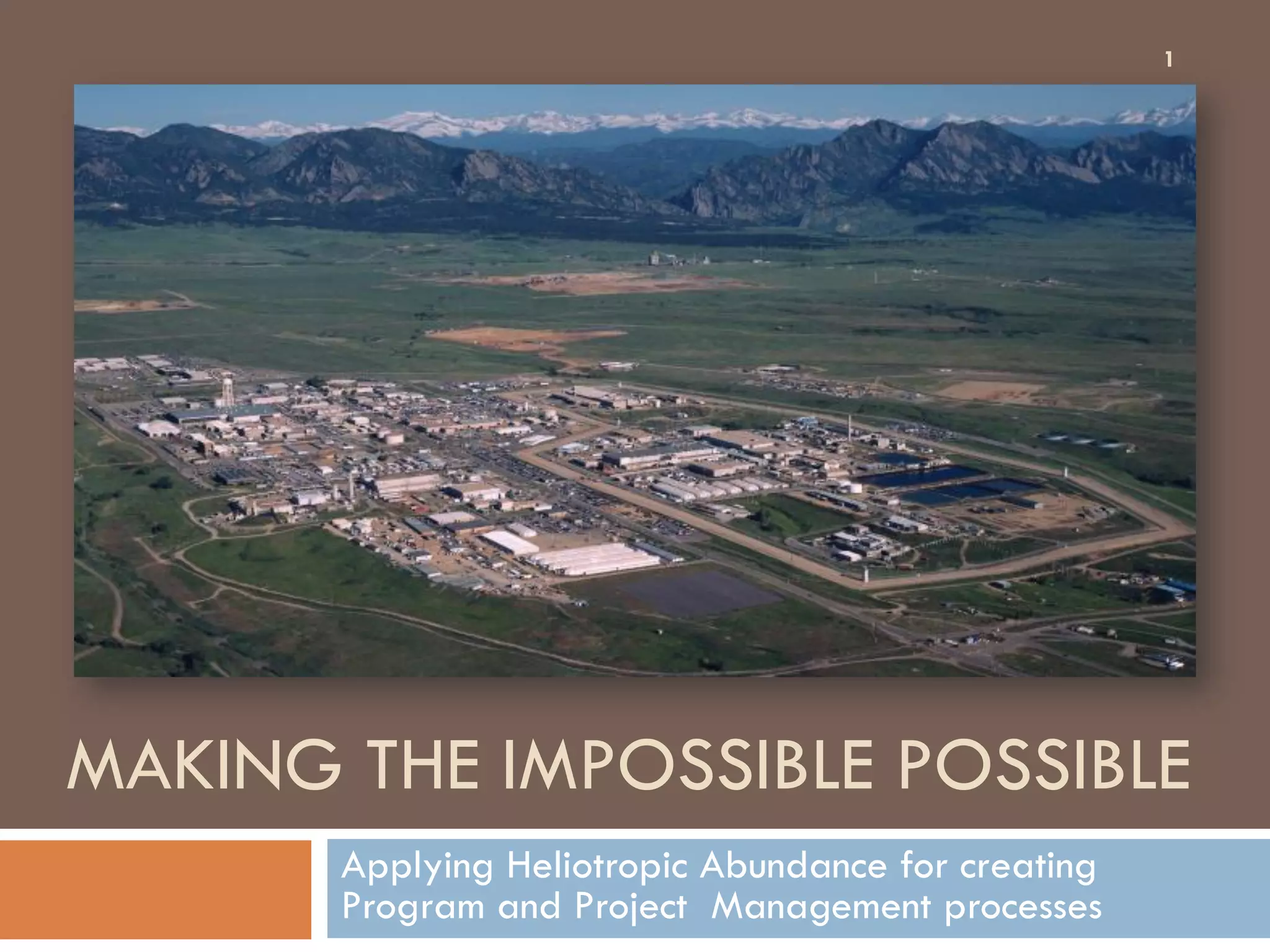
Making the Impossible Possible, Kim Cameron and Marc Lavine, 2006
Lessons learned from the cleanup of America’s most
dangerous Nuclear Weapons Plan
Abundance Principle of Management
 Strive for positive deviance, pursuing the best of the
human condition and working to fulfill the highest
potential of the organization.
 Focuses on:
 Resilience
 Flourishing
 Vitality
 Extraordinarily positive individual and organizational
outcomes
4
The Ordinary Approach to Change†
5
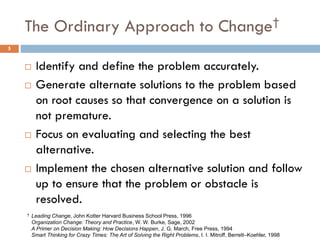
 Identify and define the problem accurately.
 Generate alternate solutions to the problem based
on root causes so that convergence on a solution is
not premature.
 Focus on evaluating and selecting the best
alternative.
 Implement the chosen alternative solution and follow
up to ensure that the problem or obstacle is
resolved.
† Leading Change, John Kotter Harvard Business School Press, 1996
Organization Change: Theory and Practice, W. W. Burke, Sage, 2002
A Primer on Decision Making: How Decisions Happen, J. G. March, Free Press, 1994
Smart Thinking for Crazy Times: The Art of Solving the Right Problems, I. I. Mitroff, Berrett–Koehler, 1998
The Abundance Approach
6
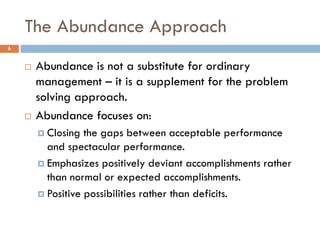
 Abundance is not a substitute for ordinary
management – it is a supplement for the problem
solving approach.
 Abundance focuses on:
 Closing the gaps between acceptable performance
and spectacular performance.
 Emphasizes positively deviant accomplishments rather
than normal or expected accomplishments.
 Positive possibilities rather than deficits.
Conventional Principles versus Abundance
7
Conventional Principles Abundance Principles
General Leadership Principles
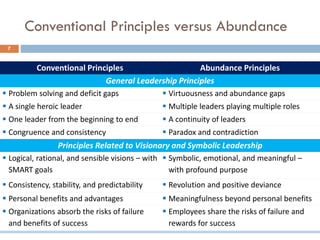
 Problem solving and deficit gaps  Virtuousness and abundance gaps
 A single heroic leader  Multiple leaders playing multiple roles
 One leader from the beginning to end  A continuity of leaders
 Congruence and consistency  Paradox and contradiction
Principles Related to Visionary and Symbolic Leadership
 Logical, rational, and sensible visions – with
SMART goals
 Symbolic, emotional, and meaningful –
with profound purpose
 Consistency, stability, and predictability  Revolution and positive deviance
 Personal benefits and advantages  Meaningfulness beyond personal benefits
 Organizations absorb the risks of failure
and benefits of success
 Employees share the risks of failure and
rewards for success
Conventional Principles versus Abundance
8
Conventional Principles Abundance Principles
Careful, Clear, and Controlled Leadership
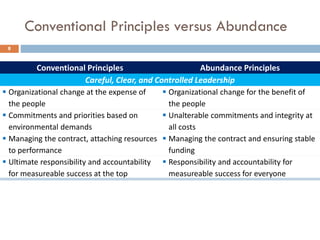
 Organizational change at the expense of
the people
 Organizational change for the benefit of
the people
 Commitments and priorities based on
environmental demands
 Unalterable commitments and integrity at
all costs
 Managing the contract, attaching resources
to performance
 Managing the contract and ensuring stable
funding
 Ultimate responsibility and accountability
for measureable success at the top
 Responsibility and accountability for
measureable success for everyone
Conventional Principles versus Abundance
9
Conventional Principles Abundance Principles
Collaboration, Engagement, and Participation
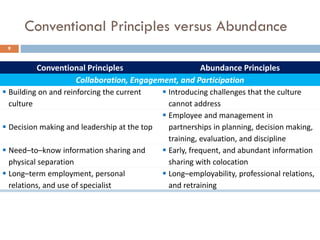
 Building on and reinforcing the current
culture
 Introducing challenges that the culture
cannot address
 Decision making and leadership at the top
 Employee and management in
partnerships in planning, decision making,
training, evaluation, and discipline
 Need–to–know information sharing and
physical separation
 Early, frequent, and abundant information
sharing with colocation
 Long–term employment, personal
relations, and use of specialist
 Long–employability, professional relations,
and retraining
Conventional Principles versus Abundance
10
Conventional Principles Abundance Principles
Rigorous, uncompromising, and results oriented leaderhip
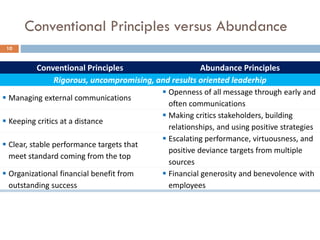
 Managing external communications
 Openness of all message through early and
often communications
 Keeping critics at a distance
 Making critics stakeholders, building
relationships, and using positive strategies
 Clear, stable performance targets that
meet standard coming from the top
 Escalating performance, virtuousness, and
positive deviance targets from multiple
sources
 Organizational financial benefit from
outstanding success
 Financial generosity and benevolence with
employees
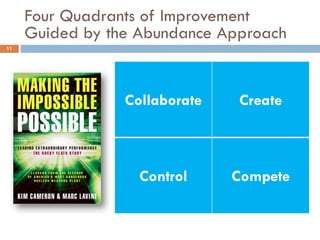
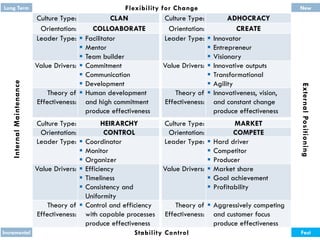
Four Quadrants of Improvement
Guided by the Abundance Approach
Collaborate Create
Control Compete
11
Collaborate
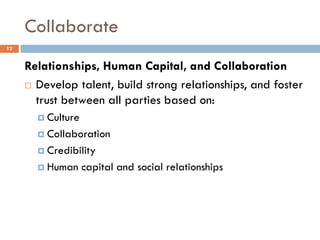
Relationships, Human Capital, and Collaboration
 Develop talent, build strong relationships, and foster
trust between all parties based on:
 Culture
 Collaboration
 Credibility
 Human capital and social relationships
12
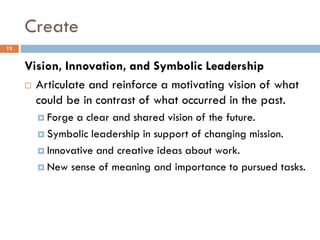
Create
Vision, Innovation, and Symbolic Leadership
 Articulate and reinforce a motivating vision of what
could be in contrast of what occurred in the past.
 Forge a clear and shared vision of the future.
 Symbolic leadership in support of changing mission.
 Innovative and creative ideas about work.
 New sense of meaning and importance to pursued tasks.
13
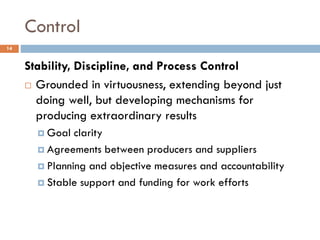
Control
Stability, Discipline, and Process Control
 Grounded in virtuousness, extending beyond just
doing well, but developing mechanisms for
producing extraordinary results
 Goal clarity
 Agreements between producers and suppliers
 Planning and objective measures and accountability
 Stable support and funding for work efforts
14
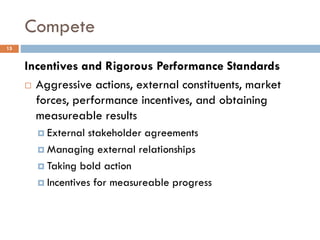
Compete
Incentives and Rigorous Performance Standards
 Aggressive actions, external constituents, market
forces, performance incentives, and obtaining
measureable results
 External stakeholder agreements
 Managing external relationships
 Taking bold action
 Incentives for measureable progress
15
16
Long Term Flexibility for Change New
InternalMaintenance Culture Type: CLAN Culture Type: ADHOCRACY
ExternalPositioning
Orientation: COLLOABORATE Orientation: CREATE
Leader Type:  Facilitator
 Mentor
 Team builder
Leader Type:  Innovator
 Entrepreneur
 Visionary
Value Drivers:  Commitment
 Communication
 Development
Value Drivers:  Innovative outputs
 Transformational
 Agility
Theory of
Effectiveness:
 Human development
and high commitment
produce effectiveness
Theory of
Effectiveness:
 Innovativeness, vision,
and constant change
produce effectiveness
Culture Type: HEIRARCHY Culture Type: MARKET
Orientation: CONTROL Orientation: COMPETE
Leader Type:  Coordinator
 Monitor
 Organizer
Leader Type:  Hard driver
 Competitor
 Producer
Value Drivers:  Efficiency
 Timeliness
 Consistency and
Uniformity
Value Drivers:  Market share
 Goal achievement
 Profitability
Theory of
Effectiveness:
 Control and efficiency
with capable processes
produce effectiveness
Theory of
Effectiveness:
 Aggressively competing
and customer focus
produce effectiveness
Incremental Stability Control Fast
This is What DONE Looks Like
17

Making the impossible possible

  • 1.
    MAKING THE IMPOSSIBLEPOSSIBLE Applying Heliotropic Abundance for creating Program and Project Management processes 1
  • 2.
  • 3.
    Making the ImpossiblePossible, Kim Cameron and Marc Lavine, 2006 Lessons learned from the cleanup of America’s most dangerous Nuclear Weapons Plan
  • 4.
    Abundance Principle ofManagement  Strive for positive deviance, pursuing the best of the human condition and working to fulfill the highest potential of the organization.  Focuses on:  Resilience  Flourishing  Vitality  Extraordinarily positive individual and organizational outcomes 4
  • 5.
    The Ordinary Approachto Change† 5  Identify and define the problem accurately.  Generate alternate solutions to the problem based on root causes so that convergence on a solution is not premature.  Focus on evaluating and selecting the best alternative.  Implement the chosen alternative solution and follow up to ensure that the problem or obstacle is resolved. † Leading Change, John Kotter Harvard Business School Press, 1996 Organization Change: Theory and Practice, W. W. Burke, Sage, 2002 A Primer on Decision Making: How Decisions Happen, J. G. March, Free Press, 1994 Smart Thinking for Crazy Times: The Art of Solving the Right Problems, I. I. Mitroff, Berrett–Koehler, 1998
  • 6.
    The Abundance Approach 6 Abundance is not a substitute for ordinary management – it is a supplement for the problem solving approach.  Abundance focuses on:  Closing the gaps between acceptable performance and spectacular performance.  Emphasizes positively deviant accomplishments rather than normal or expected accomplishments.  Positive possibilities rather than deficits.
  • 7.
    Conventional Principles versusAbundance 7 Conventional Principles Abundance Principles General Leadership Principles  Problem solving and deficit gaps  Virtuousness and abundance gaps  A single heroic leader  Multiple leaders playing multiple roles  One leader from the beginning to end  A continuity of leaders  Congruence and consistency  Paradox and contradiction Principles Related to Visionary and Symbolic Leadership  Logical, rational, and sensible visions – with SMART goals  Symbolic, emotional, and meaningful – with profound purpose  Consistency, stability, and predictability  Revolution and positive deviance  Personal benefits and advantages  Meaningfulness beyond personal benefits  Organizations absorb the risks of failure and benefits of success  Employees share the risks of failure and rewards for success
  • 8.
    Conventional Principles versusAbundance 8 Conventional Principles Abundance Principles Careful, Clear, and Controlled Leadership  Organizational change at the expense of the people  Organizational change for the benefit of the people  Commitments and priorities based on environmental demands  Unalterable commitments and integrity at all costs  Managing the contract, attaching resources to performance  Managing the contract and ensuring stable funding  Ultimate responsibility and accountability for measureable success at the top  Responsibility and accountability for measureable success for everyone
  • 9.
    Conventional Principles versusAbundance 9 Conventional Principles Abundance Principles Collaboration, Engagement, and Participation  Building on and reinforcing the current culture  Introducing challenges that the culture cannot address  Decision making and leadership at the top  Employee and management in partnerships in planning, decision making, training, evaluation, and discipline  Need–to–know information sharing and physical separation  Early, frequent, and abundant information sharing with colocation  Long–term employment, personal relations, and use of specialist  Long–employability, professional relations, and retraining
  • 10.
    Conventional Principles versusAbundance 10 Conventional Principles Abundance Principles Rigorous, uncompromising, and results oriented leaderhip  Managing external communications  Openness of all message through early and often communications  Keeping critics at a distance  Making critics stakeholders, building relationships, and using positive strategies  Clear, stable performance targets that meet standard coming from the top  Escalating performance, virtuousness, and positive deviance targets from multiple sources  Organizational financial benefit from outstanding success  Financial generosity and benevolence with employees
  • 11.
    Four Quadrants ofImprovement Guided by the Abundance Approach Collaborate Create Control Compete 11
  • 12.
    Collaborate Relationships, Human Capital,and Collaboration  Develop talent, build strong relationships, and foster trust between all parties based on:  Culture  Collaboration  Credibility  Human capital and social relationships 12
  • 13.
    Create Vision, Innovation, andSymbolic Leadership  Articulate and reinforce a motivating vision of what could be in contrast of what occurred in the past.  Forge a clear and shared vision of the future.  Symbolic leadership in support of changing mission.  Innovative and creative ideas about work.  New sense of meaning and importance to pursued tasks. 13
  • 14.
    Control Stability, Discipline, andProcess Control  Grounded in virtuousness, extending beyond just doing well, but developing mechanisms for producing extraordinary results  Goal clarity  Agreements between producers and suppliers  Planning and objective measures and accountability  Stable support and funding for work efforts 14
  • 15.
    Compete Incentives and RigorousPerformance Standards  Aggressive actions, external constituents, market forces, performance incentives, and obtaining measureable results  External stakeholder agreements  Managing external relationships  Taking bold action  Incentives for measureable progress 15
  • 16.
    16 Long Term Flexibilityfor Change New InternalMaintenance Culture Type: CLAN Culture Type: ADHOCRACY ExternalPositioning Orientation: COLLOABORATE Orientation: CREATE Leader Type:  Facilitator  Mentor  Team builder Leader Type:  Innovator  Entrepreneur  Visionary Value Drivers:  Commitment  Communication  Development Value Drivers:  Innovative outputs  Transformational  Agility Theory of Effectiveness:  Human development and high commitment produce effectiveness Theory of Effectiveness:  Innovativeness, vision, and constant change produce effectiveness Culture Type: HEIRARCHY Culture Type: MARKET Orientation: CONTROL Orientation: COMPETE Leader Type:  Coordinator  Monitor  Organizer Leader Type:  Hard driver  Competitor  Producer Value Drivers:  Efficiency  Timeliness  Consistency and Uniformity Value Drivers:  Market share  Goal achievement  Profitability Theory of Effectiveness:  Control and efficiency with capable processes produce effectiveness Theory of Effectiveness:  Aggressively competing and customer focus produce effectiveness Incremental Stability Control Fast
  • 17.
    This is WhatDONE Looks Like 17